Bayesian Optimization in Protein Engineering: A Data-Driven Guide for Accelerating Therapeutic Discovery
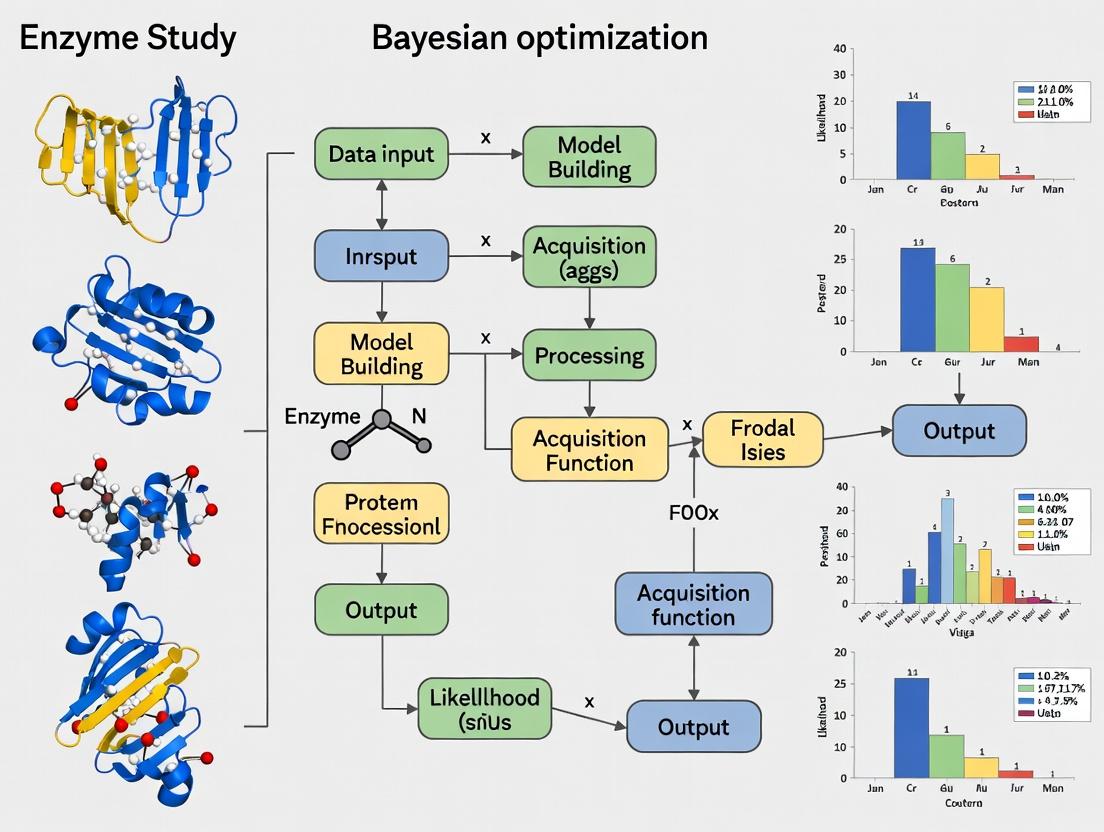
This comprehensive guide explores Bayesian optimization (BO) as a transformative framework for protein engineering.
Bayesian Optimization in Protein Engineering: A Data-Driven Guide for Accelerating Therapeutic Discovery
Abstract
This comprehensive guide explores Bayesian optimization (BO) as a transformative framework for protein engineering. It begins by establishing the core statistical principles of BO and its necessity in navigating high-dimensional, resource-intensive protein fitness landscapes. The article details the practical workflow, from selecting acquisition functions and surrogate models to integrating wet-lab experiments in automated platforms. We address common experimental pitfalls, computational bottlenecks, and strategies for model optimization. Finally, we validate BO's performance by comparing it to traditional methods (e.g., Directed Evolution, Random Search) and highlighting recent breakthroughs in therapeutic protein design. Tailored for researchers and drug development professionals, this article provides the methodological insights and troubleshooting guidance needed to implement BO for efficient protein optimization.
Why Bayesian Optimization? Mastering the Fundamentals for Protein Fitness Landscapes
Technical Support Center: Troubleshooting Bayesian Optimization in Protein Engineering
FAQs & Troubleshooting Guides
Q1: During an initial Bayesian optimization (BO) campaign for enzyme activity, my first 5 experimental batches showed no improvement over wild-type. Should I abort the campaign? A1: Not necessarily. This is a common scenario. BO requires an initial phase of exploration.
- Diagnosis: The acquisition function (e.g., Expected Improvement) may be prioritizing exploration of the vast sequence space. The model's uncertainty is still high.
- Solution: First, verify your experimental assays for consistency. Ensure your model uses a sensible kernel (e.g., Matern 5/2 for protein landscapes). Do not adjust the model hyperparameters prematurely. Continue for at least 10-15 iterations. If no improvement is seen by then, revisit your feature representation (e.g., from one-hot encoding to physicochemical embeddings).
Q2: My BO model's predictions and the actual experimental results diverge significantly after several rounds. What could be wrong? A2: This indicates model breakdown, often due to the "search space shift" problem.
- Diagnosis: The model was trained on data from a region of sequence space that is no longer representative of the current promising regions. The assumed smoothness of the landscape is violated.
- Solution:
- Retrain from Scratch: Discard old data from poor-performing regions and retrain the Gaussian Process (GP) model only on data from the last few promising batches.
- Incorporate Ensemble Methods: Switch to using a Random Forest or Gradient Boosting Machine as the surrogate model, which can handle more complex, non-stationary landscapes.
- Adjust the Kernel: Implement a spectral mixture kernel or combine multiple kernels to capture different scales of variation.
Q3: The computational cost of training the Gaussian Process model is becoming prohibitive as my experimental dataset grows beyond 500 variants. What are my options? A3: This is a key scalability challenge.
- Diagnosis: Standard GP regression scales cubically O(n³) with the number of data points
n. - Solution: Implement scalable approximate GP methods.
- Sparse Variational GPs: Use inducing points to approximate the full dataset.
- Deep Kernel Learning: Combine neural networks for feature extraction with a GP layer, improving scalability and representation power.
- Switch to Bayesian Neural Networks: While potentially less data-efficient, they scale better for very large
n.
Key Experimental Protocols
Protocol 1: Setting Up a Baseline BO Campaign for Protein Thermostability (Tm) Objective: To find protein variants with increased melting temperature (Tm) using a library of 10^5 possible single and double mutants.
- Feature Encoding: Encode each variant using a one-hot encoding of amino acid identities at variable positions. Consider adding predicted structural features (e.g., solvent accessibility, secondary structure) as additional dimensions.
- Initial Design: Use a space-filling design (e.g., Sobol sequence) or a diverse subset from existing data to select the first 20-30 variants for experimental characterization.
- Surrogate Model: Initialize a Gaussian Process model with a Matern 5/2 kernel and automatic relevance determination (ARD).
- Acquisition Function: Use Expected Improvement (EI) with a small jitter parameter (ξ=0.01) to balance exploration/exploitation.
- Batch Selection: For each cycle, select the next batch of 5-8 variants using a parallel acquisition strategy (e.g., q-EI, or Thompson Sampling).
- Experimental Loop: Express, purify, and measure Tm via DSF (Differential Scanning Fluorimetry) for selected variants. Append results to the training dataset and re-train the GP model. Iterate for 15-20 cycles.
Protocol 2: Handling Noisy High-Throughput Screening Data for Binding Affinity (KD) Objective: Optimize protein-protein binding affinity using a noisy yeast display or phage display screening output (e.g., sequencing counts).
- Data Preprocessing: Normalize sequence counts per batch. Transform counts into log-enrichment scores relative to a reference. Model the score variance as a function of mean to estimate uncertainty for each variant.
- Probabilistic Model: Use a Heteroskedastic GP model, which learns input-dependent noise levels. This prevents the optimizer from being misled by high-variance measurements.
- Acquisition: Use the Noisy Expected Improvement acquisition function, which explicitly accounts for measurement noise in the experimental data.
- Validation: Periodically (every 3-4 cycles) validate top predictions using a low-throughput, high-accuracy method (e.g., SPR or BLI).
Table 1: Comparison of Surrogate Models for Protein Engineering BO
| Model | Typical Data Size (n) | Computational Scaling | Handles Non-Stationary Data? | Best For |
|---|---|---|---|---|
| Gaussian Process (GP) | < 500 | O(n³) | Poor (without custom kernel) | Data-efficient search, uncertainty quantification |
| Sparse Variational GP | 500 - 10,000 | O(m²n) where m< | Moderate | Medium-scale campaigns |
| Random Forest | > 100 | O(n features * n log n) | Excellent | Complex, rugged landscapes, parallel batches |
| Bayesian Neural Network | > 1,000 | O(n parameters) | Good | Very large datasets, integration w/ deep learning |
Table 2: Common Acquisition Functions and Their Parameters
| Function | Key Parameter(s) | Effect of Increasing Parameter | Recommended Use Case |
|---|---|---|---|
| Expected Improvement (EI) | ξ (jitter) | More exploration | General-purpose, balanced search |
| Upper Confidence Bound (UCB) | β (balance weight) | More exploration | Theoretical convergence guarantees |
| Probability of Improvement (PI) | ξ (trade-off) | More exploration | Pure exploitation (not recommended alone) |
| Thompson Sampling | (None) | N/A | Parallel batch selection, simple implementation |
Visualizations
BO Workflow for Protein Engineering
Bayesian Optimization Core Cycle
The Scientist's Toolkit: Research Reagent Solutions
| Item | Function in BO-Driven Protein Engineering |
|---|---|
| Directed Evolution Library (e.g., NNK degenerate primers) | Creates the initial diverse sequence space for the first BO batch. Essential for exploration. |
| High-Throughput Expression System (e.g., 96-well microplate cultures) | Enables parallel production of the batch of protein variants proposed by the BO algorithm. |
| Rapid Purification Kit (e.g., His-tag plates/beads) | Facilitates fast, parallel purification of multiple variants for functional assays. |
| Stability Assay Reagents (e.g., SYPRO Orange for DSF) | Provides the quantitative fitness metric (Tm) for training the surrogate model on stability. |
| Binding Affinity Reagents (e.g., Biotinylated ligand for SPR/BLI) | Provides the quantitative fitness metric (KD) for optimizing protein-protein interactions. |
| Next-Generation Sequencing (NGS) Kit | Critical for analyzing pooled screening outputs (e.g., from phage display), generating data for noisy, high-throughput BO campaigns. |
| Positive/Negative Control Plasmids | Essential for normalizing experimental batch effects and ensuring data quality for robust model training. |
This technical support center provides guidance for researchers applying Bayesian optimization (BO) in protein engineering. Our troubleshooting guides and FAQs address common pitfalls in constructing probabilistic models, defining acquisition functions, and executing sequential experimental loops, all within the context of optimizing protein properties like stability, binding affinity, or enzymatic activity.
Frequently Asked Questions (FAQs) & Troubleshooting
Q1: My Gaussian Process (GP) model fails to converge or produces "ill-conditioned matrix" errors during fitting. What should I do? A: This is often caused by numerical instability due to length-scale parameters becoming too small or highly correlated data points.
- Action 1: Add a kernel WhiteKernel. Explicitly add a
WhiteKernel(e.g.,WhiteKernel(noise_level=1e-3)) to your composite kernel to model experimental noise and improve matrix conditioning. - Action 2: Increase
alphain the regressor. Use thealphaparameter (e.g., in scikit-learn'sGaussianProcessRegressor) to add a diagonal value to the kernel matrix during fitting, acting as a regularization term. - Action 3: Normalize your input data. Ensure all your protein sequence features (e.g., descriptors, embeddings) and target values (e.g., fluorescence, affinity score) are standardized to zero mean and unit variance.
Q2: The acquisition function (e.g., Expected Improvement) suggests samples very close to existing ones, failing to explore new regions. How can I encourage more exploration? A: This indicates over-exploitation. Adjust the balance between exploration and exploitation.
- Action 1: Tune the acquisition function's
xiparameter. Increase thexiparameter in Expected Improvement (EI) or Upper Confidence Bound (UCB) to weight unexplored regions more heavily. - Action 2: Use a different acquisition function. Switch to an explicitly explorative function like
UCBwith a highkappaparameter for early iterations. - Action 3: Add a minimum distance constraint. Programmatically reject candidate points within a specified Euclidean distance of previous experiments to enforce diversity in your protein sequence space.
Q3: My sequential optimization loop appears stuck in a local optimum of the protein fitness landscape. How can I escape it? A: Local optima are common in rugged protein fitness landscapes.
- Action 1: Introduce random exploration steps. Implement a mixed strategy where, with a small probability (e.g., 5%), the next experiment is chosen completely at random from the design space, not by the acquisition function.
- Action 2: Use a multi-start optimization for the acquisition function. When maximizing the acquisition function to propose the next point, run the optimizer from multiple random starting positions to find a global, not just local, maximum of the acquisition landscape.
- Action 3: Periodically re-initialize or adapt the kernel. If the model is too confident in a region, consider restarting the GP with a different kernel length-scale or using a periodic transformation if you suspect multimodality.
Q4: How do I effectively incorporate known protein biophysical constraints (e.g., structural viability) into the Bayesian optimization loop? A: Constraints must be integrated into the proposal mechanism.
- Action 1: Use a constrained acquisition function. Formulate the constraint as a second GP classifier or regressor and use a constrained acquisition method like Constrained Expected Improvement.
- Action 2: Pre-filter candidate proposals. Generate a batch of candidate points from the acquisition function, then filter out those predicted (by a separate rule-based or machine learning model) to violate key constraints (e.g., unstable folding) before selecting the final experiment.
- Action 3: Encode constraints directly into the input space. Design your feature representation (e.g., using latent space coordinates from a generative model trained on stable proteins) so that the search space inherently respects the constraints.
Experimental Protocol: A Standard Bayesian Optimization Cycle for Protein Engineering
Objective: To iteratively optimize a target protein property (e.g., thermostability expressed as Tm) over a defined sequence or mutant space.
Protocol Steps:
- Initial Design of Experiment (DoE):
- Select 10-20 initial protein variants using a space-filling design (e.g., Latin Hypercube Sampling) over your parameterized sequence space.
- Express, purify, and assay these variants to obtain initial fitness data.
Model Initialization:
- Standardize input features (e.g., one-hot encoded mutations, physicochemical descriptors) and target values.
- Define a GP model with a composite kernel (e.g.,
Matern()+WhiteKernel()). - Fit the GP to the initial data.
Sequential Loop (Iterate until budget exhausted): a. Surrogate Model Update: Re-fit the GP model using all data collected to date. b. Acquisition Optimization: Maximize the Expected Improvement (EI) acquisition function over the entire sequence space. c. Candidate Selection: The point maximizing EI is selected as the next protein variant to test. d. Wet-Lab Experimentation: Conduct the experiment (cloning, expression, purification, assay) for the chosen variant. e. Data Augmentation: Append the new
(variant, measured_fitness)pair to the dataset.Validation:
- After the loop, characterize the top-performing identified variants with biological replicates.
- Validate model predictions on a held-out test set of variants.
Bayesian Optimization Workflow for Protein Engineering
Diagram Title: Bayesian Optimization Loop for Protein Design
Research Reagent Solutions Toolkit
| Item | Function in Bayesian Optimization for Protein Engineering |
|---|---|
| Plasmid Library (e.g., Site-saturation Mutagenesis) | Provides the foundational genetic diversity for the initial Design of Experiments (DoE) and subsequent variant testing. |
| High-Throughput Expression System (e.g., E. coli, yeast, cell-free) | Enables parallel production of dozens to hundreds of protein variants for initial screening and iterative testing. |
| Thermofluor Dye (e.g., SYPRO Orange) | Allows rapid, high-throughput measurement of protein thermostability (Tm) as a key fitness parameter for optimization. |
| Microplate Reader (Fluorescence-capable) | Essential for running and reading high-throughput assays (e.g., thermal shift, enzymatic activity, binding). |
| Gaussian Process Software (e.g., scikit-learn, GPyTorch, BoTorch) | Provides the computational backbone for building the surrogate model and calculating acquisition functions. |
| Automated Liquid Handling System | Critical for minimizing manual error and enabling reproducibility in preparing assays and variant samples. |
Comparison of Common Acquisition Functions
| Acquisition Function | Key Parameter(s) | Best For | Risk of Stagnation |
|---|---|---|---|
| Expected Improvement (EI) | xi (exploration weight) |
General-purpose optimization; balanced search. | Medium (can exploit if xi is low) |
| Upper Confidence Bound (UCB) | kappa (balance parameter) |
Explicit exploration; theoretical guarantees. | Low (with high kappa) |
| Probability of Improvement (PI) | xi (trade-off) |
Simple, quick convergence to any improvement. | High (very greedy) |
| Thompson Sampling | Random draws from posterior | Natural trade-off; good for batch/parallel settings. | Low |
Typical Model Hyperparameters and Ranges
| Hyperparameter | Description | Typical Value/Range (Initial) |
|---|---|---|
| Kernel Length Scale | Determines smoothness of GP. | 1.0 (after data normalization) |
| Kernel Variance | Output scale of GP. | 1.0 (after target normalization) |
| Alpha / Noise Level | Homoscedastic noise variance. | 1e-3 to 1e-5 |
EI xi |
Exploration-exploitation balance. | 0.01 (low exploit) to 0.1 (high explore) |
UCB kappa |
Controls exploration. | 2.0 - 5.0 (higher = more explore) |
Troubleshooting Guides & FAQs
FAQ 1: Why does my optimization loop fail to improve after the first few iterations?
Answer: This is often due to an over-exploitative acquisition function or an inaccurate surrogate model. The Expected Improvement (EI) function may become too greedy, while a Gaussian Process (GP) model with an incorrectly specified kernel (e.g., length-scale) cannot generalize. First, visualize the surrogate's mean and uncertainty across the search space. If uncertainty is negligible outside data points, the model is over-confident. Switch to an Upper Confidence Bound (UCB) with a higher beta parameter (e.g., increase from 2 to 5) to force exploration. Alternatively, re-fit the GP using a Matérn kernel (e.g., Matérn 5/2) instead of the common Radial Basis Function (RBF), as it handles non-smooth functions better. Ensure your data is normalized (zero mean, unit variance) before model training.
FAQ 2: How do I handle high-dimensional protein sequence spaces where performance plateaus?
Answer: High-dimensional spaces (>20 dimensions) break standard BO. The surrogate model becomes unreliable. Employ one or more dimensionality reduction strategies:
- Embeddings: Use learned representations (e.g., from ESM-2 protein language model) as inputs instead of one-hot encoding.
- Additive GP Models: Decompose the high-dimensional function into a sum of lower-dimensional functions.
- Trust Region BO: Limit searches to a local region of the high-dimensional space and adaptively move it.
Experimental Protocol for Embedding Integration:
- Generate Embeddings: For your initial sequence library, compute sequence embeddings using a pre-trained model (e.g., ESM-2
esm2_t30_150M_UR50D). - Dimensionality Reduction: Apply Principal Component Analysis (PCA) to reduce embedding dimensions to 10-50.
- Initialize BO: Use PCA-reduced vectors as the input
Xfor the GP surrogate model. - Optimize: Run the standard BO loop.
- Decode: For suggested points in PCA space, find the nearest neighbor in the original embedding library to obtain a candidate sequence.
FAQ 3: My experimental measurement is noisy. How do I prevent the BO loop from overfitting to noise?
Answer: A GP model inherently accounts for noise via its alpha or noise parameter. If not set correctly, the model will overfit.
Protocol: Configuring a GP for Noisy Protein Expression Data:
- Define Kernel: Use
ConstantKernel() * Matern(nu=2.5) + WhiteKernel(). - Set Bounds: Constrain the
WhiteKernel'snoise_levelparameter based on your assay's known coefficient of variation (CV). For example, if CV is ~10%, set bounds[1e-4, 0.1]. - Optimize Hyperparameters: Fit the GP by maximizing the log-marginal likelihood, allowing the
noise_levelto be optimized within bounds. - Acquisition Function: Use the Noisy Expected Improvement (NEI) which integrates over the posterior uncertainty, rather than standard EI.
Key Performance Metrics & Parameters
| Issue | Key Parameter | Typical Value Range | Recommended Adjustment |
|---|---|---|---|
| Over-exploitation | UCB beta |
0.01 - 10 | Increase to 5-10 for more exploration. |
| Model Inaccuracy | GP Kernel | RBF, Matérn, etc. | Use Matérn 5/2 for physical landscapes. |
| High Dimensionality | Input Dimension | >20 | Use embeddings + PCA to reduce to <50. |
| Experimental Noise | GP alpha / WhiteKernel |
1e-6 - 0.1 | Set based on assay CV; use WhiteKernel. |
| Slow Computation | Training Data Size | >500 points | Use sparse GP (SVGP) or Bayesian NN surrogate. |
The Bayesian Optimization Workflow
Research Reagent Solutions Toolkit
| Item | Function in Protein Engineering BO |
|---|---|
| Pre-trained Protein Language Model (e.g., ESM-2) | Generates continuous vector representations (embeddings) of protein sequences, reducing dimensionality for the surrogate model. |
| Gaussian Process Library (e.g., GPyTorch, scikit-learn) | Provides flexible, scalable models to build the probabilistic surrogate that predicts fitness from sequence. |
| Acquisition Function Library (e.g., BoTorch, Ax Platform) | Implements and optimizes functions like EI, UCB, and NEI to balance exploration and exploitation. |
| High-Throughput Cloning System (e.g., Golden Gate) | Enables rapid assembly of candidate DNA variants for experimental testing. |
| Microplate Fluorescence/Absorbance Reader | Measures protein expression or activity in a high-throughput format to generate fitness labels for the BO loop. |
| Automated Liquid Handler | Robots experimental steps (transformation, culture, assay) to increase throughput and reduce manual noise. |
Surrogate Model Selection Logic
Technical Support Center: Troubleshooting & FAQs
FAQs for Bayesian Optimization in Protein Engineering
Q1: Why is my Bayesian optimization model failing to converge or improve protein fitness after several iterations?
A: This is often due to an inadequate acquisition function or kernel choice for your specific landscape. For noisy, high-throughput screening (HTS) data, consider switching from the standard Expected Improvement (EI) to the Noisy Expected Improvement (NEI). Ensure your kernel (e.g., Matérn 5/2) hyperparameters are optimized via marginal likelihood maximization, not left at defaults. Check the table below for guidance.
Q2: How do I handle excessive experimental noise that is overwhelming the optimization signal?
A: Implement explicit noise modeling. Use a Gaussian Process (GP) with a dedicated noise parameter (alpha or GaussianProcessRegressor(alpha=...)). Start by quantifying your baseline noise from replicate controls and set this as the prior. For batch parallelization, use a noisy acquisition function like q-Noisy Expected Improvement (qNEI), which accounts for both noise and parallel candidates.
Q3: My parallel batch suggestions appear highly correlated and do not explore the sequence space effectively. How can I fix this?
A: You are likely using a naive parallelization strategy. Implement a batch diversity mechanism. Use local penalization or the Kriging Believer algorithm to force exploration. For q candidates, the optimization should solve a multi-point acquisition problem. The diagram "Parallel Batch Selection Workflow" outlines this logic.
Q4: What are the best practices for defining the initial design for a new protein engineering campaign?
A: Never use a purely random design. For a sequence space of dimension d, use a space-filling design like Latin Hypercube Sampling (LHS) or Sobol sequences. The initial sample size n should be at least 4d to 6d for a reasonable initial GP model. See the protocol below.
Troubleshooting Guides
Issue: High Variance in Model Predictions Symptoms: The GP surrogate model's uncertainty bounds are excessively wide across the design space, making the acquisition function uninformative. Solution:
- Re-evaluate your kernel choice. The Matérn kernel is generally preferred over the Radial Basis Function (RBF) for biological landscapes.
- Check for input scaling. Ensure all sequence features (e.g., physicochemical descriptors, one-hot encodings) are standardized to zero mean and unit variance.
- Verify the likelihood optimization. Increase the
n_restarts_optimizerparameter (e.g., to 10) to avoid poor local minima.
Issue: Optimization Stuck in a Local Optimum Symptoms: Rapid initial improvement plateaus at a suboptimal fitness level. Solution:
- Increase the exploration weight. Temporarily increase the κ parameter in Upper Confidence Bound (UCB) or adjust the xi parameter in EI.
- Inject diversity. Add a small percentage of random samples to your next batch (e.g., 1 out of 4 candidates).
- Consider a trust region approach. Implement Turbo by dynamically adjusting the search bounds based on progress.
Table 1: Comparison of Acquisition Functions for Noisy HTS Data
| Acquisition Function | Sample Efficiency (Typical Iterations to Hit) | Noise Robustness | Parallelization (q > 1) Support | Best Use Case |
|---|---|---|---|---|
| Expected Improvement (EI) | High | Low | No | Low-noise, sequential optimization |
| Noisy EI (NEI) | High | High | No | Noisy, sequential screening |
| Upper Confidence Bound (UCB) | Medium | Medium | No | Exploration-focused campaigns |
| q-Noisy EI (qNEI) | High | High | Yes | Noisy, high-throughput parallel screening |
| q-Probability of Improvement (qPI) | Low-Medium | Low | Yes | Pure exploitation in batches |
Table 2: Impact of Initial Design Size on Convergence
| Initial Design Size (n) | Convergence Iterations (Mean ± SD) | Probability of Success (>90% Optimum) | Recommended For |
|---|---|---|---|
| n = 2d | 45 ± 12 | 65% | Very low-throughput assays |
| n = 4d | 28 ± 8 | 89% | Standard protein engineering |
| n = 6d | 22 ± 7 | 95% | High-dimensional landscapes (d>20) |
| Random 10d | 35 ± 15 | 70% | (Baseline for comparison) |
Experimental Protocols
Protocol 1: Establishing a Bayesian Optimization Loop for Directed Evolution Objective: To efficiently navigate a protein sequence-function landscape using noisy HTS data.
- Sequence Encoding: Encode protein variants using a relevant feature set (e.g., one-hot encoding, ESM-2 embeddings, or physicochemical descriptors).
- Initial Design: Generate n = 4 x [feature dimension] initial variants using a Sobol sequence for maximal space-filling.
- High-Throughput Assay: Measure fitness (e.g., fluorescence, binding, activity) of the initial batch. Include at least 3 replicate controls per plate to estimate experimental noise (α).
- Model Training: Train a Gaussian Process Regressor (Matérn 5/2 kernel) on the collected data. Set the
alphaparameter to the measured variance from replicates. Optimize kernel hyperparameters. - Candidate Selection: Using the trained GP, optimize the q-Noisy Expected Improvement (qNEI) acquisition function (q=4-8) to select the next batch of variants.
- Iteration: Return to Step 3. Loop for a predefined budget (e.g., 10-15 rounds) or until convergence (no improvement in rolling average for 3 rounds).
Protocol 2: Quantifying and Integrating Experimental Noise
- Replicate Experiment: In every assay plate, include 3-5 identical control variants (wild-type and a medium-fitness variant).
- Noise Calculation: After each round, calculate the coefficient of variation (CV = standard deviation / mean) for each control. The plate-wide median CV is your empirical noise estimate (σₙ).
- Model Integration: Set the GP's noise prior (
alpha) to σₙ². For adaptive integration, use a WhiteKernel component within the GP kernel, fixing its initial value to σₙ² but allowing it to be re-optimized.
Visualizations
Title: Bayesian Optimization Loop for Protein Engineering
Title: Parallel Batch Selection with Diversity
The Scientist's Toolkit: Research Reagent Solutions
Table 3: Essential Materials for Bayesian Optimization-Driven Screening
| Item / Reagent | Function in the Workflow | Example/Note |
|---|---|---|
| Sobol Sequence Generator | Creates optimal space-filling initial designs to maximize information gain. | Use sobol_seq (Python) or randtoolbox (R). Critical for sample efficiency. |
| Gaussian Process Library | Core engine for building the surrogate model of the sequence-fitness landscape. | scikit-learn (GPRegressor), GPyTorch, or BoTorch. BoTorch is built for parallelization. |
| Acquisition Optimizer | Solves the high-dimensional problem of selecting the next best variant(s). | BoTorch for qNEI. For simple EI, scipy.optimize is sufficient. |
| Plate Reader / HTS Imager | Generates the high-throughput fitness data, the primary source of observational noise. | Calibrate regularly. Use same instrument settings throughout a campaign. |
| Noise Control Variants | Provides an empirical estimate of experimental noise for robust GP modeling. | Clone 3-5 reference variants into every assay plate. |
| Sequence Feature Encoder | Transforms protein sequences into numerical vectors for the GP. | One-hot, AAIndex (physicochemical), or deep learning embeddings (ESM-2). |
FAQs & Troubleshooting Guide
Q1: In a Bayesian optimization campaign for a therapeutic antibody, my model seems stuck on a local optimum, favoring variants with high stability but mediocre affinity. What can I do? A: This is a classic multi-objective trade-off issue. Your acquisition function is likely not properly balanced. Implement a Pareto-frontier aware acquisition function like Expected Hypervolume Improvement (EHVI). This explicitly searches for candidates that improve the trade-off between your objectives (e.g., stability and affinity).
Q2: My high-throughput activity assay data is noisy, leading to poor BO model performance. How should I handle this?
A: You must account for heteroscedastic noise. Instead of a standard Gaussian Process (GP), use a GP model that explicitly models input-dependent noise. Provide the model with assay replicate data if possible. Also, consider adjusting the acquisition function to be less greedy; using a higher xi parameter in Expected Improvement can promote exploration in noisy regions.
Q3: How do I effectively define the bounds of my protein sequence search space for BO? A: Use expert knowledge and preliminary data. Start with a curated library based on known homologs or conserved residues. Encode sequences using a relevant featurization (e.g., physicochemical properties, one-hot encoding, or embeddings from a protein language model). The bounds should be defined in this feature space. Begin with a broader space and iteratively refine based on initial BO rounds.
Q4: When optimizing for both expression yield (stability) and catalytic activity, how do I weight these objectives before I know the ideal trade-off? A: Avoid fixed weighting. Instead, perform multi-objective Bayesian optimization (MOBO) to map the Pareto front—the set of non-dominated optimal trade-offs. Present the resulting Pareto front to project stakeholders for informed decision-making. This data-driven approach reveals the feasible trade-offs without pre-commitment to arbitrary weights.
Experimental Protocols
Protocol 1: Multi-Objective Bayesian Optimization for Enzyme Engineering
This protocol details a MOBO cycle to balance thermostability (Tm) and specific activity.
- Initial Library Design: Construct a diverse library of 96 variants via site-saturation mutagenesis at 3-5 pre-identified flexible regions.
- High-Throughput Screening:
- Activity: Perform a microplate-based kinetic assay using a fluorescent or colorimetric substrate. Report initial velocity (nM/s/µg).
- Stability: Use a thermal shift assay (Sypro Orange) in a real-time PCR machine to determine melting temperature (Tm °C).
- Model Training: Use a GP with a Matérn kernel for each objective. Train on normalized log-transformed data from the completed rounds.
- Acquisition & Selection: Calculate the Expected Hypervolume Improvement (EHVI) over the current Pareto front. Select the top 24 candidates suggested by EHVI for the next round.
- Iteration: Repeat steps 2-4 for 4-5 rounds. Express and characterize top Pareto-optimal variants in triplicate for validation.
Protocol 2: Noisy Affinity Measurement for Antibody Optimization
Protocol for generating reliable KD data for a BO campaign targeting antibody affinity maturation.
- Expression: Express antibody Fv variants in a mammalian transient system (e.g., HEK293).
- Biosensor Assay: Use biolayer interferometry (BLI). Load antigen onto anti-His biosensors. Dip sensors into a dilution series of each antibody variant (e.g., 200, 100, 50, 25 nM).
- Data Collection: Record association and dissociation steps. Perform reference well subtraction.
- Noise Handling: For each variant, run two independent dilution series on separate sensors. Fit a 1:1 binding model to each curve to obtain two independent KD estimates.
- Input for BO: Report the mean of log(KD) as the target value and the standard deviation as the measurement noise parameter for the GP model, enabling robust modeling of assay uncertainty.
Data Presentation
Table 1: Comparison of Acquisition Functions for Multi-Objective Protein Optimization
| Acquisition Function | Key Principle | Best For | Computational Cost | Risk of Local Optima |
|---|---|---|---|---|
| Expected Improvement (EI) | Maximizes predicted improvement on a scalarized objective. | Single objective or pre-defined weighted sum. | Low | High in MO problems |
| ParEGO | Randomly scalarizes objectives each iteration to guide exploration. | Moderate number of objectives (2-4). | Moderate | Moderate |
| EHVI | Directly measures volume improvement in objective space. | Precisely mapping the Pareto front (2-3 objectives). | High (scales with objectives) | Low |
| qNParEGO | Batch version of ParEGO for parallel candidate selection. | When screening a batch of variants per round. | Moderate-High | Moderate |
Table 2: Example Pareto Front Results from a MOBO Campaign for a Lipase
| Variant | Thermostability (Tm °C) | Specific Activity (U/mg) | Dominance Status |
|---|---|---|---|
| WT | 45.2 | 100 | Dominated |
| P3A | 58.7 | 85 | Pareto Optimal (Best Stability) |
| F10S | 52.1 | 180 | Pareto Optimal (Best Activity) |
| D5G | 56.5 | 165 | Pareto Optimal (Balanced) |
| K2R | 47.8 | 110 | Dominated |
Visualizations
Title: Bayesian Optimization Cycle for Protein Design
Title: Pareto Front Defining Optimal Trade-offs
The Scientist's Toolkit: Research Reagent Solutions
| Item | Function in Optimization Workflow |
|---|---|
| Gaussian Process Software (BoTorch, GPyTorch) | Provides flexible models for MOBO, handling noise and complex objective spaces. |
| Sypro Orange Dye | Fluorescent dye for high-throughput thermal shift assays to estimate protein stability (Tm). |
| Biolayer Interferometry (BLI) Biosensors | For label-free, parallel measurement of binding kinetics (KD) of multiple protein variants. |
| Phosphate Sensor (e.g., PiColorLock) | Coupled enzyme assay system for high-throughput measurement of phosphatase/kinase activity. |
| Site-Directed Mutagenesis Kit (NEB Q5) | Enables rapid construction of variant libraries for validation of BO-predicted sequences. |
| Mammalian Transient Expression System | For producing properly folded, glycosylated proteins (e.g., antibodies) for functional assays. |
A Practical Workflow: Implementing Bayesian Optimization in Your Protein Engineering Pipeline
Technical Support Center
Troubleshooting Guides & FAQs
Q1: My one-hot encoded protein sequence data is leading to poor Bayesian optimization performance. The acquisition function is not effectively exploring the sequence space. What could be wrong?
A: This is often due to the lack of meaningful topological relationships in one-hot encoding. Each variant is equidistant in encoding space, providing no useful gradient for the surrogate model. We recommend transitioning to a feature-based encoding.
Recommended Protocol:
- Generate Features: Use tools like
PROFEToresm-2to generate per-residue or per-sequence embeddings. For a protein variant, extract the embedding vector for the mutated position(s) and its neighbors. - Dimensionality Reduction: Apply UMAP or PCA to reduce the embedding dimensions to a manageable size (e.g., 10-50 features) for the BO loop.
- Encode: Concatenate these reduced embeddings with other scalar features (e.g., predicted stability ΔΔG, hydrophobicity index) to form your final parameterization vector
X_i. - Validate: Compute pairwise distances between encoded variants. Functionally similar variants should be closer in this new space.
Q2: When integrating predicted protein structure features (e.g., from AlphaFold2), how should I handle low pLDDT confidence regions in my feature vector?
A: Low confidence (pLDDT < 70) features can inject noise. Implement a confidence-weighted encoding scheme.
Recommended Protocol:
- Run AlphaFold2 or RoseTTAFold on your wild-type and variant sequences to obtain predicted structures and per-residue pLDDT scores.
- Extract Structural Features: Calculate features like dihedral angles, solvent accessible surface area (SASA), and distance maps for each variant.
- Apply Weights: For each residue's structural feature, multiply by a weight factor
w = pLDDT / 100. This down-weights contributions from low-confidence regions. - Pool Features: Create a fixed-length vector by calculating the mean and standard deviation of each weighted feature across all residues, or across a region of interest.
Q3: I am combining sequence embeddings with experimental physicochemical data. How do I normalize these heterogeneous features for a Gaussian Process model?
A: Standard scaling (Z-score normalization) per feature across your dataset is critical for stable kernel computation.
Recommended Protocol:
- Compile Raw Data: Assemble your
N x Mmatrix, where N is the number of variants, and M is the total number of features (e.g., 1280 from ESM-2 + 5 experimental metrics). - Fit StandardScaler: Calculate the mean (μ) and standard deviation (σ) for each of the M feature columns using only the training/observed data.
- Transform: For each feature column
j, applyX_norm = (X_raw - μ_j) / σ_j. - Important: Store the μ and σ for each feature. When a new, unobserved variant is encoded for prediction by the GP, it must be normalized using the original training μ and σ.
Table 1: Comparison of Protein Variant Encoding Strategies
| Encoding Method | Dimensionality | Pros | Cons | Best Use Case |
|---|---|---|---|---|
| One-Hot (Amino Acid) | 20 x L | Simple, interpretable. | Extremely high-dim, no relatedness info. | Small, discrete mutation sets. |
| BLOSUM62 Substitution Matrix | 20 x L | Encodes biochemical similarity. | Still high-dim, linear. | Saturation mutagenesis studies. |
| Learned Sequence Embeddings (e.g., ESM-2) | 1280 - 5120 | Captures deep sequence context; dense. | Computationally intensive; "black box". | Large-scale variant screening. |
| Predicted Structural Features | Variable (~10-100) | Directly related to function. | Dependent on prediction accuracy. | Enzyme or binder engineering. |
| UniRep / TAPE Embeddings | 1900 - 4800 | Protein-level representation; transferable. | May miss local mutation effects. | Protein fitness prediction tasks. |
Experimental Protocols
Protocol 1: Generating a Feature-Based Encoding from ESM-2 and Rosetta Objective: Create a 50-dimensional feature vector for a set of single-point protein variants.
- Sequence Preparation: Prepare a FASTA file for each variant (e.g.,
>Variant_A123G). - ESM-2 Embedding Extraction:
- Use the
esm-extracttool or HuggingFacetransformerslibrary. - Load the
esm2_t33_650M_UR50Dmodel. - Pass each sequence to obtain the last hidden layer representation (1280 dimensions per residue).
- Pooling: For the region around the mutation site (e.g., positions ± 15), take the mean of the embedding vectors. This yields a 1280-dim local context vector.
- Use the
- Rosetta ΔΔG Calculation:
- Use the
RosettaScriptsprotocol with theddg_monomerapplication. - Input the wild-type and variant PDB files (can be AlphaFold2 models).
- Run the flexibility protocol (e.g.,
backrub) with at least 35,000 trajectories. - Extract the calculated ΔΔG (kcal/mol) from the output.
- Use the
- Feature Concatenation & Reduction:
- Concatenate the 1280-dim ESM-2 vector with the scalar ΔΔG value (1281 total).
- Using a pre-fitted PCA model (trained on a large corpus of natural sequences), reduce the 1281-dim vector to 50 principal components. This is your final encoded variant
X_i.
Protocol 2: Setting Up a Bayesian Optimization Loop with Protein Encodings Objective: Iteratively select protein variants to test based on previous experimental results.
- Initial Data (
D_n): Start with 10-20 experimentally characterized variants. Encode each into feature vectorsX_1:n. Assay results are targetsy_1:n. - Surrogate Model Training: Fit a Gaussian Process (GP) model to
{X_1:n, y_1:n}. Use a Matérn 5/2 kernel. Optimize hyperparameters (length scale, noise) via marginal likelihood maximization. - Acquisition Function Maximization: Apply the Expected Improvement (EI) function to the GP posterior over the search space (1000s of in silico encoded, but untested, variants).
- Select Next Variant: Identify the variant
X_n+1with the highest EI score. - Experiment & Iterate: Synthesize and test variant
X_n+1to obtainy_n+1. Append{X_n+1, y_n+1}toD_n. Retrain the GP and repeat from step 2.
Diagrams
Protein Variant Parameterization Workflow
Bayesian Optimization Loop for Protein Engineering
The Scientist's Toolkit: Research Reagent Solutions
Table 2: Key Reagents & Tools for Parameterization Experiments
| Item | Function in Encoding | Example Product / Software |
|---|---|---|
| Multiple Sequence Alignment (MSA) Generator | Provides evolutionary context for sequences, used by many embedding methods. | HH-suite3, JackHMMER (Pfam database) |
| Protein Language Model (Pre-trained) | Generates dense, context-aware sequence embeddings without requiring an MSA. | ESM-2 (Meta), ProtT5 (Rostlab) |
| Structure Prediction Engine | Predicts 3D structure from sequence to enable structural feature extraction. | AlphaFold2 (ColabFold), RoseTTAFold |
| Structure Analysis Suite | Calculates quantitative structural features (angles, distances, energies). | Rosetta (ddg_monomer), Biopython PDB, MDTraj |
| Physicochemical Calculator | Computes scalar biochemical properties from sequence. | PROPKA (pI), Bio.SeqUtils (instability index, aromacity) |
| Dimensionality Reduction Library | Reduces high-dimensional embeddings for efficient BO. | scikit-learn (PCA, UMAP), umap-learn |
| Bayesian Optimization Framework | Implements the surrogate model (GP) and acquisition function logic. | BoTorch, GPyOpt, scikit-optimize |
| High-Throughput Cloning Kit | Rapidly constructs encoded variant libraries for experimental validation. | Gibson Assembly kits, Golden Gate Assembly kits (e.g., NEB) |
Welcome to the Technical Support Center for Bayesian Optimization in Protein Engineering. This guide provides troubleshooting and FAQs for selecting and implementing surrogate models in your research pipeline.
Troubleshooting Guides & FAQs
Q1: My Gaussian Process (GP) regression is failing due to memory errors when my protein sequence or fitness dataset exceeds ~5000 data points. What are my options? A: This is a common scalability issue. GP memory complexity scales O(n²). Consider these actions:
- Use Sparse Gaussian Processes. Implement inducing point methods (e.g., SGPR, SVGP) to approximate the full dataset.
- Switch to a Tree-Based Method. For very large datasets (>10k points), Bayesian Optimization with Tree-structured Parzen Estimator (TPE) or Bayesian Neural Networks may be more memory-efficient initially.
- Optimize Kernels. Use a combination of
LinearandMaternkernels instead of the computationally heavyRBFkernel if appropriate for your fitness landscape.
Q2: How do I handle categorical variables, like amino acid types at a specific position, in my surrogate model? A: GPs require careful kernel encoding for categorical inputs.
- Solution 1 (GPs): Use a kernel that computes similarity between categorical values, such as the Hamming kernel integrated into libraries like
BoTorchorGPyTorch. - Solution 2 (BNNs/Trees): Use embedding layers in a BNN to transform categories into continuous vectors, or rely on tree-based methods (e.g., SMAC, TPE) which natively handle categorical parameters.
- Protocol: For a GP with 20 amino acid choices per position, define a kernel:
K = Matern(nu=2.5) + Hamming. Normalize your continuous parameters separately.
Q3: My Bayesian Neural Network (BNN) surrogate provides poor uncertainty quantification (UQ), leading to uninformative acquisition function scores. How can I improve this? A: Poor UQ often stems from inappropriate inference or architecture.
- Checklist:
- Inference Method: Are you using a true Bayesian method (e.g., Stochastic Gradient Hamiltonian Monte Carlo, Deep Ensembles) versus a simple dropout approximation? For protein engineering, Deep Ensembles often provide robust UQ.
- Network Calibration: Regularly assess calibration metrics (e.g., Expected Calibration Error) on a held-out validation set of protein variants.
- Architecture Size: Increase model capacity (width/depth) if underfitting; consider ensembling if computationally feasible.
Q4: For tree-based methods like SMAC or TPE, how should I set the initial design of experiments (DoE) for screening protein variants? A: The initial DoE is critical for model bootstrapping.
- Protocol: For a library with
dtunable parameters (e.g., 10 residue positions), generate2dto5dinitial random samples. Use a space-filling design like Sobol sequences if your sequence space allows. Ensure the initial set includes diverse variants (e.g., wild-type, known active mutants, and random combinations) to seed the model effectively.
Q5: How do I choose between a model that excels at interpolation (GP) vs. one good at handling complex, discontinuous landscapes (BNN/Trees)? A: This depends on your prior knowledge of the protein fitness landscape.
- Guidance: Start with a GP if you expect a smooth, continuous relationship between sequence and function (e.g., stability metrics). Use BNNs or Tree-based methods (TPE) if you anticipate sharp peaks, discontinuities, or very high-dimensional interactions (e.g., antigen-binding affinity with epistatic effects). You can run a quick benchmark using a held-out set of known variants to compare model prediction error.
Surrogate Model Comparison & Benchmark Data
Table 1: Quantitative Comparison of Surrogate Models for Protein Engineering
| Feature | Gaussian Process (GP) | Bayesian Neural Network (BNN) | Tree-Based (e.g., TPE/SMAC) |
|---|---|---|---|
| Native Handling of Categorical Data | Poor (requires special kernels) | Good (via embeddings) | Excellent (native split) |
| Scalability (Data Points) | Poor (<10k) | Good (>10k) | Excellent (>50k) |
| Uncertainty Quantification | Excellent (analytic) | Good (via ensembles/MCMC) | Fair (distribution-based) |
| Extrapolation Ability | Good | Fair | Poor |
| Typical Optimization Loop Speed | Slow | Moderate | Fast |
| Best for Landscape Type | Smooth, Continuous | Complex, High-Dim | Discontinuous, Mixed Variables |
Table 2: Recent Benchmark Results on Protein Fitness Prediction (Normalized RMSE)
| Model | GB1 Dataset (4 sites) | AAV Dataset (capsid) | Recommended Use Case |
|---|---|---|---|
| Sparse GP (500 inducing) | 0.15 | 0.32 | Medium datasets (<15k), need robust UQ |
| Deep Ensemble BNN | 0.18 | 0.28 | Large datasets, complex epistasis |
| Bayesian Random Forest | 0.22 | 0.31 | Fast iteration, many categorical choices |
| TPE (Tree-structured) | 0.25 | 0.30 | Very large initial random screens |
Experimental Protocol: Benchmarking Surrogate Models
Objective: To empirically select the best surrogate model for a given protein engineering dataset. Protocol:
- Data Partitioning: Split your dataset of
Nprotein variant sequences and measured fitness into training (70%), validation (15%), and hold-out test (15%) sets. Ensure splits are random but stratified across fitness ranges if possible. - Model Training: Train each candidate surrogate model (GP, BNN, TPE) on the training set. For GP, optimize kernel hyperparameters via marginal likelihood maximization. For BNN, train an ensemble of 5 networks with different random seeds.
- Validation & Calibration: On the validation set, evaluate: a) Root Mean Square Error (RMSE), b) Mean Absolute Error (MAE), c) Spearman's Rank Correlation, and d) Expected Calibration Error (for UQ assessment).
- Acquisition Simulation: Simulate one step of Bayesian Optimization. For each model, calculate the Expected Improvement (EI) over the validation set. Select the top 5 proposed variants. Calculate the average true fitness of these proposed variants from the held-out validation labels. The model whose proposals yield the highest average fitness is most effective for optimization.
- Final Test: Retrain the best model on training+validation data and report final metrics on the hold-out test set.
Visualization: Surrogate Model Selection Workflow
Diagram Title: Workflow for Selecting a Bayesian Optimization Surrogate Model
The Scientist's Toolkit: Research Reagent Solutions
Table 3: Essential Computational Tools for Surrogate Modeling
| Item (Software/Package) | Function in Protein Engineering | Key Consideration |
|---|---|---|
| GPyTorch / BoTorch | Implements scalable Gaussian Processes with GPU acceleration and built-in kernels for categorical data. | Use Linear + Matern kernels for stability screens. |
| TensorFlow Probability / Pyro | Provides probabilistic layers and trainers for building and inferring Bayesian Neural Networks. | Essential for implementing Deep Ensembles. |
| Optuna (TPE) | A hyperparameter optimization framework that uses the Tree-structured Parzen Estimator as its default surrogate. | Excellent for rapid, high-dimensional sequence space exploration. |
| SMAC3 | Sequential Model-based Algorithm Configuration; uses random forests as surrogates. | Handles mixed parameter spaces (continuous, categorical, conditional) natively. |
| scikit-learn | Provides baseline models (Random Forests) and essential metrics for benchmarking. | Use for initial data exploration and simple baselines. |
| Custom Embedding Layers | Neural network layers to convert amino acid sequences into continuous numerical vectors. | Critical for BNNs to process raw sequence data effectively. |
Troubleshooting Guides and FAQs
Q1: During my Bayesian optimization (BO) run for protein fitness, the Expected Improvement (EI) acquisition function consistently selects the same point for evaluation. My optimization has stalled. What could be the cause and how do I fix it?
A: This is a common issue known as "over-exploitation" where the model's uncertainty is too low, causing EI to see no potential for improvement elsewhere. To troubleshoot:
- Check your GP kernel hyperparameters. An excessively large length scale can oversmooth the model. Re-optimize hyperparameters by maximizing the marginal likelihood.
- Add or increase "jitter". Most BO libraries (like BoTorch or GPyOpt) have a
jitterparameter that adds a small noise term to the diagonal of the covariance matrix. This artificially inflates uncertainty at observed points, encouraging exploration. Start with a value like 1e-6. - Consider switching to a more exploratory acquisition function, such as Upper Confidence Bound (UCB) with a higher
betaparameter, for a few iterations to gather new, diverse data.
Q2: When using Upper Confidence Bound (UCB), how do I choose the correct beta (κ) parameter to balance exploration and exploitation for my protein sequence screen?
A: The beta parameter controls the confidence level. There is no universal setting, but standard strategies exist:
- Theoretically: For linear kernels,
beta = 0.2 * d * log(2t)(where d is dimension, t is iteration) provides theoretical guarantees, but is often too conservative for practical GP models. - Empirically: A common heuristic is to set
betabetween 0.5 and 5. Start withbeta=2.0. Monitor the optimization:- If the process seems too random (poor exploitation), gradually decrease
beta. - If it gets stuck in local optima (poor exploration), increase
beta.
- If the process seems too random (poor exploitation), gradually decrease
- Adaptive Schemes: Use libraries like BoTorch that implement
betaschedules (e.g., decaying over time) or algorithms like GP-UCB that computebetaautomatically based on iteration count.
Q3: I want to use Knowledge Gradient (KG) for my expensive, batch-based protein expression assay, but the computation is extremely slow. Is this expected?
A: Yes, this is a known limitation. KG's value requires solving a nested optimization problem, which is computationally expensive, especially in high-dimensional spaces (like protein sequence space). Solutions:
- Use a one-shot or multi-fidelity approximation. Modern libraries like BoTorch provide
qKnowledgeGradientandqMultiFidelityKnowledgeGradientwhich use stochastic optimization to approximate KG efficiently for batch (parallel) settings. - Reduce candidate set size. Instead of optimizing over the full continuous space, optimize KG over a discrete, randomly sampled set of candidate points (e.g., 500-1000 points).
- For very high dimensions, consider pairing KG with a dimensionality reduction technique (like PCA on sequence embeddings) before running BO.
Q4: My acquisition function (EI, UCB, KG) suggests a protein sequence that is physically invalid or cannot be synthesized. How should I handle this constraint?
A: You must incorporate constraints into the optimization loop.
- Feasibility Modeling: Train a separate classifier (e.g., GP classifier or random forest) on known feasible/infeasible sequences. Use its predictive probability of feasibility to penalize the acquisition function.
- Constrained Acquisition Functions: Use
ConstrainedExpectedImprovementorConstrainedUpperConfidenceBound(available in BoTorch). These functions multiply the standard acquisition value by the probability of satisfying the constraint. - Direct Penalization: Manually set the acquisition value of invalid regions to a very low number (e.g., -1e10) during the optimization of the acquisition function.
Quantitative Comparison of Acquisition Functions
The table below summarizes the core characteristics of the three acquisition functions in the context of protein engineering.
Table 1: Comparison of Acquisition Functions for Protein Engineering BO
| Feature | Expected Improvement (EI) | Upper Confidence Bound (UCB) | Knowledge Gradient (KG) |
|---|---|---|---|
| Core Principle | Expected value of improvement over current best. | Optimistic estimate: mean + β * uncertainty. | Value of information: incorporates post-decision optimization. |
| Exploration/Exploitation | Adaptive balance. | Explicit control via β parameter. | Information-theoretic, inherently global. |
| Computational Cost | Low (analytic). | Low (analytic). | Very High (requires nested optimization). |
| Best For | General-purpose, efficient global optimization. | When explicit control over exploration is needed. | Very expensive, batch, or multi-fidelity experiments. |
| Key Hyperparameter | Jitter (ξ) to prevent stalling. | Beta (β) or Kappa (κ). | Number of fantasy samples (for approximations). |
| Constraint Handling | Requires modified version (e.g., CEI). | Requires modified version (e.g., CUCB). | Complex, but possible with approximations. |
Experimental Protocol: Benchmarking Acquisition Functions for a Protein Fitness Landscape
Objective: To empirically compare the performance of EI, UCB, and KG on a simulated or empirically derived protein fitness landscape.
Materials: See Research Reagent Solutions below. Workflow:
- Landscape Preparation: Use a publicly available dataset (e.g., from the
FLIPbenchmark or a deep mutational scanning study of GB1 or PABP). Split data into a sparse initial training set (5-10 points) and a held-out test set representing the full landscape. - Model Initialization: Fit a Gaussian Process (GP) model with a Matérn 5/2 kernel to the initial training set.
- BO Iteration Loop: For a fixed number of iterations (e.g., 50):
- Optimize each acquisition function (EI, UCB with β=2.0, one-shot KG) to select the next point (protein variant) to "evaluate."
- "Evaluate" the point by retrieving its true fitness value from the held-out test set.
- Augment the training data with this new point.
- Refit the GP model hyperparameters.
- Metrics & Analysis: Track and plot the best observed fitness vs. iteration number for each method. Repeat the entire process with multiple random initial training sets to generate performance statistics.
Research Reagent Solutions
Table 2: Key Computational Tools for Acquisition Function Research
| Item / Software | Function in Experiment |
|---|---|
| BoTorch / GPyTorch | Primary Python libraries for defining GP models and implementing state-of-the-art acquisition functions (including qEI, qUCB, qKG). |
| Ax Platform | Adaptive experimentation platform from Meta that provides user-friendly APIs for BO, ideal for benchmarking. |
| FLIP (Fitness Landscape Inference Package) | Provides benchmark protein fitness landscapes for standardized testing of optimization algorithms. |
| PyMOL / BioPython | For visualizing protein structures and handling sequence data, especially when enforcing physical constraints. |
| Jupyter Notebook | Interactive environment for prototyping BO loops, visualizing convergence, and analyzing results. |
Workflow and Logical Diagrams
Technical Support Center
Frequently Asked Questions (FAQs) & Troubleshooting
General Workflow & System Integration
- Q1: Our robotic liquid handler consistently fails to pick up tips during the protein variant plate preparation step. What could be the issue?
- A: This is often a calibration or labware definition issue. First, verify the tip box location in the deck layout definition matches the physical deck slot. Check for tip box misalignment. Re-run the tip pick-up calibration routine for the specific head and tip type. Ensure the tip box barcode (if used) is correctly registered in the scheduler software.
Q2: The Bayesian optimization loop seems to have stalled; it's no longer suggesting new protein variants after several cycles. How can we diagnose this?
- A: This typically indicates convergence or an issue with the acquisition function. Check the convergence criteria (e.g., expected improvement below threshold). Inspect the model's surrogate landscape; it may be overly confident. Try adjusting the acquisition function's exploration/exploitation parameter (e.g., kappa for UCB, xi for EI). Verify that the measured experimental data (e.g., fluorescence, absorbance) from the robot is being correctly parsed and fed back to the optimizer without formatting errors.
Q3: We are observing high variance in the assay readouts (e.g., ELISA) from our robotic platform, even for technical replicates. What steps should we take?
- A: High inter-plate or inter-replicate variance undermines the BO loop. Follow this protocol:
- Liquid Handler Check: Perform gravimetric or dye-based dispense verification for all critical reagents (enzyme, substrate, buffer).
- Assay Protocol: Ensure consistent incubation times and temperatures. Use a calibrated plate reader.
- Data Normalization: Implement robust plate normalization using positive and negative controls on every plate.
- Control Chart: Maintain a statistical process control (SPC) chart for your control samples to track system performance over time.
- A: High inter-plate or inter-replicate variance undermines the BO loop. Follow this protocol:
Software & Data Pipeline
- Q4: The data pipeline fails when translating raw plate reader OD values into the fitness score for the Bayesian model. Error logs point to a "type mismatch."
- A: This is a common data parsing error. The script expects a numeric value but receives text (e.g., "OVRFLW" for overflows, or a comma as a decimal separator). Implement a pre-processing filter to: 1) Replace any non-numeric flags with
NaN. 2) Handle locale-specific number formats. 3) Apply a defined fitness function (e.g., normalized signal/background) only to valid numeric data, imputing or flaggingNaNvalues for review.
- A: This is a common data parsing error. The script expects a numeric value but receives text (e.g., "OVRFLW" for overflows, or a comma as a decimal separator). Implement a pre-processing filter to: 1) Replace any non-numeric flags with
- Q5: How do we integrate a custom, proprietary assay readout from a specialized instrument into the automated optimization loop?
- A: The key is creating a standardized connector. Develop a Python wrapper that:
- Polls a designated network folder for the instrument's output file.
- Extracts the relevant metric using a known file format (CSV, JSON) or a regular expression.
- Maps the well ID from the instrument file to the variant ID from the robotic run log.
- Writes the final (variant ID, fitness) pair to the central database queue for the BO model.
- A: The key is creating a standardized connector. Develop a Python wrapper that:
Experimental Protocol: Key Methodologies
Protocol 1: Microplate-Based High-Throughput Protein Expression & Screening
- Cloning & Transformation: Use robotic liquid handling to assemble variant genes via Golden Gate or Gibson Assembly into an expression vector. Transform into high-efficiency E. coli or yeast competent cells.
- Expression Culturing: Pick colonies into deep-well 96-well plates containing auto-induction media. Incubate with shaking (800 rpm) at optimal temperature for 24 hours.
- Cell Lysis & Clarification: Add lysis buffer (e.g., B-PER with lysozyme) via reagent dispenser. Shake, then centrifuge plates to pellet debris.
- Activity Assay: Transfer clarified lysate to assay plates pre-loaded with substrate. For an enzymatic assay, monitor product formation kinetically using a plate reader.
- Data Reduction: Calculate initial velocity for each well. Normalize to total protein concentration (via Bradford assay on parallel plate) to determine specific activity.
Protocol 2: Automated Bayesian Optimization Cycle Execution
- Iteration Zero (Initial Design): Manually or robotically prepare an initial diverse set of 24-96 protein variants (e.g., covering sequence space). Measure fitness.
- Model Update: Input (variant sequence/structure features, fitness) into the Gaussian Process (GP) model. Train model hyperparameters.
- Acquisition & Selection: Use the acquisition function (Expected Improvement) on the GP posterior to select the next batch (e.g., 8-24) of predicted-high-performing variants.
- Robotic Validation: Automated scheduler converts the variant list into physical labware instructions (which well contains which DNA). The robotic platform executes Protocol 1 for the new batch.
- Loop Closure: New fitness data is automatically uploaded, and the cycle returns to Step 2. Continue for predetermined cycles or until convergence.
Table 1: Comparison of Bayesian Optimization Acquisition Functions for Protein Engineering
| Acquisition Function | Key Parameter(s) | Best For | Convergence Speed | Risk of Stagnation |
|---|---|---|---|---|
| Expected Improvement (EI) | ξ (Exploration) | General-purpose, balanced search | High | Moderate |
| Upper Confidence Bound (UCB) | κ (Balance) | Explicit exploration control | Very High | Low |
| Probability of Improvement (PI) | ξ (Trade-off) | Pure exploitation, local search | Moderate (local) | Very High |
| Thompson Sampling | N/A | Parallel/batch selection, natural trade-off | High | Low |
Table 2: Common Robotic Liquid Handler Performance Metrics
| Metric | Target Specification | Typical Impact of Deviation |
|---|---|---|
| Dispense Precision (CV%) | <5% for 1-50µL | High assay variance, poor replicates. |
| Tip Pick-Up Success Rate | >99.5% | Run failures, incomplete data. |
| Well-to-Well Carryover | <0.1% | Cross-contamination, false positives. |
| Deck Temperature Uniformity | ±1.0°C from setpoint | Variable reaction kinetics. |
Research Reagent Solutions Toolkit
Table 3: Essential Materials for Robotic Protein Engineering Pipeline
| Item | Function | Example Product/Catalog |
|---|---|---|
| Low-Bind, Round-Bottom 96-Well Plates | Minimizes protein loss during expression and assay steps. | Greiner 96-well PP, V-bottom |
| Automation-Compatible Tip Boxes | Ensures reliable robotic tip pick-up. | Beckman Coulter Biomek FX Tips |
| Lyophilized Substrate Plates | Enables rapid, consistent assay initiation by adding lysate. | Custom-spotted fluorogenic substrate plates |
| Lysis Buffer with Robust Protease Inhibitors | Ensures consistent, active protein extraction across variants. | Commercial bacterial lysis reagent + EDTA/PMSF |
| Master Mix for qPCR/Colony PCR | Quality control of DNA constructs pre-expression. | ThermoFisher Platinum SuperFi II |
| Barcoded Tube Racks & Plates | Critical for sample tracking and preventing pipeline errors. | ThermoScientific Matrix 2D-barcoded tubes |
Visualizations
Bayesian Optimization Cycle for Protein Engineering
Pipeline: Robotic Execution to Data Processing
Technical Support Center
Troubleshooting Guides & FAQs
Q1: Our high-throughput screening for an engineered lipase shows inconsistent activity readings between replicates. What could be the cause? A: Inconsistent activity in enzyme screens is often due to substrate preparation variability or microplate edge effects. For lipid substrates, ensure uniform emulsion by sonicating immediately before dispensing. Use a plate seal during incubation to prevent evaporation gradients. Always include internal control columns on every plate. Center the plate in the plate reader and pre-equilibrate to the assay temperature.
Q2: Post-transfection, our HEK293 cell viability drops significantly during AAV vector production, reducing titers. How can we mitigate this? A: This indicates cellular stress from transfection reagents or transgene toxicity. First, optimize the DNA:PEI ratio (typically 1:2 to 1:3) in a small-scale test. Consider using a ternary transfection system with a transfection enhancer. Implement a temperature shift from 37°C to 32°C at 24 hours post-transfection to slow metabolism and improve yield. Supplement media with 1mM valproic acid to boost ITR-driven expression without increasing cell death.
Q3: Our Bayesian optimization model for antibody affinity maturation is converging on a local optimum with poor off-rate. How do we escape this? A: Your acquisition function may be too exploitative. Increase the exploration parameter (kappa or epsilon). Incorporate a "random mutation" batch (10-15% of each library cycle) to explore sequence space outside the model's predictions. Also, ensure your training data includes negative (poor binding) clones to better define the fitness landscape. Re-evaluate your feature representation; include structural descriptors like charge patches if using only sequence.
Q4: Purification yields of our His-tagged engineered enzyme are low despite high expression. What steps should we take? A: This suggests insolubility or tag inaccessibility. First, run a solubility check via fractionation. If insoluble, refactor the construct: add a solubility tag (MBP, SUMO) N-terminal to the His-tag, or co-express with chaperones. If soluble, the tag may be buried. Optimize binding conditions: increase imidazole (10-40mM) in the binding buffer to reduce weak non-specific interactions, test different buffers (Tris vs. Phosphate, pH 7.4-8.0), and ensure no reducing agents are chelating the Ni²⁺ resin.
Q5: Our adenoviral vector loses infectivity after CsCl gradient purification. How can we stabilize it? A: CsCl can be destabilizing. Switch to a non-ionic iodixanol gradient which is gentler and improves recovery. After purification, promptly desalt into a stabilizing formulation buffer: 20mM Tris, 2mM MgCl2, 25mM NaCl, 5% sucrose (w/v), pH 8.0. Always use low-protein-binding tubes and pipette tips. Determine the optimal storage temperature; for many adenoviruses, -80°C in single-use aliquots is better than 4°C.
Q6: During yeast surface display for antibody fragments, the antigen-binding signal is weak despite known affinity. Why? A: This is commonly an expression/folding issue in the yeast secretory pathway. Codon-optimize the scFv gene for S. cerevisiae. Ensure your induction conditions are optimal: maintain OD600 < 2.0 at induction, use SC -Trp -Ura medium with 2% galactose, and induce at 20-30°C for 18-24 hours. Include a mild reducing agent (e.g., 5mM DTT) in the staining buffer to reduce non-specific disulfide-mediated aggregation.
Table 1: Bayesian Optimization Performance in Protein Engineering Case Studies
| Protein Class | Library Size | Initial Hits | BO Cycles | Final Improvement | Key Metric |
|---|---|---|---|---|---|
| PETase Enzyme | 5x10^5 | 0.12 U/mg | 6 | 4.8x | Activity (kcat/Km) |
| Anti-IL17 Antibody | 2x10^7 | 3.2 nM (KD) | 8 | 78x (41 pM) | Binding Affinity (KD) |
| AAV9 Capsid | 1x10^6 | 12% TR | 5 | 3.1x (37% TR) | Tropism Ratio (CNS/Liver) |
| CAR-T scFv Domain | 3x10^6 | EC50: 45nM | 7 | 22x (EC50: 2nM) | Cytotoxicity (EC50) |
Table 2: Critical Reagent Formulations for Viral Vector Production
| Reagent | Composition / Specification | Purpose & Critical Notes |
|---|---|---|
| Polyethylenimine (PEI) | Linear, 40kDa, pH 7.0, 1mg/mL in water, filter sterilized | Transfection; batch variability is high, test each new lot. |
| Iodixanol Gradient | 15%, 25%, 40%, 60% (w/v) in DPBS + 1mM MgCl2 + 2.5mM KCl | AAV/AdV purification; osmolarity must be ~270 mOsm/kg. |
| Cell Culture Media | FreeStyle 293 or similar, + 1% GlutaMAX, + 0.1% Pluronic F-68 | Suspension HEK293 culture; reduces shear stress. |
| Lysis Buffer | 50mM Tris, 150mM NaCl, 1mM MgCl2, 0.5% Triton X-100, pH 8.0 | Harvesting intracellular vectors; include Benzonase (50U/mL). |
Detailed Experimental Protocols
Protocol 1: Bayesian-Optimized Site-Saturation Library Construction for Enzymes
- Input: Identify 5-8 mutable positions from structural analysis.
- Oligo Design: Design degenerate primers using NNK codons (32 codons, all 20 AAs) for each position.
- PCR Assembly: Perform overlap extension PCR (OE-PCR) to incorporate degenerate primers into the gene template.
- Purification: Gel-purify the full-length product using a column-based kit (e.g., Zymoclean).
- Cloning: Digest both insert and vector (e.g., pET-28a+) with appropriate restriction enzymes (2h, 37°C). Ligate at a 3:1 insert:vector molar ratio using T4 DNA ligase (1h, 22°C).
- Transformation: Desalt the ligation mixture and electroporate into competent E. coli DH10B cells (2.5kV, 5ms). Recover in 1mL SOC for 1h.
- Library Quality Control: Plate serial dilutions to calculate transformation efficiency. Sequence 10-20 random colonies to assess diversity and mutation rate.
- Induction: Express in E. coli BL21(DE3) with 0.5mM IPTG at 18°C for 16h.
Protocol 2: High-Throughput SPR Screening for Antibody Affinity Maturation
- Sensor Chip Preparation: Prime a Series S CM5 chip with HBS-EP+ buffer (10mM HEPES, 150mM NaCl, 3mM EDTA, 0.05% P20, pH 7.4).
- Antigen Immobilization: Dilute antigen to 20μg/mL in 10mM sodium acetate pH 4.5. Inject for 300s at 10μL/min to achieve ~5000 RU response using amine coupling chemistry (EDC/NHS activation).
- Library Binding: Clarify crude periplasmic extracts by centrifugation (15,000xg, 10min). Dilute 1:5 in HBS-EP+.
- High-Throughput Injection: Using an autosampler, inject each sample for 120s at 30μL/min, followed by 300s dissociation. Regenerate with two 30s pulses of 10mM Glycine pH 2.0.
- Data Processing: Double-reference all sensograms (reference flow cell & buffer blank). Fit the steady-state binding response at equilibrium (Req) vs. concentration to a 1:1 Langmuir model to derive apparent KD.
- Model Update: Feed Req values for the screened subset (e.g., 200 clones) into the Gaussian Process model. The acquisition function (e.g., Expected Improvement) selects the next batch for screening.
Visualizations
Title: Bayesian Optimization Cycle for Protein Engineering
Title: Viral Vector Production Workflow & Troubleshooting
The Scientist's Toolkit: Research Reagent Solutions
Table 3: Essential Reagents for Protein Engineering & Optimization
| Item | Function & Application |
|---|---|
| NNK Degenerate Oligos | Encodes all 20 amino acids + TAG stop; used for comprehensive site-saturation mutagenesis library design. |
| Linear Polyethylenimine (PEI Max) | High-efficiency, low-cost transfection reagent for transient viral vector production in HEK293 cells. |
| Protein A/G Magnetic Beads | Rapid, small-scale purification of antibodies/FC-fusions from crude lysates for quick screening assays. |
| Benzonase Nuclease | Digests host cell nucleic acids post-lysis to reduce viscosity and improve vector purity. |
| Iodixanol (OptiPrep) | Non-ionic, iso-osmotic density gradient medium for high-recovery purification of AAV and other vectors. |
| HBS-EP+ Buffer (10X) | Gold-standard running buffer for surface plasmon resonance (SPR) to minimize non-specific binding. |
| Tris(2-carboxyethyl)phosphine (TCEP) | Stable, odorless reducing agent for disulfide bonds in protein storage and assay buffers. |
| Pluronic F-68 (10% Solution) | Non-ionic surfactant added to suspension culture to protect cells from shear stress. |
Overcoming Challenges: Troubleshooting and Advanced Optimization Strategies for Robust Performance
Troubleshooting Guides & FAQs
Q1: Why does my assay show high technical variability (CV > 20%) between replicates, even with the same protein variant? A1: High technical variability often stems from inconsistent reagent handling or environmental drift. Implement these steps:
- Pre-wet Pipette Tips: For viscous solutions (e.g., glycerol stocks, concentrated protein), pre-wet tips by aspirating and dispensing the liquid 3 times before taking the final transfer volume.
- Single-Use Aliquots: Thaw master stocks of critical reagents (e.g., enzymes, co-factors) once and create single-use aliquots to avoid freeze-thaw degradation.
- Plate Reader Calibration: Perform a full-wavelength scan and path length check monthly using a neutral density filter and water absorbance test, respectively.
Q2: How can I distinguish true protein function signal from background noise in a high-throughput screen? A2: Utilize Z'-factor analysis for each assay plate to statistically validate screen quality.
- Protocol: Include 16 positive control wells (known active variant) and 16 negative control wells (wild-type or knockout) on every 384-well plate. Calculate using:
Z' = 1 - [ (3σ_positive + 3σ_negative) / |μ_positive - μ_negative| ]A Z' > 0.5 indicates a robust assay suitable for Bayesian optimization input. Discard plates with Z' < 0.
Q3: My expression titers (mg/L) and activity (U/mg) data from the same clone are negatively correlated. What's wrong? A3: This indicates a sample processing timing issue. High titers can lead to rapid resource depletion and proteolytic degradation if harvest is delayed.
- Fix: Standardize harvest time by optical density (OD600) rather than fixed hours post-induction. For E. coli, harvest at OD600 = 0.8 ± 0.05. For yeast/Pichia, harvest at mid-log phase (OD600 5-10) before carbon source depletion.
Q4: How should I preprocess inconsistent data before feeding it into a Bayesian optimization (BO) model? A4: Apply a tiered normalization and fusion strategy. Do not use raw heterogenous readings.
Table 1: Data Preprocessing Protocol for BO in Protein Engineering
| Data Type | Primary Issue | Normalization Method | Weight in Multi-Fidelity BO |
|---|---|---|---|
| HTS Activity (96/384-well) | High noise, false positives | Robust Z-score: (x – median)/(MAD*1.4826) | Low (0.3-0.5) |
| Purified Protein Activity | Low throughput, consistent | Min-Max to [0,1] scale relative to wild-type | High (1.0) |
| Expression Titer (mg/L) | Scale mismatch with activity | Log10 transformation, then Z-score | Medium (0.7) |
| Thermostability (Tm, °C) | Instrument-specific bias | Plate-based correction using control Tm | High (0.8) |
MAD = Median Absolute Deviation
Q5: What's the best way to handle missing or "failed" data points in my sequence-function dataset? A5: Do not simply impute with the mean. Use a Bayesian hierarchical model for informed imputation during the BO loop.
- Flag data as "missing" if the assay control's Z' < 0 or if the purification yield was below a detectable threshold (e.g., < 0.1 mg/L).
- The BO algorithm's surrogate model (e.g., Gaussian Process) treats these as latent variables, inferring their distribution based on correlations with other measured features (e.g., expression level correlates with solubility).
- This explicitly models uncertainty, preventing the optimizer from being overly confident in sparse regions of the sequence space.
The Scientist's Toolkit: Research Reagent Solutions
Table 2: Essential Reagents for Noise-Reduced Protein Engineering Assays
| Reagent / Material | Function & Noise-Reduction Rationale |
|---|---|
| NanoBIT PPI System (Promega) | Split-luciferase system for in-cell protein-protein interaction assays. Reduces noise from cell lysis and purification steps. |
| Cytiva HiTrap ImpRes Columns | Small-scale, automated purification columns for consistent 1 mL purification of 96 variants. Enables high-fidelity activity data. |
| HygroGold Fluorescent Dye (Sigma) | Background-suppressing near-IR dye for Western blotting. Increases signal-to-noise ratio for expression level quantification. |
| Protease Inhibitor Cocktail VI (GoldBio) | Broad-spectrum, animal-free inhibitor. Prevents inconsistent proteolytic degradation during cell lysis, standardizing protein yields. |
| Pierce Quantitative Fluorometric Peptide Assay | Quantifies peptide concentration without interference from buffers or reducing agents, standardizing input for activity assays. |
| Nunclon Delta Surface Plate (Thermo) | Tissue culture-treated plates with ultra-low evaporation lid. Minimizes edge effects and volume loss in 5-7 day mammalian expression assays. |
| Lunatic UV/Vis Spectrophotometer (Unchained Labs) | No-dilution, cuvette-free measurement of protein concentration and purity (A280/A260). Eliminates dilution errors. |
Experimental Workflow & Bayesian Optimization Logic
Title: Workflow for Integrating Noisy Data into Bayesian Optimization
Title: Bayesian Optimization Logic for Handling Data Noise
Troubleshooting Guides & FAQs
Q1: My Bayesian optimization (BO) loop for protein variant screening is stalling and failing to find improved sequences after a few iterations. The convergence is poor. What could be wrong?
A: This is a classic symptom of the curse of dimensionality. You are likely using a high-dimensional sequence representation (e.g., one-hot encoding for 200 positions) which creates a vast, sparse search space. The Gaussian Process (GP) model cannot form meaningful correlations, and the acquisition function cannot effectively guide the search.
- Solution: Implement input space reduction.
- Dimensionality Analysis: First, quantify the problem. Calculate the ratio of your observations (N) to your features (D). For reliable GP modeling, a rule of thumb is N > 10*D. If your D is 200 (amino acid positions), you need >2000 initial datapoints, which is often infeasible.
- Protocol - Principal Component Analysis (PCA) on Sequence Embeddings:
- Step 1: Take your library of N variant sequences (e.g., 500 variants).
- Step 2: Use a pre-trained protein language model (e.g., ESM-2) to generate a per-sequence embedding vector of length E (e.g., 1280).
- Step 3: Apply PCA to these N x E embeddings. Retain enough principal components (PCs) to explain >95% of the variance.
- Step 4: Use the lower-dimensional PCA coordinates (e.g., 20 PCs) as the new input features for your BO model.
- Verification: Monitor the model's predictive log-likelihood on a held-out test set. It should increase significantly after reduction.
Q2: I have reduced dimensions using PCA, but my BO is now exploring regions that decode to non-viable or non-physical protein sequences. How do I constrain the search?
A: PCA creates a continuous latent space where naive sampling can extrapolate beyond regions corresponding to real sequences.
- Solution: Impose constraints in the latent space.
- Protocol - Convex Hull or Density-Based Constraint:
- Step 1: Using your N variant sequences, compute their latent coordinates (e.g., the first 20 PCs) as above.
- Step 2: Define the feasible region. For a simple convex boundary, calculate the convex hull of all latent points. For a probabilistic boundary, fit a simple density model (e.g., Gaussian Mixture Model) to the latent points.
- Step 3: During BO, when the acquisition function proposes a new point in latent space, check if it resides within the defined feasible region. If not, penalize the acquisition function value heavily or use an optimization subroutine that respects these constraints.
- Alternative: Use a variational autoencoder (VAE) trained to encode sequences and decode back to sequence space. The BO searches within the VAE's latent space, and every point can be decoded to a valid sequence.
- Protocol - Convex Hull or Density-Based Constraint:
Q3: I am using functional assay data from multiple related protein targets. How can I leverage this to reduce the effective dimensionality for a new target?
A: You can use transfer learning to build a low-dimensional, informative prior.
- Solution: Implement a linear embedding (e.g., embedding) or a shared latent space model.
- Protocol - Linear Projection from Multi-Task Data:
- Step 1: Assay data: Collect fitness scores for M related protein targets (tasks) across a shared (or partially shared) library of N variants. Structure data as an N x M matrix, with missing entries allowed.
- Step 2: Apply a low-rank matrix factorization technique like Bayesian Canonical Polyadic (CP) decomposition. This decomposes the matrix into variant-specific latent vectors (length L, where L << number of positions) and target-specific weight vectors.
- Step 3: For a new target, use the N x L variant latent factors as fixed input features. Your BO now only needs to learn the mapping from this L-dimensional space to the new target's fitness, drastically reducing the number of parameters.
- Protocol - Linear Projection from Multi-Task Data:
Table 1: Impact of Dimensionality Reduction on GP Model Performance
| Scenario | Input Dim (D) | N | N/D Ratio | GP Predictive R² (Test Set) | BO Best Found (After 50 Iter.) |
|---|---|---|---|---|---|
| Raw One-Hot Encoded | 200 | 200 | 1.0 | 0.12 ± 0.05 | 1.5x (Baseline) |
| PCA on ESM-2 Embeddings | 20 | 200 | 10.0 | 0.73 ± 0.08 | 4.2x (Baseline) |
| VAE Latent Space (Dim=10) | 10 | 200 | 20.0 | 0.68 ± 0.07 | 3.9x (Baseline) |
| Multi-Task Latent Factors (L=5) | 5 | 200 | 40.0 | 0.81 ± 0.06 | 5.1x (Baseline) |
Experimental Protocol: Dimensionality Reduction Workflow for BO in Protein Engineering
Title: Integrated Pipeline for High-Dimensional Protein Sequence Optimization.
Objective: To enable efficient Bayesian optimization for protein engineering by constructing a informative, low-dimensional representation of protein sequence space.
Materials: See "Research Reagent Solutions" below.
Procedure:
- Initial Library Construction: Generate a diverse initial library of 300-500 protein variant sequences using site-saturation mutagenesis or combinatorial assembly.
- High-Throughput Screening: Measure the functional activity (e.g., fluorescence, binding signal, enzymatic rate) for each variant in the library. This forms the initial dataset
(Sequence_i, Fitness_i). - Sequence Embedding: Use the ESM-2 Python API to convert each amino acid sequence into a numerical embedding vector (e.g., the mean of the last layer representations).
- Dimensionality Reduction: Apply PCA (
sklearn.decomposition.PCA) to the matrix of embeddings. Setn_componentsto the smallest number that explains >95% variance. The resulting PCA-transformed coordinates are your new featuresX_lowdim. - GP Model Training: Train a Gaussian Process model (
gpytorchorscikit-learn) usingX_lowdimand the corresponding fitness valuesy. Use a Matérn kernel. - Constrained BO Loop: For
tin 1 tonum_iterations:- Optimize the Expected Improvement acquisition function over
X_lowdimspace, using a penalty term for points outside the convex hull of the initialX_lowdimdata. - Select the top candidate point
x*_lowdim. - Sequence Recovery (Critical): Find the real protein sequence in your initial library whose low-dim representation is closest (Euclidean distance) to
x*_lowdim. Synthesize and assay this physical sequence. - Add the new
(sequence, fitness)datapoint to your dataset, update the embedding/PCA model (optional, can be done in batches), and retrain the GP.
- Optimize the Expected Improvement acquisition function over
Visualizations
Title: BO Workflow with Input Space Reduction
Title: Multi-Task Learning for Dimensionality Reduction
The Scientist's Toolkit: Research Reagent Solutions
Table 2: Essential Materials for Input-Reduced Bayesian Optimization Experiments
| Item | Function in Experiment | Example/Provider |
|---|---|---|
| Pre-trained Protein Language Model | Generates semantically rich, continuous vector embeddings from amino acid sequences. | ESM-2 (Meta AI), ProtTrans |
| PCA/NMF Software Library | Performs linear dimensionality reduction on high-dimensional embeddings. | scikit-learn (Python) |
| Variational Autoencoder (VAE) Framework | Provides a non-linear method to learn a constrained, generative latent space. | PyTorch, TensorFlow Probability |
| Bayesian Optimization Suite | Provides Gaussian Process models and acquisition functions. | BoTorch (PyTorch-based), GPyOpt |
| Constrained Optimization Solver | Optimizes acquisition functions within latent space boundaries. | L-BFGS-B (via scipy.optimize), cvxopt |
| High-Throughput Assay Reagents | Enables rapid phenotypic screening of variant libraries (source of fitness data). | NGS-based deep mutational scanning kits, cell-surface display systems (e.g., yeast, phage). |
| Oligo Pool Synthesis Service | For physical construction of the designed variant sequences identified by BO. | Twist Bioscience, IDT, GenScript |
Optimizing Model Hyperparameters and Avoiding Overfitting to Initial Data
Technical Support Center: Troubleshooting Guide & FAQs
Q1: During a Bayesian optimization (BO) loop for protein design, my acquisition function stops suggesting new, diverse sequences after only a few iterations. It seems to over-exploit the initial promising data. What's wrong?
A: This is a classic symptom of overfitting to your initial dataset or an incorrectly balanced acquisition function. The model's surrogate function (often a Gaussian Process) has become overconfident in the regions of your initial high-performing variants, causing the optimizer to stall.
- Primary Fix: Adjust acquisition function parameters. Increase the exploration weight. For the common Upper Confidence Bound (UCB) function, systematically increase the
kappaparameter. - Protocol:
- Suspend your main BO loop.
- Initialize a secondary, diagnostic BO loop using only your initial data.
- Run this diagnostic loop for 5-10 iterations while varying
kappa(e.g., values: 0.1, 1, 2, 5). Use a small, synthetic search space for speed. - Monitor the diversity of suggested points (e.g., using average pairwise Hamming distance). Select the
kappathat yields a reasonable balance between suggesting high-prediction areas and novel areas. - Restart your main loop with the adjusted
kappa. Consider schedulingkappato decrease over time for a more efficient search.
Q2: How do I choose the right kernel and its length scales for my Gaussian Process when optimizing protein fitness landscapes?
A: The kernel defines the smoothness and structure of your fitness landscape model. An incorrect choice leads to poor extrapolation and inefficient optimization.
- Solution: Implement a kernel selection and hyperparameter optimization protocol within the outer loop of your BO setup.
- Protocol:
- From your initial data, hold out 20-30% as a validation set.
- Define a set of candidate kernels relevant to biological sequences (see table below).
- For each kernel, optimize its hyperparameters (like length scale) by maximizing the log marginal likelihood on your training data.
- Evaluate each optimized model on the validation set using the Mean Squared Error (MSE) or Negative Log Predictive Density (NLPD).
- Select the kernel with the best validation performance for your main BO loop.
Quantitative Data: Kernel Performance Comparison
| Kernel Name | Best for Landscape Type | Key Hyperparameter | Typical Value Range (Optimized) | Validation MSE (Example) |
|---|---|---|---|---|
| Radial Basis (RBF) | Smooth, continuous fitness changes. | Length Scale (l) |
0.5 - 3.0 (in normalized space) | 0.15 |
| Matérn (ν=3/2) | Moderately rugged landscapes. | Length Scale (l) |
0.3 - 2.0 | 0.12 |
| Hamming Kernel | Discrete sequence spaces (direct). | Length Scale (l) |
1.0 - 5.0 | 0.09 |
Q3: My BO model makes accurate predictions on the training data but performs poorly on validation or new experimental rounds. How can I diagnose and prevent this overfitting?
A: This indicates overfitting of the Gaussian Process hyperparameters. Regularization and more robust validation are required.
- Diagnosis & Fix Protocol:
- Check Length Scales: Optimized length scales much smaller than the feature space range often indicate overfitting to noise. Impose a prior (e.g., Gamma prior) to constrain them.
- Increase Noise Estimation: Explicitly model the observational noise by optimizing the
alphaornoiseparameter in your GP, rather than assuming a tiny, fixed value. - Use Leave-One-Out (LOO) Cross-Validation:
- For each point
iin your dataset of sizeN, train the GP on all otherN-1points. - Predict the mean and variance for point
i. - Calculate the standardized LOO error:
(y_true_i - y_pred_i) / sqrt(variance_i). - If many LOO errors have an absolute value > 3, your model is poorly calibrated and likely overfit.
- For each point
Q4: What is a practical workflow to ensure my BO campaign is robust from the start?
A: Follow a structured workflow that embeds validation and checks for overfitting at each stage.
BO Workflow for Protein Engineering
The Scientist's Toolkit: Research Reagent Solutions
| Item / Solution | Function in Bayesian Optimization for Protein Engineering |
|---|---|
| Gaussian Process (GP) Library (e.g., GPyTorch, BoTorch) | Provides the core surrogate model to predict protein fitness and estimate uncertainty from sequence-activity data. |
| Acquisition Function (e.g., UCB, EI, qEI) | Quantifies the trade-off between exploration and exploitation to recommend the next best sequences to test. |
| Sequence Encoding (e.g., One-Hot, AAindex, ESM-2 Embeddings) | Converts amino acid sequences into numerical feature vectors that the GP model can process. |
| Kernel Function (e.g., Hamming, RBF on embeddings) | Defines the similarity metric between two protein sequences, critically shaping the fitness landscape model. |
| High-Throughput Assay Plates | Enables parallel experimental testing of the candidate sequences proposed by the BO algorithm in each round. |
| Bayesian Optimization Platform (e.g., Ax, Dragonfly) | Orchestrates the closed-loop cycle of suggestion (by the algorithm) and evaluation (by experiment). |
Incorporating Prior Knowledge and Offline Data to Warm-Start the Optimization
Troubleshooting Guides & FAQs
Q1: My warm-started Bayesian Optimization (BO) run is converging to a suboptimal region, seemingly ignoring the promising offline data I provided. What could be wrong?
A: This is often an issue of data misspecification or prior conflict. The algorithm's surrogate model (e.g., Gaussian Process) is balancing the prior (from offline data) and the likelihood (new experimental data). If the scale, noise, or underlying function shape between your offline and online data differs significantly, the model can be misled.
- Check 1: Data Normalization. Ensure both offline and online input features (e.g., protein sequence descriptors) are normalized to the same range (e.g., [0,1]).
- Check 2: Noise Estimation. Offline data from literature or low-throughput assays may have different noise levels than your high-throughput experiment. Explicitly model this by setting different
noise_priorfor offline vs. online data points in your GP. - Check 3: Kernel Choice. The chosen kernel (e.g., RBF, Matern) defines the similarity between data points. A kernel with automatic relevance determination (ARD) can learn different length scales for each feature, helping to down-weight irrelevant or mis-scaled prior data.
- Protocol: To diagnose, run a "prior-only" prediction: train the GP model solely on your offline data and predict across your design space. Visualize the mean and uncertainty. If the prior model's optimum does not align with biologically plausible regions, you need to curate or re-featurize your offline data.
Q2: How much offline data is needed to effectively warm-start a protein engineering campaign, and when does more data become detrimental?
A: The utility follows a law of diminishing returns and depends on data quality. A small amount of high-quality, relevant data is vastly superior to a large, noisy, or biased dataset.
| Data Scenario | Recommended Quantity (Variant-Measurement Pairs) | Risk & Mitigation |
|---|---|---|
| High-Fidelity (e.g., previous round of the same assay) | 20-50 | Low risk. Can strongly inform priors. Use a small noise prior. |
| Low-Fidelity / Indirect (e.g., computational stability score) | 50-200 | Medium risk. Use multi-fidelity modeling or a linear mean prior to capture trend, not absolute values. |
| Noisy HTS from related protein | 100-500 | High risk of bias. Use a more conservative prior (e.g., larger kernel length scales) or train only the kernel hyperparameters on this data, not the mean function. |
| Mixed-Source Aggregation | 100-1000+ | High conflict risk. Use a source-aware prior or a hierarchical model to weight data sources. |
Q3: I have offline data from multiple sources (MD simulations, literature, legacy experiments). How do I combine them without one source dominating the model?
A: Implement a weighted or hierarchical prior.
- Protocol: For a weighted approach, assign a reliability weight ( ws ) to each data source ( s ). Modify the Gaussian Process likelihood so the noise parameter ( \sigma^2 ) for each point is scaled by ( 1/ws ). More reliable data will have lower effective noise.
- Alternative Protocol: Use a linear model of coregionalization (LMC) as a multi-task GP. Treat each data source as a related "task." The LMC will learn the correlations between tasks, automatically down-weighting uncorrelated or contradictory sources.
Diagram Title: Integrating Multiple Offline Data Sources for Warm-Start
Q4: After warm-starting, my acquisition function (e.g., EI) is not exploring. It keeps suggesting points very close to the best prior point. How can I encourage exploration?
A: This indicates an overly confident prior. The model's uncertainty is too low around the prior data, making the algorithm exploit what it "thinks" it knows.
- Solution 1: Inflate Uncertainty. Add a constant jitter or increase the
alpha(noise) parameter specifically for the offline data points in the GP regression. - Solution 2: Adjust Acquisition Hyperparameter. Increase the xi parameter in Expected Improvement (EI) or Lower Confidence Bound (LCB). This explicitly forces more exploration.
- Solution 3: Prior Down-weighting. Gradually reduce the influence of the prior as new data comes in. Implement a forgetting factor ( \phi ) (e.g., 0.95) that scales the prior covariance matrix at each iteration.
- Protocol: A robust method is to run an initial batch of random or space-filling experiments after warm-start but before active learning. This directly "tests" and updates the prior uncertainty in key regions.
Diagram Title: Fixing Lack of Exploration in Warm-Start BO
The Scientist's Toolkit: Research Reagent Solutions
| Item | Function in Warm-Start BO for Protein Engineering |
|---|---|
| GPyTorch / BoTorch | PyTorch-based libraries for flexible Gaussian Process modeling, essential for implementing custom likelihoods and priors for offline data. |
| scikit-learn | Provides robust data preprocessing tools (StandardScaler, MinMaxScaler) for normalizing heterogeneous offline and online data. |
| Pyro / NumPyro | Probabilistic programming frameworks for building complex hierarchical models to combine multiple, uncertain offline data sources. |
| ProteinMPNN / ESM-2 | Pre-trained deep learning models to generate meaningful, continuous feature representations (embeddings) for protein sequences from offline datasets. |
| AlphaFold2 / RoseTTAFold | Provide structural features (e.g., pLDDT, residue distances) as informative prior knowledge for stability or function optimization. |
| DirtyCat | Tools for encoding and similarity matching on heterogeneous data (e.g., mixing sequence, structure, and text from literature). |
| Custom Gibbs Sampler | For advanced users, to explicitly model and integrate out uncertainty about the fidelity of each offline data source. |
Troubleshooting Guides & FAQs
Q1: During Batch Bayesian Optimization (BBO), my acquisition function (e.g., qEI) becomes computationally intractable to optimize. What are my options?
A: This is a common issue when scaling batch size (q). Implement one of the following strategies:
- Use Monte Carlo (MC) acquisition functions: Replace the closed-form acquisition function with a Monte Carlo approximation (e.g., using the reparameterization trick). This is more scalable for larger q.
- Employ local penalization or greedy heuristics: These methods sequentially build the batch by approximating the global optimization of q points, reducing complexity.
- Leverage Thompson Sampling: Draw a sample from the posterior Gaussian Process and optimize it in parallel to select the batch. This is often highly effective and parallelizable.
Q2: My multi-fidelity optimizer keeps suggesting evaluations at the lowest (cheapest) fidelity, even when higher fidelities are available. How do I correct this?
A: This indicates a potential mis-specification of the cost model or information gain.
- Verify Cost Ratios: Ensure the cost parameter in your multi-fidelity model (e.g., in BOCA, Hyperband-based BO) accurately reflects the true experimental time/resource ratio between fidelities. An overestimated high-fidelity cost will bias towards cheap, low-information experiments.
- Check Kernel Choice: The automatic relevance determination (ARD) parameters for the fidelity dimension may be incorrectly learned. Try fixing or setting stronger priors on these length-scales based on domain knowledge.
- Inspect the Acquisition Function: For knowledge gradient (KG)-type methods, validate that the approximation of value-of-information is functioning correctly; it may require more Monte Carlo samples.
Q3: When using a Gaussian Process (GP) surrogate in high-dimensional protein sequence spaces, model fitting becomes slow and predictions are poor. What should I do?
A: This stems from the curse of dimensionality and inappropriate kernels.
- Dimensionality Reduction: Encode protein sequences using informative, lower-dimensional representations (e.g., from ESM2 embeddings, physico-chemical properties, or PCA) before feeding them into the GP.
- Use Structured Kernels: Replace the standard RBF kernel with a kernel tailored for sequences, such as a Hamming kernel or a kernel derived from protein language model embeddings.
- Consider Approximate Models: For very large datasets (>10k points), switch to scalable GP approximations (e.g., GPyTorch's SKI, sparse GPs) or Bayesian neural networks as the surrogate model.
Q4: How do I decide between a continuous, trust-region BO approach (e.g., TuRBO) and a batch synchronous approach for my protein screening campaign?
A: The choice depends on your experimental pipeline constraints.
Table 1: Comparison of BO Strategies for Experimental Pipelines
| Feature | Trust-Region BO (e.g., TuRBO) | Synchronous Batch BO |
|---|---|---|
| Experimental Flow | Asynchronous, sequential suggestions | Synchronous parallel batches |
| Best For | Flexible automation (e.g., robotic platforms) | Fixed, plate-based assays (e.g., 96-well plates) |
| Optimization Focus | Fast local convergence within a region | Global exploration and parallel throughput |
| Key Parameter | Trust region size | Batch size (q) and diversity parameter (β) |
Q5: My multi-fidelity model fails to transfer knowledge from low-fidelity computational screens (e.g., docking scores) to high-fidelity wet-lab assays. Why?
A: The correlation between fidelities is likely low or non-linear.
- Validate Fidelity Relationship: Perform an initial design of experiments (DoE) to empirically measure the correlation between fidelities before full-scale optimization.
- Non-Linear Autoregressive Model: Move beyond the linear autoregressive model. Implement a non-linear multi-fidelity GP (e.g., using deep kernel learning or a non-linear latent variable model) to capture complex relationships.
- Re-evaluate Low-Fidelity Model: The computational model may not be a useful proxy. Consider using an ensemble of low-fidelity predictors or a more accurate simulation.
Experimental Protocol: Multi-Fidelity Bayesian Optimization for Protein Activity Engineering
1. Objective: Optimize protein activity (e.g., fluorescence, binding affinity) using a computational predictor (low-fidelity) guided by iterative wet-lab validation (high-fidelity).
2. Materials & Reagent Solutions:
Table 2: Research Reagent Solutions Toolkit
| Item | Function in Experiment |
|---|---|
| Plasmid Variant Library | DNA template encoding the protein sequence diversity to be tested. |
| E. coli Expression System | Host for recombinant protein expression (e.g., BL21(DE3) cells). |
| Chromogenic/Fluorescent Substrate | Assay reagent to quantify protein activity or binding event. |
| Microplate Reader | Instrument for high-throughput absorbance/fluorescence measurement. |
| Autoinduction Media | For standardized, parallel protein expression in deep-well plates. |
| Nickel-NTA Agarose Resin | For His-tagged protein purification if required for assay. |
| Protein Language Model (e.g., ESM-2) | Generates informative sequence embeddings for the GP surrogate model. |
3. Procedure:
- Step 1 - Initial Design: Generate an initial set of 20-50 protein sequence variants. Encode each sequence using a 128-dimensional vector from a pre-trained protein language model (ESM-2).
- Step 2 - Low-Fidelity Evaluation: Compute a predicted stability score (ΔΔG) or functional score for each variant using a computational tool (e.g., FoldX, Rosetta, or a custom predictor).
- Step 3 - High-Fidelity Seed: Select 5-8 variants from the initial set using a space-filling design on the embeddings and measure their activity experimentally in the lab. This forms the initial high-fidelity dataset.
- Step 4 - Model Training: Fit a multi-fidelity GP surrogate model (e.g., using
gpytorchorEmukit). Use the ESM-2 embeddings as input (x). The model takes paired data{x, fidelity level (t), activity (y)}. Set fidelityt=0for computational scores andt=1for experimental data. - Step 5 - Acquisition & Batch Selection: Optimize the Multi-Fidelity Knowledge Gradient (MFKG) acquisition function. For a given batch budget (e.g., one 96-well plate), it will suggest a combination of:
- New sequences to test at low fidelity (computation only).
- New sequences to test directly at high fidelity (lab experiment).
- Previous low-fidelity points to re-evaluate at high fidelity.
- Step 6 - Parallel Evaluation: Conduct the suggested computational evaluations and wet-lab experiments in parallel for the batch.
- Step 7 - Iteration: Update the dataset with the new
{x, t, y}results. Re-train the GP model and repeat from Step 5 for a set number of rounds (e.g., 10-15 cycles).
Multi-Fidelity Bayesian Optimization Workflow
Multi-Fidelity Gaussian Process Model Structure
Benchmarking Success: Validating Performance and Comparative Analysis Against Traditional Methods
Troubleshooting Guides and FAQs
Q1: My Bayesian optimization loop seems to converge too quickly to a suboptimal region of the protein sequence space. How can I improve exploration?
A: This indicates over-exploitation. Mitigate this by:
- Adjust the acquisition function: Switch from Expected Improvement (EI) to Upper Confidence Bound (UCB) and increase the kappa parameter (e.g., from 2.0 to 5.0) to weight exploration more heavily.
- Re-evaluate your kernel: A Matern kernel (ν=5/2) is standard. If convergence is premature, shorten the length-scale bounds to allow for more local variability.
- Inject noise: Add a small noise term (Gaussian noise ~1e-4) to the Gaussian Process to prevent it from overfitting to sparse initial data points.
Q2: The "Best Performance Found" metric plateaus early, suggesting the optimizer is stuck. What protocols can break this stagnation?
A: Implement a multi-strategy approach:
- Trust Region Reset: Define a trust region around the current best. If no improvement is seen for 10 iterations, reset or expand the region.
- Batch Diversity: In the next batch of sequences to test, enforce diversity via a distance penalty in the acquisition function. Use a deterministic or greedy approach for at least one point in the batch to sample a region far from existing data.
- Kernel Combination: Use a composite kernel, e.g.,
Linear Kernel + Matern Kernel, to capture both global trends and local details that might be missed.
Q3: The "Total Cost" (e.g., wet-lab assays, compute time) is exceeding my project budget. How can I make the optimization more cost-efficient?
A: Focus on maximizing information gain per experiment:
- Implement a Cost-Aware Acquisition Function: Modify EI or UCB to divide by the approximate cost of evaluating a proposed protein variant (e.g.,
EI(x) / Cost(x)). This penalizes expensive-to-test proposals. - Use a Proxy Model: Initial rounds can use a cheap, low-fidelity proxy (like a trained deep learning stability predictor) to screen candidates. Only the top proposals from the proxy are evaluated with the high-fidelity assay (e.g., ELISA).
- Optimal Experimental Design: For batch Bayesian optimization, use
q-Lower Confidence Boundor aGreedyalgorithm that considers the mutual information between points to avoid redundant suggestions in a single batch.
Experimental Protocols
Protocol 1: Benchmarking Optimization Algorithms for Directed Evolution
- Define Search Space: Library of 10^5 variants defined by 5 mutable residues, each with 20 possible amino acids.
- Establish Ground Truth: Use a known, computationally simulated fitness landscape (e.g., from a pre-trained protein language model).
- Initialize: Randomly sample 20 sequences as the initial dataset.
- Iterate: Run 50 iterations of optimization. Compare Bayesian Optimization (GP-UCB), Random Search, and a Genetic Algorithm.
- Metrics: Record Speed of Convergence (iteration where 90% of max fitness is first achieved), Best Performance Found (max fitness found at end), and Total Cost (each function evaluation = 1 cost unit).
Protocol 2: High-Throughput Screening with Cost-Varying Assays
- Tiered Assay System: Tier 1 (cheap, low-fidelity): Fluorescence-activated cell sorting (FACS) readout. Tier 2 (expensive, high-fidelity): Purified protein activity assay.
- Modeling: Train a multi-fidelity Gaussian Process model using data from both tiers.
- Optimization: Use a multi-fidelity acquisition function (e.g., Knowledge Gradient) to decide both which sequence to test and which assay tier to use.
- Budget: Allocate a total cost budget where Tier 2 assay = 10x cost of Tier 1.
- Analysis: Compare the Pareto front of Best Performance Found vs. Total Cost against a single-fidelity optimizer.
Data Presentation
Table 1: Comparative Performance of Optimization Algorithms on Benchmark Task
| Algorithm | Speed of Convergence (Iteration #) | Best Performance Found (Fitness, max=1.0) | Total Cost (Evaluations) |
|---|---|---|---|
| Random Search | 42 | 0.87 | 70 |
| Genetic Algorithm | 28 | 0.92 | 70 |
| Bayesian Opt. (EI) | 15 | 0.95 | 70 |
| Bayesian Opt. (UCB, κ=3) | 18 | 0.98 | 70 |
| Cost-Aware Bayesian Opt. | 22 | 0.96 | 50 |
Table 2: Impact of Multi-Fidelity Modeling on Total Cost
| Strategy | Best Performance Found (Tier 2 Fitness) | Total Cost (Cost Units) | Tier 1 / Tier 2 Calls |
|---|---|---|---|
| Single-Fidelity (Tier 2 only) | 0.95 | 70 | 0 / 70 |
| Multi-Fidelity (KG) | 0.96 | 35 | 45 / 20 |
Visualizations
Bayesian Optimization Cycle for Protein Engineering
Multi-Fidelity Cost-Aware Candidate Routing
The Scientist's Toolkit: Research Reagent Solutions
| Item | Function in Bayesian Optimization for Protein Engineering |
|---|---|
| Gaussian Process Library (GPyTorch/BoTorch) | Provides flexible, scalable models to build surrogate functions and calculate acquisition function values. |
| High-Throughput FACS System | Enables rapid, low-fidelity screening of protein expression or binding for thousands of variants (Tier 1 assay). |
| Automated Liquid Handling Robot | Executes the batch of experiments proposed by the BO algorithm, ensuring reproducibility and scale. |
| Plate Reader (Fluorescence/Absorbance) | Quantifies the output of enzymatic activity or binding assays for medium-throughput validation (Tier 2 assay). |
| Surface Plasmon Resonance (SPR) Instrument | Provides high-pidelity kinetic data (KD, kon, koff) for final lead characterization, often used as the ground truth. |
| Cloud Compute Credits | Necessary for training large protein language models as informative priors or for extensive hyperparameter tuning of the GP. |
Troubleshooting Guide & FAQs
Q1: When using Bayesian Optimization (BO) for protein engineering, my acquisition function gets "stuck," repeatedly suggesting similar points in the sequence space. How do I escape this local optimum?
A1: This is often due to over-exploitation. Implement the following checks:
- Increase Exploration Parameter (κ or ξ): In the Upper Confidence Bound (UCB) or Expected Improvement (EI) function, systematically increase the κ/ξ parameter over several iterations to force exploration of uncertain regions.
- Diversify Initial Design: Ensure your initial dataset (for Gaussian Process model training) is space-filling (e.g., using Latin Hypercube Sampling) and not clustered.
- Inject Random Points: Manually introduce a completely random variant into the next batch of experiments to perturb the model.
- Check Kernel Choice: The Matérn kernel is often preferred over the Radial Basis Function (RBF) kernel for biological landscapes as it is less likely to produce overly smooth predictions.
Q2: In Directed Evolution (DE) cycles, I observe a rapid increase in fitness followed by a plateau. What strategies can break through this plateau?
A2: Plateaus often indicate exhaustion of diversity in your mutant library.
- Recombine Top Performers: Use DNA shuffling or StEP PCR on the top -5-10% of variants from the plateaued population to recombine beneficial mutations.
- Switch Mutagenesis Method: If using error-prone PCR, adjust the mutation rate or switch to a method like multiplex automated genome engineering (MAGE) for more targeted diversity.
- Alternate Selection Pressure: Modify your screening assay to be more stringent or to select for a slightly different property (e.g., stability instead of activity) to reveal new functional sequences.
Q3: Random Mutagenesis yields an overwhelmingly high percentage of non-functional variants, wasting screening capacity. How can I improve the functional hit rate?
A3:
- Employ Saturation Mutagenesis: Focus on known active sites or flexible loops instead of the whole gene. Use NNK or NDT codons to reduce library size and stop codons.
- Use Tunable Mutagenesis: With error-prone PCR, optimize the Mn²⁺ concentration and nucleotide bias to aim for a low mutation rate (e.g., 1-3 amino acid substitutions per variant).
- Implement a Pre-screen: Use a coarse, high-throughput filter (e.g., bacterial colony size on selective medium, FACS pre-sorting) before your resource-intensive main screen.
Q4: How do I handle high experimental noise or outlier data points when training a Bayesian Optimization model?
A4: BO is sensitive to noise. Mitigation strategies include:
- Incorporate Noise Estimation: Use a Gaussian Process model that explicitly models noise (e.g., set
alphaparameter or use a WhiteKernel). - Technical Replicates: Perform experimental replicates for the same variant, especially for points the model deems highly important (e.g., predicted optimum). Use the mean value for the model.
- Robust Acquisition Functions: Consider using the Noisy Expected Improvement (NEI) acquisition function, which is designed for noisy observations.
Q5: The computational cost of updating the Gaussian Process (GP) model in BO is becoming prohibitive with over 200 data points. What are my options?
A5:
- Sparse Gaussian Processes: Implement sparse variational GP approximations to reduce computational complexity from O(n³) to O(n·m²), where m is a smaller set of inducing points.
- Batch Selection: Use a batch acquisition function (e.g., q-EI, Local Penalization) to select multiple points per model update, amortizing the cost.
- Trust Region Methods: Use a method like TuRBO (Trust Region Bayesian Optimization) that fits local GP models within a trust region, significantly speeding up iteration.
Experimental Protocols
Protocol 1: Standard Workflow for Bayesian Optimization-Guided Protein Engineering
- Initial Library Creation: Generate a small, diverse initial library (20-50 variants) via site-saturation mutagenesis at 3-5 predicted key residues or low-rate error-prone PCR.
- High-Throughput Screening: Express and screen all initial variants using your quantitative assay (e.g., fluorescence, absorbance, FACS).
- Model Initialization: Normalize fitness data. Train a Gaussian Process (GP) model using a Matérn kernel on the variant sequence (encoded) and fitness data.
- Iteration Loop: a. Proposal: Use an acquisition function (EI or UCB) to propose the next 3-5 variant sequences predicted to maximize fitness. b. Experimental Validation: Synthesize, express, and screen the proposed variants. c. Model Update: Re-train the GP model with the augmented dataset.
- Termination: Repeat Step 4 for a set number of cycles (e.g., 10-15) or until convergence (no improvement over 3 cycles).
- Validation: Express and characterize the top BO-predicted variant alongside the best DE variant using purified protein assays.
Protocol 2: Typical Directed Evolution Cycle with Error-Prone PCR
- Gene Template Preparation: Purify plasmid DNA encoding the parent gene.
- Error-Prone PCR: Set up a 50 µL PCR reaction using Taq polymerase, unbalanced dNTPs (e.g., 0.2 mM dATP/dGTP, 1 mM dCTP/dTTP), 0.5 mM MnCl₂, and template DNA. Run 25-30 cycles.
- Library Construction: Digest PCR product and vector backbone. Ligate and transform into competent E. coli cells. Aim for a library size >10⁵ clones.
- Screening/Selection: Plate cells on solid media or grow in liquid culture under selective pressure (e.g., antibiotic, substrate analog). Alternatively, perform a robotic colony pick-and-assay for ~1000-5000 clones.
- Hit Identification: Isolate plasmid DNA from the top 10-50 performing clones. Sequence to identify mutations.
- Gene Recombination (Optional): Pool hits and perform DNA shuffling before starting the next cycle.
Data Presentation
Table 1: Comparative Performance Metrics (Hypothetical Case Study: Fluorescent Protein Engineering)
| Metric | Random Mutagenesis + Screening | Directed Evolution (3 Rounds) | Bayesian Optimization (15 Cycles) |
|---|---|---|---|
| Total Experiments/Variants Tested | 10,000 | 3,000 | 155 (50 initial + 15x7) |
| Fold Improvement | 1.5x | 8.2x | 12.5x |
| Person-weeks of Effort | 6 | 10 | 7 |
| Computational Cost (CPU hours) | <1 | <1 | ~40 |
| Key Advantage | Vast sequence exploration | Combines beneficial mutations | Efficient information use |
| Key Limitation | Low hit rate; brute force | Can plateau; path-dependent | Sensitive to initial data & noise |
Table 2: Research Reagent Solutions Toolkit
| Item | Function in Experiment |
|---|---|
| Taq DNA Polymerase | Enzyme for error-prone PCR; low fidelity introduces mutations. |
| MnCl₂ Solution | Divalent cation added to error-prone PCR to increase mutation rate. |
| NNK Oligonucleotides | Primers for saturation mutagenesis; NNK codon encodes all 20 AAs + 1 stop. |
| Golden Gate Assembly Mix | Efficient, seamless cloning method for assembling mutant gene libraries. |
| Competent E. coli (High-Efficiency) | For high-transformation efficiency crucial for large library construction. |
| 96-well Deep Well Plates | For parallel small-scale protein expression and purification. |
| Fluorescence/Absorbance Plate Reader | Essential for high-throughput quantitative screening of enzyme activity. |
| FACS Aria Cell Sorter | Enables ultra-high-throughput screening based on cellular fluorescence. |
| GPyOpt or BoTorch Library | Python libraries for implementing Bayesian Optimization workflows. |
Visualizations
Title: Bayesian Optimization Workflow for Protein Engineering
Title: Directed Evolution Cyclic Process
Troubleshooting Guides & FAQs
General Model Comparison Issues
Q1: When optimizing protein fitness, my Random Forest (RF) model plateaus quickly and doesn't find improved variants. What could be wrong?
A: This is often due to inadequate exploration of the sequence space. RF is a greedy algorithm that may converge to a local optimum. Within the thesis context of Bayesian optimization (BO) for protein engineering, consider these steps:
- Increase Initial Sampling: Ensure your initial training set for the RF model is diverse and sufficiently large (e.g., >200 unique variants with measured fitness). Use a space-filling design like Latin Hypercube Sampling for the initial library.
- Feature Engineering: RF performance heavily relies on input features. Move beyond one-hot encoding. Incorporate biophysical features (e.g., stability ΔΔG, solubility score, charge) predicted from tools like Rosetta or FoldX.
- Hybrid Approach: Use RF to build a quick baseline model, then switch to a BO framework using a Gaussian Process (GP) surrogate model for its superior uncertainty quantification, which guides more informative exploration.
Q2: My deep learning (DL) model for protein sequence-fitness prediction requires enormous datasets, which are expensive to generate experimentally. How can I proceed?
A: This is a key limitation of DL in data-scarce protein engineering projects. Solutions include:
- Transfer Learning: Start with a model pre-trained on a large, general protein sequence database (e.g., UniRef). Fine-tune the final layers on your much smaller experimental fitness dataset. Protocols for ESM-2 or ProtBERT fine-tuning are common.
- Data Augmentation: Carefully generate synthetic but plausible sequences by introducing conservative mutations or using generative models to expand your training set.
- Active Learning Loop: Integrate the DL model within a BO cycle. The DL model predicts fitness and uncertainty (using techniques like Monte Carlo dropout). BO selects the most "informative" sequences (high prediction, high uncertainty) for the next round of experimental testing, maximizing data efficiency.
Q3: How do I choose between a simpler Random Forest and a complex Deep Learning model for my directed evolution campaign?
A: The decision is based on your dataset size and sequence context.
| Criterion | Random Forest | Deep Learning (e.g., CNN, Transformer) |
|---|---|---|
| Minimal Viable Dataset | ~100-500 variants | ~1,000-10,000 variants for de novo training; fewer with transfer learning. |
| Interpretability | High. Feature importance scores show which sequence positions/features matter. | Low. "Black-box" nature; requires additional saliency maps (e.g., SHAP, Integrated Gradients). |
| Sequence Context Capture | Low. Treats positions as largely independent (unless paired features added). | High. Natively models epistatic interactions and long-range dependencies via convolutions/attention. |
| Computational Cost | Low to Moderate | Very High (requires GPUs for training) |
| Best Used For | Smaller screens, establishing baseline, providing interpretable features for BO. | Large-scale datasets, leveraging pre-trained models, capturing complex epistasis. |
Technical Implementation Problems
Q4: I implemented a Bayesian Optimization loop with a Gaussian Process, but it's much slower than my previous Random Forest approach. Is this normal?
A: Yes, this is expected. GP inference scales cubically (O(n³)) with the number of data points n. Mitigation strategies:
- Sparse Gaussian Processes: Use inducing point methods to approximate the full GP, reducing complexity.
- Batch Selection: Instead of querying one sequence at a time, use a batch BO method (e.g., q-LCB, Thompson Sampling) to select a batch of sequences for parallel experimental testing, amortizing the computational cost.
- Model Switching: For very large datasets (>2000 points), consider switching to a Bayesian Neural Network (BNN) or a Deep Kernel Learning model within the BO loop, which may offer better scalability.
Q5: How do I formally compare the performance of my Bayesian Optimization method against Random Forest or Deep Learning baselines?
A: You need a rigorous experimental protocol and standardized metrics.
- Protocol: Use a historical dataset from a previous protein engineering campaign. Perform a temporal split: train each model (RF, DL, BO-GP) on the first
Nrounds of data. Simulate an iterative campaign where each model selects the topKpredicted sequences to "add" to the training set for the next round. Repeat for 5-10 rounds. - Key Metrics: Track (1) Best Fitness Found per round, (2) Average Fitness of selected batch, and (3) Cumulative Regret (difference between model's choice and the optimal possible choice).
Table: Key Performance Metrics Comparison (Hypothetical Data after 5 Rounds)
| Model | Best Fitness Achieved | Round Best Found | Average Fitness (Round 5) |
|---|---|---|---|
| Random Forest (Greedy) | 12.5 | 3 | 10.1 |
| Deep Learning (Transfer) | 14.2 | 4 | 11.8 |
| BO with GP Surrogate (Thesis) | 15.7 | 5 | 13.5 |
Experimental Protocol: Benchmarking ML Approaches for Protein Engineering
Title: A Comparative Workflow for Evaluating Machine Learning-Guided Protein Optimization.
Objective: To systematically evaluate and compare the performance of Random Forest, Deep Learning, and Bayesian Optimization in guiding iterative protein engineering campaigns.
Materials: See "Research Reagent Solutions" below.
Procedure:
- Data Preparation:
- Obtain a curated dataset of protein variant sequences and their corresponding fitness scores (e.g., fluorescence, activity, binding affinity).
- Split data into an initial training set (Round 0, ~200 variants) and a held-out validation set representing the full landscape.
- Encode sequences: Use one-hot encoding for RF and DL baseline. Consider embedding layers or pre-trained embeddings for DL.
- Model Training & Iteration Simulation:
- Round 1: Train each model (RF, DL, BO) on the initial training set.
- Query: Each model selects the top 50 variants it predicts to have the highest fitness from a large candidate pool (~10,000 in silico variants).
- "Experimental" Feedback: Simulate experiments by retrieving the actual fitness scores for these 50 variants from the held-out validation set.
- Update: Add these 50 variant-fitness pairs to the training set.
- Repeat: Conduct Steps 2 for 5-10 iterative rounds.
- Analysis:
- Plot the maximum fitness found vs. iteration round for each model.
- Calculate the cumulative regret for each model across all rounds.
- Perform statistical testing to confirm significance of differences in final performance.
The Scientist's Toolkit: Research Reagent Solutions
| Item | Function in Experiment |
|---|---|
| Plasmid Library (e.g., Site-saturation Mutagenesis Kit) | Provides the genetic diversity of protein variants for initial model training. |
| High-Throughput Assay Reagents (e.g., Fluorescence Substrate, ELISA Kit) | Enables rapid phenotypic screening of thousands of variants to generate fitness data. |
| Next-Generation Sequencing (NGS) Reagents & Platform | For paired sequence-fitness mapping (e.g., via deep mutational scanning). Critical for generating large, high-quality datasets. |
| Cloud Computing Credits (AWS, GCP, Azure) | Essential for training large deep learning models and running extensive BO simulations. |
| Automated Liquid Handling System | Enables reproducible construction of variant libraries and assay preparation for iterative experimental rounds. |
Visualizations
Title: Hybrid RF-GP Workflow for Efficient Bayesian Optimization
Title: Decision Flowchart for Selecting a Protein ML Model
Technical Support Center: Troubleshooting Bayesian-Optimized Protein Engineering Workflows
This technical support center addresses common experimental challenges encountered when validating in silico predictions from Bayesian optimization (BO) loops in protein engineering. The FAQs and guides are framed within the iterative "design-build-test-learn" cycle central to modern computational design.
Frequently Asked Questions (FAQs)
Q1: My in vitro activity assay results for BO-predicted high-scoring variants show no improvement over the wild-type. The BO model seemed confident. What went wrong? A: This is a classic sign of a model-experiment gap. Potential causes and solutions are summarized below.
| Potential Cause | Diagnostic Checks | Recommended Action |
|---|---|---|
| Faulty Assay Conditions | - Verify assay linearity with a known standard. - Check substrate/enzyme stability under assay conditions. - Confirm detector sensitivity is within variant activity range. | Re-optimize assay protocol. Use a positive control (a previously characterized improved variant) to benchmark the assay. |
| Incorrect Feature Representation | The model used poor descriptors (e.g., only primary sequence) that don't capture relevant biophysics. | Retrospectively analyze if in vitro activity correlates with the BO objective function (e.g., docking score). Incorporate more informative features (e.g., structural flexibility metrics, ΔΔG predictions) in the next BO cycle. |
| Overfitting in Silico | The BO model was trained on a small, biased, or noisy initial dataset. | Examine the acquisition function's exploration/exploitation balance. Increase the weight on exploration or inject random variants in the next design batch to improve model generality. |
| Protein Expression/Folding Issues | High-scoring variants may express poorly or be insoluble. | Run an SDS-PAGE and Western blot to check expression levels. Perform a solubility assay (e.g., fractionation) or use a thermal shift assay to check folding stability. |
Q2: How should I handle high experimental noise or outliers when feeding data back into the Bayesian optimization loop? A: BO is sensitive to noisy data. Implement a rigorous outlier and replicate strategy.
Protocol: Handling Noisy Experimental Data for BO
- Replicate Strategy: Perform a minimum of n=3 technical replicates for each unique variant. For critical or surprising results, perform n=2 biological replicates (independent expression/purification).
- Outlier Identification: Use the Grubbs' test (for normally distributed data) or the IQR (Interquartile Range) method to identify statistical outliers within replicates.
- Data Aggregation: Before reporting the value to the BO model, calculate the median of the replicates. The median is more robust to outliers than the mean.
- Uncertainty Quantification: Report the Median Absolute Deviation (MAD) or the range as a measure of uncertainty to the BO model. Advanced BO implementations can use this uncertainty directly.
Q3: My in vivo efficacy (e.g., in an animal model) of the top in vitro-validated variant is disappointing, despite strong in vitro binding/activity. What are the next steps? A: This highlights the complexity of translating in vitro results to in vivo systems. Key disconnects are listed below.
| Disconnect Area | Investigative Experiment | Purpose |
|---|---|---|
| Pharmacokinetics (PK) | Perform a preliminary PK study in rodents: measure serum half-life, clearance, and bioavailability after a single dose. | Determines if the protein is stable and present in circulation long enough to exert its effect. |
| Off-Target Binding | Use techniques like SPR or BLI against a panel of related proteins to assess binding specificity. | Rules out efficacy loss due to the variant binding irrelevant targets in vivo. |
| Cell Permeability / Localization | If targeting an intracellular target, perform confocal microscopy with a fluorescently tagged variant. | Confirms the protein reaches the correct cellular compartment. |
| Immunogenicity | Perform an in silico T-cell epitope screen on the variant sequence vs. wild-type. | Flags potential immune response triggers that could clear the protein. |
Experimental Protocols for Key Validation Steps
Protocol 1: High-Throughput Thermal Shift Assay (TSA) for Folding Stability Objective: Rapidly assess the folding stability and expression propensity of hundreds of BO-designed variants. Reagents: Purified protein variants, fluorescent dye (e.g., SYPRO Orange), PCR plates, real-time PCR instrument. Method:
- Dilute SYPRO Orange dye 1:1000 in buffer.
- Mix 18 µL of each protein variant (0.2 mg/mL) with 2 µL of diluted dye in a PCR plate well.
- Run a melt curve program on the real-time PCR instrument: Ramp from 25°C to 95°C at a rate of 1°C per minute, with fluorescence measurement.
- Analyze data to determine the melting temperature (Tm). A significant drop in Tm (>5°C) suggests destabilization.
Protocol 2: Surface Plasmon Resonance (SPR) for Binding Kinetics Validation Objective: Precisely measure the binding affinity (KD) and kinetics (ka, kd) of top BO-predicted hits. Reagents: SPR instrument, sensor chip, ligand protein, analyte (purified variants), running buffer. Method:
- Immobilize the ligand protein onto a sensor chip channel using standard amine coupling.
- Dilute analyte variants in running buffer across a concentration series (e.g., 0.5x, 1x, 2x, 5x, 10x of predicted KD).
- Inject analyte series over the ligand and reference surfaces using a multi-cycle kinetics program.
- Regenerate the surface between cycles.
- Fit the resulting sensograms to a 1:1 binding model to extract ka (association rate), kd (dissociation rate), and KD (kd/ka).
Visualizations: Workflows and Relationships
Bayesian Optimization Cycle for Protein Design
Data Processing Pipeline for Bayesian Model Updates
The Scientist's Toolkit: Research Reagent Solutions
| Item | Function in Validation |
|---|---|
| SYPRO Orange Dye | A fluorescent dye used in Thermal Shift Assays. It binds to hydrophobic patches exposed upon protein unfolding, reporting thermal stability (Tm). |
| Biacore T200 / SPR Instrument | Gold-standard platform for label-free, real-time measurement of biomolecular binding kinetics and affinity, crucial for confirming in silico binding predictions. |
| Octet RED96e / BLI System | Label-free biosensor for kinetic analysis. Uses fiber optic probes for dip-and-read measurements, enabling higher throughput than traditional SPR. |
| HEK293F Cells | A robust mammalian cell line for transient protein expression, often used to produce properly folded, glycosylated proteins for functional assays. |
| HisTrap FF Crude Column | Ni-NTA affinity chromatography column for one-step purification of polyhistidine-tagged variant proteins from crude lysates. |
| ProteOn XPR36 Protein Array System | Enables parallel SPR analysis of up to 36 ligand-analyte interactions simultaneously, useful for screening specificity panels. |
Technical Support Center: Troubleshooting Bayesian Optimization for Protein Engineering
FAQ: Common Issues in BO-Driven Biologics Discovery
Q1: My Bayesian Optimization (BO) campaign for antibody affinity maturation is plateauing too quickly. The acquisition function seems stuck in a local optimum. What are the primary troubleshooting steps?
A: This is a common issue where the surrogate model's uncertainty estimates are poor or the acquisition function is too exploitative.
- Check Your Kernel: For protein sequence spaces, standard Squared-Exponential (RBF) kernels often fail. Switch to a specialized kernel like the Hamming kernel for discrete mutations or a combined kernel (e.g.,
RBF + WhiteKernel). - Adjust Exploration-Exploitation Balance: Increase the
kappaorxiparameter in your Upper Confidence Bound (UCB) or Expected Improvement (EI) function. For the latest benchmarks, see Table 1. - Incorporate Prior Knowledge: Use a mean function in your Gaussian Process (GP) to embed physico-chemical rules or scores from a pre-trained protein language model (e.g., ESM-2).
- Validate the Surrogate Model: Perform leave-one-out validation on your observed data. If the model's predicted mean and variance do not calibrate well (see Table 2), consider increasing training data diversity.
Q2: I am integrating high-throughput screening (HTS) data from a SPR biosensor with BO. How do I handle the significant, non-Gaussian noise in my low-signal measurements?
A: Non-Gaussian noise corrupts the GP likelihood.
- Model Transformation: Implement a Heteroscedastic GP. This models the noise variance as a function of the input (e.g., signal strength), allowing higher uncertainty for low-signal variants. The 2023 paper by Wang et al. details this protocol below.
- Robust Likelihood: Use a Student-t likelihood instead of a Gaussian likelihood within the GP to make the model less sensitive to outliers.
- Pre-processing Protocol: Apply a variance-stabilizing transform (e.g., Anscombe transform) to your raw screening data before feeding it into the BO loop.
Q3: When engineering multi-specific biologics, the design space is combinatorially vast. My standard BO iteration is computationally prohibitive. What are the current scalable solutions?
A: This requires moving beyond standard exact GPs.
- Sparse Gaussian Processes (SGPs): Use inducing points to approximate the full GP. The Hilbert Space SGP (HSGP) is a 2024 breakthrough offering superior accuracy for high-dimensional inputs.
- Batch/Balanced Parallel BO: Use
qEIorqUCBto select a batch of diverse candidates for parallel synthesis and screening in each cycle, dramatically reducing wall-clock time. - Hybrid Modeling: Train a fast, approximate deep learning surrogate (e.g., a convolutional neural network on protein graphs) to pre-screen candidates, using the BO-GP to model the residual error and guide exploration.
Experimental Protocols from Landmark Papers
Protocol 1: Heteroscedastic GP for Noisy Biosensor Data (Wang et al., 2023 Nat. Mach. Intell.)
- Objective: Model uncertainty from high-throughput bioscreening to improve BO for antibody engineering.
- Steps:
- Data Collection: Obtain kinetic data (e.g.,
kon,koff,KD) for an initial library (N~500-1000) via SPR or BLI. Record the measurement standard error for each variant. - Model Definition: Construct a two-layer GP. The first layer,
f(x) ~ GP(μ, k1), models the protein's true affinity. The second layer,g(x) ~ GP(0, k2), models the log of the observation noise. - Inference: Use variational inference to approximate the posterior of
f(x)andg(x)jointly. - BO Loop: Use the posterior mean of
f(x)for prediction and the posterior ofg(x)to inform a noise-aware acquisition function. Select the next batch of variants for experimental testing.
- Data Collection: Obtain kinetic data (e.g.,
- Key Reagents: See "Research Reagent Solutions" below.
Protocol 2: Batch BO for Multi-Specific Scaffold Engineering (Chen & Lopez, 2024 Cell Systems)
- Objective: Efficiently navigate the combinatorial space of protein-protein interface mutations.
- Steps:
- Space Definition: Encode protein variants using a one-hot or physicochemical embedding for each residue position.
- Initialization: Screen a space-filling design (e.g., Sobol sequence) of 0.1% of the theoretical space.
- Surrogate Model: Train a Sparse Variational GP using 1000 inducing points, with a deep kernel (a neural network feature extractor followed by a standard kernel).
- Batch Selection: Use the K-Means Batch Optimization method: a) Use the acquisition function to score a large candidate set, b) Cluster the top 10% of candidates in the latent feature space, c) Select the highest-scoring candidate from each of the
qclusters for parallel synthesis. - Iteration: Re-train the SGP model every 3-5 batches.
Table 1: Comparison of Acquisition Functions for Affinity Maturation (Simulated Benchmark)
| Acquisition Function | Average Steps to >10x Improvement | Best Candidate Found (pM KD) | Computational Cost per Iteration |
|---|---|---|---|
| Expected Improvement (EI) | 24 | 12 | Low |
| Upper Confidence Bound (κ=0.3) | 31 | 25 | Low |
| Noisy Expected Improvement | 19 | 8 | Medium |
| q-Expected Improvement (q=5) | 15 | 5 | High |
Table 2: Performance of Surrogate Models on AAV Capsid Engineering Data
| Model Type | RMSE (log fitness) | Calibration Error (↓) | Training Time (sec) |
|---|---|---|---|
| Standard Gaussian Process | 0.89 | 0.15 | 120 |
| Sparse Variational GP | 0.91 | 0.18 | 45 |
| Heteroscedastic GP | 0.72 | 0.07 | 210 |
| Random Forest (Baseline) | 1.15 | 0.32 | 10 |
Visualizations
Title: Heteroscedastic GP Workflow for Noisy Biosensor Data
Title: Scalable Batch BO for Large Protein Design Spaces
The Scientist's Toolkit: Research Reagent Solutions
| Item | Function in BO-Driven Protein Engineering |
|---|---|
| Surface Plasmon Resonance (SPR) Chip (Series S CMS) | Immobilizes target antigen for high-throughput kinetic screening (kon, koff, KD) of antibody libraries. |
| Octet RED96e Biolayer Interferometry (BLI) System | Provides label-free, parallel affinity measurement for 96 samples, generating rapid data for BO feedback. |
| NGS Library Prep Kit (e.g., Illumina Nextera Flex) | Enables deep mutational scanning by barcoding protein variants for genotype-phenotype linkage. |
| Gibson Assembly Master Mix | Allows rapid, seamless cloning of variant libraries from oligonucleotide pools into expression vectors. |
| HEK293F Transient Expression System | Enables rapid, mammalian production of glycosylated protein variants for functional testing. |
| Stable CHO Pool Generation Reagents | Critical for scaling production of lead candidates identified through BO cycles for in vivo validation. |
| Protein Language Model API (e.g., ESM-2) | Provides pre-computed embeddings or fitness scores to use as an informative prior in the BO surrogate model. |
Conclusion
Bayesian optimization represents a paradigm shift in protein engineering, offering a principled, data-efficient framework to navigate complex fitness landscapes. By understanding its foundational principles, implementing a robust methodological pipeline, and proactively troubleshooting common issues, researchers can dramatically accelerate the design of novel enzymes, therapeutics, and biomaterials. The validation against traditional methods underscores its superiority in sample efficiency and performance. Looking forward, the integration of BO with high-throughput experimental automation, richer protein language models, and multi-objective frameworks promises to further streamline the path from protein sequence to clinically viable therapeutic, ultimately shortening development timelines for new vaccines, biologics, and targeted therapies.