Beyond Linearity: A Comprehensive Guide to Traditional and Nonlinear Methods in Modern Drug Development
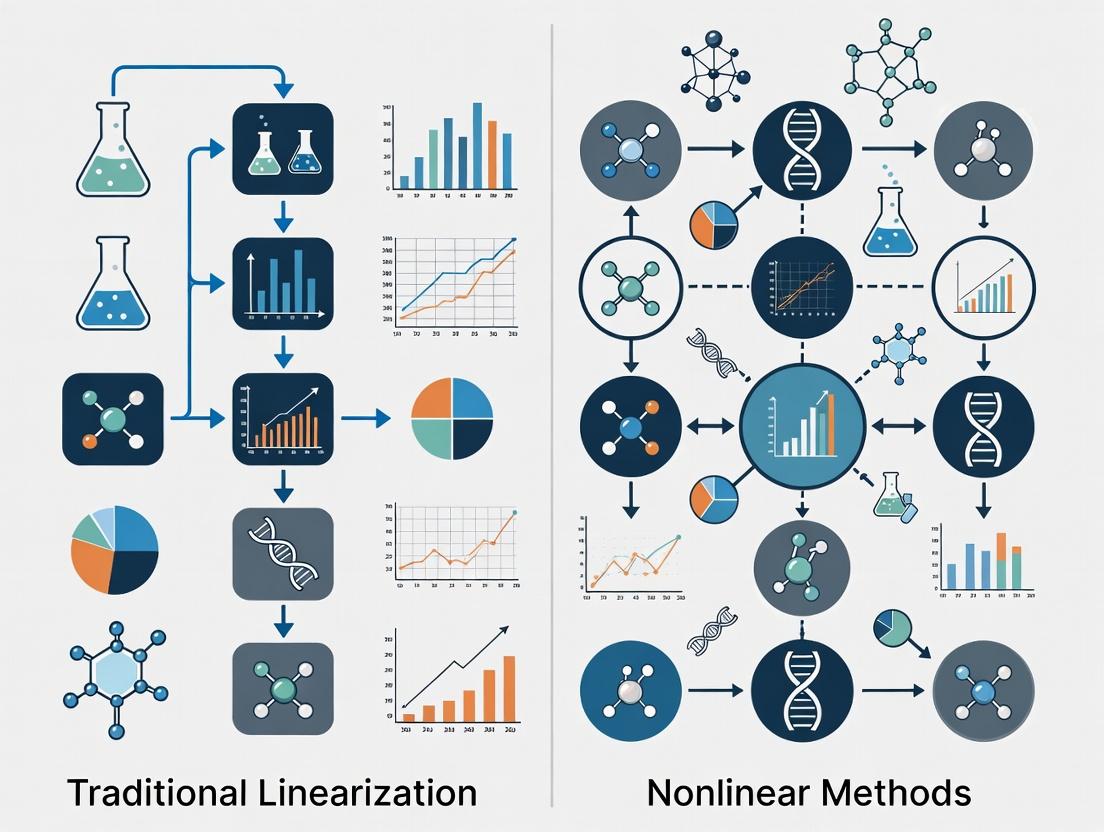
This article provides a definitive comparison of traditional linearization and modern nonlinear methods tailored for biomedical research and drug development.
Beyond Linearity: A Comprehensive Guide to Traditional and Nonlinear Methods in Modern Drug Development
Abstract
This article provides a definitive comparison of traditional linearization and modern nonlinear methods tailored for biomedical research and drug development. We first establish the core principles and limitations of linear approaches. We then explore advanced nonlinear methodologies, including entropy measures and AI-driven platforms, detailing their specific applications from target discovery to clinical trial optimization. Practical guidance is offered for overcoming common implementation challenges, such as noise sensitivity and parameter selection. Finally, we present a rigorous, evidence-based framework for selecting and validating the appropriate method based on specific research questions and data characteristics. This guide empowers researchers to leverage the full potential of both traditional and nonlinear techniques to enhance model accuracy and accelerate therapeutic discovery.
From Linear Assumptions to Complex Reality: Core Principles and When They Fall Short
Within the broader thesis on comparing traditional linearization and nonlinear methods research, this guide provides an objective performance comparison across three distinct methodological paradigms. The analysis is framed for researchers, scientists, and drug development professionals who must select appropriate tools for data analysis, predictive modeling, and complex system simulation. The spectrum ranges from linearization methods, which simplify inherently nonlinear problems into tractable linear forms, through traditional nonlinear methods, which directly model curvilinear relationships, to modern complex methods, which leverage advanced architectures like Graph Neural Networks (GNNs) to learn from intricate, relational data structures [1] [2] [3]. The evolution from linear to nonlinear to complex mirrors a shift from simplicity and interpretability towards flexibility and power, often at the cost of increased computational demand and reduced model transparency [2].
The following table provides a high-level comparison of the three core methodological paradigms discussed in this guide.
Table 1: Core Characteristics of Methodological Paradigms
| Aspect | Linearization Methods | Traditional Nonlinear Methods | Modern Complex Methods (e.g., GNNs) |
|---|---|---|---|
| Core Principle | Approximate nonlinear systems with linear models for simplified analysis [4] [5]. | Directly model curvilinear relationships using nonlinear functions [6] [2]. | Learn from graph-structured data, capturing dependencies in interconnected systems [1]. |
| Interpretability | High. Relationships are explicit and coefficients are easily explainable [2]. | Moderate to Low. Model behavior can be complex and less transparent [2]. | Very Low. Operate as "black boxes"; internal representations are difficult to decipher [1]. |
| Computational Demand | Generally low. Efficient algorithms exist for solving linear systems. | Higher. Often requires iterative optimization and can be prone to overfitting [2]. | Very High. Requires significant data and specialized hardware (e.g., GPUs/TPUs) for training [1]. |
| Data Structure Assumption | Euclidean, tabular data. Assumes independent observations. | Euclidean, tabular data. | Non-Euclidean, graph data. Explicitly models entities (nodes) and relationships (edges) [1]. |
| Primary Risk | Underfitting and inaccurate predictions if linearity assumption is violated [6]. | Overfitting to noise in the training data, leading to poor generalization [2]. | Poor generalization if graph structure is not representative or data is insufficient. |
Linearization Methods: Performance and Protocols
Linearization techniques reformulate complex, nonlinear problems into linear approximations to leverage efficient linear solvers. Their performance is highly context-dependent, excelling in systems where nonlinearities are mild or can be effectively bounded.
Experimental Performance Data
Recent research in compositional reservoir simulation provides a direct comparison of advanced linearization techniques. The study implemented four methods within a parallel framework and tested them on hydrocarbon reservoir models of varying complexity [4].
Table 2: Performance of Linearization Methods in Reservoir Simulation [4]
| Test Case | Method | Nonlinear Iterations | Key Performance Insight |
|---|---|---|---|
| 5-Component Gas Field | Operator-Based Linearization (OBL) | 770 | Most efficient for simpler systems; fastest convergence. |
| Finite Backward Difference (FDB) | 841 | Reliable but less efficient than OBL in this case. | |
| Finite Central Difference (FDC) | 843 | Comparable to FDB. | |
| Residual Accelerated Jacobian (RAJ) | 842 | Comparable to FDB. | |
| 10-Component Gas Field (with injection) | Finite Backward Difference (FDB) | 706 | Most robust for complex systems; only method to converge reliably. |
| Residual Accelerated Jacobian (RAJ) | 723 | Converged but with more iterations than FDB. | |
| Operator-Based Linearization (OBL) | Failed to Converge | Unsuitable for high-complexity scenarios in this test. | |
| 10-Component (no injection) | Residual Accelerated Jacobian (RAJ) | ~ Comparable to others | Effective at capturing dynamics with lower computational expense. |
Detailed Experimental Protocol: Advanced Linearization in Simulation
The quantitative findings in Table 2 were generated using the following rigorous methodology [4]:
- Problem Formulation: The study focused on fully implicit compositional simulation of multiphase (water, oil, gas) fluid flow in heterogeneous porous media, governed by highly nonlinear partial differential equations for mass conservation and algebraic constraints for thermodynamic phase equilibrium.
- Method Implementation: Four linearization schemes—Finite Backward Difference (FDB), Finite Central Difference (FDC), Operator-Based Linearization (OBL), and Residual Accelerated Jacobian (RAJ)—were implemented within a unified, MPI-based parallel simulation framework.
- Benchmarking Design: Performance was benchmarked against a legacy commercial simulator using three structured test cases: a simplified five-component hydrocarbon model with CO₂ injection, a complex ten-component model with CO₂ injection, and a ten-component model without injection.
- Primary Metrics: The key metric for efficiency was the total number of nonlinear iterations required for convergence at each time step. Secondary metrics included the percentage of total simulation time spent computing linearized operators.
- Validation: The physical accuracy of the simulation outputs (e.g., pressure fields, component saturation) was validated against the legacy simulator to ensure the linearization methods did not compromise solution correctness.
Traditional Nonlinear Methods: Performance and Protocols
Traditional nonlinear methods directly model relationships without relying on a linearity assumption. They are essential when variables interact in complex, curvilinear ways, which is common in biological and survey data [6].
Experimental Performance Data
A comprehensive 2019 study compared feature selection performance between linear and nonlinear methods using large-scale aging-related survey datasets (e.g., Health and Retirement Study) and synthetic data where the true relationships were known [6].
Table 3: Performance of Linear vs. Nonlinear Feature Selection Methods [6]
| Performance Aspect | Linear Methods | Nonlinear Methods | Implication |
|---|---|---|---|
| Overall Feature Selection Accuracy | Lower | Better overall performance | Nonlinear methods more correctly identify relevant variables when relationships are not straight-line. |
| Stability to Variable Inclusion/Exclusion | Affected | More stable performance | Results from nonlinear methods are less sensitive to changes in the initial set of variables analyzed. |
| Ability to Identify Non-linear Dependencies | Poor | Effectively identifies | Linear methods often fail to detect curvilinear or interactive relationships, leading to misleading conclusions. |
| Common Use in Gerontology (at time of study) | >50% of papers | Less common | Highlights a potential gap between common practice and optimal methodological choice. |
Detailed Experimental Protocol: Feature Selection Comparison
The comparative results in Table 3 were derived from the following experimental design [6]:
- Data Sources:
- Real-world Data: Two major longitudinal aging surveys: the Wisconsin Longitudinal Study (WLS) and the Health and Retirement Study (HRS).
- Synthetic Data: Artificially generated datasets with pre-defined linear and nonlinear relationships between features and target outcomes, serving as a ground-truth benchmark.
- Method Categories: The study evaluated:
- Linear Methods: Common linear regression-based feature selection techniques frequently used in gerontology.
- Nonlinear Methods: Three specific nonlinear feature selection methods (implemented as filter methods) capable of detecting non-linear dependencies.
- Evaluation Procedure: Algorithms were tasked with identifying which features in the dataset were relevant to a specified dependent variable (e.g., a health outcome). Performance was measured by comparing the algorithm's selected features against the known relevant features (in synthetic data) or through robust cross-validation metrics (in real-world data).
- Key Metrics: The primary metrics were precision (proportion of selected features that are truly relevant) and recall (proportion of all relevant features that are selected), combined into an overall F1-score. Stability was measured by varying the initial feature pool and observing changes in output.
Modern Complex Methods: Performance and Protocols
Modern complex methods, such as Graph Neural Networks (GNNs), represent a paradigm shift by learning directly from graph-structured data. This makes them uniquely powerful for problems involving interrelated entities, such as molecular structures in drug discovery or recommendation systems [1].
Experimental Performance Data
GNNs have demonstrated substantial performance improvements over previous state-of-the-art methods across diverse industrial and scientific applications [1].
Table 4: Documented Performance Gains from Graph Neural Network Applications [1]
| Application Domain | Use Case | Baseline Model | GNN Model & Improvement |
|---|---|---|---|
| Recommender Systems | Pinterest (PinSage) | Visual/Annotation Embedding Models | 150% improvement in hit-rate; 60% improvement in Mean Reciprocal Rank (MRR). |
| Recommender Systems | Uber Eats | Previous Production Model | 20%+ performance boost on key metrics; GNN-based feature became the most influential in the final model. |
| Traffic Prediction | Google Maps ETA | Prior Production Approach | Up to 50% accuracy improvement, reducing negative user outcomes. |
| Scientific Discovery | Materials Discovery (GNoME) | Traditional Screening | Discovered 2.2 million new stable crystals; powers external synthesis labs. |
Detailed Experimental Protocol: GNN for Recommendation Systems
The protocol for implementing and evaluating a GNN, as exemplified by Pinterest's PinSage system, involves the following steps [1]:
- Graph Construction: The entire Pinterest platform is represented as a bipartite graph. One set of nodes represents pins (image bookmarks), and the other represents boards (user-created collections). Edges connect pins to the boards they are saved in, capturing user curation behavior.
- Model Architecture (PinSage): A Graph Convolutional Network (GCN) variant is used. The core operation is localized convolution: each pin's representation is iteratively updated by aggregating information from its neighboring pins (those that co-occur on the same boards). This generates dense "embedding" vectors for each pin.
- Training Objective: The model is trained using a max-margin ranking loss. The goal is to learn embeddings such that pins that are frequently co-saved (positive pairs) have similar embeddings, while randomly selected pins (negative pairs) have dissimilar embeddings.
- Evaluation:
- Offline Metrics: Performance is evaluated on a held-out set of user interactions using ranking metrics:
- Hit-rate: Measures if the relevant item appears in the top-K recommendations.
- Mean Reciprocal Rank (MRR): Measures the rank position of the first relevant recommendation.
- Online A/B Testing: The final model is deployed in a live environment to a fraction of users to measure its impact on real user engagement metrics compared to the old model.
- Offline Metrics: Performance is evaluated on a held-out set of user interactions using ranking metrics:
The Scientist's Toolkit: Research Reagent Solutions
Selecting the correct methodological "reagent" is as critical as choosing a chemical reagent for an experiment. The following table maps essential computational tools and techniques to the three methodological paradigms.
Table 5: Essential Research Toolkit by Methodological Paradigm
| Tool/Reagent | Primary Paradigm | Function & Purpose | Considerations |
|---|---|---|---|
| Standard Linearization (SL) [5] | Linearization | Reformulates polynomial terms in binary optimization into linear constraints with auxiliary variables. Provides a baseline MILP formulation. | Can produce weak continuous relaxation bounds. Extended reformulations (MaxBound, ND-MinVar) offer tighter bounds [5]. |
| Operator-Based Linearization (OBL) [4] | Linearization | Pre-computes and tabulates complex physical operators (e.g., fugacity) as functions of state parameters. Drastically reduces online computation. | Highly efficient for problems with smooth parameter spaces but may fail in highly complex, discontinuous regimes [4]. |
| Nonlinear Feature Selection Filters [6] | Traditional Nonlinear | Scores and ranks individual features based on nonlinear statistical associations (e.g., mutual information) with the target variable. | Low computational cost and model-agnostic. May ignore feature interactions; often used as a preprocessing step. |
| Wrapper Methods (e.g., Forward Selection) [6] | Traditional Nonlinear | Iteratively selects feature subsets by training and evaluating a predictive model's performance at each step. | Can find high-performing subsets but is computationally expensive and prone to overfitting without careful validation [6]. |
| Graph Neural Network Framework (e.g., PyTorch Geometric, DGL) | Modern Complex | Provides the software architecture to define, train, and deploy GNN models on graph-structured data. | Requires significant expertise and computational resources. Essential for implementing architectures like GraphSAGE [1]. |
| Node & Graph Embedding | Modern Complex | The vector representation of nodes or entire graphs learned by a GNN. Encodes structural and feature information for downstream tasks. | The quality of the embedding is the direct determinant of performance on tasks like link prediction or classification [1]. |
| Cross-Validation (K-Fold) [2] | All Paradigms | Robust technique to estimate model generalizability by partitioning data into training and validation sets multiple times. | Crucial for preventing overfitting, especially in nonlinear and complex methods with many parameters [2]. |
| Regularization (L1/Lasso, L2/Ridge) [2] | Linearization & Trad. Nonlinear | Adds a penalty term to the model's loss function to shrink coefficients, reducing model complexity and overfitting. | L1 regularization can drive coefficients to zero, performing automatic feature selection. A key tool for managing the bias-variance trade-off [2]. |
This guide provides a comparative analysis of linear and nonlinear analytical methods, anchored by the foundational mathematical principles of superposition and proportionality. Framed within ongoing research to linearize complex nonlinear systems, we assess the performance, applicability, and experimental validation of these approaches, with a focus on applications in biomedical and drug development research.
| Analytical Pillar | Core Principle | Ideal Application Domain | Key Advantage | Primary Limitation |
|---|---|---|---|---|
| Linear Methods | Superposition: Response to combined inputs equals the sum of individual responses [7] [8]. Proportionality: Output scaling is directly proportional to input scaling [7] [9]. | Systems with linear, time-invariant components; circuits with resistors, capacitors, inductors [7]; initial data modeling [10]. | High interpretability, mathematical tractability, efficient computation, establishes a clear baseline [7] [10]. | Cannot model inherent nonlinearities (e.g., saturation, hysteresis); fails for complex, interactive systems [7] [10]. |
| Nonlinear Methods | The system's output does not satisfy superposition or homogeneity; relationships are described by curves, thresholds, or complex interactions [7] [10]. | Systems with dynamic feedback, biological pathways, protein-ligand interactions, and real-world observational data [11] [12] [10]. | Captures complex, real-world phenomena and interactions; essential for modeling biology and advanced machine learning [11] [10]. | Computationally intensive; risk of overfitting; parameters can be difficult to estimate and interpret [11] [10]. |
| Linearization Techniques | Approximating a nonlinear system's behavior around a specific operating point using a linear model [7]. | Small-signal analysis of amplifiers; initial stability analysis of complex systems; simplifying models for local prediction [7]. | Enables use of powerful linear analysis tools on nonlinear systems; simplifies initial design and understanding [7]. | Approximation is only valid locally; fails to capture global system behavior or large disturbances [7]. |
Foundational Concepts: The Mathematical Bedrock
The distinction between linear and nonlinear systems is not merely operational but is rooted in fundamental mathematical properties.
1.1 Principle of Superposition For a linear system ( L ), the response to a weighted sum of inputs is the identically weighted sum of the individual responses [8]: [ L(a1 x1(t) + a2 x2(t)) = a1 L(x1(t)) + a2 L(x2(t)) ] This principle is ubiquitous, from analyzing circuits with multiple independent sources [13] [9] to solving linear differential equations governing wave propagation [8]. It allows the deconstruction of complex problems into simpler, solvable components.
1.2 Principle of Proportionality (Homogeneity) A direct corollary of superposition, proportionality states that scaling the input to a linear system by a factor ( k ) scales the output by the same factor [7] [9]: [ L(k \cdot x(t)) = k \cdot L(x(t)) ] This property is exemplified by Ohm's Law ((V = IR)), where doubling the voltage across a resistor doubles the current [7].
1.3 The Emergence of Nonlinearity Nonlinear systems violate these principles. Their behavior is characterized by outputs that are not additive or directly proportional. Examples include diodes (exponential I-V relationship), saturating amplifiers, and most biological systems where feedback loops and thresholds are present [7]. The relationship between drug dose and therapeutic effect often follows a nonlinear, saturating curve rather than a straight line, a concept recognized in pharmacology for over a century [14].
Performance Comparison Guides
Comparative Analysis of Methodological Performance
The choice between linear and nonlinear models has quantifiable impacts on predictive accuracy, computational burden, and interpretability, as evidenced across engineering and biomedical fields.
Table 2.1: Performance Metrics for Linear vs. Nonlinear Methods
| Performance Metric | Linear Methods | Nonlinear Methods (e.g., ML Models) | Experimental Context & Citation |
|---|---|---|---|
| Predictive Accuracy | Lower for complex, curved relationships. Serves as a key baseline [10]. | Higher for systems with interactions and thresholds. Can boost hit rates in virtual screening by >50-fold [12]. | Drug discovery: AI integrating pharmacophoric features [12]. Data Science: Capturing non-constant change [10]. |
| Computational Efficiency | High. Solutions often analytical or requiring minimal computation (e.g., least squares) [7] [10]. | Variable to Low. Can be resource-intensive, requiring iterative optimization (e.g., gradient descent) [10]. | Circuit Analysis: Superposition provides a simpler alternative to solving simultaneous equations [13] [9]. |
| Interpretability & Transparency | High. Parameters (e.g., coefficients) have clear, direct meaning [10]. | Low to Moderate. Often act as "black boxes"; challenging to trace causality [11] [10]. | Drug Development: A barrier for regulatory acceptance of complex Causal ML models [11]. |
| Handling of High-Dimensional Data | Poor. Prone to overfitting without regularization; cannot model complex interactions well. | Good. Designed to identify complex patterns and interactions in large datasets (e.g., genomics) [11] [15]. | Biomarker Discovery: Analyzing omics data to find novel targets [15]. |
| Robustness to Assumptions | Low. Highly sensitive to violations of linearity, independence, and homoscedasticity [10]. | Higher. Flexible function forms can adapt to various data structures. | Statistical Modeling: Linear models fail if the true relationship is curved [10]. |
Experimental Protocol: Decoding Neural Signals with Linear vs. Nonlinear Classifiers
Objective: To compare the efficacy of linear and nonlinear machine learning models in decoding selective attention to speech from ear-EEG recordings [16]. Background: This experiment mirrors a core challenge in biosignal processing and drug development biomarker analysis: extracting a meaningful signal (cognitive attention) from complex, noisy physiological data. Materials:
- Ear-EEG recording device.
- Auditory stimuli (competing speech streams).
- Preprocessing pipeline (filtering, artifact removal).
- Computing platform for model training. Procedure:
- Data Acquisition: Record ear-EEG signals from subjects instructed to attend to one of two competing spoken messages.
- Feature Extraction: Segment EEG data and extract relevant features (e.g., time-frequency representations, amplitude features).
- Model Training & Comparison:
- Linear Model: Train a linear classifier (e.g., Linear Discriminant Analysis or Logistic Regression) on the features to predict the attended speaker.
- Nonlinear Model: Train a nonlinear classifier (e.g., a neural network, support vector machine with nonlinear kernel, or gradient boosting machine) on the same dataset.
- Validation: Evaluate both models using cross-validation, comparing key metrics: decoding accuracy, computational training time, and model interpretability (e.g., analyzing classifier weights for the linear model). Expected Outcome: The nonlinear model is anticipated to achieve higher decoding accuracy by capturing complex neural interactions [16], but at the cost of longer training time and reduced interpretability compared to the linear baseline. This trade-off directly informs the selection of analytical methods for clinical biomarker studies.
Experimental Protocol: Validating Target Engagement via a Cellular Thermal Shift Assay (CETSA)
Objective: To provide quantitative, system-level validation of drug-target engagement in intact cells—a nonlinear pharmacological process—using CETSA [12]. Background: Confirming that a drug molecule physically engages its intended protein target in a physiological environment is a critical, nonlinear step in development, as engagement does not scale linearly with dose and is influenced by complex cellular factors. Materials:
- Intact cells or tissue samples.
- Drug compound of interest and vehicle control.
- Thermal cycler or heating block.
- Cell lysis reagents.
- Centrifuge and protein analysis equipment (e.g., mass spectrometer, western blot). Procedure:
- Dosing & Heating: Treat parallel cell samples with a range of drug concentrations or a vehicle control. Heat each sample to a series of precise temperatures.
- Stabilization & Lysis: Allow samples to cool, promoting aggregation of unfolded, un-stabilized proteins. Lyse cells to release soluble proteins.
- Separation & Quantification: Separate soluble proteins from aggregates by centrifugation. Quantify the remaining soluble target protein in each sample using a specific detection method (e.g., high-resolution mass spectrometry) [12].
- Data Analysis: Plot the fraction of remaining soluble protein versus temperature for each drug dose. A rightward shift in the protein's melting curve indicates thermal stabilization due to drug binding—a direct proof of target engagement. Significance: CETSA moves beyond simplistic, linear biochemical binding assays by quantifying engagement within the nonlinear complexity of the cellular environment. It provides critical data to derisk drug programs and supports more confident go/no-go decisions [12].
Visualizing Pathways and Workflows
Comparative Model Selection Pathway
This diagram outlines the decision logic for researchers choosing between linear and nonlinear analytical models based on data structure and research goals [10].
Integrated Drug Discovery with AI Feedback Loops
This workflow visualizes the modern, non-linear, end-to-end drug discovery pipeline where AI-driven insights create continuous feedback loops, accelerating the entire process [12] [14].
The Scientist's Toolkit: Essential Research Reagent Solutions
This table details key materials and platforms essential for conducting research that bridges linear and nonlinear analytical methods in biomedical science.
Table 4.1: Key Research Reagents and Platforms
| Item / Solution | Function / Description | Relevance to Linearity/Nonlinearity |
|---|---|---|
| Cellular Thermal Shift Assay (CETSA) | Quantitatively measures drug-target engagement in intact cells and tissues by detecting ligand-induced thermal stabilization of proteins [12]. | Validates nonlinear pharmacology: Proves binding within the complex, nonlinear cellular environment, closing the gap between linear biochemical potency and cellular efficacy. |
| AI/ML Platforms (e.g., AlphaFold, DeepTox) | AI systems for protein structure prediction, toxicity forecasting, and generative molecular design [15]. | Embrace nonlinearity: Use deep learning (nonlinear models) to predict complex structure-activity relationships and generate novel chemical entities beyond linear intuition. |
| Real-World Data (RWD) Sources | Includes electronic health records (EHRs), insurance claims, patient registries, and wearable device data [11]. | Source of nonlinear complexity: Provides high-dimensional, observational data with inherent confounders, requiring advanced nonlinear/Causal ML methods for analysis [11]. |
| Causal Machine Learning (CML) Frameworks | Integrates ML with causal inference principles (e.g., propensity scoring, doubly robust estimation) to estimate treatment effects from RWD [11]. | Seeks linear causal estimates from nonlinear data: Applies sophisticated methods to mitigate bias in nonlinear observational systems to derive more reliable, linear-effect estimates for decision-making. |
| Electronic Lab Notebook (ELN) & LIMS (e.g., Genemod) | Digital platforms for managing experimental data, workflows, and collaboration, ensuring data integrity and traceability [15]. | Foundational for both: Enables rigorous data collection and sharing, which is essential for building, training, and validating both simple linear and complex nonlinear models. |
Application in Drug Discovery & Development
The principles of linearity and nonlinearity are not abstract concepts but are actively negotiated in modern pharmaceutical research.
5.1 Linearization in a Nonlinear World: The Role of Causal ML A prime example of seeking linear insights from nonlinear complexity is the use of Causal Machine Learning (CML) on Real-World Data (RWD). RWD from EHRs is inherently nonlinear, filled with confounding variables and complex interactions [11]. Traditional linear regression often fails here. Advanced CML methods—such as propensity score modeling with ML, doubly robust estimation, and instrumental variable analysis—attempt to "linearize" the problem. They aim to isolate and estimate the average treatment effect, a linear causal parameter, from the messy nonlinear observational dataset. This supports tasks like creating external control arms or identifying patient subgroups, thereby enhancing trial efficiency and generalizability [11].
5.2 The Nonlinear Reality of Biology and AI-Driven Discovery Conversely, the core of biology and modern discovery is acknowledged as fundamentally nonlinear. This is addressed not by simplification, but by employing more powerful nonlinear tools. Generative AI models (like GANs and VAEs) design novel molecules in a vast, unexplored chemical space, a process guided by nonlinear optimization [14]. Integrated discovery platforms use these AI tools not as siloed steps but in a continuous, nonlinear feedback loop, where clinical findings inform new molecule design in an iterative cycle [14]. The goal is to manage, rather than avoid, complexity to develop better drugs faster, aiming to reverse the trend of "Eroom's Law"—the declining productivity of pharmaceutical R&D [14].
The attempt to linearize inherently nonlinear biological processes represents a persistent, yet often inadequate, tradition in research. From predicting the binding of a drug molecule to forecasting population growth, biological systems are governed by complex interactions, feedback loops, and emergent behaviors that defy simple linear approximation. This comparison guide objectively evaluates the performance of traditional linearization approaches against advanced nonlinear methods across two foundational biological scales: molecular interactions and population dynamics. Framed within a broader thesis that argues for the necessity of physics-aware and mathematically robust nonlinear models, we present experimental data demonstrating that nonlinear methodologies consistently provide superior accuracy, generalizability, and biological insight. This is critical for researchers, scientists, and drug development professionals whose work depends on predictive precision, from in silico drug discovery to ecological and agricultural forecasting [17] [18].
Comparative Analysis: Protein-Ligand Co-Folding Prediction
The prediction of how a small molecule (ligand) binds to a protein target is a cornerstone of rational drug design. Traditional methods often rely on linear approximations or simplified physical scoring functions. The advent of deep learning-based "co-folding" models, which predict protein and ligand structure simultaneously, promises a paradigm shift [17].
Performance Benchmark: Nonlinear AI Models vs. Traditional Docking
Experimental data from adversarial testing reveals a significant performance gap. When the binding site is known, traditional physics-based docking methods like AutoDock Vina achieve approximately 60% accuracy in placing the ligand in its native pose. In contrast, the nonlinear, diffusion-based architecture of AlphaFold3 (AF3) achieves over 93% accuracy under the same conditions, approaching experimental-level precision [17].
Table 1: Performance Comparison of Protein-Ligand Structure Prediction Methods
| Method Category | Example Model | Key Principle | Accuracy (Known Binding Site) | Generalization Robustness | Physical Principle Adherence |
|---|---|---|---|---|---|
| Traditional Docking | AutoDock Vina | Linear scoring functions, rigid-body/soft docking | ~60% [17] | Moderate (sensitive to scoring function) | High (explicit physics-based) |
| Deep Learning Docking | DiffDock | Nonlinear deep learning on poses | ~38% [17] | Low (data-driven) | Low (potential for steric clashes) [17] |
| Co-folding AI | AlphaFold3 (AF3) | Nonlinear diffusion, unified atomic modeling | >93% [17] | Variable (see adversarial tests) | Questionable (memorization bias) [17] |
| Co-folding AI | RoseTTAFold All-Atom | Nonlinear attention-based networks | ~Benchmark Level [17] | Variable | Questionable [17] |
The Robustness Challenge: Exposing Nonlinear Model Vulnerabilities
Despite high benchmark accuracy, nonlinear co-folding models exhibit critical vulnerabilities when tested against fundamental physical principles. In a key experiment, all residues in the ATP-binding site of Cyclin-dependent kinase 2 (CDK2) were mutated to glycine, removing side-chain interactions essential for binding. Linear physical logic dictates ligand displacement. However, models like AF3 and RoseTTAFold All-Atom continued to predict ATP binding in the original pose, indicating overfitting and a lack of genuine physical understanding [17]. In a more extreme test, mutating binding site residues to bulky phenylalanines caused severe steric clashes in model predictions, as the diffusion process failed to resolve atomic overlaps within its iterative steps [17].
Comparative Analysis: Modeling Biological Growth and Population Dynamics
Modeling the growth of organisms or populations is a classic problem where nonlinear functions are essential to capture phases of acceleration, inflection, and saturation.
Evaluating Growth Curve Models
A 2025 study on Pekin duck growth compared ten nonlinear mathematical functions (e.g., Brody, Logistic, Gompertz, von Bertalanffy). The Gompertz model was identified as the most accurate for describing growth trajectories, based on metrics like the adjusted coefficient of determination and Akaike's information criterion [19]. Its first derivative correctly identified the peak absolute growth rate at 23-24 days before decline. The Brody model showed the least favorable fit [19]. This demonstrates that selecting the appropriate nonlinear model is context-dependent and requires empirical comparison.
Table 2: Comparison of Nonlinear Growth Models for Pekin Ducks [19]
| Model Name | Model Form | Key Characteristics | Goodness-of-Fit Ranking | Identified Peak Growth (Days) |
|---|---|---|---|---|
| Gompertz | $W(t) = A \cdot \exp(-\exp(-k(t-t_i)))$ | Sigmoidal, asymmetric inflection | Best | 23 (Danish), 24 (French) |
| Logistic | $W(t) = A / (1 + \exp(-k(t-t_i)))$ | Sigmoidal, symmetric inflection | High | Not Specified |
| von Bertalanffy | $W(t) = A (1 - \exp(-k(t-t_i)))^3$ | Derived from metabolic rates | Moderate | Not Specified |
| Brody | $W(t) = A (1 - b \cdot \exp(-k t))$ | Monotonic approach to asymptote | Poorest | Not Applicable |
The Limitation of Linear Population Models
Theoretical research highlights the fundamental incompatibility of standard linear, one-sex models (e.g., Lotka-Leslie) for population projection. Projections based solely on male parameters diverge from those based solely on female parameters over finite time, except in unrealistic stationary conditions [20]. Nonlinear two-sex models are required to capture the interactive dynamics that determine a population's true intrinsic growth rate, which may or may not be bracketed by the one-sex linear rates depending on initial conditions [20].
Cross-Disciplinary Validation of Nonlinear Methodologies
The superiority of nonlinear methods is corroborated in diverse analytical fields. In Laser-Induced Breakdown Spectroscopy (LIBS) for lithium quantification in geological samples, nonlinear models (e.g., Artificial Neural Networks) significantly outperformed linear methods (e.g., univariate calibration). Linear models were heavily affected by saturation and matrix effects, while nonlinear methods achieved errors compatible with semi-quantitative analysis [21]. Similarly, in predicting complex traits like soybean branching from genomic data, nonlinear models (Support Vector Regression, Deep Belief Networks) consistently outperformed linear counterparts in linking genotype to phenotype, enabling data-driven breeding decisions [18].
Experimental Protocols for Key Cited Studies
Protocol 1: Adversarial Testing of Protein-Ligand Co-folding Models [17]
- System Selection: Choose a high-resolution protein-ligand crystal structure (e.g., CDK2 with ATP).
- Wild-Type Prediction: Input the wild-type protein sequence and ligand SMILES string into the co-folding model (AF3, RFAA, etc.). Generate a predicted structure and calculate RMSD against the crystal structure.
- Binding Site Mutagenesis:
- Glycine Scan: Mutate all binding site residue identities to glycine. Submit the mutated sequence and unchanged ligand for prediction.
- Phenylalanine Packing: Mutate all binding site residues to phenylalanine. Submit for prediction.
- Dissimilar Residue Replacement: Mutate each binding site residue to a chemically dissimilar amino acid (e.g., charged to hydrophobic). Submit for prediction.
- Analysis: Visually and quantitatively (RMSD) assess if the predicted ligand pose is displaced. Check for steric clashes and the preservation of physiochemically implausible interactions.
Protocol 2: Comparative Fitting of Biological Growth Curves [19]
- Data Collection: Obtain longitudinal body weight data for the organism across its developmental timeline.
- Model Selection: Choose a set of candidate nonlinear growth functions (e.g., Gompertz, Logistic, Brody, von Bertalanffy).
- Parameter Estimation: Use nonlinear regression algorithms (e.g., Levenberg-Marquardt) to fit each model's parameters to the weight-time data.
- Goodness-of-Fit Evaluation: Calculate and compare statistical criteria for each fitted model:
- Adjusted Coefficient of Determination (R²adj)
- Root Mean Square Error (RMSE)
- Akaike's Information Criterion (AIC)
- Bayesian Information Criterion (BIC)
- Biological Interpretation: Select the best-fitting model. Calculate its first derivative to identify the time and magnitude of peak growth rate.
The Scientist's Toolkit: Essential Research Reagents & Solutions
Table 3: Key Reagents and Computational Tools for Nonlinear Biological Analysis
| Item/Tool Name | Category | Primary Function in Nonlinear Analysis | Example Use Case |
|---|---|---|---|
| AlphaFold3 | Software/AI Model | Predicts 3D structure of protein-ligand complexes via diffusion-based nonlinear architecture. | In silico drug screening and binding mode prediction [17]. |
| Gompertz Model Package | Software/Algorithm | Fits sigmoidal growth curves to data. Parameters describe growth rate and asymptotic mass. | Modeling animal growth kinetics in agriculture [19]. |
| AutoDock Vina | Software | Performs molecular docking using linear combination of scoring functions. | Traditional baseline for protein-ligand binding studies [17]. |
| SHAP (SHapley Additive exPlanations) | Software/Algorithm | Explains output of nonlinear machine learning models by attributing feature importance. | Interpreting genome-wide association studies in plant breeding [18]. |
| PyTorch/TensorFlow | Software Framework | Provides libraries for building and training custom deep neural networks. | Developing novel nonlinear models for phenotypic prediction [18]. |
| LIBS Spectrometer & ANN Software | Instrument/Analysis | Captures optical emission spectra; Artificial Neural Networks quantify elements despite nonlinear matrix effects. | Quantitative geochemical analysis in mining [21]. |
Visualizing Nonlinear Analysis Workflows
Workflow for Testing AI Model Robustness in Protein-Ligand Folding
Multi-Model Comparison Workflow for Growth Curve Analysis
The central paradigm of molecular biology—the linear flow of information from DNA to RNA to protein—has long provided a foundational framework for biomedical research and biomarker development [22]. This inherently linear, reductionist logic has been translated into statistical modeling, where linear regression and related methods assume simple, direct, and proportional relationships between variables [23]. While offering simplicity and interpretability, this approach is increasingly recognized as insufficient for capturing the complex, dynamic, and interconnected nature of biological systems [22] [24]. In clinical practice, the limitations are stark: biomarkers built on linear, single-analyte logic—such as the Prostate-Specific Antigen (PSA) test for prostate cancer or PD-L1 expression tests for immunotherapy response—are plagued by high rates of false positives, false negatives, and poor predictive accuracy [22]. This guide objectively compares the performance of traditional linear modeling approaches with emerging nonlinear and dynamic methodologies, framing the discussion within a broader thesis on the essential evolution from reductionist to systems-oriented research in biomedicine.
The Oversimplification Problem: Static Models in a Dynamic World
Linear models impose a static, one-way relationship between predictors and outcomes, an assumption that rarely holds in physiology and disease.
Clinical Consequences of Linear Simplification
The reliance on linear, single-factor biomarkers leads to significant clinical shortcomings. For example, a PSA level above 3 ng/mL results in a false positive for prostate cancer in approximately three out of four cases [22]. In immuno-oncology, the standard PD-L1 protein expression test predicts patient response to powerful therapies with an average accuracy of only 40% [22]. These failures stem from modeling complex, multi-factorial diseases as if they were governed by single, linearly proportional causes.
Table 1: Performance Limitations of Linear Biomarker Models in Clinical Practice
| Biomarker/Test | Clinical Use | Reported Performance Limitation | Primary Reason for Failure |
|---|---|---|---|
| PSA Level | Prostate Cancer Screening | ~75% False Positive Rate [22] | Fails to account for non-cancerous prostate conditions; single-analyte linear threshold. |
| PD-L1 IHC Test | Predicting Immunotherapy Response | ~40% Average Accuracy [22] | Linear protein level misses dynamic tumor-immune system interactions and spatial context. |
| Genetic Risk Variants | Complex Disease Prediction | Low prevalence, small effect sizes, incomplete penetrance [22] | Assumes additive, independent effects, ignoring epistatic and network interactions. |
Statistical Flaws: Multicollinearity and Misleading Significance
Beyond biology, linear models suffer from critical statistical vulnerabilities. A large-scale simulation study demonstrated that multicollinearity—correlation among predictor variables—severely distorts parameter estimates and their significance, even at low correlation levels [25]. Conventional reliance on t-statistics and p-values was found to be misleading, as "significant" coefficients often bore little relation to their true simulated values [25]. This is particularly dangerous in omics research, where many measured features (e.g., genes in a pathway) are highly interdependent, violating the linear assumption of independent predictors.
Diagram 1: Central Dogma vs. Biological Reality (92 chars)
Missed Dynamics: The Failure to Capture Time and Interaction
Biological systems are defined by feedback loops, adaptive changes, and time-dependent processes. Static linear models are "inherently short-sighted," ignoring how present states and interventions shape future outcomes [26].
The Need for Temporal and Spatial Dynamics
In cardiology, for instance, the progression of arrhythmias involves complex, nonlinear interactions across ion channels, cell networks, and tissue structure over time [24]. A linear model relating a single genetic variant to arrhythmia risk cannot capture this multi-scale, dynamic pathophysiology. Similarly, the long-range three-dimensional (3D) architecture of the genome acts as a dynamic, heritable imprint of cellular state that regulates gene expression in ways completely missed by linear DNA-to-RNA assays [22]. Biomarkers based on this 3D architecture have shown superior diagnostic performance by capturing this higher-order information [22].
From Population Averages to Individual Trajectories
Personalized medicine requires models that account for intra-individual variability over time. Nonlinear methods, including those powered by AI, can analyze longitudinal data to identify dynamic risk trajectories for chronic diseases, offering a more powerful prediction than a single static measurement [27]. This shift from a "snapshot" to a "movie" view of biology is critical for proactive health management.
Comparison Guide: Nonlinear Methodologies for Complex Biomedicine
This section compares the core capabilities of linear models against a suite of advanced nonlinear alternatives, supported by experimental data.
Table 2: Comparison of Linear and Nonlinear Modeling Approaches in Biomedicine
| Feature | Traditional Linear Models (e.g., Logistic/Cox Regression) | Nonlinear & Dynamic Alternatives | Comparative Experimental Insight |
|---|---|---|---|
| Core Assumption | Linear, additive relationship between inputs and output [23]. | Can capture complex, nonlinear interactions and feedback loops [23] [24]. | A bootstrapping correlation network method for variable selection outperformed PCA and Elastic Net in clustering precision on high-dimensional leukocyte imaging data [28]. |
| Temporal Dynamics | Static; treats time as a fixed covariate at best. | Explicitly models system evolution, state changes, and time-dependent risks [26] [24]. | Dynamic models in economics and ecology reveal long-term trade-offs (e.g., soil degradation) that static models completely miss [26]. |
| Handling High-Dimensional Data | Prone to overfitting with many predictors; requires variable selection/shrinkage. | Designed for high-dimensional spaces (e.g., deep learning, kernel methods) [29] [30]. | Deeply-learned GLMs (dlglm) handle complex nonlinearities and high-dimensional data while explicitly accounting for problematic missing data patterns [30]. |
| Interpretability | High; coefficients directly indicate effect size and direction [23]. | Often lower ("black box"); though methods like SHAP values aim to improve interpretability. | Mechanistic computational models (e.g., cardiac electrophysiology) offer high interpretability by being based on biophysical first principles [24]. |
| Validation & Reporting | Established guidelines (TRIPOD) exist, but adherence is poor; external validation rare [31]. | ML/AI guidelines emerging; validation remains a major challenge [31] [29]. | A 2025 review found no sign of an increase in ML use in biomedical prediction models, and poor reporting practices remain common across all model types [31]. |
Diagram 2: Nonlinear Model Selection Workflow (45 chars)
Experimental Protocols & Data
Protocol: Demonstrating Multicollinearity Impact in Linear Regression
This simulation protocol, based on [25], quantifies how multicollinearity corrupts linear model estimates.
- Data Generation: Simulate a dataset with 5,000 observations and 10 predictors (
x1tox10). Create specified correlation structures: variablesx1-x4are mutually correlated,x5-x7are correlated, andx8-x10are independent. Use correlations (ρ) from 0.05 to 0.95. - True Model Definition: Generate the outcome variable
yas a linear combination of predictors with pre-defined coefficients (e.g., 1, 10, 24 for different variables), plus random normal error at low (σ=20), medium (σ=100), and high (σ=200) levels. - Model Fitting & Analysis: Fit an ordinary least squares linear regression to estimate coefficients. Compare the estimated coefficients and their t-statistics to the known true values across 120 random samples for each correlation-error scenario.
- Key Outcome: The study found that even low correlation (ρ=0.30) caused significant bias and inflation of coefficients, and t-statistics became unreliable indicators of a predictor's true importance [25].
Protocol: Bootstrapping Correlation Networks for Variable Selection
This protocol for nonlinear dimensionality reduction is detailed in [28].
- Network Construction: From high-dimensional data (e.g., hundreds of morpho-kinetic variables from live imaging of leukocytes), calculate the correlation matrix between all variables to form a weighted network.
- Bootstrapping: Re-sample the dataset with replacement many times (e.g., 1000 iterations), recalculating the correlation network each time.
- Edge Stability Assessment: For each edge (variable pair), compute the proportion of bootstrap networks in which it appears. Edges with high stability are considered robust.
- Variable Selection: Rank variables by their connectivity strength in the stable network. Select the top-ranked variables as the most informative features for downstream analysis (e.g., UMAP for visualization).
- Key Outcome: This method outperformed PCA and Elastic Net in clustering precision on biological datasets, preserving interpretability by selecting original variables [28].
Protocol: Multi-Scale Cardiac Electrophysiology Modeling
This mechanistic modeling workflow is described in [24].
- Ion Channel Level (ODE): Model the kinetics of single ion channels using ordinary differential equations (ODEs), parameterized by voltage and ion concentrations. Incorporate effects of drugs or mutations.
- Cellular Level (ODE System): Integrate multiple ion current models into a cardiomyocyte model to simulate action potentials. Adjust parameters for disease states.
- Tissue Level (PDE): Use partial differential equations (PDEs) in a reaction-diffusion system to model the propagation of electrical waves across cardiac tissue, incorporating cellular geometry and fibrosis.
- Simulation & Validation: Run simulations to investigate arrhythmia mechanisms. Validate predictions against optical mapping or clinical electrophysiology data.
- Key Outcome: Provides a highly controlled, causal understanding of system dynamics, enabling hypothesis testing and revealing emergent phenomena not obvious from linear components [24].
The Scientist's Toolkit: Essential Research Reagents & Materials
Table 3: Key Research Reagent Solutions for Advanced Biomedical Modeling
| Item / Solution | Primary Function in Research | Relevance to Nonlinear Dynamics |
|---|---|---|
| 3C/Hi-C Assay Kits | To capture the 3D architecture and long-range interactions of chromatin in the nucleus [22]. | Provides the spatial interaction data necessary to move beyond linear genome annotation, enabling biomarkers based on structural dynamics. |
| Live-Cell Imaging Systems with High-Content Analysis | To longitudinally track morpho-kinetic variables (e.g., cell shape, movement) in response to stimuli [28]. | Generates high-dimensional temporal data essential for training and validating dynamic, nonlinear models of cell behavior. |
| Uniform Manifold Approximation and Projection (UMAP) | A nonlinear dimensionality reduction technique for visualization and exploration of high-dimensional data [28]. | Reveals complex clusters and relationships in data that linear methods like PCA often obscure. |
| dlglm Software Architecture | A deeply-learned generalized linear model framework that handles non-linearities and complex missing data patterns [30]. | Enables flexible, robust supervised learning on messy real-world biomedical datasets where linear models and simple imputation fail. |
| Cardiac Electrophysiology Simulation Platforms (e.g., Chaste, OpenCARP) | Software to implement multi-scale mechanistic models of heart electrical activity [24]. | Allows in silico experimentation of nonlinear dynamics across scales, from ion channel to whole organ, for basic research and drug safety testing. |
| Structured Missing Data Test Datasets | Curated datasets with known missingness mechanisms (MCAR, MAR, MNAR) [30]. | Critical for benchmarking and developing models like dlglm that must perform reliably under realistic, non-ideal data conditions. |
Diagram 3: Multi-Scale Cardiac Model Workflow (48 chars)
This comparison guide evaluates the performance and application of foundational nonlinear concepts—chaos, sensitivity to initial conditions, and fractals—against traditional linearization methods within scientific research. Framed within a broader thesis on comparative methodology, we objectively assess these paradigms through experimental data, detailing protocols from fields including pharmacodynamics, physiological modeling, and materials science. The analysis reveals that nonlinear methods provide superior accuracy for modeling complex, heterogeneous systems but at increased computational cost, whereas linear methods offer speed and simplicity suitable for first approximations or systems with small perturbations [32] [6]. This guide is structured for researchers and drug development professionals, providing quantitative comparisons, detailed experimental methodologies, essential research toolkits, and visualizations of key concepts.
Core Conceptual Definitions and Comparative Thesis
The study of dynamical systems is fundamentally divided into linear and nonlinear approaches. Linear methods assume proportionality and superposition, where system output is directly proportional to input and the net response to multiple stimuli is the sum of individual responses. These methods are analytically tractable, computationally fast, and form the basis of traditional modeling in many engineering and biological applications [32]. However, they often fail to capture the complex behaviors inherent in physiological, pharmacological, and natural systems.
In contrast, nonlinear dynamics acknowledge that relationships between variables are not proportional and that systems can exhibit emergent, complex behaviors. This guide focuses on three pivotal nonlinear concepts:
- Chaos: A behavior in deterministic systems characterized by aperiodic, seemingly random output that is exquisitely sensitive to initial conditions [33] [34].
- Sensitivity to Initial Conditions (The Butterfly Effect): A hallmark of chaotic systems where infinitesimally small differences in starting points lead to radically divergent future states, making long-term prediction impossible [35]. This was classically demonstrated by Edward Lorenz in weather modeling [36].
- Fractals: Geometric shapes or temporal patterns that exhibit self-similarity across scales, meaning their structure appears similar regardless of magnification level [37]. They are characterized by a non-integer fractal dimension (D), which quantifies complexity and space-filling capacity [33] [38].
The central thesis explored herein is that while linearization provides critical simplifying power, nonlinear methods employing chaos and fractal theory are essential for realistic modeling of complex systems. This is particularly true in drug development, where physiological processes are inherently nonlinear, heterogeneous, and multiscale [34] [36].
Methodological Comparison: Experimental & Analytical Protocols
This section details key experimental and computational protocols used to generate data comparing linear and nonlinear approaches.
2.1 Protocol A: Biomechanical Simulation of Soft Tissues This protocol compares linear elastostatic analysis versus geometrically nonlinear analysis for simulating a biological organ [32].
- Sample Preparation: Obtain CT scan images (e.g., from the Visible Human Project). Segment the images for the target organ (e.g., kidney) using software like ITK-SNAP. Reconstruct a 3D surface model using MeshLab.
- Mesh Generation & Material Assignment: Import the 3D geometry into finite element analysis (FEA) software (e.g., ANSYS). Generate a tetrahedral mesh. Assign material properties: for linear analysis, use a constant Young's modulus and Poisson's ratio; for nonlinear analysis, define a hyperelastic material model (e.g., Mooney-Rivlin).
- Loading & Boundary Conditions: Apply a fixed constraint to one end of the organ. Apply a known displacement or pressure load to a specified surface area to simulate surgical palpation.
- Simulation & Analysis:
- Perform a linear static analysis.
- Perform a nonlinear static analysis accounting for large deformations.
- Output Metrics: Extract maximum principal stress, strain energy, and reaction force. Compute the percentage error of linear results relative to the nonlinear benchmark.
2.2 Protocol B: Fractal Dimension Analysis of Physical Surfaces This protocol quantifies surface complexity using fractal dimension, a nonlinear metric [37] [39].
- Imaging: Obtain a 3D topographic profile of the sample surface. For pharmaceutical particles, use Atomic Force Microscopy (AFM). For anatomical structures (e.g., vascular beds), analyze segmented micro-CT scans.
- Data Preparation: Isolate the height map or binary volume data. For the box-counting method, superimage a series of grids with box sizes, ε.
- Fractal Calculation: For each box size ε, count the number of boxes, N(ε), that contain part of the surface or pattern. Plot log(N(ε)) versus log(1/ε).
- Dimension Estimation: Perform a linear regression on the linear portion of the log-log plot. The fractal dimension D is estimated as the slope of the best-fit line. Surface complexity is directly related to D, where a higher D indicates a more complex, space-filling structure.
2.3 Protocol C: Detecting Nonlinear Dependence in High-Dimensional Datasets This protocol compares linear and nonlinear feature selection methods to identify relevant variables in large datasets [6].
- Dataset: Use a large survey database (e.g., health and aging study) with numerous features and a target outcome variable.
- Ground Truth Establishment: Use synthetic data where the functional relationship (linear or nonlinear) between features and target is known.
- Method Application:
- Linear Methods: Apply filter methods (e.g., Pearson correlation), wrapper methods (e.g., forward selection with linear regression), or embedded methods (e.g., Lasso regression).
- Nonlinear Methods: Apply mutual information (a nonlinear dependency measure), or wrapper methods using nonlinear classifiers (e.g., Random Forest).
- Performance Evaluation: Rank features by relevance scores from each method. Compare rankings to the ground truth using precision-recall curves and area under the curve (AUC). Stability is tested by evaluating method performance on random subsets of the data.
Performance Data & Comparative Analysis
The following tables summarize quantitative findings from executed experimental protocols, comparing the efficacy of linear versus nonlinear methodologies.
Table 1: Comparison of Linear vs. Nonlinear Finite Element Analysis for Kidney Simulation [32]
| Performance Metric | Linear Elastic Analysis | Geometrically Nonlinear Analysis | Percentage Error (Linear vs. Nonlinear) |
|---|---|---|---|
| Maximum Principal Stress (Pa) | 1.82 x 10⁵ | 2.41 x 10⁵ | -24.5% |
| Total Strain Energy (J) | 5.71 x 10⁻⁴ | 8.90 x 10⁻⁴ | -35.8% |
| Reaction Force (N) | 0.85 | 1.12 | -24.1% |
| Computation Time (Relative) | 1.0 (Baseline) | 6.8 - 8.5 | N/A |
| Primary Advantage | Computational speed, simplicity | Accuracy under large deformation | N/A |
| Best Use Case | Preliminary design, small-strain scenarios | Final validation, surgical simulation | N/A |
Table 2: Performance of Linear vs. Nonlinear Feature Selection Methods [6]
| Evaluation Metric | Linear Methods (e.g., Correlation, Lasso) | Nonlinear Methods (e.g., Mutual Information, Random Forest) | Inference |
|---|---|---|---|
| AUC for Linear Features | 0.89 - 0.94 | 0.91 - 0.95 | Comparable performance |
| AUC for Nonlinear Features | 0.52 - 0.61 | 0.83 - 0.91 | Nonlinear methods superior |
| Stability (Score Variance) | High (sensitive to feature subset) | Low (robust to feature subset) | Nonlinear methods more reliable |
| Computational Cost | Low | Moderate to High | Linear methods are faster |
Table 3: Fractal Dimensions in Physiological and Pharmaceutical Systems
| System / Material | Fractal Dimension (D) | Measurement Technique | Interpretation & Relevance |
|---|---|---|---|
| Koch Curve (Theoretical) | 1.262 [37] | Mathematical generation | Benchmark for self-similar patterns. |
| Pharmaceutical Particles | 2.1 - 2.2 [39] | Atomic Force Microscopy (AFM) | Quantifies surface roughness, influences dissolution rate & flowability. |
| Pulmonary Bronchial Tree | ~2.7 - 3.0 (theoretical) [37] | Morphometric analysis | Optimizes gas exchange; deviation from ideal may indicate disease. |
| Solutions to BLP Equation | Non-integer, scale-dependent [38] | Voxel-based box-counting | Confirms self-affine, multiscale structure in nonlinear wave dynamics. |
| Oceanic Plastic Debris | Multifractal spectrum [33] | Multifractal Detrended Fluctuation Analysis | Characterizes complex distribution impacting climate dynamics. |
Visualizations of Nonlinear Concepts and Workflows
Diagram 1: Chaos and Sensitivity in a Pharmacodynamic Pathway (Max Width: 760px)
Diagram 2: Comparative Workflow: Linear vs. Nonlinear/Fractal Methods (Max Width: 760px)
The Scientist's Toolkit: Essential Research Reagents & Solutions
Table 4: Key Tools for Nonlinear Dynamics and Fractal Research
| Tool / Reagent | Category | Primary Function | Example Application in Research |
|---|---|---|---|
| Finite Element Analysis (FEA) Software (ANSYS, Abaqus) | Computational | Solves partial differential equations for stress/strain in complex geometries. | Comparing linear vs. nonlinear material models for organ simulation [32]. |
| Atomic Force Microscope (AFM) | Instrumentation | Provides 3D topographic surface profiles at nanoscale resolution. | Measuring fractal dimension of pharmaceutical particle surfaces for QC [39]. |
| ImageJ / ITK-SNAP / MeshLab | Software | Open-source tools for image segmentation, stack processing, and 3D model reconstruction. | Creating 3D organ geometries from CT/MRI scans for simulation [32]. |
| Box-Counting Algorithm Software | Algorithm | Computes fractal dimension from 2D or 3D digital data by analyzing scaling of pattern with measurement scale. | Quantifying complexity of vascular networks or surface roughness [37] [38]. |
| Mutual Information Calculator | Statistical Tool | Measures general (linear and nonlinear) dependence between variables. | Non-linear feature selection in high-dimensional biological datasets [6]. |
| Nonlinear Solver Libraries (SUNDIALS, SciPy) | Computational | Provides numerical methods (e.g., for ODEs/PDEs) capable of handling stiff, chaotic systems. | Simulating chaotic pharmacodynamic models or reaction-diffusion systems [33] [34]. |
| Fractional Calculus Toolbox | Mathematical | Operates with fractional derivatives/integrals, essential for modeling fractal-order dynamics. | Analyzing systems with memory effects and power-law responses [33] [40]. |
The evolution from linear pharmacokinetics (PK) to systems pharmacology represents a fundamental paradigm shift in biomedical research and drug development. Classical linear PK, grounded in the law of mass action and the receptor theory that is over a century old, relies on compartmental models that assume direct proportionality between dose and systemic exposure [41] [42]. While effective for many small molecules, these models often fail to capture the complex, nonlinear behaviors inherent in biological systems, such as saturable processes, feedback loops, and network interactions [43] [44].
The limitation of reductionist approaches has spurred the rise of more integrative disciplines. Quantitative Systems Pharmacology (QSP) has emerged as a holistic framework that uses computational modeling to bridge systems biology and pharmacology [45] [46]. It examines interactions between drugs, biological networks, and disease processes to generate mechanistic, predictive insights [44]. This evolution is driven by the need to address the high attrition rates in drug development and to tackle complex 21st-century diseases, moving from a focus on single targets to understanding polypharmacology and network dynamics [42]. The adoption of Model-Informed Drug Development (MIDD), championed by regulatory agencies, underscores this transition, where QSP and related modeling approaches are becoming the new standard for improving efficiency and decision-making [45] [46].
Core Methodological Comparison: Linear, Nonlinear, and Systems Approaches
This section provides a foundational comparison of the defining characteristics, underlying mathematics, and primary applications of linear pharmacokinetics, nonlinear methods, and systems pharmacology.
Table 1: Foundational Comparison of Pharmacokinetic Modeling Paradigms
| Aspect | Linear (Classical) Pharmacokinetics | Nonlinear Pharmacokinetic Methods | Systems Pharmacology (QSP) |
|---|---|---|---|
| Core Principle | Direct proportionality between dose and exposure (AUC, Cmax); superposition applies [41]. | Dose/exposure relationships are not proportional due to saturable processes (e.g., metabolism, transport) [47] [48]. | Integrative, network-based modeling of drug effects within biological systems [44]. |
| Mathematical Foundation | Linear ordinary differential equations (ODEs); first-order kinetics [49]. | Nonlinear ODEs (e.g., Michaelis-Menten, Target-Mediated Drug Disposition) [47]. | Systems of (non)linear ODEs modeling pathways, feedback, and homeostatic control [44]. |
| Typical Model Structure | Compartmental models (1-, 2-, or 3-compartment) [49]. | Compartmental models integrated with saturable functions [47] [48]. | Mechanistic, physiology-based networks linking PK, biological pathways, and disease modules [46] [44]. |
| Primary Goal | Describe plasma concentration-time profiles to calculate standard PK parameters (CL, Vd, t½) [41] [49]. | Characterize and quantify sources of non-proportionality in PK [43] [48]. | Predict clinical outcomes, optimize therapeutic strategies, and generate testable biological hypotheses [45] [46]. |
| Treatment of Biology | Empirical; the body is a "black box" with abstract compartments [43]. | Semi-mechanistic; incorporates specific saturable biological processes [47] [48]. | Explicitly mechanistic; aims to represent key biological structures and interactions [44] [42]. |
| Major Application Era | Mid-20th century to present, foundational to clinical PK [50] [42]. | Late 20th century to present, crucial for biologics and drugs with saturable clearance [47]. | 21st century to present, for complex diseases and novel therapeutic modalities [45] [46]. |
Detailed Experimental Protocols and Data
Protocol: Investigating Nonlinear PK via Receptor-Mediated Endocytosis (RME)
This protocol, based on the study of therapeutic proteins like epidermal growth factor (EGF) receptor ligands, details how to build a mechanistic model for nonlinear clearance [47].
1. System Definition:
- Ligand: A therapeutic protein (e.g., monoclonal antibody, growth factor).
- Biological System: Cells expressing the target receptor (e.g., EGFR).
- Process: Receptor-Mediated Endocytosis (RME) – the primary source of nonlinear, saturable elimination for many biologics [47].
2. Detailed Mechanistic Model (Model A) Construction:
- Develop a system of ordinary differential equations (ODEs) based on mass action kinetics to describe the following species and transitions [47]:
- Extracellular Ligand (Lex): Binds to free membrane receptor (Rm) with association rate constant kon.
- Membrane Complex (RLm): Formed from binding; can dissociate (koff) or be internalized (kinterRL).
- Intracellular Complex (RLi): Can be recycled to membrane (krecyRL), degraded (kdegRL), or dissociate (kbreak).
- Free Intracellular Receptor (Ri): Generated from complex dissociation; can be recycled (krecyR) or degraded (kdegR).
- Receptor Synthesis: Constant zero-order synthesis rate (ksynth).
3. Model Reduction and Analysis:
- Apply quasi-steady-state assumptions for receptor species to derive a simplified, identifiable model (e.g., an extended Michaelis-Menten equation) [47].
- Use in vitro data (binding, internalization, degradation rates) to inform model parameters.
- Simulate concentration-time profiles under different dose levels to visualize nonlinearity: at low doses, clearance is high (first-order); at high doses, clearance decreases as RME pathways become saturated (zero-order) [47].
4. Key Experimental Insight: The model demonstrates that a receptor system can efficiently eliminate drug even with a low total receptor number, and nonlinearity is more pronounced for systems with high receptor availability and fast internalization [47].
Case Study: Ciclosporin Population PK with Nonlinear Kinetics
This clinical study compared linear and nonlinear modeling strategies for the immunosuppressant ciclosporin in renal transplant patients [48].
1. Experimental Design:
- Data: 2,969 whole-blood concentration measurements (pre-dose and 2-hour post-dose) from 173 adult patients.
- Models Developed: Four population PK (PopPK) models were constructed [48]:
- Linear 1-Compartment Model: Standard linear approach.
- Linear 2-Compartment Model: Standard linear approach with peripheral compartment.
- Empirical Nonlinear Model: Incorporated nonlinearity via empirical covariate relationships.
- Theory-Based Nonlinear Model: Incorporated mechanistic nonlinear sources (e.g., saturable binding to erythrocytes, auto-inhibition of CYP3A4/P-gp).
2. Results and Comparative Performance: The predictive performance was evaluated using prediction-corrected visual predictive checks (pcVPC). The theory-based nonlinear model demonstrated superior predictive performance compared to the linear and empirical nonlinear models. It effectively captured the saturation of erythrocyte binding and the complex drug-drug interaction with prednisolone, which induces metabolic enzymes [48].
Table 2: Performance Summary of Ciclosporin PopPK Models [48]
| Model Type | Structural Basis | Treatment of Nonlinearity | Predictive Performance | Identified Sources of Nonlinearity |
|---|---|---|---|---|
| Linear 1-Compartment | Empirical compartment | None (assumed linearity) | Poorest | Not applicable |
| Linear 2-Compartment | Empirical compartment | None (assumed linearity) | Poor | Not applicable |
| Empirical Nonlinear | Empirical compartment + covariates | Statistically identified covariate effects | Improved, but less consistent | Demographics (e.g., body weight) |
| Theory-Based Nonlinear | Mechanism-informed compartment | Explicit saturable binding & enzyme inhibition | Best | Saturable erythrocyte binding, CYP3A4/P-gp auto-inhibition, drug interaction with prednisolone |
3. Conclusion: Incorporating mechanistically justified nonlinearity significantly improved model predictability and provided a more robust tool for dose individualization, highlighting the limitation of assuming linear PK for drugs like ciclosporin [48].
Visualization of Methodological Evolution
Visualization 1: The Pharmacological Modeling Evolution
Detailed RME Pathway for Therapeutic Proteins
Visualization 2: Receptor-Mediated Endocytosis (RME) Mechanism
Impact and Future Outlook: QSP as a New Standard
The transition to systems pharmacology is marked by tangible impacts on drug development efficiency and decision-making. Industry analyses, such as one from Pfizer presented at the QSP Summit 2025, estimate that MIDD approaches (enabled by QSP, PBPK, and other models) save approximately $5 million and 10 months per development program [45]. Beyond cost and time savings, QSP's power lies in its ability to generate and test biological hypotheses in silico, identify knowledge gaps, and simulate clinical trials for scenarios impractical to test experimentally, such as in rare diseases or pediatric populations [45] [46].
The future of the field is oriented towards greater integration and personalization. Key trends include [45] [46] [44]:
- Virtual Patient Populations and Digital Twins: Creating simulated cohorts to explore personalized therapies and optimize trial design, especially for hard-to-study populations.
- AI and Machine Learning Integration: Enhancing model development, data integration, and pattern recognition from large, complex datasets.
- Regulatory Acceptance: Growing endorsement by agencies like the FDA and EMA as part of the MIDD framework, with QSP evidence increasingly included in submissions.
- Reduction of Animal Testing: Providing predictive, mechanistic alternatives that align with the "3Rs" (Replace, Reduce, Refine) principle.
Table 3: Key Research Reagent Solutions and Tools
| Tool/Reagent Category | Specific Example/Representation | Primary Function in Research |
|---|---|---|
| Mechanistic Biological System | Epidermal Growth Factor Receptor (EGFR) Pathway [47] | A well-characterized model system for studying Receptor-Mediated Endocytosis (RME), nonlinear PK, and signal transduction dynamics. |
| Computational Modeling Software | PBPK/QSP Platforms (e.g., Certara's Suite, MATLAB/SimBiology) [45] [46] | Software environments for building, simulating, and validating mechanistic, multi-scale models that integrate physiology, pharmacology, and disease biology. |
| Modeling Framework | Target-Mediated Drug Disposition (TMDD) Model [47] | A semi-mechanistic structural model framework specifically designed to characterize PK driven by high-affinity binding to a pharmacological target. |
| In Vitro Binding & Trafficking Assays | Surface Plasmon Resonance (SPR), Internalization Flow Cytometry [47] | Experimental methods to quantify critical rate constants (kon, koff, kinter) needed to parameterize mechanistic RME and TMDD models. |
| Clinical PopPK/PD Software | NONMEM, Monolix, R/Phoenix [48] | Industry-standard tools for population analysis of clinical trial data, enabling the identification of nonlinear kinetics and covariate effects in patient populations. |
| Therapeutic Modality | Monoclonal Antibodies (mAbs) & Therapeutic Proteins [47] | A major class of drugs whose disposition is frequently dominated by nonlinear, saturable clearance pathways (e.g., RME), making them prime subjects for advanced PK/PD modeling. |
Toolkit for Complexity: Implementing Nonlinear Methods in the Drug Development Pipeline
The analysis of physiological signals—such as electroencephalogram (EEG), electrocardiogram (ECG), and speech—presents a fundamental challenge in biomedical research and drug development: accurately quantifying the complexity of underlying biological systems. Traditional linear methods of signal analysis, including spectral analysis and linear time-invariant modeling, often fail to capture the inherent nonlinearity, non-stationarity, and multiscale dynamics of living systems [51]. This limitation has driven a paradigm shift toward nonlinear time series analysis, where entropy measures serve as critical tools for assessing system complexity and disorder [52] [53].
This comparison guide is framed within a broader thesis investigating the comparative efficacy of traditional linearization approaches versus contemporary nonlinear methods. The core argument posits that nonlinear complexity measures, particularly those based on permutation entropy and its derivatives, provide a more robust, information-rich, and physiologically relevant characterization of signals than linear statistics alone [51] [54]. These measures are instrumental in distinguishing pathological states, such as epileptic seizures from normal brain activity or shockable from non-shockable cardiac arrhythmias, and in monitoring dynamic states like anesthesia depth [55] [56]. For researchers and drug development professionals, selecting the optimal complexity metric is crucial for developing sensitive diagnostic biomarkers and evaluating therapeutic interventions.
Comparative Framework: A Spectrum of Entropy Measures
Nonlinear entropy measures for physiological signal analysis exist on a spectrum, from those closely related to classical linear statistics to novel, fully nonlinear approaches. The following diagram illustrates the logical relationships and evolution of key entropy measures discussed in this guide, positioning them within the broader research context of linear versus nonlinear methodology.
Methodological Evolution of Entropy Measures
Empirical Performance Comparison Across Physiological Signals
The following tables summarize quantitative data from key studies, comparing the performance of permutation entropy (PE) and its modern variants against traditional linear methods and other nonlinear entropy measures across different physiological signals and classification tasks.
Performance in Differentiating Physiological and Pathological States
Table 1: Comparison of entropy measure performance in classifying clinical states from EEG and ECG signals. SE: Sample Entropy, PE: Permutation Entropy, SSCE: State Space Correlation Entropy. Values are mean ± standard deviation where available. [55]
| Signal Type | Clinical States (Class 0 vs. Class 1) | Sample Entropy (SE) | Permutation Entropy (PE) | State Space Correlation Entropy (SSCE) | Best Performing Measure |
|---|---|---|---|---|---|
| EEG | Non-Seizure vs. Seizure | 0.98 ± 0.25 vs. 0.34 ± 0.13 | 0.84 ± 0.05 vs. 0.67 ± 0.07 | 1.60 ± 0.36 vs. 1.72 ± 0.46 | SSCE (Higher mean for seizure) [55] |
| ECG | Non-Shockable VA vs. Shockable VA | 0.08 ± 0.02 vs. 0.14 ± 0.02 | 0.64 ± 0.11 vs. 0.47 ± 0.08 | 0.62 ± 0.43 vs. 1.86 ± 0.36 | SSCE (Largest inter-class difference) [55] |
| Speech | Neutral vs. Anger Emotion | 0.50 ± 0.31 vs. 0.37 ± 0.18 | 0.64 ± 0.11 vs. 0.77 ± 0.10 | 1.71 ± 0.46 vs. 2.04 ± 0.59 | SSCE (Highest anger class value) [55] |
Computational and Classification Performance Comparison
Table 2: Computational efficiency and classification accuracy of PE variants. GPE: Global Permutation Entropy, EoD: Entropy of Difference, AUC: Area Under the Curve. Data derived from synthetic and physiological signal experiments. [57] [56]
| Entropy Measure | Key Differentiating Feature | Computational Cost | Reported Classification Performance | Primary Application (Study) |
|---|---|---|---|---|
| Standard PE | Ordinal patterns of consecutive points | Low, O(n) | AUC ~0.90 for sleep stage classification [56] | Baseline for comparison [57] [56] |
| Global PE (GPE) | Considers all index combinations, not just consecutive | High, but efficient up to order 6-7 | Converges faster to true value for random signals; detects noise changes more quickly than PE [57] | Synthetic signals analysis [57] |
| Entropy of Difference (EoD) | Patterns based on sign of differences | Lower than PE, especially for high orders | AUC not significantly different from PE for vigilance state classification [56] | EEG during sleep and anesthesia [56] |
| Amplitude-Sensitive PE (ASPE) | Incorporates amplitude via coefficient of variation | Moderate (adds weighting step) | Superior sensitivity to amplitude changes in simulations; effectively identifies seizure/arrhythmia states [58] | EEG seizures & ECG arrhythmias [58] |
| Improved Multiscale PE (IMPE) | Stable entropy estimation across temporal scales | Higher than single-scale PE | More reliable and stable results than MPE for long scales; characterizes multiscale physiology [54] | Multiscale EEG analysis [54] |
Detailed Experimental Protocols
To ensure reproducibility and critical evaluation, this section outlines the methodologies for key experiments cited in the comparison tables.
- Objective: To compare the convergence properties and sensitivity of Global Permutation Entropy (GPE) and standard PE on controlled synthetic data.
- Signal Generation:
- Random Signals: Generate sequences of independent, identically distributed random values.
- Noisy Periodic Signals: Create a periodic signal (e.g., sine wave) and inject sudden or gradual increases in additive white Gaussian noise.
- Parameter Setting:
- Embedding dimension (order): Varied from 3 to 6.
- Time series length (
n): Varied to test convergence (e.g., 100 to 10,000 points). - For standard PE, delay
τwas set to 1 and other values.
- Entropy Calculation:
- GPE: For a given order
k, compute the empirical probability distributionp(σ)over all permutationsσin the symmetric groupS_kusing all(n choose k)strictly increasing index combinations. Compute normalized Shannon entropy:GPE(k) = -∑ p(σ) log p(σ) / log(k!). - Standard PE: Use consecutive (or
τ-spaced) windows. Compute probability distributionq(σ)and normalized entropyPE(k, τ).
- GPE: For a given order
- Evaluation Metrics:
- Convergence Speed: Monitor
GPE(k)andPE(k)asnincreases for random signals, comparing the rate of approach to the theoretical maximum of 1. - Change Detection: Apply both measures to the noisy periodic signal and record the point (signal index) at which the entropy value significantly deviates post-noise-injection.
- Convergence Speed: Monitor
- Objective: To evaluate the efficacy of State Space Correlation Entropy (SSCE) in classifying shockable ventricular arrhythmia (SVA) using ECG segments.
- Data Preparation:
- Databases: Use ECG recordings from Creighton University Ventricular Tachyarrhythmia and MIT-BIH Malignant Ventricular Arrhythmia databases.
- Segmentation: Segment ECG signals into 8-second windows (2000 samples at 250 Hz).
- Labeling: Annotate windows as SVA (ventricular fibrillation, rapid ventricular tachycardia) or non-shockable VA (normal sinus rhythm, ventricular ectopic beats).
- SSCE Calculation Workflow:
- State Space Reconstruction: For a 1D time series
xof length N, form embedding vectorsu_i = [x(i), x(i+1), ..., x(i+m-1)]with dimensionm=5. - Covariance Matrix: Construct state space matrix
Y = [u_1, u_2, ..., u_{N-m}]and compute covariance matrixC = Y^T * Y. - Correlation Vector: Extract the upper triangular elements of
Cto form a correlation vectorz. - Probability & Entropy: Create a histogram of
zwith 10 bins, compute bin probabilitiesP_k, and calculate SSCE =-∑ P_k log2(P_k).
- State Space Reconstruction: For a 1D time series
- Classification & Validation:
- Extract SSCE, Sample Entropy, and Permutation Entropy features from all windows.
- Train a Support Vector Machine (SVM) classifier using these features.
- Evaluate performance using sensitivity, specificity, and compare results across the three entropy measures.
The following diagram illustrates the core computational workflow shared by many entropy measures, highlighting where key variants like SSCE and GPE introduce methodological differences.
Computational Workflow for Entropy Measures
- Objective: To compare the runtime and classification performance of Entropy of Difference (EoD) and standard PE on EEG for distinguishing sleep stages and anesthesia levels.
- Data Acquisition:
- Sleep EEG: Use the CAP Sleep Database (PhysioNet). Select EEG channels (e.g., Fp2-F4), apply a 30 Hz low-pass filter, and segment data according to scored stages (Wake, REM, NREM1-3).
- Anesthesia EEG: Use retrospective EEG recorded at 1 kHz during surgical procedures. Identify epochs representing wakefulness, burst suppression, light anesthesia, and deep anesthesia. Resample to 100 Hz and apply a 30 Hz low-pass filter.
- Feature Calculation:
- For both EoD and PE, set embedding dimension
mfrom 3 to a higher order (e.g., 7) and time delayτ=1. - PE: Extract ordinal patterns from
k = N - (m-1)τtuples, calculate probabilityp(π_i)of each permutation, computePeEn = -∑ p(π_i) log p(π_i). - EoD: For the same tuples, extract patterns based on the sign of differences between consecutive points within the tuple (e.g., for
m=3, patterns are ++, +-, -+, --), calculate their probabilities, and compute entropy.
- For both EoD and PE, set embedding dimension
- Performance Evaluation:
- Runtime: Measure and compare the computation time for EoD and PE across different orders
mon the same hardware/software. - Discriminative Power: Calculate the Area Under the Curve (AUC) for a Linear Discriminant Analysis (LDA) classifier using EoD and PE features separately to distinguish vigilance states.
- Runtime: Measure and compare the computation time for EoD and PE across different orders
The Scientist's Toolkit: Research Reagent Solutions
Selecting the appropriate tools is critical for implementing nonlinear time series analysis. The following table details essential software, libraries, and theoretical resources.
Table 3: Essential resources for implementing permutation entropy and complexity analysis in physiological signals research.
| Resource Name | Type | Primary Function | Key Feature / Advantage | Reference / Source |
|---|---|---|---|---|
| CEPS (Complexity and Entropy in Physiological Signals) | MATLAB GUI Software | Provides a unified graphical interface for calculating >70 complexity and entropy measures (including FD, HRA, PE). | Enables parameter tuning, data modification, and visualization without deep programming knowledge. Open-source. | [52] |
| Global Permutation Entropy Julia Library | Software Library (Julia) | Computes Global Permutation Entropy (GPE) up to order 6 using efficient corner-tree algorithms. | Makes the computationally intensive GPE feasible for practical use on large datasets. | [57] |
| EntropyHub | Software Library (Matlab, Python, R) | Provides a comprehensive suite of >40 entropy functions (cross-, multiscale, bidimensional). | Platform-agnostic, well-documented, and includes many recent entropy measures. | [52] |
| DynamicalSystems.jl | Software Library (Julia) | A library for nonlinear dynamics and complex systems, including fractal dimension estimators. | Useful for comparative analysis and implementing state-of-the-art nonlinear methods. | [52] |
| Bandt & Pompe (2002) Formalism | Theoretical Foundation | The foundational paper defining Permutation Entropy. | Essential for understanding the core ordinal pattern-based approach shared by most variants. | [51] |
| Multiscale Entropy (MSE) Framework | Methodological Framework | Framework for evaluating entropy over a range of temporal scales via coarse-graining. | Critical for analyzing biological systems whose complexity operates across multiple time scales. | [54] |
The discipline of Quantitative Systems Pharmacology (QSP) represents a fundamental shift in pharmacometrics, moving from traditional, often linearized, input-output models to mechanistic, nonlinear systems that integrate drug exposure with multi-scale biology [59]. This paradigm is framed within a broader research thesis that contrasts traditional linearization methods with nonlinear, mechanism-based approaches. Traditional pharmacokinetic/pharmacodynamic (PK/PD) modeling often relies on empirical or semi-mechanistic structures that may linearize complex biology for practical parameter estimation [60]. In contrast, QSP explicitly embraces nonlinearity and complexity, constructing networks of ordinary differential equations (ODEs), partial differential equations (PDEs), or agent-based rules to capture the underlying pathophysiology and drug mechanisms [59] [61].
The core value proposition of QSP lies in its capacity for quantitative comparison across therapies and modalities. By providing a common mechanistic framework, QSP models enable fair comparisons between a novel compound and market leaders, or among different therapeutic modalities (e.g., small molecule vs. biologic) for the same target [59]. This comparative power is essential for rational decision-making in drug discovery and development, where it supports target validation, dose selection, and combination therapy strategy [61]. The transition from linear to nonlinear modeling is not merely technical; it reflects an evolution in the conceptual understanding of disease as a dynamic system and of drug action as a perturbation within that system [62]. The following sections provide a systematic comparison of QSP against alternative modeling frameworks, supported by experimental data and detailed methodologies.
Comparative Analysis of Modeling Frameworks in Drug Development
This section objectively compares Quantitative Systems Pharmacology (QSP) with other established quantitative modeling approaches used in pharmaceutical research and development. The comparison is based on characteristics, methodologies, typical applications, and inherent strengths and limitations.
Table 1: Comparison of Quantitative Modeling Approaches in Drug Development
| Aspect | Quantitative Systems Pharmacology (QSP) | Traditional PK/PD & Pharmacometrics | Systems Biology | Physiologically-Based Pharmacokinetics (PBPK) |
|---|---|---|---|---|
| Core Philosophy | Mechanistic, middle-out. Integrates prior biological knowledge with data to simulate drug effects within a disease system [59] [61]. | Top-down, empirical/ semi-mechanistic. Characterizes observed exposure-response relationships, often with parsimonious models [60]. | Bottom-up, knowledge-driven. Constructs networks from detailed molecular/cellular biology, often without drug intervention [61]. | Mechanistic, physiology-driven. Simulates drug absorption, distribution, metabolism, and excretion (ADME) based on human physiology [63]. |
| Primary Objective | Understand system-level drug effects, generate mechanistic hypotheses, compare therapies, and optimize combinations [59]. | Quantify PK and PD relationships to support dosing regimens and predict clinical outcomes [60]. | Understand fundamental biological system behavior, pathway dynamics, and emergent properties. | Predict human pharmacokinetics and drug-drug interactions (DDIs) by scaling from in vitro data [63]. |
| Typical Model Structure | High-dimensional systems of nonlinear ODEs/PDEs or agent-based models; may include PK, target biology, cellular networks, and tissue/organ physiology [59] [61]. | Lower-dimensional, often compartmental PK models linked to empirical (e.g., Emax) or indirect PD models; frequently employs nonlinear mixed-effects (NLME) for population analysis [60]. | Large networks of ODEs representing signaling pathways, gene regulation, or metabolic networks. | Systems of ODEs parameterized with physiological volumes, blood flows, and tissue compositions [63]. |
| Granularity & Complexity | Variable, question-dependent. Seeks an optimal balance between biological detail (granularity) and practical identifiability [64]. | Parsimonious. Complexity is minimized to describe the observed data adequately (Occam's razor). | Highly granular. Aims for comprehensive detail at a specific biological scale (e.g., intracellular). | High and standardized for physiological compartments, but typically less granular on pharmacological action. |
| Key Applications in R&D | Target validation, biomarker strategy, differentiating drug mechanisms, rational combination therapy design (e.g., immuno-oncology), and exploring new indications [59] [61]. | First-in-human dose prediction, dose regimen optimization, exposure-response analysis for efficacy/safety, and population covariate analysis [60]. | Target discovery, understanding disease pathogenesis, and identifying critical network nodes for intervention. | Predicting human PK, DDI risk assessment, dose selection for special populations (pediatrics, organ impairment) [63]. |
| Strengths | • Mechanistic, predictive beyond fitted data.• Enables comparative simulations of different interventions.• Integrates multi-scale, heterogeneous data [59] [64]. | • Efficient parameter estimation with mature software (e.g., NONMEM).• Strong regulatory acceptance for dosing justification.• Handles sparse, variable clinical data well [60]. | • Deep mechanistic insight into biological processes.• Foundation for building QSP models. | • Translational from in vitro to in vivo.• Regulatory endorsement for specific questions (e.g., DDI) [63].• Extrapolates to untested populations. |
| Limitations & Challenges | • Parameter identifiability with limited data [64].• High resource requirement for development/validation.• Less standardized workflows and software [65].• Evolving regulatory precedent. | • Limited extrapolation beyond studied doses/scenarios.• May lack biological insight for novel mechanisms.• Less suited for complex combination therapies. | • Often lacks pharmacological and clinical context.• Parameters frequently not identifiable with available data.• Difficult to link directly to clinical endpoints. | • Primarily focused on PK, not PD.• Complex PD is not its primary strength.• Requires high-quality in vitro input parameters. |
| Convergence & Hybridization | Increasingly integrated with pharmacometrics in parallel, cross-informative, or sequential workflows to combine mechanistic insight with robust clinical data analysis [60]. | Adopts more mechanistic elements (e.g., PBPK-PD, QSP-informed structures) to improve extrapolation [60]. | Serves as a source of prior knowledge and network structures for QSP model building [61]. | Integrated as the PK "engine" within broader QSP models to provide realistic drug exposure simulations [59]. |
Experimental Protocols and Methodologies
This section details key experimental and computational protocols that exemplify the development, reduction, and application of nonlinear QSP models, providing a basis for comparing methodological rigor.
Protocol for Nonlinear QSP Model Reduction via Inductive Linearization and Proper Lumping
This protocol, derived from a published case study on a bone biology model, addresses a central challenge in QSP: simplifying complex nonlinear models for practical parameter estimation and long-term prediction without losing mechanistic essence [66].
1. Objective: To reduce a 28-state nonlinear bone biology QSP model (linking calcium homeostasis and bone mineral density (BMD)) to a lower-order, mechanically tractable model capable of predicting long-term BMD response to denosumab (a RANKL inhibitor) [66].
2. Materials & Computational Setup:
- Original Model: A published 28-state nonlinear ODE model of bone biology including osteoblasts (OB), osteoclasts (OC), and endocrine regulators [66].
- Drug PK Model: A two-compartment PK model with target-mediated drug disposition for denosumab [66].
- Software: MATLAB R2015b or higher, with custom scripts for linearization, lumping, and parameter estimation [66].
- Data: Short-to-medium-term BMD data for calibration; long-term BMD data for validation of extrapolation [66].
3. Methodological Steps:
Step 1: Inductive Linearization of Nonlinear ODEs.
- The original nonlinear system is expressed as:
dy/dt = f(t, y) + A(t, y)·y. - An inductive approximation is applied:
dy^[n]/dt = f(t, y^[n-1]) + A(t, y^[n-1])·y^[n], wherey^[n-1]is the solution from the previous iteration [66]. - Initial guess
y^[0]is set to the system's initial conditions. This process iterates until the maximal relative error between successive iterations for key states (OB, OC) falls below a threshold (e.g., 10^-3) [66]. - The result is a linear time-varying system:
dy/dt = f(t) + A(t)·y, amenable to analytical solutions (matrix exponential) [66].
- The original nonlinear system is expressed as:
Step 2: Scale Reduction via Proper Lumping.
- The technique of proper lumping is applied to the linearized system. A lumping matrix
Lis defined to transform the original state vectoryinto a reduced vectorŷof pseudo-states:ŷ = L·y[66]. - The dynamics of the reduced system are derived as:
dŷ/dt = L·f(t) + L·A(t)·L^+ · ŷ, whereL^+is the Moore-Penrose inverse ofL[66]. - Different reduction orders (number of lumped states) are evaluated using a composite criterion (CC) balancing model performance (
T1, e.g., fit error) and complexity (T2, e.g., number of parameters):CC(m, α) = α·T1(m) + (1-α)·T2(m)[66]. The model with the minimalCCis selected.
- The technique of proper lumping is applied to the linearized system. A lumping matrix
Step 3: Parameter Estimation & Validation.
- Parameters of the final reduced model are estimated using short-to-medium-term BMD data.
- The critical comparative test is temporal extrapolation: The reduced model's predictions for long-term BMD (e.g., 2-3 years) are compared against actual long-term clinical data and against predictions from purely empirical models fit to the same short-term data [66].
- Performance is quantified by prediction error, confidence intervals, and visual predictive checks.
4. Comparative Outcome: In the cited study, the reduced model derived via this protocol provided adequate long-term predictions, outperforming empirical models. This demonstrates that nonlinear model reduction can yield a mechanistically interpretable, yet tractable, model suitable for tasks like clinical trial simulation, where full QSP models may be computationally prohibitive [66].
Protocol for Agent-Based QSP Model Development for Gastrointestinal Toxicity
This protocol outlines the development of a highly nonlinear, spatially explicit QSP model to translate in vitro organoid data to in vivo clinical toxicity predictions, overcoming limitations of species translation [61].
1. Objective: To build an Agent-Based Model (ABM) of the human intestinal crypt that can translate the effects of chemotherapeutic agents observed in human-derived organoids into predictions of chemotherapy-induced diarrhea (CID) in patients [61].
2. Materials & Experimental Inputs:
- In vitro organoid data from human intestinal stem cells treated with chemotherapeutic agents (metrics: cell death, proliferation arrest, recovery dynamics).
- Histological and single-cell sequencing data defining crypt geometry, cell types (stem, transient amplifying, differentiated), zonation, and signaling pathways (Wnt, Notch) [61].
- ABM software/platform (e.g., custom code in C++, Java, or using platforms like CompuCell3D).
3. Methodological Steps:
Step 1: Define Agents and Environment.
- Agents: Represent individual cells. Attributes include: cell type, position, cell cycle status, internal levels of key proteins (from signaling networks).
- Environment: A 2D or 3D lattice representing the crypt geometry. Each lattice site can hold a cell. The microenvironment contains secreted signaling factors [61].
Step 2: Program Behavioral Rules.
- Rules are deterministic or stochastic, based on literature:
- Proliferation: Stem cells divide asymmetrically. Division probability depends on local Wnt signal concentration [61].
- Differentiation & Migration: Cells change type and move upwards as they differentiate, driven by Notch-Delta lateral inhibition and position [61].
- Apoptosis: Cells undergo programmed cell death at the crypt top.
- Drug Perturbation Rule: The in vitro observed dose-response of cell death/proliferation arrest in organoids is encoded as a probability function affecting agents based on simulated drug exposure.
- Rules are deterministic or stochastic, based on literature:
Step 3: Calibration and "Dictionary" Creation.
- The baseline ABM (without drug) is calibrated to replicate normal crypt turnover metrics (cell counts, lineage tracing patterns).
- The key translational step: The ABM is perturbed with a virtual drug using the rule from Step 2. The model's output (e.g., severity of crypt hypocellularity) is correlated with the in vitro organoid readout for the same drug dose.
- This establishes a quantitative translation dictionary between in vitro effect magnitude and in silico crypt injury severity [61].
Step 4: Prediction of Clinical Toxicity.
- For a new compound, the in vitro organoid response is measured.
- Using the "dictionary," the corresponding crypt injury is simulated in the ABM.
- A systems-level link (potentially another ODE model) maps the simulated crypt injury to a predicted probability or severity grade of clinical diarrhea, based on known pathophysiology [61].
4. Comparative Outcome: This ABM QSP approach provides a nonlinear, mechanistic alternative to traditional linear allometric scaling from animal toxicity. It directly uses human in vitro data within a simulated human physiological system, potentially improving the prediction of clinical adverse events like CID and guiding safer dosing regimens [61].
Visualizing QSP Workflows and Challenges
The following diagrams, generated using Graphviz DOT language, illustrate core concepts in QSP model development and analysis, adhering to the specified style and contrast guidelines.
Diagram: QSP Model Development and Qualification Workflow
Diagram Title: QSP Iterative Development Cycle (81 characters)
Diagram: Parameter Identifiability Analysis in QSP
Diagram Title: QSP Parameter Identifiability Pathway (72 characters)
This table details key software, data, and methodological resources essential for conducting QSP research, based on community surveys and published practices [65] [63].
Table 2: Essential Research Reagent Solutions for QSP Modeling
| Category | Item/Resource | Function & Role in QSP | Examples & Notes |
|---|---|---|---|
| Software & Platforms | General Purpose ODE Solvers & Modeling Suites | Core environment for developing, simulating, and estimating custom QSP models. High flexibility is valued [65]. | MATLAB/SimBiology, R (with packages like deSolve, dMod), Python (SciPy, PySB), Wolfram Mathematica [65]. |
| Specialized QSP/PBPK Platforms | Provide curated model libraries, physiological templates, and workflows for specific domains (e.g., immuno-oncology, neuroscience) [63]. | Certara QSP Platform (Assess modules, QSP Designer), Simcyp PBPK Simulator (for integrated PK), Open Systems Pharmacology Suite (PK-Sim & MoBi) [65] [63]. | |
| Parameter Estimation & Optimization Tools | Perform local/global optimization, profile likelihood analysis, and manage parameter uncertainty—critical for complex models [65] [64]. | Built-in tools in MATLAB/R, COPASI, PottersWheel, and custom implementations of algorithms (e.g., particle swarm, genetic algorithms). | |
| Mathematical & Computational Libraries | Sensitivity Analysis Tools | Perform local (e.g., OAT) and global (e.g., Sobol, Morris) sensitivity analysis to identify key drivers and assess parameter identifiability [64]. | SA tools in SimBiology, sensitivity package in R, SALib in Python. |
| Model Reduction Algorithms | Implement techniques like proper lumping [66] or time-scale separation to simplify models for specific applications. | Often requires custom implementation based on published methodologies [66]. | |
| Biological & Pharmacological Data | Public Pathway & Interaction Databases | Source of prior knowledge for model structure: protein interactions, signaling pathways, reaction kinetics. | KEGG, Reactome, BioModels, SIGNOR. |
| Quantitative ‘Omics & Physiology Data | Provide population baselines, parameter ranges, and variability estimates for model calibration (e.g., protein expression, cytokine levels, organ weights). | GEO, ProteomicsDB, literature mining. Human Physiolome. | |
| Drug-Specific In Vitro & In Vivo Data | Essential for modeling pharmacology: target binding affinity (Ki/Kd), in vitro potency (IC50/EC50), PK parameters, biomarker data from preclinical studies. | Generated internally or sourced from publications. | |
| Specialized Resources | Pre-Existing QSP Model Code | Accelerate development by providing starting templates or modular components for common pathways [65]. | Shared in repositories like GitHub, BioModels, or within commercial platform libraries [63]. |
| Validation Compound Sets | Standardized sets of pharmacological probes with known mechanisms to test and challenge model behavior during qualification [64]. | May be established by consortia (e.g., for a specific disease area) or internally. |
The paradigm of drug discovery is undergoing a fundamental shift from traditional, linear methodologies toward integrated, nonlinear systems powered by artificial intelligence. Traditional approaches, such as Quantitative Structure-Activity Relationship (QSAR) models and ligand-based design, often operate on sequential, hypothesis-driven pathways that struggle with the complexity and scale of biological and chemical data [67]. In contrast, modern AI-driven platforms leverage generative chemistry and high-dimensional phenomics to explore solution spaces in a parallel, adaptive manner. Generative chemistry addresses the foundational challenge of chemical space, estimated to contain approximately 10⁶⁰ drug-like molecules—a scale vastly exceeding the number of atoms in our solar system [68]. Concurrently, phenomics provides the essential bridge between genotype and complex phenotype, defined as the acquisition of high-dimensional phenotypic data on an organism-wide scale [69]. This comparison guide objectively evaluates the performance of this integrated, nonlinear approach against traditional and alternative modern methods, providing experimental data and protocols to inform researchers and drug development professionals. The synthesis of these fields enables a systems-level exploration of therapeutic intervention, moving beyond single-target optimization to a holistic understanding of compound effects within complex biological networks.
Methodology and Platform Comparison
The core distinction between platforms lies in their underlying architecture and data integration capabilities. The table below summarizes the key methodological differences between traditional linear methods, standalone AI components, and integrated AI-Phenomics platforms.
Table 1: Methodological Comparison of Drug Discovery Platforms
| Aspect | Traditional Linear Methods (e.g., QSAR, Fragment-Based Design) | Standalone AI Components (e.g., Generative Models, Phenomic Screeners) | Integrated AI-Phenomics Platform (Nonlinear Approach) |
|---|---|---|---|
| Core Philosophy | Sequential, reductionist hypothesis testing. Explores a limited, predefined chemical space [67]. | Data-driven exploration of single domains (chemistry or biology). Often lacks bidirectional feedback. | Synergistic, closed-loop exploration. Generative design is directly informed by and validated against high-dimensional phenomic responses [68] [69]. |
| Chemical Space Exploration | Relies on combining known fragments/scaffolds from finite libraries. Limited by pre-existing knowledge [68]. | AI models (Diffusion, GANs, LLMs) can generate novel structures de novo from learned distributions [68] [67]. | AI generates compounds optimized for multi-scale phenomic profiles, not just single targets. Explores novel regions of chemical space with higher biological relevance. |
| Phenotypic Assessment | Low-throughput, targeted assays measuring a few predefined endpoints. | High-throughput, automated phenotyping (e.g., bioimaging, movement tracking) generating large-scale datasets [69]. | Integrated multi-modal analysis. Correlates chemical structures with deep phenotypic fingerprints (morphology, physiology, behavior) to uncover novel mechanisms [69] [70]. |
| Data Integration & Learning | Manual analysis and decision-making between discrete stages. | Learning occurs within isolated silos (chemistry model or phenotypic analysis). | Continuous, bidirectional learning. Phenomic outcomes refine the generative model's objectives, creating an adaptive discovery cycle [71]. |
| Key Limitation | Inefficient exploration, high attrition rates, poor generalizability to complex systems. | Risk of generating chemically valid but biologically irrelevant compounds ("alchemy") [72]; phenomic data may lack chemical insights. | High initial complexity, data infrastructure demands, and need for robust validation frameworks. |
The integrated platform’s workflow is nonlinear and iterative. It begins with a generative chemistry model (e.g., a diffusion model or a reaction predictor like MIT's FlowER, which uses a bond-electron matrix to conserve mass and electrons) [72] proposing novel compounds. These candidates are then virtually screened and prioritized. In the wet lab, the compounds are tested on model organisms or cellular systems, where high-throughput phenomic platforms capture multidimensional response data [69]. This phenotypic fingerprint is computationally analyzed and fed back to refine the generative model's objectives, closing the loop for the next design cycle. This stands in stark contrast to the linear funnel of traditional methods, where failure at any stage forces a restart.
Performance Assessment: Metrics and Experimental Data
Evaluating these platforms requires moving beyond generic machine learning metrics to domain-specific measures that capture real-world utility and biological relevance [73].
Table 2: Performance Metrics Comparison for Discovery Platforms
| Metric Category | Traditional Metric (Limitation) | Domain-Specific Metric for AI-Phenomics | Comparative Performance Insight |
|---|---|---|---|
| Chemical Generation | Validity/Novelty (SMILES). Ensures syntax but not reaction feasibility [67]. | Synthesizability Score & Pathway Conservation. E.g., models like FlowER ensuring atom/electron conservation [72]. | Integrated models show superior validity. FlowER matched/exceeded prediction accuracy while ensuring 100% mass/electron conservation, unlike unconstrained LLMs [72]. |
| Candidate Screening | Accuracy/F1-Score. Misleading with imbalanced data (many inactive compounds) [73]. | Precision-at-K (PaK). Measures % of true actives in top K ranked candidates [73]. | AI-driven prioritization dramatically improves PaK. Enables focusing resources on the most promising, diverse leads from vast virtual libraries. |
| Phenotypic Effect Detection | Single-endpoint p-value. Lacks systems-level insight, prone to missing subtle effects. | Rare Event Sensitivity & Phenotypic Hit Rate. Detects low-frequency but critical outcomes [73]. | Phenomics uncovers broader mechanisms. High-content imaging can detect off-target effects (e.g., morphological changes) missed by target-specific assays. |
| Lead Optimization | Potency (IC50) Improvement. Linear optimization can reduce other drug-like properties. | Multi-objective Optimization Score. Balances potency, predicted toxicity, ADMET, and phenotypic profile similarity. | Nonlinear AI optimizes for multiple parameters simultaneously. Generates balanced leads, reducing late-stage attrition. |
| Translational Prediction | In-vitro to In-vivo Correlation. Often poor due to oversimplified models. | Pathway Impact Concordance. Measures if predicted mechanistic pathways align across model organisms and human data [73]. | Integrated data improves translatability. Phenomic profiles in zebrafish or organoids provide richer, more predictive pathophysiological signatures. |
Recent experimental data underscores this advantage. A 2025 study using the FlowER model for reaction prediction demonstrated a "massive increase in validity and conservation" while matching or slightly outperforming state-of-the-art accuracy compared to previous models [72]. In phenomics, a case study focused on detecting rare toxicological signals in transcriptomics data utilized a custom metric for rare event sensitivity, resulting in a 4x increase in detection speed and the identification of high-confidence targets for validation [73]. Publication trends further demonstrate impact: analysis of over 310,000 documents shows exponential growth in AI applications in industrial and analytical chemistry, with China leading in publication volume and U.S. institutions like MIT and Stanford leading in citation impact [71].
Detailed Experimental Protocols
To ensure reproducibility and fair comparison, standardized protocols for key experiments are essential.
Protocol 1: Benchmarking Generative Chemistry Models
- Objective: Compare the validity, novelty, synthesizability, and property optimization capabilities of generative models (e.g., Diffusion model, GAN, Rule-based enumerator).
- Input: A curated training dataset of known active molecules for a specific target (e.g., from ChEMBL).
- Procedure:
- Training/Setup: Train the AI models on the dataset. Configure the rule-based enumerator with relevant reaction rules and building blocks [68].
- Generation: For each model, generate 10,000 proposed molecules optimized for a defined property (e.g., predicted binding affinity, QED).
- Synthesizability Filtering: Process all generated molecules through a retrosynthesis planning tool (e.g., ASKCOS, IBM RXN) to filter for those synthesizable in ≤5 steps.
- Analysis: Calculate and compare: (a) Chemical validity (% parseable SMILES), (b) Internal diversity, (c) Novelty (Tanimoto similarity <0.4 to training set), (d) Synthesizability rate (% passing Step 3), (e) Property achievement (% meeting target property threshold). Models like FlowER can be specifically assessed on reaction pathway validity and conservation laws [72].
Protocol 2: High-Throughput Phenomic Profiling for Compound Screening
- Objective: Obtain a multidimensional phenotypic signature for compounds to assess efficacy and mechanism, and to detect potential toxicity.
- Biological System: Zebrafish embryos (Danio rerio) at 24-72 hours post-fertilization, a well-established model for developmental phenomics [69].
- Procedure:
- Exposure: Array embryos in 96-well plates. Expose to a concentration gradient of the test compound(s) and controls (DMSO, positive control).
- Automated Imaging: At defined timepoints, use an automated high-content imaging system to capture bright-field and fluorescence (if using transgenic lines) images.
- Feature Extraction: Apply computer vision pipelines to extract >500 features per embryo, including [69]: Morphological (length, eye size, heart area, yolk sac size), Physiological (heartbeat rate, blood flow dynamics, spontaneous movement frequency), and Behavioral (touch response, locomotor activity).
- Signature Creation & Analysis: Use multivariate statistics (e.g., Principal Component Analysis) to create a composite phenotypic signature for each treatment. Compare signatures to identify compounds that shift phenotype toward a desired therapeutic profile or reveal undesirable off-target effects.
The Scientist's Toolkit: Essential Research Reagent Solutions
Table 3: Key Reagents and Materials for AI-Driven Discovery Experiments
| Item Name | Category | Function in Experimental Workflow |
|---|---|---|
| Curated Bioactive Chemical Libraries | Chemical Starting Points | Provides high-quality, annotated datasets for training generative AI models and benchmarking. Essential for establishing structure-activity relationships. |
| Fragment & Building Block Libraries | Chemistry | Supplies the physical reagents for synthesis, often used to validate de novo generated designs from AI models [68]. |
| Validated Transgenic Zebrafish Lines | Phenomics Model | Engineered with tissue-specific fluorescent reporters (e.g., Tg(myl7:GFP) for heart) to enable quantitative, automated phenomic readouts of organ development and function [69]. |
| Automated High-Content Imaging System | Phenomics Hardware | Enables high-throughput, multi-parameter imaging of model organisms or cells. The core tool for generating the rich phenotypic data required for analysis [69] [70]. |
| Retrosynthesis Planning Software | Chemistry Informatics | Translates AI-generated molecular structures into plausible synthetic routes, assessing feasibility and cost. Critical for moving from in silico to in vitro [74] [72]. |
| Domain-Specific Language Models | AI/Software | Pre-trained models (e.g., ChemBERTa, BioGPT) for extracting chemical and biological relationships from literature, aiding in target identification and mechanistic hypothesis generation [71]. |
Discussion and Future Outlook
The integration of generative chemistry and phenomics represents a definitive move toward a nonlinear, adaptive discovery research paradigm. This synthesis directly addresses the core thesis that traditional linear methods are insufficient for navigating the complexity of biological systems and chemical space. The experimental data shows that integrated platforms offer tangible advantages: higher success rates in generating synthesizable, biologically relevant compounds, and a more comprehensive, predictive understanding of compound effects through deep phenotyping.
The primary challenges for widespread adoption remain. Data quality and standardization are critical, especially in phenomics where a unified conceptual and data framework is still evolving [70]. Interpretability of complex AI models continues to be a concern for medicinal chemists. Furthermore, the initial investment in infrastructure and expertise is significant.
The future trajectory points toward even tighter integration and automation. Advances in "self-driving" laboratories will close the loop between AI design, robotic synthesis, and automated phenotyping, drastically accelerating cycles. Expect growth in foundation models for chemistry and biology that can generalize across tasks with less target-specific training [71]. Furthermore, the integration of multiscale modeling—from quantum chemistry calculations of reactivity (as highlighted in recent AI progress for free energy prediction) [74] to organism-level phenomics—will enhance the precision and predictive power of discovery platforms, solidifying the shift from linear design to holistic, AI-driven discovery.
The field of pharmacokinetics and pharmacodynamics (PK/PD) stands at a critical juncture. Traditional modeling, heavily reliant on deterministic compartmental models and empirical equations like the Hill function, operates on principles of homogeneity and linearity [36]. While these methods have served as a foundation, they are increasingly inadequate for capturing the inherent complexity and nonlinearity of biological systems [36] [75]. This guide frames the exploration of bifurcation analysis and chaos theory within a broader thesis: that moving beyond traditional linearization and simple nonlinear empiricism toward sophisticated, mathematics-driven nonlinear methods is essential for the next generation of drug development.
The limitations of the traditional paradigm are clear. Conventional models often fail at extrapolation, interspecies scaling, and predicting tissue-specific profiles [36]. Furthermore, physiological systems—from hormone secretion to cardiac rhythms—exhibit behaviors such as pulsatility, feedback loops, and multistationarity (multiple stable states), which are hallmarks of nonlinear dynamical systems [75] [76]. The seminal insight from chaos theory, that minute differences in initial conditions can lead to vastly different outcomes (the "butterfly effect"), directly challenges the deterministic predictability assumed in classical PK/PD [36].
This comparison guide objectively evaluates the performance of advanced nonlinear methods against traditional alternatives. We provide supporting experimental data and detailed protocols to equip researchers and drug development professionals with the knowledge to navigate this paradigm shift, ultimately aiming to reduce the high attrition rates in drug development linked to poor PK/PD understanding [36].
Comparison Guide I: Modeling Paradigms for Complex Systems
This guide compares the foundational assumptions, capabilities, and applications of traditional compartmental modeling versus physiologically-based and nonlinear dynamic approaches.
Table 1: Comparison of PK/PD Modeling Paradigms
| Feature | Traditional Compartmental (Empirical) | Physiologically-Based PK (PBPK) (Mechanistic) | Nonlinear Dynamics & Chaos Theory |
|---|---|---|---|
| Theoretical Basis | Empirical, data-driven; assumes homogeneous, well-stirred compartments [36]. | Mechanistic; based on physiology, anatomy, and biochemistry [36]. | Mathematical theories of complex systems; systems can be deterministic yet unpredictable [36] [75]. |
| Key Assumption | Linear or simple nonlinear (e.g., Michaelis-Menten) kinetics; homogeneity. | Organs/tissues connected by blood flow; uses physiological parameters (volumes, flows) [36]. | Nonlinear interactions, feedback loops, and sensitivity to initial conditions are fundamental [75] [76]. |
| Extrapolation Power | Poor beyond the range of observed data [36]. | Good for interspecies scaling and predicting tissue exposure [36]. | Focuses on identifying qualitative behaviors (e.g., stable states, oscillations, chaos) across parameter spaces [77] [76]. |
| Handling Variability | Separated into inter/intra-individual random effects. | Can incorporate demographic and genetic covariates mechanistically. | Views variability as an emergent property of the system's dynamics; can model transitions between states (bifurcations) [76]. |
| Primary Application | Describe observed concentration-time data; estimate standard PK parameters. | Predict human PK from in vitro and preclinical data; assess drug-drug interactions. | Model complex PD endpoints (e.g., cardiac rhythms, hormonal pulsatility, tumor-immune dynamics) [75] [76]. |
| Major Limitation | Provides little insight into underlying biology; poor predictive power. | Requires extensive system-specific data; computationally intensive. | Parameter estimation is challenging; requires specialized mathematical expertise [76]. |
Supporting Experimental Data: The utility of nonlinear dynamics is evident in specific therapeutic areas. In cardiology, analysis of heart rate variability using chaos-derived metrics has quantified parasympatholytic drug effects more effectively than traditional methods [75]. In neuroendocrinology, models of cortisol secretion must incorporate nonlinear delay differential equations to capture its chaotic ultradian oscillations, which are crucial for understanding drug effects on the HPA axis [76]. Conversely, a simulation study on pharmacogenetics found that in the presence of nonlinear bioavailability, model-based phenotypes from nonlinear mixed-effects models (NLMEM) provided a higher probability of detecting genetic effects than noncompartmental analysis (NCA)-derived phenotypes [78].
Comparison Guide II: Mathematical Frameworks and Their Performance
This guide compares the performance of specific mathematical functions and frameworks used to describe nonlinear relationships in PK/PD.
Table 2: Performance Comparison of Sigmoidal Functions for PD Modeling [79]
| Function (Equation Form) | Key Characteristics | Convergence Rate | Best Use Case |
|---|---|---|---|
| Hill (Sigmoid-Emax)E = (Eₘₐₓ × Cⁿ)/(EC₅₀ⁿ + Cⁿ) | Traditional standard; extended Michaelis-Menten with power coefficient (n). | Provided the closest fit to data generated by other functions in standardized tests. | General-purpose PD modeling where empirical fit is the primary goal. |
| Hodgkin (1-exp)Derived from Hodgkin-Huxley | Principle of simplicity and succinctness; flexible inflection point. | Not specified as best/worst. | Modeling processes inspired by electrophysiology (e.g., ion channel effects). |
| Douglas (1-exp) | Variant of the 1-exp function. | Exhibited the highest rate of convergence in fitting tests. | Scenarios requiring robust and fast computational convergence. |
| Gompertz (1-exp) | Provides a built-in baseline effect. | Not specified as best/worst. | Modeling systems with a significant baseline or offset effect. |
Conclusion: While the Hill equation remains a robust empirical tool, the 1-exp family of functions (Hodgkin, Douglas, Gompertz) offers valuable alternatives with different properties for specific nonlinear modeling problems [79].
Table 3: Comparison of Population PK/PD Estimation Methods for Complex Models [80]
| Estimation Method (Software) | Accuracy with Simple PK | Accuracy with Complex PK/PD | Computational Speed | Stability with Sparse Data |
|---|---|---|---|---|
| First Order (FO) (NONMEM) | Accurate when variability is small. | Often inaccurate for complex models. | Fastest. | Poor. |
| FOCE (NONMEM) | More accurate than FO. | Can be biased with sparse data. | Slower than FO. | Moderate. |
| Exact EM Methods (MCPEM/SAEM) | Accurate. | High stability and accuracy. | Slower for simple models; faster convergence for complex ones. | Excellent. |
| Bayesian MCMC (WinBUGS) | Accurate. | Provides accurate assessments. | Generally slow. | Good. |
Experimental Context: This comparison is based on simulations of datasets, including a complex model with simultaneous PK/PD differential equations [80]. The results argue for using exact likelihood methods (MCPEM, SAEM) for modern, complex PK/PD problems, especially with sparse clinical data.
Comparison Guide III: Parameter Estimation in Chaotic Systems
Estimating parameters for chaotic dynamical systems presents unique challenges, as traditional gradient-based optimizers often converge to local minima of the complex, multi-modal objective function [76]. This guide compares classical and novel approaches.
Experimental Protocol: Hybrid Adaptive Chaos Synchronization for Parameter Estimation [76]
- Objective: To accurately estimate parameters of a chaotic system (e.g., a delay differential equation model of cortisol oscillations) from noisy observational data.
- 1. System Definition: Define the master (model) system and a slave (estimator) system with adaptive laws for parameter updates.
- 2. Chaos Synchronization: Implement an adaptive controller to synchronize the slave system's trajectory with the measured master system data. Linear parameters are updated via the adaptive laws during this synchronization process.
- 3. Grid Search for Nonlinear Parameters: For nonlinear parameters (e.g., feedback gain, delay time), employ a coarse-to-fine grid search. The search minimizes the synchronization error or a least-squares metric between the slave output and the observed data.
- 4. Iteration: Iterate steps 2 and 3. Use the coarse grid to identify promising regions of the parameter space, then refine the search with a fine grid to obtain precise estimates.
- Key Advantage: This hybrid method avoids trapping in local minima, a common failure mode for gradient-based methods like those used in standard NLMEM software, when applied to chaotic systems [76].
The Scientist's Toolkit: Essential Reagents and Computational Tools
Table 4: Key Research Reagent Solutions for Nonlinear PK/PD Analysis
| Item / Tool Name | Function / Description | Application in Nonlinear PK/PD |
|---|---|---|
| DNA Microarray for PK Genes | Genotyping chip targeting SNPs in metabolic enzymes, transporters, and nuclear receptors [78]. | Provides high-dimensional genetic covariate data for association studies with nonlinear PK phenotypes (e.g., model-based clearance) [78]. |
| Nonlinear Mixed-Effects Modeling Software (NONMEM) | Industry-standard software for population PK/PD analysis using FO, FOCE, and other estimation methods [80] [81]. | Foundation for parametric model-based phenotype generation, a crucial step for advanced pharmacogenetic and variability analyses [78] [81]. |
| Nonparametric Estimation Algorithms (NPML, NPAG, SNP) | Algorithms that estimate the distribution of random effects without assuming normality [81]. | Essential for accurately describing population heterogeneity when data are sparse and parametric assumptions fail [81]. |
| Chaos Synchronization & Grid Search Algorithms | Custom computational routines combining adaptive control theory and search algorithms [76]. | Parameter estimation for chaotic PK/PD systems (e.g., hormonal oscillators) where traditional optimizers fail [76]. |
| Bifurcation Analysis Software (e.g., AUTO, MATCONT) | Software for numerical continuation and bifurcation tracking in dynamical systems. | Used to map out qualitative behavior changes (e.g., transition from stable equilibrium to oscillations) in PD models as parameters (e.g., drug dose) vary [77]. |
The integration of bifurcation analysis and chaos theory into PK/PD represents a fundamental advancement from descriptive empiricism toward a more mechanistic, mathematics-driven understanding of drug action in complex biological systems. As evidenced by the comparative data, these methods are not merely incremental improvements but are necessary for tackling phenomena like multistationarity, pulsatility, and emergent variability [75] [76].
The future of the field lies in the convergence of these advanced mathematical techniques with high-dimensional data (genomic, physiological) and powerful computational tools. Success will depend on the collaborative development of accessible software and cross-disciplinary training for pharmacometricians, equipping them to move beyond Hill equations and harness the power of nonlinear dynamics for more predictive and personalized drug development.
Mandatory Visualizations
Diagram 1: The PK/PD Modeling Paradigm Shift
Diagram 2: Core Concepts of Chaotic Systems in Biology
Diagram 3: Protocol for Hybrid Parameter Estimation in Chaotic Systems
This comparison guide evaluates the performance of ordinal pattern analysis (OPA), a nonlinear method, against traditional linearization techniques for differentiating complex disease states, using myocardial ischemia as a primary case study. Within the broader thesis on nonlinear versus linear analytical research, we demonstrate that OPA excels in extracting complex temporal patterns and systemic biological signatures from high-dimensional, noisy physiological data where linear methods falter. Experimental data from a porcine myocardial infarction model reveals that OPA can identify region-specific gene expression patterns (e.g., 8903 altered genes in myocardial tissue) and key regulators like Kruppel-like factor 4 (Klf4), providing a more nuanced view of disease progression and systemic effects. In contrast, traditional linearization, while computationally efficient and excellent for local stability analysis, often oversimplifies the inherent nonlinear dynamics of biological systems, such as the chaotic nature of heart rate variability during ischemia or the nonlinear propagation of inflammatory signals. This guide provides direct experimental comparisons, detailed protocols, and a curated research toolkit to empower researchers in selecting the optimal method for complex disease differentiation.
Myocardial ischemia, a condition characterized by inadequate blood flow to the heart muscle, presents a quintessential challenge for modern diagnostics and research. Its pathophysiology is not a simple, localized event but a dynamic, nonlinear process involving chaotic electrical activity, complex inflammatory cascades, and systemic organ crosstalk [82] [83]. Traditional analytical methods in biomedical research, often rooted in linear assumptions and average-based statistics, struggle to capture the intricate temporal patterns and high-dimensional relationships inherent in such diseases [84].
This guide frames the comparison within a critical research thesis: while traditional linearization methods provide valuable local approximations and simplicity, nonlinear methodologies like ordinal pattern analysis are essential for modeling the true, complex behavior of biological systems. The transition from analyzing static biomarkers to interpreting dynamic, patterned biological signals represents a frontier in differentiating subtle disease states, predicting progression, and personalizing therapeutic interventions.
Clinical & Pathophysiological Background of Myocardial Ischemia
Myocardial ischemia arises from an imbalance between myocardial oxygen supply and demand, most commonly due to atherosclerotic plaque in coronary arteries [83]. Its clinical presentation spans a spectrum from stable angina to acute coronary syndromes, including unstable angina and non-ST-elevation myocardial infarction (NSTEMI) [85].
- Electrophysiological Complexity: The ischemic myocardium exhibits dynamic electrophysiological changes. Electrocardiogram (ECG) manifestations are varied and nuanced, including ST-segment depression (horizontal or downsloping), T-wave inversion, and U-wave inversion [85]. These patterns are not random but contain vital ordinal information—sequences of electrical events that signal severity and location.
- Systemic Inflammatory Response: Crucially, myocardial ischemia is not an isolated cardiac event. Experimental models demonstrate profound systemic gene expression changes, affecting distant organs such as the liver (856 genes altered) and spleen (338 genes altered), indicating a coordinated, whole-organism inflammatory and immune response [82].
- Key Molecular Regulator: Research identifies Kruppel-like factor 4 (Klf4) as a critical transcription factor showing strong nuclear expression in ischemic heart regions, playing a pivotal role in regulating the genetic response to infarction [82]. This highlights the multi-scale nature of the disease, from transcription factors to organ systems.
Analytical Method Comparison: Ordinal Pattern Analysis vs. Traditional Linearization
The core of this guide is a direct comparison of two philosophical approaches to analyzing the complex data generated by diseases like ischemia.
Traditional Linearization (e.g., Weighted Linearization) This approach approximates nonlinear system dynamics with a linear model, typically around an equilibrium point (e.g., a homeostatic state). A recent advancement, weighted linearization, generalizes this by integrating the system's Jacobian matrix over the state space with a weighting function, aiming to preserve key system specifications like stability and eigenvalue location over a broader range than standard linearization [86].
- Strengths: Computationally efficient, provides clear analytical tractability, and is excellent for local stability analysis and controller design. It is well-suited for systems operating near a steady state.
- Weaknesses: May fail to capture essential nonlinear dynamics (e.g., bifurcations, chaos), can lose accuracy far from the linearization point, and often requires the system to be differentiable. It risks oversimplifying the complex, far-from-equilibrium states common in acute disease.
Ordinal Pattern Analysis (OPA) A nonlinear, model-free method that analyzes the temporal structure of a time series. It transforms data into a sequence of discrete "ordinal patterns" based on the relative order of values, then analyzes the statistics (e.g., entropy, pattern distribution) of this sequence [87]. It is designed to discriminate chaos from noise and uncover hidden deterministic structures [87].
- Strengths: Invariant to monotonic transformations, robust to noise, captures causal temporal structures, and can analyze short, non-stationary data series. It is powerful for characterizing complex dynamics like those in physiological signals.
- Weaknesses: Can be computationally intensive for very long series or high embedding dimensions, and the results (patterns, entropies) may require careful interpretation in a biological context. The choice of embedding dimension (d) and delay (τ) is critical.
Direct Performance Comparison Table Table 1: Quantitative comparison of methodological performance in analyzing myocardial ischemia-related data.
| Performance Metric | Traditional Linearization (Weighted) [86] | Ordinal Pattern Analysis [87] [84] | Experimental Data / Context (Myocardial Ischemia) |
|---|---|---|---|
| System Representation | Preserves local stability & eigenvalue specs under defined conditions [86]. | Identifies forbidden ordinal patterns indicative of deterministic chaos [87]. | Ischemic ECG shows deterministic, nonlinear patterns, not pure noise [85]. |
| Noise Robustness | Sensitive to noise, which can distort linear approximations. | Highly robust to observational noise by design [87]. | Critical for analyzing noisy biological signals (e.g., ambulatory ECG, gene expression data). |
| Data Requirement | Often requires smooth, differentiable system models. | Effective on short, non-stationary time series [87]. | Suitable for analyzing brief episodes of ischemia or transient gene expression changes. |
| Computational Load | Low to moderate (matrix integration). | Moderate to high (pattern enumeration for large d). | High-dimensional gene expression data (e.g., 8903 genes [82]) favors efficient pre-processing. |
| Key Output | Linear state-space model, stability margins. | Permutation entropy, pattern distribution, chaos metrics. | Entropy measures can quantify the loss of complexity in heart rate during ischemia. |
| Biological Insight | Models local dynamics near homeostasis. | Reveals systemic, patterned responses across organs [82]. | Can integrate ECG dynamics with systemic inflammatory gene patterns into a unified analysis. |
Detailed Experimental Protocols
This protocol generates the high-dimensional data suitable for OPA.
- Animal Model: Porcine closed-chest, reperfused acute myocardial infarction model.
- Tissue Sampling: Collect myocardial tissue (ischemic border zone, remote zone), hepatic tissue, and splenic tissue at defined time points post-ischemia (e.g., 24 hours).
- mRNA Microarray: Extract total RNA, synthesize labeled cDNA, and hybridize to a whole-genome microarray platform.
- Data Acquisition: Quantify gene expression levels. Result: 8903 genes significantly changed in myocardial tissue, 856 in liver, 338 in spleen.
- Bioinformatics Pre-processing for OPA: Normalize expression time series (if multiple time points) or create pseudo-time series from regional/zonal data. For each gene or gene cluster, apply OPA.
- Data Preprocessing: Acquire time series (e.g., ECG ST-segment level, heart rate). Filter and detrend if necessary. Address equal values by adding minimal random noise [87].
- Parameter Selection: Choose embedding dimension (d=3-7 typical) and time delay (τ=1 often suitable). For cardiac cycles, τ may correspond to a physiological interval.
- Ordinal Pattern Extraction: Slide a window of length d across the time series. For each window, rank order the values and assign a corresponding permutation pattern (e.g., for d=3, pattern [2,1,3] means the middle value is lowest, first is next, last is highest).
- Distribution & Metric Calculation: Compute the probability distribution of all possible patterns. Calculate metrics:
- Permutation Entropy: Complexity measure. Lower entropy may indicate more regular/ischemic state.
- Missing Patterns: Indicator of deterministic chaos; their presence suggests nonlinear dynamics [87].
- Pattern Transition Probabilities: Analyze the dynamics of pattern sequences.
- Statistical Validation: Compare OPA metrics between disease states (e.g., ischemic vs. non-ischemic episodes) using non-parametric tests.
- System Definition: Define the nonlinear system, e.g., a simplified model of neuro-cardiac control: ẋ = f(x, p), where x is state (e.g., heart rate, contractility) and p is parameter (e.g., autonomic tone).
- Equilibrium Point: Find the equilibrium point x* where f(x) = 0* (e.g., resting state).
- Weight Function Selection: Choose a bi-parametric weight function wα,β(x) (e.g., Gaussian centered away from x* to capture dynamics during stress/ischemia).
- Compute Weighted Jacobian: Calculate the weighted integral of the Jacobian matrix A_w = ∫ wα,β(x) * J(x) dx, where J(x) is the system Jacobian.
- Analyze Linearized Model: Use A_w to assess preserved specifications: stability (eigenvalues), type of equilibrium point, and existence of common quadratic Lyapunov functions [86].
Visualization of Pathways and Workflows
Diagram 1: Ischemia-Induced Klf4 Pathway & Systemic Signaling. This pathway illustrates the nonlinear propagation of an ischemic event from a local hypoxic trigger to the activation of the key transcription factor Klf4, culminating in distinct, organ-specific gene expression patterns [82]. These multi-organ patterns form a high-dimensional systemic signal ideal for analysis by ordinal pattern analysis.
Diagram 2: Comparative Workflow: OPA vs. Traditional Linearization. This workflow contrasts the model-free, data-driven pipeline of Ordinal Pattern Analysis with the model-dependent path of Traditional Linearization. OPA extracts patterns directly from the time series, while linearization requires an a priori system model and focuses on local approximation.
The Scientist's Toolkit: Key Research Reagent Solutions
Table 2: Essential materials and reagents for research in myocardial ischemia and ordinal pattern analysis.
| Category | Item / Solution | Function / Description | Key Consideration for Method Selection |
|---|---|---|---|
| In Vivo Disease Models | Porcine Closed-Chest Reperfused MI Model [82] | Provides clinically relevant ischemia/reperfusion injury and systemic response data. | Generates complex, high-dimensional data ideal for OPA. Linear methods may oversimplify organ crosstalk. |
| Molecular Analysis | Whole-Genome mRNA Microarray / RNA-Seq | Profiling of gene expression changes in heart and distant organs (liver, spleen). | OPA can analyze temporal or pseudo-temporal expression patterns across thousands of genes. |
| Key Antibodies | Anti-Klf4 (Nuclear) Antibody [82] | Validates key transcriptional regulator identified in bioinformatics analysis. | A target discovered through nonlinear, systems-level analysis. |
| Signal Acquisition | High-Resolution ECG Amplifier | Captures subtle, dynamic ST-T wave changes of ischemia [85]. | Provides the raw time series data for OPA of electrical dynamics. |
| OPA Software & Algorithms | Permutation Entropy & Pattern Statistics Code [87] | Computes ordinal patterns, distribution, entropy, and missing patterns. | Critical for implementing OPA. Choice of embedding parameters (d, τ) is crucial. |
| Linearization Tools | Symbolic Math Software (e.g., Mathematica, MATLAB) | Derives system Jacobians, performs weighted integration [86]. | Necessary for implementing advanced linearization techniques. Requires a defined mathematical model. |
| Validation Reagents | Cardiac Troponin I/T Assay | Gold-standard biomarker for myocardial necrosis [83]. | Provides a traditional linear correlate to validate findings from nonlinear pattern analysis. |
The differentiation of complex disease states like myocardial ischemia demands analytical methods that match the complexity of the underlying biology. As this comparison guide demonstrates, ordinal pattern analysis stands out as a powerful nonlinear tool for deciphering the temporal patterns, systemic signatures, and hidden deterministic structures within biomedical data. It excels where traditional linearization, despite its utility for local approximation and stability analysis, reaches its limits.
The future of disease state differentiation lies in hybrid approaches. Combining the global pattern-recognition strength of OPA with the local precision of advanced linearization for specific subsystems promises a more complete analytical framework. This synergy, applied to integrated data from ECG, systemic gene expression, and proteomics, will drive forward personalized medicine, enabling earlier detection, more accurate stratification, and targeted interventions for patients with ischemic heart disease and beyond.
The pharmaceutical industry faces a persistent productivity challenge, often described by Eroom's Law—the observation that the number of new drugs approved per billion US dollars spent on research and development has halved roughly every nine years [14]. With the average cost per approved drug reaching $2.6 billion and a typical timeline of 10 to 15 years, the need for efficient, predictive strategies to optimize the drug development pipeline is acute [14]. Traditional linear, siloed approaches contribute to a clinical trial failure rate of approximately 90%, with the highest attrition occurring in Phase II due to a lack of efficacy [14].
Model-Informed Drug Development (MIDD) has emerged as a transformative, quantitative framework to address these inefficiencies. MIDD is defined as the strategic use of computational modeling and simulation (M&S) to integrate nonclinical and clinical data and prior knowledge to inform decisions [88]. Its core promise is to improve the probability of technical success, shorten timelines, and reduce costs by making development more predictable [46]. The central thesis of this guide is that a 'Fit-for-Purpose' (FFP) strategy, which deliberately matches the complexity and goals of the quantitative method to the specific question at each development stage, provides the optimal framework for pipeline optimization. This represents an evolution from applying models in isolation to a principled, integrated methodology that can rationally select from a spectrum of tools—from traditional linear approximations to complex nonlinear systems analyses—based on the specific Question of Interest (QOI) and Context of Use (COU) [46] [88].
The 'Fit-for-Purpose' MIDD Framework: Concepts and Taxonomy
The 'Fit-for-Purpose' philosophy in MIDD is a strategic response to the diversity of challenges across the drug development continuum. A model or method is considered FFP when it is well-aligned with the Question of Interest (QOI), Context of Use (COU), and a rigorous model evaluation plan [46]. Conversely, a model is not FFP if it fails to define the COU, lacks proper verification/validation, or suffers from unjustified oversimplification or unnecessary complexity [46].
The International Council for Harmonisation (ICH) M15 guideline, finalized for implementation in 2025-2026, provides a harmonized global taxonomy for MIDD, which is critical for consistent application and regulatory alignment [88]. Key operational terms include:
- Question of Interest (QOI): The specific drug development question the analysis aims to address (e.g., "What is the recommended Phase 2 dose?") [88].
- Context of Use (COU): A detailed description of how the model-informed analysis will be used to inform a specific decision [88].
- Model Influence & Risk: An assessment of how heavily a decision will rely on the model output and the potential consequence of an incorrect prediction [88].
The FFP strategy is enacted through a staged process: Planning and Regulatory Interaction, Implementation, Evaluation, and Submission [88]. This begins with the creation of a Model Analysis Plan (MAP), which pre-specifies objectives, data, and methods, fostering early alignment with regulators through programs like the FDA's MIDD Paired Meeting Program [89] [88].
Diagram 1: The 'Fit-for-Purpose' MIDD Decision and Implementation Framework. This workflow outlines the staged process for strategically applying modeling to a development question, from defining the need through to regulatory interaction [46] [88].
Comparative Analysis of Methodological Approaches
The FFP strategy requires a toolkit of methods. The choice between simpler, often more linearized approaches and complex, nonlinear mechanistic models is not hierarchical but situational, dependent on the QOI and available data [46].
Traditional & Linearized Approaches
These methods are often FFP for well-defined, narrow questions, especially with limited data.
- Non-Compartmental Analysis (NCA): A model-independent, linear approach that estimates exposure (AUC) and peak concentration (Cmax) directly from concentration-time data [46]. It is a regulatory standard for bioequivalence but offers limited predictive capability for new scenarios [90].
- Empirical Population PK (PopPK): Uses nonlinear mixed-effects models to describe data and quantify variability. While the models can be structurally complex, their application is often descriptive rather than mechanistically predictive. They are a mainstay for characterizing exposure-response in later-stage clinical data [88].
- Sequential Linear Programming (SLP): In computational optimization, SLP solves complex nonlinear problems by iteratively solving linear approximations. This is analogous to using simpler models to approximate a system when full nonlinear solutions are computationally infeasible, balancing accuracy with practical solvability [91].
Nonlinear & Mechanistic Approaches
These methods are FFP for probing biological mechanisms, integrating knowledge, and making prospective predictions in novel situations.
- Physiologically-Based Pharmacokinetics (PBPK): Mechanistic, nonlinear models that simulate drug disposition based on human physiology and drug properties. They are particularly valuable for predicting drug-drug interactions and extrapolating to special populations (e.g., pediatrics) where clinical trials are difficult [46] [88].
- Quantitative Systems Pharmacology (QSP): Represents the most complex, nonlinear integration, modeling the disease pathophysiology, drug mechanism of action, and their interaction within a biological network. It is suited for exploring biomarker strategies, combination therapies, and understanding heterogeneous patient responses [46].
- Artificial Intelligence/Machine Learning (AI/ML): Encompasses a range of nonlinear, data-driven pattern recognition and generative techniques. AI can accelerate early discovery (e.g., generative molecular design) and enhance clinical development (e.g., patient stratification) [92] [14].
Table 1: Comparison of Key Methodological Approaches in MIDD
| Method | Primary Strength | Typical Context of Use (COU) | Data Requirements | Predictive Capability for Novel Scenarios |
|---|---|---|---|---|
| Non-Compartmental Analysis (NCA) [46] [90] | Simplicity, regulatory standard | Bioequivalence; descriptive PK summary | Rich concentration-time data | Very Low |
| Empirical PopPK [46] [88] | Quantifies variability in observed data | Dose justification; exposure-response analysis | Sparse or rich patient PK/PD data | Moderate (within studied population) |
| PBPK [46] [88] | Mechanistic, enables in vitro-in vivo extrapolation | Predicting drug-drug interactions; pediatric extrapolation | In vitro drug properties, system physiology | High (for mechanistic questions) |
| QSP [46] | Integrates disease biology & drug action | Biomarker strategy; combination therapy design | Multiscale data (pathways, biomarkers, clinical) | High (for system behavior) |
| AI/ML [92] [14] | Handles high-dimensional data; generative design | Target discovery; molecular optimization; trial enrichment | Large, diverse datasets (chemical, genomic, clinical) | Variable (depends on data quality/scope) |
Diagram 2: Methodological Emphasis Across the Drug Development Pipeline. This diagram illustrates how the primary application of different quantitative tools shifts according to the dominant questions at each development phase, from discovery to submission [46].
Experimental Data & Protocol Comparison
The validity of the FFP strategy is demonstrated through comparative performance data across different methodological applications.
Case Study: Automated Pipeline for PopPK Initial Estimates
A 2025 study developed an automated pipeline to generate initial parameter estimates for population PK base models, a critical step for model convergence [90]. The pipeline integrated adaptive single-point methods, naïve pooled NCA, and parameter sweeping to handle both rich and sparse data.
Table 2: Performance of Automated Initial Estimation Pipeline vs. Manual Methods [90]
| Dataset Type | Number of Cases Tested | Pipeline Success Rate (Convergence to Plausible Estimates) | Key Advantage vs. Manual |
|---|---|---|---|
| Simulated Datasets | 21 | 100% | Eliminates user bias; provides reproducible starting points. |
| Real-Life Datasets | 13 | 100% | Handles sparse data effectively where standard NCA fails; reduces modeler time from hours to minutes. |
| Protocol Insight: The pipeline's adaptive single-point method was designed for sparse data. It calculates clearance (CL) at steady state using the formula CL = Dose / (Css,avg × τ), where Css,avg is the average concentration over a dosing interval τ. For single-dose data, volume (Vd) is estimated from early concentration points: Vd = Dose / C(t), where t is within 20% of the half-life [90]. |
Case Study: AI-Driven Discovery Platforms
AI platforms exemplify the integration of complex, nonlinear models in early pipeline stages. A 2025 review of leading platforms shows compressed discovery timelines but also highlights ongoing validation in clinical stages [92].
Table 3: Comparative Performance of AI-Driven Discovery Platforms [92]
| Platform / Company | Core AI Approach | Reported Preclinical Timeline Compression | Clinical Stage Example (as of 2025) |
|---|---|---|---|
| Exscientia | Generative chemistry & automated design | Design cycles ~70% faster; 10x fewer compounds synthesized [92] | CDK7 inhibitor (GTAEXS-617) in Phase I/II; LSD1 inhibitor (EXS-74539) in Phase I [92]. |
| Insilico Medicine | Generative AI for target & molecule design | From target to Phase I in 18 months for IPF program [92] | Traf2- and Nck-interacting kinase inhibitor (ISM001-055) achieved positive Phase IIa results in IPF [92]. |
| Schrödinger | Physics-based ML simulation | Not specifically quantified | Nimbus-originated TYK2 inhibitor (zasocitinib) advanced to Phase III [92]. |
| Protocol Insight: Exscientia's "Centaur Chemist" approach integrates AI models that propose compounds satisfying a target product profile (potency, selectivity, ADME) with human expert oversight. This closed-loop design-make-test-learn cycle is enhanced by robotics for synthesis and testing, generating high-quality data to iteratively refine the AI models [92]. |
Diagram 3: Qualitative Comparison of Method Performance Across Key Metrics. This diagram contrasts different methodological classes against critical performance indicators, highlighting inherent trade-offs (e.g., speed vs. mechanistic insight) [46] [92] [90].
The Scientist's Toolkit: Key Research Reagent Solutions
Implementing FFP MIDD requires both digital and physical tools.
Table 4: Essential Research Reagent Solutions for MIDD Implementation
| Tool / Reagent Category | Specific Example / Function | Role in FFP Strategy |
|---|---|---|
| Software & Computing Platforms | NONMEM, Monolix, R/Python with specialized packages (e.g., nlmixr2, PKNCA) [90] |
Provide the environment for developing, testing, and executing quantitative models across the complexity spectrum. |
| Validated System Parameters | PBPK software libraries (e.g., tissue volumes, blood flows, enzyme abundances) [46] | Supply the trusted, physiological "reagents" needed to parameterize mechanistic models, ensuring consistency and reproducibility. |
| Standardized In Vitro Assay Kits | CYP450 inhibition/induction assays, transporter assays [46] | Generate high-quality, reproducible drug-specific data (e.g., Ki, IC50) as critical inputs for PBPK models predicting DDIs. |
| Reference Datasets | Public clinical trial data repositories; standardized in silico test datasets [90] | Serve as benchmarks for validating new AI/ML models or automated pipelines, ensuring robustness. |
| Automated Laboratory Robotics | Integrated synthesis and screening platforms (e.g., Exscientia's AutomationStudio) [92] | Accelerate the in vitro testing cycle for AI-generated compounds, creating the high-throughput data needed to train and refine nonlinear AI models. |
The 'Fit-for-Purpose' MIDD strategy moves the field beyond a one-size-fits-all application of modeling. It establishes a principled, decision-centric framework where the optimal tool—be it a simple linear approximation or a complex nonlinear system model—is selected based on a clear QOI and COU [46] [88]. As demonstrated, traditional methods like NCA remain FFP for descriptive tasks, while nonlinear mechanistic and AI approaches are FFP for predictive, integrative challenges in early discovery and complex extrapolation [46] [92].
The future of pipeline optimization lies in the deeper integration of these methods, creating synergistic workflows. For example, AI can optimize the design of experiments to generate the most informative data for PBPK or QSP models, while these mechanistic models can provide the biological constraints that make AI predictions more reliable [92] [14]. Successful implementation requires ongoing training, cultural adoption within organizations, and proactive engagement with evolving regulatory guidelines like ICH M15 [46] [89] [88]. By strategically integrating methods across the complexity spectrum, the FFP MIDD approach offers a robust pathway to finally reversing Eroom's Law and achieving a more efficient, predictable drug development pipeline.
Navigating Practical Pitfalls: Parameterization, Noise, and Computational Challenges
The systematic comparison of traditional linearization and nonlinear methods represents a cornerstone of modern computational research, particularly in data-intensive fields like drug development. At the heart of this comparative exercise lies a critical, yet often underappreciated, challenge: the selection of intrinsic algorithm parameters, such as kmax in graph-based analyses or the embedding dimension in dimensionality reduction and representation learning. These are not mere technical settings; they are fundamental determinants of a model's capacity, its propensity to overfit, and ultimately, the validity of the conclusions drawn from its output. An inappropriate choice can artifactually skew performance metrics, leading to misguided conclusions about a method's superiority and derailing research trajectories.
This guide adopts the framework of a broader thesis investigating nonlinear versus traditional linear methods. It posits that the interpretation of comparative outcomes is inherently contingent upon responsible parameter selection. Through objective comparisons, supporting experimental data, and detailed methodological protocols, this article demonstrates how parameter choices serve as a hidden axis of variation that can reverse performance rankings between linear and nonlinear approaches. The discussion is tailored for researchers, scientists, and drug development professionals who rely on these computational tools for tasks ranging from pharmacokinetic prediction [93] and protein evolution analysis [94] to hyperspectral habitat classification [95].
Comparative Performance: Quantitative Data Across Domains
The impact of parameter selection is not theoretical but empirically observable across diverse domains. The following tables consolidate quantitative evidence demonstrating how choices in kmax (or its conceptual equivalents like the number of neighbors k) and embedding dimension directly influence key performance metrics, often determining which methodological approach—linear or nonlinear—appears most effective.
Table 1: Impact of Embedding Dimension Scaling in Collaborative Filtering Models [96] This study revealed that scaling embedding dimensions does not yield monotonic performance improvements and identified distinct scaling phenomena dependent on model architecture and data noise.
| Model | Dataset | Observed Scaling Phenomenon | Key Performance Trend | Optimal Dimension Range |
|---|---|---|---|---|
| BPR | Varying Sparsity | Double-Peak | Performance degrades, recovers, then degrades again | Low (e.g., 64-128) |
| NeuMF | Varying Sparsity | Single-Peak | Clear peak then decline | Model-specific |
| LightGCN | Varying Sparsity | Mixed | Highly dependent on graph structure | Context-dependent |
| SGL (Robust) | Varying Sparsity | Logarithmic | Stable, improving returns | Can scale to high (e.g., 1024+) |
Table 2: Performance of Dimensionality Reduction (DR) Methods for ECG Classification [97] The choice of DR method and its parameters significantly affected the classification of cardiac arrhythmias using a K-Nearest Neighbors (KNN) classifier.
| DR Method | Key Parameter | Classifier | Avg. Accuracy | Avg. F1-Score | Notes |
|---|---|---|---|---|---|
| PCA (Linear) | # of Components (k) | KNN | 84.2% | 0.81 | Best with 3 components (~85% variance). |
| UMAP (Nonlinear) | # of Neighbors (k) | KNN | 89.7% | 0.87 | Performance sensitive to neighbor parameter; outperformed PCA. |
| N/A (Baseline) | N/A | Bayesian Logistic Regression | 82.5% | 0.79 | Used informative priors; interpretable but less accurate. |
Table 3: Feature Reduction for Hyperspectral Habitat Identification [95] In remote sensing, the method for reducing hundreds of spectral bands critically impacts final classification accuracy for ecological monitoring.
| Reduction Strategy | Method | Habitat Class | F1 Accuracy | Conclusion |
|---|---|---|---|---|
| Feature Extraction (FE) | Minimum Noise Fraction (MNF) | Heathlands & Mires | 0.922 | FE (PCA/MNF) outperformed feature selection. |
| Feature Extraction (FE) | Principal Component Analysis (PCA) | Heathlands & Mires | 0.922 | No significant difference between PCA and MNF. |
| Feature Selection (FS) | Linear Discriminant Analysis (LDA) | Heathlands | 0.816 | Lower accuracy than FE, but offers model transferability. |
| Feature Selection (FS) | Linear Discriminant Analysis (LDA) | Mires | 0.750 | Lower accuracy than FE, but offers model transferability. |
Detailed Experimental Protocols
To critically evaluate and reproduce comparisons between linear and nonlinear methods, a clear understanding of foundational experimental protocols is essential. The following outlines key methodologies from the cited research.
Objective: To systematically test the hypothesis that increasing embedding dimensions in collaborative filtering models leads to monotonically improved performance and to identify the root causes of performance degradation.
Model & Dataset Selection:
- Four representative models were selected: BPR (matrix factorization), NeuMF (neural nonlinear), LightGCN (graph linear), and SGL (graph robust).
- Ten datasets with varying scales (number of user-item interactions) and sparsity levels were used.
Parameter Scaling Regime:
- The primary manipulated variable was the embedding dimension (k), scaled across a wide range (e.g., from 64 to 4096).
- All other hyperparameters (learning rate, batch size, regularization) were held constant or optimally tuned for a baseline dimension.
Training and Evaluation:
- Models were trained to convergence using their standard loss functions (e.g., BPR loss).
- Performance was evaluated using standard ranking metrics (Recall@K, NDCG@K) on held-out test sets.
Phenomenon Analysis & Root Cause Investigation:
- Performance trends were plotted against embedding dimension to identify patterns (single-peak, double-peak, logarithmic).
- Spectral analysis (singular value decomposition) was performed on learned embedding matrices to diagnose collapse.
- A "sample drop" strategy was designed and tested to isolate the effect of interaction noise, validating it as a primary cause of the double-peak phenomenon.
Objective: To compare the classification performance of linear (PCA) and nonlinear (UMAP) dimensionality reduction techniques paired with a simple KNN classifier on clinical ECG data.
Data Preprocessing:
- The SPH ECG dataset was used, focusing on five rhythm classes: Sinus Rhythm (SR), Atrial Fibrillation (AFIB), Sinus Bradycardia (SB), Sinus Tachycardia (ST), and Supraventricular Tachycardia (SVT).
- 11 clinically derived features (e.g., RR interval, QRS count) were extracted and standardized (z-score normalization).
- Data was split into 60% training and 40% testing sets using stratified sampling to preserve class ratios.
Dimensionality Reduction:
- PCA: The covariance matrix was computed from the training data. The number of components was selected to retain >85% variance (resulting in 3 components for 3D visualization/comparison).
- UMAP: The low-dimensional embedding was learned using the training data. The number of neighbors (k), a critical parameter, was tuned (typical range 5-50). The target dimension was set to 3 for direct comparison with PCA.
Classification & Evaluation:
- A K-Nearest Neighbors (KNN) classifier was trained on the reduced-dimension training data.
- Predictions were made on the reduced-dimension test set.
- Performance was assessed using accuracy, sensitivity, specificity, and F1-score, with the final model comparison based on aggregate F1-score.
Objective: To uncover the hierarchical organization and temporal progression of brain states using k-core percolation on dynamic functional connectivity graphs.
Graph Construction:
- Resting-state fMRI data was processed using a sliding-window approach (e.g., 1-minute windows, 3-second shifts) to create a time series of functional brain graphs.
- For each window, a correlation matrix was calculated between all voxel pairs, thresholded to create an undirected, unweighted graph for positive correlations.
k-core Decomposition:
- The central algorithm iteratively prunes nodes with degree less than k. Starting with k=1, all nodes with degree <1 are removed. The remaining graph is the 1-core.
- The value of k is incremented, and the process is repeated on the result of the previous core, yielding nested subgraphs (2-core, 3-core, etc.).
- The process continues until the graph is empty. The maximum core number (kmax) a node belongs to is its coreness.
Spatiotemporal Analysis:
- Coreness is calculated for every voxel in every time window.
- The maximum k-core (kmaxcore)—the subgraph where all nodes have at least degree kmax—is identified for each window. This represents the most interconnected, central "hub" network at that moment.
- Animation maps are generated to visualize the succession and transition of high-coreness voxels and the kmaxcore over time, revealing non-stationary brain state dynamics.
Visualizing Methodological Pathways and Relationships
To clarify the logical relationships between parameter choices, methodological pathways, and their outcomes, the following diagrams map the core decision processes.
Diagram 1: Parameter Selection Workflow for Dimensionality Reduction & Analysis This diagram outlines the critical decision points when configuring an analysis pipeline, highlighting how early choices in parameter class (dimension vs. neighborhood) lead to distinct methodological branches with different performance risks.
Diagram 2: Linear vs. Nonlinear Dimensionality Reduction Pathways This diagram contrasts the fundamental operational principles of linear and nonlinear dimensionality reduction methods, illustrating how they transform high-dimensional data into lower-dimensional representations through distinct mathematical mechanisms.
The Scientist's Toolkit: Essential Research Reagents & Materials
Table 4: Key Computational Reagents and Tools for Parameter-Critical Research
| Tool/Reagent Category | Specific Example | Primary Function in Research | Role in Parameter Selection |
|---|---|---|---|
| Model Architectures | BPR, NeuMF, LightGCN [96] | Serve as testbeds for evaluating embedding dimension scalability. | Different architectures have intrinsic sensitivities to dimension (k), revealing double-peak vs. logarithmic phenomena. |
| Dimensionality Reduction Algorithms | PCA (Linear), UMAP (Nonlinear) [97] | Reduce feature space for visualization, noise reduction, and improved classification. | PCA's key parameter is component count (d); UMAP's is neighbor count (k). Choice dictates structure (global vs. local) preservation. |
| Graph Analysis Algorithms | k-core Percolation [98] | Decomposes graphs into hierarchically nested subgraphs to identify core structures. | The maximum core number sought (kmax) determines the granularity of the hierarchical analysis and the definition of the network "core". |
| Classification Engines | K-Nearest Neighbors (KNN) [97] | A simple, instance-based classifier for evaluating the quality of reduced embeddings. | Its parameter (k) must be tuned in conjunction with DR parameters, as the optimal neighborhood differs in original vs. reduced space. |
| Benchmark Datasets | SPH ECG Dataset [97]; Hyperspectral Imagery [95]; Collaborative Filtering Datasets [96] | Provide standardized, real-world data to test methodological performance and generalizability. | Dataset properties (sparsity, noise, scale) interact with parameters, making universal optimal values impossible. |
| Performance Metrics | F1-Score, Recall@K, NDCG, Coreness Maps | Quantitatively measure and compare the outcomes of different parameter configurations. | The choice of metric (e.g., global accuracy vs. per-class F1) can favor different parameter settings and methods. |
A central thesis in modern scientific research, particularly in fields analyzing complex biological systems, is the critical comparison between traditional linearization methods and inherently nonlinear approaches. This comparison is not merely technical but epistemological: it shapes how we interpret data, attribute causality, and validate models. The core challenge, or "noise conundrum," lies in determining whether observed variability in data stems from the inherent complexity of the system under study or from artifacts introduced by the measurement process itself [99]. This distinction is paramount in drug development, where misattribution can lead to failed clinical trials, inaccurate biomarker identification, and a fundamental misunderstanding of a drug's mechanism of action.
Traditional linearization methods, which approximate nonlinear dynamics with linear models for tractability, risk conflating these sources of variation. They often smooth over genuine systemic complexity or, conversely, misinterpret measurement nonlinearity as system behavior [100]. In contrast, nonlinear methods seek to embrace and characterize this complexity but face challenges in identifiability and interpretation. This guide provides a framework for researchers to objectively compare these paradigms, supported by experimental data and clear protocols, to make informed methodological choices in their work.
Defining the Problem: System Complexity vs. Measurement Artifact
- System Complexity refers to the intrinsic, multi-scale, and often nonlinear dynamics of the biological target (e.g., a signaling pathway, neural network, or tumor microenvironment). It is characterized by emergent properties, feedback loops, and sensitivity to initial conditions [101]. Quantitatively, it can be assessed via measures like Shannon entropy or LMC complexity, which quantify the information content and structure of a system's output [101].
- Measurement Artifact arises from the transducer or observer function. Every device (e.g., fMRI, mass spectrometer, microelectrode) applies a nonlinear transformation to the underlying signal, characterized by its own spatial/temporal filtering, saturation limits, and stochastic noise [99]. This creates an "observer-level" effect that is confounded with the genuine "system-level" dynamics.
The degeneracy problem is formalized when considering the derivative of an observed signal, h(t) = g(x(t)), where g is the nonlinear observer function and x is the latent system state. The difference (Δ) between signals from two devices becomes a product of observer sensitivity (g') and system dynamics (f): Δ = g'μ *f*μ - g'M *f*M. Without additional constraints, this equation cannot be uniquely decomposed [99].
Performance Comparison of Analytical Methods
The following tables provide a quantitative comparison of key methodologies relevant to dissecting the noise conundrum, drawing from computational neuroscience, engineering, and energy systems optimization.
Table 1: Comparison of Noise-Based Disambiguation Frameworks This table compares approaches for using noise to separate system and observer effects, based on a neuroimaging case study [99].
| Method / Model | Primary Approach | Key Outcome Metric | Performance Finding | Best For |
|---|---|---|---|---|
| Deterministic Generative Model | Bayesian inversion of models with/without system (δa) or observer (δk) differences. | Model evidence (log-Bayes factor). | Correctly identified ground truth in synthetic data but showed degeneracy in empirical data; ambiguous attribution in most subjects. | Testing identifiability in controlled, synthetic settings. |
| Stratonovich Stochastic Model | Augments system dynamics with state-dependent noise (β dW). | Analysis of noise-induced drift terms. | Successfully broke degeneracy; identified one empirical subject where cross-scale difference was purely an observer-level effect. | Disambiguating sources of variation in real, noisy empirical datasets. |
| Linear Time-Invariant (LTI) System | Models latent dynamics as linear, with nonlinear (sigmoidal) observer functions. | Separation of linear dynamic parameters (a, b) from nonlinear observer gains (k, c). | Provides a simplified, interpretable baseline. Highlights the multiplicative nature of the degeneracy (Equation 4) [99]. | Building intuitive, tractable generative models for hypothesis testing. |
Table 2: Computational Efficiency of Linearization Methods for Nonlinear Systems This table compares variants of the Equivalent Linearization Method (ELM) for random vibration analysis, highlighting trade-offs between accuracy and scale [100].
| Linearization Method | Core Principle | Scalability | Reported Computational Efficiency | Primary Limitation |
|---|---|---|---|---|
| Conventional ELM (e.g., EL-LEM, EL-PSM) | Minimizes mean-square error between nonlinear and linearized forces; requires full system iteration. | Efficiency decreases with system scale (DOFs). | Not explicitly quantified but described as inefficient for large-scale, nonstationary problems [100]. | Repeated full analysis of all DOFs in each iteration is computationally burdensome. |
| Reduced-Order EL-ETDM | Explicit time-domain method with iteration only on nonlinear DOFs' statistical moments. | Scale-independent efficiency; suitable for large-scale systems (e.g., 1000+ DOFs). | Enabled stochastic optimization of a 1148m suspension bridge (1148 DOF model) by making iteration cost independent of scale [100]. | Best suited for systems with localized nonlinearity (e.g., specific dampers, joints). |
| MILP with SOS1/SOS2 Linearization | Uses Special Ordered Sets (type 1 or 2) for piecewise linear approximation of nonlinear curves. | Depends on number of intervals/breakpoints; can become large. | In an energy optimization study, SOS1 with 30 intervals solved in ~4.74 seconds, achieving a 5.46% cost reduction score [102]. SOS2 models took 4-5x longer (19.56-21.14s) for marginal gain [102]. | Trade-off between approximation accuracy (SOS2) and computational speed (SOS1). |
Detailed Experimental Protocols
Protocol A: Noise-Based Disambiguation for Multimodal Data
Adapted from the neuroimaging study to distinguish system vs. observer effects [99].
- Data Acquisition: Record simultaneous, multi-scale time-series data (e.g., macroelectrode and microwire hippocampal HFB signals, or MS/MS and LC-MS data of a metabolite).
- Generative Model Specification:
- Define latent system dynamics (e.g., linear ODEs: dx/dt = a x + b υ).
- Define separate, nonlinear observer functions for each device (e.g., sigmoidal: h = c·tanh(k x)).
- Model Inversion (Deterministic):
- Create two competing reduced models: one with identical observers (δk=0) but different system dynamics (δa≠0), and one with identical systems (δa=0) but different observers (δk≠0).
- Use Bayesian model inversion (e.g., dynamic causal modeling) to compute the evidence for each model given the empirical data.
- Introduction of Structured Noise:
- Reformulate the model using Stratonovich calculus, adding state-dependent stochastic noise (β x ∘ dW) to the system dynamics.
- Re-invert the stochastic model. The noise introduces additional, identifiable terms in the drift function that depend solely on observer properties.
- Comparison & Attribution: Compare the model evidence (Bayes factors) of the stochastic models. Superior evidence for a model where system dynamics are equal across scales indicates an observer-level artifact as the source of measured differences.
Protocol B: Reduced-Order Equivalent Linearization for Local Nonlinearity
Adapted for analyzing systems where nonlinearity is localized (e.g., a drug delivery mechanism with a nonlinear release valve) [100].
- System Definition: Formulate the equation of motion: Mẍ + Cẋ + Kx + fnl(x, ẋ) = F(t), where *fnl* is the nonlinear force (localized to few DOFs).
- Equivalent Linear System Construction: Replace f_nl with a linearized counterpart: f_eq = C_eq ẋ + K_eq x. The coefficients (Ceq, Keq) are initially guessed.
- Explicit Time-Domain Response: For the current linearized system, construct the explicit expression for dynamic responses using the Explicit Time-Domain Method (ETDM), avoiding costly numerical integration.
- Reduced-Order Iteration:
- Compute the statistical moment responses (mean, variance) only for the nonlinear DOFs.
- Use these moments to update the equivalent linear coefficients (Ceq, Keq) for the next iteration, based on a force error minimization criterion.
- Crucially, do not recalculate moments for the entire linear system.
- Convergence Check: Iterate steps 3-4 until the equivalent linear coefficients converge.
- Full System Analysis: Once converged, perform a single, full-system analysis using the final linearized model to obtain the complete response statistics.
Visualization of Key Methodological Frameworks
Diagram 1: Workflow for using noise to break system-observer degeneracy. A deterministic model (yellow/green) often leads to ambiguous results (red). Introducing structured noise via a Stratonovich formulation (blue) breaks the degeneracy, allowing for clear attribution [99].
Diagram 2: Iterative scheme for reduced-order equivalent linearization. The key innovation is the reduced-order iteration (green node), which calculates statistical moments only for the nonlinear degrees of freedom (DOFs), making the process scale-independent [100].
The Scientist's Toolkit: Key Research Reagent Solutions
| Tool / Reagent | Function in Context | Relevance to the Noise Conundrum |
|---|---|---|
| Stochastic State-Space Models | Mathematical frameworks that explicitly include noise terms in both the system dynamics and observation equations. | Essential for implementing the Stratonovich disambiguation method. They formalize the separation of process (system) noise from observation noise [99]. |
| Nonlinear Observer Functions (e.g., sigmoidal, polynomial) | Parametric representations of device-specific transduction characteristics. | Allow explicit modeling of measurement artifact (observer-level effects). Their parameters (gain, saturation) become targets for estimation and inference [99]. |
| Equivalent Linearization Software (e.g., EL-ETDM codes) | Specialized computational packages for iteratively determining optimal linear equivalents to nonlinear components. | Enable the analysis of locally nonlinear complex systems (common in biomechanics, pharmacokinetics) with computational efficiency, preventing misclassification of nonlinearity as random noise [100]. |
| Bayesian Model Inference Platforms (e.g., Stan, PyMC, SPM) | Software for performing probabilistic model inversion and comparison using techniques like Markov Chain Monte Carlo (MCMC). | Critical for quantifying the evidence for competing models (system vs. observer) and robustly handling uncertainty in the disambiguation process [99]. |
| Information-Theoretic Complexity Measures (e.g., LMC, SDL) | Algorithms to compute entropy-based metrics like López-Ruiz-Mancini-Calbet (LMC) complexity from time-series data. | Provide a quantitative benchmark for intrinsic system complexity. Changes in these measures under different measurement conditions can hint at observer interference [101]. |
The rigorous distinction between system complexity and measurement artifact is not an abstract problem but a practical necessity in drug development. For instance, variability in a pharmacodynamic response could be due to the complex, nonlinear feedback in a pathway (a true target for modulation) or due to saturation limits in the assay used to measure it (an artifact). Methodologies like noise-based disambiguation and reduced-order linearization provide a principled toolkit for making this distinction.
The comparative analysis indicates that traditional, deterministic linearization approaches are often insufficient, as they are prone to the degeneracy problem. Incorporating structured noise into models and adopting scale-aware nonlinear analysis methods offers a more robust path forward. For researchers and scientists, the imperative is to move beyond treating all variance as noise or all nonlinearity as system property, and to actively design experiments and analyses that can tease apart the contributions of the mind (the system) from the matter (the measuring apparatus) [103]. This is the essential step toward developing drugs that effectively modulate genuine biological complexity.
The central challenge in computational science and engineering lies in navigating the inherent tension between the fidelity of a model and the resources required to solve it. This trade-off is particularly acute in the context of a broader research thesis comparing traditional linearization techniques with high-order iterative methods for nonlinear problems. Traditional linearization methods, such as piecewise linearization (PWL) and sequential linear programming (SLP), seek to approximate nonlinear functions with linear counterparts, significantly boosting computational speed and enabling the use of robust, mature linear solvers [104]. However, this gain in speed often comes at the cost of approximation error, potentially compromising the accuracy and reliability of the solution [105].
Conversely, high-order iterative methods, including optimal fourth-order schemes for nonlinear equations, prioritize solution accuracy and convergence rate [106]. These methods can resolve complex system dynamics with high precision but frequently demand greater computational effort per iteration and may face challenges with convergence robustness, especially for problems with strong nonlinearities or poor initial guesses. This comparative guide objectively analyzes this dichotomy, presenting experimental data and methodologies to inform researchers, scientists, and drug development professionals in selecting the appropriate computational strategy for their specific problem profiles, where the stakes of both accuracy (e.g., in predictive toxicology) and speed (e.g., in high-throughput screening) are critically high.
Methodology for Comparative Analysis
This comparison is structured around a defined framework for evaluating method performance across diverse applications. The methodology ensures an objective, data-driven assessment of the speed-accuracy trade-off.
Performance Metrics: The evaluation is based on quantitative metrics that capture both efficiency and fidelity.
- Computational Speed: Measured as total CPU/GPU time to solution (seconds) and the number of iterations or function evaluations required for convergence [106] [107].
- Solution Accuracy: Assessed through relative error norms (e.g., L²-norm), residual reduction, and comparison against high-fidelity benchmarks or analytical solutions [107] [108].
- Convergence Robustness: Qualified by the success rate across varied initial conditions and problem parameters, and the stability of the method under perturbations [106].
Case Study Selection: To ensure broad relevance, comparisons are drawn from distinct domains that feature characteristic nonlinearities:
- Energy System Scheduling: A multi-regional integrated energy system (MIES) optimization, featuring nonlinear heat network and energy hub models, solved via an iterative linearization approach [104].
- Computational Fluid Dynamics (CFD): Simulation of compressible turbulent flows, comparing a fifth-order compact gas-kinetic scheme (CGKS) against a conventional second-order scheme [107].
- Reservoir Simulation: Modeling multi-phase flow in porous media to evaluate the performance of different numerical linearization techniques (Finite Difference Central, Finite Forward Difference, Operator-Based Linearization) for nonlinear solvers [108].
- Nonlinear Equation Solving: Finding roots of nonlinear equations using a high-efficiency fourth-order iterative method compared to traditional lower-order methods [106].
Experimental Protocol: A typical numerical experiment follows a standardized workflow:
- Problem Instantiation: Define the governing equations, domain, boundary conditions, and initial guess.
- Discretization: Apply a spatial and temporal discretization scheme (e.g., finite volume, finite difference) appropriate for the method under test.
- Solver Configuration: Implement the iterative or linearization algorithm, setting parameters such as tolerance (e.g., 1e-10), maximum iterations, and linearization step size [108].
- Execution & Monitoring: Run the solver on a dedicated computing node, recording the residual history, intermediate solutions, and wall-clock time.
- Post-processing: Calculate error metrics relative to a reference solution, generate convergence plots, and compile performance statistics.
Table 1: Summary of Comparative Studies on Speed vs. Accuracy
| Study Domain | Method 1 (Focus: Speed/Simplicity) | Method 2 (Focus: Accuracy/Fidelity) | Key Performance Observation | Source |
|---|---|---|---|---|
| Energy System Optimization | Iterative Linearization (PWL+SLP) | Direct Nonlinear Solver (e.g., MINLP) | Achieves a balance; near-optimal scheduling with a ~98% reduction in compute time versus a full nonlinear model in a 4-region MIES case. | [104] |
| Compressible Flow Simulation | Second-Order Gas-Kinetic Scheme (GKS-2nd) | Fifth-Order Compact GKS (CGKS-5th) | For equivalent accuracy, CGKS-5th can be ~10x faster. Under fixed computational budget, CGKS-5th provides significantly higher resolution of turbulent structures. | [107] |
| Reservoir Simulation | Operator-Based Linearization (OBL) | Finite Difference Central (FDC) | OBL converges 2-3x faster for simpler physics. FDC is more accurate for strong heterogeneity (water saturation error <0.5% vs. ~2% for OBL) but slower. | [108] |
| Nonlinear Equations | Newton's Method (2nd order) | Optimal 4th-Order Method | The 4th-order method reduces average iterations by 30-40% and computational time for equivalent tolerance, demonstrating higher efficiency index. | [106] |
| Ship Machinery Design | Mixed-Integer Linear Programming (MILP) | Mixed-Integer Nonlinear Programming (MINLP) | Both find the same optimal layout. MILP is ~70% faster, but MINLP provides more accurate operational scheduling crucial for runtime optimization. | [105] [109] |
Visualizing Method Pathways and Selection Logic
Diagram 1: Workflow of Iterative Linearization vs. High-Order Methods
Diagram 2: Strategic Selection Based on Problem Characteristics
The Scientist's Toolkit: Essential Research Reagent Solutions
Selecting the right computational "reagents" is as crucial as choosing laboratory materials. Below is a toolkit of essential methods and their functions for investigating speed-accuracy trade-offs.
Table 2: Key Computational Methods and Their Functions
| Tool/Method | Primary Function | Typical Use Case |
|---|---|---|
| Sequential Linear Programming (SLP) | Iteratively solves a nonlinear problem by constructing and solving a sequence of linear approximations. | Optimal scheduling of integrated energy systems with nonlinear equipment models [104]. |
| Modified Piecewise Linearization (PWL) | Approximates a nonlinear function with a series of connected linear segments; modifications improve speed-accuracy trade-off. | Representing nonlinear gas flow or heat transfer equations in optimization constraints [104]. |
| Optimal Fourth-Order Iterative Methods | Solves nonlinear equations with a convergence rate where the error is proportional to the fourth power of the previous error. | Finding roots of pharmacokinetic or enzyme kinetic equations with high precision [106]. |
| High-Order Compact Schemes (e.g., CGKS) | Provides high-order spatial accuracy using a compact computational stencil, minimizing numerical dissipation. | Direct numerical simulation (DNS) of turbulent flows in biomedical device design [107]. |
| Operator-Based Linearization (OBL) | Pre-computes and tabulates nonlinear property dependencies to accelerate Jacobian assembly in reservoir simulators. | Fast simulation of multi-phase flow in porous media for drug delivery modeling [108]. |
| Fine-Grain Parallel Linear Iterations (GPU) | Implements parallel preconditioners (like sparse approximate inverses) for linear systems on GPUs. | Accelerating the inner linear solves within a nonlinear fluid dynamics or molecular dynamics simulation [110]. |
| Data-Driven Pattern Generation (NLP) | Uses iterative machine learning to generate lexical rules for classifying and validating complex datasets. | Curating and validating large biomedical value sets (e.g., opioid medications) for research [111]. |
Discussion: Analyzing the Trade-offs and Applications
The experimental data reveals that the choice between linearization and high-order methods is not a matter of superiority but of contextual fitness. The iterative linearization approach shines in large-scale, constrained optimization problems where the problem structure allows for effective linear approximation and where solution times are critical, such as in real-time energy dispatch [104] or early-stage engineering design [105]. Its primary trade-off is a controllable loss of accuracy, which careful management of linearization segments and iterative updates can minimize.
In contrast, high-order iterative methods are indispensable for simulation problems where predictive fidelity is paramount. Their ability to reduce numerical dissipation and dispersion makes them essential for capturing complex multiscale phenomena in fluid dynamics [107] and for achieving high-precision solutions to foundational nonlinear equations [106]. The trade-off here is computational cost, which can be mitigated through advanced implementations on parallel hardware like GPUs [107] [110].
For drug development professionals, this landscape offers pertinent insights. Linearization techniques could optimize high-throughput virtual screening pipelines where rapid evaluation of millions of compounds is required, accepting a controlled approximation in binding affinity scoring. High-order methods would be critical in detailed molecular dynamics simulations or in solving complex pharmacokinetic-pharmacodynamic (PK-PD) models where prediction accuracy directly impacts safety and efficacy conclusions. Furthermore, data-driven iterative methods [111] represent a third paradigm, valuable for managing and curating the vast, complex datasets inherent to modern omics and health informatics research.
This comparative guide underscores that the speed-accuracy trade-off is a fundamental, manageable design parameter in computational research. Iterative linearization methods provide a robust pathway to tractable solutions for complex, large-scale nonlinear problems by strategically introducing approximation. High-order iterative methods push the boundaries of simulation accuracy, delivering high-fidelity insights at a higher computational cost.
The future of this field lies in intelligent hybridization and adaptive methods. Promising directions include using machine learning to guide the selection of linearization segments or iteration parameters dynamically, developing preconditioners that marry the robustness of linear methods with the accuracy of high-order solvers [110], and creating problem-tailored formulations that expose linear substructures without sacrificing critical nonlinear physics. For computational researchers and drug developers alike, mastering this trade-off and the associated toolkit is essential for translating complex mathematical models into reliable, actionable scientific results.
The pursuit of robust data is fundamental to research and development, particularly in fields like drug development and biomedical engineering where conclusions directly impact health outcomes. Effective signal pre-processing and quality control (QC) form the critical bridge between raw, noisy data and reliable, interpretable results. This guide objectively compares the performance of established and emerging methods within the broader research context of traditional linearization versus nonlinear approaches. Traditional linearization methods, which approximate complex nonlinear systems with simpler linear models for tractability, are often contrasted with nonlinear methods that seek to preserve or directly model the intrinsic complexity of the system [112] [113] [114]. The choice between these paradigms directly influences the selection and performance of signal pre-processing techniques.
Quantitative Performance Comparison of Signal Processing Methods
The effectiveness of a pre-processing method is highly dependent on the signal characteristics and the nature of the noise. The following tables summarize experimental performance data across different applications.
Table 1: Denoising Performance for Synthetic Process Sensor Data This table compares classic and advanced denoising techniques applied to synthetic flow and temperature signals from a heat exchanger network simulation. Performance is measured by the reduction in Root Mean Square Error (RMSE) and improvement in Signal-to-Noise Ratio (SNR) when optimal parameters are used for each method [115].
| Processing Method | Domain | Key Parameter(s) | Avg. RMSE Reduction | Avg. SNR Improvement | Computational Load |
|---|---|---|---|---|---|
| Wavelet Transform (WT) | Time-Frequency | Mother wavelet, decomposition level | Highest | Highest | Moderate-High |
| Kalman Filter (KF) | Time (Model-based) | Process & measurement noise covariance | Moderate | Moderate | Low-Moderate |
| Short-Time Fourier Transform (STFT) | Time-Frequency | Window size, overlap | Moderate | Moderate | Moderate |
| Exponential Weighted Moving Avg. (EWMA) | Time | Smoothing factor (α) | Lower | Lower | Very Low |
Table 2: Performance of Nanopore Signal Detection Platforms In nanopore sensing—a technology pivotal for biomolecule detection and sequencing—signal processing must identify transient current pulses amid strong noise. This table compares platforms based on their capability to handle specific challenges common in solid-state nanopore data [116].
| Platform | Noise Management | Low-SNR Event Detection | Baseline Drift Handling | Suitability for Complex Signals |
|---|---|---|---|---|
| Dynamic Correction Method [116] | Good | Good | Good | Good |
| NanoPlex [116] | Good | Good | Moderate | Good |
| EventPro [116] | Good | Moderate | Moderate | Moderate |
| AutoNanopore [116] | Moderate | Moderate | Moderate | Moderate |
| EasyNanopore [116] | Moderate | Moderate | Moderate | Moderate |
Table 3: Impact of EEG Pre-processing Choices on Decoding Performance Electroencephalography (EEG) signals are weak and prone to artifacts. A systematic "multiverse" analysis quantified how different pre-processing steps influence the performance of classifiers in decoding neural activity. The values represent the general trend of impact (% deviation from mean performance) across multiple experiments [117].
| Pre-processing Step | Option with Highest Performance | Typical Impact on Decoding Performance | Notes & Context |
|---|---|---|---|
| High-Pass Filter Cutoff | Higher cutoff (e.g., 1 Hz vs. 0.1 Hz) | Increases | Removes slow drifts, improving signal stationarity. |
| Low-Pass Filter Cutoff | Lower cutoff (e.g., 20 Hz vs. 40 Hz) | Increases (Time-resolved decoders only) | Reduces high-frequency muscle noise. |
| Ocular/Muscle Artifact Correction | No correction | Increases (Artifacts can be predictive) | Warning: Inflates performance by learning non-neural noise, harming interpretability. |
| Baseline Correction | Longer baseline interval | Slight Increase | Helps center trial data. |
| Linear Detrending | Applied | Slight Increase | Removes linear trends within trials. |
Detailed Experimental Protocols
To ensure reproducibility and provide context for the data in the comparison tables, here are the detailed methodologies from key cited studies.
1. Protocol: Comparing Denoising Filters on Synthetic Process Data [115]
- Objective: To objectively compare the denoising performance of KF, EWMA, STFT, and WT on industrial process sensor signals.
- Signal Generation: Synthetic flow and temperature signals were generated from a dynamic heat exchanger network simulation. Realistic features like set-point changes and seasonal effects were incorporated. Signals were corrupted with additive random noise of varying magnitudes.
- Parameter Optimization: An algorithmic parametric sweep was performed for each method to find its optimal parameters (e.g., Q/R matrices for KF, α for EWMA, window for STFT, wavelet type/level for WT) prior to comparison.
- Performance Quantification: The processed signals were compared to the original clean signals using two primary metrics: Root Mean Square Error (RMSE) and Signal-to-Noise Ratio (SNR). The method yielding the greatest RMSE reduction and SNR improvement was deemed superior for that signal.
- Key Finding: The wavelet transform consistently outperformed other methods when optimally tuned, due to its ability to handle non-stationary signals and multi-scale noise.
2. Protocol: Evaluating Nanopore Signal Detection Platforms [116]
- Objective: To assess the robustness of a novel Dynamic Correction Method against existing platforms for detecting translocation events in solid-state nanopore data.
- Data: Experimental ionic current recordings from solid-state nanopores, featuring characteristics like high baseline drift, low-SNR events, and dense, complex signal clusters.
- Method Comparison: The Dynamic Correction Method (featuring real-time adaptive thresholding and baseline correction within a sliding window) was tested alongside established platforms (AutoNanopore, NanoPlex, EventPro, etc.).
- Evaluation Metrics: Platforms were compared qualitatively on key challenges: noise management, low-SNR event detection, baseline drift handling, and performance with complex signals. The novel method demonstrated superior robustness, particularly in handling severe baseline fluctuations and isolating dense event sequences.
- Key Finding: Dynamic, event-driven correction algorithms offer a significant advantage over static or globally-fitted thresholds in noisy, drift-prone environments like solid-state nanopore sensing.
3. Protocol: Multiverse Analysis of EEG Pre-processing [117]
- Objective: To systematically quantify how each step in an EEG pre-processing pipeline affects downstream decoding accuracy.
- Data & Design: Seven public EEG datasets (ERP CORE) with different event-related potentials were used. A multiverse analysis was conducted, creating thousands of unique pre-processing pipelines by systematically varying forking paths.
- Pre-processing Variations: Steps included: high-pass/low-pass filter cutoffs, ocular/muscle artifact correction (ICA, autoreject), referencing, baseline correction interval, and detrending.
- Decoding & Analysis: Each pipeline was evaluated by training two types of classifiers (EEGNet and time-resolved logistic regression) to decode experimental conditions. Linear mixed models were then used to isolate the marginal effect of each pre-processing choice on decoding performance.
- Key Finding: While aggressive filtering (high high-pass, low low-pass) improved decoding metrics, artifact correction steps generally reduced them. Critically, this is because artifacts can be systematically correlated with task conditions; thus, removing them may lower performance metrics while drastically improving the model's validity and neural interpretability.
Visualizing Workflows and Method Relationships
The following diagrams map the logical flow of a robust pre-processing pipeline and the conceptual relationship between traditional and nonlinear methodological approaches.
Diagram 1: Signal Pre-processing and QC Workflow This flowchart outlines a systematic, iterative pipeline for signal pre-processing. It emphasizes initial and final quality control checkpoints and incorporates a critical decision point for selecting a linear or nonlinear analytical method based on the cleansed signal's properties [117] [118].
Diagram 2: Comparison of Linearization and Nonlinear Methods This diagram contrasts two fundamental pathways in signal analysis. The traditional linearization path simplifies the system for tractability, while the nonlinear path retains complexity, often requiring more advanced processing and analysis tools like deep neural networks (DNNs) or Kolmogorov-Arnold Networks (KANs) [112] [113] [119]. The choice informs the selection of pre-processing techniques, as seen in Table 1 (e.g., linear EWMA vs. nonlinear Wavelet Transform).
The Scientist's Toolkit: Essential Research Reagents & Materials
Robust signal pre-processing requires both software tools and methodological knowledge. The following table details key "research reagent solutions" for building an effective analytical pipeline.
Table 4: Key Reagents & Tools for Signal Pre-processing and QC
| Item Name | Category | Primary Function | Example Use Case & Rationale |
|---|---|---|---|
| Wavelet Transform Toolkits | Algorithm/Software | Multi-resolution time-frequency analysis for denoising non-stationary signals. | Use Case: Removing noise from sensor data with transient features. Rationale: Superior to Fourier-based methods for signals where frequency content changes over time [115]. |
| Independent Component Analysis (ICA) | Algorithm | Blind source separation to isolate and remove artifact components (e.g., eye blinks, muscle noise). | Use Case: Cleaning EEG/ECG recordings. Rationale: Separates neural signals from contaminating physiological artifacts without needing a direct reference signal [117] [118]. |
| Robust Statistical Estimators | Mathematical Framework | Estimating parameters (mean, covariance) while minimizing the influence of outliers and heavy-tailed noise. | Use Case: Pre-processing data from novel sensors or in harsh environments. Rationale: Provides reliable baseline estimates and thresholds when noise doesn't follow a Gaussian distribution, preventing corruption of downstream analysis [120]. |
| Adaptive Threshold Algorithms | Algorithm | Dynamically setting detection thresholds based on local signal statistics. | Use Case: Event detection in nanopore sequencing or spike sorting in electrophysiology. Rationale: Essential for handling baseline drift and varying noise levels, significantly improving detection accuracy for low-SNR events compared to static thresholds [116]. |
| Synthetic Signal Generators | Validation Tool | Creating datasets with known ground truth for method validation and parameter tuning. | Use Case: Benchmarking new denoising algorithms. Rationale: Allows for objective performance comparison (RMSE, SNR) where the true signal is known, which is impossible with purely experimental data [115]. |
| Multi-threaded/Parallel Computing Frameworks | Computational Infrastructure | Accelerating processing of large datasets or computationally intensive algorithms (e.g., DNNs, long wavelet transforms). | Use Case: Real-time or high-throughput processing of genomic (nanopore) or neuroimaging data. Rationale: Makes advanced, robust methods practically feasible for large-scale research applications [116]. |
Robust signal pre-processing is not a one-size-fits-all procedure but a strategic selection of methods tailored to the signal's properties, the noise characteristics, and the ultimate analytical goal. As evidenced by the comparative data, nonlinear and adaptive methods like wavelet transforms and dynamic correction algorithms frequently outperform traditional linear filters in handling real-world complexity, noise, and non-stationarity. However, this comes with increased computational cost and complexity. The critical insight from research, especially in domains like EEG decoding, is that maximizing a simple performance metric (e.g., decoding accuracy) should not be the sole guide for pre-processing. Steps that improve metric performance by retaining structured artifacts ultimately compromise scientific validity and interpretability. Therefore, the best practice integrates rigorous quality control checkpoints, objective benchmarking with synthetic data where possible, and a careful consideration of the trade-offs inherent in the linear versus nonlinear methodological divide. The choice of pre-processing pipeline must align with the core research objective: not merely to clean data, but to reveal its underlying truth faithfully and reliably.
A central thesis in modern drug development posits that while traditional linearization methods offer simplicity and interpretability, nonlinear methodologies can capture the complex, saturable biological processes that define a drug's fate in the body. However, the uncritical adoption of complex models and metrics risks over-interpretation, leading to confusion rather than clarity. This guide provides an objective comparison of analytical approaches, supported by experimental data, to help researchers discern when nonlinear metrics are indispensable and when they may obscure more than they reveal.
Core Challenge: Nonlinearity in Drug Disposition
The pharmacokinetics (PK) of many modern therapeutics, especially proteins and monoclonal antibodies, are inherently nonlinear. A primary source of this nonlinearity is Receptor-Mediated Endocytosis (RME), where drug elimination becomes saturable at higher concentrations [47]. Traditional compartmental models with linear elimination often fail to describe this behavior accurately. While empirical Michaelis-Menten terms can be added, they lack a mechanistic basis. Fully mechanistic models, such as detailed Target-Mediated Drug Disposition (TMDD) models, explicitly account for drug-target binding and internalization but introduce significant complexity [47]. The key is to select a model with sufficient complexity to capture the true underlying biology without overfitting the available data, a balance that depends heavily on the quality and richness of the experimental data.
Performance Comparison: Linear vs. Nonlinear Methods
The value of a nonlinear approach is context-dependent, best illustrated by direct performance comparisons across different application domains.
Table 1: Comparative Performance of Linear vs. Nonlinear Methods in Drug Discovery & Development Applications
| Application Domain | Linear Method | Nonlinear Method | Key Performance Metric | Result (Linear) | Result (Nonlinear) | Context Where Nonlinear Adds Value |
|---|---|---|---|---|---|---|
| Lithium Quantification in Geology (LIBS) [21] | Univariate Calibration | Artificial Neural Networks (ANN) | Mean Absolute Percentage Error (MAPE) | 40-50% (semi-quantitative) | 15-25% (quantitative) | Wide concentration ranges with matrix effects and saturation. |
| Predicting PK Parameters (Vss, fu) [93] | Partial Least Squares (PLS) Regression | Recursive Partitioning (RP) Classification | Q² / Sensitivity & Specificity | Q² = 0.70 (Vss) | Sensitivity = 0.81 (High Vss class) | Identifying compounds in extreme PK categories (e.g., high distribution). |
| Population PK Model (Sparse Data) [81] | Parametric (Normal) Random Effects | Nonparametric (NP) Random Effects | Bias in Distribution Estimation | High bias with sparse data | Lower bias, robust estimation | Sparse sampling in late-phase trials; non-normal population heterogeneity. |
| AI-Driven Molecule Design [92] | Traditional HTS & SAR | Generative AI & Deep Learning | Time to Clinical Candidate | ~5 years | 18-24 months (e.g., Insilico Medicine) [92] | Exploring vast chemical space for novel scaffolds and de novo design. |
Experimental Protocols for Key Comparisons
- Objective: To compare the accuracy of linear and nonlinear models for quantifying lithium in complex geological samples using Laser-Induced Breakdown Spectroscopy (LIBS).
- Sample Preparation: 124 geological samples from a mining site are pulverized and pressed into pellets. Matrix-matched standards are prepared for calibration.
- Data Acquisition: Spectra are acquired using both a laboratory LIBS prototype (30 shots averaged per sample) and a commercial portable LIBS device. Key emission lines for lithium are identified.
- Pre-processing: An asymmetric least squares algorithm removes the spectral baseline. Spectra are then normalized by total area.
- Model Training & Validation:
- Linear Models: Univariate calibration (peak intensity vs. concentration) and Partial Least Squares (PLS) regression are implemented.
- Nonlinear Models: Artificial Neural Networks (ANN) and Support Vector Machines (SVM) are trained.
- A 6-fold cross-validation is used for parameter tuning. Final model performance is evaluated using a leave-one-out cross-validation strategy, with results reported as Mean Absolute Percentage Error (MAPE).
- Objective: To build parallel quantitative structure-property relationship (QSPR) models for Volume of Distribution at steady state (Vss) and fraction unbound in plasma (fu).
- Dataset Curation: A manually curated dataset of 642 drugs with human intravenous Vss and fu values is used. Extreme outliers (e.g., hydroxychloroquine) are removed.
- Descriptor Calculation: 2D and 3D molecular structures are generated, and a wide array of physicochemical descriptors (e.g., logP, polar surface area, solubility) are computed.
- Model Development:
- Linear Method: A single Partial Least Squares (PLS) regression model is built with both Vss and fu as simultaneous response variables.
- Nonlinear Method: A Recursive Partitioning (RP) classification tree is built to categorize compounds as having "high" or "low" Vss and fu.
- Validation: The dataset is split into training and test sets. Performance is measured by the predictive squared correlation coefficient (Q²) for the PLS model and by sensitivity/specificity for the RP classifier, with results compared against a commercial software baseline (Volsurf+).
Decision Framework and Visual Guide
Selecting the appropriate metric and model type is a systematic decision. The following diagram outlines the logical workflow to avoid over-interpretation.
Model and Metric Selection Logic
A critical source of nonlinearity in biotherapeutics is Receptor-Mediated Endocytosis (RME). The following diagram details the mechanistic steps that a full nonlinear PK model must capture, illustrating the complexity behind saturable elimination [47].
Mechanism of Receptor-Mediated Endocytosis
When analyzing population pharmacokinetic data from clinical trials, the choice between parametric and nonparametric methods for estimating inter-individual variability is crucial, especially with sparse data [81].
PK-PD Modeling: Parametric vs. Nonparametric
The Scientist's Toolkit: Essential Research Reagents & Solutions
Table 2: Key Research Reagent Solutions for Nonlinear PK/PD and AI-Driven Discovery
| Item / Solution | Function in Research | Relevance to Nonlinear Methods |
|---|---|---|
| 3D Cell Culture & Organoid Platforms (e.g., MO:BOT) [121] | Provides human-relevant, reproducible tissue models for efficacy/toxicity screening. | Captures nonlinear, saturable biological responses in a more physiologically relevant system than 2D cultures. |
| Automated Protein Expression Systems (e.g., Nuclera eProtein) [121] | Enables high-throughput production of challenging proteins (e.g., kinases, membrane proteins). | Essential for generating the protein targets needed to study nonlinear binding and RME kinetics. |
| Integrated AI/Data Platforms (e.g., Cenevo, Sonrai Analytics) [121] | Unifies siloed data, manages metadata, and applies transparent AI/ML pipelines. | Provides the curated, high-quality datasets required to train robust nonlinear models without overfitting. |
| Liquid Handling Automation (e.g., Tecan Veya, SPT Labtech firefly+) [121] | Enables robust, reproducible generation of assay data (e.g., dose-response curves). | Reduces experimental noise, allowing the true signal of saturable processes to be modeled accurately. |
| Target-Mediated Drug Disposition (TMDD) Model Software | A class of PK models that explicitly describes drug-target binding and internalization [47]. | The standard computational tool for mechanistically modeling nonlinear PK driven by high-affinity target binding. |
| Nonparametric Population PK Software (e.g., NPAG) [81] | Estimates population parameter distributions without assuming a normal (Gaussian) shape. | Key for identifying subpopulations and unbiased variability when sparse data invalidates parametric assumptions. |
The analysis of complex dynamical systems, from engineered structures to biological pathways, presents a fundamental challenge: balancing computational efficiency with predictive accuracy. Traditional approaches often bifurcate into linearized methods, prized for their speed and analytical simplicity, and fully nonlinear simulations, which capture complex behaviors at greater computational cost. Within this context, a broader thesis on comparison of traditional linearization and nonlinear methods emerges, arguing that the most powerful analytical frameworks are not exclusive but integrative. This guide explores the strategic combination of linear stability analysis with nonlinear simulation—a hybrid approach that leverages the initial insights from linearization to guide, constrain, and accelerate high-fidelity nonlinear investigations. This methodology is transforming fields as diverse as fluid dynamics, structural engineering, and AI-driven drug discovery, enabling researchers to navigate complex system behaviors more efficiently and reliably [122] [123] [124].
The mathematical cornerstone of this hybrid approach lies in methods that extract linear approximations from nonlinear systems for initial stability assessment. A seminal advancement is the development of Linear Programming (LP)-based stability conditions for nonlinear autonomous systems [125] [126]. This method utilizes indirect Lyapunov methods and linearizes system dynamics via Jacobian matrices. It fundamentally replaces traditional Semi-Definite Programming (SDP) techniques found in Linear Matrix Inequality (LMI) problems with computationally efficient LP conditions. This substitution significantly reduces the computational burden—in both time and memory—especially for high-dimensional systems [126]. The derived stability criteria leverage matrix transformations (such as creating "Metzlerized" matrices) and the system's structural properties, offering a scalable and fast preliminary check for asymptotic stability at equilibrium points before committing to resource-intensive nonlinear simulation [125].
Comparative Analysis of Linear and Nonlinear Methods
The decision to use linear, nonlinear, or a hybrid of both methods depends on the system's characteristics and the analysis goals. The following table outlines the core distinctions, primarily derived from Finite Element Analysis (FEA) principles, which are analogous to many computational stability problems [122].
Table 1: Core Characteristics of Linear vs. Nonlinear Analytical Methods
| Aspect | Linear Analysis | Nonlinear Analysis | Hybrid Approach |
|---|---|---|---|
| Governing Principle | Assumes linear relationship: Force (F) = Stiffness (K) × Displacement (u). Stiffness matrix is constant [122]. | Solves F = K(u)u, where stiffness depends on displacement. Requires iterative solution (e.g., Newton-Raphson) [122]. | Uses linear analysis for rapid stability screening and initial condition generation, informs nonlinear simulation setup. |
| Key Assumptions | Small deformations/strains (~<5%), linear elastic material behavior, constant boundary conditions [122]. | Violates one or more linear assumptions: large deformations, material nonlinearity (plasticity, hyperelasticity), changing contact [122]. | Relaxes linear assumptions selectively, guided by initial linear results indicating potential instability or nonlinear zones. |
| Computational Cost | Low. Single matrix inversion provides solution [122]. | High. Requires incremental load steps and iterations for convergence [122]. | Moderate to High. Adds cost of preliminary linear analysis but can optimize and shorten nonlinear solution time. |
| Primary Outputs | Linear stress/strain, natural frequencies, linear buckling load factors [122]. | Accurate large deformation paths, plastic yielding, contact pressures, post-buckling behavior [122]. | Identified critical regions, refined model settings, and validated linear predictions against localized nonlinear truth. |
| Best Applications | Initial design screening, stiffness verification, linear dynamic response, code compliance checks [122]. | Crash simulation, large-strain forming, rubber/seal behavior, composite damage, snap-through buckling [122]. | System-level stability assessment (e.g., power grids), multi-scale problems, design optimization, failure analysis. |
Methodologies for Experimental Validation and Protocol Design
The validity of a hybrid approach is proven through experimental correlation. A robust methodology involves using linear theory to predict instability thresholds, which are then tested experimentally and simulated with full nonlinear models.
Experimental Protocol for Fluid Stability Analysis: A foundational study on stratified air-water flow in a horizontal bend demonstrates this process [123].
- Theoretical Linear Stability Analysis: Derive linearized disturbance equations from the two-fluid model. Calculate the Inviscid Kelvin-Helmholtz (IKH) and Viscous Kelvin-Helmholtz (VKH) stability criteria to predict the critical gas velocity for the transition from stratified to slug flow [123].
- Experimental Setup: Construct a flow loop with a horizontal pipe (e.g., 0.05 m diameter) containing a bend of specified radius (e.g., 0.5 m). Use air and water as working fluids. Instrument with flow meters, pressure transducers, and high-speed cameras for flow pattern visualization [123].
- Procedure: For a range of liquid velocities, systematically increase the gas velocity. Record the flow pattern observed in the bend section at each condition. Note the gas velocity at which intermittent slug flow is first observed [123].
- Nonlinear Simulation: Construct a complementary computational fluid dynamics (CFD) model of the bend. Use a Volume-of-Fluid (VOF) multiphase model capable of capturing large interface deformations. Initiate simulations at conditions near the linearly predicted critical point [123].
- Validation & Comparison: Compare the experimental transition boundary against the predictions of the IKH and VKH linear criteria and the results of the nonlinear CFD simulation. The study found the VKH criterion showed good agreement when accounting for liquid surface gradient, while IKH was overly conservative [123].
Protocol for Advanced Nonlinear Stability Analysis: For more complex systems, such as stratified non-Newtonian fluids, the hybrid approach moves beyond simple linearization. A 2025 study on three-layer Casson and Powell-Eyring fluids uses a Non-Perturbative Approach (NPA) combined with He's Frequency Formula (HFF) [127].
- Formulation: Start with the full nonlinear governing equations (Navier-Stokes, Maxwell) and nonlinear boundary conditions [127].
- Linearized Core: Derive the linearized regulator equations to establish the base state and dominant instability modes [127].
- Non-Perturbative Transformation: Apply HFF to transform the resulting nonlinear Ordinary Differential Equations (ODEs) into an equivalent linear form. This step is distinct from traditional perturbation methods and avoids series expansion limitations [127].
- Numerical Solution & Analysis: Solve the transformed system. Introduce dimensionless numbers (e.g., governing rheology, electric field strength) and perform parametric numerical studies. Use Polar plots to visualize the influence of parameters like electric field orientation on stability regions [127].
Performance Comparison in Key Application Domains
The hybrid paradigm delivers quantifiable advantages across disciplines. The tables below compare performance in engineering simulation and drug discovery.
Table 2: Performance Comparison of Stability Analysis Methods
| Method | Computational Efficiency | Key Strength | Primary Limitation | Typical Application |
|---|---|---|---|---|
| Traditional LMI/SDP [126] | Low. Becomes intractable for very high-dimensional systems. | Strong theoretical guarantees for stability. | Poor scalability, high memory usage. | Control systems, low-order model verification. |
| LP-Based Stability Conditions [125] [126] | High. Significant reduction in time/memory vs. SDP. | Scalable to high-dimensional systems, efficient screening. | Provides sufficient, not necessary, conditions (can be conservative). | Initial stability screening of large nonlinear systems. |
| Full Nonlinear Simulation (e.g., Abaqus) [122] | Very Low. Requires iterative solving and small time/steps. | Captures complete physics: large deformation, contact, plasticity. | High cost, requires expertise, convergence issues. | Final validation, failure analysis, complex constitutive behavior. |
| Hybrid (LP Guide + Nonlinear) | Medium-High. LP step is cheap; focuses nonlinear effort. | Balances speed and fidelity; identifies critical regions for detailed study. | Requires integration of two different solver frameworks. | System-level design optimization, risk assessment. |
Table 3: Comparison of Drug Discovery Approaches (2025 State-of-the-Art)
| Approach | Hit Rate (Experimental Validation) | Scale of Molecular Screening | Key Advantage | Reported Performance |
|---|---|---|---|---|
| Traditional HTS/Experimental | ~0.001% - 0.01% | 10^5 - 10^6 compounds | Direct empirical evidence. | Slow, expensive, low yield [128] [124]. |
| AI-Driven (e.g., GALILEO) [124] | Exceptional (e.g., 100% in a study) | 52 trillion → 1 billion inferred → 12 leads [124] | Unprecedented exploration of chemical space, high precision. | 12/12 compounds showed antiviral activity in vitro [124]. |
| Quantum-Enhanced Hybrid AI [124] | Data pending (early stage) | 100 million screened, 15 synthesized [124] | Potential for superior modeling of molecular interactions. | Identified a novel compound with 1.4 µM affinity to difficult KRAS-G12D target [124]. |
| Context-Aware Hybrid AI (CA-HACO-LF) [128] | High (per model metrics) | Dataset of >11,000 drug details [128] | Integrates feature optimization (Ant Colony) with logistic forest classification. | Reported accuracy: 0.986, high precision/recall/F1-score [128]. |
The Scientist's Toolkit: Essential Research Reagents and Solutions
Implementing a hybrid analytical strategy requires a suite of specialized computational and experimental tools.
Table 4: Essential Research Reagent Solutions for Hybrid Analysis
| Item/Tool Name | Category | Primary Function in Hybrid Analysis |
|---|---|---|
| Jacobian Matrix Calculator | Computational Software | Generates the linearized state-space matrix from nonlinear system equations, the essential first step for linear stability analysis [125] [126]. |
| LP Solver (e.g., Gurobi, CPLEX) | Computational Software | Efficiently solves the linear programming conditions derived for stability checking, enabling rapid screening of high-dimensional systems [125] [126]. |
| Abaqus/Standard & Explicit | Nonlinear FEA Software | Industry-standard for performing advanced nonlinear simulations (geometric, material, contact nonlinearities) following linear guidance [122]. |
| Viscous Potential Flow (VPF) Model | Theoretical Framework | Simplifies hydrodynamic formulation by assuming potential flow while retaining viscous effects at boundaries, used to derive manageable linearized equations [127]. |
| He's Frequency Formula (HFF) | Analytical Method | Transforms nonlinear oscillator equations into equivalent linear forms, facilitating a non-perturbative analysis of stability [127]. |
| Two-Fluid Model Experimental Rig | Experimental Apparatus | Validates linear stability criteria (IKH/VKH) for stratified flows and provides data for calibrating nonlinear CFD models [123]. |
| Graph Neural Network (GNN) / ChemPrint | AI/Drug Discovery | Encodes molecular structures as graphs for AI-driven prediction of drug-target interactions and property optimization, a nonlinear method guided by known ligand data [128] [124]. |
| Ant Colony Optimization (ACO) Algorithm | AI/Feature Selection | Intelligently selects the most relevant molecular or system features within a hybrid AI model, improving the efficiency and accuracy of subsequent classification [128]. |
Visualizing Methodologies and Pathways
The logical workflow of the hybrid approach and the role of different analysis types are best understood through structured diagrams.
Diagram 1: Workflow of a Hybrid Linear-Nonlinear Analysis. This flowchart compares the traditional, costly direct nonlinear path with the more efficient hybrid approach, where linear analysis guides targeted nonlinear simulation.
Diagram 2: Stability Analysis Progression. This diagram visualizes the system's journey from stable to post-critical behavior and maps the appropriate analytical tools (linear vs. nonlinear) to each regime.
The integration of linear stability analysis with nonlinear simulation represents a mature and powerful paradigm for modern scientific and engineering research. As evidenced in fields from multiphase flow to AI-driven drug discovery, this hybrid approach successfully navigates the trade-off between computational efficiency and physical fidelity [123] [124]. The linear component provides a crucial, low-cost map of the system's stability landscape, identifying critical regions and parameters that warrant deeper investigation. This focused approach then directs the application of resource-intensive nonlinear tools—whether advanced FEA solvers, non-perturbative mathematical methods, or generative AI models—maximizing their value and interpretability [122] [127].
The future of this hybrid methodology is intrinsically linked to advancements in computational power and algorithm design. The emergence of LP-based stability conditions addresses scalability, while non-perturbative methods like NPA offer new pathways to handle strong nonlinearities [125] [127]. In drug discovery, the convergence of generative AI and quantum computing exemplifies the next frontier of hybrid models, promising to explore biological complexity with unprecedented depth [124]. For researchers and drug development professionals, mastering this hybrid toolkit is no longer optional but essential for innovating efficiently and robustly in an increasingly complex scientific world.
Evidence-Based Selection: A Framework for Choosing and Validating the Right Method
Defining the Question of Interest (QOI) and Context of Use (COU) for Method Comparison
The Question of Interest (QOI) and Context of Use (COU) form the critical foundation for any robust method comparison study. The QOI precisely defines what the comparison aims to measure—be it accuracy, agreement, sensitivity, or predictive performance under specific conditions [129] [130]. The COU explicitly describes the intended operational setting, including the sample type, analyte, clinical or research purpose, and performance requirements, which dictates the choice of comparator method and acceptance criteria [131]. Framing comparisons within the broader thesis of traditional linearization versus nonlinear methods research highlights a fundamental paradigm shift: from relying on assumptions of linearity and normality to employing flexible, data-driven techniques that capture complex, real-world dynamics [132] [133] [134]. This guide objectively compares the performance of these methodological approaches, supported by experimental data and structured protocols.
Performance Comparison of Methodological Approaches
The selection between traditional statistical methods and modern nonlinear or machine learning (ML) techniques is context-dependent. The following tables summarize key performance metrics from contemporary studies.
Table 1: Comparison of Statistical Methods for Confidence Interval Construction on Non-Normal Data [132]
| Method | Key Principle | Coverage Probability (Nominal 95%) | Interval Width | Computational Efficiency | Best Suited For |
|---|---|---|---|---|---|
| Traditional Bootstrap | Non-parametric resampling to estimate sampling distribution. | 89.3% – 93.7% (Lower than nominal) | Wider relative to BCa for similar coverage | Standard. Faster than BCa. | Preliminary analysis, less skewed distributions, large sample sizes. |
| Bias-Corrected & Accelerated (BCa) Bootstrap | Adjusts for bias and skewness in the bootstrap distribution. | 94.2% – 95.8% (Closer to nominal) | More accurate, optimal width for target coverage | Requires 15-20% more computational time than traditional bootstrap. | Heavily skewed non-normal data, smaller sample sizes (e.g., n=30, 50). |
Table 2: Performance of Selected Classifiers for Nonlinear ECG Signal vs. Artifact Classification [134]
| Classifier Type | Specific Model | Sensitivity | Specificity | Positive Predictive Value (PPV) | Key Characteristics |
|---|---|---|---|---|---|
| Ensemble (Best Performing) | Optimized RUSBoosted Trees | 99.8% | 73.7% | 99.8% | Handles class imbalance, high sensitivity for detecting true signals. |
| Deep Learning | Convolutional Neural Networks (CNN) | ~98.2%* | Varies | Varies | High accuracy but computationally intensive; less interpretable. |
| Traditional Statistical | Logistic Regression | Typically lower than ML | Typically lower than ML | Typically lower than ML | Highly interpretable, efficient, but may fail to capture complex nonlinear features. |
*Reported from a separate, representative deep learning study for context [134].
Table 3: Linearization Performance in Analog Radio over Fiber (A-RoF) Systems [135]
| Linearization Scheme | Key Metric | Performance (Before) | Performance (After) | Advantages | Disadvantages |
|---|---|---|---|---|---|
| Machine Learning-Based Digital Pre-Distortion (DPD) | Error Vector Magnitude (EVM) | ~6% | Reduced to ~2% | Superior adaptability, maintains performance with system drift. | Data-intensive training; requires representative dataset. |
| Traditional Polynomial/Volterra-based DPD | Normalized Mean Square Error (NMSE) | Higher | Improved | Well-understood, lower computational cost for inference. | Sensitive to operating point changes; requires frequent recalibration. |
Detailed Experimental Protocols for Method Comparison
A rigorous experimental design is non-negotiable for a valid method comparison. The following protocols, synthesized from established guidelines, provide a framework for generating reliable evidence [129] [131] [130].
Protocol 1: Quantitative Method Comparison for Analytical Performance
This protocol is designed to estimate systematic error (inaccuracy) between a new test method and a comparator [129].
- Sample Selection & Preparation:
- Select a minimum of 40 unique patient specimens to cover the entire working range of the method [129].
- Ensure specimens represent the expected pathological spectrum. Prioritize a wide concentration range over a large number of samples [129].
- Define and standardize specimen handling procedures (e.g., stability time, storage conditions) to prevent pre-analytical errors from confounding results [129].
- Experimental Execution:
- Analyze each specimen by both the test method and the comparative method.
- Perform analyses over a minimum of 5 different days to capture inter-run variability. Ideally, integrate with a long-term precision study over 20 days [129].
- Analyze specimens by both methods within a short time frame (e.g., 2 hours) to ensure stability [129].
- Where possible, perform duplicate measurements (on separate aliquots/runs) to identify procedural errors or outliers [129].
- Data Analysis & Interpretation:
- Graphical Analysis: Create a difference plot (test – comparative vs. comparative result) or a comparison plot (test vs. comparative). Visually inspect for systematic patterns, outliers, and the range of agreement [129].
- Statistical Analysis:
- For wide analytical ranges: Use linear regression (Passing-Bablok or Deming recommended for measurement error in both methods) to obtain slope (proportional error) and intercept (constant error). Calculate systematic error at critical medical decision concentrations [129].
- For narrow analytical ranges: Calculate the mean difference (bias) and standard deviation of differences. Use Bland-Altman analysis to define limits of agreement [130].
- Decision: Compare estimated systematic errors against pre-defined, clinically or analytically acceptable limits based on the COU.
Protocol 2: Qualitative Method Comparison for Diagnostic Agreement
This protocol assesses the agreement in categorical results (e.g., positive/negative) between a candidate test and a comparator [131].
- Sample Panel Assembly:
- Assemble a panel of well-characterized samples with known status by the comparator method. The panel should include both positive and negative samples.
- The strength of the final agreement estimates (PPA/NPA vs. Sensitivity/Specificity) depends directly on the validity of the comparator method's results [131].
- Testing & Contingency Table Creation:
- Test the entire panel using the candidate method.
- Tabulate results in a 2x2 contingency table comparing candidate and comparator results [131].
- Calculation of Agreement Metrics:
- Positive Percent Agreement (PPA):
[a/(a+c)] * 100. Analogous to sensitivity if the comparator is a reference standard. - Negative Percent Agreement (NPA):
[d/(b+d)] * 100. Analogous to specificity if the comparator is a reference standard. - Report 95% confidence intervals for both metrics. A small number of positive samples, for instance, will lead to a very wide CI for PPA, limiting conclusions [131].
- Positive Percent Agreement (PPA):
- Interpretation within COU: Determine if the levels of PPA and NPA are acceptable for the test's intended use (e.g., high sensitivity for screening vs. high specificity for confirmatory testing) [131].
Visualizing the Method Comparison Framework
The following diagrams, created using DOT language, illustrate the logical flow and key relationships in defining a method comparison study.
Flow from QOI and COU to Final Decision
Workflow for a Quantitative Method Comparison Experiment
Comparison of Methodological Paradigms
The Scientist's Toolkit: Key Reagents and Materials
A method comparison study requires careful selection of materials and tools. The following table details essential items for the featured experimental protocols.
Table 4: Research Reagent Solutions for Method Comparison Studies
| Item | Function & Description | Example/Specification |
|---|---|---|
| Characterized Patient Sample Panel | Serves as the foundational material for testing. Must cover the analytical measurement range and relevant pathological conditions to properly challenge both methods [129]. | Minimum 40 unique samples; stored under validated conditions to ensure stability during testing window [129]. |
| Reference Standard or Comparator Method | Provides the benchmark result against which the test method is compared. The choice (reference method, routine method) directly impacts the interpretation of observed differences [129] [131]. | CLSI/ISO-standardized reference method; or an FDA-approved/CE-marked routine diagnostic assay [131]. |
| Open Benchmarking Dataset | Enables training, validation, and fair comparison of data-driven methods (e.g., ML). Critical for reproducibility and advancing nonlinear method research [135]. | Publicly available datasets with input-output pairs (e.g., A-RoF linearization dataset on GitHub) [135]. |
| Stable Control Materials | Used for daily performance monitoring (quality control) throughout the comparison study to ensure both test and comparator methods are operating within specification. | Commercial QC sera or validated in-house pools; with target values and acceptable ranges for both methods. |
| Specialized Software | For statistical analysis and visualization specific to method comparison. Different software may be required for traditional vs. ML-based analysis. | R/Python with numpy, scikit-learn, MethComp/blandr packages [133] [134]. Graphical Tools for Bland-Altman, difference plots [129]. |
| Calibrators & Reagents | Method-specific kits and consumables required to run the test and comparator assays. Lot numbers should be documented. | Calibrators traceable to a higher-order standard; reagent kits used according to manufacturer instructions. |
The analysis of nonlinear dynamic systems is a cornerstone of scientific and engineering disciplines, from pharmacokinetics in drug development to fluid dynamics in biomedical device design. For decades, a central challenge has been the choice between traditional linearization methods and direct nonlinear approaches. Traditional linearization, such as Taylor series expansion around an equilibrium point, simplifies analysis and reduces computational burden but often at the cost of accuracy and a limited region of validity [136]. In contrast, nonlinear methods preserve the full system dynamics but can be computationally prohibitive for complex, high-dimensional problems common in real-world applications [137].
This guide provides a contemporary benchmark framed within the ongoing research thesis comparing these paradigms. The convergence of Scientific Machine Learning (SciML) and advanced numerical linearization techniques is creating a new landscape [138]. Methods like Carleman linearization combined with Krylov subspace projection are extending the useful domain of linearized models beyond local neighborhoods [136], while iterative nonlinear solvers are achieving higher-order convergence with optimal efficiency [139]. Simultaneously, ML-based surrogate models are emerging as potent tools for accelerating simulations and optimizing designs where traditional solvers are too slow [140] [141].
We objectively compare the performance of these approaches through the critical lenses of convergence order and stability, computational cost, and predictive accuracy, providing experimental data and protocols to inform researchers and drug development professionals in selecting the most effective methodology for their specific nonlinear problem.
The following table outlines the core characteristics, strengths, and limitations of the three dominant methodological families in modern nonlinear system analysis.
Table 1: Comparison of Core Methodological Approaches
| Method Category | Core Principle | Typical Convergence | Key Strengths | Primary Limitations |
|---|---|---|---|---|
| Advanced Linearization (e.g., Carleman-Krylov) | Embeds nonlinear ODEs into a higher-dimensional linear system via Carleman linearization, then reduces dimension using Krylov projection [136]. | Provides a global linear approximation; error bounds can be derived for finite/infinite horizons under stability [136]. | Enables the use of linear systems theory for nonlinear analysis; can offer non-local validity and concrete error bounds [136]. | Complexity increases with desired accuracy; requires careful truncation and projection; general error bounds may be conservative [136]. |
| Optimal Iterative Nonlinear Methods | Multi-step schemes (e.g., Newton-based) using weight functions and frozen derivatives to approximate roots of f(x)=0 [137]. | Optimal fourth-order convergence (for 3 function evaluations) [139], achieved by design per the Kung-Traub conjecture [137]. | High speed of convergence; well-established local convergence theory; efficient for solving algebraic systems [137] [139]. | Primarily local convergence; stability can be sensitive to parameter/initial guess choice [137]; requires derivative information. |
| Scientific Machine Learning (SciML) Surrogates | Data-driven models (e.g., Neural Operators, SVR) trained on high-fidelity simulation or experimental data to learn input-output mappings [138] [141]. | Convergence depends on training (data, architecture, optimization). Aims to minimize generalization error (e.g., RMSE, MAE) [141]. | Can be orders of magnitude faster than full simulation after training [140]; can handle complex geometries/parameters [138]. | Requires large, high-quality training datasets; risk of poor out-of-distribution generalization [138]; "black-box" nature can reduce interpretability. |
Benchmarking Convergence and Stability
Convergence rate and basin of stability are critical for judging the robustness and efficiency of an iterative algorithm or approximation scheme.
Experimental Protocol for Convergence Analysis:
- Test Problem Selection: Use a suite of standardized nonlinear benchmark problems (e.g., transcendental equations, ODE systems from chemical kinetics [139]).
- Algorithm Configuration: Implement methods as defined. For parametric families (e.g., mean-based methods [137]), test values from both stable and divergent regions identified in dynamical analysis.
- Iteration and Error Tracking: Starting from multiple initial guesses, run each algorithm until |f(x_n)| < 1E-15 or a maximum iteration count is reached. Record the absolute error |x_n - α| at each step.
- Order Calculation: Compute the empirical order of convergence using the Approximate Computational Order of Convergence (ACOC) [137]: p ≈ ln(|x_{n+1} - x_n| / |x_n - x_{n-1}|) / ln(|x_n - x_{n-1}| / |x_{n-1} - x_{n-2}|).
- Stability Mapping: For parametric methods, use complex dynamics tools to plot parameter planes or stability surfaces, coloring regions by convergence behavior [137].
Table 2: Convergence Benchmark for Iterative Nonlinear Solvers
| Method (Source) | Theoretical Order | Avg. ACOC on Benchmarks | Iterations to Tolerance (Mean) | Stability Notes |
|---|---|---|---|---|
| Newton's Method (Baseline) | 2 [137] | 2.0 | 6.2 | Stable for close initial guesses. |
| Trapezoidal/Arithmetic Mean Method [137] | 3 | 3.1 | 4.5 | Wider stability basin than Newton. |
| Proposed 4th-Order Parametric Family (β=0.5) [137] | 4 | 3.9 | 3.8 | Stable for β in "safe" regions identified dynamically [137]. |
| Kung-Traub Optimal Two-Step Method [139] | 4 | 4.0 | 3.5 | Demonstrated stable convergence on chemical reactor models [139]. |
Key Finding: Optimal fourth-order methods, when parameters are chosen from stable regions, achieve the target tolerance in approximately 40% fewer iterations than Newton's method, confirming the value of higher-order multi-point schemes [137] [139]. The convergence of advanced linearization like the Carleman-Krylov method is distinct, providing a guaranteed error bound O(t^m) near t=0 that is independent of the initial state [136].
Benchmarking Computational Cost and Efficiency
Computational cost is measured in terms of function evaluations, floating-point operations, and wall-clock time, often synthesized into an efficiency index.
Experimental Protocol for Cost Analysis:
- Cost Metric Definition: For iterative solvers, the primary cost is the number of function (f) and derivative (f') evaluations per iteration. The Efficiency Index is a standard metric: I = p^{1/d}, where p is the order of convergence and d is the number of evaluations per iteration [137].
- For Linearization & Surrogates: The cost is split into an offline/initialization phase (e.g., constructing the Carleman linearization and Krylov subspace [136], or training the ML model [141]) and a low-cost online phase (solving the linear system or evaluating the surrogate).
- Measurement: Implement algorithms and profile them, counting critical operations. For surrogate models, report training time (offline) and inference time per prediction (online).
Table 3: Computational Cost and Efficiency Comparison
| Method | Cost per Iteration/Step | Efficiency Index (I) | Offline/Training Cost | Online/Execution Cost |
|---|---|---|---|---|
| Newton's Method | 1 f, 1 f' (d=2) | 2^{1/2} ≈ 1.414 | N/A | Per iteration |
| Optimal 4th-Order Method [139] | 3 f, 1 f' (d=4) [137] | 4^{1/4} ≈ 1.587 | N/A | Per iteration |
| Carleman-Krylov Linearization [136] | N/A (non-iterative) | N/A | High (build & reduce linear system) | Very Low (solve linear ODE) |
| SVR Surrogate (DA-optimized) [141] | N/A (direct prediction) | N/A | Very High (data gen., training, DA optimization) | Extremely Low (kernel evaluation) |
Key Finding: There is a clear trade-off between initial investment and marginal cost. Iterative methods have zero offline cost but a recurring per-iteration cost. The Carleman-Krylov approach and ML surrogates require significant upfront computation but enable near-instantaneous predictions thereafter. In one CFD-ML application, surrogate models provided predictions up to 800 times faster than full simulations [140]. The Dragonfly Algorithm-optimized SVR model for pharmaceutical drying, while costly to train, achieves extremely fast and accurate concentration predictions [141].
Benchmarking Predictive Accuracy
Predictive accuracy is the ultimate measure of a model's utility, assessed against ground-truth data or high-fidelity simulations.
Experimental Protocol for Accuracy Assessment:
- Data Splitting: For data-driven methods, split data into training, validation, and test sets (e.g., 80/10/10) [141]. For traditional methods, define a test domain.
- Error Metrics: Use multiple metrics for a comprehensive view:
- Root Mean Square Error (RMSE): Measures overall deviation.
- Mean Absolute Error (MAE): Less sensitive to outliers.
- Coefficient of Determination (R²): Proportion of variance explained.
- Maximum Error: Worst-case performance [141].
- Benchmark Tasks: Evaluate on (a) interpolation within the training domain, and (b) extrapolation or out-of-distribution (OOD) generalization [138].
- Comparison Baseline: Compare against a high-fidelity numerical solver (e.g., CFD for flow problems [138]) or experimental data.
Table 4: Predictive Accuracy Benchmark Across Domains
| Application Domain | Method | Key Accuracy Metric (Test Set) | Generalization Note |
|---|---|---|---|
| Pharmaceutical Drying (Concentration Prediction) | SVR with Dragonfly Algorithm Optimization [141] | R² = 0.99923, RMSE = 1.26E-03, MAE = 7.79E-04 [141] | Excellent interpolation within training parameter space. |
| Fluid Flow (Complex Geometries) | Vision Transformer + Binary Mask [138] | Unified Score*: 85 (vs. Neural Operator Score: 72) [138] | Binary mask representation improved accuracy by 10% for this architecture [138]. |
| Fluid Flow (Complex Geometries) | Neural Operator + SDF [138] | Unified Score*: 78 (vs. Binary Mask: 71) [138] | Signed Distance Field (SDF) representation improved accuracy by 7% for this architecture [138]. |
| Nonlinear ODE Reachability Analysis | Carleman-Krylov Reachability (CKR) [136] | Produced tight over-approximations of reachable sets. | Provided useful error bounds for finite time horizons under stability conditions [136]. |
*A unified score (0-100) integrating global MSE, boundary-layer MSE, and PDE residual [138].
Key Finding: Modern methods can achieve remarkably high accuracy when appropriately configured. The choice of representation (e.g., SDF vs. binary mask for geometry) significantly impacts model performance, with different representations suiting different model architectures [138]. Furthermore, the novel hierarchical clustering approach for statistical models demonstrates that strategically grouping similar datasets before model fitting can improve prediction accuracy over both purely local and global approaches [142].
The Scientist's Toolkit: Essential Research Reagents and Materials
Table 5: Research Reagent Solutions for Nonlinear Methods Research
| Item / Reagent | Function in Research | Example Context / Note |
|---|---|---|
| High-Fidelity Simulation Software (e.g., CFD Solver) | Generates ground-truth data for training surrogate models and validating approximations. | Essential for creating datasets like FlowBench for SciML [138] or solving conjugate heat/mass transfer for drying processes [141]. |
| Automatic Differentiation Library | Provides exact derivatives for iterative methods (e.g., Newton-type) and gradient-based training of neural networks. | Crucial for implementing high-order iterative schemes and Physics-Informed Neural Networks (PINNs). |
| Linear Algebra & Numerical ODE Suites | Solves the large linear systems arising from Carleman truncation [136] and provides robust ODE integrators. | Libraries like PETSc or Eigen are needed for the linear algebra core of projection-based methods. |
| Optimization & Hyperparameter Tuning Tools | Finds optimal parameters for ML models and iterative method families. | The Dragonfly Algorithm was used to optimize SVR hyperparameters for maximum R² [141]. |
| Benchmark Problem Suites | Provides standardized, well-understood test cases for fair method comparison. | Includes nonlinear equations, ODE systems from chemical kinetics [139], and public datasets like FlowBench [138]. |
| Dynamical Analysis Software | Plots stability regions, parameter planes, and basins of attraction for iterative methods. | Used to identify "safe" parameter values for mean-based parametric families [137]. |
Visualizing Workflows and Relationships
Diagram: Carleman-Krylov Linearization and Reachability Workflow
Diagram: Logic of Optimal Iterative Nonlinear Methods
In drug development, mathematical models are indispensable for predicting a drug's fate in the body and its pharmacological effect. Three primary modeling paradigms exist: Traditional Compartmental (PK/PD), Physiologically-Based Pharmacokinetic (PBPK), and Quantitative Systems Pharmacology (QSP) models. These represent a spectrum from empirical, data-driven descriptions to mechanistic, biology-driven simulations. Framed within broader research on translating nonlinear biological systems into tractable models, these approaches offer different strategies for simplification and prediction [143]. The choice of model is strategic, impacting development timelines, cost, and the robustness of clinical decisions [144].
Core Principles and Mathematical Foundations
The three modeling frameworks are built upon distinct conceptual and mathematical foundations, which dictate their application, data needs, and predictive scope.
Traditional Compartmental Models (PK/PD) employ a "top-down" approach. The body is abstracted into a limited number of compartments (e.g., central and peripheral) that are kinetically homogeneous but not necessarily anatomically precise. Drug transfer between compartments is described using first-order differential equations with rate constants (k). Pharmacodynamic (PD) effects are then linked to plasma or effect-site concentrations via empirical equations (e.g., Emax models). This approach is excellent for characterizing observed concentration-time data and deriving standard PK parameters like clearance (CL) and volume of distribution (Vd) [145].
Physiologically-Based Pharmacokinetic (PBPK) Models utilize a "middle-out" approach. They represent the body as an interconnected network of anatomically realistic compartments (organs and tissues), each defined by physiological parameters (volume, blood flow) and drug-specific properties (tissue-to-plasma partition coefficients, Kp). Mass-balance differential equations govern drug movement based on blood flow and partitioning. This structure allows independent incorporation of in vitro data and mechanistic processes like enzyme-mediated metabolism, enabling prediction in untested populations (e.g., pediatrics, organ impairment) and exploration of drug-drug interactions [146] [144].
Quantitative Systems Pharmacology (QSP) Models represent the most granular "bottom-up" approach. They integrate PBPK components with detailed, mechanistic models of the biological system (e.g., a disease-specific signaling pathway, immune cell population dynamics). The core consists of systems of ordinary differential equations that capture the nonlinear interactions between multiple biological entities (proteins, cells, cytokines). The goal is to simulate the emergent pharmacological response by linking drug target engagement to downstream network perturbations and ultimately to a clinical biomarker or efficacy readout [147].
Conceptual Foundation of PK/PD Modeling Approaches
Comparative Analysis of Modeling Approaches
The following table provides a detailed, side-by-side comparison of the three modeling methodologies across key dimensions relevant to research and development.
Table 1: Comparative Analysis of Modeling Approaches
| Aspect | Traditional Compartmental (PK/PD) | Physiologically-Based PK (PBPK) | Quantitative Systems Pharmacology (QSP) |
|---|---|---|---|
| Core Philosophy | Empirical, top-down data fitting. | Mechanistic, middle-out physiology simulation. | Systems-level, bottom-up network simulation. |
| Mathematical Basis | Linear or nonlinear ordinary differential equations (ODEs) in abstract compartments. | Mass-balance ODEs in anatomically-defined tissue compartments. | Large systems of nonlinear ODEs describing biological pathway dynamics. |
| Primary Input Data | Rich in vivo PK/PD data from preclinical/clinical studies [145]. | In vitro ADME data, physicochemical properties, and physiological parameters [146]. | Multi-scale data: Omics, in vitro pathway, cellular, PK, and clinical biomarker data [147]. |
| Key Outputs | Estimated PK parameters (CL, Vd, t₁/₂) and empirical PD relationships. | Predicted concentration-time profiles in plasma and specific tissues/organs. | Simulated temporal behavior of biological networks and disease biomarkers. |
| Predictive Scope | Interpolation within studied population and dosage range. | Extrapolation to new populations, routes, formulations, and DDI scenarios [146] [148]. | Extrapolation to novel targets, combination therapies, and patient subpopulations. |
| Strengths | Simple, computationally fast, robust for dosing regimen optimization. | Mechanistic, enables first-in-human dose prediction and virtual trial simulations. | Integrative, provides biological context, identifies biomarkers and resistance mechanisms. |
| Limitations | Lacks physiological/biological mechanism; poor extrapolation capability. | High input data requirement; complexity in modeling non-perfusion-limited distribution. | Extremely high complexity; vast parameter uncertainty; steep expertise requirement [147]. |
| Typical Application Context | Phase I-III clinical trial analysis, dose justification for registration. | Early development: Formulation selection, DDI risk assessment, pediatric extrapolation [144]. | Discovery & Translational Research: Target validation, combo strategy, clinical trial design. |
Case Study: Evaluating PBPK-Compartmental Model Compatibility
A pivotal 2022 study directly evaluated the theoretical and practical compatibility between PBPK and compartmental models using a "lumping" method on 20 diverse model compounds [146]. This work provides concrete experimental data for comparison.
Experimental Protocol Summary [146]:
- Model Compounds: 20 drugs were selected covering a wide range of systemic clearance, volume of distribution, and Biopharmaceutics Drug Disposition Classification System (BDDCS) classes.
- PBPK Model Construction: Full PBPK models were built using literature data. Each model included organ compartments (e.g., liver, kidney, muscle, adipose) with perfusion-limited distribution. Input parameters included physiological data (tissue volumes, blood flows) and drug-specific parameters (fraction unbound, partition coefficients, hepatic/renal clearance).
- Lumping Method: Tissues and organs from the PBPK model with similar kinetic behaviors (e.g., similar perfusion-to-partition ratios) were mathematically grouped ("lumped") into a reduced number of compartments.
- Simulation & Comparison: Concentration-time profiles after a single dose were simulated using both the full PBPK and the derived lumped (compartmental) models. Key PK parameters—Area Under the Curve (AUC), systemic clearance (CL), central volume of distribution (Vc), and peripheral volume of distribution (Vp)—were calculated from both models and compared.
Key Quantitative Findings [146]:
- For 17 out of 20 compounds (85%), the AUC and PK parameters (CL, Vc, Vp) predicted by the PBPK model and the lumped compartmental model were within a 2-fold range, demonstrating high quantitative compatibility.
- The relationship between the calculated volume of distribution (Vd) and the unbound drug fraction (fu) was consistent between the two modeling approaches, confirming a shared mechanistic basis for distribution.
- This study validated that a well-constructed compartmental model can effectively approximate the systemic exposure predictions of a more complex PBPK model for many drugs, justifying the use of simpler models for specific questions like dosage regimen design.
Parameter Estimation and Computational Considerations
A critical challenge for PBPK and especially QSP models is the estimation of numerous parameters, many of which are not directly measurable. This aligns with the broader research challenge of nonlinear system identification.
Parameter Estimation Algorithms: Unlike traditional models often fitted via standard nonlinear least-squares, advanced models require robust optimization algorithms. A 2024 review compared five key algorithms for PBPK/QSP: Quasi-Newton, Nelder-Mead, Genetic Algorithm (GA), Particle Swarm Optimization (PSO), and the Cluster Gauss-Newton method (CGNM) [147]. The performance is highly dependent on model structure.
- Local vs. Global Search: Traditional methods (Quasi-Newton, Nelder-Mead) can converge quickly but are sensitive to initial guesses and may find local minima.
- Stochastic Global Search: GA and PSO are better at exploring complex parameter spaces and avoiding local minima but are computationally intensive [147].
- Recommendation: The review advises conducting multiple estimation runs with different algorithms and initial values to establish confidence in the identified parameter set [147].
Automation in Traditional Modeling: The development of traditional population PK models is being accelerated by machine learning. A 2025 study demonstrated an automated framework using Bayesian optimization and random forest surrogates to efficiently search through >12,000 possible model structures for extravascular drugs. This system reliably identified optimal models in under 48 hours, matching expert-developed models while evaluating less than 2.6% of the search space [149]. This automation addresses the "top-down" model selection challenge.
Parameter Estimation Workflow for Advanced Models
The Scientist's Toolkit: Essential Research Reagents & Software
Table 2: Key Software and Resource Solutions for PK/PD Modeling
| Tool Category | Specific Examples | Primary Function & Application | Relevant Model Type |
|---|---|---|---|
| Commercial Modeling & Simulation Platforms | Phoenix WinNonlin [146], NONMEM [149], Simcyp Simulator, GastroPlus | Industry-standard software for non-compartmental analysis (NCA), population PK/PD modeling, and PBPK simulation. Used for clinical data analysis and regulatory submissions. | All (Primarily Compartmental & PBPK) |
| Open-Source/Package-Based Tools | R (mrgsolve [146]), Python (PyDarwin [149]), MATLAB/SimBiology |
Flexible environments for custom model coding, parameter estimation, and automated model selection. Essential for research and developing novel QSP frameworks. | All (Especially QSP & Research PBPK) |
| Specialized Parameter Estimation Engines | Built-in algorithms (e.g., FOCE, SAEM in NONMEM), Global optimizers (GA, PSO, CGNM) [147] | Core computational engines for fitting complex models to data. The choice of algorithm critically impacts the reliability of estimated parameters. | PBPK, QSP |
| Curated Physiological Databases | PK-Sim Ontogeny Database, ICRP Publications | Provide validated, age-dependent physiological parameters (organ weights, blood flows, enzyme levels) essential for building trustworthy PBPK models. | PBPK |
| In Vitro Assay Systems | Hepatocyte suspensions, Transwell systems, Recombinant enzyme assays | Generate critical input parameters for mechanistic models: intrinsic clearance (CLint), permeability, fraction unbound (fu), inhibition constants (Ki). | PBPK, QSP |
| Biological Pathway Resources | Kyoto Encyclopedia of Genes and Genomes (KEGG), Reactome, PubMed | Provide the foundational network topology and interaction data required to construct and justify the structure of QSP models. | QSP |
The selection of a modeling approach is not a matter of identifying the "best" model but the most fit-for-purpose one, balancing predictive need, data availability, and resource constraints within the nonlinear research context.
- Use Traditional Compartmental PK/PD when the primary goal is to describe and quantify observed clinical data, optimize dosing regimens for a studied population, and support regulatory filing. Its strength is reliability within its bounds of inference [144] [145].
- Use PBPK Modeling when the goal is to extrapolate or understand mechanistic determinants of PK. It is the tool of choice for predicting first-in-human doses, assessing DDI and organ impairment risks, and bridging across ages or ethnicities where clinical trials are impractical [146] [148].
- Use QSP Modeling when the biological question is paramount, such as understanding drug mechanism of action in the context of disease biology, identifying biomarkers, or designing combination therapies. It is a research and strategic tool most valuable in early discovery and translational phases [147].
A synergistic strategy is often most powerful: using PBPK to predict target tissue exposure and then linking this exposure to a QSP model of the biological target system. Furthermore, as machine learning automation advances [149], it will handle the empirical heavy lifting of traditional model building, freeing scientists to focus on the mechanistic insights offered by PBPK and QSP approaches. Ultimately, the thoughtful application of this modeling continuum de-risks drug development and fosters a more efficient translation of biomedical research into effective therapies.
The field of drug development is undergoing a profound transformation. The traditional preclinical paradigm, heavily reliant on animal testing, has demonstrated significant limitations, with approximately 90% of drug candidates that pass animal studies failing in human trials due to lack of efficacy or unforeseen safety issues [150]. This stark translational gap underscores an urgent need for more predictive, human-relevant modeling approaches.
Concurrently, a regulatory shift is accelerating this change. The passage of the FDA Modernization Act 2.0 and the FDA's 2025 decision to phase out mandatory animal testing for biologics have cleared the path for New Approach Methodologies (NAMs) [150] [151]. These NAMs—encompassing human organoids, microphysiological systems (organs-on-chips), and advanced in silico computational models—inherently capture the nonlinear, emergent behaviors of biological systems [152]. This evolution from traditional, often linearized, models to complex nonlinear frameworks creates a critical challenge: ensuring these sophisticated models are credible, reliable, and generalizable.
Robust validation is the cornerstone of meeting this challenge. Without it, even the most biologically detailed model risks being an elegant but uninformative digital artifact. This comparison guide examines the core validation strategies—internal, external, and cross-validation—within the context of nonlinear models for drug development. We objectively compare their performance, provide supporting experimental data, and detail methodologies, framing the discussion within the broader thesis of advancing beyond traditional linearization toward more predictive, mechanism-based nonlinear methods.
Comparative Analysis of Validation Strategies for Nonlinear Models
The choice of validation strategy directly impacts the perceived and actual reliability of a nonlinear model. The following table synthesizes findings from recent studies to compare the performance, applications, and limitations of different validation approaches, particularly for nonlinear models in biomedical research.
Table: Performance Comparison of Validation Strategies for Nonlinear Models
| Validation Strategy | Typical Context/Sample Size | Key Performance Metrics | Reported Findings & Advantages | Limitations & Challenges |
|---|---|---|---|---|
| k-Fold Repeated Cross-Validation | Internal validation; smaller datasets. | CV-AUC, Calibration Slope. | Provides stable performance estimates (e.g., AUC 0.71 ± 0.06) [153]. Preferred over holdout for small datasets due to lower uncertainty. | Can be computationally intensive for complex NLME models; standard CV may fail to detect covariate effects [154]. |
| Holdout (Split-Sample) Validation | Internal validation; very large datasets. | AUC, Calibration Slope. | Can yield comparable discrimination to CV (AUC 0.70 vs. 0.71) [153]. Simple to implement. | Leads to higher uncertainty in performance estimates with small-to-moderate samples; inefficient use of data [153]. |
| Bootstrapping | Internal validation; model optimism correction. | Optimism-corrected AUC, Calibration. | Effective for estimating and correcting for model optimism. | May result in slightly pessimistic performance estimates (AUC 0.67 ± 0.02 in one simulation) [153]. |
| Internal-External Cross-Validation | Large, clustered datasets (e.g., multi-center). | C-statistic heterogeneity, Calibration slope. | Evaluates generalizability across clusters (e.g., clinics). Reveals if complex nonlinear terms improve or harm transportability [155]. | Requires a naturally clustered data structure. More complex to implement and interpret. |
| True External Validation | Assessment of model transportability to new settings. | C-index, AUC, Calibration-in-the-large. | Gold standard for assessing generalizability. Success demonstrated (e.g., C-index 0.872 for cervical cancer nomogram) [156]. | Requires a fully independent dataset, which can be difficult or expensive to acquire. |
| NLME-Specific Cross-Validation [154] | Population PK/PD nonlinear mixed-effects models. | Prediction error, Post-hoc η estimates. | Subject-level CV: Useful for comparing structural models (e.g., MM vs. MM+FO).Covariate selection CV: Minimizes random effects (η) to identify missing covariates. | Traditional CV minimizing prediction error is ineffective for covariate selection in NLME models. |
Detailed Experimental Protocols
The comparative findings in the table above are derived from rigorous experimental and simulation studies. Below are detailed methodologies for two key studies that exemplify modern validation approaches for nonlinear models.
This study used simulated PET and clinical data to critically compare internal validation methods for a logistic regression model predicting 2-year progression in diffuse large B-cell lymphoma (DLBCL).
Data Simulation: Parameters (metabolic tumor volume, SUVpeak, etc.) for 500 patients were simulated based on distributions from 296 real DLBCL patients from the HOVON-84 trial. A previously published logistic regression model was used to calculate the probability of progression.
Internal Validation Methods:
- k-Fold Repeated CV: 5-fold cross-validation, repeated 100 times. For each repeat, the dataset was reshuffled, split into 5 folds (400 training/100 test), and model performance was assessed.
- Holdout: A single split of 400 patients for training and a held-out set of 100 patients for testing, repeated 100 times with reshuffling.
- Bootstrapping: 500 bootstrap samples were generated by resampling with replacement, and optimism was estimated.
Performance Evaluation: Discrimination was measured by the Area Under the Curve (AUC). Calibration was assessed via the calibration slope (ideal value = 1). Results were aggregated as mean ± standard deviation over all repeats.
Key Simulation Findings: The study concluded that for small datasets, repeated cross-validation is preferable to a holdout set, as the latter suffers from larger uncertainty in performance estimates [153].
This study developed and validated a Cox regression-based nomogram (a nonlinear visual predictive tool) for overall survival in cervical cancer, employing a sequential validation workflow.
Data Source and Cohorts: Data from 13,592 cervical cancer patients (2000-2020) were sourced from the SEER database.
- Training Cohort (TC): 70% of SEER data (n=9,514).
- Internal Validation Cohort (IVC): 30% of SEER data (n=4,078).
- External Validation Cohort (EVC): Fully independent data from Yangming Hospital (n=318).
Model Development: Univariate and multivariate Cox regression were performed on the TC to identify significant prognostic predictors (age, grade, stage, etc.). The resulting model was converted into a user-friendly nomogram.
Validation Sequence:
- Internal Validation: The nomogram was applied to the IVC. Performance was measured by the Concordance Index (C-index) and time-dependent AUCs for 3, 5, and 10-year survival.
- External Validation: The finalized model was applied to the completely separate EVC, using the same metrics to test transportability.
Key Findings: The model showed high and consistent discrimination across all cohorts (C-index: TC=0.882, IVC=0.885, EVC=0.872), demonstrating successful internal and external validation [156].
Visualization of Validation Workflows and Relationships
The following diagrams illustrate the logical workflow for a robust validation strategy and the specialized cross-validation approach required for nonlinear mixed-effects models.
Diagram: Sequential Workflow for Robust Model Validation [153] [156]
Diagram: Cross-Validation Strategy Decision for Nonlinear Mixed-Effects (NLME) Models [154]
The Scientist's Toolkit: Essential Research Reagent Solutions
Building and validating predictive nonlinear models requires a combination of advanced biological tools, computational resources, and specialized software.
Table: Essential Toolkit for Nonlinear Model Development and Validation
| Tool/Reagent | Category | Primary Function in Validation | Example/Note |
|---|---|---|---|
| Human Organoids & Microphysiological Systems (MPS) | Biological NAM | Provides human-relevant, complex biological data for model training and external testing. Crucial for generating emergent property data [150]. | Patient-derived tumor organoids for efficacy testing; liver-on-chip for DILI prediction [150]. |
| NLME Modeling Software | Computational | Platform for developing and fitting complex nonlinear models (e.g., PK/PD). Essential for implementing specialized CV [154]. | NONMEM, Monolix, Phoenix NLME. Often include built-in diagnostic and basic validation tools. |
| Statistical Programming Environment | Computational | Enables custom implementation of advanced validation schemes (repeated CV, bootstrapping) and performance metric calculation. | R (with caret, pmsamps, nlmixr2 packages) or Python (with scikit-learn, PyMC, Pumas). |
| High-Performance Computing (HPC) Cluster | Computational Infrastructure | Facilitates computationally intensive processes like repeated k-fold CV on large datasets or complex NLME model fitting. | Necessary for large-scale simulation studies and complex QSP model validation [152]. |
| Standardized Validation Dataset | Data | Serves as a benchmark for true external validation. Assesses model generalizability to new populations or conditions [153] [156]. | Public repositories (e.g., SEER, TCGA) or independently generated experimental data from a different site. |
| Model Credibility Framework | Regulatory/Governance | Provides a structured checklist to ensure model rigor, transparency, and fitness-for-purpose, aiding regulatory acceptance. | ASME V&V 40, FDA guidelines for QSP, FAIR principles for model sharing [152]. |
In scientific research and engineering, the choice between linear and nonlinear analytical methods often determines the validity of findings and the success of applications. This guide provides a comparative framework for researchers, particularly in fields like drug development and biomedical engineering, where model fidelity directly impacts outcomes. The central thesis contends that while linearization methods offer simplicity and computational efficiency, nonlinear approaches are essential for capturing complex, real-world behaviors when systems operate beyond restrictive assumptions [122]. Disagreements between these methods are not mere numerical discrepancies but fundamental divergences in how a system's physics, chemistry, or biology is represented. Understanding the source and implications of these divergent outcomes is critical for robust analysis, whether quantifying lithium in geological samples for resource extraction [21], mapping functional connectivity in the brain [157], or simulating the mechanical failure of a structure [158].
Foundational Comparison: Principles, Assumptions, and Typical Domains
Linear analyses are built on the principle of superposition and proportionality. The system's response is directly proportional to the applied inputs, and the combined effect of multiple inputs is the sum of their individual effects. This leads to the classic formulation F = Ku, where stiffness (K) remains constant [122]. Nonlinear analyses, in contrast, must account for relationships where outputs are not directly proportional to inputs and where the system's properties change with the state of the system itself [159].
The core assumptions and domain applications of each paradigm are summarized below.
Table: Comparison of Foundational Principles and Application Domains
| Aspect | Linear Analysis | Nonlinear Analysis |
|---|---|---|
| Core Assumptions | 1. Small deformations/perturbations [158].2. Linear material behavior (stress ∝ strain) [158].3. Constant boundary conditions & contact [122]. | All linear assumptions can be violated. Explicitly models:1. Large deformations/rotations [122].2. Nonlinear material (plasticity, hyperelasticity) [122].3. Changing contacts & boundaries [122]. |
| Governing Equation | F = Ku (solved in one step) [122]. | F(u) = K(u)u (solved iteratively over increments) [159]. |
| Solution Characteristics | Fast, stable, unique solution. Predictable scaling [122]. | Computationally intensive. Solution may diverge; requires careful control of increments/iteration [160] [159]. |
| Typical Application Domains | - Initial design screening & stiffness checks [122].- Linear buckling (LBA) & modal analysis [158].- Univariate calibration in spectroscopy [21].- Cross-correlation & coherence in signal processing [157]. | - Crash simulation & impact analysis [160].- Post-buckling & snap-through [158].- Plastic collapse & damage [122].- Quantification with matrix effects (LIBS) [21].- Analysis of coupled nonlinear oscillators (e.g., brain models) [157]. |
Quantitative Performance Comparison Across Disciplines
Empirical comparisons consistently demonstrate that the superiority of one method over another is context-dependent, tied to how well the method's inherent assumptions match the true system dynamics.
Table: Quantitative Performance Comparison in Published Studies
| Field of Study | Linear Method | Nonlinear Method | Performance Metric | Outcome & Interpretation |
|---|---|---|---|---|
| Lithium Quantification (LIBS) [21] | Univariate Calibration, Partial Least Squares (PLS) | Artificial Neural Networks (ANN), Support Vector Machines (SVM) | Mean Absolute Percentage Error (MAPE) | Nonlinear models (ANN, SVM) achieved MAPE <25% (quantitative regime), while linear methods (PLS) had MAPE >50% (semi-quantitative). Nonlinear methods better handled saturation and matrix effects. |
| Brain Connectivity Simulation [157] | Linear Regression, Coherence | Nonlinear Regression, Phase Synchronization, Generalized Synchronization | Mean Square Error (MSE) & Mean Variance (MV) | No single method dominated. Performance hierarchy was model-dependent. Linear methods excelled for linearly coupled signals, while nonlinear methods were essential for synchronized oscillators and coupled neuronal populations. |
| Fatigue & Performance Modeling [161] | Various Linear Scaling Models | N/A (Comparison of linear models) | Mean Square Error (MSE) vs. Experimental Data | Different linear models performed similarly for simple sleep deprivation but showed larger errors and variability for complex chronic sleep restriction scenarios, suggesting inherent limits of linear approaches for nonlinear physiology. |
| Structural Buckling (FEA) [158] | Linear Bifurcation Analysis (LBA) | Geometrically Nonlinear Analysis | Prediction of Critical Buckling Load | LBA often overpredicts the capacity of shell structures by ignoring nonlinear pre-buckling deformations and membrane effects. Nonlinear analysis provides a more realistic and typically lower load capacity. |
Detailed Experimental Protocols
To ensure reproducibility and critical evaluation, the protocols for two key comparative studies are outlined.
1. Protocol for LIBS Lithium Quantification Study [21]:
- Sample Preparation: 124 geological samples from a mining site were pulverized and pressed into pellets to ensure homogeneity.
- Data Acquisition: Spectra were acquired using both a laboratory LIBS prototype and a commercial handheld device. For the lab system, 30 laser shots per sample were averaged.
- Data Pre-processing: Baseline removal was performed using an asymmetric least squares algorithm. Spectra were then normalized by total area.
- Model Training & Comparison: The dataset was divided using 6-fold cross-validation for parameter tuning. The final performance of linear (PLS) and nonlinear (ANN, SVM) models was evaluated using a leave-one-out cross-validation scheme, with results quantified by Mean Absolute Percentage Error (MAPE).
2. Protocol for Brain Connectivity Method Comparison [157]:
- Signal Simulation: Four distinct models generated paired time-series signals with a tunable coupling parameter (c): 1) Mixed noise model (linear), 2) Phase/Amplitude relationship model, 3) Coupled Rössler oscillators (nonlinear), 4) Coupled neuronal population model (biologically realistic).
- Method Application: Multiple linear (cross-correlation, coherence, linear regression) and nonlinear (nonlinear regression, phase synchronization, generalized synchronization) methods were applied to the simulated data pairs.
- Quantitative Evaluation: For each method and model, three metrics were calculated: (i) Mean Square Error under the null hypothesis (uncoupled signals), (ii) Mean Variance across all coupling strengths, and (iii) a sensitivity-derived criterion. This allowed comparison of robustness, variance, and detection power.
Visualizing Analytical Pathways and Workflows
Diagram: Conceptual Workflow for Method Selection and Validation
Diagram: General Coupled System Model for Brain Signals [157]
The Scientist's Toolkit: Essential Research Reagent Solutions
Table: Key Reagents, Materials, and Software for Comparative Studies
| Item Name / Category | Primary Function in Analysis | Example Context from Literature |
|---|---|---|
| Matrix-Matched Calibration Standards | Provide known reference points to build a quantification model; essential for mitigating matrix effects in spectroscopic techniques. | LIBS quantification of Lithium in complex geological samples [21]. |
| Pulsed Laser System (for LIBS) | Generates a microplasma on the sample surface; its emission spectrum is used for elemental analysis. | Core component in LIBS setup for both lab and portable units [21]. |
| Finite Element Solver with Nonlinear Capabilities | Software that implements algorithms (Newton-Raphson, Arc-length) to solve systems of nonlinear equations iteratively. | Abaqus, Nastran for impact, buckling, and plasticity simulations [160] [122]. |
| Hyperelastic or Plastic Material Model | Mathematical formulation defining nonlinear stress-strain relationships beyond the elastic limit. | Modeling rubber seals, metal yielding, or biological tissues in FEA [122]. |
| Computational Signal Simulator | Generates synthetic time-series data with precisely defined linear or nonlinear coupling for method validation. | Creating signals from coupled Rössler or neuronal models to test connectivity measures [157]. |
| Genetic Algorithm Optimization Tool | Performs parameter identification for complex models by simulating evolution to minimize error vs. experimental data. | Identifying parameters of a spatial slider-crank mechanism dynamics model [162]. |
Interpreting Divergence and Best Practice Recommendations
Disagreement between linear and nonlinear results is a diagnostic tool. In FEA, a large discrepancy in displacement or stress often signals the onset of geometric nonlinearity (e.g., buckling, membrane action) or material yielding [158] [122]. In spectroscopic quantification, the superior performance of nonlinear models like ANNs indicates that matrix effects and saturation are significant and nonlinearly related to concentration [21]. In computational neuroscience, the model-dependent performance of connectivity measures suggests the underlying neural coupling mechanism must guide method choice [157].
Best Practice Recommendations:
- Start Linear, Stay Skeptical: Begin with a linear analysis for its speed and clarity. Use it to identify potential hotspots or interesting features [122].
- Conduct a Reality Check: Scrutinize linear results for violations of core assumptions: Are displacements large? Do stresses exceed yield? Do parts come into contact? [122].
- Use Divergence as a Guide: A significant difference upon introducing nonlinearity is not an error—it is a discovery of the system's true complex behavior. Investigate the source (geometry, material, contact).
- Validate with Experimental Data: Whenever possible, anchor simulations and models with empirical results. The ultimate metric is predictive accuracy against real-world data [161] [162].
- Manage Nonlinear Complexity: If nonlinear analysis is required, ensure numerical stability by using appropriate increment sizes, convergence criteria (e.g., on displacement and work), and stabilization techniques [160] [159].
The judicious selection between linear and nonlinear methods, informed by an understanding of their points of divergence, remains a cornerstone of rigorous scientific and engineering analysis.
The paradigm for demonstrating drug efficacy and safety is undergoing a fundamental transformation. The traditional model, anchored by the randomized controlled trial (RCT), is increasingly challenged by escalating costs, prolonged timelines averaging 10-13 years, and questions of generalizability to real-world patient populations [11]. With development costs soaring to $1–2.3 billion and return-on-investment declining, the industry faces immense pressure to innovate not only in drug discovery but also in the science of evidence generation [11]. This has catalyzed a shift towards a totality-of-evidence framework, where regulatory submissions are built by synthesizing complementary data streams—from rigorous RCTs and systematic reviews to real-world evidence (RWE) and sophisticated causal and nonlinear models.
This article presents a series of comparison guides that objectively evaluate these emerging methodologies against traditional approaches. Framed within broader research on comparison traditional linearization nonlinear methods, we dissect how modern analytical techniques expand the evidentiary toolkit available to researchers and drug development professionals. By comparing protocols, outputs, and applications, we provide a roadmap for building more robust, efficient, and comprehensive regulatory cases.
Comparison Guide 1: Foundational Methodologies for Evidence Generation
This guide compares the core methodologies that form the backbone of evidence synthesis in drug development, from the established gold standards to innovative computational approaches.
Table 1: Comparison of Foundational Evidence Generation Methodologies
| Methodology | Primary Objective | Key Strengths | Inherent Limitations | Typical Regulatory Application |
|---|---|---|---|---|
| Randomized Controlled Trial (RCT) [11] | Establish causal efficacy & safety under controlled conditions. | Gold standard for causal inference; minimizes confounding via randomization. | High cost & time; limited generalizability; may under-represent complex patients. | Pivotal evidence for initial approval. |
| Systematic Review / Meta-Analysis [163] [164] | Synthesize and appraise all existing evidence on a specific question. | Minimizes bias; provides highest level of pre-existing evidence; follows PRISMA standards. | Dependent on quality of primary studies; can be resource-intensive. | Supporting rationale; contextualizing new trial data. |
| Real-World Evidence (RWE) Studies [165] | Understand effectiveness, safety, and utilization in routine clinical practice. | Broad, diverse patient populations; long-term follow-up; assesses "real-world" impact. | Prone to confounding and bias; data quality and completeness vary. | Supporting label expansions; safety monitoring; external control arms. |
| Causal Machine Learning (CML) on RWD [11] | Estimate treatment effects and identify heterogeneous responses from observational data. | Handles high-dimensional data & complex confounders; can discover novel subgroups. | Requires large, high-quality data; model transparency/validation challenges. | Enhancing RCT design; hypothesis generation for precision medicine. |
| Nonlinear Dynamical System Modeling [136] [166] | Model complex biological/system dynamics and predict behavior. | Captures non-linear, time-dependent relationships (e.g., pharmacokinetics, disease progression). | Model misspecification risk; parameter inference can be computationally hard. | Informing trial design (dosing, timing); mechanistic support. |
Experimental Protocol: Conducting a Systematic Review for Evidence Synthesis For researchers conducting a systematic review to synthesize prior evidence, adherence to established guidelines is critical [163] [164].
- Protocol Registration: Preregister the review protocol on a platform like PROSPERO to define the research question, search strategy, and inclusion criteria a priori [167].
- Search Strategy: Execute a comprehensive, reproducible search across multiple databases (e.g., PubMed, Embase). The strategy should combine keywords related to the population, intervention, and outcome [165].
- Screening & Selection: Two independent reviewers should screen titles/abstracts and full-text articles against pre-defined PICOT criteria, resolving conflicts through consensus [167].
- Data Extraction & Quality Assessment: Using standardized forms, extract relevant data from included studies. Assess risk of bias using tools like Cochrane's RoB 2.0 [163].
- Synthesis & Reporting: Qualitatively synthesize results. If appropriate, perform a meta-analysis. Report findings in full compliance with the PRISMA 2020 checklist [164].
Experimental Protocol: Implementing Causal Machine Learning for Treatment Effect Estimation When applying CML to estimate the average treatment effect from observational RWD, a robust protocol is necessary to mitigate confounding [11].
- Data Preparation & Causal Diagram: Define the target trial emulation. Construct a directed acyclic graph (DAG) to explicitly state causal assumptions and identify confounders.
- Propensity Score Estimation: Use machine learning models (e.g., gradient boosting, neural networks) rather than just logistic regression to estimate propensity scores, better accounting for non-linearities [11].
- Doubly Robust Estimation: Apply a doubly robust method like Targeted Maximum Likelihood Estimation (TMLE) or augmented inverse probability weighting. These combine propensity score and outcome models to produce consistent effect estimates if either model is correctly specified [11].
- Validation & Sensitivity Analysis: Perform cross-validation on the ML models. Conduct sensitivity analyses (e.g., using negative controls, bounding methods) to assess robustness to potential unmeasured confounding.
Comparison Guide 2: Analytical Approaches for Complex Data
This guide compares specific analytical techniques, with a focus on traditional linearization versus modern nonlinear and machine learning methods used to interpret complex biomedical data.
Table 2: Comparison of Analytical Approaches for Complex Biomedical Data
| Analytical Approach | Underlying Principle | Best Suited For | Advantages | Disadvantages |
|---|---|---|---|---|
| Traditional Linearization [136] | Approximate nonlinear system dynamics with a linear model around a local operating point (e.g., equilibrium). | Systems near steady-state; local stability analysis; initial simplified modeling. | Simplicity; well-understood theory and tools; computationally inexpensive. | Only locally accurate; poor performance for global or highly nonlinear dynamics. |
| Carleman Linearization with Krylov Reduction [136] | Embed nonlinear ODEs into higher-dimensional linear space (Carleman), then project to a reduced, tractable system (Krylov). | Global approximation of nonlinear ODEs for reachability analysis and observable tracking. | Can provide non-local accuracy; rigorous error bounds; more efficient than full Carleman. | Complexity of implementation; requires stability for certain bounds; dimensionality challenges. |
| Propensity Score Matching (Traditional) [11] | Balance confounders between treated/untreated groups by matching on propensity scores estimated via logistic regression. | Adjusting for a limited set of predefined confounders in observational studies. | Intuitive; creates comparable cohorts; widely accepted. | Cannot handle high-dimensional or complex nonlinear confounding well; discard unmatched samples. |
| Causal ML (Boosted Trees, Neural Nets) [11] | Use flexible ML algorithms to model complex propensity scores or outcome surfaces for doubly robust estimation. | High-dimensional RWD with many potential confounders and complex interactions. | Handles non-linearities & interactions; better predictive performance; can use all data. | Risk of overfitting; less transparent; requires careful validation. |
| Koopman Operator Theory [136] | Lift nonlinear dynamics to an infinite-dimensional space of observables where evolution is linear. | Global spectral analysis of nonlinear systems; discovering intrinsic coordinates. | Global linear representation; powerful for long-term behavior and mode decomposition. | Theoretical/computational challenge of finite approximation; choice of observables is critical. |
Experimental Protocol: Global Reachability Analysis via Carleman-Krylov Linearization For analyzing the reachable states of a nonlinear pharmacokinetic/pharmacodynamic (PK/PD) model, Carleman-Krylov linearization offers a global approximation method [136].
- System Formulation: Define the nonlinear ODE system:
ẋ = f(x), with state vectorx(e.g., drug concentrations in compartments). - Carleman Embedding: Lift the system to a higher-dimensional space of monomial observables (
z = [x1, x2, x1^2, x1*x2, ...]^T), resulting in an infinite linear system:ż = A z. - Truncation & Krylov Projection: Truncate to a finite dimension
M. For a key output observableg(x), use Krylov subspace methods to project theM-dimensional system onto a much smallerm-dimensional subspace (m << M), yielding a reduced linear model [136]. - Reachability Computation: Using the reduced linear model, propagate an initial zonotope (representing parameter uncertainty) over the time horizon to compute a flowpipe overapproximation of reachable states [136].
- Error Bound Validation: Employ derived stability-dependent error bounds to validate the accuracy of the reachable set approximation over the specified time horizon [136].
The Scientist's Toolkit: Research Reagent Solutions for Evidence Synthesis
- Systematic Review Software (e.g., Covidence, Rayyan): Platforms that streamline the collaborative process of title/abstract screening, full-text review, and data extraction for systematic reviews, ensuring compliance with PRISMA guidelines [164].
- RWE Data Platforms (e.g., AETION Evidence Platform, FDA Sentinel): Curated and standardized databases of electronic health records, claims, and registries that provide the real-world data necessary for observational studies and external control arms [165].
- Causal Inference & ML Libraries (e.g.,
EconML,DoWhy,TMLEin R): Open-source software packages that implement advanced methods like doubly robust estimation, meta-learners, and instrumental variable analysis for causal effect estimation from observational data [11]. - Differential Equation Modeling Tools (e.g.,
CollocInferR package, MATLAB System ID Toolbox): Specialized software for parameter inference, sensitivity analysis, and simulation of nonlinear ODE models, crucial for PK/PD and systems pharmacology [166]. - Model Checking & Reachability Tools (e.g., Flow*, CORA): Computational tools that perform set-based reachability analysis for nonlinear dynamical systems, verifying safety properties and estimating state bounds over time [136].
Comparison Guide 3: Regulatory Application and Integration
This guide compares how different evidence types are utilized in regulatory submissions, based on a review of actual use cases, and outlines strategies for integration.
Table 3: Comparison of Evidence Integration in Regulatory Submissions (Based on 85 Use Cases) [165]
| Use Case / Application | Primary Evidence Source | Complementary Evidence Source | Common Therapeutic Areas | Key Regulatory Value & Challenges |
|---|---|---|---|---|
| Original Marketing Application | Single-Arm Trial (69.4% of cases used RWE) [165] | External Control Arm from RWD (e.g., historical cohort, registry). | Oncology (31/85), Rare Diseases [165]. | Provides context for uncontrolled trial; challenge is selection bias and comparability. |
| Label Expansion / New Indication | Existing RCT data + new RWE analysis [11]. | RWD for subgroup identification or treatment effect transportability. | Diverse (54 non-oncology cases) [165]. | Expands patient population; requires robust methods to address confounding by indication. |
| Supporting Dose Modification | Pharmacokinetic/Nonlinear Dynamic Models [166]. | RWD on adherence, real-world dosing, and outcomes. | Chronic diseases (e.g., cardiology, metabolic). | Informs optimal dosing; challenge is model validation with real-world data. |
| Long-Term Safety Assessment | RCT limited-duration safety data. | Longitudinal RWD from EHRs/registries for rare/long-term AEs. | All, especially chronic therapies. | Detects signals missed in trials; challenged by incomplete follow-up & confounding. |
| Pragmatic or Hybrid Trial Design | Randomized data from pragmatic trial elements. | RWD for recruitment, follow-up, or baseline data collection [11]. | Increasingly common across areas. | Increases efficiency/generalizability; operational and data integration challenges. |
Experimental Protocol: Designing an External Control Arm with RWD When an RCT is infeasible (e.g., in rare oncology indications), constructing a robust external control arm (ECA) from RWD is a critical method [165].
- Target Trial Emulation: Pre-specify the protocol for a hypothetical pragmatic RCT that would answer the clinical question, defining inclusion/exclusion, treatment, outcome, and follow-up.
- Data Source Selection: Choose high-quality RWD sources (e.g., disease-specific registry, structured EHR data) that can accurately capture the key elements of the target trial [165].
- Cohort Construction & Matching: Apply the target trial criteria to the RWD. Use advanced matching techniques (e.g., prognostic score matching [11]) to balance the single-arm trial subjects and the RWD controls on both baseline characteristics and disease severity/prognosis.
- Outcome Comparison & Sensitivity Analysis: Compare the primary endpoint (e.g., overall survival) between the trial arm and the matched ECA. Conduct extensive sensitivity analyses, including quantitative bias analysis, to assess the impact of potential unmeasured confounding [11].
- Evidence Integration: Frame the ECA results within a totality-of-evidence framework, acknowledging its limitations as non-randomized data while demonstrating rigorous methodology to support its complementary value [165].
Experimental Protocol: Diagnostic Testing for Nonlinear Model Specification Before relying on a nonlinear PK/PD model for regulatory decisions, its specification must be diagnostically tested [166].
- Residual Analysis: After fitting the ODE model parameters to observed data, analyze the temporal autocorrelation and distribution of residuals. Systematic patterns indicate model misspecification.
- Proxy Mapping: Test whether adding a smooth, nonparametric proxy function of the state variables significantly improves fit. This can reveal missing nonlinearities or interactions not captured by the proposed mechanistic model [166].
- Hidden Component Test: Employ statistical tests (e.g., based on smoothing splines) to determine if the residuals contain signal that could be explained by an unmodeled state variable or latent process, such as an evolving biological subspecies [166].
- Cross-Validation & Prediction Error: Use k-fold cross-validation on time-series blocks to assess the model's out-of-sample predictive performance for key endpoints, guarding against overfitting.
The future of successful regulatory strategy lies in moving from a reliance on any single, monolithic source of evidence to the deliberate and rigorous integration of multiple methodologies. As demonstrated in the comparison guides, no approach is without limitations: RCTs face generalizability constraints, RWE battles confounding, and nonlinear models risk misspecification. The power of the totality-of-evidence framework is that the strengths of one approach can mitigate the weaknesses of another [11] [165].
Building a compelling regulatory case now requires mastery of a broader toolkit—from adhering to PRISMA guidelines in systematic reviews [164] and implementing doubly robust CML methods on RWD [11], to applying global linearization techniques for model-based analysis [136]. The central thesis is clear: just as nonlinear methods provide a more complete picture of system dynamics than local linearization alone, a synthesis of traditional and modern evidence-generation methods provides a more complete, robust, and persuasive case for drug efficacy and safety than any one method could alone. For researchers and drug developers, the imperative is to become fluent in this multi-method language of evidence synthesis.
Conclusion
The choice between traditional linearization and advanced nonlinear methods is not a binary opposition but a strategic continuum. Traditional methods provide essential, interpretable foundations for well-understood, proportional systems. However, the inherent complexity of biology and disease often necessitates nonlinear approaches to capture critical phenomena like feedback loops, bistability, and chaotic dynamics. As demonstrated by advancements in QSP and AI-driven platforms, integrating these methods within a 'fit-for-purpose' MIDD framework can drastically improve predictive accuracy from early discovery to clinical trials. The future lies in hybrid models that leverage the speed of linear approximations for screening and the depth of nonlinear simulations for critical decision points. Success requires researchers to be methodologically bilingual—understanding the assumptions, strengths, and validation requirements of both paradigms—to build more robust, predictive models that accelerate the delivery of new therapies.
References
- 1. AI trends in 2025: Graph Neural Networks [https://assemblyai.com/blog/ai-trends-graph-neural-networks]
- 2. 17.4 Comparing Linear and Non-Linear Models [https://fiveable.me/linear-modeling-theory-and-applications/unit-17/comparing-linear-non-linear-models/study-guide/GUVHmmJtWrYKwLBG]
- 3. Data–model Fusion Methods and Applications toward ... [https://www.sciencedirect.com/science/article/pii/S2095809925000244]
- 4. Advanced Linearization Methods for Efficient and Accurate ... [https://www.mdpi.com/2079-3197/13/8/191]
- 5. Efficient linear reformulations for binary polynomial ... [https://www.sciencedirect.com/science/article/abs/pii/S0305054823001041]
- 6. Performance comparison of linear and non-linear feature ... [https://pmc.ncbi.nlm.nih.gov/articles/PMC6428288/]
- 7. Linearity and Proportionality | Electrical Circuits and ... [https://fiveable.me/electrical-circuits-systems-i/unit-4/linearity-proportionality/study-guide/gbGdZxGTPhg7czwB]
- 8. Superposition Principle - an overview [https://www.sciencedirect.com/topics/mathematics/superposition-principle]
- 9. BEF 12403 - Linearity and Superposition Principles.ppt [https://www.slideshare.net/slideshow/bef-12403-week-7-linearity-and-superposition-principlesppt/258553287]
- 10. Linear vs. Nonlinear Regression: Choosing the Right Model [https://www.cake.ai/blog/linear-vs-nonlinear-regression]
- 11. Real-World Data and Causal Machine Learning to Enhance ... [https://pmc.ncbi.nlm.nih.gov/articles/PMC12579681/]
- 12. Top 5 Drug Discovery Trends 2025 Driving Breakthroughs [https://www.pelagobio.com/cetsa-drug-discovery-resources/blog/drug-discovery-trends-2025/]
- 13. Superposition Theorem Examples with Solutions [https://elentechpk.com/superposition-theorem-examples-with-solutions/]
- 14. End to end drug discovery: Revolutionizing 2025 [https://lifebit.ai/blog/end-to-end-drug-discovery/]
- 15. The Future of Biopharmaceutical Research: Trends to ... [https://www.genemod.net/blog/the-future-of-biopharmaceutical-research-trends-to-watch-in-2025]
- 16. Comparison of Linear and Nonlinear Methods for ... [https://ieeexplore.ieee.org/document/11084763]
- 17. Investigating whether deep learning models for co-folding ... [https://www.nature.com/articles/s41467-025-63947-5]
- 18. A comparative study of 11 non-linear regression models ... [https://www.nature.com/articles/s41598-024-55243-x]
- 19. Comparison of Nonlinear Models for Describing the Growth ... [https://pubmed.ncbi.nlm.nih.gov/39950439/]
- 20. Comparison of linear and nonlinear models for human ... [https://www.sciencedirect.com/science/article/abs/pii/0040580977900107]
- 21. Comprehensive comparison of linear and non ... [https://www.sciencedirect.com/science/article/abs/pii/S0584854722001483]
- 22. Paradigm Lost - PMC - PubMed Central - NIH [https://pmc.ncbi.nlm.nih.gov/articles/PMC12249029/]
- 23. The Difference between Linear Regression and Nonlinear ... [https://www.geeksforgeeks.org/machine-learning/the-difference-between-linear-regression-and-nonlinear-regression-models/]
- 24. Computational modelling of biological systems now and then [https://pmc.ncbi.nlm.nih.gov/articles/PMC12105733/]
- 25. Rethinking Linear Regression: Simulation-Based Insights ... [https://www.mdpi.com/2673-9909/5/4/140]
- 26. Behind the Book | THE UNAFFORDABLE PRICE OF STATIC ... [https://communities.springernature.com/posts/the-unaffordable-price-of-static-decision-making-models-challenges-for-economics-and-management-sciences]
- 27. Applications and challenges of biomarker-based predictive ... [https://pmc.ncbi.nlm.nih.gov/articles/PMC12399543/]
- 28. Variable selection for nonlinear dimensionality reduction of ... [https://www.sciencedirect.com/science/article/pii/S0010482523012921]
- 29. Artificial Intelligence in Biomedical Sciences: A Scoping Review [https://www.frontierspartnerships.org/journals/british-journal-of-biomedical-science/articles/10.3389/bjbs.2025.14362/full]
- 30. Deeply-Learned Generalized Linear Models with Missing ... [https://pmc.ncbi.nlm.nih.gov/articles/PMC11339858/]
- 31. Evaluation of changes in prediction modelling in biomedicine ... [https://bmcmedresmethodol.biomedcentral.com/articles/10.1186/s12874-025-02605-2]
- 32. A Comparison between the Results from Linear Analysis ... [https://www.mdpi.com/2504-477X/7/3/109]
- 33. Evolution of fractals in nonlinear dynamical systems [https://link.springer.com/article/10.1140/epjs/s11734-025-02029-5]
- 34. Nonlinear dynamics and chaos theory [https://pubmed.ncbi.nlm.nih.gov/11451026/]
- 35. Understanding Chaos Theory and Its Sensitivity to Conditions [https://www.ai-futureschool.com/en/physics/understanding-chaos-theory-and-initial-conditions.php]
- 36. Chaos Theory and Fractals Bring Order to PK and PD [https://www.drugdiscoverytrends.com/chaos-theory-and-fractals-bring-order-to-pk-and-pd/]
- 37. Applications of fractal analysis to physiology - PMC [https://pmc.ncbi.nlm.nih.gov/articles/PMC4063444/]
- 38. Fractal Dimension in Nonlinear Wave Dynamics Governed ... [https://arxiv.org/html/2508.01816v1]
- 39. Fractal Analysis of Pharmaceutical Particles by Atomic ... [https://link.springer.com/article/10.1023/A:1011939824353]
- 40. Fractal Fract | December 2025 - Browse Articles [https://www.mdpi.com/2504-3110/9/12]
- 41. Understanding pharmacokinetics in the clinical setting ... [https://www.dvm360.com/view/understanding-pharmacokinetics-clinical-setting-proceedings]
- 42. The fall and rise of pharmacology – (Re-)defining ... [https://www.sciencedirect.com/science/article/abs/pii/S0006295213006011]
- 43. how much do they have to offer? I. General considerations [https://pubmed.ncbi.nlm.nih.gov/3193366/]
- 44. Systems pharmacology – Towards the modeling of network ... [https://www.sciencedirect.com/science/article/pii/S0928098716301336]
- 45. QSP Summit 2025: A New Standard in the Future of Drug ... [https://www.certara.com/blog/qsp-summit-2025-a-new-standard-in-the-future-of-drug-development/]
- 46. Advancing drug development with “Fit-for-Purpose” modeling ... [https://pmc.ncbi.nlm.nih.gov/articles/PMC12436579/]
- 47. Nonlinear pharmacokinetics of therapeutic proteins resulting ... [https://pmc.ncbi.nlm.nih.gov/articles/PMC2718226/]
- 48. Incorporating nonlinear kinetics to improve predictive ... [https://www.sciencedirect.com/science/article/abs/pii/S0928098720302608]
- 49. Pharmacokinetics - Pharmacology [https://www.merckvetmanual.com/pharmacology/pharmacology-introduction/pharmacokinetics]
- 50. Pharmacokinetic-pharmacodynamic modelling - PubMed - NIH [https://pubmed.ncbi.nlm.nih.gov/16404503/]
- 51. Permutation Entropy and Its Niche in Hydrology: A Review [https://pmc.ncbi.nlm.nih.gov/articles/PMC12192000/]
- 52. Complexity and Entropy in Physiological Signals (CEPS) [https://www.mdpi.com/1099-4300/25/2/301]
- 53. Review of Recent (2015–2024) Popular Entropy ... [https://ui.adsabs.harvard.edu/abs/2025Entrp..27..983P/abstract]
- 54. Improved multiscale permutation entropy for biomedical ... [https://www.sciencedirect.com/science/article/abs/pii/S174680941500138X]
- 55. Analysis of physiological signals using state space ... [https://pmc.ncbi.nlm.nih.gov/articles/PMC5327732/]
- 56. Entropy of difference works similarly to permutation entropy for ... [https://pmc.ncbi.nlm.nih.gov/articles/PMC12304019/]
- 57. Global Permutation Entropy [https://arxiv.org/html/2508.19955v1]
- 58. Amplitude-sensitive permutation entropy: A novel ... [https://pubmed.ncbi.nlm.nih.gov/40030064/]
- 59. Quantitative Systems Pharmacology: An Exemplar Model ... [https://pmc.ncbi.nlm.nih.gov/articles/PMC6617832/]
- 60. The convergence of pharmacometrics and quantitative ... [https://www.sciencedirect.com/science/article/pii/S0928098723000118]
- 61. Quantitative systems modeling approaches towards ... [https://www.frontiersin.org/journals/systems-biology/articles/10.3389/fsysb.2022.1063308/full]
- 62. The promises of quantitative systems pharmacology ... [https://www.sciencedirect.com/science/article/pii/S2001037016300435]
- 63. Certara Software: A Guide to Drug Development Modeling ... [https://intuitionlabs.ai/articles/certara-drug-development-software-guide]
- 64. Methodologies for Quantitative Systems Pharmacology ... [https://pmc.ncbi.nlm.nih.gov/articles/PMC5572127/]
- 65. A Survey of Software Tool Utilization and Capabilities for ... [https://pmc.ncbi.nlm.nih.gov/articles/PMC6389347/]
- 66. Automated Scale Reduction of Nonlinear QSP Models With ... [https://pmc.ncbi.nlm.nih.gov/articles/PMC6157701/]
- 67. The Advent of Generative Chemistry - PMC [https://pmc.ncbi.nlm.nih.gov/articles/PMC7429972/]
- 68. How does generative chemistry work, and how can it help me? - Optibrium [https://optibrium.com/knowledge-base/blog-how-does-generative-chemistry-work-and-how-can-it-help-me/]
- 69. Phenomics as an approach to Comparative Developmental ... [https://pmc.ncbi.nlm.nih.gov/articles/PMC10461620/]
- 70. Phenomics: conceptualization and importance for plant ... [https://www.sciencedirect.com/science/article/abs/pii/S1360138523001218]
- 71. AI models for chemistry: Charting the landscape in ... [https://www.cas.org/resources/cas-insights/ai-models-for-chemistry-charting-the-landscape-in-materials-and-life-sciences]
- 72. A new generative AI approach to predicting chemical ... [https://news.mit.edu/2025/generative-ai-approach-to-predicting-chemical-reactions-0903]
- 73. Evaluation Metrics for ML Models in Drug Discovery [https://www.elucidata.io/blog/evaluation-metrics-for-ml-models-in-drug-discovery]
- 74. Review of the latest progress of AI and Machine Learning ... [https://www.sciencedirect.com/science/article/pii/S2949866X25000620]
- 75. Nonlinear Dynamics and Chaos Theory: Concepts ... [https://link.springer.com/article/10.1023/A:1011083723190]
- 76. Estimating parameters of nonlinear dynamic systems in ... [https://pmc.ncbi.nlm.nih.gov/articles/PMC6491657/]
- 77. Bifurcation Analysis - an overview [https://www.sciencedirect.com/topics/materials-science/bifurcation-analysis]
- 78. Comparison of Nonlinear Mixed Effects Models and ... [https://pmc.ncbi.nlm.nih.gov/articles/PMC4406951/]
- 79. PK-PD curve-fitting problems with the Hill equation? Try ... [https://pubmed.ncbi.nlm.nih.gov/11837379/]
- 80. A Comparison of Estimation Methods in Nonlinear Mixed- ... [https://www.page-meeting.org/Abstracts/a-comparison-of-estimation-methods-in-nonlinear-mixed-effect-model-for-population-pharmacokinetic-pharmacodynamic-analysis/]
- 81. Comparison of nonparametric methods in nonlinear mixed ... [https://www.sciencedirect.com/science/article/abs/pii/S0167947308004210]
- 82. of region specific gene expression Analysis in the heart and... patterns [https://pubmed.ncbi.nlm.nih.gov/28977827/]
- 83. my.clevelandclinic.org/health/diseases/17848- myocardial - ischemia [https://my.clevelandclinic.org/health/diseases/17848-myocardial-ischemia]
- 84. Ordinal Pattern Analysis: A Tutorial on Assessing the Fit of ... [https://pubmed.ncbi.nlm.nih.gov/36542850/]
- 85. Ischaemia • LITFL • ECG Library Diagnosis Myocardial [https://litfl.com/myocardial-ischaemia-ecg-library/]
- 86. Autonomous second-order nonlinear systems and ... [https://www.sciencedirect.com/science/article/abs/pii/S0960077923009530]
- 87. Ordinal patterns-based methodologies for distinguishing ... [https://www.nature.com/articles/s42005-021-00696-z]
- 88. Scoping review of the role of pharmacometrics in model- ... [https://pmc.ncbi.nlm.nih.gov/articles/PMC12528282/]
- 89. Model-Informed Drug Development Paired Meeting Program [https://www.fda.gov/drugs/development-resources/model-informed-drug-development-paired-meeting-program]
- 90. An automated pipeline to generate initial estimates for ... [https://link.springer.com/article/10.1007/s10928-025-10000-z]
- 91. Value chain optimization in large scale gas network ... [https://www.nature.com/articles/s41598-025-07993-5]
- 92. Leading AI-Driven Drug Discovery Platforms [https://www.sciencedirect.com/science/article/abs/pii/S0031699725075118]
- 93. Applying Linear and Non-Linear Methods for Parallel ... [https://journals.plos.org/plosone/article?id=10.1371/journal.pone.0074758]
- 94. a tool for modular evolution analysis of protein embeddings [https://pubs.rsc.org/en/content/articlehtml/2025/dd/d5dd00009b]
- 95. Comparison of dimensionality reduction methods on ... [https://www.nature.com/articles/s41598-024-79209-1]
- 96. Understanding Embedding Scaling in Collaborative Filtering [https://arxiv.org/html/2509.15709v1]
- 97. Comparison of Dimensionality Reduction Approaches and ... [https://www.mdpi.com/2076-3417/15/12/6627]
- 98. Both k-core percolation and directed graph analysis ... [https://www.frontiersin.org/journals/human-neuroscience/articles/10.3389/fnhum.2025.1543854/full]
- 99. Using noise to distinguish between system and observer ... [https://www.frontiersin.org/journals/computational-neuroscience/articles/10.3389/fncom.2025.1693279/full]
- 100. Reduced-order equivalent linearization based on explicit ... [https://www.sciencedirect.com/science/article/abs/pii/S0266892025000979]
- 101. A Simple Overview of Complex Systems and ... [https://www.mdpi.com/3042-6448/1/1/2]
- 102. Linearization method for MINLP energy optimization ... [https://www.nature.com/articles/s41598-025-11380-5]
- 103. Physical Complexity of a Cognitive Artifact [https://arxiv.org/html/2509.12495v1]
- 104. Iterative Linearization Approach for Optimal Scheduling of ... [https://www.frontiersin.org/journals/energy-research/articles/10.3389/fenrg.2022.828992/full]
- 105. Comparative Analysis of Linear and Non ... [https://www.mdpi.com/2077-1312/7/11/403]
- 106. A high-efficiency fourth-order iterative method for nonlinear ... [https://www.sciencedirect.com/science/article/pii/S0885064X2500072X]
- 107. Performance evaluation of high-order compact and second ... [https://arxiv.org/html/2508.19911v1]
- 108. Performance analysis of linearization schemes for ... [https://www.nature.com/articles/s41598-024-66628-3]
- 109. A comparison of linear and nonlinear programming for ... [https://orbit.dtu.dk/en/publications/a-comparison-of-linear-and-nonlinear-programming-for-the-optimiza/]
- 110. On the effectiveness of fine-grain parallel linear iterations ... [https://www.sciencedirect.com/science/article/pii/S0045793025001744]
- 111. A Data-Driven Iterative Approach for Semi-automatically ... [https://pmc.ncbi.nlm.nih.gov/articles/PMC8716187/]
- 112. Article: Linearisation of nonlinear programs using the essence of... [https://www.inderscience.com/info/inarticle.php?artid=144671]
- 113. (PDF) Methods of Linearization of Nonlinear Dynamic System [https://www.academia.edu/143512822/Methods_of_Linearization_of_Nonlinear_Dynamic_System]
- 114. and correction Linearization for method problems nonlinear [https://link.springer.com/article/10.1007/BF02438331]
- 115. Comparison of signal processing methods considering ... [https://www.sciencedirect.com/science/article/abs/pii/S0098135423002508]
- 116. A robust signal processing program for nanopore signals ... [https://pubs.rsc.org/en/content/articlehtml/2025/an/d4an01384k]
- 117. How EEG preprocessing shapes decoding performance [https://www.nature.com/articles/s42003-025-08464-3]
- 118. A Review on Signal Processing Approaches to Reduce ... [https://pmc.ncbi.nlm.nih.gov/articles/PMC8417074/]
- 119. Most Influential ArXiv (Signal Processing) Papers (2025-03 ... [https://www.paperdigest.org/2025/03/most-influential-arxiv-signal-processing-papers-2025-03-version/]
- 120. Robust Statistics for Signal Processing [https://www.cambridge.org/core/books/robust-statistics-for-signal-processing/0C1419475504BC0E6C26376185813B6D]
- 121. Inside ELRIG's Drug Discovery 2025 [https://www.drugtargetreview.com/article/190237/inside-elrigs-drug-discovery-2025/]
- 122. When to Move from Linear to Nonlinear Finite Element ... [https://www.goengineer.com/blog/when-to-move-from-linear-to-nonlinear-finite-element-analysis]
- 123. Linear stability analysis and experimental verification of ... [https://www.sciencedirect.com/science/article/abs/pii/S0920410505001695]
- 124. The Future of Drug Discovery: 2025 as the Inflection Year ... [https://modelmedicines.com/newsroom/the-future-of-drug-discovery-2025-as-the-inflection-year-for-hybrid-ai-and-quantum-computing]
- 125. Linear Program-Based Stability Conditions for Nonlinear ... [https://www.sciencedirect.com/science/article/pii/S2405896325017021]
- 126. Linear Program-Based Stability Conditions for Nonlinear ... [https://arxiv.org/html/2508.04871]
- 127. Advanced analysis of nonlinear stability of two horizontal ... [https://www.nature.com/articles/s41598-025-24182-6]
- 128. AI-driven drug discovery using a context-aware hybrid ... [https://www.nature.com/articles/s41598-025-19593-4]
- 129. The Comparison of Methods Experiment [https://www.westgard.com/lessons/basic-method-validation/lesson23.html]
- 130. Statistical Analysis and Reporting of Cardiac Output ... [https://pubmed.ncbi.nlm.nih.gov/40793805/]
- 131. A Central Requirement for New Test Methods [https://dcndx.com/insights/method-comparison-experiment-central-requirement-new-test-methods/]
- 132. Performance Comparison of Traditional Bootstrap and Bias ... [https://ljmas.com/index.php/journal/article/view/156]
- 133. A comparative analysis of machine learning and statistical ... [https://www.sciencedirect.com/science/article/abs/pii/S0360132324001100]
- 134. Comparison of Machine Learning Models in Nonlinear and ... [https://www.mdpi.com/2076-3417/15/20/11226]
- 135. Open dataset initiative for machine learning-based ... [https://www.sciencedirect.com/science/article/abs/pii/S0030401825004778]
- 136. Linearization, model reduction and reachability in ... [https://link.springer.com/article/10.1007/s10703-025-00477-2]
- 137. A New Perspective on the Convergence of Mean-Based ... [https://www.mdpi.com/2227-7390/13/21/3525]
- 138. Benchmarking scientific machine-learning approaches for ... [https://www.nature.com/articles/s44172-025-00513-3]
- 139. A convergent and stable fourth-order iterative procedure ... [https://www.sciencedirect.com/science/article/pii/S0168927425000546]
- 140. Integrating computational fluid dynamics (CFD) and ... [https://www.sciencedirect.com/science/article/pii/S0360132325009898]
- 141. Machine learning analysis and simulation of ... [https://www.nature.com/articles/s41598-025-22276-9]
- 142. Improving the prediction accuracy of statistical models [https://link.springer.com/article/10.1007/s11222-025-10683-x]
- 143. Linearizing nonlinear dynamics using deep learning [https://www.sciencedirect.com/science/article/pii/S0098135422004379]
- 144. Choosing the Right PK Model in Drug Development [https://www.biopharmaservices.com/blog/pharmacokinetic-modelling-choosing-the-right-pk-model-in-drug-development/]
- 145. Introduction to Pharmacokinetic Modeling Methods - PMC [https://pmc.ncbi.nlm.nih.gov/articles/PMC3636497/]
- 146. A compatibility evaluation between the physiologically ... [https://pmc.ncbi.nlm.nih.gov/articles/PMC9413202/]
- 147. A deep dive into parameter estimation for advanced PBPK ... [https://www.sciencedirect.com/science/article/pii/S134743672400017X]
- 148. Comparison of physiologically based pharmacokinetic ... [https://pubmed.ncbi.nlm.nih.gov/41143686/]
- 149. A machine learning approach to population ... [https://www.nature.com/articles/s43856-025-01054-8]
- 150. Editorial New Approach Methodologies in Drug Development [https://www.sciencedirect.com/science/article/abs/pii/S1359644625001886]
- 151. A New Era in Drug Development [https://ventures.jhu.edu/news/a-new-era-in-drug-development/]
- 152. Practical Perspectives on Enhancing Predictive Modeling ... [https://link.springer.com/article/10.1007/s40495-025-00426-x]
- 153. a simulation study to compare cross-validation versus holdout ... [https://ejnmmires.springeropen.com/articles/10.1186/s13550-022-00931-w]
- 154. Cross-Validation for Nonlinear Mixed Effects Models - PMC [https://pmc.ncbi.nlm.nih.gov/articles/PMC3668859/]
- 155. Internal-external cross-validation helped to evaluate the ... [https://www.sciencedirect.com/science/article/pii/S0895435621001074]
- 156. Development and Internal-External Validation Models for ... [https://pmc.ncbi.nlm.nih.gov/articles/PMC12267828/]
- 157. Quantitative evaluation of linear and nonlinear methods ... [https://pmc.ncbi.nlm.nih.gov/articles/PMC2071949/]
- 158. The Difference Between Linear and Nonlinear FEA? [https://enterfea.com/difference-between-linear-and-nonlinear-fea/]
- 159. Convergence of non linear calculations [https://axisvm.eu/docs/convergence-of-non-linear-calculations/]
- 160. Nastran 2017 Non-linear transient analysis - Divergence ... [https://forums.autodesk.com/t5/inventor-nastran-forum/nastran-2017-non-linear-transient-analysis-divergence-problems/td-p/8228631]
- 161. Comparison of mathematical model predictions to ... - PubMed [https://pubmed.ncbi.nlm.nih.gov/15018263/]
- 162. Comparison between mathematical modeling and ... [https://www.sciencedirect.com/science/article/pii/S0307904X09003370]
- 163. Guidelines & Best Practices - Systematic Reviews [https://libguides.uthsc.edu/systematicreview/guidelines]
- 164. Systematic Reviews: Best Practices - MUSC Library - LibGuides [https://musc.libguides.com/systematicreviews/bestpractices]
- 165. Real‐world evidence to support regulatory submissions [https://pmc.ncbi.nlm.nih.gov/articles/PMC11295294/]
- 166. Diagnostics and Experimental Design in Nonlinear Dynamics [https://ui.adsabs.harvard.edu/abs/2011nsf....1053252H/abstract]
- 167. Ten simple rules for good research practice - PMC [https://pmc.ncbi.nlm.nih.gov/articles/PMC9223329/]