ELISA Protocols: A Comprehensive Guide from Setup to Validation for Biomedical Research
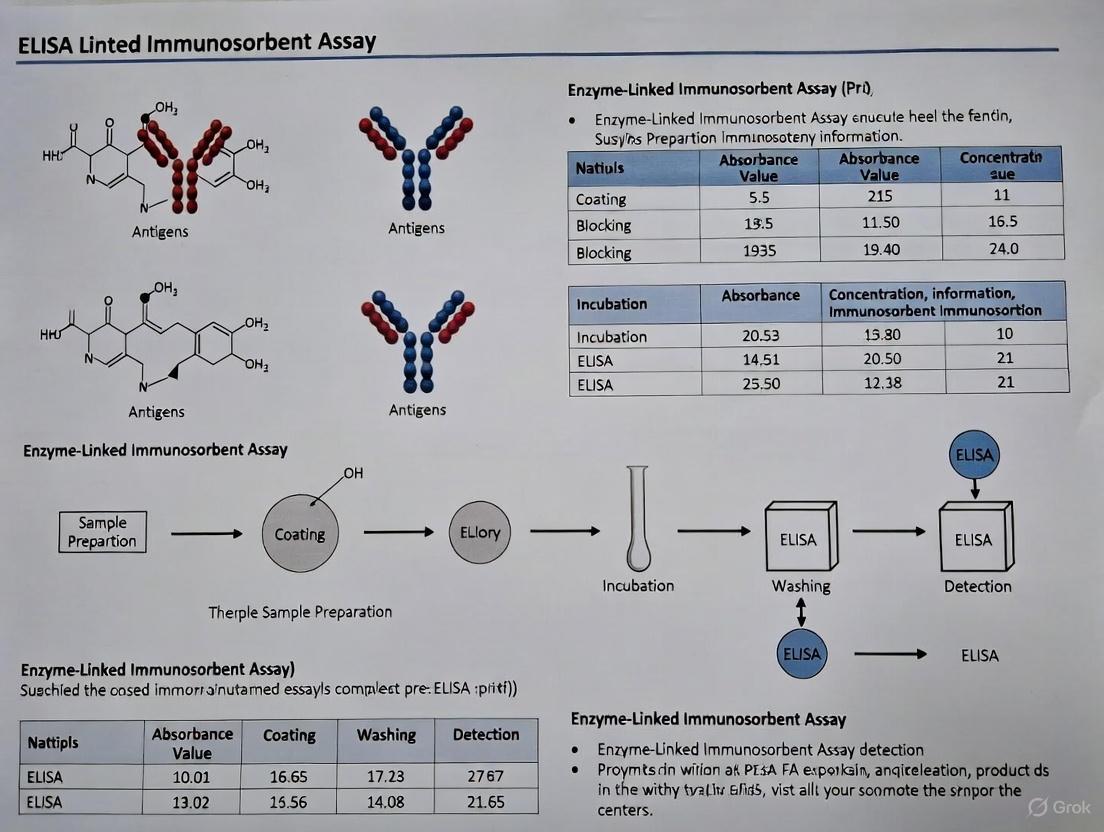
This article provides a complete guide to Enzyme-Linked Immunosorbent Assay (ELISA) for researchers, scientists, and drug development professionals.
ELISA Protocols: A Comprehensive Guide from Setup to Validation for Biomedical Research
Abstract
This article provides a complete guide to Enzyme-Linked Immunosorbent Assay (ELISA) for researchers, scientists, and drug development professionals. It covers foundational principles and major ELISA types, detailed step-by-step protocols for direct, indirect, sandwich, and competitive formats, and their applications in drug discovery and diagnostics. The guide also offers systematic troubleshooting for common issues like high background and weak signal, optimization strategies for reagents and buffers, and a rigorous framework for assay validation including precision, accuracy, and regulatory compliance. By integrating foundational knowledge with advanced methodological and validation insights, this resource supports the development of robust, reliable immunoassays for clinical and research applications.
Understanding ELISA: Core Principles, Types, and Key Components
The Enzyme-Linked Immunosorbent Assay (ELISA) is a foundational technique in biochemical research and clinical diagnostics, leveraging the specificity of antigen-antibody interactions to detect and quantify soluble substances such as peptides, proteins, antibodies, and hormones [1] [2]. First described by Engvall and Perlmann in 1971, ELISA replaced radioimmunoassays by conjugating antigens and antibodies with enzymes instead of radioactive iodine 125, offering a safer and highly versatile platform [3] [2] [4]. The assay is performed in a microplate format, typically using 96- or 384-well polystyrene plates that passively bind proteins and antibodies, facilitating the separation of bound and unbound materials through simple washing steps [1].
The fundamental principle of ELISA relies on the immobilization of an antigen (or antibody) to a solid surface, followed by its detection using a specific antibody conjugated to a reporter enzyme [4]. The most crucial element is the highly specific antibody-antigen interaction, which ensures the assay's selectivity [1]. Detection is accomplished by measuring the activity of the reporter enzyme after incubation with a substrate, which generates a measurable product such as a color change [1] [2]. The intensity of this signal is proportional to the amount of analyte present in the sample [2].
The Biochemical Interaction: Antigen and Antibody
At the heart of every ELISA is the specific, non-covalent, and reversible biochemical interaction between an antigen and its corresponding antibody. An antigen is a substance (typically a protein, peptide, or polysaccharide) that can be recognized and bound by an antibody. The specific region on the antigen that the antibody recognizes is called an epitope [1]. Antibodies, or immunoglobulins, are Y-shaped proteins produced by the immune system, with the tips of the "Y" (the variable regions) forming a unique binding pocket for a specific epitope.
This interaction is driven by multiple weak forces, including hydrogen bonding, electrostatic interactions, Van der Waals forces, and hydrophobic effects. The cumulative effect of these forces results in a high-affinity binding that is both specific and strong, allowing the assay to distinguish the target analyte from other components in a complex mixture, such as serum or cell lysates [1]. In the context of ELISA, this interaction is harnessed and stabilized by immobilizing one component on a solid phase, enabling the thorough washing away of non-specifically bound materials to ensure a low background and high signal-to-noise ratio.
Common ELISA Formats and Methodologies
The core principle of antigen-antibody interaction is applied in different ELISA formats, each tailored for specific experimental needs. The major types are direct, indirect, sandwich, and competitive ELISA [2] [4].
Table 1: Comparison of Major ELISA Formats
| Format | Principle | Key Steps | Advantages | Disadvantages |
|---|---|---|---|---|
| Direct ELISA | A labeled primary antibody detects immobilized antigen [2]. | 1. Antigen coating2. Blocking3. Incubation with enzyme-conjugated primary antibody4. Signal detection [2]. | Rapid; minimizes cross-reactivity from secondary antibodies [1]. | Lower sensitivity; expensive due to labeling every primary antibody [1] [2]. |
| Indirect ELISA | An unlabeled primary antibody is detected by a labeled secondary antibody [2]. | 1. Antigen coating2. Blocking3. Incubation with primary antibody4. Incubation with enzyme-conjugated secondary antibody5. Signal detection [3]. | High sensitivity due to signal amplification; flexible and cost-effective [1] [2]. | Potential for cross-reactivity with secondary antibody [1]. |
| Sandwich ELISA | The antigen is "sandwiched" between a capture antibody and a detection antibody [1] [2]. | 1. Capture antibody coating2. Blocking3. Sample (antigen) addition4. Incubation with detection antibody (direct or indirect)5. Signal detection [1] [2]. | Highest sensitivity and specificity; ideal for complex samples [1]. | Requires two antibodies recognizing different epitopes; more optimization needed [1]. |
| Competitive ELISA | Sample antigen and labeled reference antigen compete for binding to a limited number of antibody sites [1]. | 1. Antibody coating2. Simultaneous/additive incubation of sample and labeled antigen3. Signal detection [1] [2]. | Best for small antigens; less sample purification needed [1] [2]. | Lower specificity; signal decreases with increasing analyte [2]. |
The following workflow diagram illustrates the key steps and decision points for performing a sandwich ELISA, the most widely used format:
Essential Reagents and Materials
A successful ELISA requires a suite of optimized reagents and proper laboratory equipment. The key components are summarized in the table below.
Table 2: The Scientist's Toolkit: Essential Research Reagent Solutions for ELISA
| Reagent / Material | Function | Common Examples & Notes |
|---|---|---|
| Solid Phase | Provides a surface for immobilizing the capture molecule [3]. | 96- or 384-well polystyrene microplates; must have high protein-binding capacity and low well-to-well variation (CV <5%) [1]. |
| Coating Reagent | The first molecule immobilized to capture the target; can be an antigen or antibody [1]. | Diluted in an alkaline coating buffer (e.g., carbonate-bicarbonate buffer, pH 9.4) to facilitate passive adsorption via hydrophobic interactions [1]. |
| Blocking Buffer | Covers any remaining unsaturated binding sites on the plate surface to prevent nonspecific binding of other proteins later in the assay [1] [2]. | Solutions of irrelevant proteins like Bovine Serum Albumin (BSA), casein, or ovalbumin [2]. |
| Antibodies | Provide specificity for capturing and detecting the analyte. | Capture Antibody: Binds and immobilizes the antigen.Detection Antibody: Binds to the captured antigen; can be conjugated (direct) or detected via a secondary antibody (indirect) [1]. |
| Enzyme Conjugate | The reporter molecule linked to an antibody; catalyzes the conversion of a substrate into a detectable signal [1] [3]. | Horseradish Peroxidase (HRP) or Alkaline Phosphatase (AP) are most common [1] [2]. |
| Substrate | The compound acted upon by the enzyme conjugate to generate a measurable signal [3]. | Colorimetric: TMB (turns yellow), pNPP (turns yellow). Chemiluminescent: Luminol-based (emits light). Choice depends on desired sensitivity and available readers [1] [2]. |
| Wash Buffer | Removes unbound reagents and proteins between steps to reduce background signal [2]. | Phosphate-Buffered Saline (PBS) or Tris-buffered saline, often with a non-ionic detergent like Tween-20 [3] [2]. |
| Stop Solution | An acidic or basic solution that halts the enzyme-substrate reaction at a defined timepoint [3]. | e.g., 1M H₂SO₄ for HRP/TMB reaction, which also changes the color to a stable endpoint [3]. |
Data Analysis and Interpretation
Accurate data analysis is critical for reliable quantification. Quantitative ELISA requires comparison with a standard curve generated from serial dilutions of a known concentration of the purified antigen [5].
- Standard Curve: The optical density (OD) of the standards is plotted against their concentration. The curve is typically non-linear, and fitting with a 4- or 5-parameter logistic (4PL or 5PL) model is recommended for the best fit, especially for immunoassays [5]. For competitive ELISA, the standard curve is inverted, with the highest concentration corresponding to the lowest OD [5].
- Calculating Concentration: The mean absorbance of the unknown sample is located on the y-axis of the standard curve, and a vertical line is drawn down to the x-axis to determine the concentration [5]. Samples with OD values outside the standard curve range must be diluted and re-assayed.
- Assay Validation: To ensure accuracy, samples should be run in duplicate or triplicate, with duplicates ideally within 20% of the mean. The Coefficient of Variation (CV) should be calculated, and spike/recovery experiments are recommended to check for matrix interference [5].
The following diagram illustrates the logical flow of data analysis in a quantitative ELISA:
Applications in Research and Drug Development
The versatility, sensitivity, and robustness of ELISA make it indispensable across numerous fields. Its primary applications include:
- Diagnostic Testing: Detecting and measuring antibodies (e.g., against HIV, Hepatitis, SARS-CoV-2) and autoantibodies (e.g., ANA, anti-dsDNA) in patient serum [2].
- Biomarker Quantification: Measuring levels of tumor markers (e.g., PSA, CEA), hormones (e.g., hCG, LH, testosterone), and cytokines in biological fluids for disease diagnosis, prognosis, and monitoring [3] [2].
- Drug Development and Pharmacodynamics: Used in pre-clinical and clinical studies to measure biomarkers of drug efficacy, pharmacokinetics (e.g., anti-drug antibodies), and target engagement [6].
- Quality Control: Ensuring the safety of donated blood by screening for viral contaminants and monitoring the quality and consistency of biopharmaceutical products [2] [4].
The enzyme-linked immunosorbent assay remains a cornerstone technology in life sciences, built upon the fundamental and powerful biochemical interaction between an antigen and an antibody. Its various formats provide flexible solutions for a wide range of quantitative and qualitative analytical challenges. A deep understanding of the underlying principles, combined with meticulous optimization of protocols and rigorous data analysis, is essential for researchers and drug development professionals to harness the full potential of ELISA in generating accurate, reliable, and meaningful data.
Within the framework of a broader thesis on enzyme-linked immunosorbent assay (ELISA) protocol research, this analysis provides a detailed comparison of the four principal ELISA formats. The ELISA technique, first developed in 1971 as a safer alternative to radioimmunoassay (RIA), has become a cornerstone method in research and diagnostic laboratories for detecting and quantifying specific proteins, antibodies, and other molecules [2] [7]. The core principle of all ELISA formats involves the specific binding of an antibody to its target antigen, with one component immobilized on a solid surface, typically a 96-well polystyrene plate [2] [3]. Detection is achieved via enzyme-conjugated antibodies that catalyze a colorimetric, chemiluminescent, or fluorescent reaction, the intensity of which is proportional to the amount of analyte present [3] [8]. The selection of an appropriate ELISA format—direct, indirect, sandwich, or competitive—is critical and depends on factors such as the nature of the analyte, the required assay sensitivity and specificity, the available reagents, and the experimental timeframe [9] [8]. This article provides application notes and detailed protocols to guide researchers, scientists, and drug development professionals in selecting, optimizing, and executing these fundamental immunological assays.
The four major ELISA formats each possess a unique mechanism for antigen capture and detection, leading to distinct performance characteristics and ideal application scenarios. Direct ELISA is characterized by the use of a single enzyme-conjugated primary antibody that binds directly to the immobilized antigen [9] [10]. Indirect ELISA employs an unlabeled primary antibody, which is then detected by an enzyme-conjugated secondary antibody raised against the host species of the primary antibody [2] [7]. Sandwich ELISA, the most common format for quantifying specific antigens in complex mixtures, uses two specific antibodies that bind to different epitopes on the target antigen, effectively "sandwiching" it [9] [8]. Competitive ELISA, also known as inhibition ELISA, operates on the principle of competition, where the analyte in the sample competes with a reference substance for binding to a limited number of antibody sites, resulting in a signal that is inversely proportional to the analyte concentration [9] [7].
The following workflow diagram illustrates the fundamental steps and logical relationships shared across the different ELISA formats, from immobilization to final quantification.
Table 1: Core Procedural Steps in ELISA Protocols. This workflow outlines the common sequence of operations in most ELISA formats, though the specific components used in each step (e.g., antigen vs. antibody for immobilization) vary by type [2] [3].
Comparative Advantages, Disadvantages, and Applications
A thorough understanding of the strengths and limitations of each format is essential for making an informed selection. The table below provides a consolidated summary of the key characteristics of each ELISA type.
Table 2: Comparative Analysis of Major ELISA Formats
| ELISA Format | Key Advantages | Key Disadvantages | Ideal Applications |
|---|---|---|---|
| Direct ELISA [9] [8] | - Fast and simple protocol (fewer steps)- No cross-reactivity from secondary antibodies- Lower background noise | - Lower sensitivity- Limited to antigens that bind directly- Potential for high background with complex samples- Requires conjugated primary antibody for every target | - Rapid antigen screening- Assessing antibody affinity and specificity- Immune response analysis |
| Indirect ELISA [9] [7] | - Higher sensitivity (signal amplification)- Flexible (one labeled secondary can be used for many primaries)- Cost-effective | - More complex protocol (extra step)- Risk of cross-reactivity from secondary antibody- Longer procedure time | - Antibody detection and quantification (e.g., in serum)- Determining antibody titers (e.g., vaccine studies)- High-throughput serological surveys |
| Sandwich ELISA [9] [8] | - High sensitivity and specificity- Suitable for complex samples (e.g., serum, tissue lysates)- Low background and high precision | - Requires two specific antibodies against different epitopes- Technically demanding and longer protocol- Can be costly to develop | - Quantifying specific antigens in complex mixtures- Biomarker detection in disease diagnostics (e.g., cytokines, tumor markers)- Protein expression monitoring |
| Competitive ELISA [9] [10] | - Ability to quantify small molecules/haptens- Less susceptible to sample matrix effects- Requires only one specific antibody | - Lower sensitivity than sandwich or indirect ELISA- Inverse data interpretation can be complex- Requires careful optimization of competition conditions | - Detecting small molecules (drugs, hormones, contaminants)- Measuring haptens and inhibitors- Assessing antibody neutralization |
Detailed Methodologies and Protocols
Direct ELISA Protocol
The direct ELISA is the most straightforward format, ideal for quick assessments when a conjugated primary antibody is available [8].
Detailed Protocol:
- Coating: Dilute the antigen to a concentration of 1–10 µg/mL in a coating buffer (e.g., carbonate-bicarbonate buffer, pH 9.6). Add 50–100 µL of this solution to each well of a 96-well microtiter plate. Seal the plate and incubate overnight at 4°C or for 1–2 hours at 37°C [2] [3].
- Washing: Discard the coating solution. Wash the plate 2–3 times with a wash buffer, such as phosphate-buffered saline (PBS) containing 0.05% Tween-20 (PBS-T). To wash, fill the wells completely with wash buffer, then discard the content by flicking the plate over a sink. Blot the plate on absorbent paper to remove residual liquid [2] [3].
- Blocking: Add 200–300 µL of a blocking buffer (e.g., 1–5% Bovine Serum Albumin (BSA) or 5% non-fat dry milk in PBS) to each well to cover all potential protein-binding sites. Incubate for 1–2 hours at room temperature or 37°C [2].
- Washing: Repeat the washing step as described in Step 2.
- Detection Antibody Incubation: Add 50–100 µL of the enzyme-conjugated primary detection antibody, diluted in blocking buffer, to each well. Incubate for 1–2 hours at room temperature [9] [8].
- Washing: Repeat the washing step 3–4 times to ensure all unbound antibody is removed.
- Substrate Addition: Prepare the enzyme substrate according to the manufacturer's instructions. Common enzymes are Horseradish Peroxidase (HRP), for which TMB (3,3',5,5'-Tetramethylbenzidine) is a common substrate, or Alkaline Phosphatase (AP), which uses pNPP (p-Nitrophenyl Phosphate) [2] [3]. Add 50–100 µL of the substrate solution to each well and incubate in the dark for 15–30 minutes at room temperature to allow color development.
- Stop Solution: To terminate the enzymatic reaction, add 50 µL of a stop solution (e.g., 1M H₂SO₄ for TMB, changing the color from blue to yellow; or 3M NaOH for pNPP) [3].
- Reading: Measure the absorbance of each well within 30 minutes using a microplate reader at the appropriate wavelength (e.g., 450 nm for TMB, 405 nm for pNPP) [3].
Indirect ELISA Protocol
The indirect ELISA introduces a secondary antibody for detection, providing greater sensitivity and flexibility [7].
Detailed Protocol:
- Coating and Washing: Identical to Steps 1 and 2 of the Direct ELISA protocol. Coat the plate with the antigen of interest.
- Blocking and Washing: Identical to Steps 3 and 4 of the Direct ELISA protocol.
- Primary Antibody Incubation: Add 50–100 µL of the unlabeled, antigen-specific primary antibody (e.g., patient serum if detecting antibodies) diluted in blocking buffer to each well. Incubate for 1–2 hours at room temperature or 37°C [2] [7].
- Washing: Wash the plate 3–4 times as before to remove unbound primary antibody.
- Secondary Antibody Incubation: Add 50–100 µL of an enzyme-conjugated secondary antibody (e.g., Goat Anti-Human IgG-HRP if the primary is from a human sample) diluted in blocking buffer. Incubate for 1–2 hours at room temperature [2] [10].
- Washing, Substrate, Stop, and Reading: Identical to Steps 6–9 of the Direct ELISA protocol. The signal is amplified because multiple secondary antibodies can bind to a single primary antibody.
Sandwich ELISA Protocol
The sandwich ELISA offers superior specificity and is the format of choice for quantifying antigens in complex biological samples [8] [7].
Detailed Protocol:
- Coating: Dilute the capture antibody to 2–10 µg/mL in coating buffer. Add 50–100 µL per well and incubate overnight at 4°C. Note: The capture antibody must be specific to a different epitope on the antigen than the detection antibody [2] [8].
- Washing and Blocking: Identical to Steps 2–4 of the Direct ELISA protocol.
- Sample and Standard Incubation: Add 50–100 µL of the sample or a serial dilution of the antigen standard (prepared in blocking buffer or a sample matrix) to each well. Incubate for 90 minutes at 37°C or 2 hours at room temperature to allow the antigen to be captured [2] [11].
- Washing: Wash the plate 3–5 times thoroughly to remove all unbound material from the sample.
- Detection Antibody Incubation: Add 50–100 µL of the biotinylated or enzyme-conjugated detection antibody, diluted in blocking buffer, to each well. Incubate for 1–2 hours at room temperature [2] [8].
- Washing: Wash the plate 3–5 times.
- (Optional) Signal Amplification: If using a biotinylated detection antibody, add 50–100 µL of enzyme-conjugated streptavidin (e.g., Streptavidin-HRP) diluted in blocking buffer. Incubate for 30–60 minutes at room temperature. This step significantly amplifies the signal [8] [10].
- Washing: Perform a final 3–5 washes.
- Substrate, Stop, and Reading: Identical to Steps 7–9 of the Direct ELISA protocol. Generate a standard curve from the serial dilutions to interpolate the exact concentration of the antigen in the samples [9].
Competitive ELISA Protocol
The competitive ELISA is particularly useful for measuring small molecules that cannot be bound by two antibodies simultaneously [9] [10].
Detailed Protocol (One Common Format):
- Coating: Coat the plate with a known amount of purified antigen (not the sample antigen). Alternatively, the plate can be coated with a specific capture antibody. Follow the coating, washing, and blocking steps from the Direct or Sandwich ELISA protocols [9].
- Competition Incubation: In a separate tube, pre-mix a constant, known amount of the enzyme-conjugated antibody with a series of dilutions of the sample containing the unknown antigen. Incubate this mixture for 1–2 hours at 37°C. During this step, the antigen in the sample and the enzyme-conjugated antigen (if using that format) compete for the limited binding sites on the labeled antibody [9] [7].
- Transfer and Incubation: Transfer the pre-mixed solutions to the coated and blocked plate. Incubate for a further 30–60 minutes. The amount of labeled antibody that can subsequently bind to the immobilized antigen on the plate is inversely proportional to the amount of antigen present in the sample.
- Washing: Wash the plate thoroughly to remove all unbound components, including the sample antigen-antibody complexes.
- Substrate, Stop, and Reading: Identical to Steps 7–9 of the Direct ELISA protocol. A weaker signal indicates a higher concentration of the target analyte in the sample [9].
The following diagram visualizes the distinct antigen-antibody interactions and key procedural differences between the four major ELISA formats.
Table 3: Core Mechanisms of Major ELISA Formats. This diagram summarizes the fundamental immunological principles that differentiate each ELISA type, which dictates their specific applications and performance [9] [8] [7].
Applications in Research and Drug Development
Specialized Application Notes
The choice of ELISA format is driven by the specific analytical question. The following examples from recent literature illustrate their application in diverse fields.
Sandwich ELISA for Food Allergen Detection: To protect consumers, detecting trace amounts of undeclared food allergens is critical. A research group developed a sensitive and specific sandwich ELISA for detecting pistachio residues in processed foods. They used pooled sheep antisera as the capture reagent and pooled rabbit antisera as the detector reagent. The assay demonstrated a limit of quantification (LOQ) of less than 1 part per million (ppm) and was successfully used to recover pistachio from spiked model foods like vanilla ice cream and sugar cookies, showcasing its utility for food safety compliance [11].
Indirect ELISA for Cancer Biomarker Quantification: In cancer research, accurately measuring tumor suppressor proteins is essential. A 2023 study developed an indirect ELISA to quantify ARID1A, a protein frequently mutated in gynecologic cancers, in tissue lysates. The researchers coated the plate with cell or tissue lysates and used a specific primary antibody followed by an enzyme-conjugated secondary antibody. The assay was rigorously validated according to EMA and FDA guidelines, achieving a standard curve with an R² = 0.99 and excellent inter-assay precision, providing a more objective and quantitative alternative to semi-quantitative immunohistochemistry [12].
Sandwich ELISA for Immunological Biomarker Validation: In the study of innate immunity, a highly sensitive and specific sandwich ELISA was established for quantifying Collectin 11 (CL-11) in human serum. The assay was based on two different monoclonal antibodies, providing high specificity. It exhibited excellent reproducibility, dilution linearity, and recovery (97.7–104%), with a working range of 0.15–34 ng/ml. This reliable method facilitates the study of CL-11 levels in various human diseases and syndromes [13].
Competitive ELISA for Pharmacokinetics (PK) and Inhibitor Screening: In drug development, competitive ELISAs are invaluable for quantifying small molecules. They are used in inhibitor screening to identify candidate molecules with pharmacological effects during early-stage drug discovery [14]. Furthermore, competitive ELISA formats have been developed to measure the concentration of biologic drugs (like monoclonal antibodies) in serum samples for pharmacokinetic (PK) studies, offering advantages over traditional methods by avoiding background interference [14].
The Scientist's Toolkit: Essential Reagents and Materials
Successful execution of any ELISA protocol relies on high-quality, well-validated reagents and proper laboratory equipment. The following table details the essential components of an ELISA toolkit.
Table 4: Essential Research Reagent Solutions for ELISA
| Item | Function and Importance |
|---|---|
| Microtiter Plates [2] [12] | 96-well polystyrene plates with high protein-binding capacity (e.g., NUNC MaxiSorp) are standard. The hydrophobicity/hydrophilicity of the plate should be considered based on the analyte. |
| Coating Antibodies/Antigens [8] | High-affinity, specific monoclonal or polyclonal antibodies (for sandwich/competitive) or purified antigens (for direct/indirect) are required for the initial immobilization step. |
| Detection Antibodies [8] [7] | For sandwich ELISA, a matched antibody pair (capture and detection) recognizing different epitopes is critical. Antibodies are typically conjugated to enzymes like HRP or AP, or to biotin for amplification. |
| Blocking Buffers [2] | Solutions containing irrelevant proteins (e.g., 1-5% BSA, non-fat dry milk, or animal sera) are used to block unbound sites on the plate to prevent nonspecific binding and reduce background noise. |
| Wash Buffers [2] [3] | Typically PBS or Tris-based buffers with a mild detergent (e.g., 0.05% Tween-20) to facilitate the removal of unbound reagents and reduce non-specific signal. |
| Enzyme Substrates [2] [3] | Chromogenic (e.g., TMB for HRP, pNPP for AP), chemiluminescent, or fluorescent substrates are converted by the enzyme into a measurable signal. TMB is common, producing a blue color that turns yellow when stopped with acid. |
| Spectrophotometric Plate Reader [3] | An essential instrument for measuring the absorbance, fluorescence, or luminescence of the wells in the plate, allowing for the quantification of the assay results. |
In conclusion, the selection and proficient execution of an ELISA format are foundational to success in both basic research and applied drug development. By understanding the comparative strengths of each format, adhering to detailed protocols, and utilizing a well-characterized toolkit of reagents, scientists can leverage the full power of ELISA to generate precise, reliable, and meaningful quantitative data.
The Enzyme-Linked Immunosorbent Assay (ELISA) is a foundational technique in biomedical research and clinical diagnostics, leveraging the specificity of antigen-antibody interactions and enzymatic signal generation for the detection and quantification of target analytes. The performance of an ELISA hinges on the precise interplay of specialized reagents, consumables, and instrumentation. A thorough understanding of these core components—from the coated plates that serve as the solid phase to the specialized buffers that optimize interactions and the readers that quantify results—is critical for developing robust, sensitive, and reproducible assays. This document details the essential materials and methodologies required to execute reliable ELISA protocols, framed within the context of advanced immunoassay research and development.
Essential Reagents and Materials
The following section catalogs the fundamental reagents and materials that constitute the "research reagent solutions" for a typical ELISA workflow. Each component plays a specific role in ensuring the assay's specificity, sensitivity, and overall performance.
Table 1: Essential Reagents and Materials for ELISA
| Component | Function | Key Types & Examples |
|---|---|---|
| Solid Phase (Microplate) [15] | Provides a surface for immobilizing the capture antibody or antigen. | 96-well polystyrene plates; High-binding, medium-binding, or non-binding surface treatments. |
| Coating Antibody/Antigen [16] | The biomolecule immobilized on the plate to specifically capture the target analyte. | Purified capture antibody (for sandwich ELISA) or specific antigen (for indirect/competitive ELISA). |
| Blocking Buffer [17] | Binds to any unsaturated surface-binding sites on the coated plate to prevent non-specific binding of other proteins. | Bovine Serum Albumin (BSA) [16], casein, or proprietary commercial blockers [17]. |
| Detection Antibody [7] | Binds specifically to the captured analyte. Often conjugated to an enzyme for detection. | Monoclonal or polyclonal antibody; Can be direct (enzyme-conjugated) or indirect (recognized by a secondary antibody). |
| Enzyme Conjugate [3] [7] | Enzyme linked to the detection system catalyzes the conversion of a substrate into a measurable signal. | Horseradish Peroxidase (HRP) or Alkaline Phosphatase (AP). |
| Substrate [16] [17] | The chromogenic, chemiluminescent, or fluorescent compound acted upon by the enzyme conjugate to generate a signal. | TMB (colorimetric for HRP), pNPP (colorimetric for AP), or luminol-based (chemiluminescent for HRP). |
| Stop Solution [3] [16] | An acidic or basic solution that halts the enzyme-substrate reaction at a defined timepoint. | 0.16M Sulfuric Acid (for TMB), 1M Sodium Hydroxide (for pNPP). |
| Wash Buffer [3] [17] | Removes unbound reagents and proteins from the microplate wells between incubation steps, reducing background. | Phosphate-Buffered Saline (PBS) or Tris-Buffered Saline (TBS), often with a detergent like Tween-20. |
| Assay Diluent [17] | A matrix used to dilute samples and standards to an appropriate concentration while minimizing matrix effects. | Protein-based or protein-free commercial diluents designed to reduce non-specific interference. |
Critical Equipment and Instrumentation
The accurate execution and measurement of an ELISA require specific instruments that ensure precise liquid handling, controlled incubation, and sensitive signal detection.
Table 2: Essential Equipment for ELISA
| Equipment | Primary Function | Key Specifications |
|---|---|---|
| Microplate Reader [3] | Measures the signal generated in each well of the microplate. | Absorbance (for colorimetric), luminescence, or fluorescence detectors; Compatible with 96-well or 384-well formats. |
| Microplate Washer [16] | Automates the washing steps, ensuring thorough and consistent removal of unbound material from all wells. | Programmable wash cycles, adjustable aspiration and dispense volumes. |
| Pipettes & Tips | Enables accurate and precise transfer and aliquoting of reagents and samples. | Single-channel and multi-channel pipettes covering a range of volumes (e.g., 1µL to 1mL). |
| Incubator | Maintains a constant temperature during assay incubation steps, which is critical for consistent binding kinetics. | Capable of maintaining 37°C ± 0.5°C; some assays require room temperature or other set points. |
| Analytical Software | Analyzes the raw data from the plate reader, generates standard curves, and calculates analyte concentrations in samples. | Software provided with the plate reader or third-party data analysis packages. |
Detailed ELISA Protocols
This section provides step-by-step methodologies for the most common types of ELISA, highlighting the role of each essential reagent and critical control points.
Sandwich ELISA Protocol
The sandwich ELISA is renowned for its high specificity and sensitivity, making it ideal for detecting complex antigens in crude samples [7]. It requires two antibodies that bind to distinct epitopes on the target antigen.
Procedure:
- Coating: Dilute the capture antibody in a suitable coating buffer (e.g., 0.2M carbonate/bicarbonate, pH 9.6). Dispense 100 µL per well into a high-binding 96-well microplate. Seal the plate and incubate overnight at 4°C [16].
- Washing: Aspirate the coating solution and wash the plate three times with ~300 µL of wash buffer (e.g., PBS with 0.05% Tween-20) per well. Blot the plate firmly on clean paper towels to remove residual liquid [7] [16].
- Blocking: Add 200-300 µL of blocking buffer (e.g., 5% BSA or a commercial protein blocker) to each well. Incubate for 1-2 hours at room temperature. Wash the plate three times as before [16] [17].
- Sample & Standard Incubation: Prepare serial dilutions of the standard in the same matrix as the sample. Add 100 µL of standards, samples, and appropriate controls (e.g., blank) to designated wells. Incubate for 2 hours at room temperature or 37°C. Wash the plate three times [3].
- Detection Antibody Incubation: Add 100 µL of the detection antibody (conjugated to HRP or AP) diluted in assay diluent to each well. Incubate for 1-2 hours at room temperature. Wash the plate three times [7].
- Substrate Addition: Add 100 µL of substrate solution (e.g., TMB for HRP) to each well. Incubate in the dark for 15-30 minutes to allow color development [16].
- Stop the Reaction: Add 50-100 µL of stop solution (e.g., 0.16M sulfuric acid for TMB) to each well. The color will change from blue to yellow if TMB is used.
- Reading & Analysis: Measure the absorbance of each well within 30 minutes using a microplate reader set to the appropriate wavelength (e.g., 450 nm for TMB). Generate a standard curve by plotting the absorbance against the standard concentration and use it to interpolate the concentration of the unknown samples [3].
Competitive ELISA Protocol
The competitive ELISA is typically used for detecting small molecules or antigens with a single epitope. The signal generated is inversely proportional to the amount of analyte in the sample [3] [7].
Procedure:
- Coating: Coat wells with a known amount of the purified antigen (or an antibody, depending on the format) as described in step 4.1.1.
- Blocking: Block the plate as described in step 4.1.3.
- Competitive Reaction: Pre-mix a constant amount of enzyme-conjugated antigen (or antibody) with serially diluted standards or samples. The analyte in the sample competes with the labeled antigen for a limited number of antibody binding sites.
- Incubation: Transfer the mixture to the antigen-coated plate and incubate. The less analyte present in the sample, the more conjugated antigen will bind to the plate.
- Washing: Wash the plate thoroughly to remove any unbound conjugate.
- Substrate, Stop, and Read: Add substrate, stop solution, and read the plate as described in steps 4.1.6 to 4.1.8. A lower signal indicates a higher concentration of analyte in the sample.
Key Considerations for Protocol Optimization
- Antibody Validation: Antibodies must be specifically validated for use in ELISA to ensure high affinity and specificity for the target analyte [16].
- Matrix Effects: The sample matrix (e.g., serum, plasma) can interfere with the assay. Conduct spike-and-recovery experiments to evaluate and mitigate matrix effects [16].
- Controls: Always include appropriate controls: blank (assay diluent only), negative control (sample known to lack the analyte), and positive control (sample with a known concentration of analyte).
Advanced Reagent and Protocol Innovations
Recent advancements in nanotechnology and material science have led to significant improvements in ELISA performance, particularly in sensitivity and ease of use [18].
- Nanozymes: Nanomaterials with enzyme-like activities (e.g., peroxidase-like activity) are used as stable and cost-effective alternatives to natural enzymes like HRP, enhancing catalytic stability and sensitivity [18].
- Fluorescent and Chemiluminescent Substrates: The integration of highly sensitive fluorescent and chemiluminescent detection methods, often referred to as FELISA, offers a broader dynamic range and several-fold higher sensitivity compared to traditional colorimetric detection [16] [18].
- Signal Amplification Systems: Systems like the biotin-streptavidin interaction, which has a high binding affinity, allow for significant signal amplification by enabling multiple enzyme molecules to bind per detection antibody [7] [16].
Advantages and Inherent Limitations of ELISA in Research and Diagnostics
The Enzyme-Linked Immunosorbent Assay (ELISA) stands as a cornerstone technique in immunology and diagnostics, renowned for its ability to detect and quantify peptides, proteins, antibodies, and hormones with notable sensitivity and specificity [3] [19]. This assay detects antigen-antibody interactions using enzyme-labelled conjugates and substrates that generate a measurable color change, providing a versatile tool for both research and clinical applications [3]. The technique's evolution since the 1960s has solidified its position as an indispensable method in laboratories worldwide [3]. Despite the emergence of sophisticated technologies like Liquid Chromatography-Tandem Mass Spectrometry (LC-MS/MS), ELISA maintains widespread adoption due to its relative simplicity, cost-effectiveness, and high-throughput capabilities [20]. This application note examines the technical advantages and inherent limitations of ELISA within the context of modern research and diagnostic paradigms, providing detailed protocols and analytical frameworks for practitioners.
Core Principles and Types of ELISA
The fundamental principle of ELISA revolves around the specific binding between an antigen and its antibody, with the detection achieved via an enzyme-linked conjugate that produces a colorimetric signal upon reacting with a substrate [3]. The key components essential for any ELISA include: a solid phase (typically a 96-well microplate); a conjugate (enzyme-labelled antibodies); a substrate; wash buffers; and a stop solution to terminate the reaction [3]. The intensity of the final color, measured spectrophotometrically as optical density (OD), correlates with the concentration of the target analyte [3] [19].
Several ELISA formats have been developed to address different experimental needs, each with distinct mechanisms and applications:
Direct ELISA
In this format, a known antibody is coated onto the plate, followed by addition of the sample containing the suspected antigen. After binding and washing, an enzyme-linked antibody specific to the antigen is added, followed by substrate. This method is relatively simple but may offer lower sensitivity [3].
Indirect ELISA
Used primarily for antibody detection, this method coats the plate with a known antigen. The sample containing the primary antibody is added, followed by an enzyme-linked secondary antibody that recognizes the primary antibody. This amplification step enhances sensitivity but may increase non-specific binding [3].
Sandwich ELISA
The most sensitive format for antigens, Sandwich ELISA employs a capture antibody coated onto the plate that binds the target antigen. A second, enzyme-linked detection antibody then binds to the captured antigen, creating a "sandwich." This format is particularly useful for complex samples but requires two distinct antibodies recognizing different epitopes [19].
Competitive ELISA
Commonly used for small molecules, this format operates on the principle of competition between the patient's antigen and a labeled antigen for binding to limited antibody sites. Higher analyte concentration in the sample results in less binding of the labeled antigen and consequently a weaker signal [3] [19]. This format is especially valuable for detecting small molecules or when only one specific antibody is available.
Table 1: Comparison of Major ELISA Formats
| Format | Principle | Sensitivity | Applications | Advantages | Disadvantages |
|---|---|---|---|---|---|
| Direct | Antigen is detected by enzyme-labeled primary antibody | Moderate | Antigen detection | Simple, rapid, minimal cross-reactivity | Lower sensitivity, primary antibody must be labeled |
| Indirect | Antigen is detected by primary antibody followed by enzyme-labeled secondary antibody | High | Antibody detection, serology | Signal amplification, flexible, same secondary antibody can be used for multiple primaries | Potential for cross-reactivity, longer procedure |
| Sandwich | Antigen captured between two antibodies | Very High | Cytokine measurement, protein quantification | High specificity and sensitivity, suitable for complex samples | Requires two matched antibodies recognizing different epitopes |
| Competitive | Sample antigen competes with labeled antigen for antibody binding sites | Variable (depends on target) | Small molecules, haptens, drugs | Robust, less affected by sample matrix, ideal for small antigens | Inverse relationship between signal and concentration |
Advantages of ELISA
Technical and Operational Advantages
ELISA offers numerous technical benefits that sustain its popularity across diverse laboratory settings:
High Throughput Capability: The 96-well microplate format enables simultaneous processing of numerous samples, making ELISA ideal for large-scale screening studies, epidemiological surveillance, and clinical diagnostics [3] [21]. Automated plate washers and readers further enhance processing efficiency.
Excellent Sensitivity and Specificity: Modern ELISA kits can detect targets at picogram per milliliter concentrations, sufficient for most clinical and research applications [3]. The combination of highly specific antibody-antigen interactions and optimized blocking/washing steps minimizes cross-reactivity.
Quantitative Precision: When properly optimized with appropriate standard curves and replicates, ELISA provides highly reproducible quantitative data. The 4-parameter logistic (4PL) model typically offers the best fit for the sigmoidal standard curves generated in quantitative assays [19].
Simplicity and Accessibility: Compared to techniques like LC-MS/MS that require specialized instrumentation and expertise, ELISA utilizes standard laboratory equipment and can be established in most research or clinical settings with minimal infrastructure investment [20].
Economic and Practical Advantages
Cost-Effectiveness: ELISA represents a economically viable option for many laboratories, with lower per-test costs compared to advanced instrumental methods [20]. The availability of commercial kits from multiple suppliers (including Bio-Rad Laboratories, Fisher Scientific, and Thermo Fisher Scientific) ensures competitive pricing [22].
Proven Reliability and Established Protocols: Decades of refinement have yielded robust, validated protocols for countless analytes. The technique's long history means troubleshooting resources are widely available, and many applications have been standardized for regulatory compliance [3] [6].
Adaptability to Various Sample Matrices: ELISA has been successfully applied to diverse biological fluids including serum, plasma, urine, saliva, cerebrospinal fluid, and tissue culture supernatants [3]. Sample preparation is typically minimal, though matrix effects must be considered and addressed through appropriate controls.
Limitations and Challenges
Despite its numerous advantages, ELISA possesses inherent limitations that researchers must acknowledge and address experimentally:
Technical Limitations
Antibody Dependency and Specificity Issues: The performance of any ELISA fundamentally depends on the quality and specificity of the antibodies employed. Cross-reactivity with similar epitopes or related molecules can yield false-positive results [20]. This limitation is particularly relevant when analyzing samples from multiple species, as commercial kits validated for human applications may perform differently with animal specimens [21].
Matrix Effects: Components in complex biological samples can interfere with antibody-antigen binding or generate non-specific signals, potentially compromising accuracy [20]. This necessitates careful optimization of sample dilution and inclusion of appropriate matrix-matched controls.
Dynamic Range Constraints: The effective working range of standard ELISA is typically limited to 1.5-2 logs, potentially requiring sample dilution or concentration to bring unknown values within the quantifiable range [19]. This contrasts with LC-MS/MS, which often offers wider dynamic ranges [20].
Limited Multiplexing Capacity: Traditional ELISA measures a single analyte per well, restricting the amount of information obtainable from limited sample volumes. While multiplex platforms exist, they often require specialized instrumentation and remain less common than conventional formats.
Practical and Operational Challenges
Standardization Variability: Different commercial kits for the same analyte may yield disparate results due to variations in antibody pairs, standard preparations, or buffer compositions [21]. A 2025 comparative study of SARS-CoV-2 ELISA kits demonstrated significant performance differences, with diagnostic sensitivity varying between kits targeting different viral antigens [21].
Inability to Distinguish Isoforms and Modifications: Unlike mass spectrometry, ELISA generally cannot differentiate between various post-translationally modified forms of a protein or closely related molecular isoforms unless specifically designed to do so [20]. This limitation can obscure important biological nuances.
Sensitivity Ceiling: While sufficient for many applications, ELISA's sensitivity has inherent limits due to the enzymatic reaction kinetics and detection methodology. For trace-level analysis requiring detection beyond the femtogram range, more sensitive techniques like LC-MS/MS may be necessary [20].
Table 2: Comparative Analysis: ELISA vs. LC-MS/MS
| Feature | ELISA | LC-MS/MS |
|---|---|---|
| Principle | Antibody-antigen interaction | Separation and fragmentation by mass spectrometry |
| Complexity | Simple, single-step assay | Multistep, complex technique |
| Cost-effectiveness | Relatively inexpensive | More expensive |
| Sensitivity | Good for moderate concentrations (typically pg/mL) | Excellent for trace-level detection (often fg/mL) |
| Specificity | Can be affected by cross-reactivity | Highly specific |
| Throughput | High | Moderate |
| Multiplexing | Limited (usually single analyte) | Extensive (can measure hundreds simultaneously) |
| Ability to detect modifications | Limited unless specific antibodies are available | Excellent |
| Instrument requirements | Standard laboratory equipment | Specialized, costly instrumentation |
| Operator expertise | Moderate technical training required | Advanced technical expertise necessary |
| Sample preparation | Minimal to moderate | Extensive |
Detailed Protocol: Sandwich ELISA for Protein Quantification
The following protocol provides a standardized approach for sandwich ELISA, adaptable to various protein targets with appropriate antibody reagents.
Materials and Reagents
Table 3: Essential Research Reagent Solutions
| Reagent/Category | Specific Examples | Function/Purpose |
|---|---|---|
| Solid Phase | 96-well microplates (polystyrene, polyvinyl) | Platform for immobilizing capture antibody and subsequent reactions |
| Coating Antibody | Target-specific capture antibody | Binds and immobilizes the target antigen from the sample |
| Detection Antibody | Enzyme-conjugated target antibody | Binds captured antigen; enzyme generates detectable signal |
| Coating Buffer | Carbonate/bicarbonate buffer (pH 9.6) | Optimal pH for passive adsorption of antibodies to plastic surface |
| Wash Buffer | PBS with 0.05% Tween-20 | Removes unbound materials while maintaining protein stability |
| Blocking Buffer | PBS with 1-5% BSA or non-fat dry milk | Covers uncovered plastic surface to prevent non-specific binding |
| Standard | Recombinant protein of known concentration | Generates standard curve for quantitative interpolation |
| Substrate | TMB (3,3',5,5'-Tetramethylbenzidine) | Chromogenic enzyme substrate that produces measurable color change |
| Stop Solution | 1M H₂SO₄ or 1M HCl | Terminates enzyme-substrate reaction at defined timepoint |
| Instrumentation | Microplate reader, microplate washer, pipettes | Enables precise liquid handling, washing, and signal measurement |
Step-by-Step Procedure
Plate Coating:
- Dilute capture antibody in coating buffer to manufacturer's recommended concentration (typically 1-10 μg/mL).
- Add 100 μL per well to a 96-well microplate.
- Seal plate and incubate overnight at 4°C or for 2 hours at room temperature.
Washing and Blocking:
- Aspirate contents and wash plate 3 times with 300 μL wash buffer per well.
- Add 300 μL blocking buffer to each well.
- Incubate for 1-2 hours at room temperature with gentle shaking.
Standard and Sample Incubation:
- Prepare serial dilutions of the standard protein in appropriate matrix.
- Dilute test samples in the same matrix.
- Wash plate 3 times as before.
- Add 100 μL of standards, samples, and blanks to appropriate wells in duplicate or triplicate.
- Cover plate and incubate for 2 hours at room temperature or according to kit specifications.
Detection Antibody Incubation:
- Wash plate 3 times.
- Add 100 μL of appropriately diluted detection antibody to each well.
- Incubate for 1-2 hours at room temperature.
Signal Development:
- Wash plate 5 times to ensure complete removal of unbound detection antibody.
- Add 100 μL substrate solution to each well.
- Incubate in the dark for 15-30 minutes, monitoring color development.
Signal Measurement:
- Add 50 μL stop solution to each well.
- Read optical density at 450 nm within 30 minutes using a microplate reader.
- Subtract reference wavelength (570 nm or 630 nm) if applicable to correct for optical imperfections.
Data Analysis and Interpretation
Background Subtraction: Calculate mean OD of blank wells and subtract from all standard and sample readings.
Standard Curve Generation:
- Plot log of standard concentration versus corrected OD values.
- Apply appropriate curve fit (typically 4-parameter logistic for sandwich ELISA): Where A = minimum asymptote, B = slope factor, C = inflection point (EC50), D = maximum asymptote [19].
Sample Concentration Calculation:
- Interpolate sample concentrations from the standard curve.
- Multiply by any applicable dilution factors to obtain final concentration.
Quality Assessment:
- Calculate coefficient of variation (CV%) for replicates: CV% = (Standard Deviation ÷ Mean) × 100.
- Acceptable intra-assay CV is typically <10-15% [19].
- Verify standard curve fit with R² > 0.98.
Troubleshooting Common ELISA Issues
Even with optimized protocols, technical challenges may arise. The following table addresses common problems and their solutions:
Table 4: Troubleshooting Guide for Common ELISA Problems
| Problem | Potential Causes | Solutions |
|---|---|---|
| Low OD or No Signal | - Expired or degraded substrate- Inadequate incubation times- Improper reagent preparation- Over-washing | - Use fresh substrate aliquots- Validate incubation conditions- Calibrate pipettes and confirm concentrations- Optimize wash cycles |
| High Background | - Incomplete washing- Excessive detection antibody concentration- Inadequate blocking- Contaminated reagents | - Increase wash cycles and ensure thorough aspiration- Titrate detection antibody for optimal dilution- Extend blocking time or try alternative blocking agents- Prepare fresh reagents with purified water |
| High Variation Between Replicates | - Inconsistent pipetting- Plate edge effects- Inhomogeneous samples- Bubble formation in wells | - Calibrate pipettes and use reverse pipetting for viscous samples- Use plate sealers during incubations- Centrifuge samples before use and mix thoroughly- Tap plate gently to remove bubbles before reading |
| Poor Standard Curve Fit | - Improper standard serial dilution- Inadequate standard concentration range- Plate reader malfunction | - Prepare fresh standard dilutions with thorough mixing- Ensure standard points cover expected sample range- Validate plate reader performance with calibration plates |
| Non-linear Dilution of Samples | - Matrix interference- Target concentration outside dynamic range- Hook effect (very high antigen concentrations) | - Dilute samples in appropriate matrix- Test multiple sample dilutions to find linear range- If hook effect is suspected, test higher sample dilutions |
Recent Advances and Future Perspectives
The ELISA platform continues to evolve, with ongoing innovations addressing its traditional limitations. Automated ELISA systems from companies like Tecan, Hamilton Robotics, and Hudson Robotics are enhancing reproducibility and throughput while reducing manual errors [23]. Digital ELISA technologies are pushing sensitivity boundaries toward single-molecule detection, potentially bridging the sensitivity gap with LC-MS/MS for some applications [3].
The growing integration of ELISA with big data analytics represents another frontier, where large datasets generated from high-throughput ELISA screening are mined for biomarker discovery and systems biology applications. Furthermore, the development of multiplexed bead-based immunoassays extends the multiplexing capacity beyond traditional ELISA while maintaining the core antibody-antigen detection principle.
According to market analysis, the ELISA testing platform is projected to grow at a compound annual growth rate (CAGR) of 10.3% from 2025 to 2032, reflecting continued innovation and adoption in both diagnostic and research settings [23]. This growth is fueled by increasing demand for diagnostic testing, particularly for infectious diseases and chronic conditions, as well as ongoing technological advancements.
ELISA remains a powerful and versatile technique that strikes a balance between practicality, sensitivity, and throughput for numerous applications in research and diagnostics. Its advantages of accessibility, cost-effectiveness, and robust performance ensure its continued relevance, while its limitations regarding specificity, dynamic range, and multiplexing necessitate careful experimental design and interpretation. By understanding both the capabilities and constraints of this foundational technology, researchers and clinicians can make informed decisions about its appropriate implementation and complementarity with emerging analytical platforms. As the technique continues to evolve, ELISA will likely maintain its position as an essential tool in the biomedical sciences for the foreseeable future.
ELISA Type Selection Guide
ELISA Experimental Workflows
Executing Robust ELISA Protocols: Step-by-Step Guide and Real-World Applications
This application note provides a detailed protocol for the Enzyme-Linked Immunosorbent Assay (ELISA), a foundational technique in biomedical research and drug development. ELISA is a plate-based assay for the detection and quantification of peptides, proteins, antibodies, and hormones, leveraging the specific binding between an antigen and an antibody, with detection facilitated by an enzyme-linked conjugate [24] [25]. This document is framed within broader research on optimizing ELISA protocols for reproducibility and sensitivity, catering to the needs of researchers and scientists engaged in protein detection and quantification. The sandwich ELISA format, known for its high specificity and suitability for complex samples, will be the primary focus [24] [26].
Principle of the Assay
The ELISA technique is predicated on the immobilization of a target antigen to a solid surface (typically a polystyrene microplate) and its subsequent detection by an antibody linked to an enzyme. The conversion of a substrate by the enzyme into a measurable product, such as a colorimetric, fluorometric, or chemiluminescent signal, allows for the quantification of the analyte of interest [24] [25]. The sandwich ELISA, a common format, employs two antibodies that bind to distinct, non-overlapping epitopes on the target antigen. This "sandwiches" the antigen between a capture antibody immobilized on the plate and a detection antibody conjugated to an enzyme, enhancing specificity and reducing background [24] [26].
Materials and Reagents
Research Reagent Solutions
The following table catalogues the essential materials and reagents required to perform a standard sandwich ELISA.
Table 1: Essential Reagents and Materials for Sandwich ELISA
| Item | Function and Specification |
|---|---|
| Microplate | 96-well polystyrene plates are standard. Clear for colorimetry, black/clear-bottom for fluorescence, white for chemiluminescence [16]. |
| Capture Antibody | The first antibody, specific to the target antigen, is immobilized on the plate to facilitate capture [26]. |
| Detection Antibody | The second antibody, binding a different epitope on the antigen; often enzyme-conjugated (e.g., HRP or AP) [26]. |
| Coating Buffer | 0.2 M carbonate/bicarbonate buffer (pH 8.4-9.6) is common; must be protein-free to avoid competitive binding [16]. |
| Blocking Buffer | 3-5% BSA in PBS or 5% normal serum to cover any remaining protein-binding sites on the plate, minimizing non-specific binding [16] [26]. |
| Wash Buffer | PBS or Tris-buffered saline (TBS), often with 0.05% Tween 20, to remove unbound materials during wash steps [26]. |
| Sample/Diluent Buffer | Buffer used to dilute samples and standards, typically containing a protein base like BSA to stabilize proteins [26]. |
| Enzyme Substrate | Solution added for detection. TMB (3,3',5,5'-Tetramethylbenzidine) is a common colorimetric substrate for HRP [16]. |
| Stop Solution | Acid (e.g., 0.16M sulfuric acid for TMB) to terminate the enzyme-substrate reaction, stabilizing the signal for reading [16]. |
Experimental Protocol
Sample Preparation
Proper sample handling is critical for assay integrity. General guidelines for various sample types are summarized below. Always keep samples on ice or at 4°C and minimize freeze-thaw cycles [26].
Table 2: Sample Preparation Guidelines
| Sample Type | Preparation Protocol |
|---|---|
| Cell Culture Supernatants | Centrifuge media at 1,500-10,000 x g for 10 min at 4°C. Aliquot and store the supernatant at -80°C [24] [26]. |
| Cell Extracts | Wash cells with cold PBS. Lyse cells in extraction buffer with protease inhibitors on ice for 15-30 min. Centrifuge at 13,000-18,000 x g for 10-20 min at 4°C. Collect, aliquot, and store the supernatant [24] [26]. Protein concentration should be ~1-2 mg/mL [24]. |
| Tissue Homogenates | Homogenize dissected tissue on ice in an ice-cold extraction buffer with protease inhibitors. Agitate for 2 hours at 4°C. Centrifuge at 13,000-18,000 x g for 20 min at 4°C. Collect, aliquot, and store the supernatant [24] [26]. |
| Serum/Plasma | Collect blood with an anti-coagulant (for plasma) or allow it to clot (for serum). Centrifuge at 1,000-10,000 x g for 10 min at 4°C. Collect, aliquot, and store the supernatant at -80°C [26]. |
| Other Fluids (e.g., Urine) | Centrifuge samples at 1,000-10,000 x g for 2-10 min at 4°C. Collect, aliquot, and store the supernatant [26]. |
Step-by-Step Procedure
The workflow for a sandwich ELISA consists of several key stages with intervening wash steps to remove unbound material.
Step 1: Plate Coating (Capture Antibody Immobilization)
- Dilute the capture antibody in a suitable coating buffer (e.g., 0.2 M carbonate/bicarbonate, pH 9.4) to a concentration of 1-10 µg/mL [16] [26].
- Add 50-100 µL of the diluted antibody to each well of a polystyrene microplate.
- Seal the plate and incubate for 2 hours at room temperature with gentle agitation or overnight at 4°C [26].
- After incubation, flick out the solution from the wells.
Step 2: Blocking
- Add 200-300 µL of a blocking buffer (e.g., 3-5% BSA in PBS or 5% normal serum) to each well to cover all remaining protein-binding sites [16] [26].
- Incubate for 1-2 hours at room temperature.
- Flick out the blocking buffer. Wash the plate three times with wash buffer (e.g., PBS with 0.05% Tween 20). Between washes, flick the plate over a sink to remove all liquid. Automated plate washers can also be used for uniformity [24] [25].
Step 3: Sample and Antigen Incubation
- Prepare serial dilutions of the antigen standard in the diluent buffer.
- Add prepared samples and standards to the assigned wells. A volume of 50-100 µL is typical.
- Cover the plate and incubate for 1-2 hours at room temperature (or as optimized) to allow the antigen to bind to the capture antibody [26].
- Flick out the content and wash the plate three times as before [25].
Step 4: Detection Antibody Incubation
- Dilute the enzyme-conjugated detection antibody in diluent buffer.
- Add 50-100 µL of the detection antibody solution to each well.
- Cover the plate and incubate for 1-2 hours at room temperature (or as optimized).
- Flick out the content and wash the plate three times thoroughly to remove any unbound detection antibody [25] [26].
Step 5: Signal Detection
- Prepare the enzyme substrate solution according to the manufacturer's instructions. For HRP, common substrates are TMB (colorimetric) or luminol (chemiluminescent) [16].
- Add 50-100 µL of the substrate solution to each well.
- Incubate the plate in the dark at room temperature for 5-30 minutes, monitoring for color development (for colorimetric assays).
- For colorimetric assays, if required, add an equal volume of stop solution (e.g., 0.16 M sulfuric acid for TMB) to each well to terminate the reaction [16].
Step 6: Plate Reading and Data Analysis
- Read the plate immediately after the reaction is stopped or as per the detection method.
- For colorimetric assays using TMB, read the absorbance at 450 nm using a microplate reader [16].
- The amount of antigen in unknown samples is calculated by interpolating their absorbance values from a standard curve generated using the known concentrations of the standard [24] [25].
Detection Methods and Data Analysis
ELISA detection can be colorimetric, fluorometric, or chemiluminescent, each with distinct advantages. The following diagram illustrates the final detection principle in a colorimetric ELISA.
Table 3: Common ELISA Detection Substrates
| Enzyme | Substrate Type | Example Substrate | Stop Solution | Final Color / Read Wavelength |
|---|---|---|---|---|
| Horseradish Peroxidase (HRP) | Colorimetric | 3,3',5,5'-Tetramethylbenzidine (TMB) | 0.16 M Sulfuric Acid | Yellow / 450 nm [16] |
| Horseradish Peroxidase (HRP) | Colorimetric | o-Phenylenediamine (OPD) | 3 M Acid (HCl/H₂SO₄) | Orange / 492 nm [16] |
| Alkaline Phosphatase (AP) | Colorimetric | p-Nitrophenyl Phosphate (pNPP) | 1 M Sodium Hydroxide | Yellow / 410 nm [16] |
For quantification, the optical density (OD) values of the standards are plotted against their known concentrations to generate a standard curve. The concentration of antigen in unknown samples is determined by comparing their OD values to this curve. Data analysis software, often integrated with plate readers, can automatically fit the data (e.g., using a four-parameter logistic (4-PL) curve fit) and calculate sample concentrations [24] [25].
Troubleshooting and Technical Notes
- High Background Signal: Ensure sufficient washing between steps and check the specificity of the antibody pairs. Verify that the blocking agent is effective and that the detection antibody is not cross-reacting [16].
- Low Signal: Check the activity of enzyme conjugates and substrates. Optimize antibody concentrations and incubation times. Ensure samples are not degraded and contain the analyte of interest [26].
- High Well-to-Well Variation: Use multichannel pipettes for consistent reagent dispensing. Ensure plates are from a trusted supplier to avoid plate-to-plate variability [16].
- Matrix Effects: For complex samples like serum, perform a spike-and-recovery experiment to assess whether the sample matrix is interfering with the assay. Diluting the sample or using a matrix-matched standard curve may be necessary [16].
Plate Selection and Coating
The foundation of a robust Enzyme-Linked Immunosorbent Assay (ELISA) is the appropriate selection and preparation of the solid phase, which is typically a polystyrene microplate. The choices made at this stage directly influence assay sensitivity, specificity, and reproducibility [1].
Microplate Selection Criteria
Table 1: Guidelines for Microplate Selection Based on Assay Requirements
| Parameter | Recommended Choice | Rationale and Key Specifications |
|---|---|---|
| Plate Type | ELISA plate (protein-binding) | Designed for high protein-binding capacity (~400 ng/cm²); not tissue culture plates [1] [27]. |
| Well Color | Clear: Colorimetric detectionWhite: Chemiluminescent detectionBlack: Fluorescent detection | Optimizes signal detection and minimizes cross-talk [1] [16]. |
| Binding Capacity | High, with low well-to-well variation | Coefficient of variation (CV) for protein binding should be low (<5% preferred) [1]. |
| Surface | Standard polystyrene | For passive adsorption of proteins via hydrophobic interactions [1]. |
Protocol: Plate Coating and Blocking
Coating via Passive Adsorption
- Coating Buffer: Dilute the capture antibody or antigen to a concentration of 2–10 µg/mL in an alkaline buffer such as phosphate-buffered saline (PBS, pH 7.4) or carbonate-bicarbonate buffer (pH 9.4) [1] [16].
- Incubation: Add the coating solution to the wells and incubate for several hours to overnight. incubation temperature can range from 4°C to 37°C [1].
- Storage: Coated plates can be used immediately, or dried and stored at 4°C for later use [1].
Blocking
- Blocking Buffer: After coating, add a blocking buffer containing irrelevant proteins (e.g., 1-5% BSA or casein) or other molecules to all wells [1] [28].
- Incubation: Incubate for 1 to 2 hours at room temperature to cover all unsaturated binding sites on the polystyrene surface, thereby preventing non-specific binding in subsequent steps [1] [24].
- Washing: Perform multiple wash steps with wash buffer (e.g., PBS or Tris-buffered saline with 0.05% Tween 20) to remove unbound coating and blocking reagents [24].
Standard Curve Preparation and Data Analysis
The standard curve is the cornerstone of quantitative ELISA, enabling the conversion of optical density (OD) readings into precise analyte concentrations [5] [29].
Protocol: Preparing the Standard Curve
- Reconstitution: Reconstitute the lyophilized standard according to the kit protocol, often using the provided sample diluent buffer [24].
- Serial Dilution: Perform a serial dilution of the reconstituted standard to create a concentration series. A common approach is a two-fold or three-fold dilution series in the same matrix as the sample to account for matrix effects [5] [30].
- Assay Run: Add the standard concentrations to the plate in duplicate or triplicate, following the same procedure as the unknown samples [5] [29].
- Data Screening: Prior to curve fitting, screen the raw data for anomalies, outliers, and increasing variability with mean spot intensity (heteroskedasticity), which may be minimized with log transformations [30].
Data Analysis and Curve Fitting
Table 2: Common Models for ELISA Standard Curve Fitting
| Model | Best For | Advantages | Disadvantages |
|---|---|---|---|
| Linear (y = mx + c) | Limited dynamic range; quick analysis. | Simple to compute without specialized software. | Poor fit for sigmoidal data; compresses data at curve ends [5]. |
| Semi-Log (x = log(conc)) | Counteracting compression at lower concentrations. | Often results in a more distributable sigmoidal curve [5]. | May not linearize the entire curve. |
| Log/Log (x & y = log) | Low to medium concentration range. | Provides good linearity for this range [5]. | Loses linearity at the higher end of the range [5]. |
| 4-Parameter Logistic (4PL) | Most sigmoidal ELISA data (assumes symmetry). | Excellent fit for most standard curves; accounts for asymptotes [5] [29]. | Requires curve-fitting software; more complex calculations. |
| 5-Parameter Logistic (5PL) | Asymmetrical sigmoidal data. | Provides the best fit for immunoassays with asymmetry [5]. | Requires sophisticated software and more data points. |
- Calculating Sample Concentration: Average the duplicate or triplicate absorbance readings for each sample. Subtract the average zero standard OD. Find the average absorbance on the standard curve's y-axis, draw a horizontal line to the curve, then a vertical line down to the x-axis to determine the concentration. Multiply by the dilution factor if applicable [5] [29].
- Quality Control: Calculate the coefficient of variation (CV) for replicates. The CV (standard deviation/mean) should generally be ≤ 20% to ensure precision. High CV can indicate pipetting errors, contamination, or temperature variations [5] [29].
Proper Washing Techniques
Washing is a critical yet often underestimated step that directly governs the signal-to-noise ratio by removing unbound reagents and minimizing non-specific binding [31].
Wash Buffer Composition and Preparation
- Base Buffer: Use phosphate-buffered saline (PBS) or Tris-buffered saline (TBS) at a physiological pH (7.2–7.4) to maintain ionic strength and prevent non-specific electrostatic interactions [31].
- Detergent: Include a non-ionic surfactant like TWEEN 20 (Polysorbate 20) at a concentration of 0.01 - 0.1% to reduce surface tension and facilitate the displacement of weakly bound, non-specific proteins [31] [28].
- Purity: Prepare wash buffers using high-purity, deionized water and filter through a 0.22 µm filter to prevent contamination [31].
Protocol: Optimizing the Washing Process
Manual Washing:
- Aspirate the content of the well and dispense wash buffer to fill the wells completely. Invert the plate onto absorbent tissue after each wash, tapping firmly to remove residual fluid [27].
Automated Washer Calibration: The mechanics of automated washing must be precisely controlled [31].
Table 3: Automated Microplate Washer Optimization Parameters
| Parameter | ELISA Recommendation | Rationale and Impact |
|---|---|---|
| Dispense Volume | 300 - 350 µL per cycle [31] | Ensures complete exchange of the liquid phase within the well. |
| Number of Cycles | 3 - 6 cycles per wash step [31] | Sufficient for background reduction without risking delamination of bound components. |
| Soak Time | Incorporate a 5-30 second soak between cycles [31] [32] | Helps to dislodge non-specific binding. |
| Residual Volume | < 5 µL is the industry standard target [31] | High residual volume dilutes subsequent reagents, lowering signal and increasing variability. |
| Aspiration Depth | Position probe as close to well bottom as possible without touching [31] | Primary determinant of residual volume. |
| Aspiration Speed | Use a slower speed [31] | Minimizes bubble formation and vacuum stress that can disturb bound material. |
The Scientist's Toolkit: Essential Research Reagent Solutions
Table 4: Key Reagents and Materials for ELISA
| Item | Function | Key Considerations |
|---|---|---|
| ELISA Plates | Solid phase for immobilization of capture antibody or antigen. | Choose binding capacity, well color, and surface based on assay needs [1] [16]. |
| Coating Buffers | Stabilize the biomolecule during passive adsorption to the plate. | Carbonate/bicarbonate (pH 9.4-9.6) or PBS (pH 7.4); must be protein-free [1] [16]. |
| Blocking Agents | Cover unsaturated binding sites to prevent non-specific antibody binding. | BSA, casein, or gelatin at 1-5%; or normal serum from a non-immunized animal [1] [28] [16]. |
| Wash Buffer | Remove unbound reagents and reduce background. | PBS or TBS with 0.05% Tween 20; pH 7.2-7.4 [31] [28]. |
| Matched Antibody Pairs | For sandwich ELISA: capture and detect the target antigen. | Must recognize different, non-overlapping epitopes [1] [28]. |
| Enzyme Conjugates | Generate a detectable signal. | Horseradish Peroxidase (HRP) and Alkaline Phosphatase (AP) are most common [1] [16]. |
| Detection Substrates | Converted by the enzyme conjugate into a measurable product. | TMB (colorimetric/HRP), pNPP (colorimetric/AP), or luminol-based (chemiluminescent/HRP) [16]. |
| Stop Solution | Halt the enzyme-substrate reaction. | Acidic solution (e.g., 0.16M H₂SO₄ for TMB); stabilizes the signal for reading [16]. |
The Enzyme-Linked Immunosorbent Assay (ELISA) represents a cornerstone analytical technique in the development and assessment of therapeutic monoclonal antibodies (mAbs). This immunological biochemical assay detects antigen-antibody interactions using enzyme-labelled conjugates and substrates that generate measurable color changes [3]. In the context of biotherapeutic development, ELISA provides a reliable means to quantify antibody concentrations in biological fluids, assess pharmacokinetic (PK) profiles, and evaluate immunogenic responses [3] [33]. The method's specificity, sensitivity, and reproducibility make it particularly valuable for determining critical parameters that underlie efficacy and safety assessments throughout the drug discovery pipeline [3] [34].
A thorough understanding of drug metabolism and disposition, enabled by robust bioanalytical methods like ELISA, is essential for accurate assessment of efficacy and safety for biotherapeutic candidates [35]. For therapeutic antibodies, which constitute a rapidly growing class of targeted therapeutics, ELISA-based quantification provides the exposure data necessary to establish PK/pharmacodynamic (PD) relationships, determine safety margins, and project doses from animal studies to humans [34]. This application note details the specific methodologies and experimental considerations for applying ELISA technologies to the evaluation of therapeutic antibody efficacy and pharmacokinetics.
Key Applications of ELISA in Antibody Assessment
Pharmacokinetic Profiling of Therapeutic Antibodies
Pharmacokinetic analysis tracks the temporal dynamics of therapeutic antibody concentration in biological systems, providing critical information about absorption, distribution, metabolism, and excretion (ADME) properties. ELISA formats are particularly valuable for distinguishing between different drug species that may coexist in vivo, especially in the presence of soluble targets or shed receptors [34].
Free vs. Total Drug Measurement: The choice between measuring "free" (unbound) versus "total" (both bound and unbound) antibody concentrations represents a critical consideration in PK assay design [34]. Free antibody concentrations typically reflect the pharmacologically active form required for establishing PK/PD relationships and safety margin calculations [34]. In contrast, total drug measurement may be more relevant for evaluating the dynamic interaction between the drug and its target, as well as assessing overall drug exposure [34]. In situations with minimal circulating target, both measurements often yield equivalent results; however, in the presence of significant amounts of soluble ligand or shed receptor, the assay format dramatically influences the resulting PK profiles and subsequent interpretation [34].
Case Study: Assay Format Impact on PK Profiles: A comparative analysis of anti-CD20 therapeutic antibodies (rituximab, ocrelizumab, and v114) demonstrated how assay format selection significantly influences PK interpretation [34]. When a monoclonal anti-CDR (MAC) assay format was used to quantify ocrelizumab in rheumatoid arthritis patients, the calculated terminal half-life was approximately 8 days, suggesting the drug cleared three times faster than rituximab [34]. However, when a polyclonal anti-CDR (PAC) assay format was applied to the same samples, the half-life extended to 16.7-17.4 days, aligning with expected profiles [34]. This discrepancy underscores how reagent selection and assay design fundamentally affect which drug species are detected and quantified [34].
Table 1: Comparison of ELISA Formats for Therapeutic Antibody PK Assessment
| Assay Format | Target Species | Advantages | Limitations |
|---|---|---|---|
| Direct ELISA | Free drug | Measures pharmacologically active form; minimal reagent requirements | Potential underestimation due to target interference |
| PAC (Polyclonal anti-CDR) Assay | Total drug | Comprehensive detection of various drug forms; less susceptible to format-based discrepancies | May not reflect bioactive concentration |
| MAC (Monoclonal anti-CDR) Assay | Variable (depends on epitope) | High specificity; potential to block drug-target interactions | Epitope accessibility may affect detection of complexed forms |
Immunogenicity Assessment
Therapeutic proteins, including monoclonal antibodies, carry inherent immunogenic risk, potentially inducing anti-drug antibody (ADA) production that can compromise efficacy and patient safety [33]. ELISA provides a robust platform for immunogenicity assessment throughout preclinical and clinical development.
Bridging ELISA for ADA Detection: A validated bridging ELISA format effectively detects anti-drug antibodies in biological matrices such as serum [33]. This approach involves coating plates with the therapeutic antibody itself, allowing ADA molecules to form a bridge between the immobilized drug and an enzyme-conjugated version of the same drug [33]. During assay development and validation, parameters including sensitivity, drug tolerance, precision, and robustness must be established to ensure reliable immunogenicity data [33].
Impact on PK and Efficacy: Immunogenicity significantly influences therapeutic antibody exposure and efficacy. Research demonstrates that ADA formation can dramatically increase antibody clearance, as evidenced in a study where anti-CD96 concentrations became undetectable in most animals after 10 days due to ADA development [36]. This accelerated clearance directly impacted the interpretation of efficacy results, as low plasma concentrations prevented proper assessment of the anti-CD96 treatment effect [36]. Such findings highlight the critical importance of concurrent ADA and drug level monitoring throughout efficacy studies to correctly attribute pharmacological outcomes [36].
Table 2: Immunogenicity Impact on Therapeutic Antibody PK Parameters
| Parameter | Without ADA | With ADA | Clinical Implications |
|---|---|---|---|
| Half-life | 16.7-17.4 days [34] | 8.0-8.34 days [34] | Reduced exposure may necessitate higher or more frequent dosing |
| Clearance | Expected rate based on FcRn recycling | Dramatically increased [36] | Potential loss of efficacy |
| Trough Concentrations | Maintained above therapeutic threshold | Undetectable in most animals [36] | Compromised target coverage |
Essential ELISA Protocols for Antibody Assessment
Protocol 1: Quantitative PK ELISA for Therapeutic Antibodies
This protocol details the procedure for quantifying therapeutic antibody concentrations in biological matrices such as serum or plasma to establish pharmacokinetic profiles.
Materials and Reagents:
- 96-well microplates (polystyrene, polyvinyl, or polypropylene) [3]
- Capture reagent (anti-idiotypic antibody for PAC format or target antigen for free drug assay) [34]
- Reference standard (purified therapeutic antibody in known concentrations) [5]
- Detection antibody (enzyme-conjugated anti-therapeutic antibody) [3]
- Wash buffer (phosphate-buffered saline with Tween 20) [3] [33]
- Blocking buffer (PBS with 1% BSA or proprietary blocking solutions) [33]
- Substrate solution (TMB for HRP, producing blue color that turns yellow when acid stop solution is added) [3] [33]
- Stop solution (HCl or H2SO4) [3]
Experimental Workflow:
- Plate Coating: Coat microplate wells with capture reagent (1-10 µg/mL in carbonate-bicarbonate buffer, 100 µL/well). Incubate overnight at 4°C [3] [25].
- Washing: Wash plates three times with wash buffer (PBS-T) using a microplate washer to remove unbound material [25].
- Blocking: Block remaining protein-binding sites with blocking buffer (200 µL/well). Incubate 1-2 hours at room temperature [33].
- Standard and Sample Addition: Prepare serial dilutions of reference standard in matrix-matched solution. Add standards and study samples (100 µL/well) in duplicate or triplicate. Incubate 2 hours at room temperature [5] [29].
- Washing: Repeat washing step three times to remove unbound material [25].
- Detection Antibody Addition: Add enzyme-conjugated detection antibody at optimized concentration. Incubate 1-2 hours at room temperature [3] [25].
- Washing: Repeat washing step five times to ensure removal of unbound detection antibody [25].
- Substrate Addition: Add enzyme substrate solution (100 µL/well). Incubate 15-30 minutes for color development [3] [25].
- Reaction Termination: Add stop solution (50-100 µL/well). Gently tap plate to mix [3].
- Signal Detection: Measure absorbance at appropriate wavelength (450 nm for TMB) using a microplate reader [3].
Figure 1: PK ELISA Experimental Workflow
Data Analysis:
- Calculate mean absorbance values for each set of standards and samples [5] [29].
- Generate a standard curve by plotting the mean absorbance (y-axis) against the reference standard concentration (x-axis) [5].
- Apply appropriate curve-fitting model (4- or 5-parameter logistic for sigmoidal curves, semi-log or log/log for linearization) [5].
- Interpolate sample concentrations from the standard curve, multiplying by dilution factor if applicable [5] [29].
- Calculate coefficient of variation (CV) for replicates (acceptable ≤20%) using the formula: CV = (standard deviation/mean) × 100% [5] [29].
Protocol 2: Immunogenicity (Anti-Drug Antibody) Bridging ELISA
This protocol describes a bridging ELISA format for detecting antibodies directed against therapeutic antibodies in biological samples.
Materials and Reagents:
- 96-well high-binding plates (e.g., Nunc MaxiSorp) [33] [36]
- Therapeutic antibody (both biotinylated and non-biotinylated versions)
- Streptavidin-HRP conjugate [33]
- Positive control (polyclonal antibody against therapeutic) [33]
- Negative control (pooled matrix from naïve subjects)
- LowCross-Buffer or similar for sample dilution [33]
- TMB substrate and acid stop solution [33]
Experimental Workflow:
- Plate Coating: Coat plates with non-biotinylated therapeutic antibody (100 µL/well at 1-5 µg/mL in PBS). Incubate overnight at 4°C [33].
- Washing and Blocking: Wash plates three times with PBS-T. Block with appropriate blocking buffer (200 µL/well) for 1-2 hours at room temperature [33].
- Sample and Control Addition: Dilute samples and controls in sample diluent (e.g., LowCross-Buffer). Add to plates (100 µL/well) in duplicate. Incubate 2 hours at room temperature [33].
- Washing: Wash plates five times with PBS-T [33].
- Detection Reagent Addition: Add biotinylated therapeutic antibody at predetermined concentration. Incubate 1-2 hours at room temperature [33].
- Washing: Repeat washing step five times [33].
- Enzyme Conjugate Addition: Add streptavidin-HRP conjugate at optimized dilution. Incubate 1 hour at room temperature [33].
- Washing: Repeat washing step five times [33].
- Substrate and Stop: Add TMB substrate (100 µL/well). Incubate 15-30 minutes. Stop reaction with acid solution [33].
- Signal Detection: Measure absorbance at 450 nm [33].
Cut-Point Determination: Establish assay cut-point using matrix from at least 25 naïve individuals to account for inherent serum variability and minimize false positives [33]. The cut-point represents the threshold above which samples are considered positive for ADAs.
Critical Methodological Considerations
Assay Design and Reagent Characterization
The accurate interpretation of PK data requires careful consideration of which drug species the assay detects, which is fundamentally determined by reagent selection and assay format [34]. Reagents must be thoroughly characterized to understand their binding epitopes and potential interference with drug-target interactions [34]. For instance, monoclonal antibody reagents, while offering high specificity, may produce different results depending on whether their binding epitopes are accessible in drug-target complexes [34]. Polyclonal reagents typically provide more consistent detection of total drug concentrations but may not reflect the pharmacologically active fraction [34].
Matrix Effects and Interference
Biological matrices introduce numerous variables that can affect assay performance. Serum proteins may hinder antibody binding, increasing signal-to-noise ratio and potentially leading to underestimation of target concentration [5]. Spike recovery experiments, where known concentrations of analyte are added to both sample matrix and standard diluent, help identify matrix interference [5]. When interference is detected, possible solutions include using matrix-matched standards, modifying sample dilution protocols, or employing extraction procedures to eliminate interfering substances [5].
Data Analysis and Standard Curve Fitting
Appropriate standard curve modeling is essential for accurate concentration interpolation. While linear regression may suffice for limited concentration ranges, most immunoassays benefit from more sophisticated fitting approaches [5]. The 4-parameter logistic (4PL) model accommodates the sigmoidal nature of ELISA standard curves, accounting for maximum and minimum asymptotes, slope factor, and inflection point [5]. For asymmetric curves, the 5-parameter logistic (5PL) provides improved accuracy, particularly at the upper and lower extremes of the curve [5]. Regular validation through back-calculation of standard values ensures proper curve fit, with accepted criteria typically within ±10-15% of expected values [5].
Table 3: Troubleshooting Common ELISA Challenges in Antibody Assessment
| Challenge | Potential Causes | Solutions |
|---|---|---|
| High CV between replicates | Inaccurate pipetting; temperature variations; plate washing inconsistencies | Ensure proper pipette calibration; maintain stable incubation environment; optimize washing procedures [5] |
| Poor spike recovery | Matrix interference; target degradation; hook effect | Use matrix-matched standards; validate sample stability; test sample dilutions [5] |
| Shallow standard curve | Suboptimal reagent concentrations; improper curve fitting | Titrate capture and detection antibodies; employ appropriate curve-fitting model [5] |
| Inconsistent PK profiles | Differential detection of complexed vs. free drug; ADA interference | Characterize reagent specificity; implement immunogenicity assessment [34] [36] |
The Scientist's Toolkit: Essential Research Reagent Solutions
Table 4: Key Research Reagents for Therapeutic Antibody ELISA Development
| Reagent Category | Specific Examples | Function in ELISA |
|---|---|---|
| Solid Phase | 96-well microplates (polystyrene, polyvinyl) | Provides surface for antigen/antibody immobilization [3] |
| Capture Reagents | Anti-idiotypic antibodies; target antigens | Specifically binds therapeutic antibody or target of interest [34] |
| Detection Systems | HRP or AP enzyme conjugates; streptavidin-biotin | Amplifies signal for quantification; enables detection [3] |
| Substrate Solutions | TMB (tetramethylbenzidine); PNPP (p-Nitrophenyl Phosphate) | Enzyme substrate that generates measurable color change [3] [33] |
| Reference Standards | Purified therapeutic antibody | Enables standard curve generation for quantitative analysis [5] |
| Matrix Materials | Species-specific serum; artificial biological fluids | Provides appropriate background for standard preparation [5] |
ELISA methodologies provide indispensable tools for assessing the disposition, exposure, and immunogenic potential of therapeutic antibodies throughout the drug development pipeline. The careful selection of assay formats and thorough characterization of critical reagents fundamentally influence the interpretation of pharmacokinetic and efficacy data. As evidenced by the case studies presented, understanding whether an assay detects free, total, or complexed drug species is essential for accurate PK/PD relationship establishment and appropriate dose selection. Furthermore, concurrent assessment of immunogenicity provides crucial context for interpreting efficacy results, particularly when using surrogate antibodies in preclinical models. The protocols and methodological considerations outlined in this application note provide a framework for robust therapeutic antibody assessment using ELISA technologies, ultimately supporting the development of safer and more effective biotherapeutic candidates.
The Enzyme-Linked Immunosorbent Assay (ELISA) is a foundational biochemical technique that detects antigen-antibody interactions with high specificity and sensitivity, making it indispensable for quantifying biomarkers in clinical and research settings [3]. First developed in the early 1970s, ELISA has evolved into a versatile method for diagnosing diseases, monitoring therapeutic drugs, and measuring immune responses to infection and vaccination [3] [37]. Its ability to accurately measure peptides, proteins, antibodies, and hormones from diverse biological fluids like serum, plasma, saliva, and cerebrospinal fluid solidifies its role in modern laboratories [3]. This application note details optimized ELISA protocols for detecting cytokines and infectious disease antibodies, providing a standardized framework for generating reliable, publication-quality data.
The core principle of ELISA involves immobilizing a target antigen or antibody on a solid phase, followed by sequential binding of specific antibodies conjugated to enzymes such as Horseradish Peroxidase (HRP) or Alkaline Phosphatase (AP) [3]. The subsequent addition of a chromogenic substrate produces a color change measurable by a spectrophotometer, with the optical density (OD) directly or inversely correlating to the analyte concentration [3] [38]. Among various formats, the sandwich ELISA is preferred for quantifying specific proteins like cytokines due to its high specificity, as the target analyte is captured between two primary antibodies [39]. Conversely, indirect ELISA is the format of choice for detecting and quantifying specific antibodies in serum, which is crucial for serosurveys and evaluating vaccine immunogenicity [3] [40].
Experimental Protocols
This section provides detailed methodologies for two key applications: quantifying a specific cytokine and evaluating the serological response to a viral pathogen.
Protocol 1: Sandwich ELISA for Quantitative Cytokine Detection
This protocol is designed for the precise quantification of a specific cytokine (e.g., TNF-α, IL-6) in cell culture supernatant or serum [39] [38].
- Workflow Overview: The following diagram illustrates the key steps and decision points in the sandwich ELISA workflow.
- Step-by-Step Procedure:
- Plate Coating: Dilute the capture antibody to a recommended concentration of 1–12 µg/mL in a coating buffer (e.g., carbonate-bicarbonate buffer, pH 9.6) [39]. Add 100 µL per well to a 96-well microplate. Seal the plate and incubate overnight at 4°C or for 1-2 hours at room temperature.
- Washing: Aspirate the coating solution and wash the plate three times with >300 µL of wash buffer (e.g., PBS with 0.05% Tween 20) per well. Remove residual liquid by blotting the plate against absorbent paper [39].
- Blocking: Add 200–300 µL of a blocking solution (e.g., 1% BSA or 5% non-fat dry milk in PBS) to each well to cover all reactive sites. Incubate for 1–2 hours at room temperature. Repeat the washing step as in Step 2 [41] [39].
- Sample and Standard Incubation: Prepare a serial dilution of the standard cytokine in a diluent that matches the sample matrix [42]. Add 100 µL of standards, controls, and test samples (preferably diluted to fall within the standard curve's linear range) to assigned wells in duplicate or triplicate. Cover the plate and incubate for 2 hours at room temperature. Wash the plate as before [42] [39].
- Detection Antibody Incubation: Add 100 µL of the biotinylated detection antibody, diluted to 0.5–5 µg/mL in assay diluent, to each well. Incubate for 1–2 hours at room temperature. Wash the plate thoroughly [39].
- Enzyme Conjugate Incubation: Add 100 µL of Streptavidin-HRP conjugate, diluted according to the manufacturer's instructions (typically 20–200 ng/mL for colorimetric HRP), to each well. Incubate for 30–60 minutes at room temperature, protected from light. Perform a final wash [39].
- Signal Development: Add 100 µL of substrate solution (e.g., TMB for HRP) to each well. Incubate in the dark for 5–30 minutes, monitoring for color development.
- Reaction Stopping: When the standard curve shows adequate gradation, add 50–100 µL of stop solution (e.g., 0.16M sulfuric acid for TMB) to each well. The blue color will turn yellow immediately.
- Plate Reading: Measure the optical density (OD) at 450 nm within 30 minutes, using 570 nm or 630 nm as a reference wavelength to correct for optical imperfections [42] [38].
Protocol 2: Indirect ELISA for Serological Detection of Anti-Viral IgG
This protocol is optimized for detecting virus-specific IgG antibodies in human serum, such as those against SARS-CoV-2 Spike protein or Respiratory Syncytial Virus (RSV) Pre-F protein [43] [40] [44].
- Workflow Overview: The diagram below outlines the procedural flow for an indirect ELISA.
- Step-by-Step Procedure:
- Antigen Coating: Coat the plate with 100 µL per well of purified viral antigen (e.g., pre-fusion RSV F protein or SARS-CoV-2 Spike RBD) at a pre-optimized concentration (e.g., 2–5 µg/mL) in coating buffer [43] [40]. Incubate and wash as in Protocol 1.
- Blocking: Block the plate with 5% skim milk in PBS-T (PBS with 0.05% Tween 20) for 1–2 hours at room temperature to minimize non-specific reactions [43] [40]. Wash.
- Sample Incubation: Prepare a 1:400 dilution of test sera, positive controls, and pre-immune/negative controls in the sample diluent [40]. Add 100 µL per well in replicate. Incubate for 1–2 hours at room temperature. Wash.
- Secondary Antibody Incubation: Add 100 µL of HRP-conjugated anti-human IgG antibody (e.g., diluted 1:2000) to each well [43]. Incubate for 1 hour at room temperature. Wash thoroughly.
- Signal Development and Stopping: Proceed with substrate addition and reaction stopping as described in Steps 7-9 of Protocol 1.
Optimization and Validation Strategies
A robust ELISA requires systematic optimization and validation to ensure data accuracy and reproducibility.
Assay Optimization
Key parameters must be optimized to maximize the assay window (difference between positive signal and background) [41]. The checkerboard titration is an efficient approach for this.
- Checkerboard Titration: Vary the concentrations of the coating antibody (across the plate) and the detection antibody (down the plate) while keeping other factors constant [41] [39]. This matrix approach rapidly identifies the optimal combination that yields the strongest specific signal with the lowest background.
- Critical Parameters to Optimize:
- Antibody Concentrations: See Table 1 for recommended ranges [39].
- Blocking Buffer: Test different solutions (e.g., BSA, casein, non-fat milk) to find the most effective one for reducing background [39].
- Incubation Times and Temperatures: Optimize for each step (coating, sample, detection) to ensure complete binding without increasing non-specific signal [41].
Table 1: Recommended Antibody Concentration Ranges for Sandwich ELISA Optimization
| Antibody Source | Coating Antibody Range | Detection Antibody Range |
|---|---|---|
| Polyclonal Serum | 5–15 µg/mL | 1–10 µg/mL |
| Crude Ascites | 5–15 µg/mL | 1–10 µg/mL |
| Affinity-Purified Polyclonal | 1–12 µg/mL | 0.5–5 µg/mL |
| Affinity-Purified Monoclonal | 1–12 µg/mL | 0.5–5 µg/mL |
Source: Thermo Fisher Scientific [39]
Assay Validation
For an ELISA to provide reliable quantitative data, it must be validated using the following experiments [41]:
- Spike and Recovery: Assess the impact of the sample matrix. A known amount of analyte is spiked into the sample matrix and a reference diluent. The recovery percentage is calculated by comparing the measured concentration to the expected concentration. Ideal recovery is 80–120%, indicating minimal matrix interference [41].
- Dilutional Linearity: Evaluate whether sample dilution yields proportional results. A sample with a high analyte concentration is serially diluted and analyzed. The observed concentration should be proportional to the dilution factor, confirming the assay's compatibility with the sample [41].
- Parallelism: Ascertain if the antibody affinity is consistent between the endogenous analyte in samples and the standard curve analyte. Serially dilute a sample with high endogenous analyte concentration. The calculated concentrations after dilution should show low variation (%CV), indicating similar binding characteristics [41].
Data Analysis and Interpretation
Accurate data analysis is the final critical step in obtaining valid results from an ELISA.
Quantitative Analysis Workflow
- Data Pre-processing: Average the replicate readings for each standard, control, and sample. Subtract the average OD of the zero standard (blank) from all other readings to correct for background [42] [29] [38].
- Standard Curve Generation: Plot the mean blank-corrected OD (y-axis) against the standard concentration (x-axis) using a curve-fitting algorithm. The 4-parameter logistic (4PL) model is recommended for most ELISA data as it best fits the sigmoidal nature of the response [41] [42] [38].
- Sample Concentration Interpolation: Use the standard curve equation to interpolate the concentration of unknown samples from their OD values. Multiply the interpolated value by any sample dilution factor to obtain the final concentration [29] [38].
- Quality Control:
Determining Seropositivity in Indirect ELISA
For serological assays, a qualitative (positive/negative) result is often required.
- Calculate Cutoff Value: Test a panel of known negative control sera (e.g., pre-pandemic or pre-immune samples). The cutoff is typically set as the mean OD of negatives plus 2 or 3 standard deviations [40] [38]. Using 3 standard deviations provides higher specificity (e.g., >99%) [40].
- Interpret Results: A sample is considered seropositive if its blank-corrected OD is greater than the cutoff value [38].
The Scientist's Toolkit: Essential Reagents and Materials
Table 2: Key Research Reagent Solutions for ELISA
| Item | Function / Description | Examples / Notes |
|---|---|---|
| Microplates | Solid phase for immobilization. | 96-well plates made of high-binding polystyrene. |
| Capture & Detection Antibodies | Form the core of the sandwich ELISA for specific analyte capture and detection. | Affinity-purified monoclonal or polyclonal antibodies; used as a matched pair. |
| Viral Antigens | Key reagents for serological (indirect) ELISAs. | Recombinant proteins (e.g., SARS-CoV-2 Spike RBD, pre-fusion RSV F protein) [43] [40] [44]. |
| Enzyme Conjugates | Enable signal generation by catalyzing substrate conversion. | Horseradish Peroxidase (HRP) or Alkaline Phosphatase (AP) conjugated to streptavidin or secondary antibodies. |
| Chromogenic Substrates | Produce a measurable color change upon reaction with the enzyme. | TMB (Tetramethylbenzidine) for HRP (turns blue, then yellow after stopping) [3]. |
| Blocking Buffers | Cover non-specific binding sites on the plate to reduce background noise. | 1-5% BSA, non-fat dry milk, or commercial protein blockers in PBS-T. |
| Wash Buffers | Remove unbound reagents between steps to minimize non-specific signal. | PBS or Tris-based buffers with a detergent (e.g., 0.05% Tween 20). |
| Controls and Standards | Essential for assay validation, standard curve generation, and quality control. | Known positive, negative, and blank controls; purified analyte of known concentration for the standard curve. |
Troubleshooting Common Issues
- High Background Signal: Often caused by inadequate blocking or washing, or excessive concentration of detection antibodies. Solutions include optimizing the blocking buffer, increasing wash cycles and volume, and titrating down antibody concentrations [38].
- Low or No Signal: May result from expired substrates, omitted reagents, insufficient incubation times, or incorrect antibody concentrations. Ensure reagents are fresh and all steps are followed, and re-titrate key antibodies [38].
- Poor Replicate Correlation (High CV%): Typically indicates pipetting errors, uneven coating, or temperature gradients across the plate. Check pipette calibration, ensure thorough mixing of reagents, and incubate plates in a stable, draught-free environment [42] [38].
ELISA Troubleshooting and Optimization: Solving Common Problems and Enhancing Performance
Within enzyme-linked immunosorbent assay (ELISA) protocols research, achieving consistent, high-quality data is foundational for reliable scientific and diagnostic outcomes. Researchers, scientists, and drug development professionals frequently encounter technical challenges that can compromise data integrity, leading to costly delays and erroneous conclusions. This application note provides a structured framework for diagnosing and resolving three of the most pervasive issues in ELISA workflows: weak signal, high background, and poor replicate data. By integrating systematic troubleshooting guides, detailed corrective protocols, and visual workflows, this document aims to enhance assay robustness and reproducibility.
Troubleshooting Common ELISA Issues
The following tables summarize the primary causes and validated solutions for weak signal, high background, and poor replicate data, synthesizing information from extensive troubleshooting guides [28] [27] [45].
Weak or No Signal
| Possible Cause | Recommended Solution |
|---|---|
| Reagents added in incorrect order or prepared incorrectly [28] | Repeat the assay, closely following the established protocol for solution preparation and order of addition [28] [27]. |
| Low antibody concentration [28] | Increase the concentration of the primary or secondary antibody; perform titrations to determine the optimal concentration [28]. Consider a 4°C overnight incubation for the primary antibody [28] [45]. |
| Incompatible antibody pairs [28] | For sandwich ELISA, ensure the capture and detection antibodies recognize distinct epitopes. Verify the secondary antibody is raised against the host species of the primary antibody [28] [46]. |
| Poor plate coating [28] [27] | Use a plate validated for ELISAs. For in-house coating, ensure the use of an appropriate buffer (e.g., PBS or carbonate-bicarbonate) and consider extending the coating incubation to 4°C overnight [28] [47]. |
| Degraded standard or reagent [28] [27] | Confirm reagents have not expired. Prepare a fresh standard aliquot, ensuring it is reconstituted and stored according to the manufacturer's instructions [28] [27] [45]. |
| Incorrect plate reader wavelength [28] [45] | Verify the instrument is set to the correct wavelength for the substrate being used (e.g., 450 nm for TMB) [28] [45] [47]. |
| Presence of enzyme inhibitors [28] [45] | Ensure sodium azide is not present in buffers used with HRP-conjugated antibodies, as it inhibits enzyme activity [28] [45]. |
High Background
| Possible Cause | Recommended Solution |
|---|---|
| Insufficient washing [28] [27] | Increase the number and/or duration of washes. Incorporate a 30-second soak step between washes and ensure plates are drained thoroughly after washing [27] [45] [32]. |
| Inadequate blocking [28] | Increase the blocking time and/or concentration of the blocking agent (e.g., BSA, casein) [28] [48]. |
| Excessive antibody concentration [28] [45] | Titrate the primary and/or secondary antibody to find the optimal concentration that maximizes signal-to-noise [28] [45]. |
| Substrate overdevelopment [28] [45] | Reduce substrate incubation time. For colorimetric detection, read the plate immediately after adding the stop solution [28] [45]. |
| Contaminated reagents or plastics [28] [32] | Prepare fresh buffers and use fresh, disposable plastics to avoid cross-contamination with HRP from previous steps [28] [32]. |
| Substrate exposure to light [27] [45] | Protect light-sensitive substrates from exposure by storing them in the dark and carrying out incubations in the dark [27] [45]. |
Poor Replicate Data (High Variability)
| Possible Cause | Recommended Solution |
|---|---|
| Inconsistent pipetting technique [45] [49] | Use calibrated pipettes and ensure proper pipetting technique. Use fresh tips for each reagent, standard, and sample [45] [49]. |
| Inadequate or uneven washing [28] [32] | Ensure consistent and thorough washing across all wells. If using an automated washer, check that all ports are clean and unobstructed [28] [32]. |
| Bubbles in wells during reading [28] [45] | Centrifuge the plate prior to reading to remove bubbles [28] [45]. |
| Uneven coating or reagent mixing [28] | Mix all solutions thoroughly before adding them to the plate. Ensure an equal volume of coating solution is added to each well [28]. |
| Well evaporation or edge effects [28] [27] | Use a plate sealer during all incubation steps to prevent evaporation. Avoid stacking plates and incubate in a stable, uniform temperature environment [28] [27] [32]. |
| Inconsistent sample preparation/storage [28] [45] | Use consistent sample preparation methods. Limit freeze-thaw cycles and ensure samples are stored at recommended temperatures [28] [45]. |
Experimental Protocols for Diagnosis and Resolution
Systematic Diagnostic Workflow
A logical, step-by-step approach is critical for efficiently identifying the root cause of an ELISA problem. The following diagnostic pathway guides the user from initial observation to a confirmed diagnosis.
Protocol 1: Resolving Weak Signal
Objective: To identify and correct factors leading to insufficient assay signal.
Materials:
- Freshly prepared reagents and standards
- Validated positive control sample
- Calibrated pipettes and fresh tips
- ELISA microplate reader
Method:
- Verify Reagent Integrity and Preparation: Confirm all reagents are within their expiration dates and have been stored correctly. Prepare a fresh dilution series of the standard according to the protocol, double-checking calculations [27] [45].
- Check Assay Temperature: Ensure all reagents are at room temperature (allow 15-20 minutes on the bench) before starting the assay, unless specified otherwise [27] [46].
- Confirm Antibody Compatibility and Concentration:
- For sandwich ELISA, ensure the antibody pair is matched and recognizes non-overlapping epitopes [28] [46].
- If signal remains weak, systematically increase the concentration of the primary or detection antibody. A titration experiment is recommended to find the optimal concentration [28].
- Consider extending the incubation time of the primary antibody to 4°C overnight to enhance binding [28] [45].
- Inspect Plate Coating: If coating plates in-house, verify that an ELISA-approved plate is used (not a tissue culture plate). Ensure the coating buffer is at the optimal pH (e.g., PBS pH 7.4 or carbonate buffer pH 9.5) and increase the coating incubation time if necessary [27] [48] [47].
- Test with a Positive Control: Include a well-characterized positive control sample known to contain the target antigen. A strong signal in the control well but not in sample wells indicates an issue with the sample itself (e.g., analyte concentration below the detection limit, matrix interference) [45] [47].
- Evaluate the Detection System: Check that the enzyme conjugate is active and the substrate is prepared fresh and used immediately. Verify the plate reader is set to the correct wavelength [45] [47].
Protocol 2: Reducing High Background
Objective: To minimize non-specific signal, thereby improving the signal-to-noise ratio.
Materials:
- Fresh washing buffer (e.g., PBS with 0.05% Tween-20)
- High-quality blocking agent (e.g., BSA, casein, or normal serum)
- Fresh substrate solution
- New plate sealers
Method:
- Optimize Washing Stringency: Increase the number of wash cycles (e.g., from 3 to 5) and/or incorporate a 30-second soak period with wash buffer in the well before aspiration [27] [45]. After the final wash, invert the plate and tap it forcefully on absorbent tissue to remove any residual fluid [27] [45] [46].
- Enhance Blocking Efficiency: Increase the concentration of the blocking agent (e.g., from 1% to 3% BSA) or the duration of the blocking step [28]. Test different blocking buffers (e.g., casein, serum) to find the most effective one for your specific antibody-antigen system [48].
- Titrate Detection Antibodies: High background is frequently caused by excessive antibody concentration. Perform a checkerboard titration to find the dilution that yields a strong specific signal with minimal background [28] [45] [46].
- Prevent Contamination: Use a fresh plate sealer for each incubation step to prevent cross-contamination between wells. Do not reuse reservoirs or tips that have contacted HRP-conjugated reagents [28] [32].
- Control Substrate Incubation: Protect the substrate from light and prepare it immediately before use [27] [45]. Strictly adhere to the recommended substrate incubation time and read the plate immediately after adding the stop solution [28] [45].
Protocol 3: Improving Replicate Consistency
Objective: To minimize intra-assay variability and ensure reproducible results.
Materials:
- Calibrated and maintained pipettes
- Automated plate washer (recommended) or manual washing system
- Plate sealers
- Multichannel pipette
Method:
- Standardize Pipetting Technique: Use calibrated pipettes and train all users on proper technique. Pre-wet tips for viscous solutions, and consistently hold the pipette at the correct angle. Use a multichannel pipette for adding reagents to multiple wells simultaneously to reduce time-based variation [49].
- Ensure Consistent Washing: Automated plate washers are preferred for uniformity. If washing manually, establish a consistent pattern and timing for filling and aspirating from wells. Check that all ports of an automated washer are clean and delivering buffer evenly to every well [28] [32].
- Prevent Evaporation and Edge Effects: Always use a new plate sealer during incubations [27] [32]. Avoid incubating plates in areas with drafts or temperature gradients. Do not stack plates during incubations unless using a forced-air incubator designed for this purpose [28] [27].
- Mix Reagents Thoroughly: Gently vortex all reagents and standards before use to ensure homogeneity. Ensure samples are mixed consistently before aliquoting into the plate [28] [45].
- Remove Bubbles: After adding all reagents, briefly centrifuge the plate (e.g., 1000 rpm for 1 minute) to remove bubbles that can interfere with optical readings [28] [45].
The Scientist's Toolkit: Essential Reagents and Materials
The following table lists key reagents and materials critical for successful and reproducible ELISA execution, along with their primary functions and optimization tips.
| Item | Function | Key Considerations |
|---|---|---|
| Matched Antibody Pairs [46] | Capture and detect the target antigen in a sandwich ELISA. | Must bind to distinct, non-overlapping epitopes. Monoclonal-monoclonal or monoclonal-polyclonal combinations can be used [46]. |
| ELISA Plate [28] [27] | Solid surface for immobilizing the capture antibody or antigen. | Use high-binding, ELISA-validated plates, not tissue culture plates. Binding capacity can vary by manufacturer [28] [27] [47]. |
| Blocking Buffer [28] [48] | Blocks remaining protein-binding sites on the plate to prevent non-specific antibody binding. | Common agents include BSA, casein, or non-fat milk. Optimal blocker should be determined empirically for each assay [28] [48]. |
| Wash Buffer [28] [45] | Removes unbound reagents and decreases non-specific binding. | Typically PBS or TBS with a detergent like Tween-20 (0.01-0.05%). The detergent concentration can be optimized to reduce background [28] [45]. |
| Enzyme Conjugate [45] [47] | Catalyzes the conversion of a substrate into a detectable product. | HRP and Alkaline Phosphatase (AP) are common. Store correctly, avoid sodium azide with HRP, and check activity with fresh substrate if signal is weak [45] [47] [46]. |
| Detection Substrate [45] [46] | Provides the measurable signal (colorimetric, chemiluminescent, fluorescent). | Choose based on sensitivity needs. Prepare fresh, protect from light, and strictly control incubation time [45] [46]. |
| Reference Standard [28] [48] | Generates a standard curve for quantitative analysis. | Handle as per protocol; reconstitute and dilute accurately. Prepare fresh for each assay and avoid freeze-thaw cycles [28] [45] [48]. |
Effective troubleshooting of ELISA protocols demands a systematic approach that meticulously examines each component of the assay workflow. By understanding the underlying causes of weak signal, high background, and poor replicate data—and applying the detailed diagnostic and corrective protocols outlined herein—researchers can significantly enhance the precision, accuracy, and reliability of their data. Adherence to optimized protocols, coupled with the consistent use of high-quality reagents detailed in the toolkit, is paramount for generating robust, reproducible results that uphold the scientific rigor essential in research and drug development.
Within the broader context of developing robust enzyme-linked immunosorbent assay (ELISA) protocols, the systematic optimization of reagents is a critical step that profoundly influences assay performance. ELISA, a cornerstone technique in clinical and research laboratories, relies on the specific binding of antibodies to their target antigens, with detection enabled by enzyme-linked reactions [2]. While the fundamental principles of ELISA are well-established, the assay sensitivity, specificity, and reproducibility are highly dependent on the meticulous optimization of key reagents, particularly antibody concentrations and blocking buffers [48] [50]. Failure to optimize these parameters can lead to high background noise, reduced signal strength, and increased variability, thereby compromising data integrity [50]. This application note provides detailed methodologies for the titration of antibody concentrations and the evaluation of blocking buffers, framed within the essential practice of checkerboard titration to efficiently identify optimal assay conditions [48].
Experimental Design and Workflow
A structured approach to optimization ensures that all critical variables are tested in a systematic and efficient manner. The core of this process is the checkerboard titration, which allows for the simultaneous investigation of multiple reagent concentrations.
Checkerboard Titration Design
The checkerboard titration is employed to optimize the concentrations of both the capture and detection antibodies concurrently [48]. A typical experimental layout for a 96-well microplate is outlined below. This design tests a range of concentrations for each antibody to identify the combination that yields the strongest specific signal with the lowest background.
Table 1: Checkerboard Titration Layout for Capture and Detection Antibody Optimization
| Capture Antibody (Coating Conc.) | Detection Antibody Dilution 1 | Detection Antibody Dilution 2 | Detection Antibody Dilution 3 | Detection Antibody Dilution 4 |
|---|---|---|---|---|
| 10 µg/mL | A1, B1 | A2, B2 | A3, B3 | A4, B4 |
| 5 µg/mL | C1, D1 | C2, D2 | C3, D3 | C4, D4 |
| 2.5 µg/mL | E1, F1 | E2, F2 | E3, F3 | E4, F4 |
| 1.25 µg/mL | G1, H1 | G2, H2 | G3, H3 | G4, H4 |
The Scientist's Toolkit: Essential Research Reagent Solutions
The following table details key reagents and materials required for executing the optimization protocols described in this document.
Table 2: Essential Research Reagents and Materials for ELISA Optimization
| Item | Function and Importance in Optimization |
|---|---|
| Polystyrene Microplates | Solid phase for protein immobilization; high protein-binding capacity (e.g., Nunc MaxiSorp) is crucial for consistency [51] [16]. |
| Capture & Detection Antibodies | Matched antibody pair that recognizes distinct epitopes on the target antigen to prevent competition [48] [16]. |
| Blocking Buffers | Solutions of irrelevant proteins (e.g., BSA, casein) or sera used to saturate unused binding sites on the plate, reducing background [50]. |
| Coating Buffers | PBS (pH 7.4) or carbonate/bicarbonate buffer (pH 9.4-9.6); the optimal buffer is protein- and detergent-free and must be determined empirically [16]. |
| Wash Buffer | Typically PBS or Tris-buffered saline (TBS) with a non-ionic detergent (e.g., 0.05% Tween-20) to remove unbound reagents and reduce background [48] [50]. |
| Enzyme-Conjugated Secondary Antibody | For indirect or sandwich ELISA detection; must be specific to the host species of the detection antibody and cross-adsorbed to minimize cross-reactivity [48] [16]. |
| Enzyme Substrate | Chromogenic (e.g., TMB for HRP, pNPP for AP), chemiluminescent, or fluorescent; choice depends on required sensitivity and available detectors [2] [16]. |
| Microplate Reader | Instrument to measure absorbance, fluorescence, or luminescence; must be compatible with the chosen detection method and microplate format [51] [16]. |
Protocol 1: Titration of Antibody Concentrations
Materials and Reagents
- Purified capture antibody
- Purified detection antibody
- Coating buffer (e.g., 0.2 M carbonate-bicarbonate buffer, pH 9.4)
- Phosphate-buffered saline (PBS), pH 7.4
- Blocking buffer (e.g., 1-5% BSA in PBS)
- Wash buffer (e.g., PBS with 0.05% Tween-20, PBST)
- Antigen standard
- Enzyme-conjugated secondary antibody (if using an indirect detection system)
- Appropriate substrate for the enzyme label (e.g., TMB for HRP)
- Stop solution (e.g., 0.16 M sulfuric acid for TMB)
- 96-well microplate (e.g., clear polystyrene, high-binding)
Step-by-Step Procedure
- Plate Coating: Prepare a dilution series of the capture antibody in coating buffer. A typical starting range is 0.5 to 10 µg/mL. Dispense 100 µL per well into a 96-well microplate according to the checkerboard layout (Table 1). Cover the plate and incubate for a minimum of 2 hours at room temperature or overnight at 4°C.
- Washing: Aspirate the coating solution and wash the plate three times with wash buffer (250-300 µL per well). Blot the plate firmly on clean paper towels to remove residual liquid.
- Blocking: Add 200-300 µL of blocking buffer to each well. Incubate for 1-2 hours at room temperature.
- Washing: Repeat the wash step as described in step 2.
- Antigen Addition: Prepare a dilution of the target antigen in a suitable buffer (e.g., the same buffer used for sample dilution). Add a fixed, optimal concentration (determined from prior titration) in 100 µL volumes to all test wells. Incubate for 1-2 hours at room temperature.
- Washing: Repeat the wash step three times.
- Detection Antibody Addition: Prepare a dilution series of the detection antibody. If the antibody is directly conjugated, add it now. If using an indirect system, the detection antibody is unlabeled. Add 100 µL per well according to the checkerboard layout. Incubate for 1-2 hours at room temperature.
- Washing: Repeat the wash step three times.
- Secondary Antibody (if applicable): If using an indirect detection system, add an enzyme-conjugated secondary antibody at its predetermined optimal dilution. Incubate for 1 hour at room temperature, protected from light.
- Washing: Repeat the wash step three to five times.
- Signal Development: Add 100 µL of substrate solution to each well. Incubate for the required time (e.g., 15-30 minutes for colorimetric substrates) until color develops adequately.
- Signal Stopping: If required by the substrate, add 100 µL of stop solution.
- Data Acquisition: Immediately read the plate using a microplate reader at the appropriate wavelength (e.g., 450 nm for TMB).
Data Analysis and Interpretation
Plot the absorbance values for each well of the checkerboard titration. The optimal combination of capture and detection antibodies is the one that provides the highest signal-to-noise ratio, where the signal from wells with antigen is strong and the signal from blank (no antigen) wells is minimal [48]. This condition ensures high sensitivity and low background. A visual representation of the decision-making process is provided below.
Protocol 2: Optimization of Blocking Buffers
Background and Principle
Blocking is a crucial step to prevent non-specific binding of antibodies to the polystyrene plate, a primary cause of high background signal [50]. After coating the plate with the capture antibody, unsaturated binding sites remain on the plastic surface. A blocking buffer containing irrelevant proteins occupies these sites, thereby improving the signal-to-noise ratio [50] [16]. No single blocking buffer is universal, and selection must be empirically validated for each assay system [50].
Materials and Reagents
- Candidate blocking buffers (e.g., 1-5% BSA, 1-5% non-fat dry milk, 1-10% normal serum from an irrelevant species)
- Plate coated with optimized concentration of capture antibody
- Other reagents as listed in Protocol 3.1
Step-by-Step Procedure
- Plate Preparation: Coat a microplate with the predetermined optimal concentration of capture antibody, following steps 1-2 from Protocol 3.2.
- Blocking: Divide the coated plate into sections. To each section, add a different candidate blocking buffer (200-300 µL per well). Incubate for 1-2 hours at room temperature.
- Washing: Wash the plate three times with wash buffer.
- Assay Completion: Continue the ELISA from the antigen addition step (Protocol 3.2, Step 5) through to data acquisition, using the optimized antibody concentrations. Include control wells without antigen to measure non-specific background.
Data Analysis and Interpretation
Compare the performance of the different blocking buffers by calculating the signal-to-noise ratio for each. The ideal blocking buffer will yield a high signal in antigen-positive wells while maintaining a very low signal in blank wells.
Table 3: Comparison of Common ELISA Blocking Buffers
| Blocking Buffer | Typical Working Concentration | Advantages | Disadvantages |
|---|---|---|---|
| Bovine Serum Albumin (BSA) | 1-5% | Inexpensive; well-documented efficacy; compatible with Protein A [50]. | High lot-to-lot variability; may cross-react with some classes of antibodies; less effective for some interactions [50]. |
| Non-Fat Dry Milk | 1-5% | Inexpensive; highly stable in dry form; effective at low concentrations [50]. | May cross-react with phospho-specific antibodies; incompatible with alkaline phosphatase detection systems [50]. |
| Normal Serum | 1-10% | Very effective at blocking all non-specific interactions, including protein-protein; acts as a protein stabilizer [50]. | Can be expensive; may cross-react with Protein A and anti-IgG antibodies; requires higher concentrations [50]. |
| Casein | 1-3% | Effective blocker with low background; often used in commercial kits. | Can be more expensive than BSA or milk; requires preparation. |
| Non-Ionic Detergents (e.g., Tween-20) | 0.05-0.1% (in wash buffer) | Inexpensive; stable; useful as a supplement in wash buffers [50]. | Ineffective as a sole blocking agent; can be stripped during washing [50]. |
Systematic optimization of antibody concentrations and blocking buffers is not a mere recommendation but a fundamental requirement for developing a robust and reliable ELISA. The checkerboard titration method provides an efficient framework for identifying the optimal working conditions for antibody pairs, while empirical testing is essential for selecting the most effective blocking buffer [48] [50]. The resulting optimized protocol will exhibit superior sensitivity, specificity, and reproducibility, which are critical for generating high-quality data in both research and diagnostic applications [48]. Once established, it is imperative to adhere strictly to the optimized protocol, including the use of reagents from consistent suppliers, to maintain assay performance and ensure lot-to-lot consistency [48].
In enzyme-linked immunosorbent assay (ELISA) development, sample matrix effects represent one of the most significant challenges to achieving accurate and reliable quantification of target analytes. Biological matrices such as serum, plasma, urine, and cell culture supernatants contain numerous components—including proteins, lipids, salts, and other endogenous factors—that can interfere with antibody-binding kinetics, leading to inaccurate results [52] [53]. These matrix effects can cause either suppression or enhancement of the assay signal, ultimately compromising data integrity and potentially leading to erroneous conclusions in both research and diagnostic settings.
The fundamental issue stems from differences between the controlled environment in which standard curves are prepared and the complex, variable nature of biological samples [52]. When the sample matrix affects analyte detection differently than the standard diluent, the accuracy of the quantification is jeopardized. This is particularly critical in pharmaceutical development and clinical diagnostics, where regulatory compliance requires rigorous demonstration of assay validity [53]. Two powerful methodological approaches—strategic diluent selection and spike-and-recovery experiments—provide researchers with systematic means to identify, quantify, and correct for these matrix effects, thereby ensuring the generation of reliable, reproducible data.
Understanding Sample Matrix Effects
Matrix effects in ELISA refer to the phenomenon where components in a biological sample alter the immunoassay's ability to accurately detect and quantify the target analyte. These effects manifest through various mechanisms, including nonspecific binding to assay components, interference with antibody-antigen interactions, or direct interaction with the analyte itself [52] [54]. The consequences can be substantial, generating either false positive or false negative results that undermine the validity of the entire assay [53].
The complexity of biological matrices varies significantly across sample types. Serum and plasma contain high concentrations of proteins (e.g., albumin and immunoglobulins), lipids, and other components that can contribute to background noise or interfere with specific antibody binding [52]. Cell culture media may contain supplements like fetal bovine serum or growth factors that similarly affect assay performance. Even urine samples, while generally less complex, can vary in salt concentration and pH, potentially influencing antigen-antibody interactions [52].
Table: Common Matrix Interferents and Their Effects in ELISA
| Interferent Type | Example Components | Potential Impact on ELISA |
|---|---|---|
| Proteins | Albumin, Immunoglobulins | Non-specific binding, high background |
| Lipids | Triglycerides, Lipoproteins | Turbidity, light scattering |
| Ions | Ca²⁺, Mg²⁺, Na⁺ | Alter antibody affinity and stability |
| pH Modifiers | Bicarbonate, Phosphate | Suboptimal binding conditions |
| Proteases | Matrix Metalloproteinases | Analyte degradation |
| Binding Proteins | Complement, Acute Phase Proteins | Masking of analyte epitopes |
The primary goal in addressing matrix effects is to achieve equivalence between the standard curve diluent and the sample matrix, ensuring that a given amount of analyte produces the same response regardless of the matrix in which it is presented [52]. Failure to achieve this equivalence can lead to systematic inaccuracies in quantification, with potentially significant consequences in both research and clinical applications.
The Critical Role of Assay Diluent Selection
Assay diluent serves a critical function in ELISA protocols, acting not merely as a vehicle for dilution but as an active component designed to equalize the differences between the calibrator matrix and the complex biological sample matrix [55]. The optimal diluent creates an environment where the detectability of the analyte is identical in both the standard curve and the sample, thereby ensuring accurate quantification [52].
Strategic Approaches to Diluent Optimization
Several strategic approaches exist for selecting or formulating an effective assay diluent. A common method involves using a matrix-matching strategy, where the standard diluent is modified to more closely resemble the composition of the sample matrix [52]. For instance, when analyzing culture supernatants, using culture medium as the standard diluent can help minimize matrix disparities. Similarly, for serum samples, adding background proteins such as bovine serum albumin (BSA) to the standard diluent can mimic the protein content of the sample matrix [52].
An alternative approach involves modifying the sample matrix itself through dilution in an optimized sample diluent [52]. Dilution reduces the concentration of potential interferents while maintaining the analyte at a detectable level. In many cases, a simple 1:1 dilution of a neat serum sample in an appropriate diluent can significantly improve recovery. Other adjustments may include modifying the pH to match the optimized standard diluent or adding carrier proteins to stabilize the analyte [52].
Commercial assay diluent optimization packs provide a practical solution for systematically evaluating different diluent formulations [55]. These packs typically contain multiple diluents with varying compositions, allowing researchers to perform parallel testing to identify which formulation provides the best recovery and signal-to-noise ratio for their specific sample type and analyte.
Table: Types of Assay Diluents and Their Applications
| Diluent Type | Key Characteristics | Recommended Applications |
|---|---|---|
| General Assay Diluent | Contains mammalian proteins | Standard serum/plasma samples |
| IgM-Reducing Assay Diluent | Contains reducing agents | Assays susceptible to IgM interference |
| Neptune Assay Diluent | Non-mammalian protein base | Cell culture media, unique matrices |
| Antigen-Down Assay Diluent | Optimized for antigen capture | Competitive ELISA formats |
Practical Diluent Selection Workflow
The process for selecting the optimal assay diluent typically follows a systematic workflow. First, researchers prepare standard curves using each candidate diluent according to the kit or in-house protocol [55]. Next, they spike known amounts of the target analyte into representative sample matrices and measure recovery against each of the different standard curves. The diluent that yields recovery values closest to 100% (typically within 80-120%) is identified as optimal [54] [56]. Finally, this diluent should be validated across multiple samples and concentrations to ensure consistent performance before being adopted for routine use.
Spike-and-Recovery Experiments: Principles and Protocols
The spike-and-recovery experiment is a fundamental validation technique designed to quantitatively assess whether the sample matrix affects the detection of the target analyte compared to the standard diluent [52] [41]. The core principle involves adding ("spiking") a known quantity of purified analyte into both the sample matrix and the standard diluent, then comparing the measured values after running the ELISA [52]. The percentage recovery is calculated to determine if components in the sample matrix are interfering with analyte detection.
Protocol for Spike-and-Recovery Assessment
Materials Needed:
- Purified analyte of known concentration
- Biological sample matrix (neat or diluted)
- Standard diluent (from ELISA kit or optimized formulation)
- ELISA components (plate, antibodies, buffers, substrates)
Step-by-Step Procedure:
Prepare Spike Solutions: Create a concentrated stock solution of the purified analyte in a compatible buffer. The concentration should be calculated such that when added to the sample and diluent, it will result in multiple data points within the standard curve range (e.g., low, medium, and high spike concentrations) [52].
Spike the Matrices: Add identical volumes of the spike solution to both the biological sample matrix and the standard diluent. Include unspiked controls for both to account for endogenous levels of the analyte [52].
Run ELISA: Assay the spiked samples, spiked diluent, and unspiked controls alongside the standard curve following the established ELISA protocol.
Calculate Recovery: For each spike level, calculate the percentage recovery using the formula:
Recovery (%) = (Measured concentration in spiked matrix - Measured concentration in unspiked matrix) / Theoretical spike concentration × 100 [52] [54]
The theoretical spike concentration is determined from the spiked diluent control [52].
Interpretation and Acceptance Criteria
Ideal recovery is 100%, indicating perfect equivalence between the sample matrix and standard diluent. In practice, recoveries between 80-120% are generally considered acceptable, though specific applications may require tighter criteria [54] [56]. Consistent recoveries outside this range indicate significant matrix effects that must be addressed before the assay can be considered valid for those samples [52].
Table: Example Spike-and-Recovery Data for Recombinant Human IL-1 Beta in Human Urine
| Sample | No Spike (0 pg/mL) | Low Spike (15 pg/mL) | Medium Spike (40 pg/mL) | High Spike (80 pg/mL) |
|---|---|---|---|---|
| Diluent Control | 0.0 | 17.0 | 44.1 | 81.6 |
| Donor 1 | 0.7 | 14.6 | 39.6 | 69.6 |
| Donor 2 | 0.0 | 17.8 | 41.6 | 74.8 |
| Donor 3 | 0.6 | 15.0 | 37.6 | 68.9 |
| Mean Recovery (± S.D.) | NA | 86.3% (± 9.9%) | 85.8% (± 6.7%) | 84.6% (± 3.5%) |
Adapted from Thermo Fisher Scientific application note [52]
The experimental workflow for spike-and-recovery assessment can be visualized as follows:
Dilution Linearity and Parallelism Assessments
Dilution Linearity
Dilution linearity experiments determine whether samples containing analyte concentrations above the upper limit of quantification can be accurately measured after dilution into the assay's dynamic range [54] [57]. This validation parameter confirms that the assay maintains accuracy across different dilution factors and ensures that antibody excess is maintained for all analyte components, a particularly critical consideration in assays detecting multiple analytes such as host cell protein (HCP) ELISAs [57].
Protocol for Dilution Linearity Assessment:
- Identify a sample with endogenous analyte concentration above the upper limit of quantification or spike a sample to achieve this [54].
- Prepare a series of doubling dilutions (e.g., 1:2, 1:4, 1:8, etc.) in the chosen assay diluent until the predicted concentration falls below the lower limit of quantification [57].
- Assay all dilutions alongside the standard curve.
- For each dilution, calculate the dilution-corrected concentration (observed concentration × dilution factor).
- Assess linearity by comparing dilution-corrected values across the dilution series [57].
Acceptable dilution linearity is typically demonstrated when dilution-corrected concentrations vary by no more than ±20% between doubling dilutions [57]. The minimum required dilution (MRD) is identified as the lowest dilution at which this criterion is consistently met [57].
Table: Example Dilution Linearity Assessment
| Sample Dilution | Dilution-Corrected Value (ng/mL) | % Change from Previous Dilution | Interpretation |
|---|---|---|---|
| Neat (undiluted) | 146 | NA | Poor linearity |
| 1:2 | 233 | 60% | Poor linearity |
| 1:4 | 312 | 34% | Poor linearity |
| 1:8 | 361 | 16% | Acceptable |
| 1:16 | 356 | 1% | Acceptable |
| 1:32 | 370 | 4% | Acceptable |
| 1:64 | Not calculated (<2×LOQ) | NA | Below range |
Data adapted from Cygnus Technologies application note [57]
Parallelism
Parallelism assessment verifies that the immunoreactivity of the endogenous analyte in diluted samples parallels that of the calibration standard, ensuring comparable antibody binding affinity between the native protein and the recombinant or purified protein used for the standard curve [41] [54]. This is particularly important when the standard is a recombinant protein that may have different post-translational modifications than the endogenous analyte.
Protocol for Parallelism Assessment:
- Identify samples with naturally high concentrations of the endogenous analyte [54].
- Prepare serial dilutions of these samples until the concentration falls below the lower limit of detection.
- Assay all dilutions and calculate the concentration of each using the standard curve.
- Determine the coefficient of variation (%CV) across the dilution series.
A %CV within 20-30% generally indicates successful parallelism, though specific acceptance criteria should be established based on the assay's intended purpose [54]. Higher %CV values suggest differences in immunoreactivity between the endogenous and standard analytes, potentially due to matrix effects or structural differences in the proteins [54].
Integrated Experimental Approach and Troubleshooting
Combined Experimental Design
Spike-and-recovery, dilution linearity, and parallelism assessments are interrelated validation parameters that can be efficiently evaluated through an integrated experimental design [52]. A checkerboard matrix approach, testing multiple spike levels, sample types, and dilution factors simultaneously, provides comprehensive data on assay performance while conserving valuable samples and reagents [41].
The relationship between these key validation experiments can be visualized as follows:
Troubleshooting Common Issues
Poor performance in spike-and-recovery or dilution linearity experiments indicates the need for assay optimization. Common issues and corrective actions include:
Low Spike Recovery (<80%): Suggests matrix components are interfering with analyte detection or binding. Potential solutions include: increasing sample dilution to reduce interferent concentration; modifying the standard diluent to more closely match the sample matrix; or adding a carrier protein (e.g., BSA) to the standard diluent [52].
High Spike Recovery (>120%): Indicates matrix components are enhancing the signal nonspecifically. Remedies may include: changing the blocking buffer to reduce nonspecific binding; increasing wash stringency or number of washes; or optimizing the sample diluent composition [52].
Poor Dilution Linearity: Often caused by limited antibody availability for certain analytes in complex mixtures (e.g., HCP ELISAs) or matrix effects that disproportionately affect concentrated samples [57]. Solutions include: establishing and adhering to the minimum required dilution; in extreme cases, developing a process-specific assay with more appropriate antibody coverage [58].
Plate Position Effects: Recent case studies have demonstrated that low spike recoveries can sometimes be associated with well position in the plate rather than true matrix effects, particularly when using single-channel pipetting that creates timing disparities in reagent addition [58]. This can be resolved by using an intermediate dilution plate and multichannel pipettes for simultaneous transfer to the assay plate [58].
The Scientist's Toolkit: Essential Research Reagent Solutions
Successful management of matrix effects requires strategic selection and optimization of key reagents. The following table outlines essential solutions for addressing sample and matrix challenges in ELISA:
Table: Research Reagent Solutions for Addressing Matrix Effects
| Reagent Solution | Primary Function | Application Notes |
|---|---|---|
| General Assay Diluent | Equalizes matrix differences | Contains mammalian proteins; suitable for most serum/plasma samples [55] |
| Matrix-Matched Standard Diluent | Minimizes standard/sample disparity | Formulated to mimic sample matrix composition [52] |
| IgM-Reducing Assay Diluent | Reduces interference from IgM | Contains components that minimize nonspecific IgM binding [55] |
| Protein A Blockers | Prevents false positive signals | Neutralizes protein A that can bridge detection and capture antibodies [58] |
| Commercial Diluent Optimization Packs | Systematic diluent screening | Contains multiple formulations for parallel testing [55] |
| Reference Standards | Calibration and recovery assessment | Known concentration of purified analyte for spike experiments [41] |
Addressing sample and matrix effects through strategic diluent selection and comprehensive spike-and-recovery experiments is not merely an optional refinement but a fundamental requirement for generating valid, reliable ELISA data. The systematic approaches outlined in this application note provide researchers with validated methodologies to identify, quantify, and correct for matrix interference, thereby ensuring accurate analyte quantification across diverse biological sample types.
The integration of these validation techniques—spike-and-recovery, dilution linearity, and parallelism assessments—into routine ELISA development and qualification workflows represents a critical investment in data quality. Furthermore, the troubleshooting strategies presented offer practical pathways to resolve common matrix-related challenges encountered in immunoassay work. Through diligent application of these principles and protocols, researchers can overcome the significant challenge of matrix effects, producing ELISA data of the highest quality to support robust scientific conclusions and regulatory decision-making.
The pursuit of heightened sensitivity in Enzyme-Linked Immunosorbent Assay (ELISA) represents a critical frontier in diagnostic and research capabilities. Conventional ELISA methods typically achieve detection limits in the picomolar to nanomolar range, creating a significant sensitivity gap compared to nucleic acid-based tests that can detect targets in the attomolar to femtomolar range [59]. Bridging this gap is essential for applications requiring the detection of low-abundance protein biomarkers, which often provide more direct correlation with active disease states than nucleic acid biomarkers [59]. This application note details advanced methodologies for enhancing ELISA sensitivity through integrated automation workflows and sophisticated signal amplification technologies, providing researchers with practical protocols for implementation within drug development and clinical research environments.
The fundamental limitation of conventional ELISA stems from the lack of intrinsic amplification mechanisms for proteins, unlike the enzymatic amplification available for nucleic acids via PCR [59]. Consequently, sensitivity enhancement strategies have focused on two primary avenues: optimization of the solid phase to improve biomarker capture efficiency, and implementation of advanced signal generation and amplification techniques [59]. Recent innovations, particularly in cell-free synthetic biology and homogeneous immunoassays, have demonstrated potential to elevate ELISA sensitivity by orders of magnitude while simultaneously reducing manual intervention requirements through automated workflows.
Signal Amplification Technologies
Synthetic Biology-Enhanced Immunoassays
The integration of cell-free synthetic biology components represents a transformative approach to signal amplification in ELISA formats. These systems utilize programmable nucleic acid and protein synthesis mechanisms to generate substantial signal enhancement beyond conventional enzyme-substrate reactions.
Expression Immunoassays incorporate synthetic gene circuits that activate upon target recognition, leading to the continuous production of reporter enzymes or fluorescent proteins. This methodology replaces the static enzyme conjugates of traditional ELISA with dynamic expression systems that generate amplifying feedback loops [59]. The implementation typically involves DNA plasmids encoding reporter proteins under the control of promoters that are activated by the antibody-antigen binding event. The sustained enzyme production throughout the incubation period enables significantly greater substrate turnover compared to conventional ELISA.
CRISPR-Linked Immunoassays (CLISA) leverage the programmable nucleic acid recognition capabilities of CRISPR-Cas systems coupled to immunoassay detection. In this approach, antigen-antibody binding events trigger the activation of Cas enzymes that subsequently cleave reporter molecules or amplify signals through collateral nucleic acid cleavage activities [59]. The CLISA workflow maintains the initial antigen capture and detection antibody steps of sandwich ELISA, but replaces the traditional enzyme conjugate with CRISPR-Cas complexes that are activated upon target recognition. The activated Cas enzymes then cleave multiple reporter molecules, creating substantial signal amplification.
T7 RNA Polymerase–Linked Immunosensing Assays (TLISA) utilize bacteriophage RNA polymerase to generate RNA amplification cascades following immuno-recognition events [59]. The produced RNA molecules can either serve as direct reporters or activate additional amplification cycles through engineered riboswitches and aptamers. The TLISA system is particularly effective for achieving attomolar sensitivity while maintaining robust performance across complex sample matrices.
Table 1: Comparison of Advanced Signal Amplification Technologies
| Technology | Mechanism | Reported Sensitivity | Key Advantages |
|---|---|---|---|
| Expression Immunoassays | In situ expression of reporter enzymes | Femtomolar range | Continuous signal amplification, modular design |
| CRISPR-Linked Immunoassays (CLISA) | Nucleic acid cleavage and collateral activity | Attomolar to femtomolar | Extreme sensitivity, programmability |
| T7 Polymerase–Linked Immunosensing (TLISA) | RNA amplification cascades | Attomolar range | Exponential amplification, high specificity |
| Bioluminescence Oligonucleotide Detection (BOLD) | Oligonucleotide-guided luminescence complementation | Low femtomolar | No-wash protocol, high throughput compatibility |
| Lumit Immunoassays | NanoBiT luciferase fragment complementation | Picomolar to femtomolar | Homogeneous format, rapid results (10-60 min) |
Homogeneous Bioluminescence Detection Systems
Recent advancements in homogeneous immunoassays provide compelling alternatives to traditional ELISA with significantly simplified workflows and enhanced sensitivity. These systems eliminate multiple washing steps while maintaining robust detection capabilities.
Lumit Immunoassays employ a luciferase fragment complementation strategy based on the NanoBiT technology [60]. Two antibodies specific to the target analyte are conjugated to small (SmBiT) and large (LgBiT) fragments of NanoLuc luciferase. When both antibodies bind to the target molecule, the luciferase fragments are brought into proximity, reconstituting enzymatic activity and generating a luminescent signal proportional to analyte concentration [60]. This technology eliminates washing steps entirely, reduces assay time to approximately 10-60 minutes, and provides sensitivity in the picomolar to femtomolar range [60].
Exazym BOLD (Binding Oligo Ladder Detection) technology utilizes antibody conjugates labeled with short oligonucleotides that facilitate proximity-dependent signal generation [60]. When two antibodies bind the same target molecule, their associated oligonucleotides come into close proximity, enabling a templated enzymatic reaction that produces amplified bioluminescence. The BOLD system achieves low femtomolar sensitivity with a wide dynamic range (4-5 logs) and requires approximately 15-30 minutes to complete without wash steps [60].
Automation and Workflow Optimization
Microfluidic ELISA Systems
The implementation of microfluidic technologies addresses fundamental limitations in conventional ELISA procedures, particularly the reliance on passive diffusion for biomarker-antibody interactions and manual washing steps that introduce variability [59]. Microfluidic systems enable automated fluid manipulation in miniaturized channels, significantly reducing reagent consumption while improving assay reproducibility and throughput [59].
Early microfluidic ELISA platforms faced practical limitations due to dependence on external pumps and peripheral connections [59]. Recent advances have integrated on-chip pumping mechanisms, valving systems, and detection capabilities that create self-contained analysis systems. These automated platforms typically reduce total assay time from several hours to under 60 minutes while maintaining or enhancing sensitivity through controlled flow conditions that improve binding efficiency [59].
Protocol 1: Automated Microfluidic ELISA Implementation
- Device Priming: Initialize microfluidic channels with coating buffer (typically carbonate-bicarbonate, pH 9.6) at 10-20 μL/min for 5 minutes to prepare surfaces for antibody immobilization [59].
- Antibody Immobilization: Introduce capture antibody solution (2-10 μg/mL in coating buffer) through designated inlet ports. Utilize staggered flow profiles (alternating between 5 μL/min and stationary phases) to maximize surface coverage while conserving reagents. Incubate for 30-60 minutes at room temperature [59] [41].
- Blocking Protocol: Pass blocking solution (BSA 1-5% or commercial protein-free blockers) through the system at 5 μL/min for 20 minutes, followed by static incubation for 30 minutes to ensure complete surface passivation [59] [2].
- Sample Introduction and Binding: Dilute samples in appropriate buffer (PBS with 0.05% Tween-20 typically recommended) and introduce at 2-5 μL/min for 15 minutes, followed by reduced flow rate (1-2 μL/min) for 45 minutes to maximize target capture [59].
- Detection Antibody Incubation: Introduce detection antibody conjugate (diluted in blocking buffer) using flow parameters identical to sample introduction. Optimal concentration typically ranges from 1:1000 to 1:5000 dilution for commercial conjugates [61] [41].
- Automated Washing: Implement programmed wash cycles (6-8 cycles) with wash buffer (PBS with 0.05% Tween-20) between each incubation step. Each wash cycle consists of 50-100 μL buffer at 20-30 μL/min flow rate [59] [2].
- Signal Development and Detection: Introduce chemiluminescent or colorimetric substrate at 10 μL/min for 5 minutes, followed by static incubation for signal development. On-chip detection occurs via integrated optical components or external plate readers [59].
Workflow Optimization Through Checkerboard Assay Design
Systematic optimization of ELISA parameters remains essential even when implementing advanced platforms. The checkerboard titration approach enables simultaneous evaluation of multiple variables to determine optimal assay conditions [41].
Protocol 2: Checkerboard Titration for Assay Optimization
- Plate Configuration: Design 96-well plate layout to test multiple concentrations of capture antibody (across rows) and detection antibody (down columns) simultaneously [41].
- Coating Parameter Optimization:
- Prepare capture antibody dilutions in coating buffer (typically ranging from 0.5-10 μg/mL)
- Incubate overnight at 4°C or 2 hours at 37°C
- Evaluate coating efficiency through subsequent detection steps [41]
- Blocking Condition Assessment:
- Detection Antibody Titration:
- Prepare detection antibody conjugates at dilutions ranging from 1:1000 to 1:50000
- Incubate for 1-2 hours at room temperature with gentle shaking
- Identify concentration providing optimal signal-to-noise ratio [41]
- Incubation Time Optimization:
- Test antigen incubation periods from 30 minutes to 2 hours
- Evaluate detection antibody incubation from 30 minutes to 90 minutes
- Determine minimal time required for maximum signal development [41]
Table 2: Automated vs. Manual ELISA Workflow Comparison
| Parameter | Automated Microfluidic ELISA | Traditional Manual ELISA |
|---|---|---|
| Total Assay Time | 60-90 minutes | 3-5 hours |
| Hands-on Time | <15 minutes | 60-90 minutes |
| Reagent Consumption | 10-25% of conventional volumes | 100-200 μL/well |
| Wash Consistency | High (programmed cycles) | Variable (manual technique) |
| Throughput | Moderate (multiple chips in parallel) | High (96-384 well plates) |
| Sensitivity | Potentially enhanced (controlled flow) | Standard (passive diffusion) |
| Implementation Cost | High initial investment | Low equipment requirements |
Surface Engineering for Enhanced Capture Efficiency
Nonfouling Surface Modifications
The initial coating step in ELISA significantly influences overall assay sensitivity by determining the efficiency of target biomarker immobilization. Traditional passive adsorption via hydrophobic interactions often results in random antibody orientation and partial denaturation, reducing the quantity of functionally active capture antibodies [59]. Advanced surface engineering strategies address these limitations through controlled orientation and nonfouling modifications.
Polymer-Based Nonfouling Surfaces utilizing polyethylene glycol (PEG) grafted copolymers demonstrate exceptional resistance to nonspecific protein adsorption while facilitating multivalent antibody conjugation [59]. Recent developments include PEG-grafted systems that not only minimize nonspecific binding but also enhance immunoassay sensitivity by improving antibody accessibility and avidity toward target proteins [59]. Implementation typically involves functionalized PEG derivatives that can be covalently linked to polystyrene surfaces prior to antibody immobilization.
Polysaccharide Coatings including dextran, chitosan, and hyaluronic acid provide alternative nonfouling surfaces with enhanced protein immobilization characteristics [59]. Chitosan-coated surfaces specifically have emerged as promising ELISA platforms due to their combination of effective nonfouling properties and capacity for high-density antibody immobilization [59]. These natural polymers offer additional advantages of biocompatibility and cost-effectiveness compared to synthetic alternatives.
Antibody Orientation Strategies
Controlled orientation of capture antibodies dramatically improves antigen binding capacity and assay reproducibility. Several established methods facilitate optimal Fc-mediated antibody positioning.
Protein A/G Immobilization utilizes bacterial proteins with high affinity for antibody Fc regions to ensure uniform orientation [59]. While commercial Protein G microplates represent established tools for oriented immobilization, their cost can be prohibitive for large-scale applications. An innovative alternative involves coating surfaces with Protein G-expressing cells fixed onto poly-D-lysine-coated microplates, eliminating the requirement for purified Protein G while maintaining efficient antibody orientation [59].
Biotin-Streptavidin Systems provide exceptionally stable immobilization through the strong biotin-streptavidin interaction [59]. This approach requires prior biotinylation of capture antibodies but ensures consistent orientation and functional availability of antigen-binding domains. Researchers should note that biotinylation efficiency must be optimized to prevent impairment of antibody functionality [59].
Protocol 3: Surface Engineering with Oriented Antibody Immobilization
- Surface Activation:
- Prepare polystyrene surfaces with amine or carboxyl functionalization using plasma treatment or chemical modification
- For PEG-based surfaces, incubate with heterobifunctional PEG crosslinkers (e.g., NHS-PEG-Maleimide) at 5-10 mM concentration for 2 hours at room temperature [59]
- Protein G-Mediated Coating:
- Immobilize recombinant Protein G at 5-10 μg/mL in PBS overnight at 4°C
- Block remaining surfaces with 3% BSA for 1 hour at room temperature
- Apply capture antibodies at 1-5 μg/mL in PBS and incubate for 2 hours at room temperature [59]
- Biotin-Streptavidin Coating:
- Immobilize streptavidin at 2-5 μg/mL in carbonate-bicarbonate buffer (pH 9.6) overnight at 4°C
- Block with 3% BSA for 1 hour
- Apply biotinylated capture antibodies at optimized concentration (typically 0.5-2 μg/mL) for 1 hour at room temperature [59]
- Quality Assessment:
Validation and Quality Control
Assay Performance Validation
Robust validation protocols are essential for implementing advanced ELISA methodologies in research and diagnostic applications. Comprehensive validation ensures accurate quantification and identifies potential sources of interference that could compromise data integrity [41].
Spike and Recovery Experiments assess the impact of sample matrix components on assay performance [41]. Known quantities of purified analyte are added to both the sample matrix and the standard diluent, with recovery percentages calculated after analysis. Optimal performance demonstrates 80-120% recovery, indicating minimal matrix interference [41].
Dilutional Linearity evaluation determines the compatibility of the ELISA with samples containing varying analyte concentrations [41]. Samples with high endogenous analyte levels are serially diluted and analyzed to confirm proportional response. Significant deviations from linearity may indicate matrix effects or hook effects at high analyte concentrations [41].
Parallelism Assessment verifies equivalent antibody binding affinity between the endogenous analyte and the purified standard [41]. Samples with naturally high analyte concentrations are serially diluted and analyzed alongside the standard curve. The calculated concentrations should demonstrate minimal variation (%CV < 15-20%) across dilutions, confirming comparable immunoreactivity [41].
Research Reagent Solutions
Table 3: Essential Research Reagents for Advanced ELISA Applications
| Reagent Category | Specific Examples | Function | Optimization Guidelines |
|---|---|---|---|
| Capture Antibodies | Protein G-oriented, biotinylated, directly adsorbed | Target molecule immobilization | Checkerboard titration (0.5-10 μg/mL) [41] |
| Detection Conjugates | HRP, AP, luciferase, fluorescent conjugates | Signal generation | Titrate from 1:1000 to 1:50000 [61] [41] |
| Blocking Agents | BSA, casein, non-fat dry milk, commercial blockers | Minimize non-specific binding | Test multiple agents at 1-5% concentration [59] [2] |
| Signal Substrates | TMB, PNPP, luminescent substrates | Enzyme-mediated signal production | Optimize concentration and incubation time [2] |
| Surface Modifiers | PEG derivatives, chitosan, Protein G | Enhanced antibody orientation and reduced fouling | Concentration-dependent efficacy testing [59] |
| Wash Buffers | PBS with 0.05-0.1% Tween-20 | Remove unbound reagents | Optimize wash cycles (typically 3-6) [2] [41] |
The integration of advanced signal amplification technologies with automated workflow solutions provides researchers with powerful approaches for enhancing ELISA sensitivity and efficiency. Synthetic biology-based amplification methods, particularly CRISPR-linked systems and expression immunoassays, demonstrate potential to bridge the sensitivity gap between protein and nucleic acid detection [59]. Simultaneously, homogeneous bioluminescence assays offer simplified workflows with maintained sensitivity for applications requiring rapid results [60].
Implementation planning should consider the specific application requirements, available infrastructure, and expertise. Automated microfluidic platforms provide substantial benefits for standardized, high-value applications where reproducibility and reagent conservation are priorities [59]. Conversely, microplate-based systems with enhanced surface chemistry may represent more practical solutions for laboratories requiring flexibility and maximal throughput [59] [41].
Future directions in ELISA sensitization will likely focus on further integration of cell-free synthetic biology components, development of multiplexed detection platforms, and creation of increasingly automated systems that minimize manual intervention while maximizing data quality. The continued evolution of these advanced methodologies promises to expand the applications of immunoassay technology in low-abundance biomarker detection, point-of-care diagnostics, and high-throughput drug development.
ELISA Assay Validation and Platform Comparison: Ensuring Reliability and Regulatory Compliance
Within the framework of enzyme-linked immunosorbent assay (ELISA) protocols research, the rigorous validation of analytical methods is a fundamental prerequisite for generating reliable and actionable data. ELISA, a cornerstone technique in immunology and diagnostics, is lauded for its ability to detect and quantify substances such as peptides, proteins, antibodies, and hormones in complex biological matrices [3] [53]. The application of these assays in clinical diagnostics, pharmaceutical research, and biomarker qualification demands that they be not only technically functional but also scientifically sound and reproducible [62] [53]. The core validation parameters—precision, accuracy, sensitivity, and specificity—form the bedrock of this process, ensuring that results are consistent, truthful, and fit for their intended purpose, whether in a research setting or for regulatory submission [63] [53] [64]. This document outlines detailed application notes and experimental protocols for the characterization of these critical parameters, providing researchers and drug development professionals with a clear roadmap for robust ELISA assay validation.
Core Validation Parameters: Definitions and Quantitative Assessment
A thorough validation of an ELISA assay involves characterizing a set of interlinked performance parameters. The table below summarizes the definitions and target acceptance criteria for the four core parameters, along with other essential characteristics.
Table 1: Core Validation Parameters for ELISA Assays
| Parameter | Definition | Typical Acceptance Criteria | Key Consideration |
|---|---|---|---|
| Precision | Closeness of agreement between a series of measurements from multiple sampling of the same homogeneous sample [53] [65]. | Intra-assay CV < 10-15%Inter-assay CV < 15-20% [65] | Measures reproducibility, both within a single plate (intra-assay) and across different plates, days, or operators (inter-assay) [53] [65]. |
| Accuracy | Closeness of the measured value to the true or nominal concentration of the analyte [63] [53]. | Recovery of 80-120% for spiked samples [53]. | Often demonstrated through spike-and-recovery experiments, comparing results to known reference standards [53]. |
| Sensitivity | Lowest concentration of an analyte that can be reliably distinguished from zero [63] [66]. | Determined statistically from the standard deviation of the blank and the slope of the standard curve [53]. | Also known as the Lower Limit of Detection (LLOD). Crucial for detecting low-abundance targets [63] [66]. |
| Specificity | Ability of the assay to exclusively measure the intended analyte without cross-reactivity from other substances [63] [66] [53]. | Minimal cross-reactivity (< 5%) with a panel of related substances [53]. | Ensures results are not confounded by similar molecules, isoforms, or matrix components [63] [53]. |
| Linearity | Capacity of the assay to produce results that are directly proportional to the analyte concentration within a given range [63] [53]. | R² > 0.98 for the standard curve when using appropriate models like 4PL [67]. | Defines the working range of the assay. The range is capped by the upper and lower limits of quantification [53]. |
| Robustness | Measure of the assay's capacity to remain unaffected by small, deliberate variations in method parameters [63] [53]. | Consistent performance despite minor changes in incubation time, temperature, or reagent volumes [53]. | Demonstrates reliability for routine use across different operators and laboratories [63]. |
Experimental Protocols for Parameter Validation
Protocol for Assessing Precision
Precision is validated by evaluating both intra-assay (repeatability) and inter-assay (intermediate precision) variability [53] [65].
Materials:
- Validated ELISA kit and reagents
- Quality Control (QC) samples at low, mid, and high concentrations within the assay range
- Microplate reader, calibrated pipettes, and plate washer
Procedure:
- Intra-Assay Precision: In a single assay run, prepare a plate with a minimum of 20 replicates for each QC sample [53]. Process the entire plate according to the established protocol. Calculate the mean concentration, standard deviation (SD), and percent coefficient of variation (%CV) for each QC level. The %CV is calculated as: %CV = (Standard Deviation / Mean) × 100 [67] [65]. Acceptability is typically CV < 10-15% [65].
- Inter-Assay Precision: Across three different days, using different reagent lots and preferably different analysts, run a full assay for each of the same QC samples (in duplicate or triplicate per run) [53]. Calculate the overall mean, SD, and %CV from all data points collected across the different runs. The expected %CV for inter-assay precision is generally < 15-20% [65].
Troubleshooting: High CV% can result from inconsistent pipetting technique, overly aggressive plate washing that dissociates bound reactants, poorly calibrated pipettes, or contamination [67] [65]. Implementing gentle, consistent washing procedures and regularly calibrating equipment is critical.
Protocol for Assessing Accuracy (Spike-and-Recovery)
Accuracy confirms that the assay correctly measures the analyte in the specific sample matrix of interest [53].
Materials:
- Known, purified analyte standard
- Pooled matrix free of the target analyte (e.g., serum, plasma)
- ELISA kit reagents
Procedure:
- Prepare a stock solution of the purified analyte at a known, high concentration.
- Spike the analyte into the analyte-free matrix at three different concentrations (e.g., low, mid, high range). Prepare a corresponding set of standards in an ideal buffer (as per kit instructions).
- Run both the spiked samples and the standards in the same ELISA plate.
- Calculate the measured concentration of the analyte in each spiked sample by interpolating from the standard curve.
- Calculate the percent recovery for each spike level using the formula: % Recovery = (Measured Concentration / Expected Spiked Concentration) × 100. The mean recovery across the levels should ideally be within 80-120% [53].
A lack of parallelism or consistent bias in recovery indicates a matrix effect, where components of the sample interfere with the antigen-antibody interaction, necessitating further assay optimization [53].
Protocol for Determining Sensitivity (Lower Limit of Detection - LLOD)
Sensitivity is statistically derived and should not be confused with the lowest standard on the curve [53].
Procedure:
- Run a minimum of 16-20 replicates of the zero standard (blank) or a sample matrix known to not contain the analyte [53].
- Calculate the mean optical density (OD) and standard deviation (SD) of these blank replicates.
- The LLOD is typically calculated as: LLOD = Mean(blank) + 2 × SD(blank) This value, expressed in OD, is then interpolated from the standard curve to determine the corresponding concentration [53].
Protocol for Establishing Specificity
Specificity ensures the antibody binds only to the intended target and not to structurally similar molecules [63] [66] [53].
Procedure:
- Cross-Reactivity Test: Prepare a panel of related substances (e.g., metabolites, isoforms, precursors) that are likely to be present in the sample matrix.
- Spike these substances individually into the assay matrix at physiologically relevant high concentrations and run the ELISA.
- Calculate the apparent concentration of the target analyte measured for each cross-reactant. The percentage cross-reactivity is calculated as: % Cross-reactivity = (Apparent Concentration of Target / Concentration of Cross-reactant) × 100. A well-validated assay should show < 5% cross-reactivity with related substances [53].
- Alternative Method (Competitive ELISA): For competitive formats, specificity can be demonstrated by showing that the displacement curve generated by the unlabeled target analyte is parallel to the curve generated by the related compound. A lack of parallelism indicates non-specific binding [53].
Workflow and Relationship of Validation Parameters
The following diagram illustrates the logical workflow for the core ELISA validation process, demonstrating how the key parameters are interlinked.
Precision Assessment Methodology
A detailed understanding of precision measurement is critical. The following diagram breaks down the process for evaluating both intra-assay and inter-assay precision.
The Scientist's Toolkit: Essential Research Reagent Solutions
The following table catalogs the essential materials and reagents required for establishing and running a validated ELISA.
Table 2: Essential Reagents and Equipment for ELISA Validation
| Item | Function / Description | Application Note |
|---|---|---|
| Microplate | 96- or 384-well polystyrene plate for immobilizing antigens/antibodies [3] [1]. | Choose clear plates for colorimetry; black/white for fluorescence/chemiluminescence. Ensure high protein-binding capacity and low well-to-well variation [1]. |
| Capture Molecule | High-affinity antibody (for sandwich ELISA) or antigen (for indirect/competitive ELISA) that binds the target [1]. | Coating conditions (concentration, buffer pH) must be optimized. Typically used at 2–10 μg/mL in carbonate-bicarbonate buffer (pH 9.4) [1]. |
| Blocking Buffer | Irrelevant protein (e.g., BSA, non-fat milk) or polymer solution to cover unsaturated binding sites [1]. | Prevents non-specific binding of detection antibodies to the plate, which is a major cause of high background and false positives [67] [1]. |
| Detection Antibody | Enzyme-conjugated antibody that binds specifically to the target analyte [1]. | For sandwich ELISA, must recognize a different epitope than the capture antibody. Can be a direct conjugate (primary) or followed by an enzyme-conjugated secondary for amplification [1]. |
| Enzyme Substrate | Chromogenic, fluorogenic, or chemiluminescent substrate that produces a measurable signal upon reaction with the enzyme [3] [1]. | Common enzymes are Horseradish Peroxidase (HRP) and Alkaline Phosphatase (AP). Substrate choice depends on required sensitivity and available detection instrumentation [1]. |
| Wash Buffer | Buffered solution (e.g., PBS with Tween-20) to remove unbound reagents between steps [3]. | Critical for reducing background. Inconsistent or overly aggressive washing is a common source of poor precision [65]. |
| Microplate Reader | Instrument to measure the absorbance, fluorescence, or luminescence of the plate wells [3] [67]. | Must be properly calibrated. For colorimetric HRP-TMB, read at 450 nm with a 570 nm or 630 nm reference wavelength to correct for imperfections [67] [65]. |
| Quality Control (QC) Samples | Samples with known analyte concentrations, used to monitor assay performance over time [53]. | Essential for validating inter-assay precision and ensuring lot-to-lot consistency of in-house developed assays [53]. |
The rigorous validation of ELISA assays against the core parameters of precision, accuracy, sensitivity, and specificity is not a mere procedural formality but a scientific imperative. As regulatory bodies like the FDA and EMA continue to emphasize a fit-for-purpose, science-based approach to biomarker and bioanalytical method validation, the implementation of detailed, well-documented protocols becomes paramount [62] [53] [64]. The methodologies outlined in this document provide a framework for researchers to generate reliable, reproducible, and defensible data. By systematically characterizing these parameters, scientists can have confidence in their ELISA results, thereby driving forward accurate diagnostic decisions, robust pharmaceutical research, and the successful development of precision medicines.
Within the framework of enzyme-linked immunosorbent assay (ELISA) protocol research, demonstrating assay robustness is a critical component of method validation. Robustness is defined as the capacity of an assay to remain unaffected by small, deliberate variations in procedural parameters, ensuring reliability and reproducibility under normal laboratory conditions [53]. For researchers and drug development professionals, a formal robustness assessment is not merely a regulatory expectation from agencies like the FDA and EMA [53] but a practical necessity. It instills confidence in generated data, helps define precise control limits for the protocol, and mitigates the risk of future assay failure [68]. This application note provides a detailed protocol for the systematic evaluation of ELISA robustness using a Design of Experiments (DOE) approach, enabling the efficient identification of critical procedural factors.
Principles of ELISA Robustness Testing
Robustness testing evaluates the impact of minor, intentional changes in methodological conditions on the assay's key performance outputs [53]. These variations mimic the inevitable fluctuations encountered in daily laboratory practice, such as minor differences in incubation times, temperatures, or reagent concentrations. A well-characterized assay demonstrates minimal deviation in its results when subjected to such variations, confirming its stability and ruggedness.
The consequences of poorly validated assays are significant, potentially leading to the generation of false positive or false negative results, which can derail research conclusions or clinical diagnostics [53]. A systematic assessment of robustness, therefore, is integral to the lifecycle management of an analytical method, ensuring that the data supporting pharmaceutical and clinical decisions is accurate and reliable.
Experimental Design and Workflow
The traditional approach of testing one factor at a time (OFAT) is inefficient and incapable of detecting interactions between factors. This protocol advocates for the use of Statistical Design of Experiments (DOE), which allows for the simultaneous evaluation of multiple factors with a minimal number of total assay runs [68].
Table 1: Key Factors for Robustness Assessment in ELISA
| Category | Factor | Nominal Value | Variation Range |
|---|---|---|---|
| Timing | Coating Incubation Time | 60 minutes | ±15 minutes |
| Sample Incubation Time | 90 minutes | ±20 minutes | |
| Detection Antibody Incubation | 60 minutes | ±15 minutes | |
| Temperature | Assay Incubation Temperature | Room Temperature | ±2°C |
| Reagent Conditions | Blocking Buffer Concentration | 5% BSA | ±1% |
| Antibody Concentrations | As optimized | ±10% | |
| Wash Buffer Composition | 1X PBS + 0.05% Tween | ±0.01% Tween | |
| Instrumentation | Plate Manufacturer | Brand A | Alternative Brand B |
The selection of factors should be based on a risk assessment that considers development data, scientific experience, and commonly expected sources of variability [68]. A Resolution III fractional factorial design is highly suitable for initial screening, as it can efficiently evaluate numerous factors (e.g., 15 factors in 16 runs) [68]. The primary outputs (responses) for statistical analysis should include the maximum signal of the standard curve and the weighted root mean square error (WRMSE) of the curve fit [68].
The following workflow outlines the key stages of a robustness study using DOE:
Materials and Reagents
Table 2: Research Reagent Solutions and Essential Materials
| Item | Function / Description |
|---|---|
| Polystyrene Microplates | Solid phase for immobilizing antigens or antibodies; 96-well plates with high protein-binding capacity and low well-to-well variation (<5% CV) are preferred [1]. |
| Capture & Detection Antibodies | Highly specific antibody pairs for sandwich ELISA; critical to titrate for optimal signal-to-noise ratio [53]. |
| Coating Buffer (e.g., Carbonate-Bicarbonate, pH 9.4) | Buffer for passive adsorption of capture antibody or antigen to the plate surface [1]. |
| Blocking Buffer (e.g., 1-5% BSA or Non-Fat Milk) | Covers all unsaturated binding sites on the plate to prevent non-specific binding of other proteins later in the assay [53]. |
| Wash Buffer (e.g., PBS with 0.05% Tween-20) | Removes unbound reagents and decreases background signal; thorough washing is essential for low background [53]. |
| Enzyme Conjugate (e.g., HRP or AP labeled) | Enzyme-linked antibody (directly or via a secondary antibody) that produces a measurable signal upon substrate addition [3]. |
| Chromogenic Substrate (e.g., TMB for HRP) | Substance that reacts with the enzyme conjugate to produce a colored, measurable product [3]. |
| Stop Solution (e.g., 1-2M H₂SO₄ or HCl) | Acidic solution that halts the enzyme-substrate reaction at a defined timepoint [3]. |
| Microplate Reader | Instrument to measure the optical density (OD) of the developed color, typically at 450 nm [3]. |
Protocol for Robustness Assessment
Step 1: Pre-Experimental Planning
- Define Scope: Select 5-7 critical factors from Table 1 for initial screening. Including all possible factors is impractical.
- Develop DOE Matrix: Use statistical software (e.g., JMP, Minitab) to generate a fractional factorial design (e.g., a 16-run Resolution III design). This creates a set of experimental instructions specifying the high (+) and low (-) level for each factor in each run.
- Prepare Reagents: Prepare all reagents, standards, and quality control (QC) samples in advance. The standard curve and QC samples should be included in every run to serve as a baseline for comparison.
Step 2: Executing the DOE ELISA Runs
- Follow Design Matrix: Perform the ELISA according to the protocol defined by the DOE matrix. Each run will have a unique combination of factor levels.
- Maintain Consistency: Keep all other parameters not being tested as constant as possible. Use the same lot of critical reagents for the entire study.
- Replication: Run key samples, including standards and QCs, in duplicate to assess intra-assay precision. The coefficient of variation (CV) for duplicates should be ≤ 20% [29] [5].
Step 3: Data Collection and Analysis
- Collect Raw Data: Record OD values for all wells.
- Calculate Responses: For each run, calculate the key outputs:
- Max Signal: The OD value of the top standard.
- Assay Sensitivity: The calculated concentration of the low QC sample.
- Curve Fit (WRMSE): A measure of how well the standard curve data fits the chosen model (e.g., 4-parameter logistic).
- Statistical Modeling: Input the responses and the DOE factor levels into statistical analysis software. Fit a model to identify which factors, and their interactions, have a statistically significant effect (p < 0.05) on the responses.
- Interpret Results: The analysis will reveal which procedural variations most impact the assay. For example, a study might find that the plate manufacturer interacts with the coating concentration and time [68].
Data Analysis and Interpretation
The following diagram illustrates the logical process of data analysis, from raw data to the final control strategy:
Table 3: Example of a Precision and Accuracy Table from Assay Validation
| Sample | n | Mean (pg/ml) | Standard Deviation | CV(%) |
|---|---|---|---|---|
| Intra-Assay Precision | ||||
| Sample 1 | 20 | 175 | 7.9 | 4.5 |
| Sample 2 | 20 | 383 | 16.6 | 4.3 |
| Sample 3 | 20 | 582 | 20.9 | 3.6 |
| Inter-Assay Precision | ||||
| Sample 1 | 20 | 178 | 10.2 | 5.8 |
| Sample 2 | 20 | 379 | 21.5 | 5.7 |
| Sample 3 | 20 | 599 | 28.7 | 4.8 |
Data adapted from validation studies, where CV ≤10% is typically acceptable [53].
Interpreting Results:
- Precision: The intra-assay and inter-assay CV% should be low (e.g., <10%), indicating high reproducibility [53]. The data in Table 3 demonstrates excellent precision.
- Identifying Critical Factors: The statistical model will highlight which factors cause a significant shift in QC sample concentration or a deterioration of the curve fit (increased WRMSE). These factors are deemed critical and require tight control in the standard operating procedure (SOP).
- Defining Tolerances: The results allow you to define safe operating ranges for each factor. For instance, the study may show that an incubation time of 90 ± 20 minutes does not significantly affect the result, establishing a valid operating range.
Troubleshooting and Best Practices
- High Background: Often caused by insufficient washing, excessive detection antibody concentration, or inadequate blocking. Increase wash cycles and ensure thorough aspiration between steps [69].
- High Replicate Variation (CV > 20%): Typically results from inaccurate pipetting, cross-contamination during plate sealing removal, or inhomogeneous samples. Calibrate pipettes and ensure samples are mixed thoroughly before addition [5] [69].
- Poor Standard Curve Fit: Can be due to inaccurate standard dilutions or an inadequate range. Use 4-parameter logistic (4PL) fitting for sigmoidal curves and ensure the R² value is >0.98 [5] [69].
- Spike Recovery Issues: If recovery of a spiked analyte is outside 80-120%, it suggests matrix interference. Consider using a standard diluent that matches the sample matrix or further diluting the sample to mitigate interference [5] [53].
A rigorously planned and executed robustness study is fundamental to establishing a reliable and stable ELISA protocol. By employing a DOE approach, researchers can move beyond guesswork and efficiently identify the procedural parameters that are critical to control. This not only ensures the generation of high-quality, reproducible data that meets regulatory standards but also builds a foundation of confidence for the use of the assay in critical drug development and research applications.
For researchers and drug development professionals, navigating the regulatory landscape for Enzyme-Linked Immunosorbent Assay (ELISA) protocols is fundamental to successful drug approval and commercialization. Regulatory bodies including the U.S. Food and Drug Administration (FDA) and the European Medicines Agency (EMA) provide specific guidelines to ensure that bioanalytical methods like ELISA are accurate, reliable, and reproducible for their intended purpose [70]. These standards apply throughout the drug development lifecycle, from preclinical research to post-market surveillance. Adherence to Good Laboratory Practices (GLP) and other relevant regulatory frameworks is not merely a bureaucratic hurdle but a critical scientific endeavor that validates the integrity of the data generated, ultimately supporting the safety and efficacy conclusions of therapeutic products [71].
The regulatory requirements for bioanalytical assays are not static; they evolve with scientific advancement. A significant recent development is the FDA's initiative to phase out animal testing requirements for monoclonal antibodies and other drugs, promoting instead New Approach Methodologies (NAMs) such as AI-based computational models and human cell-based toxicity testing [72]. Furthermore, the EMA has adopted a new guideline on investigational Advanced Therapy Medicinal Products (ATMPs), effective July 1, 2025, which includes specific quality and clinical requirements [73]. For ELISA protocols specifically, the core validation principles remain focused on demonstrating assay performance through a set of predefined parameters, which will be detailed in this application note.
Regulatory Guideline Comparison: FDA vs. EMA
The FDA and EMA provide comprehensive guidelines for the validation of bioanalytical methods. While their objectives are aligned—to ensure the quality, safety, and efficacy of medicinal products—there are nuances in their guidance documents. The following table summarizes the key regulatory guidelines and their applications.
Table 1: Key Regulatory Guidelines for Bioanalytical Method Validation
| Regulatory Body | Primary Guideline | Scope & Focus | Status & Key Points |
|---|---|---|---|
| U.S. FDA | Bioanalytical Method Validation (2001) [70] | Validation of methods generating quantitative data for pharmacokinetic and toxicokinetic studies. | Largely superseded by ICH M10 but foundational. Focus on accuracy, precision, sensitivity, specificity, and reproducibility in drug development [70]. |
| European Medicines Agency (EMA) | EMEA/CHMP/EWP/192217/2009 Rev. 1 Corr. 2 [74] | Validation of bioanalytical methods for human and animal study samples. | Superseded by the ICH M10 guideline, finalized in July 2022 [74]. |
| International Council for Harmonisation (ICH) | ICH M10 on bioanalytical method validation [74] | The unified, global standard for the validation of bioanalytical methods. | Now the standard for both FDA and EMA. Replaces previous individual guidelines [74]. |
| European Medicines Agency (EMA) | Guideline on investigational ATMPs [73] | Quality, non-clinical, and clinical requirements for advanced therapy medicinal products in clinical trials. | Effective 1 July 2025. Provides structure for clinical trial applications with ATMPs [73]. |
A critical concept in applying these guidelines is the phase-appropriate assay strategy. The level of assay validation required is tailored to the stage of drug development, as outlined in the table below. This ensures resources are allocated efficiently while meeting the regulatory standards appropriate for each phase [71].
Table 2: Phase-Appropriate Assay Validation Requirements
| Clinical Phase | Assay Stage | Purpose of Phase | Key Validation Parameters |
|---|---|---|---|
| Preclinical / Phase 1 | Fit-for-Purpose | Early safety, screening, and pharmacokinetic studies. | Demonstration of accuracy, reproducibility, and biological relevance sufficient for early decision-making [71]. |
| Phase 2 | Qualified | Dose optimization and process development. | Intermediate precision, accuracy, specificity, linearity, and range. Aligns with ICH Q2(R2) [71]. |
| Phase 3 & Commercial | Validated | Confirmatory efficacy, safety, lot release, and stability testing. | Full validation meeting FDA/EMA/ICH GMP/GLP standards. Requires robust documentation, SOPs, and QC/QA oversight [71]. |
ELISA Validation Parameters and Experimental Protocols
The validation of an ELISA protocol requires a systematic assessment of its performance characteristics. The following section details the key parameters and provides experimental methodologies for their determination, following regulatory expectations [70] [75].
Key Validation Parameters
- Accuracy and Precision: Accuracy is determined as the percentage difference between the measured and theoretical concentrations of the analyte. Precision, expressed as the Coefficient of Variation (CV %, is defined as the standard deviation divided by the mean value. Both within-run (repeatability) and between-run (intermediate precision) precision should be assessed [75].
- Linearity and Range: The calibration curve must demonstrate linearity within the defined concentration range. The range is the interval between the upper and lower concentration of analyte for which the method has suitable accuracy, precision, and linearity [70] [75].
- Sensitivity: Lower Limit of Quantification (LLoQ) is the lowest analyte concentration that can be quantitatively measured with acceptable accuracy and precision. It is a key indicator of assay sensitivity [75].
- Specificity and Selectivity: Assay specificity is its ability to measure the analyte accurately in the presence of other components, such as interfering substances or cross-reactive molecules. Selectivity refers to the reliability of the assay in a biological matrix [70] [75].
- Robustness: The capacity of the method to remain unaffected by small, deliberate variations in method parameters (e.g., incubation time, temperature, reagent concentrations) which indicates its reliability during normal usage [70].
Detailed Experimental Protocols
Protocol for Determining Accuracy and Precision
1. Sample Preparation: Prepare quality control (QC) samples at a minimum of three concentrations (low, medium, high) within the calibration range of the assay. Use a validated reference standard and spike it into the appropriate biological matrix. 2. Assay Run: Analyze the QC samples in a minimum of three independent runs, each with at least three replicates per concentration level. Runs should be performed by different analysts on different days to properly assess intermediate precision [71]. 3. Data Analysis:
- Accuracy: For each QC sample, calculate the mean measured concentration. Accuracy (%) = (Mean Measured Concentration / Theoretical Concentration) × 100.
- Precision: Calculate the standard deviation (SD) and mean for the replicates at each QC level, both within a single run (repeatability) and between different runs (intermediate precision). CV (%) = (SD / Mean) × 100. 4. Acceptance Criteria: For a validated method, accuracy should be within ±15% of the theoretical value, and precision (CV) should be ≤15%, except for the LLoQ, where ±20% is typically acceptable [71].
Protocol for Determining Specificity and Selectivity
1. Interference Testing: Spike the analyte of interest at the LLoQ and a high QC level into at least 10 individual sources of the intended biological matrix. Compare the measured concentrations to the theoretical values. 2. Cross-Reactivity Testing: Test structurally similar compounds, known metabolites, or concomitant medications that are likely to be present in the study samples. These compounds should be added to the QC samples at expected physiological concentrations. 3. Data Analysis: Assess the percentage deviation of the measured concentration from the theoretical value in the presence of potential interferents. 4. Acceptance Criteria: The mean accuracy should be within ±15-20% of the nominal concentration, demonstrating that the assay is not significantly affected by the matrix or cross-reacting substances.
Figure 1: Experimental workflow for assessing ELISA specificity.
The Scientist's Toolkit: Research Reagent Solutions
Successful development and validation of an ELISA protocol depend on the quality and consistency of key reagents. The following table details essential materials and their critical functions in the assay.
Table 3: Essential Reagents for ELISA Development and Validation
| Reagent / Material | Function & Importance | Considerations for Validation |
|---|---|---|
| Antigen & Antibodies (Capture/Detection) | Core recognition elements that determine the assay's specificity and sensitivity. | Validate specificity, cross-reactivity, and titer. Use a well-characterized Reference Standard for calibration [70] [76]. |
| Reference Standard (RS) | Calibrates the assay; the benchmark for all quantitative measurements. | Must be of high purity and well-characterized. Establish a Master Cell Bank and single-use aliquots for long-term consistency [71]. |
| Biological Matrix (e.g., plasma, serum) | The sample environment from which the analyte is measured. | Critical for assessing matrix effects. Use from multiple individual donors during validation [70] [75]. |
| Conjugate & Substrate | Generates the detectable signal (e.g., colorimetric, chemiluminescent). | Optimize concentration to ensure a dynamic signal range and low background. Stability must be verified [70]. |
| Microtiter Plates | Solid phase to which the capture antibody is immobilized. | Plate-to-plate consistency is vital for robustness. Ensure uniform coating and blocking [76]. |
| Cell Bank (for cell-based assays) | Provides a consistent biological reagent for potency assays. | Produced under GMP guidance with full QC/QA for validated assays to ensure long-term reproducibility [71]. |
Common Compliance Pitfalls and Case Studies
Understanding common regulatory missteps can help researchers avoid costly delays and enforcement actions. Recent FDA warning letters highlight several critical areas for attention.
- Misbranding of Research Use Only (RUO) Products: A significant compliance issue involves marketing in vitro diagnostic devices, including ELISA kits, as "Research Use Only" when the firm's intent, as evidenced by labeling and promotional materials, is for clinical diagnostic use. In one case, a firm's RUO-labeled salivary cortisol ELISA was deemed a medical device because its website described clinical applications, provided patient sampling instructions, and sold the product to clinical diagnostic laboratories [76] [77]. Such products are misbranded if they lack the required 510(k) clearance or Premarket Approval (PMA).
- Unapproved Compounded Drugs: The FDA closely monitors drug compounding. Drug products compounded using bulk drug substances (like retatrutide) that are not components of an FDA-approved drug, subject to a USP monograph, or on the 503A/B bulks lists, are considered unapproved new drugs [78]. Furthermore, claiming that a compounded product (e.g., semaglutide) is a "generic" equivalent to an FDA-approved drug is false and misleading, resulting in misbranding [78] [79].
- Inadequate 510(k) Submission for Modified Devices: Once an ELISA is cleared as a device via the 510(k) pathway, any significant change that could affect safety or effectiveness—such as changing a critical reagent like a monoclonal antibody or altering the assay's measuring range—requires submission of a new 510(k). Failure to do so renders the device adulterated and misbranded [76].
Figure 2: Decision tree for identifying common regulatory compliance pitfalls.
Adherence to FDA, EMA, and GLP standards for ELISA protocols is a dynamic and integral part of biomedical research and drug development. The process, guided by a phase-appropriate strategy, ensures that data generated from preclinical studies through commercialization is scientifically sound and regulatorily compliant, thereby protecting public health. The key to success lies in a thorough understanding and implementation of validation parameters—accuracy, precision, sensitivity, specificity, and robustness—supported by meticulous documentation and quality control.
The regulatory landscape continues to evolve towards greater harmonization and scientific modernization. The adoption of ICH M10 creates a unified global standard for bioanalytical method validation, simplifying submissions for international markets [74]. Furthermore, initiatives like the FDA's plan to phase out animal testing for monoclonal antibodies in favor of human-relevant New Approach Methodologies (NAMs), including advanced computer simulations and organ-on-a-chip systems, signal a paradigm shift in regulatory science [72]. For researchers, staying abreast of these changes and proactively adopting these modern, human-based test systems will not only ensure compliance but also accelerate the development of safer and more effective therapeutics.
The enzyme-linked immunosorbent assay (ELISA) represents a cornerstone technology in diagnostic and research laboratories for the detection and quantification of peptides, proteins, antibodies, and hormones [2] [3]. Since its development in 1971 as a non-radioactive alternative to radioimmunoassays (RIA), ELISA has undergone significant technological evolution, branching into various formats and platforms to address emerging analytical challenges [3] [7]. This evolution has produced advanced platforms including Electrochemiluminescence (ECL)-based immunoassays, Gyrolab automated systems, and novel solution-phase ELISA formats, each offering distinct advantages for specific applications in pharmaceutical development and clinical diagnostics [80] [81] [7].
Within drug development, particularly for biotherapeutics, the demand for higher throughput, improved sensitivity, reduced sample volume requirements, and greater workflow efficiency has driven the adoption of these advanced platforms [80]. This application note provides a comparative analysis of traditional ELISA against three advanced platforms: ECL, Gyros, and Solution ELISA. We examine the technical specifications, operational workflows, and performance characteristics of each platform, supported by experimental data and detailed protocols to guide researchers in selecting the most appropriate technology for their specific application needs.
Traditional ELISA
Traditional ELISA operates on the principle of detecting antigen-antibody interactions using enzyme-labelled conjugates and chromogenic substrates [3]. The most common format is the sandwich ELISA, which employs two antibodies (capture and detection) targeting different epitopes on the antigen, thereby enhancing specificity [2] [1]. Key characteristics include high specificity, well-established protocols, and compatibility with a wide range of sample types, including serum, plasma, urine, saliva, and cell culture supernatants [3] [7]. However, limitations include multiple manual steps leading to variability, long processing times (typically several hours), and relatively high sample and reagent consumption [80] [2].
ECL (Electrochemiluminescence) Immunoassays
ECL platforms utilize electrochemiluminescent labels that emit light upon electrochemical stimulation, offering significantly enhanced sensitivity and a broader dynamic range compared to colorimetric detection [81] [1]. This technology reduces background signal and enables precise quantification of low-abundance biomarkers, making it particularly valuable for pharmacokinetic studies and biomarker validation [1].
Gyrolab Automated Systems
The Gyrolab platform transforms immunoassay workflows through integration of nanoliter-scale microfluidics, affinity flow-through principles, and full automation [80] [82]. Samples and reagents are processed through proprietary CDs (compact discs) containing predefined microfluidic structures, drastically reducing volumes and shortening run times. This system is engineered to address the key limitations of manual ELISA by automating all liquid handling and incubation steps, thereby improving reproducibility and throughput for bioprocessing applications [80].
Solution ELISA (FastScan)
Solution ELISA formats, such as the FastScan technology, represent an innovation where the antibody-antigen binding occurs in solution rather than on a solid phase [81]. The formed immune complexes are subsequently captured onto a plate via affinity tags. This solution-phase reaction kinetics leads to faster assay times and reduced washing steps while maintaining the specificity of a sandwich assay format [81].
Table 1: Comparative Platform Performance Metrics
| Performance Parameter | Traditional ELISA | ECL Immunoassays | Gyrolab System | Solution ELISA (FastScan) |
|---|---|---|---|---|
| Assay Time | 4-10 hours [80] | 2-4 hours [1] | ~1 hour [80] | "Faster results" than traditional ELISA [81] |
| Sample Volume | 50-100 µL [2] | 25-50 µL [1] | "Nanoliter volumes" [82] | Not specified |
| Dynamic Range | Typically 10-100 fold [2] | Broader than colorimetric [1] | 8-fold broader than converted ELISA [80] | Comparable to traditional sandwich ELISA [81] |
| Sensitivity | High [7] | Higher than colorimetric [1] | High [80] | High [81] |
| Throughput | Medium (96-well plate) | Medium to High (96- or 384-well) [1] | High (parallel processing) [82] | Medium (96-well plate) [81] |
| Hands-on Time | High (multiple manual steps) [80] | Medium | Low (automated) [80] | Reduced (less washing) [81] |
| Reproducibility (CV%) | Variable (manual steps) [80] | High | High (automated pipetting) [80] | High [81] |
Detailed Experimental Protocols
Traditional Sandwich ELISA Protocol
Table 2: Key Research Reagent Solutions for Traditional Sandwich ELISA
| Reagent | Function | Typical Composition/Example |
|---|---|---|
| Coating Buffer | Immobilizes capture antibody to plate | Carbonate-bicarbonate buffer (pH 9.4) or PBS (pH 7.4) [2] [1] |
| Blocking Buffer | Covers unsaturated binding sites to prevent non-specific binding | 1-5% BSA, ovalbumin, or other animal proteins in PBS [2] [1] |
| Wash Buffer | Removes unbound material between steps | PBS with 0.05% Tween-20 [2] [3] |
| Detection Antibody | Binds to captured antigen; may be enzyme-conjugated | Horseradish peroxidase (HRP) or alkaline phosphatase (AP) conjugated antibody [2] [1] |
| Substrate | Enzyme reaction produces measurable signal | TMB (tetramethylbenzidine) for HRP; pNPP for AP [2] [3] |
| Stop Solution | Halts enzyme-substrate reaction | Acidic solution (H₂SO₄, HCl) or basic solution (NaOH) [3] |
Procedure:
- Coating: Dilute capture antibody in coating buffer (2-10 µg/mL). Add 100 µL/well to 96-well polystyrene microplate. Incubate overnight at 4°C or 1-2 hours at 37°C [2] [1].
- Washing: Wash plate 2-3 times with wash buffer (300 µL/well) using a multichannel pipette or plate washer [2].
- Blocking: Add 200-300 µL/well of blocking buffer. Incubate 1-2 hours at room temperature [2].
- Washing: Repeat wash step as in #2.
- Sample/Antigen Incubation: Add 100 µL/well of sample or standard diluted in appropriate buffer. Incubate 90 minutes at 37°C [2].
- Washing: Repeat wash step as in #2.
- Detection Antibody Incubation: Add 100 µL/well of detection antibody (conjugated primary antibody or biotinylated antibody). Incubate 1-2 hours at room temperature [2].
- Washing: Repeat wash step as in #2.
- Secondary Antibody (if indirect detection): Add enzyme-conjugated secondary antibody. Incubate 1-2 hours at room temperature. Wash again [2] [7].
- Substrate Addition: Add 100 µL/well of substrate solution. Incubate 15-30 minutes at room temperature in the dark [2] [3].
- Stop Reaction: Add 50-100 µL/well of stop solution.
- Reading: Measure absorbance immediately using microplate reader at appropriate wavelength (e.g., 450 nm for TMB) [3].
Gyrolab Immunoassay Protocol
Procedure:
- Sample and Reagent Preparation: Prepare samples, biotinylated capture reagent, and fluorescently labeled detection reagent according to established assays [80] [82].
- Platform Setup: Transfer reagents to appropriate positions on Gyrolab CD. The Gyrolab system automates all subsequent steps: sample/reagent distribution, incubation, and washing within the microfluidic structures [80].
- Automated Processing: The system operates by:
- Metering nanoliter volumes of samples and reagents
- Passing them through a porous capture column where the affinity capture occurs
- Washing away unbound material
- Delivering detection reagent [82]
- Detection and Analysis: The integrated system detects fluorescence and provides analyzed data approximately one hour after loading [80].
Solution ELISA (FastScan) Protocol
Procedure:
- Solution-Phase Reaction: Mix sample containing antigen with capture and detection antibodies in solution. Incubate to form immune complexes (significantly faster than solid-phase binding) [81].
- Immobilization: Transfer mixture to microplate pre-coated with affinity tag (e.g., streptavidin). Incubate briefly to capture complexes.
- Washing: Wash plate 1-2 times to remove unbound material (fewer washes than traditional ELISA) [81].
- Substrate Addition: Add enzyme substrate to generate signal.
- Detection: Measure signal using standard microplate reader.
ECL Immunoassay Protocol
Procedure:
- Plate Coating: As traditional ELISA steps 1-4.
- Sample Incubation: As traditional ELISA step 5.
- Detection Antibody Incubation: Add detection antibody conjugated with electrochemiluminescent label (e.g., Ruthenium complex) [1].
- Reading: Add ECL read buffer and measure signal using specialized ECL plate reader. Application of electrical potential initiates light emission from labels bound to the target [1].
Workflow Visualization
Diagram 1: Comparative workflow diagrams of traditional ELISA, Gyrolab, and Solution ELISA platforms highlighting differences in process complexity and automation.
Application Scenarios and Platform Selection
Biologics Development and Quality Control
For high-throughput sample analysis in bioprocessing, the Gyrolab system offers significant advantages. A case study from Pfizer demonstrated a reduction in total assay time from 10 hours to under one hour, with an 8-fold expansion in dynamic range compared to traditional ELISA [80]. The platform's full automation and minimal sample consumption make it ideal for critical applications such as impurity quantification and batch release testing [82].
Biomarker Discovery and Validation
ECL immunoassays provide the superior sensitivity and broad dynamic range required for quantifying low-abundance biomarkers in complex matrices [1]. The technology's ability to minimize background signal enables more precise measurement of biomarkers at low concentrations, which is crucial for early disease detection and pharmacological efficacy studies.
Research and Development with Limited Sample Volumes
When sample volume is limited, such as in pediatric studies or animal model research, Gyrolab and Solution ELISA platforms offer distinct benefits. Gyrolab's nanoliter volume requirements preserve valuable sample material [80], while Solution ELISA maintains robust performance with potentially smaller sample volumes due to its efficient solution-phase binding kinetics [81].
Routine Laboratory Testing
For laboratories with established protocols and budget constraints, traditional sandwich ELISA remains a viable option, particularly for applications not requiring high throughput or extreme sensitivity. Its advantages include widespread familiarity, lower instrumentation costs, and the availability of numerous validated kits for various analytes [2] [7].
Table 3: Platform Selection Guide by Application
| Application Need | Recommended Platform | Rationale |
|---|---|---|
| High-throughput biologics testing | Gyrolab | Automated processing, minimal hands-on time, high reproducibility [80] [82] |
| Ultra-sensitive detection | ECL | Enhanced sensitivity, broad dynamic range, low background [1] |
| Rapid development/turnaround | Solution ELISA | Faster assay kinetics, reduced steps and washing [81] |
| Limited sample volume | Gyrolab | Nanoliter volume requirements [80] [82] |
| Budget-constrained environments | Traditional ELISA | Lower instrumentation costs, established protocols [2] |
| Multiplexing needs | ECL or bead-based arrays | Capability for multiple analyte detection [81] |
The evolution of ELISA technology has delivered sophisticated platforms that address specific limitations of traditional methodologies. While traditional ELISA remains a reliable and widely implemented technique, advanced platforms offer compelling advantages for modern laboratory needs. The Gyrolab system excels in automated, high-throughput environments with precious samples, ECL provides superior sensitivity for challenging detection applications, and Solution ELISA formats enable more rapid analysis with simplified workflows.
Platform selection should be guided by specific application requirements, including throughput needs, sample volume limitations, sensitivity requirements, and available resources. As immunoassay technologies continue to advance, further integration of automation, microfluidics, and enhanced detection methodologies will continue to transform biomarker analysis and biotherapeutic development.
Conclusion
Mastering ELISA requires a holistic approach that integrates foundational knowledge with meticulous protocol execution, systematic troubleshooting, and rigorous validation. This guide underscores that a successful ELISA is not just about following steps but understanding the principles behind each stage—from the critical antigen-antibody interaction to the final data interpretation. Adherence to validation protocols and regulatory guidelines is non-negotiable for generating reliable, reproducible data, especially in clinical diagnostics and pharmaceutical development. Future directions point toward increased automation for enhanced reproducibility, multiplexing for higher throughput, and ongoing development of more sensitive detection methods to push the limits of quantification. As a stalwart of biomedical research, a well-optimized and validated ELISA protocol remains an indispensable tool for driving discoveries and ensuring the accuracy of diagnostic and therapeutic advancements.
References
- 1. ELISA Assay Technique | Thermo Fisher Scientific - US [https://www.thermofisher.com/us/en/home/life-science/protein-biology/protein-biology-learning-center/protein-biology-resource-library/pierce-protein-methods/overview-elisa.html]
- 2. Enzyme Linked Immunosorbent Assay - StatPearls - NCBI - NIH [https://www.ncbi.nlm.nih.gov/books/NBK555922/]
- 3. An overview of ELISA: a review and update on best laboratory ... [https://pmc.ncbi.nlm.nih.gov/articles/PMC11808753/]
- 4. ELISA - Wikipedia [https://en.wikipedia.org/wiki/ELISA]
- 5. Data analysis for ELISA [https://www.abcam.com/en-us/technical-resources/guides/elisa-guide/calculating-elisa-data]
- 6. General ELISA Protocols | Thermo Fisher Scientific - US [https://www.thermofisher.com/us/en/home/references/protocols/cell-and-tissue-analysis/elisa-protocol/general-elisa-protocol.html]
- 7. ELISA: The Complete Guide [https://www.antibodies.com/applications/elisa]
- 8. What is an ELISA & Types of ELISA Tests [https://www.rndsystems.com/resources/what-is-an-elisa-and-elisa-types]
- 9. Explore ELISA Types: Direct, Indirect, Sandwich, and More [https://www.bosterbio.com/blog/post/elisa-types-indirect-direct-sandwich-competitive-multiplex-elisa?srsltid=AfmBOooOXy8hsYQ4fSQ5s4x2WFeBUR-fusoUtSA1fDImmNE8TxGwKPEr]
- 10. Introduction to ELISA, Formats and Signal Amplification [https://www.jacksonimmuno.com/secondary-antibody-resource/immuno-techniques/elisa-guide-part-1/]
- 11. "Development of an Enzyme-linked Immunosorbent Assay ... [https://digitalcommons.unl.edu/foodscidiss/10/]
- 12. Development of an Enzyme-Linked Immunosorbent Assay ... [https://www.mdpi.com/2072-6694/15/16/4096]
- 13. An enzyme-linked immunosorbent assay (ELISA) for ... [https://www.sciencedirect.com/science/article/pii/S0022175911002912]
- 14. ELISA application notes [https://bionordika.fi/science-hub/articles/elisa-application-notes]
- 15. Guide To ELISA Microplates: Types, Surface Treatments ... [https://www.pekybio.com/news/guide-to-elisa-microplates-types-surface-tre-85138163.html]
- 16. ELISA Guide; Part 2: The ELISA Protocol [https://www.jacksonimmuno.com/secondary-antibody-resource/immuno-techniques/elisa-guide-part-2/]
- 17. ELISA Reagents [https://shop.surmodics.com/elisa-reagents]
- 18. Recent improvements in enzyme-linked immunosorbent ... [https://www.sciencedirect.com/science/article/abs/pii/S0039914020310134]
- 19. How to Analyze ELISA Data and Calculate Results [https://www.bosterbio.com/blog/post/how-to-analyze-elisa-data-and-calculate-results-step-by-step-guide-with-troubleshooting-tips?srsltid=AfmBOopiwTqC7axIUl_PEJ8avZ10t5UtqHcxOumERi9qudwNluxaAyXu]
- 20. The advantages and the limitations of LC-MS/MS and Elisa ... [https://www.biotrial.com/bioanalysis-lc-ms-ms-vs-elisa/]
- 21. Comparison of Three Commercial ELISA Kits for Detection of ... [https://pmc.ncbi.nlm.nih.gov/articles/PMC12116064/]
- 22. Competitive ELISA Market Report 2025 (Global Edition) [https://www.cognitivemarketresearch.com/competitive-elisa-market-report]
- 23. ELISA Testing Platform Market Outlook 2025-2032 [https://www.linkedin.com/pulse/elisa-testing-platform-market-outlook-2025-2032-trends-size-yzxhf]
- 24. Application Guides / ELISA Protocol [https://www.2bscientific.com/resources/application-guides/elisa-guide/elisa-protocol]
- 25. What is ELISA: Assay and Applications [https://www.moleculardevices.com/applications/enzyme-linked-immunosorbent-assay-elisa]
- 26. Sandwich ELISA protocol [https://www.abcam.com/en-us/technical-resources/protocols/sandwich-elisa]
- 27. ELISA Troubleshooting Guide [https://www.thermofisher.com/us/en/home/life-science/protein-biology/protein-biology-learning-center/protein-biology-resource-library/pierce-protein-methods/overview-elisa/elisa-troubleshooting-guide.html]
- 28. ELISA Troubleshooting Guide [https://www.bio-techne.com/resources/protocols-troubleshooting/elisa-troubleshooting]
- 29. How to Read and Analyze ELISA Data [https://www.rndsystems.com/resources/how-to-analyze-elisa-data]
- 30. Evaluating concentration estimation errors in ELISA ... [https://pmc.ncbi.nlm.nih.gov/articles/PMC549203/]
- 31. How to Optimize Microplate Washing for ELISA and Cell- ... [https://www.labx.com/resources/how-to-optimize-microplate-washing-for-elisa-and-cell-based-assays/5573]
- 32. Troubleshooting Guide: ELISA [https://www.rndsystems.com/resources/troubleshooting-guide-elisa-development]
- 33. Development, validation, and application of ELISA for ... [https://www.sciencedirect.com/science/article/abs/pii/S0731708516305118]
- 34. The assay design used for measurement of therapeutic ... [https://pmc.ncbi.nlm.nih.gov/articles/PMC3499303/]
- 35. Quantitation and pharmacokinetic modeling of therapeutic ... [https://pubmed.ncbi.nlm.nih.gov/27216574/]
- 36. Evaluating Antibody Pharmacokinetics as Prerequisite for ... [https://www.mdpi.com/2227-9059/10/9/2146]
- 37. Optimizing your ELISA Assays [https://www.bmglabtech.com/en/blog/optimizing-your-elisa-assays/]
- 38. How to Analyze ELISA Data and Calculate Results [https://www.bosterbio.com/blog/post/how-to-analyze-elisa-data-and-calculate-results-step-by-step-guide-with-troubleshooting-tips?srsltid=AfmBOorMy_-IC5Hr6i2Fw64aSUvTTh7qXVbx6NjPpQrbbWXlfBbCOXaM]
- 39. ELISA Development and Optimization [https://www.thermofisher.com/us/en/home/life-science/protein-biology/protein-biology-learning-center/protein-biology-resource-library/pierce-protein-methods/overview-elisa/elisa-development-optimization.html]
- 40. Standardization of ELISA protocols for serosurveys of the ... [https://www.nature.com/articles/s41467-020-20383-x]
- 41. ELISA Guide; Part 3: ELISA Optimization [https://www.jacksonimmuno.com/secondary-antibody-resource/immuno-techniques/elisa-guide-part-3-elisa-optimization/]
- 42. ELISA Data Analysis | Thermo Fisher Scientific - ES [https://www.thermofisher.com/us/en/home/life-science/protein-biology/protein-biology-learning-center/protein-biology-resource-library/pierce-protein-methods/overview-elisa/elisa-data-analysis.html]
- 43. Development and Validation of an Enzyme-Linked ... [https://pubmed.ncbi.nlm.nih.gov/38932244/]
- 44. Development and evaluation of ELISA serological ... [https://www.sciencedirect.com/science/article/pii/S0732889325001580]
- 45. ELISA Kit Troubleshooting [https://www.rockland.com/resources/ELISA-Kit-Troubleshooting/?srsltid=AfmBOooMm-Acc5zO7EvaO7IJA0p65PD_eDQj2Vlb-wsTKaQxcPfXENIC]
- 46. How To Optimize Your ELISA Experiments [https://www.ptglab.com/news/blog/how-to-optimize-your-elisa-experiments/?srsltid=AfmBOoqAzGymz-2H8pa5nEbdNrToIH9QkqfecPy7mFvzOfZwC2oLglM-]
- 47. ELISA Troubleshooting: Low Signal or No Detection [https://protocolsandsolutions.com/blogs/elisa-protocols/elisa-troubleshooting-low-signal-or-no-detection]
- 48. Tips for ELISA Optimization [https://www.southernbiotech.com/tips-for-elisa-optimization/]
- 49. Getting to the root of poor ELISA data reproducibility [https://www.tecan.com/blog/getting-to-the-root-of-poor-elisa-data-reproducibility]
- 50. ELISA Blocking Optimization [https://www.bosterbio.com/protocol-and-troubleshooting/picokine-elisa-optimization/blocking?srsltid=AfmBOoqfvn1fvFi4tIT375deyzHjkRNfqGajUppfwSisEBVhqcrvjxKn]
- 51. Development of an enzyme-linked immunosorbent assay ... [https://www.frontiersin.org/journals/molecular-biosciences/articles/10.3389/fmolb.2025.1542898/full]
- 52. Spike and Recovery and Linearity of Dilution Assessment [https://www.thermofisher.com/us/en/home/life-science/protein-biology/protein-biology-learning-center/protein-biology-resource-library/pierce-protein-methods/overview-elisa/spike-recovery-linearity-assessment.html]
- 53. ELISA Assay Validation: Best Practices, Methods, and Key ... [https://www.nebiolab.com/elisa-assay-validation-guide/]
- 54. Dilutional Linearity, Parallelism, Spike-and-Recovery in ... [https://www.enzo.com/note/dilutional-linearity-parallelism-spike-and-recovery-in-elisa-how-to-qc-your-results/]
- 55. Assay Diluent Optimization Pack | 958 [https://www.antibodiesinc.com/products/assay-diluent-optimization-pack-958?srsltid=AfmBOoo2HJjPj9tqMdtYX0CtmJZQc_IL3XKpRgQbCIkA3T5s-8-Jruze]
- 56. How to select the right ELISA kit - Biomedica [https://www.bmgrp.com/how-to-select-the-right-elisa/]
- 57. Establishing Dilution Linearity for Your Samples in an ELISA [https://www.cygnustechnologies.com/establishing-dilution-linearity-for-your-samples-in-an-elisa?srsltid=AfmBOop6QGYv1GGg0BoYQI_SFQD25Ka62mYH22kGkl0vJNctWb0vLGpD]
- 58. Optimized HCP Assay: Reduced Matrix Interference & ... [https://www.bioprocessintl.com/product-characterization/optimized-hcp-assay-with-reduced-matrix-interference-from-protein-a-improved-performance-in-dilution-linearity-and-spike-recovery]
- 59. Enhancing ELISA Sensitivity: From Surface Engineering to ... [https://pmc.ncbi.nlm.nih.gov/articles/PMC12293621/]
- 60. New Immunoassay Tools: From Samples to Results Faster [https://www.criver.com/eureka/new-immunoassay-tools-samples-results-faster]
- 61. Development and optimization of a new competitive ELISA ... [https://journals.plos.org/plosone/article?id=10.1371/journal.pone.0317227]
- 62. Beyond ELISA: the future of biomarker validation [https://www.drugtargetreview.com/article/154316/beyond-elisa-the-future-of-biomarker-validation/]
- 63. Understanding ELISA Validation Parameters: Sensitivity ... [https://synapse.patsnap.com/article/understanding-elisa-validation-parameters-sensitivity-specificity-and-beyond]
- 64. ICH Guidelines for Analytical Method Validation Explained [https://amsbiopharma.com/ich-guidelines-analytical-method/]
- 65. ELISA Assay Qualification: Precision & Reproducibility Tips [https://www.cygnustechnologies.com/evaluating-precision-and-reproducibility-in-your-elisa?srsltid=AfmBOorQ60QvRj2r0uJLo-x7b_u8bwhKBzqVzwpNstVT65m-4qtVX9Aw]
- 66. ELISA Sensitivity and Specificity [https://www.mybiosource.com/learn/elisa-sensitivity-and-specificity-2/]
- 67. How to Analyze ELISA Data and Calculate Results [https://www.bosterbio.com/blog/post/how-to-analyze-elisa-data-and-calculate-results-step-by-step-guide-with-troubleshooting-tips?srsltid=AfmBOopiTO5AKPNA-Gqyqk4pgDrtCl0wunmyUln2QTiMf8Xbx0b1nwsU]
- 68. Application of DOE to ELISA and Ruggedness Assessment Robustness [https://link.springer.com/article/10.1208/s12248-025-01048-3]
- 69. How to Analyze ELISA Data and Calculate Results [https://www.bosterbio.com/blog/post/how-to-analyze-elisa-data-and-calculate-results-step-by-step-guide-with-troubleshooting-tips?srsltid=AfmBOorrGAKwX_OJZ9yQiRDF0s11lHEjGkQHfVG2lXDzHzLnJy-Gc1Nk]
- 70. Validation of Elisa protocol as per FDA Regulation for Drug ... [https://www.mybiosource.com/learn/validation-of-elisa-protocol-as-per-fda-regulation-for-drug-developmen/]
- 71. Selecting Bioanalytical Assays for FDA Approved Clinical ... [https://www.marinbio.com/company/selecting-bioanalytical-assays-fda-clinical-trials-commercialization/]
- 72. FDA Announces Plan to Phase Out Animal Testing ... [https://www.fda.gov/news-events/press-announcements/fda-announces-plan-phase-out-animal-testing-requirement-monoclonal-antibodies-and-other-drugs]
- 73. New EMA Guideline on quality, non-clinical and clinical… [https://www.nsf.org/life-science-regulatory-news/new-ema-guideline-on-quality-non-clinical-and-clinical-requirements-for-investigational-advanced-therapy-medicinal-products-in-clinical-trials]
- 74. Bioanalytical method validation - Scientific guideline [https://www.ema.europa.eu/en/bioanalytical-method-validation-scientific-guideline]
- 75. Validation Requirements [https://bio-protocol.org/exchange/minidetail?id=18330927&type=30]
- 76. DRG Instruments GmbH - 700918 - 03/31/2025 [https://www.fda.gov/inspections-compliance-enforcement-and-criminal-investigations/warning-letters/drg-instruments-gmbh-700918-03312025]
- 77. FDA Advertising and Promotion Enforcement Activities [https://www.cov.com/en/news-and-insights/insights/2025/07/fda-advertising-and-promotion-enforcement-activities-update]
- 78. GLP-1 Solution September 09, 2025 [https://www.fda.gov/inspections-compliance-enforcement-and-criminal-investigations/warning-letters/glp-1-solution-09092025]
- 79. FDA clarifies policies for compounders as national GLP-1 ... [https://www.fda.gov/drugs/drug-safety-and-availability/fda-clarifies-policies-compounders-national-glp-1-supply-begins-stabilize]
- 80. Gyrolab vs ELISA | Automated Immunoassays [https://www.gyrosproteintechnologies.com/immunoassays/gyrolab-vs-elisa-comparison]
- 81. Types of ELISA (Enzyme-linked Immunosorbent Assay) Tests [https://www.cellsignal.com/applications/elisa/types-of-elisa-tests?srsltid=AfmBOopG8ykPYUcfUPDYHi0bV_mOOn1QbtDkKRXoD-7jp9QZfZL5uzas]
- 82. Gyrolab Immunoassays | Automated ... [https://www.gyrosproteintechnologies.com/immunoassays]