Enzymatic Biosensors: Advanced Bioreceptors for Biomedical Research and Drug Development
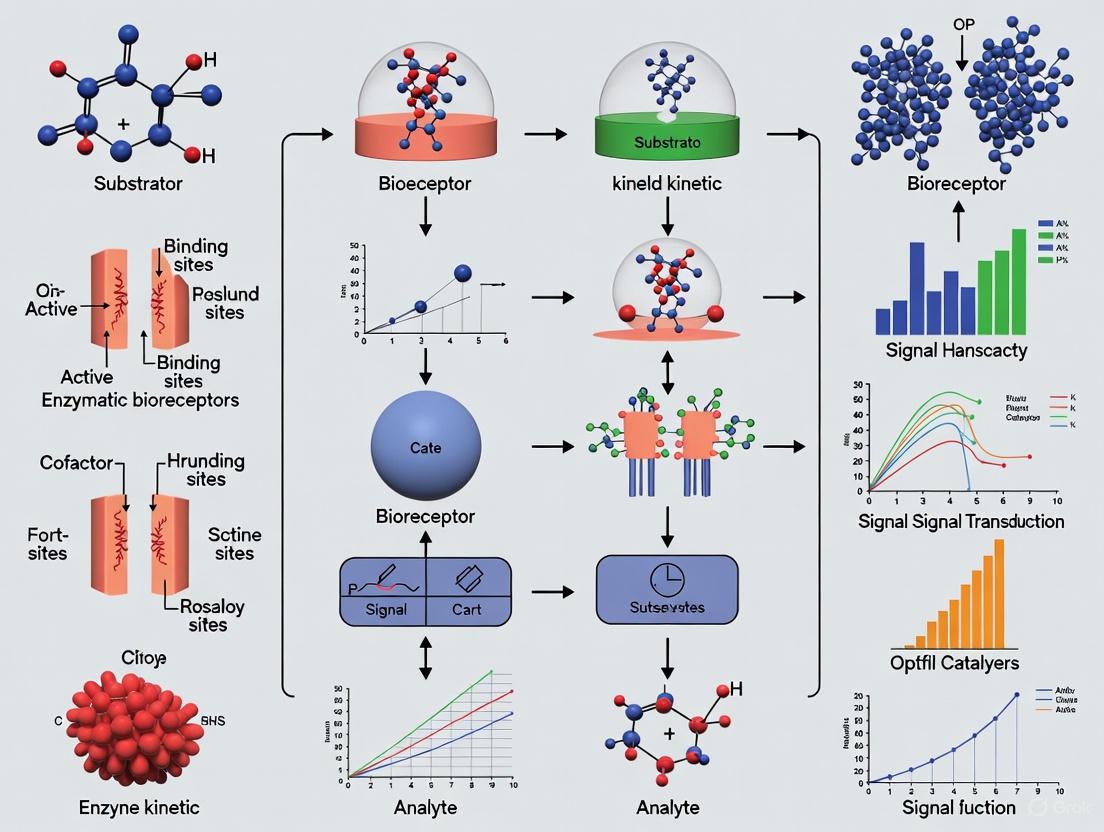
This article provides a comprehensive analysis of enzymatic biosensors, a cornerstone technology in biomedical research and drug development.
Enzymatic Biosensors: Advanced Bioreceptors for Biomedical Research and Drug Development
Abstract
This article provides a comprehensive analysis of enzymatic biosensors, a cornerstone technology in biomedical research and drug development. Tailored for researchers, scientists, and pharmaceutical professionals, it explores the foundational principles of enzyme-based biorecognition, from molecular interactions to device architecture. It details current methodologies, fabrication techniques, and diverse applications in therapeutic monitoring and diagnostics. The scope extends to critical challenges such as selectivity enhancement, interference management, and stability optimization, offering practical troubleshooting strategies. Finally, the article presents a comparative validation of enzymatic biosensors against other bioreceptor paradigms, evaluating their performance, commercial viability, and future potential in clinical and research settings.
The Core Principles of Enzymatic Bioreceptors: From Molecular Recognition to Sensor Architecture
Enzymatic biosensors are analytical devices that integrate a biological recognition element, typically an enzyme, with a physicochemical transducer to detect target analytes with high specificity and sensitivity [1] [2]. These devices function by converting a biological response into an quantifiable electrical, optical, or thermal signal. The core of a biosensor's specificity lies in its biological recognition element (BRE), which dictates its classification into one of two primary mechanistic categories: biocatalytic or affinity-based [3] [2].
Biocatalytic biosensors utilize enzymes that act as biocatalysts, continuously converting a substrate into a product and generating a measurable signal in the process. In contrast, affinity-based biosensors rely on the specific binding of a target analyte to a biorecognition element, such as an antibody, aptamer, or engineered protein, without catalyzing a permanent chemical change in the analyte [3]. This article delineates the fundamental principles, components, and applications of these two distinct sensing mechanisms, providing a framework for their application in research and drug development.
Table: Core Characteristics of Biocatalytic and Affinity-Based Biosensors
| Feature | Biocatalytic Biosensors | Affinity-Based Biosensors |
|---|---|---|
| Recognition Element | Enzymes (e.g., Glucose Oxidase, Urease) | Antibodies, Aptamers, ssDNA, Synthetic Receptors |
| Mechanism | Catalytic conversion of substrate | Selective binding and complex formation |
| Signal Generation | Consumption of substrate/formation of product | Change in mass, charge, or optical properties |
| Reusability | Often reusable due to catalyst regeneration | Typically single-use if binding is irreversible |
| Primary Application | Monitoring metabolites (e.g., glucose, lactate) | Detecting biomarkers, drugs, pathogens |
| Response Time | Typically fast (seconds to minutes) | Can be slower, depending on binding kinetics |
Fundamental Principles and Components
All enzymatic biosensors share a common architecture, comprising two fundamental components: a biorecognition layer and a transducer [1] [4].
The Biorecognition Layer
This layer houses the biological element that confers specificity to the sensor. In biocatalytic sensors, this involves immobilizing enzymes such as oxidoreductases or hydrolases on the transducer surface [1] [2]. Effective enzyme immobilization is critical for stability and reusability, achieved through methods like physical adsorption, covalent bonding, entrapment in gels or polymers, or incorporation into nanomaterials [1]. For affinity-based sensors, the layer is functionalized with capture agents like antibodies or aptamers that have high specificity for a target antigen or molecule [5] [3].
The Transducer
The transducer converts the biochemical interaction occurring at the biorecognition layer into a measurable analytical signal. Common transduction mechanisms include [1]:
- Electrochemical: Measures changes in electrical properties (current, potential, impedance). Amperometric sensors, which measure current from redox reactions, are the most prevalent, particularly in continuous glucose monitors [1] [6].
- Optical: Detects changes in light properties, such as absorbance, fluorescence, luminescence, or surface plasmon resonance [7].
- Thermometric: Measures the heat absorbed or released during an enzymatic reaction [1].
- Photoelectrochemical (PEC): An emerging method where light excites a photoactive material, generating an electrical signal that is modulated by a biological binding event [3].
The following diagram illustrates the generalized workflow and logical decision process involved in configuring these two primary types of enzymatic biosensors.
The Biocatalytic Biosensing Mechanism
Biocatalytic biosensors leverage the inherent catalytic properties of enzymes. When the target analyte (substrate) interacts with its specific enzyme, a catalytic reaction occurs, leading to the formation of a product or the consumption of a co-substrate. This biochemical change is what the transducer detects and quantifies [1]. A quintessential and commercially triumphant example is the glucose biosensor, which uses the enzyme glucose oxidase (GOx) [2].
Signaling Pathways in Biocatalysis
The mechanism of a GOx-based amperometric biosensor demonstrates the principle elegantly. GOx catalyzes the oxidation of glucose to gluconolactone, while simultaneously reducing its innate cofactor, Flavin Adenine Dinucleotide (FAD). The reduced cofactor (FADH₂) must then be re-oxidized for the catalytic cycle to continue. The method of this re-oxidation defines the "generation" of the biosensor, each with distinct signaling pathways as shown below [1] [6].
Key Enzymes and Their Analytical Targets
A wide array of enzymes serves as robust biorecognition elements in biocatalytic biosensors for diverse applications.
Table: Key Enzymes Used in Biocatalytic Biosensors
| Enzyme | Target Analyte | Reaction Catalyzed | Primary Application Domain |
|---|---|---|---|
| Glucose Oxidase (GOx) | Glucose | β-D-glucose + O₂ → Gluconic acid + H₂O₂ | Medical Diagnostics (Diabetes Management) [1] |
| Urease | Urea | Urea + H₂O → 2NH₃ + CO₂ | Medical Diagnostics (Kidney Function), Environmental Monitoring [1] |
| Lactate Oxidase (LOx) | Lactate | L-lactate + O₂ → Pyruvate + H₂O₂ | Sports Medicine, Critical Care [1] |
| Cholesterol Oxidase (ChOx) | Cholesterol | Cholesterol + O₂ → Cholest-4-en-3-one + H₂O₂ | Cardiovascular Health Monitoring, Food Science [1] |
| Acetylcholinesterase (AChE) | Acetylcholine / Pesticides | Acetylcholine → Choline + Acetate | Environmental Monitoring (Pesticide Detection) [1] |
| Tyrosinase | Phenolic Compounds | Phenols → Quinones | Environmental Monitoring [1] |
The Affinity-Based Biosensing Mechanism
Affinity-based biosensors operate on a fundamentally different principle: molecular recognition without catalytic turnover. These sensors utilize biorecognition elements that form a stable, specific complex with the target analyte [3]. The binding event itself induces a physicochemical change—such as a shift in mass, charge, or refractive index—which is then detected by the transducer. This mechanism is ideal for detecting analytes for which no direct catalytic enzyme exists, such as specific proteins, DNA sequences, hormones, or entire pathogens [5].
Signaling Pathways in Affinity Sensing
A common strategy in affinity-based electrochemical sensors is the use of an electroactive reporter molecule. The biological binding event either modulates the access of this reporter to the electrode surface or alters the electron transfer efficiency, leading to a measurable change in current or potential [5]. Photoelectrochemical (PEC) readout is another sensitive method where biological binding modulates a photocurrent generated by a photoactive material [3]. The general workflow for a sandwich-style affinity immunosensor, a common format, is detailed below.
Key Biorecognition Elements in Affinity Biosensors
The selectivity of affinity-based biosensors is determined by the chosen biorecognition element. Each element offers a unique balance of specificity, stability, and production cost.
Table: Biorecognition Elements for Affinity-Based Biosensors
| Recognition Element | Description | Target Examples | Advantages & Challenges |
|---|---|---|---|
| Antibodies | Immunoglobulins that bind to a specific antigen with high affinity. | Proteins, Hormones, Pathogens, Drugs [5] | Advantages: High specificity and affinity. Challenges: Can be sensitive to environment; irreversible binding limits reusability [2]. |
| Aptamers | Short, single-stranded DNA or RNA oligonucleotides selected for high-affinity binding. | Ions, Small molecules, Proteins, Cells [3] | Advantages: Chemical stability, reusability, ease of synthesis. Challenges: Selection process can be complex [3]. |
| Nucleic Acids (ssDNA) | Single-stranded DNA probes for complementary sequence hybridization. | DNA, RNA, Genetic Biomarkers [3] | Advantages: High predictability of interactions, design flexibility. Challenges: May require stringent hybridization conditions [3]. |
| Synzymes | Synthetic, engineered enzyme mimics. | Metabolites, Pollutants, Pharmaceuticals [8] | Advantages: Enhanced stability under harsh conditions, tunable catalytic properties. Challenges: Achieving high specificity can be challenging [8]. |
Experimental Protocols
This section provides detailed methodologies for establishing core assays for both biocatalytic and affinity-based biosensors, focusing on electrochemical transduction.
Protocol: Fabricating a Mediated (2nd Generation) Glucose Biosensor
This protocol outlines the steps to create a disposable amperometric glucose biosensor using a ferrocene-derived mediator [6].
5.1.1 Research Reagent Solutions Table: Essential Materials for Glucose Biosensor Fabrication
| Reagent/Material | Function/Description | Specifications/Notes |
|---|---|---|
| Carbon-based Electrode | Transducer platform | Screen-printed carbon electrodes (SPCEs) are ideal for disposability. |
| Glucose Oxidase (GOx) | Biocatalytic recognition element | Lyophilized powder, ~150 U/mg. Store at -20°C. |
| Glutaraldehyde | Crosslinking agent | 2.5% (v/v) solution in phosphate buffer. Use in a fume hood. |
| Bovine Serum Albumin (BSA) | Stabilizing matrix | Provides a robust protein matrix for enzyme immobilization. |
| Ferrocene Carboxylic Acid | Artificial redox mediator | Shuttles electrons from FADH₂ to the electrode surface. |
| Phosphate Buffered Saline (PBS) | Electrolyte and dilution buffer | 0.1 M, pH 7.4. Provides a stable physiological environment. |
| Nafion Perfluorinated Resin | Permselective membrane | 5% solution. Prevents fouling and interference from large molecules [9]. |
5.1.2 Step-by-Step Procedure
- Electrode Pretreatment: Clean the working electrode surface of the SPCE by cycling the potential between 0.0 and +1.0 V (vs. Ag/AgCl reference) in 0.1 M PBS, pH 7.4, until a stable voltammogram is obtained.
- Enzyme-Ink Preparation: In a microcentrifuge tube, mix 2 µL of GOx (50 mg/mL in PBS), 2 µL of BSA (50 mg/mL in PBS), 1 µL of ferrocene carboxylic acid (10 mM in DMSO), and 5 µL of PBS. Vortex gently to mix.
- Crosslinking and Immobilization: Add 1 µL of glutaraldehyde (2.5% v/v) to the enzyme-ink mixture and pipette to mix. Immediately deposit 5 µL of this mixture onto the active area of the pretreated working electrode.
- Membrane Casting: Allow the enzyme layer to cure for 30 minutes at room temperature. Then, dip-coat the entire electrode in a 0.5% Nafion solution and allow it to air dry for 15 minutes to form a thin, protective permselective membrane.
- Calibration and Measurement: Connect the biosensor to a potentiostat. In a stirred electrochemical cell containing 10 mL of 0.1 M PBS (pH 7.4), apply a constant potential of +0.3 V vs. the onboard reference. Successively add known volumes of a concentrated glucose stock solution to achieve a desired concentration range (e.g., 0–20 mM). Record the steady-state current after each addition.
- Data Analysis: Plot the steady-state current as a function of glucose concentration. Perform linear regression to obtain the sensor's sensitivity (slope) and linear dynamic range.
Protocol: Developing an Affinity-Based Immunosensor for Protein Detection
This protocol describes the development of a sandwich-type amperometric immunosensor for detecting a model protein, such as Interlukin-6 (IL-6), in a processed sample [5].
5.2.1 Research Reagent Solutions Table: Essential Materials for Affinity Immunosensor
| Reagent/Material | Function/Description | Specifications/Notes |
|---|---|---|
| Gold Disk Electrode | Transducer platform | Provides a stable surface for antibody immobilization via thiol-gold chemistry. |
| Capture Anti-IL-6 Antibody | Primary biorecognition element | Monoclonal antibody specific for IL-6. |
| Reporter Anti-IL-6 Antibody | Secondary, signal-generating element | Monoclonal antibody conjugated to Horseradish Peroxidase (HRP). Binds a different epitope. |
| Hydrogen Peroxide (H₂O₂) | Enzyme substrate | 10 mM solution in buffer, prepared fresh. |
| TMB (3,3',5,5'-Tetramethylbenzidine) | Electron donor for HRP | The reduced form of TMB (colorless) is oxidized by HRP/H₂O₂ to a product that can be electrochemically detected. |
| Ethanolamine | Blocking agent | 1 M solution, pH 8.5. Used to deactivate and block unreacted sites on the sensor surface. |
| NHS/EDC Coupling Kit | Chemistry for covalent immobilization | Standard kit for activating carboxyl groups on self-assembled monolayers for antibody coupling. |
5.2.2 Step-by-Step Procedure
- Electrode Functionalization: Clean the gold electrode according to standard protocols. Immerse it in a 2 mM solution of 11-mercaptoundecanoic acid (in ethanol) for 12 hours to form a self-assembled monolayer (SAM) with terminal carboxyl groups.
- Antibody Immobilization: Rinse the SAM-modified electrode and activate the carboxyl groups using a fresh mixture of 0.4 M EDC and 0.1 M NHS in water for 30 minutes. Rinse and incubate the electrode with a solution of the capture antibody (e.g., 50 µg/mL in PBS) for 2 hours. The antibody's amine groups will covalently attach to the activated surface.
- Surface Blocking: Incubate the electrode in 1 M ethanolamine (pH 8.5) for 30 minutes to block any remaining activated ester groups, minimizing nonspecific binding.
- Antigen Incubation and Sandwich Formation: Expose the functionalized electrode to the sample containing the target antigen (IL-6) for 30 minutes. Wash thoroughly with PBS containing 0.05% Tween-20 (PBST) to remove unbound material. Then, incubate with the HRP-conjugated reporter antibody solution for 30 minutes, followed by another wash step.
- Amperometric Detection: Transfer the electrode to an electrochemical cell containing PBS with 0.5 mM TMB. Apply a potential of -0.1 V (vs. Ag/AgCl) to monitor the reduction current of the oxidized TMB product generated by the HRP enzyme in the presence of 1 mM H₂O₂ (added to the cell just before measurement).
- Quantification: The magnitude of the cathodic current is proportional to the amount of captured HRP, which in turn is proportional to the concentration of the target antigen present in the sample. Generate a calibration curve using known standard concentrations.
Advanced Concepts and Future Perspectives
The convergence of materials science, nanotechnology, and enzyme engineering is pushing the boundaries of biosensing. Key advancements include:
- Wearable and Self-Powered Devices: The integration of biosensors into flexible substrates for wearable devices enables real-time, non-invasive health monitoring [4]. Enzymatic biofuel cells (EBFCs) can harness energy from bodily fluids like sweat, paving the way for self-sustaining, closed-loop diagnostic and therapeutic systems [4].
- Novel Materials and Transducers: The use of nanomaterials (graphene, carbon nanotubes, metal nanoparticles) enhances electron transfer, increases surface area for enzyme immobilization, and improves overall sensor sensitivity and stability [1] [4]. Photoelectrochemical (PEC) sensing is emerging as a highly sensitive alternative to traditional electrochemical methods [3].
- Addressing Selectivity Challenges: In complex matrices like whole blood, strategies such as the use of permselective membranes (e.g., Nafion/cellulose acetate composites), sentinel sensors (for background subtraction), and on-chip plasma separation membranes are critical to mitigate interference from electroactive species like ascorbic acid and uric acid [9] [5].
- Engineering Novel Biorecognition Elements: The development of synzymes (synthetic enzymes) offers catalysts with enhanced stability under extreme physicochemical conditions, suitable for applications in harsh industrial or environmental settings [8]. Furthermore, protein engineering aims to create oxidoreductases capable of Direct Electron Transfer (DET), which would simplify biosensor design and improve stability by eliminating the need for mediators or oxygen [2].
Enzyme-based biosensors represent a transformative technology in analytical science, leveraging the exceptional specificity and catalytic efficiency of enzymes for detecting target substances, or analytes. These devices integrate a biological recognition element (the enzyme) with a physicochemical transducer to convert a biochemical reaction into a quantifiable signal [1]. The core of this process, termed biorecognition, is the specific interaction between the enzyme and its target analyte. This interaction is the foundational "engine" of the biosensor, initiating a cascade that yields a measurable output proportional to the analyte's concentration. The high specificity of enzyme-analyte interactions ensures that even trace amounts of a target compound can be accurately identified in complex sample matrices like blood, urine, or environmental samples, making these biosensors indispensable in medical diagnostics, environmental monitoring, and food safety [1] [10].
The performance and reliability of a biosensor are governed by several key characteristics rooted in this biorecognition event. Selectivity is the most critical, referring to the bioreceptor's ability to detect a specific analyte in a sample containing other admixtures and contaminants [10]. Other vital attributes include sensitivity, which is the minimum amount of analyte that can be detected; reproducibility, the ability to generate identical responses for a duplicated experimental setup; and stability, the degree to which the sensor is susceptible to ambient disturbances over time [10]. The enzyme's intrinsic kinetic parameters, primarily the Michaelis-Menten constant ((Km)) and the turnover number ((k{cat})), directly influence these characteristics, defining the sensor's operational range, speed, and catalytic efficiency [11].
The Fundamentals of Enzyme-Analyte Interaction
Key Components of the Biorecognition System
The functionality of an enzyme-based biosensor is built upon three essential components that work synergistically.
Biological Recognition Element (Enzyme): The enzyme serves as the biocatalyst and is the source of the sensor's specificity. It initiates a reaction with its target substrate (analyte) to produce a detectable byproduct. Commonly used enzymes include glucose oxidase (GOx) for glucose monitoring, acetylcholinesterase (AChE) for pesticide detection, and urease for kidney function diagnostics [1].
Transducer: This element converts the biochemical signal from the enzyme-analyte reaction into a quantifiable electrical or optical signal. Several transducer types are employed, including electrochemical (amperometric, potentiometric), optical (fluorescence, absorbance), thermistor (detecting temperature change), and piezoelectric (detecting mass changes) [1].
Immobilization Matrix: To ensure the enzyme remains stable, active, and in proximity to the transducer, it is immobilized using various techniques. These include physical adsorption, covalent bonding, entrapment in gels or polymers, or incorporation into nanoparticles. The choice of immobilization method significantly affects the sensor's stability, reusability, and response time [1].
Kinetics of Biorecognition
The interaction between an enzyme (E) and its substrate/analyte (S) is quantitatively described by enzyme kinetics. The most fundamental model is the Michaelis-Menten mechanism, which involves the formation of an enzyme-substrate complex (ES) that subsequently decomposes to yield the product (P) and release the enzyme [11].
The mechanism is described by: [ E + S \underset{k{-1}}{\overset{k1}{\rightleftharpoons}} ES \overset{k_2}{\rightarrow} E + P ]
The rate of product formation ((v)) is given by the Michaelis-Menten equation: [ v = \frac{d[P]}{dt} = \frac{V{max} [S]}{Km + [S]} ] where:
- ( V_{max} ) is the maximum reaction rate (achieved when the enzyme is saturated with substrate).
- ( Km ) is the Michaelis constant, defined as the substrate concentration at which the reaction rate is half of ( V{max} ). It is a measure of the enzyme's affinity for the substrate; a lower ( K_m ) indicates a higher affinity [11].
- ( k{cat} ), the turnover number, is the number of substrate molecules converted to product per enzyme molecule per unit time when the enzyme is fully saturated. It is related to ( V{max} ) by ( V{max} = k{cat} [E]0 ), where ( [E]0 ) is the total enzyme concentration [12].
The catalytic efficiency of an enzyme is given by the ratio ( k{cat}/Km ). Understanding these parameters is crucial for biosensor design, as they determine the sensor's operational range, limit of detection, and response time. The following workflow outlines the process from analyte binding to signal generation.
Quantitative Parameters of Enzyme-Substrate Interactions
The following table summarizes key kinetic parameters for enzymes commonly used in biosensing, compiled from structured datasets like SKiD which integrates experimental data from resources such as BRENDA [12].
Table 1: Kinetic Parameters of Common Enzymes Used in Biosensors
| Enzyme | EC Number | Target Analyte | kcat (s⁻¹) | Km (mM) | Assay Conditions (pH, Temp) |
|---|---|---|---|---|---|
| Glucose Oxidase (GOx) | 1.1.3.4 | β-D-glucose | Varies by source; ~700 [12] | 20-30 [12] | pH 5.5-7.0, 25-37°C |
| Acetylcholinesterase (AChE) | 3.1.1.7 | Acetylcholine | Varies by source & type | ~0.1 (for acetylcholine) | pH 7.4-8.0, 25-37°C |
| Urease | 3.5.1.5 | Urea | ~4.0 x 10⁴ | ~5.0 | pH 7.0, 37°C |
| Lactate Oxidase (LOx) | 1.1.3.2 | L-lactate | Varies by source | ~0.2-1.0 | pH 7.0, 30°C |
| Cholesterol Oxidase (ChOx) | 1.1.3.6 | Cholesterol | Varies by source | ~0.05-0.15 | pH 7.0-7.5, 37°C |
Note: kcat and Km values are highly dependent on the enzyme source (species, tissue), immobilization method, and exact experimental conditions. The values presented are representative ranges. For rigorous experimental design, consult primary literature or curated databases like BRENDA or SKiD [12].
Application Notes: Experimental Protocols
This section provides detailed methodologies for key experiments that leverage enzymatic biorecognition, from a standard calibration procedure to a cutting-edge technique for spatial mapping of enzyme activity within cells.
Protocol 1: Standard Calibration of an Amperometric Glucose Biosensor
Principle: Glucose oxidase (GOx) catalyzes the oxidation of β-D-glucose to gluconolactone and hydrogen peroxide (H₂O₂). An amperometric transducer held at a constant potential (e.g., +0.6 V vs. Ag/AgCl) detects the H₂O₂ produced, generating a current proportional to the glucose concentration [1].
Research Reagent Solutions:
Table 2: Essential Materials for Glucose Biosensor Calibration
| Reagent/Material | Function / Description |
|---|---|
| Glucose Oxidase (GOx) | Biorecognition element; catalyzes the oxidation of glucose. |
| Phosphate Buffered Saline (PBS) | (0.1 M, pH 7.4) Provides a stable ionic strength and pH for the enzymatic reaction. |
| D-Glucose Stock Solution | (1 M in PBS) Primary analyte for calibration. Store at 4°C. |
| Ferrocene or Ferricyanide | Optional electron mediators to shuttle electrons from GOx to the electrode, lowering operating potential. |
| Nafion or Polyurethane | Polymer membrane for enzyme immobilization and to reject interferents (e.g., ascorbic acid, uric acid). |
Procedure:
- Biosensor Preparation: Immobilize GOx onto the working electrode surface. A common method is cross-linking: mix 5 µL of GOx solution (10 mg/mL in PBS) with 2 µL of a glutaraldehyde solution (2.5% v/v) and 3 µL of BSA (10 mg/mL). Spot this mixture onto the cleaned electrode surface and allow it to dry at 4°C for 1 hour.
- Apparatus Setup: Configure a potentiostat with a three-electrode system: the GOx-modified electrode as the working electrode, a Pt wire as the counter electrode, and an Ag/AgCl electrode as the reference. Set the applied potential to +0.6 V (or a lower potential if using a mediator).
- Calibration Curve Generation:
- Place the biosensor in a stirred electrochemical cell containing 10 mL of PBS (0.1 M, pH 7.4) at 25°C.
- Allow the background current to stabilize.
- Sequentially add small, known volumes of the 1 M glucose stock solution to achieve increasing concentrations in the cell (e.g., 0.1, 0.2, 0.5, 1.0, 2.0, 5.0 mM).
- Record the steady-state current response after each addition.
- Data Analysis: Plot the steady-state current (µA) against the corresponding glucose concentration (mM). Perform linear regression on the data points within the linear range. The slope of this line represents the sensitivity of the biosensor (µA/mM).
Protocol 2: ProKAS for Spatial Mapping of Kinase Activity in Live Cells
Principle: The Proteomic Kinase Activity Sensors (ProKAS) technology uses barcoded peptides that mimic natural kinase substrates. When a kinase acts on its specific peptide, the incorporated barcode allows for the simultaneous detection of the kinase's activity and its spatial location within the cell via mass spectrometry [13]. This protocol provides an overview of the method.
Workflow Overview:
Research Reagent Solutions:
Table 3: Key Reagents for ProKAS Protocol
| Reagent/Material | Function / Description |
|---|---|
| Barcoded Peptide Library | Engineered peptides with kinase-specific sequences and unique amino acid "barcodes" for spatial resolution. |
| Transfection Reagent | (e.g., Lipofectamine) For delivering peptides into live cells. |
| Cell Culture Components | Appropriate cell line, growth media, and reagents for drug stimulation (e.g., chemotherapeutic agents). |
| Lysis Buffer | RIPA buffer supplemented with phosphatase and protease inhibitors to preserve phosphorylation states. |
| Phospho-specific Antibody Beads | Anti-phospho-serine/threonine/tyrosine antibodies immobilized on beads for enriching phosphorylated peptides. |
| LC-MS/MS System | Liquid Chromatography coupled to Tandem Mass Spectrometry for peptide identification and quantification. |
Procedure:
- Peptide Library Design and Synthesis: Design a library of peptides that are specific substrates for the kinases of interest. Each peptide is tagged with a unique barcode sequence that corresponds to a specific subcellular location (e.g., nucleus, cytoplasm, membrane).
- Cell Transfection and Stimulation: Transfect the library of barcoded peptides into live cells using a standard transfection protocol. After allowing time for peptide distribution, subject the cells to an experimental stimulus (e.g., a DNA-damaging chemotherapeutic drug).
- Cell Lysis and Peptide Enrichment: At designated time points, lyse the cells. Use anti-phospho-amino acid antibody beads to immunoprecipitate and enrich the phosphorylated, barcoded peptides from the complex cellular lysate.
- Mass Spectrometry Analysis: Analyze the enriched peptides by LC-MS/MS. The mass spectrometer identifies the phosphorylated peptides and sequences the barcodes.
- Data Processing and Spatial Mapping: Using computational tools, decode the barcode sequences to determine the subcellular location of each measured phosphorylation event. The intensity of the phosphopeptide signal corresponds to the level of kinase activity at that specific location and time [13].
Advanced Research and Data Integration
The field of enzymatic biosensing is being revolutionized by the integration of advanced data science and novel technologies. The creation of structured, comprehensive datasets is crucial for moving beyond empirical design. Resources like the Structure-oriented Kinetics Dataset (SKiD) are addressing a critical gap by mapping fundamental kinetic parameters ((k{cat}), (Km)) to the three-dimensional structures of enzyme-substrate complexes [12]. This allows researchers to understand the structural basis of enzymatic function and catalytic efficiency, facilitating the rational design of improved biocatalysts for biosensing applications [12].
Simultaneously, novel biosensor technologies like ProKAS are providing unprecedented insights into enzyme activity within its native cellular environment. This method overcomes the limitations of traditional microscopy-based techniques by using mass spectrometry to read the activity of multiple kinases simultaneously with high spatial and temporal resolution [13]. As noted by the developers, "We use mass spectrometry to read the activity, and this is a different approach to tracking kinase action in cells... The approach lets us follow multiple kinases at once and see exactly when and where they act inside cells" [13]. This capability is invaluable for pharmaceutical research, enabling the high-throughput screening of drug candidates and the elucidation of their mechanisms of action on kinase signaling pathways in disease processes [13].
Core Principles of Enzymatic Biosensors
Enzymatic biosensors are analytical devices that integrate a biological recognition element with a transducer to produce a measurable signal proportional to the concentration of a target analyte. These devices function based on a coherent framework of five essential components that work in sequence: the analyte, bioreceptor, transducer, electronics, and display [14].
The analyte is the substance of interest that the biosensor is designed to detect and quantify. In clinical and pharmaceutical contexts, typical analytes include glucose, lactate, cholesterol, urea, and specific biomarkers such as alanine aminotransferase (ALT), a key indicator of liver function [15] [1]. The bioreceptor is a biological molecule that specifically interacts with the target analyte. In enzymatic biosensors, this is typically an enzyme like glucose oxidase, cholesterol oxidase, or pyruvate oxidase, which catalyzes a specific biochemical reaction involving the analyte [1] [14]. This interaction between the analyte and bioreceptor is termed biorecognition.
The transducer is a critical component that converts the biochemical response resulting from the biorecognition event into a quantifiable energy signal. Transducers can be electrochemical (amperometric or potentiometric), optical, thermal, or piezoelectric [1] [14]. The electronics unit processes this transduced signal, performing functions such as amplification, filtering, and conversion from analog to digital form. Finally, the display presents the processed data in a user-interpretable format, such as a numerical value, graph, or figure on a computer screen or digital readout [14].
Performance Evaluation of Enzymatic Systems
The analytical performance of enzymatic biosensors is critically dependent on the selection of the biorecognition element and the design of the transduction pathway. The table below summarizes key performance parameters for different enzyme-based biosensing systems, highlighting the trade-offs between sensitivity, detection range, and robustness.
Table 1: Performance comparison of enzyme-based biosensing systems for different analytes
| Target Analyte | Bioreceptor Enzyme | Linear Range | Limit of Detection (LOD) | Transduction Method | Key Advantage |
|---|---|---|---|---|---|
| ALT (Liver Health) | Pyruvate Oxidase (POx) | 1–500 U/L [15] | 1 U/L [15] | Amperometric (H₂O₂) [15] | Higher sensitivity [15] |
| ALT (Liver Health) | Glutamate Oxidase (GlOx) | 5–500 U/L [15] | 1 U/L [15] | Amperometric (H₂O₂) [15] | Greater stability in complex solutions [15] |
| E. coli (Pathogen) | Anti-O Antibody (Immunosensor) | 10–10¹⁰ CFU mL⁻¹ [16] | 1 CFU mL⁻¹ [16] | Electrochemical (Impedance) [16] | Excellent selectivity and field applicability [16] |
| Cytokines (Inflammation) | Capture Antibody (Immunosensor) | Sub-picomolar [17] | Sub-picomolar [17] | Silicon Photonic Microring (Optical) [17] | Suited for complex, clinical matrices [17] |
The selection of an appropriate immobilization method is equally critical for sensor performance, as it directly impacts enzyme stability, activity, and leakage. Different techniques offer distinct advantages.
Table 2: Comparison of enzyme immobilization techniques in biosensors
| Immobilization Technique | Mechanism | Example Use Case | Advantages | Disadvantages |
|---|---|---|---|---|
| Entrapment | Enzyme physically confined within a polymeric network [15] [1] | POx in PVA-SbQ photopolymer for ALT sensing [15] | Mild conditions, simple procedure [1] | Potential enzyme leaching, diffusion limitations [1] |
| Covalent Crosslinking | Enzyme chemically bonded to support matrix via crosslinkers (e.g., glutaraldehyde) [15] [1] | GlOx crosslinked with glutaraldehyde for ALT sensing [15] | Strong binding, minimal enzyme leakage [1] | Possible loss of enzyme activity due to harsh chemistry [1] |
| Physical Adsorption | Enzyme bound to surface via weak forces (van der Waals, ionic) [1] | Not specified in search results | Very simple and rapid [1] | Weak binding, prone to desorption [1] |
Detailed Experimental Protocols
Protocol 1: Fabrication of an Amperometric ALT Biosensor
This protocol details the construction of an amperometric biosensor for detecting Alanine Aminotransferase (ALT) using a Pyruvate Oxidase (POx)-based approach, adapted from a 2025 study [15].
Principle: ALT catalyzes the transamination of L-alanine and α-ketoglutarate to produce pyruvate and L-glutamate. Pyruvate is then oxidized by the immobilized Pyruvate Oxidase (POx), generating hydrogen peroxide (H₂O₂). H₂O₂ is electrochemically oxidized at a platinum electrode, and the resulting current is measured amperometrically [15].
Diagram 1: POx-based ALT detection principle.
Materials and Reagents:
- Pyruvate Oxidase (POx) from Aerococcus viridans (35 U/mg) [15]
- ALT from porcine heart (84 U/mg) [15]
- Polyvinyl alcohol with steryl pyridinium groups (PVA-SbQ) [15]
- HEPES buffer (25 mM, pH 7.4) [15]
- Glycerol and Bovine Serum Albumin (BSA) [15]
- Platinum disc working electrode, Ag/AgCl reference electrode, platinum counter electrode [15]
Procedure:
- Electrode Pretreatment: Polish the platinum disc working electrode with alumina slurry, rinse thoroughly with ethanol and distilled water, and dry under a nitrogen stream [15].
- Interference-Blocking Membrane: Electropolymerize a meta-phenylenediamine (m-PPD) membrane onto the clean Pt surface. Immerse the electrode in a solution of 5 mM m-PPD in 10 mM phosphate buffer (pH 6.5). Apply cyclic voltammetry between 0 V and 0.9 V (scan rate: 0.02 V/s) for 10-20 cycles. A stable voltammogram indicates complete surface coverage [15].
- POx Immobilization Gel Preparation: Prepare a mixture containing 10% glycerol, 5% BSA, and 4.86 U/µL POx in 25 mM HEPES buffer (pH 7.4). Mix this gel thoroughly with a 19.8% PVA-SbQ photopolymer solution in a 1:2 ratio. The final mixture will contain approximately 1.62 U/µL POx and 13.2% PVA-SbQ [15].
- Enzyme Layer Deposition: Apply 0.15 µL of the final POx/PVA-SbQ mixture onto the surface of the m-PPD-modified Pt electrode. Immediately photopolymerize the layer under UV light (365 nm) for approximately 8 minutes until an energy dose of 2.4 J is delivered [15].
- Sensor Conditioning: Prior to measurements, rinse the biosensor 2-3 times for 3 minutes each in the working buffer (e.g., HEPES or phosphate buffer) to remove any loosely bound enzyme [15].
- Amperometric Measurement: Place the biosensor in a standard three-electrode cell with the appropriate counter and reference electrodes. Add the sample containing ALT and its substrates (L-alanine and α-ketoglutarate) to the cell. Apply a constant potential of +0.6 V (vs. Ag/AgCl) and record the steady-state current generated by the oxidation of H₂O₂. The change in current is proportional to ALT activity [15].
Protocol 2: Silicon Photonic Microring Immunoassay for Protein Biomarkers
This protocol describes a quantitative, multiplexed sandwich immunoassay using silicon photonic microring resonators, a type of optical biosensor, for the detection of protein biomarkers like cytokines [17].
Principle: Target-specific capture antibodies are immobilized on the sensor surface. Binding of the target analyte (protein) followed by a biotinylated detection antibody and a streptavidin-horseradish peroxidase (SA-HRP) conjugate creates a complex. Enzymatic deposition of an insoluble product by HRP causes a measurable shift in the resonator's wavelength [17].
Diagram 2: Microring resonator sandwich immunoassay.
Materials and Reagents:
- Silicon photonic microring resonator array (e.g., from Genalyte, Inc.) [17]
- Capture antibody (≥ 0.25 mg/mL, amine-free buffer) [17]
- Biotinylated tracer (detection) antibody [17]
- Streptavidin-Horseradish Peroxidase (SA-HRP) conjugate [17]
- 4-chloro-1-naphthol (4-CN) precipitation substrate [17]
- Bissulfosuccinimidyl suberate (BS3) crosslinker [17]
- Aminopropyltriethoxysilane (APTES) [17]
- Assay Buffer: PBS with 0.5% BSA [17]
- Blocking Buffer: Commercial buffer like StartingBlock (PBS) or DryCoat stabilizer [17]
Procedure:
- Sensor Surface Silanization: Clean the sensor chip with acetone and isopropanol. Submerge the chip in a fresh 1% APTES solution in acetone for 4 minutes with mild agitation. Rinse sequentially with acetone and isopropanol for 2 minutes each [17].
- Capture Antibody Immobilization: Incubate the silanized sensor with a 5 mM solution of BS3 crosslinker (in 2 mM acetic acid) to activate the surface. After rinsing, spot the sensor with the capture antibody solution (in 2 mM acetic acid) using a robotic microarrayspotter for multiplexing. Allow the coupling reaction to proceed. Quench any remaining active esters with a buffer containing BSA [17].
- Assay Procedure:
- Analyte Binding: Incubate the functionalized sensor with the sample or protein standard solution to allow antigen binding to the capture antibody.
- Tracer Binding: Introduce the biotinylated tracer antibody to form the sandwich complex.
- Signal Enhancement: Incubate with SA-HRP conjugate, followed by the 4-CN substrate. The enzymatic conversion leads to the localized precipitation of an insoluble product on the sensor surface, amplifying the signal [17].
- Signal Detection and Analysis: Continuously monitor the resonance wavelength shift of each microring throughout the assay. The shift after the final enzymatic step is proportional to the target protein concentration in the sample. Generate a calibration curve using known standards for quantitative analysis [17].
The Scientist's Toolkit: Essential Research Reagents
Successful development and implementation of enzymatic biosensors rely on a set of critical reagents and materials. The following table details these key components and their specific functions within the biosensing system.
Table 3: Essential research reagents for enzymatic biosensor development
| Reagent/Material | Function | Example Application/Note |
|---|---|---|
| Pyruvate Oxidase (POx) | Bioreceptor for detecting pyruvate; generates H₂O₂ [15] | Used in ALT biosensors for liver health monitoring [15] |
| Glutamate Oxidase (GlOx) | Bioreceptor for detecting glutamate; generates H₂O₂ [15] | Used in ALT/AST biosensors; can be affected by AST activity [15] |
| Polyvinyl Alcohol-SbQ (PVA-SbQ) | Photocrosslinkable polymer for enzyme entrapment [15] | Used for POx immobilization; enables gentle UV-induced crosslinking [15] |
| Glutaraldehyde (GA) | Homobifunctional crosslinker for covalent enzyme immobilization [15] | Used for GlOx immobilization; creates stable bonds but requires controlled conditions [15] |
| meta-Phenylenediamine (m-PPD) | Monomer for electropolymerized interference-blocking membrane [15] | Forms a size-exclusion membrane on Pt electrodes to block ascorbic acid etc. [15] |
| Bissulfosuccinimidyl suberate (BS3) | Homobifunctional NHS-ester crosslinker for antibody immobilization [17] | Used to covalently attach capture antibodies to aminated sensor surfaces [17] |
| Streptavidin-HRP (SA-HRP) | Signal amplification conjugate in immunoassays [17] | Binds to biotinylated detection antibodies and catalyzes precipitation reaction [17] |
| Aminopropyltriethoxysilane (APTES) | Silane coupling agent for creating surface amine groups [17] | Primes silicon/silicon oxide surfaces for subsequent antibody immobilization [17] |
The development of enzymatic biosensors represents a cornerstone of modern analytical science, bridging fundamental biochemistry with practical applications across medical diagnostics, environmental monitoring, and drug discovery. At the heart of this field lies the Clark electrode, invented in the 1950s by Leland Clark, which established the fundamental principle of coupling biological recognition with physicochemical transduction [18] [10]. This pioneering technology not only solved the immediate challenge of measuring blood oxygen tension but unexpectedly laid the groundwork for the entire biosensor field [19]. The original Clark electrode employed a platinum surface to catalyze oxygen reduction according to the net reaction: O₂ + 4e⁻ + 4H⁺ → 2H₂O, with a semipermeable Teflon membrane isolating the electrode compartment to reduce fouling while allowing oxygen diffusion [18]. This clever design established the basic biosensor architecture that would subsequently be adapted for countless other analytes.
The evolution from the Clark electrode to contemporary enzymatic biosensors demonstrates how a fundamental sensing platform can be creatively adapted through different bioreceptors and transduction mechanisms. Clark himself demonstrated this potential in 1962 when he and Lyons created the first true biosensor by immobilizing glucose oxidase onto the oxygen-permeable membrane of his electrode, thereby coupling enzyme-catalyzed substrate conversion with electrochemical detection [18] [1]. This critical innovation established the template for subsequent enzymatic biosensors that now employ diverse enzymes including urease, lactate oxidase, cholesterol oxidase, acetylcholinesterase, and tyrosinase for detecting various analytes [1]. Modern research continues to refine these principles, addressing challenges such as enzyme instability, interference from complex matrices, and the need for portability through innovations in nanomaterials, synthetic enzymes, and miniaturization technologies [1].
The Clark Electrode: Mechanism and Historical Significance
Technical Operation and Components
The Clark electrode operates as a polarographic device that measures current generated by the electrochemical reduction of oxygen at a platinum cathode when a specific voltage is applied [19]. The key components and their functions are detailed in the following table:
Table 1: Core Components of the Clark Electrode and Their Functions
| Component | Material/Value | Function |
|---|---|---|
| Cathode | Platinum | Serves as a catalytic surface for oxygen reduction; resistant to reaction with other compounds [19] |
| Anode | Silver/Silver Chloride | Provides a steady supply of electrons through the reaction: Ag → Ag⁺ + e⁻ [19] |
| Electrolyte Solution | Potassium Chloride (KCl) | Source of chloride ions to neutralize silver ions (Ag⁺ + Cl⁻ → AgCl) [19] |
| Membrane | Polytetrafluoroethylene (Teflon) | Oxygen-permeable barrier that separates electrodes from sample; reduces fouling and metal plating [18] |
| Applied Voltage | 0.6V | Polarizes electrodes to drive oxygen reduction while minimizing interference from other reactions [19] |
The 0.6V operating voltage represents a critical "sweet spot" in the current-voltage relationship—sufficient to rapidly reduce all available oxygen without initiating competing reactions like water reduction that would occur above 1V [19]. This specific voltage ensures the reaction rate becomes limited by oxygen diffusion rather than applied potential, establishing a linear relationship between current and oxygen partial pressure [18] [19].
From Oxygen Detection to Glucose Sensing
The transition from oxygen measurement to glucose detection exemplifies the adaptability of the Clark electrode platform. The fundamental innovation involved immobilizing glucose oxidase (GOx) onto the oxygen-permeable membrane [18] [19]. This enzyme catalyzes the oxidation of glucose to gluconic acid and hydrogen peroxide, consuming oxygen in the process. The subsequent decrease in oxygen tension detected by the underlying Clark electrode correlates directly with glucose concentration [18] [1]. This conceptual framework—using an enzyme to convert the target analyte into a measurable change in oxygen consumption—established the operational principle for countless subsequent enzyme-based biosensors.
Table 2: Evolution of Early Biosensor Technology
| Year | Development | Significance |
|---|---|---|
| 1956 | Clark Oxygen Electrode | First device to electrochemically measure oxygen in fluids; foundation for future biosensors [10] |
| 1962 | Clark and Lyons Glucose Biosensor | First true biosensor; introduced enzyme immobilization on electrode surface [18] |
| 1969 | Guilbault and Montalvo Potentiometric Urea Biosensor | Expanded biosensor concept to new enzymes and detection methods [10] |
| 1975 | First Commercial Glucose Biosensor (YSI) | Demonstrated commercial viability of biosensor technology [10] |
Modern Innovations in Enzymatic Biosensing
Advanced Sensing Platforms and Techniques
Contemporary enzymatic biosensing has evolved substantially from the original Clark electrode design, incorporating diverse transduction mechanisms including optical, thermal, and mass-sensitive detection alongside electrochemical methods [1]. The following table compares these modern biosensing approaches:
Table 3: Comparison of Modern Biosensor Transduction Mechanisms
| Transduction Type | Detection Principle | Example Enzymes | Applications |
|---|---|---|---|
| Amperometric | Measures current from redox reactions [1] | Glucose oxidase, Lactate oxidase [1] | Continuous glucose monitoring, metabolite detection [1] |
| Potentiometric | Measures potential difference [1] | Urease [1] | Kidney function diagnostics, environmental monitoring [1] |
| Optical | Measures changes in light properties (absorbance, fluorescence) [20] | Tyrosinase, Cholesterol oxidase [1] | Phenolic compound detection, cholesterol measurement [1] |
| Mass-Sensitive (QCM, SAW) | Detects mass changes on sensor surface [20] | Various immobilized enzymes | Pathogen detection, toxin monitoring [20] |
| Thermal (Thermistor) | Measures heat from enzymatic reactions [1] | Enzyme-catalyzed exothermic reactions | Process monitoring, metabolic studies [1] |
ProKAS: A Case Study in Modern Innovation
A groundbreaking advancement in enzymatic biosensing is the recently developed Proteomic Kinase Activity Sensors (ProKAS) technology, which represents a complete reimagining of how kinase activity can be measured within living cells [13]. This innovative approach addresses a fundamental challenge in cell biology: mapping the spatial and temporal activity patterns of the more than 500 kinases that regulate nearly all cellular processes [13].
The ProKAS methodology employs:
- Barcoded Peptide Substrates: Engineered peptides that mimic natural kinase targets, each containing a unique amino acid "barcode" that marks its intracellular location [13].
- Mass Spectrometry Readout: Unlike traditional microscopy-based techniques, ProKAS uses mass spectrometry to detect both kinase action and the corresponding location barcode [13].
- High-Throughput Capability: The system can currently analyze 36 samples in a single 30-minute mass spectrometry run, with scalability to hundreds or thousands of samples [13].
Researchers have successfully implemented ProKAS to monitor DNA damage response kinases (ATR, ATM, CHK1) following anti-cancer drug treatment, revealing previously unmeasurable differences in kinase activity across specific nuclear regions [13]. This spatial resolution provides unprecedented insight into kinase signaling patterns relevant to drug mechanisms and disease processes, particularly in cancer [13].
Experimental Protocols
Protocol 1: Clark Electrode-Based Glucose Biosensor
Principle: Coupling glucose oxidase-mediated glucose oxidation with amperometric detection of oxygen consumption [18] [19].
Materials:
- Clark electrode system with platinum cathode and silver/silver chloride anode
- Oxygen-permeable Teflon membrane
- Glucose oxidase enzyme
- Cross-linking reagent (glutaraldehyde or similar)
- Buffer solution (phosphate buffer, pH 7.4)
- Standard glucose solutions for calibration
Procedure:
- Electrode Preparation: Assemble Clark electrode with Teflon membrane ensuring secure fit.
- Enzyme Immobilization:
- Prepare glucose oxidase solution in appropriate buffer.
- Apply enzyme solution to Teflon membrane surface.
- Cross-link with glutaraldehyde vapor (0.5% v/v) for 30 minutes.
- Rinse thoroughly with buffer to remove unbound enzyme.
- System Calibration:
- Immerse electrode in oxygen-saturated buffer, apply 0.6V.
- Record baseline current (I₀).
- Add standard glucose solutions of known concentration.
- Record steady-state current (I) after each addition.
- Plot ΔI (I₀ - I) versus glucose concentration to establish calibration curve.
- Sample Measurement:
- Immerse biosensor in sample solution.
- Record steady-state current.
- Determine glucose concentration from calibration curve.
- Quality Control:
- Verify electrode response with standard between samples.
- Replace membrane and reimmobilize enzyme when sensitivity decreases >10%.
Technical Notes: Optimal enzyme loading is critical; excessive enzyme can hinder oxygen diffusion, while insufficient enzyme reduces sensitivity. The 0.6V operating potential must be maintained consistently to ensure oxygen reduction without side reactions [19].
Protocol 2: ProKAS for Kinase Activity Profiling
Principle: Using barcoded peptide substrates with mass spectrometry detection to map spatial kinase activity in live cells [13].
Materials:
- Library of barcoded peptide substrates with location-specific sequences
- Cell culture system of interest
- Lysis buffer compatible with mass spectrometry
- Mass spectrometer with electrospray ionization
- Anti-cancer drugs or other kinase modulators for treatment
- Solid-phase extraction columns for peptide cleanup
Procedure:
- Peptide Library Design:
- Design peptides mimicking natural kinase target sequences.
- Incorporate unique amino acid "barcodes" corresponding to specific subcellular locations.
- Synthesize and purify peptides to >95% purity.
- Cell Treatment and Incubation:
- Culture cells under appropriate conditions.
- Treat with kinase modulators (e.g., DNA-damaging agents for ATR/ATM studies).
- Introduce barcoded peptide library using optimized delivery method.
- Incubate for predetermined time (typically 15-60 minutes).
- Sample Processing:
- Lyse cells at specific time points.
- Isolate phosphorylated peptides using enrichment methods if necessary.
- Clean up samples using solid-phase extraction.
- Mass Spectrometry Analysis:
- Separate peptides using liquid chromatography.
- Analyze using tandem mass spectrometry.
- Detect both phosphorylation status and location barcodes.
- Data Analysis:
- Identify phosphorylated peptides and their corresponding barcodes.
- Map kinase activity to specific cellular locations.
- Quantify temporal changes in activity patterns.
Technical Notes: The barcode system enables multiplexed analysis of multiple kinases and locations simultaneously. Kinase activity is quantified by normalizing phosphorylated peptide intensity to total peptide intensity for each barcode [13].
The Scientist's Toolkit: Essential Research Reagent Solutions
Table 4: Essential Research Reagents for Enzymatic Biosensor Development
| Reagent Category | Specific Examples | Function in Biosensor Development |
|---|---|---|
| Enzyme Bioreceptors | Glucose oxidase, Lactate oxidase, Urease, Acetylcholinesterase [1] | Biological recognition elements that provide specificity through catalytic activity [1] |
| Immobilization Matrices | Chitosan, Polyacrylamide, Sol-gels, Nanoparticles [1] | Stabilize enzyme structure, maintain proximity to transducer, extend operational lifetime [1] |
| Transducer Materials | Platinum, Gold, Glassy carbon, Screen-printed electrodes [18] [1] | Convert biochemical signals into measurable electrical outputs [18] |
| Membrane Materials | Polytetrafluoroethylene, Polycarbonate, Cellulose acetate [18] | Control analyte diffusion, reduce interference, prevent fouling [18] |
| Nanomaterial Enhancers | Graphene, Carbon nanotubes, Metal nanoparticles, Nanozymes [1] | Increase surface area, enhance electron transfer, improve sensitivity and stability [1] |
| Signal Generation Systems | Hydrogen peroxide, Redox mediators (ferrocene), Fluorescent dyes [10] [1] | Amplify detection signals, enable different transduction mechanisms [10] |
Visualizing Biosensor Evolution and Mechanisms
Biosensor Technology Evolution Pathway
Clark Electrode Operational Mechanism
ProKAS Technology Workflow
Biosensor technology, which integrates a biological recognition element with a physicochemical transducer, has undergone significant evolution since its inception in the 1950s [21] [22]. This progression is categorized into three distinct generations, each marked by fundamental improvements in how the biological recognition event is translated into a measurable signal [21]. Enzymatic bioreceptors, particularly oxidoreductases like glucose oxidase, have been at the forefront of this development, serving as the foundational biological element from the first generation to the advanced direct electron transfer systems of the third generation [1] [2]. The global biosensor market is experiencing significant growth, driven by rising demand across medical diagnostics, environmental monitoring, and food safety sectors [21] [23]. This application note, framed within broader thesis research on enzymatic biosensors, provides a structured comparison of biosensor generations, detailed experimental protocols for characterizing third-generation systems, and essential toolkit resources for researchers and drug development professionals.
Generational Evolution of Biosensors
The development of biosensors is categorized into three generations, primarily defined by the mechanism of signal transduction and the level of integration between the bioreceptor and the transducer [21] [22]. Table 1 provides a systematic comparison of the key characteristics across these generations.
Table 1: Comparative Analysis of Biosensor Generations
| Feature | First Generation (1960s-1970s) | Second Generation (1980s-1990s) | Third Generation (21st Century-Present) |
|---|---|---|---|
| Core Principle | Diffusion of reaction products to transducer [22] | Use of synthetic redox mediators [21] [2] | Direct electron transfer (DET) between enzyme and electrode [21] [2] |
| Signal Transduction | Mediator-less; measures O₂ consumption or H₂O₂ production [21] | "Enzyme-mediator-electrode" system [21] | Direct bioelectrocatalysis; no mediators needed [2] |
| Key Materials | Platinum black electrodes, polytetrafluoroethylene membranes [21] | Potassium ferricyanide, ferrocene [21] | Nanomaterials (graphene, CNTs), engineered enzymes, MOFs [21] [24] |
| Sensitivity Level | μM (micromolar) [21] | nM (nanomolar) [21] | Beyond fM (femtomolar) [21] |
| Detection Potential | Based on natural cosubstrates (e.g., O₂) [2] | Lowered potential (0.2–0.4 V) [21] | Intrinsic to the enzyme's redox center [2] |
| Primary Advantages | Simple concept, foundational technology | Improved sensitivity, reduced interference from sample matrix | High sensitivity, selectivity, miniaturization, ideal for in vivo sensing [21] [2] |
| Inherent Limitations | Low sensitivity, weak anti-interference ability | Potential mediator toxicity, complexity [21] [2] | Limited availability of native DET-capable enzymes [2] |
The first generation, exemplified by Clark's oxygen electrode, relied on the natural diffusion of reactants and products, such as oxygen consumption or hydrogen peroxide production, to the transducer surface [21] [22]. The second generation introduced synthetic redox mediators (e.g., ferrocene) to shuttle electrons between the enzyme's active site and the electrode, which lowered the operating potential and reduced interference, thereby enhancing sensitivity [21]. The current third generation represents the most advanced class, where the enzyme directly exchanges electrons with the electrode material without mediators, enabling superior selectivity, miniaturization, and stability [21] [2]. This direct electron transfer is considered the ideal principle for continuous in vivo monitoring applications, such as implantable glucose sensors [2].
Experimental Protocols for Third-Generation Biosensor Characterization
This section outlines a detailed methodology for fabricating and characterizing a third-generation enzymatic biosensor, using a glucose biosensor based on a fusion protein of glucose dehydrogenase and a cytochrome domain as a model system.
Fabrication of a Direct Electron Transfer (DET)-Capable Bioelectrode
Principle: The objective is to immobilize an engineered oxidoreductase enzyme capable of DET onto a nanostructured electrode surface, facilitating unmediated electron transfer [2].
Materials:
- Working Electrode: Glassy carbon electrode (GCE, 3 mm diameter) or gold electrode.
- Nanomaterial Modification: Graphene oxide (GO) dispersion (1 mg/mL in deionized water) or a suspension of platinum nanoparticles (PtNPs) [25] [24].
- Bioreceptor: Purified fusion protein of PQQ-glucose dehydrogenase (PQQ-GDH) with a Shewanella cytochrome domain [2].
- Crosslinker: Poly(ethylene glycol) diglycidyl ether (PEGDGE).
- Buffers: Phosphate Buffered Saline (PBS, 0.1 M, pH 7.4).
Procedure:
- Electrode Pre-treatment:
- Polish the GCE sequentially with 1.0, 0.3, and 0.05 μm alumina slurry on a microcloth.
- Rinse thoroughly with deionized water and dry under a nitrogen stream.
- Electrochemically clean by performing cyclic voltammetry (CV) in 0.5 M H₂SO₄ from -0.2 V to +1.0 V (vs. Ag/AgCl) until a stable CV profile is obtained.
Nanomaterial Modification:
- Deposit 8 μL of the GO dispersion onto the polished surface of the GCE.
- Allow the electrode to dry overnight at room temperature under a dust-free atmosphere.
- Electrochemically reduce the GO to conductive reduced graphene oxide (rGO) by performing 10 cycles of CV in PBS (0.1 M, pH 7.4) between 0 V and -1.5 V (vs. Ag/AgCl) at a scan rate of 50 mV/s [24].
Enzyme Immobilization:
- Prepare an immobilization mixture containing 5 μL of the PQQ-GDH-cytochrome fusion protein (2 mg/mL) and 1 μL of PEGDGE crosslinker.
- Deposit 6 μL of this mixture onto the rGO-modified GCE surface.
- Allow the bioelectrode to cure for 24 hours at 4°C in a humidified chamber to prevent drying.
The following workflow diagram illustrates the key fabrication steps:
Figure 1. Third-Generation Biosensor Fabrication Workflow.
Electrochemical Characterization and Performance Validation
Principle: Confirmation of successful DET is achieved by observing a redox couple in the cyclic voltammogram that is dependent on the enzyme's intrinsic cofactors and is stable over successive scans. The analytical performance is then validated by measuring the amperometric response to glucose additions [2].
Materials:
- Electrochemical Setup: Potentiostat, three-electrode system (fabricated biosensor as working electrode, Pt wire as counter electrode, Ag/AgCl as reference electrode).
- Analyte: D-Glucose stock solution (1 M) in deoxygenated PBS (0.1 M, pH 7.4).
Procedure:
- Cyclic Voltammetry (CV) for DET Confirmation:
- Immerse the fabricated biosensor in a stirred electrochemical cell containing 10 mL of deoxygenated PBS (0.1 M, pH 7.4).
- Record CV scans between -0.6 V and +0.2 V (vs. Ag/AgCl) at a scan rate of 50 mV/s, both in the absence and presence of 10 mM glucose.
- Expected Outcome: A well-defined, quasi-reversible redox couple appears, corresponding to the direct electron transfer of the enzyme's cytochrome center. The oxidation and reduction peak currents should increase proportionally with the addition of glucose, confirming bioelectrocatalytic activity.
Amperometric Sensitivity and Linear Range Determination:
- Apply a constant potential corresponding to the formal potential of the observed redox couple (typically between -0.3 V and -0.1 V vs. Ag/AgCl for PQQ-enzymes).
- Under continuous stirring, successively add small volumes of the D-glucose stock solution to achieve cumulative concentration increases in the range of 0.1 to 30 mM.
- Record the current response until a stable signal is achieved after each addition.
- Plot the steady-state current versus glucose concentration. The slope of the linear portion of this plot represents the sensitivity of the biosensor (e.g., in µA mM⁻¹ cm⁻²) [25].
Control Experiment:
- Repeat the amperometric measurement using a control electrode fabricated without the enzyme or with a denatured enzyme. This validates that the observed signal is due to the specific catalytic activity of the immobilized enzyme.
The signaling pathway of a third-generation biosensor can be visualized as follows:
Figure 2. Direct Electron Transfer Signaling Pathway.
The Scientist's Toolkit: Essential Research Reagents and Materials
The development and fabrication of advanced third-generation biosensors rely on a specific set of materials and reagents. Table 2 details key components for research and development in this field.
Table 2: Essential Research Reagents for Third-Generation Biosensor Development
| Item Name | Function/Application | Key Characteristics |
|---|---|---|
| Graphene/GO/rGO | Nanostructured electrode material [24] | High electrical conductivity, large surface area, facilitates DET [24] |
| Platinum Nanoparticles (PtNPs) | Electrode nanomodifier [25] | High catalytic activity, enhances electrode surface area and signal [25] |
| PQQ-Glucose Dehydrogenase | Model oxidoreductase enzyme | Oxygen-independent, suitable for mediatorless or DET systems [2] |
| Poly(ethylene glycol) diglycidyl ether (PEGDGE) | Crosslinking agent | Forms stable covalent bonds for robust enzyme immobilization [2] |
| Fusion Proteins (e.g., GDH-Cytochrome) | Engineered bioreceptor [2] | Genetically designed to enable or enhance Direct Electron Transfer [2] |
| Systematic Evolution of Ligands by Exponential Enrichment (SELEX) | Technology for generating nucleic acid aptamers [26] | Produces synthetic bioreceptors for targets where enzymes are unavailable [26] |
The evolution from first to third-generation biosensors represents a paradigm shift towards more direct, efficient, and robust analytical devices. Third-generation biosensors, characterized by their direct electron transfer mechanism, offer unparalleled advantages in sensitivity, selectivity, and miniaturization, making them ideal for advanced applications in continuous health monitoring, precise drug development analytics, and environmental sensing [21] [2]. The successful implementation of these systems hinges on the synergistic combination of engineered enzymes, advanced nanomaterials like graphene, and sophisticated fabrication protocols. While challenges remain, particularly in expanding the library of naturally DET-capable enzymes through protein engineering [2], the future of biosensing is firmly rooted in the principles of third-generation technology. The ongoing integration of these biosensors with wearable platforms, microfluidics, and artificial intelligence promises to further revolutionize diagnostic and monitoring capabilities across diverse fields [23] [22].
Fabrication and Deployment: Engineering Enzymatic Biosensors for Real-World Applications
Enzyme immobilization is a cornerstone technology in the development of enzymatic biosensors, which are critical tools in medical diagnostics, food safety monitoring, and environmental analysis [1]. Immobilization refers to the confinement of enzymes to a solid support or within a distinct spatial region, thereby restricting their mobility while retaining their catalytic activity [27]. This process is vital for enhancing the stability, reusability, and functionality of enzymatic bioreceptors within a biosensor setup [28] [29]. The selection of an appropriate immobilization technique directly influences key biosensor performance metrics, including sensitivity, selectivity, operational stability, and shelf life [30]. This document provides a detailed overview of four primary immobilization methods—cross-linking, entrapment, adsorption, and covalent bonding—framed within the context of biosensor research and development.
Comparative Analysis of Immobilization Techniques
The table below summarizes the core characteristics, advantages, and disadvantages of the four main immobilization techniques, providing a guide for selecting the optimal method based on specific biosensor requirements.
Table 1: Comparative Overview of Enzyme Immobilization Techniques for Biosensors
| Technique | Mechanism of Binding/Confinement | Key Advantages | Key Disadvantages | Impact on Biosensor Performance |
|---|---|---|---|---|
| Adsorption [28] [29] [27] | Weak forces (Van der Waals, electrostatic, hydrophobic) | Simple, inexpensive, minimal enzyme modification, high activity retention [29]. | Enzyme leakage due to weak bonds, sensitive to pH/ionic strength changes, non-specific adsorption [28] [29] [27]. | Low operational stability; suitable for short-term or disposable sensors. |
| Covalent Bonding [31] [28] [29] | Strong covalent bonds between enzyme and activated support | High stability, no enzyme leakage, strong binding, reusable, good operational stability [31] [29]. | Complex process, risk of enzyme denaturation, potential activity loss, requires specific functional groups [28] [29]. | Excellent long-term and storage stability; ideal for reusable biosensors. |
| Entrapment [28] [29] [32] | Enzyme physically confined within a porous polymer or gel matrix | Protects enzyme from harsh environments, high enzyme loading, minimal chemical modification [28] [32]. | Diffusion limitations for substrate/product, possible enzyme leakage, mass transfer resistance [28] [29]. | Response time may be slower; useful for protecting enzymes in complex samples. |
| Cross-linking [28] [30] | Enzyme molecules linked to each other via bifunctional reagents (e.g., glutaraldehyde) | Strong, stable enzyme aggregates, no solid support needed (carrier-free) [28]. | Risk of significant activity loss, can be combined with other methods for stability [28] [30]. | Can enhance rigidity and lifetime when used as a supplement to other methods. |
Detailed Protocols for Enzyme Immobilization
The following sections provide detailed, step-by-step protocols for implementing each immobilization technique in a biosensor development context.
Protocol for Adsorption Immobilization
Adsorption is one of the simplest and most straightforward methods for immobilizing enzymes onto a transducer surface [27]. The following protocol describes the Layer-by-Layer (LbL) electrostatic adsorption technique for creating a multi-layered, sensitive biosensor surface.
Workflow: Layer-by-Layer Adsorption
Materials:
- Support/Electrode: Gold, platinum, or carbon electrode.
- Polyelectrolytes: Polycation (e.g., Poly(diallyldimethylammonium chloride) - PDDA, Chitosan) and Polycation (e.g., Poly(sodium 4-styrenesulfonate) - PSS) solutions at 1-2 mg/mL in a suitable buffer (e.g., 10 mM phosphate, pH 7.0) [27].
- Enzyme Solution: Target enzyme (e.g., Glucose Oxidase, Acetylcholinesterase) dissolved in a compatible, low-ionic-strength buffer (typically 0.5 - 2 mg/mL) to maximize electrostatic interactions [27] [30].
- Washing Buffer: Same buffer as used for enzyme and polyelectrolyte solutions.
Procedure:
- Substrate Preparation: Clean the transducer surface (e.g., electrode) thoroughly with solvents and water, followed by plasma cleaning or chemical etching to ensure a uniform surface charge [27].
- First Layer Deposition: Immerse the substrate in the polyelectrolyte solution with the opposite charge for 15-20 minutes to form the first layer.
- First Rinse: Remove the substrate and rinse it gently but thoroughly with washing buffer for 1-2 minutes to remove any loosely adsorbed polyelectrolyte molecules.
- Enzyme Layer Deposition: Immerse the substrate into the enzyme solution for 15-30 minutes. The enzyme, bearing a net charge opposite to the first layer, will adsorb onto the surface.
- Second Rinse: Rinse the substrate again with washing buffer to remove unadsorbed enzymes.
- Layer Buildup: Repeat steps 2-5, alternating between polyelectrolyte and enzyme solutions, until the desired number of enzyme layers is achieved.
- Final Processing: Gently dry the fabricated biosensor under a stream of nitrogen or air and store at 4°C in a dry environment until use.
Protocol for Covalent Bonding Immobilization
Covalent bonding provides a stable, leak-proof connection between the enzyme and the support, making it one of the most widely used methods for developing robust biosensors [31] [29]. This protocol outlines the carbodiimide chemistry approach for creating amide bonds between enzyme amino groups and support carboxyl groups.
Workflow: Covalent Immobilization via Carbodiimide Chemistry
Materials:
- Activation Reagents:
- EDC (1-Ethyl-3-(3-dimethylaminopropyl)carbodiimide): A zero-length crosslinker that activates carboxyl groups. Concentration: 2-10 mg/mL in 50-100 mM MES buffer, pH 4.5-6.0 [31].
- NHS (N-Hydroxysuccinimide): Often used with EDC to form a more stable amine-reactive ester intermediate, improving immobilization efficiency. Concentration: 2-10 mg/mL [31] [29].
- Coupling Buffer: A non-amine buffer such as phosphate-buffered saline (PBS, 0.1 M, pH 7.0-7.4).
- Enzyme Solution: Prepared in the coupling buffer (typically 0.1-1 mg/mL).
- Quenching Agent: 1 M Ethanolamine (pH 8.5) or 1% (w/v) Bovine Serum Albumin (BSA) solution to block any remaining activated esters.
- Washing Buffers: MES buffer (pH 6.0) and coupling buffer.
Procedure:
- Support Activation: Incubate the carboxyl-functionalized support (e.g., graphene oxide, functionalized polymer) with the EDC/NHS solution in MES buffer for 1-2 hours at room temperature with gentle agitation. This step forms an amine-reactive NHS ester on the support.
- Wash: Rinse the activated support thoroughly with MES buffer to remove excess EDC and NHS.
- Enzyme Coupling: Immediately transfer the activated support to the enzyme solution. Incubate for 2-4 hours at room temperature (or overnight at 4°C) with gentle agitation to allow covalent bond formation between the enzyme's amino groups (e.g., lysine residues) and the activated support.
- Wash: Rinse the biosensor construct with coupling buffer and then with a high-ionic-strength buffer (e.g., PBS with 0.5 M NaCl) to remove any electrostatically adsorbed enzymes.
- Quenching: Incubate the biosensor with the quenching solution for 1 hour to deactivate any remaining reactive groups and minimize non-specific binding.
- Final Wash and Storage: Perform a final wash with storage buffer (e.g., 0.1 M PBS, pH 7.4). The biosensor can be stored wet at 4°C.
Protocol for Entrapment Immobilization
Entrapment involves encapsulating enzymes within a porous polymer network, allowing substrates and products to diffuse while retaining the larger enzyme molecules [28] [32]. This protocol details enzyme entrapment within a silica sol-gel matrix.
Workflow: Enzyme Entrapment via Sol-Gel Method
Materials:
- Precursor: Tetramethyl orthosilicate (TMOS) or Tetraethyl orthosilicate (TEOS).
- Hydrolysis Solution: Dilute hydrochloric acid (e.g., 1 mM HCl).
- Enzyme Solution: Prepared in a weak, neutral buffer (e.g., 10 mM PBS, pH 7.0) to avoid interference with the sol-gel chemistry.
- Hydration/Storage Buffer: 0.1 M phosphate buffer, pH 7.4.
Procedure:
- Precursor Hydrolysis: Mix the silica precursor (e.g., TMOS) with the hydrolysis solution (acidified water) in a molar ratio of approximately 1:4 to 1:16 (TMOS:Water). Stir the mixture vigorously for 30-60 minutes at room temperature until it becomes a clear, homogeneous solution.
- Enzyme Incorporation: Cool the hydrolysate on ice to slow the gelation process. Gently mix the cooled hydrolysate with the enzyme solution in a 1:1 to 2:1 (v/v) ratio using a vortex mixer. Avoid vigorous stirring to prevent enzyme denaturation and foam formation.
- Casting: Quickly deposit small aliquots (5-20 µL) of the enzyme-hydrolysate mixture onto the clean transducer surface.
- Gelation and Aging: Allow the cast film to stand undisturbed at room temperature for 12-24 hours to complete the gelation process and form a rigid, porous silica network with the enzyme trapped inside.
- Hydration: Soak the solidified gel-modified biosensor in a neutral buffer for several hours to hydrate the matrix, prevent cracking, and allow the enzyme to assume its active conformation.
- Storage: Store the biosensor in buffer at 4°C to maintain hydration and enzyme activity.
Protocol for Cross-Linking Immobilization
Cross-linking (CL) uses bifunctional reagents to create covalent bonds between enzyme molecules, forming stable enzyme aggregates [28] [30]. It is often used in combination with other methods (e.g., adsorption or entrapment) to prevent enzyme leakage, a method known as cross-linked enzyme aggregates (CLEA).
Workflow: Preparing Cross-Linked Enzyme Aggregates (CLEAs)
Materials:
- Cross-linking Agent: Glutaraldehyde (GTA) is the most common, typically used as a 0.5-2.0% (v/v) solution in a neutral buffer [28] [29] [30].
- Precipitant: Saturated ammonium sulfate solution, or water-miscible organic solvents like acetone or t-butanol.
- Enzyme Solution: Prepared in a suitable buffer (e.g., 0.1 M phosphate buffer, pH 7.0).
- Washing Buffer: Dilute buffer or water.
Procedure:
- Precipitation/Aggregation: While stirring the enzyme solution, slowly add a precipitant (e.g., cold acetone or saturated ammonium sulfate) until the solution becomes turbid, indicating the formation of enzyme aggregates.
- Cross-Linking: Add the glutaraldehyde solution dropwise to the suspension of enzyme aggregates. Continue stirring slowly for 2-4 hours at 4°C to allow for extensive cross-linking.
- Washing: Recover the cross-linked aggregates by centrifugation. Wash the pellet repeatedly with washing buffer to remove any unreacted glutaraldehyde and precipitant.
- Integration into Biosensor: The resulting CLEAs can be re-suspended in a small volume of buffer and deposited onto the transducer surface, often followed by entrapment within a secondary polymer matrix or membrane to secure them in place.
- Storage: The CLEA-modified biosensor can be stored wet at 4°C or the CLEAs can be lyophilized for long-term storage.
The Scientist's Toolkit: Essential Reagents and Materials
The table below lists key reagents and materials required for executing the immobilization protocols described in this document.
Table 2: Key Research Reagent Solutions for Enzyme Immobilization
| Reagent/Material | Function/Application | Example & Notes |
|---|---|---|
| Glutaraldehyde (GTA) | Bifunctional cross-linker for covalent bonding and cross-linking methods [29] [30]. | Typically used as 0.5-2.0% (v/v) solution. Caution: High concentrations can lead to excessive rigidity and activity loss. |
| EDC & NHS | Carbodiimide chemistry reagents for activating carboxyl groups for covalent bonding [31] [29]. | EDC is unstable in aqueous solution; prepare fresh. NHS stabilizes the intermediate, improving yield. |
| Functionalized Supports | Solid matrices for enzyme attachment. | Inorganic: Silica, porous glass [29]. Organic: Chitosan, Agarose, CNTs, Graphene Oxide [29] [33]. Choice depends on surface area, biocompatibility, and functional groups. |
| Polyelectrolytes | For Layer-by-Layer (LbL) adsorption. | Polycations: PDDA, PEI, Chitosan [27]. Polyanions: PSS, PAA [27]. Use high-purity grades for reproducible film formation. |
| Sol-Gel Precursors | For entrapment within a silica matrix. | TMOS (Tetramethyl orthosilicate) or TEOS (Tetraethyl orthosilicate) [32]. Hydrolyze under acidic conditions before enzyme addition. |
| Precipitants | For forming enzyme aggregates in CLEA preparation. | Saturated Ammonium Sulfate, cold Acetone, or t-Butanol [30]. Select based on enzyme compatibility to avoid denaturation. |
The core functionality of any biosensor hinges on its transducer, the component that converts a specific biological recognition event into a quantifiable signal [34]. The choice of transducer platform fundamentally determines the sensor's performance characteristics, including its sensitivity, selectivity, and suitability for point-of-care (POC) or continuous monitoring applications [34] [35]. For biosensors utilizing enzymatic bioreceptors, the efficient transduction of the biochemical reaction is paramount. This document provides detailed application notes and experimental protocols for four principal transducer platforms: electrochemical, optical, thermal, and piezoelectric systems. Each platform offers distinct mechanisms for detecting the activity and interaction of enzymatic bioreceptors, guiding researchers and drug development professionals in selecting and implementing the appropriate technology for their specific needs.
Comparative Analysis of Transducer Platforms
The following table summarizes the core principles, key metrics, and primary applications of the four transducer platforms, providing a basis for comparative analysis.
Table 1: Comparative Overview of Biosensor Transducer Platforms
| Transducer Platform | Primary Transduction Principle | Key Measurable Outputs | Common Enzymatic Assay Applications |
|---|---|---|---|
| Electrochemical [35] [36] | Measures electrical changes due to biochemical reactions at an electrode surface. | Current (Amperometry), Potential (Potentiometry), Impedance (EIS), Conductance (Conductometry) | Glucose monitoring, lactate detection, cholesterol sensing, pathogen detection [34] [35]. |
| Optical [37] | Detects changes in light properties as a result of a bio-recognition event. | Absorbance, Fluorescence, Luminescence, Refractive Index (SPR) | Detection of pathogens, toxins, and biomarkers using enzyme-linked colorimetric or fluorescent assays [37] [38]. |
| Thermal [39] | Monitors enthalpy changes (heat) from biochemical reactions. | Temperature Change (ΔT), Heat Flux | Detection of bacteria, virus particles, and mutations in DNA; monitoring enzyme-catalyzed reaction kinetics [39]. |
| Piezoelectric [40] | Measures change in mass from biomolecular binding on a crystal surface. | Frequency Shift (ΔF), Dissipation Factor | Real-time detection of pathogens for food safety and medical diagnostics; gas phase biosensing [40]. |
Detailed Application Notes & Experimental Protocols
Electrochemical Transducer Platforms
Application Notes: Electrochemical biosensors are among the most established and commercially successful transducer platforms, largely due to their high sensitivity, ease of miniaturization, and compatibility with complex biological fluids [35] [36]. They operate by immobilizing an enzymatic bioreceptor on the surface of a working electrode. The catalytic reaction of the enzyme with its substrate typically produces or consumes electroactive species (e.g., electrons, ions), leading to a measurable change in electrical properties [35]. For instance, glucose oxidase (GOx) catalyzes the oxidation of glucose, producing hydrogen peroxide, which can be amperometrically detected [34] [35]. A significant research focus is on developing novel electrode-modified nanomaterials, such as zero-dimensional metal nanoparticles and one-dimensional carbon nanotubes, to enhance electron transfer, increase the immobilization surface area, and improve overall sensor sensitivity and stability [36].
Protocol: Fabrication and Testing of a Mediator-Free Amperometric Glucose Biosensor
- Objective: To construct a miniaturized, mediator-free enzymatic biosensor for the detection of glucose using amperometric transduction.
- Principle: The enzyme glucose oxidase (GOx) is immobilized on a nanostructured working electrode. The catalytic reaction is:
Glucose + O₂ → Gluconolactone + H₂O₂The subsequent oxidation ofH₂O₂at the working electrode surface (typically held at a constant potential of +0.6V to +0.7V vs. Ag/AgCl) generates an electrical current proportional to the glucose concentration [35]. - Materials:
- Three-electrode system: Working Electrode (e.g., Gold, Glassy Carbon, SPCE), Counter Electrode (Platinum wire), Reference Electrode (Ag/AgCl) [35].
- Electrochemical workstation for applying potential and measuring current.
- Glucose Oxidase (GOx) from Aspergillus niger.
- Phosphate Buffered Saline (PBS, 0.1 M, pH 7.4).
- D-Glucose solution.
- Nanomaterial for electrode modification (e.g., dendritic gold nanostructures, porous graphene oxide functionalized with Au NPs) [41] [36].
- Step-by-Step Procedure:
- Working Electrode Modification: Clean the working electrode according to manufacturer protocols. Deposit the selected nanomaterial (e.g., dendritic gold) onto the electrode surface via electrochemical deposition or drop-casting to create a high-surface-area substrate [41].
- Enzyme Immobilization: Immobilize GOx onto the modified electrode surface. This can be achieved via passive adsorption, covalent bonding using cross-linkers like glutaraldehyde, or entrapment within a polymer matrix [38] [35]. Allow the modified electrode to dry at 4°C for 1 hour.
- Calibration Curve: Prepare a series of standard glucose solutions in PBS (e.g., 0.1 mM to 10 mM). Place the three-electrode system into the analyte solution under stirring. Apply a constant potential of +0.65 V vs. Ag/AgCl and allow the background current to stabilize. Record the steady-state current response after successive additions of glucose standard solutions.
- Data Analysis: Plot the steady-state current (μA) against the corresponding glucose concentration (mM). Perform linear regression to establish the calibration curve, from which sensitivity (μA/mM) and limit of detection (LOD) can be derived [41].
- Troubleshooting Tips:
- Low Sensitivity: Ensure the enzyme immobilization step did not denature the GOx. Verify the activity of the enzyme stock solution.
- High Background Noise: Check for contaminants on the electrode surface. Re-clean and re-polish the electrode.
- Non-linear Response: The sensor may be operating outside its linear range; dilute the sample or use a shorter measurement time.
Diagram 1: Amperometric glucose biosensor signal pathway.
Optical Transducer Platforms
Application Notes: Optical biosensors leverage the interaction between light and matter to detect biological events [37]. They are highly versatile, offering modalities such as colorimetry, fluorescence, luminescence, and surface plasmon resonance (SPR). For enzymatic biosensors, a common approach involves the enzyme catalyzing a reaction that produces a colored or fluorescent product, enabling detection, sometimes with the naked eye [37]. These sensors are valued for their high sensitivity, potential for multiplexing, and label-free detection capabilities (e.g., in SPR). Recent trends include integrating nanomaterials like quantum dots (QDs) to enhance fluorescence signals and the development of miniaturized, wearable optical systems for POC diagnostics [37] [38].
Protocol: Developing a Colorimetric Enzyme-Linked Immunosorbent Assay (ELISA) Biosensor
- Objective: To detect a specific protein biomarker using an enzyme-mediated colorimetric reaction in a microplate format.
- Principle: A capture antibody is immobilized on a surface. The target antigen binds to this antibody and is subsequently recognized by an enzyme-conjugated detection antibody. The enzyme (commonly Horseradish Peroxidase, HRP) catalyzes the conversion of a colorless substrate (e.g., TMB) into a colored product, the intensity of which is proportional to the antigen concentration [38].
- Materials:
- Microplate (96-well).
- Capture antibody specific to the target protein.
- Target antigen (protein biomarker).
- Enzyme-conjugated detection antibody (e.g., HRP-conjugated).
- Colorimetric substrate for HRP (e.g., 3,3',5,5'-Tetramethylbenzidine, TMB).
- Stop Solution (e.g., 1M H₂SO₄).
- Plate reader for measuring absorbance.
- Step-by-Step Procedure:
- Coating: Dilute the capture antibody in a carbonate/bicarbonate coating buffer (pH 9.6). Add 100 μL per well to the microplate and incubate overnight at 4°C.
- Blocking: Wash the plate 3 times with PBS containing 0.05% Tween 20 (PBST). Add 200 μL of a blocking buffer (e.g., 1% BSA in PBS) to each well and incubate for 1-2 hours at room temperature to prevent non-specific binding.
- Antigen Incubation: Wash the plate 3 times. Add 100 μL of the sample or standard antigen dilution to each well. Incubate for 2 hours at room temperature.
- Detection Antibody Incubation: Wash the plate 3 times. Add 100 μL of the HRP-conjugated detection antibody to each well. Incubate for 1-2 hours at room temperature.
- Signal Development: Wash the plate 5 times thoroughly. Add 100 μL of TMB substrate solution to each well. Incubate in the dark for 15-30 minutes.
- Stop and Read: Add 50 μL of stop solution to each well. Measure the absorbance immediately at 450 nm using a microplate reader.
- Troubleshooting Tips:
- High Background: Ensure thorough washing between steps. Optimize the concentration of the detection antibody and check the blocking efficiency.
- Low Signal: Check the activity of the enzyme conjugate and the substrate. Verify the integrity of the antibodies and the antigen.
Thermal Transducer Platforms
Application Notes: Thermal biosensors, or calorimetric biosensors, function by detecting the heat absorbed or released (enthalpy change) during a biochemical reaction [39]. This is a universal transduction method, as all chemical reactions involve a change in enthalpy. The Heat-Transfer Method (HTM) is a key innovation in this field, requiring a heat source and two thermometers to probe biomolecular interactions [39] [42]. A significant advantage of thermal biosensors is their label-free nature and applicability to a broad range of analytes, including bacteria, virus particles, and DNA mutations, without the need for optical labels or redox mediators [39]. They are also used in receptor-free applications, such as monitoring cell proliferation and antimicrobial efficacy [39].
Protocol: Measuring Enzyme Kinetics Using the Heat-Transfer Method (HTM)
- Objective: To quantify the activity of an enzyme by measuring the heat generated during its catalytic reaction.
- Principle: The enzyme and substrate are mixed in a thermally controlled microfluidic chamber. The catalytic conversion of substrate to product releases heat, causing a temperature gradient between upstream and downstream temperature sensors. This temperature difference (ΔT) is directly related to the reaction rate and the concentration of active enzyme [39].
- Materials:
- HTM sensor chip with integrated heater and two temperature sensors (e.g., thermistors).
- Precision syringe pumps for fluid handling.
- Data acquisition system for recording temperature.
- Enzyme of interest (e.g., catalase, urease).
- Substrate solution.
- Buffer.
- Step-by-Step Procedure:
- System Calibration: Flush the microfluidic channel with buffer at a constant flow rate. Apply a known power to the integrated heater to establish a stable baseline temperature gradient (ΔTbaseline) between the two sensors.
- Sample Injection: Switch the flow from buffer to a solution containing the enzyme and its substrate, maintaining the same flow rate and heater power.
- Data Recording: As the enzyme reaction occurs within the channel, the released heat will alter the temperature gradient. Record the new, steady-state temperature difference (ΔTreaction).
- Data Analysis: The change in the temperature gradient (ΔTreaction - ΔTbaseline) is proportional to the heat released by the reaction. By using different substrate concentrations, the Michaelis-Menten kinetic parameters (Vmax and Km) of the enzyme can be determined.
- Troubleshooting Tips:
- Unstable Baseline: Ensure the temperature of the laboratory environment is stable. Check for bubbles in the microfluidic system.
- Low Signal: Increase the enzyme concentration or the flow rate to increase the residence time in the measurement zone. Use a more thermodynamically favorable enzyme-substrate pair.
Diagram 2: Thermal biosensor workflow with HTM.
Piezoelectric Transducer Platforms
Application Notes: Piezoelectric biosensors are mass-sensitive devices that operate based on the piezoelectric effect, where an electrical charge is generated in response to applied mechanical stress [40]. The most common configuration uses a quartz crystal microbalance (QCM). The crystal is coated with an enzymatic bioreceptor, and its resonant frequency is monitored. The binding of a target analyte to the receptor increases the mass on the crystal surface, leading to a decrease in the resonant frequency that is proportional to the bound mass [40]. These sensors are highly valued for their label-free, real-time detection capabilities and are finding increasing use in medical diagnostics, food safety monitoring, and as wearable health devices [40].
Protocol: Real-Time Detection of a Target Analyte Using a Quartz Crystal Microbalance (QCM)
- Objective: To functionalize a QCM sensor with an enzymatic bioreceptor and monitor the binding of a target analyte in real-time through frequency shifts.
- Principle: The Sauerbrey equation establishes a linear relationship between the mass change (Δm) on the crystal surface and the observed frequency shift (Δf): Δf = -Cf * Δm, where Cf is the mass sensitivity constant of the crystal. Binding events are detected as a negative frequency shift [40].
- Materials:
- QCM instrument with flow cell and oscillator circuit.
- Gold-coated quartz crystal (AT-cut).
- Enzymatic bioreceptor (e.g., enzyme, antibody).
- Crosslinker for surface immobilization (e.g., cysteamine/glutaraldehyde for gold surfaces).
- Peristaltic pump and tubing for fluidics.
- Analyte solution.
- Step-by-Step Procedure:
- Surface Cleaning: Clean the gold crystal with piranha solution (Caution: Highly corrosive) or oxygen plasma, followed by rinsing with ethanol and water, and drying under a nitrogen stream.
- Receptor Immobilization: Immobilize the enzymatic bioreceptor onto the crystal surface. For a gold surface, this can involve creating a self-assembled monolayer (SAM) of cysteamine, followed by activation with glutaraldehyde, which covalently binds to amine groups on the enzyme [38].
- Baseline Acquisition: Mount the crystal in the flow cell and initiate a continuous flow of running buffer. Monitor the frequency (f₀) until a stable baseline is achieved (drift < 1 Hz/min).
- Analyte Binding Measurement: Switch the flow from buffer to the analyte solution for a fixed period (e.g., 10-20 minutes), then switch back to buffer. Monitor the frequency change (Δf) throughout the association and dissociation phases.
- Data Analysis: The maximum frequency shift (Δf_max) during the association phase is used for quantification. A calibration curve can be constructed by testing different analyte concentrations.
- Troubleshooting Tips:
- Non-specific Binding: Use an effective blocking agent (e.g., BSA, casein) after receptor immobilization. Optimize the washing buffer ionic strength.
- Excessive Drift: Ensure the temperature of the system is stable, as QCM is highly temperature-sensitive. Check for leaks in the flow cell.
The Scientist's Toolkit: Essential Research Reagents & Materials
Table 2: Key Reagents and Materials for Transducer Platform Development
| Item Name | Function/Application | Example Use-Case |
|---|---|---|
| Gold Nanoparticles (Au NPs) [36] | Electrode nanomaterial for enhancing electron transfer and providing a high-surface-area, biocompatible substrate for enzyme immobilization. | Used in electrochemical biosensors to increase sensitivity for detecting protein biomarkers like hepatitis B e antigen [36]. |
| Horseradish Peroxidase (HRP) [38] | Enzyme label for signal amplification in optical biosensors (e.g., ELISA). Catalyzes colorimetric or chemiluminescent reactions. | Conjugated to a detection antibody in a sandwich ELISA to generate a measurable color change upon substrate addition [38]. |
| Cysteamine / Glutaraldehyde [38] | Chemistry for covalent immobilization of bioreceptors (enzymes, antibodies) onto gold and amine-functionalized surfaces. | Used to create a stable cross-linked layer of enzyme on a QCM crystal or electrochemical electrode [38]. |
| Quantum Dots (QDs) [38] | Semiconductor nanocrystals used as fluorescent labels in optical biosensors. Offer high brightness and photostability. | Conjugated to antibodies or oligonucleotides for ultra-sensitive fluorescent detection of DNA or pathogens [38]. |
| Quartz Crystal Microbalance (QCM) Chip [40] | The core piezoelectric transducer that resonantly vibrates. Mass changes on its surface are detected as frequency shifts. | The platform for building a piezoelectric immunosensor for real-time pathogen detection [40]. |
| Molecularly Imprinted Polymers (MIPs) | Synthetic "plastic antibodies" that provide highly specific recognition sites for target molecules. | Used as a stable and cost-effective alternative to natural enzymes or antibodies in wearable cortisol sensors [41]. |
The integration of nanomaterials into enzymatic biosensors has fundamentally transformed their performance capabilities, primarily by enhancing three critical parameters: conductivity, surface area, and biocompatibility. These materials, defined by having at least one external dimension in the nanoscale (1–100 nm), exhibit unique properties not found in their bulk counterparts, including an extremely high surface-to-volume ratio, quantum confinement effects, and superior electrocatalytic activity [43]. These intrinsic properties are strategically leveraged to construct more sensitive, stable, and rapid biosensing platforms. For researchers and scientists developing enzymatic biosensors, understanding and utilizing these nanomaterials is crucial for advancing diagnostic, environmental, and pharmaceutical applications. This document provides a detailed overview of the core enhancement mechanisms, supported by application notes and standardized protocols for fabricating next-generation biosensors.
Enhancement Mechanisms and Material Classes
The performance improvements conferred by nanomaterials stem from direct and quantifiable enhancements to the biosensor's core physical and chemical characteristics.
Enhanced Conductivity for Superior Signal Transduction
Nanomaterials significantly improve electron transfer between the enzyme's active site and the transducer surface. This is particularly beneficial for electrochemical biosensors, where signal intensity and speed are paramount [44]. Materials like carbon nanotubes (CNTs), graphene, and metal nanoparticles (e.g., gold and silver) exhibit excellent electrical conductivity. Their nanoscale dimensions facilitate direct electron tunneling, minimizing resistance and leading to a higher signal-to-noise ratio and lower detection limits [45] [43]. For instance, CNT-based electrodes have demonstrated current increases up to 1000% compared to conventional electrodes [46].
Maximized Surface Area for Efficient Enzyme Immobilization
A fundamental advantage of nanomaterials is their dramatically increased surface-to-volume ratio [43]. When a solid material is partitioned into nanoscale pieces, the total surface area increases exponentially while the volume remains constant. This vast surface area provides a superior platform for the immobilization of enzyme molecules, allowing for a higher loading density per unit geometric area of the sensor [46]. This increased enzyme payload directly translates to more catalytic events per unit time, thereby amplifying the generated signal and improving the sensor's sensitivity.
Improved Biocompatibility for Preserving Enzyme Function
Biocompatibility is essential for maintaining the biological activity of the immobilized enzyme. The nanoscale environment and tunable surface chemistry of many nanomaterials help to preserve the native conformation and catalytic efficiency of enzymes [47]. For example, polymer-based nanomaterials like chitosan and PEG create hydrophilic, micro-environment that minimize enzyme denaturation [47] [46]. Furthermore, the strategic functionalization of nanomaterial surfaces can mimic a favorable physiological environment, ensuring that the enzymes remain stable and functional over extended periods, which is critical for the operational lifespan of the biosensor [46].
Table 1: Key Nanomaterial Classes and Their Properties in Enzymatic Biosensors
| Nanomaterial Class | Key Examples | Primary Enhancement | Typical Size Range | Common Synthesis Methods |
|---|---|---|---|---|
| Carbon-Based | Carbon Nanotubes (CNTs), Graphene | High conductivity, large surface area [44] [43] | 1-100 nm (diameter) | Chemical Vapor Deposition (CVD) [47] |
| Metal/Metal Oxide | Gold NPs, Silver NPs, Iron Oxide NPs | Conductivity, catalytic activity, optical properties (Surface Plasmon Resonance) [47] [43] | 1-200 nm | Chemical reduction, laser ablation [47] |
| Polymer-Based | PLGA, Chitosan, PEG | Biocompatibility, controlled release, functionalizable surfaces [47] | 10-200 nm | Emulsion-solvent evaporation, nanoprecipitation [47] |
| Nanozymes | Cerium Oxide, Carbon Dots | Intrinsic enzyme-like activity, high stability, tunable catalysis [1] | 5-50 nm | Co-precipitation, hydrothermal synthesis |
Experimental Protocols
The following protocols outline standardized methodologies for fabricating and characterizing a nanomaterial-enhanced enzymatic biosensor.
Protocol: Fabrication of a CNT-Based Amperometric Glucose Biosensor
This protocol details the construction of a high-sensitivity glucose biosensor using a functionalized multi-walled carbon nanotube (MWCNT) platform.
1. Reagent Preparation:
- Multi-walled carbon nanotubes (MWCNTs)
- Glucose Oxidase (GOx) enzyme
- 1-Ethyl-3-(3-dimethylaminopropyl)carbodiimide (EDC) and N-Hydroxysuccinimide (NHS) for covalent coupling
- Phosphate Buffered Saline (PBS), 0.1 M, pH 7.4
- Glutaraldehyde (for cross-linking)
2. Electrode Modification and Enzyme Immobilization:
- Step 1: MWCNT Functionalization. Disperse 5 mg of MWCNTs in 10 mL of a 3:1 mixture of H₂SO₄:HNO₃. Sonicate for 4 hours to introduce carboxylic acid groups. Centrifuge, wash with deionized water until neutral pH, and dry.
- Step 2: Electrode Preparation. Clean the glassy carbon electrode (GCE) with 0.3 and 0.05 µm alumina slurry, followed by rinsing and drying.
- Step 3: Nanomaterial Deposition. Prepare a 1 mg/mL dispersion of functionalized MWCNTs in DMF. Drop-cast 10 µL of this suspension onto the GCE surface and allow it to dry under an infrared lamp.
- Step 4: Enzyme Immobilization. Activate the carboxyl groups on the MWCNT/GCE by incubating with a 2 mM EDC/5 mM NHS solution in PBS for 1 hour. Rinse gently with PBS. Then, incubate the electrode with 20 µL of a 10 mg/mL GOx solution in PBS for 12 hours at 4°C. Finally, rinse with PBS to remove physically adsorbed enzyme.
3. Biosensor Operation and Measurement:
- Use the modified electrode (GOx/MWCNT/GCE) as the working electrode in a standard three-electrode electrochemical cell.
- Perform amperometric measurements at a constant potential of +0.7 V vs. Ag/AgCl in a stirred PBS solution.
- Upon successive additions of glucose standard solutions, monitor the increase in oxidation current from the generated H₂O₂.
- Plot the steady-state current versus glucose concentration to obtain the calibration curve.
Protocol: Assessing Biocompatibility and Enzyme Activity Retention
This procedure evaluates the success of enzyme immobilization and the biocompatibility of the nanomaterial platform.
1. Activity Assay:
- Prepare a standard solution of glucose in PBS.
- Immerse the fabricated biosensor and record the amperometric response as described in Section 3.1.
- Compare the response to a sensor prepared with a known amount of free enzyme in solution to calculate the apparent activity retention, which should exceed 90% for a well-designed interface [46].
2. Stability and Reusability Testing:
- Test the same biosensor over 20 operational cycles or store it in PBS at 4°C for 4 weeks, measuring its response to a standard glucose concentration at regular intervals.
- A high-performance sensor should retain >95% of its initial activity after 4 weeks of storage [46].
- Monitor the sensor-to-sensor reproducibility by fabricating at least 5 electrodes independently; the relative standard deviation (RSD) of the response should be below 5% [46].
The Scientist's Toolkit: Essential Research Reagents
Table 2: Key Research Reagent Solutions for Nanomaterial-Enhanced Biosensors
| Reagent/Material | Function/Application | Key Characteristics |
|---|---|---|
| Carbon Nanotubes (CNTs) | Transducer material; enhances electron transfer and provides a high-surface-area scaffold [44] [46]. | High electrical conductivity, mechanical strength, can be functionalized with -COOH, -NH₂ groups. |
| Gold Nanoparticles (AuNPs) | Signal amplification; facilitates electron transfer and can be used for enzyme immobilization [47] [43]. | Excellent biocompatibility, tunable surface chemistry, unique Surface Plasmon Resonance (SPR) properties. |
| Chitosan | Biocompatible polymer for enzyme entrapment and membrane formation [47]. | Natural biopolymer, biodegradable, mucoadhesive, enhances permeability. |
| EDC/NHS Crosslinker | Activates carboxyl groups for covalent immobilization of enzymes onto nanomaterials [46]. | Zero-length crosslinkers that form stable amide bonds with enzyme amine groups. |
| Glucose Oxidase (GOx) | Model enzyme for biorecognition of glucose [1] [46]. | High specificity for β-D-glucose, produces H₂O₂ as a detectable product. |
| Polyethylene Glycol (PEG) | Used for surface passivation ("PEGylation") to reduce non-specific adsorption and improve biocompatibility [47]. | Hydrophilic, "stealth" polymer that minimizes immune recognition and fouling. |
Visualizing Biosensor Design and Signaling Pathways
The following diagrams, generated using DOT language and the specified color palette, illustrate the core relationships and workflows in nanomaterial-enhanced biosensors.
Diagram 1: Property-Performance Link
This diagram shows how fundamental nanomaterial properties directly drive key biosensor performance metrics, enabling enhanced sensitivity, speed, and stability.
Diagram 2: Biosensor Fabrication Flow
This workflow outlines the key steps in constructing a carbon nanotube-based enzymatic biosensor, from the bare electrode to the finished functional device.
Enzyme-based biosensors represent a transformative technology in biomedical analysis, leveraging the high specificity and catalytic efficiency of enzymes for the detection of clinically relevant analytes. These devices integrate a biological recognition element with a physicochemical transducer to convert biochemical reactions into quantifiable signals [1]. The success of enzymatic biosensors is particularly evident in three key biomedical applications: continuous glucose monitoring for diabetes management, detection of metabolites for nutritional and metabolic disorder assessment, and analysis of disease-specific biomarkers [48] [2] [49]. This article details the operating principles, performance metrics, and standardized protocols for these applications, providing researchers and drug development professionals with practical frameworks for implementation within enzymatic bioreceptor research.
Application Note: Continuous Glucose Monitoring
Principles and Generations of Glucose Biosensors
Glucose monitoring represents the most successful application of enzymatic biosensors, driven largely by the global prevalence of diabetes [48] [50]. The core biorecognition element is typically glucose oxidase (GOx), which catalyzes the oxidation of β-D-glucose to gluconolactone and hydrogen peroxide [1]. The detection principle has evolved through three primary generations, each addressing limitations of its predecessor [50]:
- First-Generation: Utilizes oxygen as a natural electron acceptor, measuring oxygen consumption or hydrogen peroxide production. Limitations include oxygen dependence and interference from electroactive species [50].
- Second-Generation: Employs synthetic redox mediators to shuttle electrons between the enzyme and electrode, reducing operating potential and minimizing interference [48] [50].
- Third-Generation: Achieves direct electron transfer between the enzyme's active site and the electrode surface, eliminating need for mediators and offering superior selectivity [50].
Recent innovations focus on miniaturized form factors, including microneedle-based systems for painless interstitial fluid monitoring and wearable platforms for real-time tracking [51] [49].
Performance Metrics of Glucose Biosensing Platforms
Table 1: Performance comparison of glucose biosensing technologies
| Technology Platform | Linear Range (mM) | Detection Limit | Sensitivity | Stability | Reference |
|---|---|---|---|---|---|
| GOx/Polygel-MXene/CS | 0.03–16.5 | 3.1 μM | 48.98 μA mM⁻¹ cm⁻² | 85.83% (200 cycles) | [50] |
| Microneedle with double-layer membrane | 0–31.45 | 1.8 μM | - | - | [51] |
| h-CoMn₂O₄ nanosheets | - | - | - | 85% (4,000 cycles) | [50] |
| Commercial CGM Systems | 2–30 | ~0.1 mM | - | 7-14 days | [48] |
Experimental Protocol: Fabrication of a Microneedle Enzymatic Glucose Sensor
Principle: This protocol describes the development of a minimally invasive biosensor for continuous glucose monitoring in interstitial fluid, utilizing glucose oxidase immobilized on a polymeric microneedle platform [51].
Materials:
- Bioreceptor: Glucose oxidase (GOx) from Aspergillus niger
- Transducer: Solid microneedle array (stainless steel or polymer-based)
- Immobilization Matrix: Polyacrylamide gel or Nafion membrane
- Electrochemical Cell: Three-electrode system (Ag/AgCl reference, Pt counter, modified microneedle working electrode)
- Signal Processor: Potentiostat with data acquisition system
Procedure:
- Microneedle Preparation: Fabricate solid microneedle array (500-1500 μm length) from biocompatible polymer (e.g., PLA, PVA) or metal.
- Surface Functionalization: Activate microneedle surface with oxygen plasma treatment to enhance hydrophilicity and binding capacity.
- Enzyme Immobilization:
- Prepare enzyme solution: 10 mg/mL GOx in 10 mM phosphate buffer (pH 7.4)
- Apply covalent immobilization using crosslinker (glutaraldehyde 2.5% v/v)
- Incubate microneedles in enzyme solution for 2 hours at 4°C
- Rinse thoroughly with buffer to remove unbound enzyme
- Membrane Coating: Apply permselective membrane (e.g., polyurethane) to minimize interferents and biofouling.
- Calibration: Perform in standard glucose solutions (0-30 mM) using amperometry at +0.6V vs. Ag/AgCl.
- Validation: Compare performance with commercial glucose analyzer using clinical samples.
Troubleshooting:
- Low sensitivity: Check enzyme activity and immobilization efficiency
- High background signal: Verify membrane integrity and electrode cleanliness
- Signal drift: Ensure stable reference electrode and temperature control
Diagram 1: Electron transfer pathways in glucose biosensor generations. ET = Electron Transfer.
Application Note: Metabolite and Nutrient Detection
Principles of Metabolite Sensing
Enzymatic biosensors for metabolite monitoring employ diverse enzyme classes beyond oxidoreductases, including hydrolases and lyases, to detect clinically relevant compounds such as lactate, cholesterol, urea, and amino acids [1] [52]. These sensors provide critical information for assessing metabolic health, nutritional status, and disease risk [49]. Recent advances enable simultaneous detection of multiple metabolites in complex biological fluids like sweat, tears, and interstitial fluid using wearable platforms [49].
Key metabolite targets include:
- Lactate: Monitored using lactate oxidase in sports medicine and critical care
- Cholesterol: Detected via cholesterol oxidase for cardiovascular risk assessment
- Urea: Measured with urease for renal function evaluation
- Amino Acids: Essential amino acids detected using amino acid oxidases for nutritional status monitoring [1] [49]
Performance Metrics for Metabolite Biosensors
Table 2: Performance of enzymatic biosensors for metabolite detection
| Target Analyte | Enzyme | Linear Range | Detection Limit | Sample Matrix | Reference |
|---|---|---|---|---|---|
| Lactate | Lactate oxidase | 0–25 mM | 0.5 μM | Sweat, blood | [1] |
| Cholesterol | Cholesterol oxidase | 0.05–10 mM | 2.3 μM | Serum | [1] |
| Urea | Urease | 0.1–100 mM | 10 μM | Blood, urine | [1] |
| Amino Acids | Amino acid oxidases | 1–500 μM | 0.3 μM | Sweat, serum | [49] |
| Tyrosine | Tyrosinase | 0.1–100 μM | 5 nM | Sweat | [49] |
Experimental Protocol: Development of a Wearable Metabolite Sensor
Principle: This protocol describes creating a multiplexed wearable sensor for continuous monitoring of essential amino acids and vitamins in sweat, utilizing molecularly imprinted polymers (MIPs) with enzyme-like specificity on graphene electrodes [49].
Materials:
- Transducer: Laser-engraved graphene electrodes on flexible substrate
- Biorecognition Elements: Molecularly imprinted polymers specific to target metabolites
- Immobilization Matrix: Chitosan or Nafion hydrogel
- Reporting System: Redox-active nanoparticles (Prussian blue)
- Platform Integration: Flexible microfluidic system for sweat collection
Procedure:
- Electrode Fabrication: Pattern graphene electrodes on flexible polyimide substrate using laser engraving.
- MIP Synthesis:
- Prepare pre-polymerization mixture: functional monomer, cross-linker, and target metabolite template
- Initiate thermal polymerization on electrode surface
- Remove template molecules by washing to create specific binding cavities
- Sensor Calibration:
- Test in artificial sweat with metabolite standards (0–500 μM)
- Use chronoamperometry at low potential (-0.1V to +0.2V)
- Generate calibration curves for each target metabolite
- Integration: Incorporate microfluidic sweat collection channel and wireless electronics.
- Validation: Conduct human studies comparing sensor readings with LC-MS analysis of simultaneously collected sweat samples.
Troubleshooting:
- Cross-reactivity: Optimize MIP selectivity during template removal
- Signal decay: Regenerate sensor surface with brief pH shock
- Skin interface issues: Ensure proper skin adhesion and sweat induction
Diagram 2: Workflow for developing wearable metabolite sensors.
Application Note: Biomarker Analysis for Disease Monitoring
Principles of Enzymatic Biomarker Detection
Enzyme-based biosensors provide powerful tools for detecting disease-specific biomarkers through either direct enzymatic reactions or inhibition-based mechanisms [1] [7]. These platforms enable rapid, sensitive detection of biomarkers for conditions including cardiovascular diseases, neurological disorders, and infectious diseases. Acetylcholinesterase-based sensors, for example, detect organophosphate pesticides and nerve agents through enzyme inhibition, while tyrosinase-based systems detect phenolic compounds relevant to environmental toxicity [1]. Emerging applications include detection of antimicrobial resistance markers and cancer biomarkers using multiplexed enzymatic approaches [7].
Performance Metrics for Biomarker Biosensors
Table 3: Enzymatic biosensors for biomarker detection and analysis
| Target Biomarker | Enzyme | Detection Principle | Linear Range | Detection Limit | Application |
|---|---|---|---|---|---|
| Acetylcholine | Acetylcholinesterase | Inhibition | 0.1–100 μM | 0.05 μM | Neurotoxin detection |
| Phenolic Compounds | Tyrosinase | Direct oxidation | 0.01–10 mM | 1.2 μM | Environmental monitoring |
| Antibiotic Residues | β-lactamase | Catalytic | 0.5–50 μg/mL | 0.5 μg/mL | AMR monitoring |
| Hydrogen Peroxide | Horseradish peroxidase | Redox mediation | 0.001–1 mM | 0.5 μM | Inflammation marker |
Experimental Protocol: Acetylcholinesterase-based Inhibition Biosensor
Principle: This protocol details the development of an inhibition biosensor for detection of organophosphate pesticides and neurotoxins, based on acetylcholinesterase (AChE) activity modulation [1].
Materials:
- Bioreceptor: Acetylcholinesterase from electric eel
- Substrate: Acetylcholine chloride
- Transducer: Screen-printed carbon electrode with Prussian blue mediator
- Immobilization Matrix: Chitosan-glutaraldehyde crosslinked network
- Detection Solution: 10 mM phosphate buffer (pH 7.4) with 0.1 M KCl
Procedure:
- Electrode Modification:
- Deposit Prussian blue mediator by electrochemical cycling (-0.05 to +0.35V, 50 mV/s)
- Apply chitosan layer (1% w/v in acetic acid) by drop-casting
- Enzyme Immobilization:
- Mix AChE solution (5 U/μL) with glutaraldehyde (0.25% v/v)
- Deposit 5 μL mixture on electrode surface
- Allow crosslinking for 1 hour at room temperature
- Baseline Measurement:
- Record amperometric response to 1 mM acetylcholine at +0.2V
- Establish steady-state current (I₀)
- Inhibition Assay:
- Incubate sensor in sample containing potential inhibitor for 10 minutes
- Wash with buffer to remove unbound inhibitor
- Measure amperometric response to 1 mM acetylcholine (I)
- Calculation:
- Determine inhibition percentage: % Inhibition = [(I₀ - I)/I₀] × 100
- Quantify inhibitor concentration from calibration curve
Troubleshooting:
- Low inhibition signal: Optimize incubation time and temperature
- Poor enzyme stability: Add stabilizers (BSA, trehalose) to immobilization matrix
- Non-specific inhibition: Include control measurements with heat-inactivated enzyme
The Scientist's Toolkit: Research Reagent Solutions
Table 4: Essential research reagents for enzymatic biosensor development
| Reagent Category | Specific Examples | Function | Application Notes |
|---|---|---|---|
| Enzymes | Glucose oxidase, Lactate oxidase, Cholesterol oxidase, Acetylcholinesterase | Biological recognition element | Select based on substrate specificity, cofactor requirements, and pH/temperature stability |
| Redox Mediators | Ferrocene derivatives, Ferricyanide, Quinones, Transition metal complexes | Electron shuttle between enzyme and electrode | Consider toxicity, redox potential, and immobilization compatibility |
| Immobilization Matrices | Chitosan, Nafion, Polyacrylamide, Sol-gels, Self-assembled monolayers | Enzyme stabilization and retention | Balance enzyme loading with substrate diffusion limitations |
| Nanomaterials | Graphene, Carbon nanotubes, MXenes, Metal nanoparticles | Signal amplification and electrode modification | Enhance surface area and electron transfer kinetics |
| Membranes | Cellulose acetate, Polyurethane, Polyphenylenediamine | Interference rejection and biofouling prevention | Select based on molecular weight cutoff and permselectivity |
Enzyme-based biosensors have established themselves as indispensable tools in biomedical analysis, with demonstrated success in glucose monitoring, metabolite detection, and biomarker analysis. The protocols and performance metrics detailed in this application note provide researchers with standardized methodologies for developing and optimizing these biosensing platforms. Future directions include the integration of synthetic enzymes and nanozymes with enhanced stability, development of multi-analyte wearable systems for personalized medicine, and implementation of machine learning algorithms for improved data analysis [1] [53]. As these technologies continue to evolve, enzymatic biosensors will play an increasingly vital role in advancing precision medicine and point-of-care diagnostics.
Application Notes: Wearable Sensors for Therapeutic Drug Monitoring
Therapeutic Drug Monitoring (TDM) is essential for optimizing drug dosage and minimizing toxicity, forming a critical part of precision medicine. Traditional TDM methods, such as chromatography and immunoassays, are limited by their invasive nature, need for skilled operators, and inability to monitor dynamic, real-time changes in drug concentrations [54]. Wearable sensors with enzymatic bioreceptors are emerging as a transformative technology that addresses these limitations by enabling non-invasive, continuous monitoring of drug levels in biofluids like sweat, thereby supporting personalized therapeutic plans [54] [55].
Key Applications and Detectable Analytes
Enzyme-based wearable biosensors have been successfully developed for monitoring a range of therapeutic drugs. The table below summarizes key drugs, their monitoring specifications, and the enzymatic principles involved.
Table 1: Wearable Enzymatic Biosensors for Therapeutic Drug Monitoring
| Drug Category | Specific Compound | Enzyme Used | Biosensor Type | Matrix | Reported Detection Range / Limit | Clinical Significance |
|---|---|---|---|---|---|---|
| Anti-Parkinson's | Levodopa (L-Dopa) | Tyrosinase [54] | Electrochemical (Wearable) | Sweat [54] | Limit of Detection: 300 nM [54] | Manage Parkinson's disease symptoms; avoid overdose-linked depression [54] |
| Antibiotics | Various (e.g., Tetracycline) | β-galactosidase [7] | Optical (Colorimetric) | Environmental Water [7] | Limit of Detection: 2.1 µg/mL [7] | Combat antimicrobial resistance (AMR) via environmental monitoring [7] |
| Analgesics | Not Specified | General Enzyme-Based | Electrochemical | Sweat/Serum [54] | Toxic Range: 1–3 µg/mL (Serum) [54] | Monitor potent pain management drugs to prevent toxicity |
| Immunosuppressants | Tacrolimus | Not Specified | Not Specified | Serum [54] | Therapeutic Range: 0.01–0.015 µg mL−1 [54] | Ensure effective levels post-transplant while minimizing side effects |
Experimental Protocol: Continuous Monitoring of Levodopa in Sweat
Principle: This protocol describes the real-time detection of L-Dopa in sweat using a tyrosinase-based electrochemical biosensor. Tyrosinase catalyzes the oxidation of L-Dopa, generating an electrochemically measurable product [54] [1].
Materials:
- Bioreceptor: Tyrosinase enzyme [54].
- Transducer: Screen-printed carbon paste electrode [54].
- Immobilization Matrix: Hydrogel for sweat collection and enzyme entrapment (e.g., Polyvinyl alcohol-based hydrogel) [54] [1].
- Reference Electrode: Ag/AgCl.
- Electrochemical Workstation: For applying potential and measuring current.
- Sweat Inducer: Pilocarpine iontophoresis or physical exercise.
Procedure:
- Enzyme Immobilization: Immobilize tyrosinase onto the surface of the screen-printed carbon working electrode using a method such as covalent bonding with a cross-linker or entrapment within a polymer matrix like Nafion to ensure stability and reusability [1].
- Sensor Assembly: Cover the tyrosinase-modified electrode with a thin, sterile hydrogel layer. This hydrogel serves the dual purpose of collecting sweat from the skin and protecting the enzymatic interface [54].
- Calibration: Calibrate the sensor in vitro using standard solutions of L-Dopa in a simulated sweat buffer (e.g., pH 5.5-6.5). Perform chronoamperometry or cyclic voltammetry to establish a calibration curve of current response versus L-Dopa concentration [54].
- On-Body Deployment: Affix the wearable sensor to the patient's fingertip or forearm. Induce sweat via mild iontophoresis or controlled physical activity [54].
- Real-Time Measurement: Apply a constant working potential suitable for detecting the products of the enzymatic reaction (e.g., the reduction of o-quinone). Continuously monitor the Faradaic current, which is proportional to the concentration of L-Dopa in the sweat [54].
- Data Correlation and Validation: Correlate the real-time pharmacokinetic profile obtained from sweat with periodic blood samples analyzed via a reference method like High-Performance Liquid Chromatography (HPLC) to validate the sensor's accuracy [54].
Application Notes: Implantable Enzymatic Biosensors
Implantable sensors provide direct, continuous access to physiological information and biomarker levels in tissues and biofluids like interstitial fluid, offering superior accuracy for biomarkers with complex pharmacokinetics, such as glucose [56] [57]. These devices are poised to revolutionize chronic disease management and closed-loop therapeutic systems.
Key Materials and Fabrication Considerations
The performance and biocompatibility of implantable enzymatic biosensors are heavily dependent on material selection.
Table 2: Key Materials for Implantable Enzymatic Biosensors
| Component | Material Options | Function | Key Considerations |
|---|---|---|---|
| Substrate | Polyimide (PI), Polydimethylsiloxane (PDMS) [57] | Provides physical support and structure. | Biocompatibility, mechanical strength (flexibility to match tissue), and stability [57]. |
| Electrode | Gold (Au), Platinum (Pt), Carbon Nanotubes, Conductive Polymers (e.g., PEDOT:PSS) [57] | Transduces the biochemical signal into an electrical current. | High conductivity, electrochemical stability, and high surface area for enzyme immobilization and signal amplification [57]. |
| Enzyme Immobilization Matrix | Nafion membranes, Polyurethane hydrogels, Sol-gels [1] [57] | Entraps and stabilizes the enzyme on the transducer surface. | Permeability to the analyte, biocompatibility, and prevention of enzyme leakage or denaturation (biofouling) [1] [57]. |
| Anti-fouling Coating | PEG (Polyethylene glycol), Zwitterionic polymers [57] | Minimizes non-specific protein adsorption and inflammatory response. | Critical for long-term stability and accuracy in vivo by preventing encapsulation and signal drift [57]. |
Experimental Protocol: Fabrication of a Subcutaneous Glucose Biosensor
Principle: This protocol outlines the fabrication of a needle-type enzymatic biosensor for continuous glucose monitoring in the interstitial fluid. The sensor operates on the principle of glucose oxidase (GOx) catalyzing the oxidation of glucose, producing hydrogen peroxide (H₂O₂), which is then detected amperometrically [1] [57].
Materials:
- Substrate: Flexible polyimide film or a thin stainless-steel wire.
- Electrode Materials: Gold or platinum ink; Insulating layer (e.g., Parylene-C).
- Bioreceptor: Glucose Oxidase (GOx).
- Immobilization Matrix: Nafion solution or a polyurethane hydrogel.
- Electrochemical Deposition System.
Procedure:
- Microfabrication of Electrodes: Pattern working, reference, and counter electrodes onto the flexible polyimide substrate using photolithography and metal deposition (e.g., sputtering) or via screen-printing of conductive inks. Subsequently, apply a thin, insulating layer of Parylene-C, leaving only the active electrode sites exposed [57].
- Electrode Surface Activation: Clean the working electrode surface electrochemically (e.g., by cyclic voltammetry in sulfuric acid) to ensure a pristine and active surface for subsequent modifications.
- Nanomaterial Modification (Optional for Enhanced Sensitivity): Electrodeposit a layer of platinum nanoparticles or apply a dispersion of carbon nanotubes onto the working electrode. This increases the effective surface area and enhances the electrocatalytic activity for H₂O₂ oxidation [57].
- Enzyme Immobilization: Deposit the GOx enzyme onto the modified working electrode. This can be achieved by:
- Application of Perm-Selective Membrane: Coat the entire sensor tip with a thin layer of a perm-selective membrane (e.g., Nafion). This layer is critical for repelling electroactive interferents like ascorbic acid and acetaminophen, thereby improving sensor selectivity [57].
- Sterilization and Implantation: Sterilize the final sensor assembly using a low-temperature method such as ethylene oxide gas. Implant the sensor subcutaneously in an animal model (e.g., rat or pig) using a custom-designed introducer needle [57].
- In Vivo Validation: Connect the implanted sensor to a potentiostat for continuous amperometric measurement. Validate the sensor readings against frequent blood glucose measurements taken with a commercial glucometer over several days to assess accuracy and long-term stability [56].
Visualization: Workflow for Biosensor-Integrated Drug Management
The following diagram illustrates the logical workflow of a closed-loop system that uses an implantable enzymatic biosensor for automated drug delivery, a key goal in personalized medicine.
The Scientist's Toolkit: Research Reagent Solutions
Table 3: Essential Reagents for Enzymatic Biosensor Research
| Reagent / Material | Function | Example Use Case |
|---|---|---|
| Glucose Oxidase (GOx) | Biorecognition element for glucose; catalyzes oxidation of glucose to gluconolactone and H₂O₂ [1]. | Continuous Glucose Monitoring (CGM) systems [1] [57]. |
| Tyrosinase | Biorecognition element for phenolic compounds like L-Dopa; catalyzes oxidation to quinones [54] [1]. | Wearable sensor for monitoring anti-Parkinson's drugs [54]. |
| Nafion | Cation-exchange polymer; used for enzyme immobilization and as a perm-selective membrane to reject anionic interferents [1] [57]. | Coating on glucose sensor electrodes to improve selectivity [57]. |
| Screen-Printed Carbon Electrodes (SPCEs) | Low-cost, disposable, mass-producible transducer platform [54]. | Base electrode for single-use wearable or point-of-care biosensors [54]. |
| Glutaraldehyde | Cross-linking agent; forms stable covalent bonds to immobilize enzymes on sensor surfaces [1]. | Fixing GOx or other oxidases onto electrode matrices during fabrication [1]. |
| Platinum Nanoparticles (PtNPs) | Nanomaterial for electrode modification; enhances electrocatalytic activity and surface area for signal amplification [57]. | Modifying working electrode to lower the overpotential for H₂O₂ oxidation [57]. |
Overcoming Operational Hurdles: Strategies for Enhancing Selectivity, Stability, and Accuracy
The high specificity of enzymatic bioreceptors is a cornerstone of biosensor technology. However, this inherent selectivity is often challenged in complex analytical matrices by two primary classes of interferents: electroactive chemicals that generate non-specific signals at the electrode surface, and enzyme-inhibiting substances that alter catalytic activity. These challenges can compromise analytical accuracy, particularly in clinical diagnostics, environmental monitoring, and food safety applications where precise measurement is critical. This Application Note provides a structured framework of established and emerging methodologies to overcome these selectivity barriers, supported by detailed protocols for implementation. The strategies discussed herein are essential for researchers developing robust enzymatic biosensors capable of reliable operation in real-world samples.
Understanding the Selectivity Challenge
Classification of Interferents
Interfering compounds in enzymatic biosensors operate through distinct mechanisms, broadly categorized as follows:
- Electroactive Interferents: Endogenous compounds (e.g., ascorbic acid, uric acid, acetaminophen) that are readily oxidized or reduced at the working electrode, generating a current that is indistinguishable from the target analyte signal [9] [58]. This is particularly problematic in first-generation biosensors which operate at high applied potentials.
- Enzyme Inhibitors: Compounds that directly reduce enzymatic activity by binding to the active site or altering the enzyme's structure. This category includes environmental contaminants such as organophosphate and carbamate pesticides which inhibit acetylcholinesterase (AChE), and heavy metals [9] [59]. While this inhibition principle is exploited for detecting these toxins, it presents a major selectivity challenge for biosensors designed to measure the enzyme's natural substrate.
The Ideal Biosensor Selectivity Profile
The diagram below illustrates the signal composition in an enzymatic biosensor and the goal of selectivity strategies: to maximize the target analyte signal while eliminating contributions from interferents.
Experimental Protocols for Mitigating Electroactive Interferences
Protocol 1: Fabrication of Permselective Membrane-Modified Electrodes
Objective: To create a biosensor with a permselective membrane that physically blocks or electrostatically repels interfering substances while allowing the target analyte (e.g., H₂O₂) to reach the electrode surface.
Materials:
- Screen-printed or solid working electrode (e.g., gold, glassy carbon)
- Nafion (cation-exchange polymer) or Poly-phenylenediamine (size-exclusion polymer)
- Cellulose acetate
- Phosphate Buffered Saline (PBS), pH 7.4
- Enzyme solution (e.g., Glucose Oxidase, Lactate Oxidase)
- Glutaraldehyde or EDAC/NHS cross-linking agents
Procedure:
- Electrode Pretreatment: Clean and polish the working electrode according to standard electrochemical procedures. For glassy carbon, use 0.05 µm alumina slurry, followed by sonication in water and ethanol.
- Membrane Casting:
- Prepare a 1% (w/v) Nafion solution in a mixture of alcohol/water (e.g., 90:10 ethanol/water).
- Pipette 5-10 µL of the Nafion solution onto the working electrode surface.
- Allow the solvent to evaporate at room temperature for 60 minutes, forming a uniform film.
- Enzyme Immobilization:
- Prepare an enzyme cocktail containing 10 U/µL of your target enzyme, 1% (w/v) BSA, and 0.1% (v/v) glutaraldehyde in PBS.
- Deposit 5 µL of this mixture onto the Nafion-coated electrode.
- Allow cross-linking to proceed for 2 hours at 4°C.
- Outer Membrane Application (Optional):
- For additional size exclusion, cast a second membrane of cellulose acetate (2% w/v in acetone) over the enzyme layer.
- Curing and Storage:
- Cure the finished biosensor overnight at 4°C in a humid environment.
- Store in PBS at 4°C when not in use.
Validation: Test the biosensor's selectivity by comparing the amperometric response to the target analyte (e.g., glucose) before and after addition of known interferents (e.g., 0.1 mM ascorbic acid, 0.1 mM uric acid). A successful modification will show >90% rejection of interferent signal while retaining >80% of the original analyte sensitivity [9] [58].
Protocol 2: Construction of an Origami Paper-Based Interferent Elimination Device
Objective: To implement a low-cost, paper-based microfluidic platform that physically separates and retains electroactive interferents upstream of the detection zone.
Materials:
- Whatman No. 1 chromatography paper
- Wax pellets or wax printer
- Hot plate or oven (120-130°C)
- Screen-printed electrode (SPE)
- Enzyme solution (e.g., Glucose Oxidase)
- PBS buffer, pH 7.4
- Sample solutions
Procedure:
- Device Fabrication:
- Cut the chromatography paper into a 1 cm × 2 cm rectangle.
- Fold the paper lengthwise to create a two-tab origami structure (base tab and cover tab).
- Use a punch to create a 7 mm diameter hole in the center of the base tab.
- Wax Patterning:
- Melt wax pellets on a hotplate at 120-130°C.
- Dip the entire origami device into the molten wax for 5 seconds.
- Remove and cool to room temperature. This creates a hydrophobic barrier that defines the fluidic path.
- Sensor Assembly:
- Attach the base tab directly onto the screen-printed electrode, aligning the hole with the working electrode area.
- Load 2 µL of enzyme solution (50 U/µL in PBS) onto the cover tab and allow to dry at room temperature.
- Operation:
- Introduce the sample solution (5-10 µL) to the cover tab.
- Fold the device to bring the cover tab in contact with the base tab.
- As the sample wicks through the paper, interferents are adsorbed and retained in the cellulose matrix, while the target analyte is enzymatically converted upon reaching the enzyme-loaded zone.
- The resulting electroactive product (H₂O₂) diffuses to the working electrode for detection, free from interferents [58].
Validation: The effectiveness of the origami device is confirmed by a lack of response when standard interferent solutions (0.1-0.2 mM ascorbic acid or uric acid) are applied, while maintaining a linear response to the target analyte.
Experimental Protocols for Addressing Enzyme Inhibition
Protocol 3: Developing a Multi-Enzyme Sensor Array with Chemometric Analysis
Objective: To create a biosensor system capable of discriminating between different enzyme inhibitors (e.g., pesticides) using an array of enzymes with varying inhibition profiles, coupled with pattern recognition algorithms.
Materials:
- Acetylcholinesterase (AChE) enzymes from different sources (e.g., electric eel, bovine erythrocytes)
- Genetically engineered AChE mutants (if available)
- Screen-printed electrodes or 96-well microplates
- Acetylthiocholine iodide (ATCh) substrate
- 5,5'-dithio-bis-(2-nitrobenzoic acid) (DTNB, Ellman's reagent)
- Phosphate buffer, pH 7.4
- Artificial Neural Network (ANN) software (e.g., MATLAB, Python with scikit-learn)
Procedure:
- Enzyme Immobilization:
- Immobilize different AChE enzymes (wild-types and mutants) on separate electrodes or wells using glutaraldehyde cross-linking or physical adsorption.
- Include a control sensor with denatured enzyme or BSA.
- Inhibition Assay:
- Prepare a series of standard inhibitor solutions (e.g., paraoxon, carbofuran) at known concentrations (0-20 µg/L).
- Incubate each biosensor with 100 µL of inhibitor solution or sample for 10 minutes.
- Add 100 µL of substrate solution (ATCh + DTNB in phosphate buffer).
- Measure the enzymatic activity electrochemically (oxidation of thiocholine) or optically (absorbance at 412 nm for TNB²⁻ formation).
- Data Processing:
- Calculate percentage inhibition for each biosensor:
% Inhibition = (1 - (A_inhibited/A_control)) × 100 - Compile inhibition profiles across the sensor array for each sample.
- Calculate percentage inhibition for each biosensor:
- Chemometric Analysis:
- Train an Artificial Neural Network (ANN) using a back-propagation algorithm with a training set of known inhibitor mixtures.
- Use a factorial design to generate a comprehensive training space covering expected concentration ranges.
- Validate the model with a separate test set of randomly generated mixtures.
- Apply the trained model to predict concentrations of individual inhibitors in unknown samples [59].
Validation: The system should successfully resolve binary mixtures of common pesticides (e.g., paraoxon and carbofuran) in the 0-5 µg/L range, with prediction errors <1.5 µg/L [59].
Quantitative Performance Comparison of Selectivity Strategies
Table 1: Comparative analysis of selectivity-enhancement methods for enzymatic biosensors
| Strategy | Mechanism of Action | Target Interferents | Reported Interference Rejection | Advantages | Limitations |
|---|---|---|---|---|---|
| Permselective Membranes (Nafion, cellulose acetate) | Size/charge exclusion | Ascorbate, Urate, Paracetamol | >90% signal reduction for 0.1 mM ascorbate [58] | Simple fabrication, wide applicability | Can reduce sensitivity & increase response time |
| Sentinel Sensor | Signal subtraction | Non-specific electroactive species | Mathematically removes >95% of interferent signal [9] | Effective for complex samples | Requires matched sensor pair, doesn't address enzyme inhibition |
| Enzyme-Based Interferent Conversion (e.g., Ascorbate Oxidase) | Biochemical conversion | Ascorbic acid | Near-complete elimination [9] | Highly specific | Adds system complexity, single interferent target |
| Mediators / DET (3rd Gen) | Potential lowering | Electroactive species oxidizing >+0.2V | >80% reduction vs. 1st generation [9] | Minimizes interferent window | Oxygen interference possible with mediators |
| Origami Paper Device | Physical adsorption & separation | All electroactive interferents | Complete elimination demonstrated [58] | Low cost, simple operation | Single-use, sample volume dependent |
| Multi-Enzyme Array + Chemometrics | Pattern recognition | Enzyme inhibitors (pesticides, metals) | Discriminates inhibitors at µg/L level [59] | Identifies specific inhibitors | Complex development, requires training data |
The Scientist's Toolkit: Essential Research Reagents
Table 2: Key reagents and materials for implementing selectivity strategies in enzymatic biosensors
| Reagent/Material | Function | Example Applications | Key Considerations |
|---|---|---|---|
| Nafion | Cation-exchange permselective membrane | Blocking ascorbate, urate [9] [58] | Thickness affects response time; perfluorinated structure provides durability |
| Cellulose Acetate | Size-exclusion polymer membrane | Blocking proteins, large interferents [58] | Pore size can be tuned by concentration and fabrication method |
| Poly(phenylenediamine) | Electropolymerized barrier film | Selective H₂O₂ permeation [58] | Can be deposited electrochemically with precise thickness control |
| Meldola's Blue, Ferrocenes | Redox mediators | Lowering operating potential in 2nd gen biosensors [9] [58] | Mediator selection depends on enzyme compatibility and potential window |
| Ascorbate Oxidase | Interferent conversion enzyme | Specifically oxidizes ascorbic acid [9] | Must be co-immobilized without affecting primary enzyme activity |
| Acetylcholinesterase Mutants | Bio-recognition with varied selectivity | Pesticide discrimination in sensor arrays [59] | Source (wild-type vs. engineered) dramatically affects inhibition profile |
| BSA + Glutaraldehyde | Enzyme immobilization matrix | Protein cross-linking for stable films [9] [58] | Cross-linker concentration affects enzyme activity and leakage |
| Screen-Printed Electrodes | Disposable transducer platform | All electrochemical biosensor formats [58] [59] | Enable mass production; carbon, gold, and platinum inks available |
The selective detection of target analytes amidst complex sample matrices remains a significant challenge in enzymatic biosensor development. This Application Note has detailed multiple experimentally-validated approaches to overcome both electroactive interference and enzyme inhibition effects. The optimal strategy depends on the specific application, required detection limits, sample matrix complexity, and available resources. Permselective membranes and paper-based devices offer straightforward solutions for electroactive interferents, while multi-enzyme arrays with advanced data processing provide powerful tools for analyzing enzyme inhibitors. Implementation of these protocols will enable researchers to develop more reliable and accurate enzymatic biosensors for demanding analytical applications in healthcare, environmental monitoring, and food safety.
The accurate detection of target analytes in complex biological and environmental matrices represents a supreme challenge in the development of enzymatic biosensors [60]. Electroactive interfering species, enzyme inhibitors, activators, and similar substrates can significantly compromise biosensor selectivity, leading to inaccurate readings [9]. This application note details three advanced methodological approaches—permselective membranes, sentinel sensors, and coupled multi-enzyme systems—designed to overcome these selectivity barriers. Framed within ongoing thesis research on enzymatic bioreceptors, these protocols provide researchers, scientists, and drug development professionals with standardized procedures for enhancing the reliability of biosensing platforms in real-world applications, from biomedical diagnostics to environmental monitoring [9] [61].
The fundamental principles, applications, and performance characteristics of the three advanced solutions are summarized in Table 1.
Table 1: Comparative Analysis of Advanced Selectivity-Enhancement Technologies
| Technology | Fundamental Principle | Primary Application Context | Key Advantages | Inherent Limitations |
|---|---|---|---|---|
| Permselective Membranes [60] [9] | Physical or electrostatic exclusion of interferents based on size, charge, or hydrophobicity. | First-generation amperometric biosensors, particularly for in vivo neurochemical monitoring [60] [62]. | Highly effective reduction of electrochemical interference from species like ascorbic acid and dopamine [60]. | Can decrease analyte sensitivity and increase response time due to diffusional barriers [60]. |
| Sentinel Sensors [9] | Signal subtraction using a nearly identical control sensor lacking the biorecognition element. | Any biosensor application where non-specific signal drift or matrix effects are significant. | Simple conceptual framework; directly accounts for background current and non-specific adsorption. | Does not correct for interferents that affect the enzyme's activity; requires precise sensor pairing. |
| Coupled Multi-Enzyme Systems [63] [9] | Sequential enzymatic conversion of an initial, hard-to-detect product into a readily measurable final product. | Detection of non-electroactive substrates (e.g., arginine [63]) or elimination of enzymatic interferents (e.g., ascorbate [9]). | Extends biosensor capability to a wider range of analytes; can be designed to eliminate interferents. | Introduces kinetic complexity (e.g., lag phase) and requires optimization of multiple enzymes [63]. |
Experimental Protocols
Protocol 1: Fabrication and Optimization of Permselective Membranes
This protocol details the application of Nafion and poly-(o-phenylenediamine) (PoPD) membranes on platinum microelectrodes for the selective detection of neurotransmitters like glutamate, as employed in neuroscientific research [60] [64].
Materials and Reagents
- Working Electrode: Platinum wire microelectrode (e.g., 100 µm diameter).
- Permselective Materials: Nafion (5% wt in aliphatic alcohols) and o-phenylenediamine (oPD).
- Electrochemical Cell: Standard three-electrode system (Pt working electrode, Ag/AgCl reference electrode, Pt counter electrode).
- Buffer: Phosphate Buffered Saline (PBS), 0.1 M, pH 7.4.
- Interferent Stock Solutions: 1 mM Ascorbic Acid (AA), Dopamine (DA), Uric Acid (UA) in PBS.
Step-by-Step Procedure
A. Nafion Coating via Dip-Coating [60] [64]
- Electrode Pre-treatment: Clean the Pt microelectrode by cycling the potential in 0.5 M H₂SO₄ until a stable cyclic voltammogram is obtained.
- Membrane Application: Dip the clean, dry electrode into a diluted Nafion solution (e.g., 0.5% - 2% in alcohol) for a specified time (e.g., 10-30 seconds).
- Curing: Withdraw the electrode slowly and allow it to air-dry at room temperature for at least 30 minutes, forming a stable, negatively charged film.
B. Poly-(o-phenylenediamine) Coating via Electropolymerization [60]
- Solution Preparation: Prepare a monomer solution containing 5 mM o-phenylenediamine in a deoxygenated, neutral PBS.
- Electropolymerization: Immerse the electrode in the monomer solution. Apply a constant potential of +0.8 V (vs. Ag/AgCl) for 2-5 minutes until a total charge of ~1 mC is passed, forming a self-limiting, size-exclusive PoPD film.
Validation and Performance Assessment
- Calibration: Calibrate the coated electrode in PBS with successive additions of the target analyte (e.g., H₂O₂ for oxidase-based biosensors).
- Interference Testing: Challenge the biosensor with physiological concentrations of interferents (e.g., 250 µM AA, 25 µM DA) and measure the reduction in oxidation current compared to a bare electrode [60].
- Data Analysis: Calculate the selectivity coefficient as the ratio of the sensor's response to the target analyte versus its response to the interfering species.
Protocol 2: Implementation of a Sentinel Sensor Array
This protocol outlines the design and use of a sentinel sensor for differentiating the specific biosensor signal from non-faradaic background and electrochemical interference [9].
Materials and Reagents
- Substrate: Flexible laminate or printed circuit board.
- Biosensor Ink: Conductive carbon/PEDOT:PSS-based ink.
- Immobilization Matrix: Bovine Serum Albumin (BSA) and glutaraldehyde.
- Biorecognition Element: Target enzyme (e.g., Glucose Oxidase).
- Control Protein: Inert protein, typically BSA.
Step-by-Step Procedure
- Sensor Fabrication: Fabricate a matched pair of working electrodes on the same substrate using direct writing or screen printing [64].
- Functionalization:
- Biosensor: Immobilize the enzyme (e.g., Glucose Oxidase) onto one working electrode using a standard BSA/glutaraldehyde cross-linking procedure [65].
- Sentinel Sensor: Functionalize the second, identical working electrode with the same BSA/glutaraldehyde matrix but omit the enzyme, creating an "inert" control.
- Measurement: Immerse both sensors in the sample and apply the designated working potential. Record the amperometric current from both sensors simultaneously.
Data Processing and Analysis
- The specific signal attributable to the enzymatic reaction is calculated by subtracting the current of the sentinel sensor ((I{Sentinel})) from the current of the active biosensor ((I{Biosensor})).
- Corrected Analytic Signal = (I{Biosensor} - I{Sentinel}) This correction effectively removes the contribution from electroactive interferents and background noise.
Protocol 3: Design of a Coupled Multi-Enzyme System
This protocol describes the construction of a potentiometric biosensor for arginase activity, based on the coupled reactions of arginase and urease [63].
Materials and Reagents
- Transducer: Solid-contact ammonium ion-selective electrode with polyazulene transducing layer [63].
- Enzymes: Urease (from Jack Bean) and arginase (from bovine liver).
- Immobilization Reagents: Glutaraldehyde, BSA.
- Substrates: L-arginine, Urea.
- Buffer: 0.1 M Tris-HCl buffer, pH 9.5, containing 5 mM MnCl₂ (required for arginase activity).
Step-by-Step Procedure
- Urease Immobilization: Co-immobilize urease with BSA via cross-linking in saturated glutaraldehyde vapor on the surface of the ammonium ion-selective electrode. This creates the primary urea biosensor [63].
- Arginase Reaction: In a stirred batch cell, incubate the sample (or standard) containing arginase with its substrate, L-arginine, in Tris/Mn²⁺ buffer at 37°C.
- Coupled Detection: The urea produced by arginase in the initial reaction is hydrolyzed by the immobilized urease on the sensor. This second reaction produces ammonium ions, which are potentiometrically detected by the underlying sensor. The coupled reactions are: L-arginine (\xrightarrow[\text{Mn}^{2+}]{\text{Arginase}}) Urea + L-ornithine Urea (\xrightarrow{\text{Urease}}) 2NH₃ + CO₂ (\rightleftharpoons) NH₄⁺
Kinetic Analysis and Considerations
- Lag Phase: Note that the coupled reaction sequence is subject to a lag phase ((L)) while the intermediate (urea) reaches a steady-state concentration.
- Data Modeling: The lag time is governed by the ratio (L = KM/V), where (KM) is the Michaelis constant for urease and urea, and (V) is the activity of the immobilized urease. Model the initial rate of the arginase reaction only after this lag phase [63].
The Scientist's Toolkit: Essential Research Reagents
Table 2: Key Reagents and Materials for Advanced Biosensor Development
| Item | Function/Application | Exemplary Use Case |
|---|---|---|
| Nafion [60] [64] | Cation-exchange permselective membrane; blocks anionic interferents. | Coating for glutamate biosensors to exclude ascorbate and urate [60]. |
| Phenylenediamine Isomers (oPD, mPD) [60] | Electropolymerizable monomers for forming size-exclusion membranes. | Creating highly selective membranes against dopamine [60]. |
| Bovine Serum Albumin (BSA) [65] | Inert protein for creating enzyme immobilization matrices and sentinel sensors. | Used as a stabilizer in enzyme cross-linking and as the biorecognition element substitute in sentinel probes [9] [65]. |
| Glutaraldehyde [65] | Cross-linking agent for covalent enzyme immobilization. | Used to co-cross-link oxidases with BSA onto electrode surfaces [65]. |
| L-Lysine-α-oxidase [65] | Biorecognition element for the essential amino acid L-lysine. | Core of amperometric biosensors for monitoring L-lysine in pharmaceuticals, food, and serum [65]. |
| Arginase and Urease [63] | Paired enzymes for a coupled enzyme system. | Sequential conversion of L-arginine to urea (via arginase) and then to ammonium (via urease) for arginase activity sensing [63]. |
| Polyazulene (PAz) [63] | Hydrophobic solid-contact ion-to-electron transducing layer. | Provides exceptional signal stability in potentiometric ion-selective electrodes used in enzymatic biosensors [63]. |
Conceptual Workflow and Signaling Pathways
The following diagram illustrates the logical decision-making workflow for selecting and implementing the appropriate selectivity-enhancement strategy based on the nature of the interference.
Diagram 1: Decision Workflow for Selecting a Selectivity-Enhancement Strategy. This flowchart guides researchers in choosing the most appropriate technology based on the specific interference challenge encountered in their biosensor application.
The integration of permselective membranes, sentinel sensors, and coupled multi-enzyme systems provides a powerful toolkit for addressing the pervasive challenge of selectivity in enzymatic biosensors. The protocols and materials detailed herein serve as a foundational reference for thesis research and industrial development, enabling the creation of more reliable and accurate biosensing devices. As the field progresses, the synergy of these advanced solutions with emerging nanomaterials and sophisticated data analytics will further push the boundaries of what is possible in real-time, complex matrix analysis [1] [9] [61].
The integration of enzymatic bioreceptors into biosensing platforms has revolutionized diagnostic medicine, therapeutic drug monitoring, and biomedical research. These devices harness the exceptional catalytic properties and specificity of enzymes to detect target analytes with high sensitivity in complex biological matrices [22] [66]. However, the reliability of enzymatic biosensors can be compromised by multiple factors leading to false-positive and false-negative results, potentially impacting clinical decisions, research outcomes, and drug development processes [22]. For researchers and drug development professionals, understanding the origins of these inaccuracies is paramount for developing robust analytical methods. This application note systematically identifies the principal sources of erroneous results in enzymatic biosensor systems and provides detailed protocols for their mitigation, framed within the context of advancing biosensor research for precise analytical measurements.
Biosensor Fundamentals and Error Generation
A biosensor is an integrated analytical device comprising a biological recognition element (bioreceptor) interfaced with a transducer that converts a biological response into a quantifiable electrical signal [67]. In enzymatic biosensors, the bioreceptor is an enzyme that specifically interacts with its target substrate. This interaction triggers a biochemical reaction that the transducer (e.g., electrochemical, optical, thermal) detects and measures [22] [67]. The core components of a typical enzymatic biosensor include:
- Analyte: The substance of interest targeted for detection (e.g., glucose, lactate, urea).
- Bioreceptor: The enzyme (e.g., glucose oxidase, lactate oxidase) that specifically recognizes and catalyzes a reaction with the analyte.
- Transducer: The element that converts the biorecognition event into a measurable signal (e.g., electrode for electrochemical detection).
- Electronics: The system that processes the transduced signal.
- Display: The interface that presents the final output to the user [22] [67].
Despite their sophistication, the performance of these biosensors is susceptible to various interference points throughout the signal generation pathway, leading to false results. A generalized workflow of an enzymatic biosensor and key points of potential failure is illustrated below.
False-positive results occur when a biosensor incorrectly indicates the presence of the target analyte. These errors can lead to unnecessary treatments or incorrect conclusions in research.
- Electroactive Interferents: Endogenous compounds (e.g., ascorbic acid, uric acid, acetaminophen) present in biological samples (blood, sweat, interstitial fluid) can be oxidized or reduced at the working electrode's potential, generating a current that is mistaken for the target signal [66] [4]. This is particularly problematic in first-generation biosensors which operate at high potentials [66].
- Enzyme Cross-Reactivity: Enzymes may catalyze reactions with structural analogues of their primary substrate. For instance, alcohol oxidase (AOX), used for ethanol detection, can also catalyze the oxidation of methanol, leading to an overestimation of the target alcohol concentration if both are present [66].
- Crosstalk in Cellular Systems: In whole-cell or transcription factor-based biosensors used in biocatalyst engineering, small molecule inducers can leak from high-producer cells into low-producer or non-producer cells. This activates the biosensor in non-productive cells, enriching false-positive "cheater" populations during screening [68].
- Non-Specific Adsorption (Biofouling): Proteins, lipids, and other biomolecules from complex samples can non-specifically adsorb onto the sensor surface, physically blocking the active site or altering the electrochemical properties of the interface, which can cause a signal drift that mimics a positive response [69].
Experimental Protocols for Mitigating False Positives
Protocol 3.2.1: Application of Permselective Membranes
Objective: To eliminate signals from electroactive interferents by applying a charge- or size-exclusion membrane. Materials: Biosensor electrode, Nafion (cation exchanger), cellulose acetate, polyurethane, or other proprietary polymer membranes. Procedure:
- Electrode Preparation: Clean and prepare the working electrode according to standard protocols (e.g., polishing for solid electrodes).
- Membrane Casting: Prepare a dilute solution (e.g., 0.5-5% w/v) of the membrane polymer in a suitable solvent (e.g., acetone for cellulose acetate).
- Coating: Deposit a precise volume (e.g., 2-10 µL) of the polymer solution onto the electrode surface.
- Drying: Allow the solvent to evaporate completely under ambient or controlled conditions to form a thin, uniform film.
- Curing: If required, heat-treat the membrane according to manufacturer specifications to enhance its stability and permselectivity (e.g., 5 minutes at 60°C for cellulose acetate).
- Validation: Characterize the biosensor's performance in the presence of known interferents (e.g., 0.1 mM ascorbic acid) to confirm rejection.
Protocol 3.2.2: Implementation of a Sentinel Sensor
Objective: To measure and digitally subtract the background current from non-specific interferents. Materials: Identical biosensor fabrication setup, Bovine Serum Albumin (BSA) or an inert protein. Procedure:
- Fabricate Biosensor: Prepare the functional enzymatic biosensor.
- Fabricate Sentinel Sensor: Fabricate an identical sensor where the active enzyme is replaced by an equivalent amount of an inert protein like BSA. All other materials and fabrication steps remain the same.
- Parallel Measurement: Expose both the biosensor and the sentinel sensor to the same sample simultaneously.
- Signal Subtraction: Acquire signals from both sensors. The true analytical signal is calculated as:
Signal(Biosensor) - Signal(Sentinel). - Calibration: Calibrate both sensors in a standard buffer to ensure matching baseline characteristics.
False-negative results occur when the biosensor fails to detect an analyte that is present, potentially missing critical diagnoses or biological events.
- Enzyme Inhibition: The catalytic activity of the bioreceptor enzyme can be reduced or completely inhibited by various substances. Heavy metals (e.g., arsenic, chromium) and certain pesticides (organophosphates, carbamates) are classic examples of enzyme inhibitors [66]. This results in a diminished signal despite the presence of the substrate.
- Limited Mass Transport: Physical barriers can prevent the analyte from reaching the enzyme's active site. Biofouling, as mentioned, can block access. Additionally, dense immobilization matrices or poorly designed hydrogels can severely limit analyte diffusion, leading to an underestimation of concentration [4].
- Cofactor Depletion or Instability: Many enzymes (e.g., dehydrogenases) require cofactors like NAD(P)+ for their activity. If the cofactor is not efficiently recycled or stabilized within the biosensor architecture, the reaction will halt, causing a signal loss [22].
- Sensor Passivation/Deactivation: The immobilized enzyme can denature or leach from the sensor surface over time due to harsh storage conditions, operational extremes of pH or temperature, or physical degradation of the immobilization matrix, leading to a gradual or sudden loss of sensitivity [22] [4].
Experimental Protocols for Mitigating False Negatives
Protocol 4.2.1: Biosensor Regeneration Post-Inhibitor Exposure
Objective: To restore biosensor activity after exposure to a reversible enzyme inhibitor. Materials: Biosensor, suitable regeneration buffer (e.g., phosphate buffer saline, PBS), chelating agent (e.g., EDTA for metal inhibitors). Procedure:
- Inhibition: Record the signal decrease upon exposure to the sample containing the suspected inhibitor.
- Rinsing: Gently rinse the biosensor with a pure buffer solution (e.g., PBS, pH 7.4) to remove the sample matrix.
- Regeneration: Immerse the biosensor in a regeneration solution. For metal ion inhibition, a buffer containing 1-10 mM EDTA can be used. For other inhibitors, a mild detergent solution or a buffer that promotes conformational re-folding may be required.
- Incubation: Allow the biosensor to incubate in the regeneration solution for a predetermined time (typically 5-30 minutes).
- Re-calibration: Re-calibrate the biosensor in a standard solution to confirm the recovery of its original sensitivity before subsequent use.
Protocol 4.2.2: Optimization of Enzyme Immobilization for Stability
Objective: To enhance operational stability and prevent enzyme leaching or deactivation. Materials: Enzyme, cross-linker (e.g., glutaraldehyde), carrier matrix (e.g., chitosan, hydrogel, nanoparticles), Bovine Serum Albumin (BSA). Procedure:
- Matrix Preparation: Prepare the carrier matrix (e.g., a 1% chitosan solution in dilute acetic acid).
- Enzyme-Mix Preparation: Mix the enzyme with a stabilizing protein like BSA (e.g., in a 1:1 ratio).
- Cross-linking: Add a small volume of cross-linker (e.g., 0.1% v/v glutaraldehyde final concentration) to the enzyme-BSA-matrix mixture and mix thoroughly.
- Immobilization: Deposit the mixture onto the transducer surface and allow it to cross-link for a specific period (e.g., 1-2 hours).
- Rinsing: Rinse the modified sensor thoroughly with buffer to remove any unbound enzyme and residual cross-linker.
- Stability Testing: Perform continuous or repeated measurements over several hours/days to assess the improvement in operational half-life compared to a non-cross-linked control.
The tables below consolidate the major sources of false results and the corresponding technical solutions available to researchers.
Table 1: Sources and Mitigation of False-Positive Results
| Source Category | Specific Example | Consequence | Mitigation Strategy |
|---|---|---|---|
| Electrochemical Interference | Ascorbic acid, Uric acid, Acetaminophen [66] | Signal inflation mistaken for analyte | Use of permselective membranes (Nafion, cellulose acetate) [66] [70] |
| Bioreceptor Cross-Reactivity | Alcohol Oxidase reacting with methanol and ethanol [66] | Overestimation of target analyte | Use of specific enzymes (e.g., ADH for ethanol); Sensor arrays with chemometrics [66] |
| Biosensor Crosstalk | Inducer diffusion in cellular biosensors [68] | Enrichment of false-positive "cheater" cells | Biosensor desensitization; Orthogonal pre-screening [68] |
| Non-Specific Adsorption | Protein biofouling on sensor surface [69] | Increased background noise & signal drift | Anti-fouling coatings (e.g., PEG, hydrogels) [69] |
Table 2: Sources and Mitigation of False-Negative Results
| Source Category | Specific Example | Consequence | Mitigation Strategy |
|---|---|---|---|
| Enzyme Inhibition | Heavy metals (Arsenic), Pesticides [66] | Reduced catalytic activity & signal | Regeneration protocols; Use of inhibitor-resistant engineered enzymes [66] |
| Mass Transport Limitation | Biofouling, Dense polymer matrix [4] | Analyte cannot reach enzyme | Optimized porous nanostructures; Anti-fouling layers [4] |
| Cofactor Dependency | Instability of NAD+/NADH in dehydrogenase biosensors [22] | Reaction cannot proceed | Cofactor recycling systems; Use of oxidases instead of dehydrogenases [22] |
| Sensor Passivation | Enzyme denaturation over time [22] [4] | Gradual signal loss | Advanced immobilization (cross-linking, nanomaterials); Stable storage conditions [4] |
The Scientist's Toolkit: Essential Reagents and Materials
The following table details key reagents and materials critical for developing robust enzymatic biosensors and implementing the mitigation strategies discussed.
Table 3: Key Research Reagent Solutions for Enzymatic Biosensor Development
| Reagent/Material | Primary Function in Biosensor Development | Example Use-Case |
|---|---|---|
| Permselective Membranes (Nafion, Cellulose Acetate) | Selectively allows the passage of the target analyte while blocking interfering compounds based on charge or size [66] [70]. | Coating on glucose biosensor to exclude ascorbic acid. |
| Redox Mediators (e.g., Ferrocene derivatives, Ferricyanide) | Shuttle electrons between the enzyme's active site and the electrode, lowering the operating potential and minimizing interference [66]. | Key component in second-generation amperometric biosensors. |
| Cross-linkers (Glutaraldehyde, EDC-NHS) | Covalently bind enzymes to the sensor matrix or to other proteins, enhancing immobilization stability and preventing leaching [4]. | Creating stable enzyme-BSA composites on electrode surfaces. |
| Nanomaterials (CNTs, Graphene, Metal Nanoparticles) | Enhance electron transfer, increase surface area for enzyme loading, and can improve catalytic activity and stability [4] [67]. | Modifying electrode surfaces to create high-sensitivity third-generation biosensors. |
| Sentinel Sensor Components (BSA, inert proteins) | Create a control sensor lacking the bioreceptor to measure and subtract background and non-specific signals [66]. | Differentiating between specific and non-specific signals in complex samples. |
| Enzymes for Interference Elimination (Ascorbate Oxidase) | Convert an electroactive interferent into an electro-inactive product before it reaches the transducer [66]. | Added to the biosensor membrane stack to oxidize ascorbic acid. |
The pursuit of reliable and accurate enzymatic biosensors demands a rigorous approach to identifying and mitigating sources of false results. As research pushes the boundaries towards lower detection limits, multiplexed analysis in wearable devices, and more complex sample matrices, the challenges of interference, cross-reactivity, and instability become increasingly significant [22] [4]. By systematically understanding the origins of false positives and negatives—ranging from fundamental electrochemical interferences to complex biological crosstalk—researchers can deploy the appropriate strategies outlined in this note. The integration of advanced materials like nanomaterials and smart polymers, coupled with robust experimental design and validation protocols, provides a powerful toolkit for enhancing the selectivity, stability, and overall fidelity of enzymatic biosensors. This foundational knowledge is essential for advancing biosensor technology from a promising research tool to a dependable asset in scientific discovery, drug development, and clinical diagnostics.
The performance of enzymatic biosensors is critically dependent on the stability and operational lifespan of their biological recognition elements. Overcoming the inherent instability of enzymes—their susceptibility to denaturation under suboptimal pH, temperature, and solvent conditions—is a primary challenge in transforming biosensors from laboratory prototypes into robust commercial devices for clinical diagnostics, environmental monitoring, and food safety [1] [33]. Two synergistic strategies have emerged as particularly powerful solutions: the integration of advanced nanomaterials as enzyme immobilization scaffolds and the engineering of novel enzymes with enhanced robustness. Nanomaterials provide a high-surface-area, biocompatible microenvironment that can stabilize enzyme structure and facilitate efficient electron transfer [33]. Concurrently, enzyme engineering, including the development of artificial nanozymes, creates biocatalysts with intrinsically superior stability and functionality [1]. This Application Note details practical protocols and material solutions for implementing these strategies to develop next-generation enzymatic biosensors with significantly improved stability and lifespan.
Nanomaterial Integration for Enhanced Enzyme Performance
The strategic immobilization of enzymes onto nanomaterials is a cornerstone of modern biosensor design. Nanomaterials act as sophisticated supports that not only anchor the enzyme but also actively enhance its catalytic performance and durability.
Selection of Nanomaterials
The choice of nanomaterial is dictated by the specific requirements of the biosensing application, considering factors such as electrical conductivity, surface area, biocompatibility, and facile functionalization.
Table 1: Key Nanomaterial Classes for Enzyme Immobilization in Biosensors
| Nanomaterial Class | Key Properties | Impact on Biosensor Performance | Exemplar Applications |
|---|---|---|---|
| Carbon-Based (e.g., Graphene, CNTs) | High electrical conductivity, large surface area, tunable surface chemistry [71]. | Enhances electron transfer, increases enzyme loading, improves sensitivity [33] [71]. | Fe/N-doped graphene for dopamine detection (LOD: 27 pM) [71]. |
| Noble Metal (e.g., AuNPs, AgNPs) | Excellent conductivity, biocompatibility, surface plasmon resonance, catalytic activity [71]. | Amplifies electrochemical signals, enables label-free detection, facilitates bio-conjugation [72] [71]. | Gold nanofiber-modified electrodes for PSA detection (LOD: 8.78 fM) [71]. |
| Magnetic Nanoparticles (e.g., Fe₃O₄) | Superparamagnetism, biocompatibility, low toxicity [33]. | Enables easy separation and reuse of enzymes simplifies downstream processing [33]. | Recovery of immobilized biocatalysts from reaction mixtures [33]. |
| Porous Materials (e.g., MOFs, COFs) | Extremely high surface area, tunable pore size, structural diversity [71]. | Confines and protects enzymes, enhances stability against aggregation and denaturation [33]. | MOF/AgNP nanohybrids for ultrasensitive endotoxin detection (LOD: 0.55 fg/mL) [71]. |
| Conductive Polymers (e.g., PEDOT, PANI) | High conductivity, mechanical flexibility, facile synthesis [71]. | Ideal for wearable biosensors, provides a stable matrix for enzyme entrapment [71]. | PEDOT films for sweat lactate detection in flexible sensors [71]. |
Immobilization Techniques and Protocols
The method used to attach the enzyme to the nanomaterial is as crucial as the material itself, directly influencing the enzyme's orientation, activity, and leaching susceptibility.
Table 2: Comparison of Enzyme Immobilization Techniques on Nanomaterials
| Method | Mechanism | Advantages | Disadvantages | Best For |
|---|---|---|---|---|
| Adsorption | Weak forces (van der Waals, ionic, H-bonding) [33]. | Simple, cost-effective, minimal enzyme modification [33]. | Low stability; enzyme leaching under shifting pH/ionic strength [33]. | Rapid prototyping, stable enzymes in mild conditions. |
| Covalent Binding | Strong covalent bonds between enzyme and functionalized support [33]. | Prevents enzyme leakage; high thermal and operational stability; reusable [33]. | Risk of enzyme denaturation; complex process; potential activity loss [33]. | Applications requiring long-term stability and reusability. |
| Entrapment | Enzyme physically confined within a polymeric or porous matrix [33]. | Protects enzyme from harsh environments (e.g., extreme pH, temperature) [33]. | Diffusion limitations for substrate/product; difficult enzyme recovery [33]. | Enzymes in harsh processing environments or single-use sensors. |
| Cross-Linking | Enzymes linked to each other and the support via bifunctional reagents (e.g., glutaraldehyde) [72]. | High enzyme loading, strong attachment. | Can reduce activity, may lead to enzyme rigidification. | Creating robust, high-activity enzyme aggregates. |
Protocol 2.1: Covalent Immobilization of Glucose Oxidase on Gold Nanoparticles (AuNPs)
Principle: This protocol leverages the strong affinity between thiol groups and gold surfaces to form a self-assembled monolayer (SAM), followed by covalent attachment of enzymes via carbodiimide crosslinking. This method yields a stable, reusable biosensing interface [33] [71].
Materials:
- Citrate-capped AuNPs (e.g., 20 nm diameter)
- 11-Mercaptoundecanoic acid (11-MUA)
- Glucose Oxidase (GOx) from Aspergillus niger
- N-(3-Dimethylaminopropyl)-N′-ethylcarbodiimide (EDC) and N-Hydroxysuccinimide (NHS)
- Phosphate Buffered Saline (PBS), 0.1 M, pH 7.4
- Ultrapure Water
- Glacial Acetic Acid (for quenching)
- Centrifugal Filters (e.g., 100 kDa MWCO)
Procedure:
- SAM Formation: Mix 1 mL of AuNPs with 10 µL of 10 mM 11-MUA in ethanol. Incubate for 2 hours at room temperature with gentle shaking.
- Purification: Centrifuge the 11-MUA-functionalized AuNPs at 14,000 × g for 20 minutes. Carefully discard the supernatant and resuspend the pellet in 1 mL of PBS. Repeat this washing step twice to remove unbound 11-MUA.
- Carboxyl Group Activation: To the purified AuNP-11-MUA solution, add 400 µL of a fresh mixture of EDC (0.4 M) and NHS (0.1 M) in water. Activate for 30 minutes with gentle mixing.
- Purification (Optional but Recommended): Centrifuge and resuspend the activated AuNPs in PBS to remove excess EDC/NHS.
- Enzyme Conjugation: Add 1 mg of GOx to the activated AuNP solution. React for 2 hours at room temperature.
- Quenching: Add 10 µL of 1 M acetic acid to the reaction mixture and incubate for 15 minutes to quench unreacted NHS esters.
- Final Purification: Purify the GOx-AuNP conjugates using centrifugal filters (100 kDa MWCO) with PBS as the wash buffer. This step removes any unbound enzyme.
- Storage: Resuspend the final conjugate in PBS and store at 4°C for immediate use. The conjugate stability can be assessed over several weeks.
Visualization: Enzyme Immobilization via Covalent Binding
Enzyme Engineering for Robust Bioreceptors
Beyond improved immobilization, engineering the enzymes themselves offers a direct path to achieving superior stability and functionality in biosensors.
Approaches to Enzyme Engineering
Nanozymes: These are synthetic nanomaterials that mimic the catalytic activity of natural enzymes [1]. They offer significant advantages, including greater stability under harsh conditions (e.g., high temperature, extreme pH), tunable catalytic properties, and cost-effectiveness due to simpler production and purification processes [1]. Nanozymes can be integrated into biosensors to replace or complement natural enzymes, particularly in applications where long-term stability is paramount.
Artificial Enzymes and Directed Evolution: While not detailed in the provided search results, the field of enzyme engineering also encompasses directed evolution—an iterative process of creating genetic diversity and screening for desired traits—and rational design to create artificial enzymes with enhanced thermal stability, substrate specificity, and resistance to proteolytic degradation and organic solvents.
Protocol 3.1: Incorporating a Nanozyme in a Peroxidase-Mimic Biosensor
Principle: This protocol describes the use of carbon-based nanozymes with peroxidase-like activity to catalyze the oxidation of a chromogenic substrate (e.g., TMB) in the presence of hydrogen peroxide, generating a measurable colorimetric or electrochemical signal [1].
Materials:
- Peroxidase-Mimic Nanozyme (e.g., Fe₃O₄ nanoparticles, graphene oxide, or carbon dots)
- 3,3',5,5'-Tetramethylbenzidine (TMB)
- Hydrogen Peroxide (H₂O₂), 30% solution
- Buffer Solution (e.g., acetate buffer, 0.2 M, pH 4.0)
- 96-well microplate and microplate reader (for colorimetric analysis) or Electrochemical Workstation
Procedure:
- Nanozyme Preparation: Disperse the nanozyme in the appropriate buffer to a working concentration (e.g., 0.1 mg/mL). Sonication may be required to achieve a homogeneous dispersion.
- Reaction Setup:
- For a colorimetric assay in a 96-well plate, mix:
- 50 µL of nanozyme solution
- 50 µL of TMB solution (e.g., 1 mM)
- 50 µL of H₂O₂ solution (e.g., 10 mM)
- 50 µL of buffer to a final volume of 200 µL.
- For an electrochemical sensor, immobilize the nanozyme on the electrode surface (e.g., via drop-casting) and immerse it in a solution containing TMB and H₂O₂.
- For a colorimetric assay in a 96-well plate, mix:
- Incubation and Signal Measurement:
- Incubate the reaction mixture at the desired temperature (e.g., 37°C) for 10-15 minutes.
- For colorimetric detection, measure the absorbance at 652 nm using a microplate reader.
- For electrochemical detection, apply an amperometric or voltammetric method to measure the current generated by the oxidized TMB.
- Optimization: The concentration of nanozyme, TMB, H₂O₂, pH, and incubation time should be optimized to achieve maximum signal-to-noise ratio.
The Scientist's Toolkit: Essential Research Reagent Solutions
Table 3: Key Reagents and Materials for Developing Stable Enzymatic Biosensors
| Reagent/Material | Function | Example Use-Case |
|---|---|---|
| Gold Nanoparticles (AuNPs) | Biocompatible conductive support; enhances electron transfer and signal amplification [71]. | Electrode modification for immunosensors and aptasensors [71]. |
| Graphene & Carbon Nanotubes (CNTs) | High-surface-area conductive support; improves enzyme loading and stability [33] [71]. | Creating nanocomposite films on electrodes for sensitive metabolite detection [71]. |
| Magnetic Nanoparticles (Fe₃O₄) | Enable easy separation and recovery of immobilized enzymes using an external magnet [33]. | Reusable biocatalysts for flow-injection biosensors or sample pretreatment [33]. |
| EDC & NHS Crosslinkers | Activate carboxyl groups on supports for covalent enzyme immobilization [33] [25]. | Creating stable, leak-proof enzyme-nanomaterial conjugates (see Protocol 2.1) [33]. |
| Nanozymes | Stable, synthetic enzyme mimics; replace natural enzymes in harsh conditions [1]. | Peroxidase mimics for H₂O₂ detection in disinfectants or industrial processes [1]. |
| Conductive Polymers (e.g., PEDOT) | Provide a flexible, conductive matrix for enzyme entrapment [71]. | Fabricating wearable biosensors for continuous sweat analysis [71]. |
Integrated Application: Assembling a Stable Glucose Biosensor
Objective: To construct a highly stable and sensitive electrochemical glucose biosensor by integrating a nanostructured electrode with an engineered enzyme immobilization strategy.
Workflow:
- Electrode Fabrication: Modify a glassy carbon electrode (GCE) with a nanocomposite of highly porous gold and polyaniline/platinum nanoparticles to create a large, conductive surface area [25].
- Enzyme Immobilization: Employ a covalent coupling strategy (as detailed in Protocol 2.1) to immobilize Glucose Oxidase (GOx) onto the nanostructured electrode. Alternatively, entrap GOx within a cross-linked chitosan hydrogel matrix on the electrode.
- Performance Characterization: Calibrate the biosensor against standard glucose solutions. Evaluate its sensitivity, linear range, and limit of detection (LOD). Critically, assess its operational stability by performing continuous measurements or multiple calibrations over days/weeks and its shelf life by storing it at 4°C and testing it at regular intervals.
Visualization: Integrated Biosensor Assembly & Testing
Leveraging Machine Learning for Data Analysis and Specificity in Complex Matrices
The integration of machine learning (ML) with biosensor technology represents a paradigm shift in analytical science, particularly for applications involving complex matrices such as blood, soil, and food samples [73]. Enzymatic biosensors, while offering high specificity and sensitivity, often face challenges including matrix interference, signal instability, and limited lifespan of the biological component [53]. Machine learning algorithms effectively address these limitations by enhancing signal processing, improving analyte discrimination, and enabling the prediction of sensor performance from design parameters [73]. This document provides detailed application notes and protocols for leveraging ML to augment the data analysis and specificity of enzymatic biosensors in complex environments, framed within a broader thesis on biosensors using enzymatic bioreceptors.
Machine Learning Algorithms for Biosensor Applications
Selecting the appropriate ML algorithm is critical and depends on the biosensor's transducer type, data structure, and analytical task (e.g., classification, regression, or clustering) [73] [53]. The table below summarizes the predominant ML algorithms used in biosensing and their specific applications.
Table 1: Key Machine Learning Algorithms in Biosensor Data Analysis
| Algorithm Category | Specific Algorithms | Common Biosensing Applications | Key Advantages |
|---|---|---|---|
| Dimensionality Reduction | Principal Component Analysis (PCA), t-SNE, KPCA | Feature extraction from spectral (SERS) or electrochemical array (E-nose) data [53] | Reduces noise and computational cost; identifies latent variables |
| Classification | Support Vector Machine (SVM), k-Nearest Neighbors (k-NN), Linear Discriminant Analysis (LDA), Random Forest (RF) | Discriminating between analyte classes in complex mixtures (e.g., wine, tissue samples) [53] | Effective for high-dimensional data; handles non-linear relationships |
| Regression | Partial Least Squares Regression (PLSR), Support Vector Regression (SVR), Principal Component Regression (PCR) | Quantifying analyte concentration from sensor signal [53] | Robust to collinearity in sensor data |
| Neural Networks | Artificial Neural Networks (ANN), Convolutional Neural Networks (CNN), Recurrent Neural Networks (RNN) | Processing complex data from imaging-based biosensors, E-tongues, and spectral analysis [73] [53] | High accuracy for pattern recognition in complex, high-dimensional data |
Application Note: ML-Enhanced Glucose Biosensor
Background and Rationale
The SweetTrac1 biosensor, constructed by inserting a circularly permutated green fluorescent protein (cpsfGFP) into the Arabidopsis SWEET1 transporter, translates substrate binding into a measurable fluorescence change [74]. While this design enables real-time monitoring, the fluorescence signal in complex biological matrices can be influenced by non-specific interactions and environmental factors, challenging accurate glucose quantification. Integrating ML replaces traditional calibration curves with intelligent models that deconvolute the specific signal from complex background noise.
Experimental Protocol
Protocol 1: Data Acquisition and Preprocessing for SweetTrac1
Objective: To generate a robust dataset for training a machine learning model to correlate SweetTrac1 fluorescence with glucose concentration.
Materials:
- Yeast Cell Culture: EBY4000 strain expressing
SweetTrac1[74]. - Buffer: Appropriate physiological buffer (e.g., PBS).
- Glucose Standards: A series of glucose solutions in buffer (e.g., 0.1 mM to 100 mM).
- Microplate Reader: Capable of fluorescence excitation at ~490 nm and emission detection at ~515 nm [74].
- Data Logging Software: To record time-series fluorescence intensity.
Procedure:
- Cell Preparation: Harvest yeast cells expressing
SweetTrac1during the logarithmic growth phase. Wash and resuspend them in the assay buffer to a standardized optical density (e.g., OD600 = 0.5). - Fluorescence Measurement:
- Dispense 100 µL of cell suspension into each well of a black-walled, clear-bottom 96-well plate.
- Establish a baseline fluorescence reading for 5-10 minutes.
- Automatically inject 50 µL of the predefined glucose standard solutions into triplicate wells.
- Immediately initiate kinetic fluorescence measurements, collecting data points every 30 seconds for 60 minutes.
- Data Preprocessing:
- For each well, normalize the fluorescence intensity (F) to its initial baseline value (F₀) to calculate F/F₀.
- Extract key features from the kinetic curve, including:
- Maximum fluorescence intensity (Fmax).
- Time to reach Fmax.
- Area under the curve (AUC) for the first 10 minutes.
- Slope of the initial linear response phase.
- Assemble the feature matrix
Xwhere each row represents a sample and each column is a feature. - Create the target vector
ycontaining the known glucose concentrations for each sample.
The Scientist's Toolkit: Key Research Reagent Solutions
Table 2: Essential Materials for ML-Enhanced Biosensor Experiments
| Item | Function/Description | Example/Specification |
|---|---|---|
| cpsfGFP | Circularly permuted superfolded GFP; the fluorescent reporter inserted into the transporter [74] | Acts as the signal transducer in the SweetTrac1 biosensor. |
| EBY4000 S. cerevisiae | A genetically engineered yeast strain lacking endogenous hexose transporters [74] | Provides a clean background for functional characterization of sugar transporter biosensors. |
| Linker Peptide Library | Short amino acid sequences connecting the biosensor domains [74] | Critical for optimizing biosensor performance (e.g., DGQ and LTR linkers in SweetTrac1). |
| Nanostructured Composite Electrode | Enzyme-free electrochemical sensing platform [25] | Highly porous gold with polyaniline and Pt nanoparticles for high-sensitivity detection. |
| Au-Ag Nanostars | Plasmonic substrate for Surface-Enhanced Raman Spectroscopy (SERS) [25] | Provides intense signal enhancement for sensitive biomarker detection. |
| Polydopamine-based Coatings | Versatile surface modification material [25] | Used in electrochemical sensor fabrication for its biocompatibility and adhesion properties. |
Machine Learning Model Implementation
Protocol 2: Building a Predictive Model with scikit-learn
Objective: To train a regression model that predicts glucose concentration from preprocessed SweetTrac1 fluorescence features.
Materials:
- Python programming environment (v3.8+).
- Libraries: scikit-learn, pandas, numpy, matplotlib.
- Preprocessed dataset (Feature matrix
Xand target vectoryfrom Protocol 1).
Procedure:
- Data Partitioning:
- Model Selection and Training:
- Option A: Support Vector Regression (SVR)
- Option B: Random Forest Regression
- Model Evaluation:
- Feature Importance Analysis (for Random Forest):
Workflow Visualization
The following diagram, generated using Graphviz, illustrates the integrated experimental and computational pipeline for developing an ML-enhanced enzymatic biosensor.
Diagram 1: Integrated ML-Biosensor Development Workflow.
Quantitative Performance Analysis
The performance of ML-enhanced biosensors is quantitatively assessed using standard metrics. The following table compiles representative data from the literature, demonstrating the enhancement ML provides in key analytical figures of merit.
Table 3: Performance Metrics of ML-Enhanced Biosensors
| Biosensor Type / Analyte | ML Algorithm(s) Used | Key Performance Metric | Reported Value | Reference Context |
|---|---|---|---|---|
| Enose / Formaldehyde | Back-Propagation Neural Network (BPNN) | Regression Accuracy | High correlation with reference methods [53] | [53] |
| SERS / Congo Red | Principal Component Regression (PCR) | Quantification Accuracy | High correlation with reference methods [53] | [53] |
| SERS / Histamine | PCA + Support Vector Regression (SVR) | Quantification Accuracy | High correlation with reference methods [53] | [53] |
| Enose & Etongue / Various Gases & Liquids | PCA, SVM, k-NN, LDA | Classification Accuracy | Successful discrimination of wines, liquors, and teas [53] | [53] |
| Enzyme-free Glucose Sensor | Not Specified | Sensitivity | 95.12 ± 2.54 µA mM⁻¹ cm⁻² [25] | [25] |
| SERS Immunoassay / α-Fetoprotein | Not Specified | Limit of Detection (LOD) | 16.73 ng/mL [25] | [25] |
Advanced Application: Specificity in Complex Matrices
A significant challenge for enzymatic biosensors is maintaining specificity in the presence of structurally similar interferents (e.g., other sugars in a biological fluid for a glucose biosensor). ML models, particularly non-linear classifiers, can be trained to recognize the unique multi-feature signature of the target analyte.
Protocol 3: Specificity Enhancement with a Multi-Analyte Classifier
Objective: To train a classifier that distinguishes the biosensor's response to the target analyte from responses to common interferents.
Procedure:
- Expanded Data Acquisition: Follow Protocol 1, but acquire fluorescence kinetic data not only for the target analyte (e.g., glucose) but also for potential interferents (e.g., fructose, galactose, sucrose) across a range of physiologically relevant concentrations.
- Labeled Dataset Creation: Assemble the feature matrix
X_multias before. Create a new target vectory_multicontaining class labels (e.g., "Glucose", "Fructose", "Galactose", "None"). - Classifier Training: This model can subsequently be deployed in-line with the regression model to first identify the detected species and then, if it is the target analyte, trigger an accurate concentration prediction. This two-step process significantly enhances the effective specificity of the biosensing system in complex matrices [73] [53].
Benchmarking Performance: Validation Protocols and Comparative Analysis with Other Bioreceptors
The translation of biosensing technology from laboratory research to clinical and industrial applications hinges on rigorous analytical validation. For biosensors utilizing enzymatic bioreceptors, this process quantitatively establishes the relationship between the biochemical signal and the analyte concentration, ensuring the device's output is both reliable and meaningful. This document outlines standardized protocols for determining three fundamental parameters: Sensitivity, Limit of Detection (LOD), and Linear Range. These parameters are critical for benchmarking biosensor performance, enabling direct comparison between different sensing platforms, and providing confidence in the data generated for drug discovery, diagnostic applications, and environmental monitoring. The protocols herein are framed within the context of a broader thesis on enzymatic biosensors, providing a consistent methodological framework for researchers.
Experimental Design & Principles
The validation of enzymatic biosensors typically employs a calibration curve, which is a plot of the sensor's response against the logarithm of a series of known analyte concentrations. The key validation metrics are derived directly from this curve.
- Sensitivity is defined as the slope of the calibration curve within its linear dynamic range. It reflects the change in output signal (e.g., current in nA, voltage in mV, or optical density) per unit change in analyte concentration.
- Linear Range is the interval of analyte concentrations over which the sensor's response can be described by a linear function, typically assessed via a coefficient of determination (R²) close to 1.0. This defines the span of concentrations that can be quantified without dilution or concentration of the sample.
- Limit of Detection (LOD) is the lowest analyte concentration that can be reliably distinguished from a blank sample (containing no analyte). It is a statistical determination of detection capability, calculated from the calibration data.
The following workflow outlines the core experimental and analytical process for establishing these parameters, with a focus on electrochemical and optical transduction methods common in enzymatic biosensing.
Core Validation Workflow
The diagram below illustrates the logical sequence of experiments and analyses required for standard analytical validation.
Detailed Experimental Protocols
This section provides step-by-step methodologies for key experiments in the validation of enzymatic biosensors, incorporating specific examples from recent literature.
Protocol for Amperometric Biosensor Validation (e.g., for Alanine Aminotransferase)
This protocol is adapted from a direct comparative study of pyruvate oxidase (POx) and glutamate oxidase (GlOx)-based biosensors for ALT detection [75].
1. Objective: To determine the sensitivity, LOD, and linear range of an amperometric biosensor for the detection of Alanine Aminotransferase (ALT) activity.
2. Materials and Reagents:
- Working Electrode: Platinum disc electrode.
- Enzymes: Pyruvate Oxidase (POx) or Glutamate Oxidase (GlOx).
- Immobilization Reagents: Poly(vinyl alcohol) with steryl pyridinium groups (PVA-SbQ) for photopolymerization (for POx) OR Glutaraldehyde (GA) and Bovine Serum Albumin (BSA) for covalent crosslinking (for GlOx).
- Buffer: 10 mM Phosphate Buffered Saline (PBS), pH 7.4.
- ALT Standards: A series of ALT solutions in activity units per liter (U/L), typically ranging from 1 to 500 U/L.
- Electrochemical Cell: Standard three-electrode system with a potentiostat (e.g., PalmSens).
3. Step-by-Step Procedure:
- Step 1: Electrode Modification. Pre-modify the platinum working electrode with a semi-permeable membrane (e.g., poly(meta-phenylenediamine) via electrochemical polymerization to block interferents like ascorbic acid [75].
- Step 2: Enzyme Immobilization.
- For POx-based sensors: Mix an enzyme gel containing POx (1.62 U/µL final concentration) with PVA-SbQ photopolymer (13.2% final concentration). Apply 0.15 µL to the electrode and photopolymerize under UV light (365 nm) for ~8 minutes [75].
- For GlOx-based sensors: Mix a gel containing GlOx (2.67% w/v) with BSA and crosslink with glutaraldehyde (0.3% final concentration). Apply 0.05 µL to the electrode and air-dry for 35 minutes [75].
- Step 3: Calibration Data Acquisition.
- Place the modified electrode in a stirred electrochemical cell containing buffer.
- Apply a constant potential of +0.6 V vs. Ag/AgCl.
- Sequentially add known aliquots of ALT standard solutions to the cell to achieve concentrations across the desired range (e.g., 1, 5, 10, 50, 100, 250, 500 U/L).
- Record the steady-state current (in nA) after each addition.
- Step 4: Data Analysis. Follow the procedures outlined in Section 4.1 to calculate the validation parameters from the recorded current vs. ALT concentration data.
Protocol for Enzyme-Free Electrochemical Biosensor Validation (e.g., for miRNA)
This protocol outlines the validation of a sophisticated enzyme-free biosensor, demonstrating that validation principles also apply to complex, amplification-based systems [76].
1. Objective: To validate an enzyme-free electrochemical biosensor for microRNA-21 (miRNA-21) based on target recycling amplification (TRA) and non-linear hybridization chain reaction (NHCR).
2. Materials and Reagents:
- Working Electrode: Gold disk electrode (3 mm diameter).
- Probes: Thiol-modified Hairpin Probe 1 (HP1), Hairpin Probe 2 (HP2), and NHCR substrates.
- Signal System: Streptavidin-Alkaline Phosphatase (ST-AP) and α-naphthyl phosphate (α-NP).
- Buffers: Hybridization buffer (10 mM Tris-HCl, 50 mM NaCl, 10 mM MgCl₂, pH 8.0), washing buffer (0.01 M PBS), and DEA buffer (pH 9.6).
3. Step-by-Step Procedure:
- Step 1: Sensor Fabrication.
- Polish and clean the gold electrode with piranha solution (caution: highly corrosive).
- Immobilize 10 µL of 100 nM thiol-modified HP1 on the electrode surface at 4°C for 12 hours.
- Block the surface with 6-mercapto-1-hexanol (MCH) and BSA to prevent non-specific adsorption [76].
- Step 2: Target Recognition and Amplification.
- Incubate the prepared sensor with a mixture containing the target miRNA-21 and HP2 for 1 hour. This triggers the TRA cycle, producing HP1/HP2 complexes.
- The HP1/HP2 complex then initiates the NHCR, generating long, biotin-labeled double-stranded DNA polymers on the sensor surface [76].
- Step 3: Electrochemical Signal Generation.
- Introduce ST-AP, which binds to the biotin labels on the NHCR product.
- Add the substrate α-NP. ST-AP catalyzes its hydrolysis to electroactive α-naphthol.
- Measure the resulting oxidation current using differential pulse voltammetry or a similar technique [76].
- Step 4: Data Analysis. Generate a calibration curve by plotting the peak current against the logarithm of miRNA-21 concentration (e.g., from 1 fM to 10 nM) and calculate sensitivity, LOD, and linear range.
Data Analysis & Interpretation
Calculation of Validation Parameters
The quantitative analysis of the calibration data is the final and most critical step.
- Sensitivity: For the linear portion of the calibration curve, perform a least-squares linear regression to obtain the slope (S). The slope is the analytical sensitivity. For example, a POx-based ALT biosensor demonstrated a sensitivity of 0.75 nA/min per 100 U/L of ALT [75].
- Linear Range: Visually inspect the calibration plot and use the coefficient of determination (R²) of the linear fit to define the range where the response is linear. The upper and lower limits of this range are reported. The POx-based biosensor showed a linear range of 1–500 U/L, while the GlOx-based sensor showed 5–500 U/L [75].
- Limit of Detection (LOD): The LOD is calculated using the formula: LOD = 3.3 × σ / S, where 'σ' is the standard deviation of the blank signal (or the y-intercept of the regression line) and 'S' is the sensitivity (slope) of the calibration curve. Both the POx and GlOx-based ALT biosensors achieved an LOD of 1 U/L using this method [75].
Comparative Performance Table
The table below summarizes the analytical performance of various enzymatic and enzyme-free biosensors as reported in recent literature, providing a benchmark for expected outcomes.
Table 1: Analytical Performance of Representative Biosensors
| Target Analyte | Biorecognition Element | Transduction Method | Linear Range | Sensitivity | Limit of Detection (LOD) | Citation |
|---|---|---|---|---|---|---|
| Alanine Aminotransferase (ALT) | Pyruvate Oxidase (POx) | Amperometry | 1 – 500 U/L | 0.75 nA/min (at 100 U/L) | 1 U/L | [75] |
| Alanine Aminotransferase (ALT) | Glutamate Oxidase (GlOx) | Amperometry | 5 – 500 U/L | 0.49 nA/min (at 100 U/L) | 1 U/L | [75] |
| microRNA-21 | DNA Hairpin Probes (HP1/HP2) | Electrochemical (ST-AP/α-NP) | 1 fM – 10 nM | Not Specified | 0.8 fM | [76] |
| BRCA-1 Protein | Anti-BRCA-1 Antibody | Electrochemical (Impedimetry) | 0.05 – 20 ng/mL | Not Specified | 0.04 ng/mL | [77] |
| α-Fetoprotein (AFP) | Anti-AFP Antibody | SERS (Au-Ag Nanostars) | 500 – 0 ng/mL | Not Specified | 16.73 ng/mL | [25] |
| Glucose | PANI/Pt Nanoparticles | Amperometry | Not Specified | 95.12 ± 2.54 µA mM⁻¹ cm⁻² | Not Specified | [25] |
The Scientist's Toolkit: Key Research Reagent Solutions
A successful biosensor validation experiment relies on a suite of specialized materials and reagents. The table below details essential components and their critical functions in the experimental workflow.
Table 2: Essential Reagents and Materials for Biosensor Validation
| Reagent / Material | Function in Validation | Example from Protocols |
|---|---|---|
| Engineered Enzymes (e.g., Urate Oxidase, Aspartate Oxidase) | Enhanced stability and broader detection range; serves as the primary biorecognition element. | Thermostable engineered urate oxidase (UOx) used in electrochemical, optical, and photothermal biosensors [78]. |
| Immobilization Matrices (PVA-SbQ, Glutaraldehyde/BSA) | To securely anchor the enzyme to the transducer surface, maintaining its activity and preventing leaching. | PVA-SbQ for photopolymerization of POx; Glutaraldehyde/BSA for crosslinking GlOx [75]. |
| Blocking Agents (MCH, BSA) | To passivate the sensor surface and minimize non-specific binding of non-target molecules, improving selectivity. | MCH and BSA used on gold electrodes to block non-specific DNA and protein adsorption [76]. |
| Enzyme Substrates / Cofactors | To provide the necessary reactants for the enzymatic reaction, enabling signal generation. | α-ketoglutarate and alanine as substrates for the ALT enzyme [75]. Thiamine pyrophosphate (TPP) for POx [75]. |
| Electrochemical Mediators / Reporters | To facilitate electron transfer or generate a measurable electrochemical signal. | α-naphthol (from α-NP hydrolysis) as an electroactive reporter [76]. Hydrogen peroxide (H₂O₂) as a natural enzymatic product for detection [75]. |
| Signal Amplification Components | To dramatically enhance the output signal, enabling ultra-sensitive detection of low-abundance analytes. | Hairpin probes (HP1, HP2) for Target Recycling Amplification (TRA) and Non-linear HCR [76]. |
Visualization of Biosensor Signaling Pathways
Understanding the signal generation pathway is crucial for troubleshooting and optimizing a biosensor. The following diagram depicts a generalized signaling pathway for enzymatic biosensors, which can be adapted for specific systems like the ALT sensor.
Enzymatic Biosensor Signal Transduction
Biosensors are analytical devices that combine a biological recognition element (BRE) with a transducer to convert a biological interaction into a quantifiable signal [38]. The choice of BRE is fundamental to a biosensor's performance and application suitability. Among the most prevalent BREs are enzymes and antibodies, which function on fundamentally different principles: enzymes are catalytic bioreceptors that facilitate biochemical reactions, while antibodies are affinity bioreceptors that bind specifically to target molecules without altering them [38] [2]. This article provides a detailed comparison of these two biosensor classes, focusing on the critical performance parameters of sensitivity, cost, and reusability, framed within ongoing research into enzymatic bioreceptors.
Key Components and Operational Principles
Fundamental Biosensor Architecture
All biosensors share a common architecture, comprising a biorecognition element and a transducer. The biorecognition element (e.g., an enzyme or antibody) is immobilized on a solid support and interacts specifically with the target analyte. This interaction is then converted by the transducer into a measurable electrical, optical, or thermal signal [38].
Operational Principles: Catalytic vs. Affinity-Based Sensing
Enzyme-Based Biosensors operate on a catalytic principle. The enzyme, such as glucose oxidase (GOx) or acetylcholinesterase (AChE), catalyzes a specific chemical reaction involving the target analyte (the substrate) [1]. This reaction typically consumes a substrate or generates a product (e.g., hydrogen peroxide, protons, or ammonia), leading to a change in a physicochemical parameter (pH, redox potential, heat, or light emission) that the transducer detects [1] [46]. A significant advantage of this catalytic cycle is that a single enzyme molecule can process thousands of substrate molecules, providing inherent signal amplification [7].
Antibody-Based Biosensors (Immunosensors) function on an affinity-based principle. Antibodies are immobilized on the sensor surface and act as selective capture agents for their specific antigen [38]. The binding event itself, which does not chemically alter the antigen, is the source of the signal. Transducers detect this binding through various means, such as measuring changes in mass on a piezoelectric crystal, refractive index on a surface plasmon resonance (SPR) chip, or electrical properties on an electrochemical electrode [38]. The signal generation is typically a 1:1 relationship with the binding event, lacking the inherent amplification of a catalytic process.
Table 1: Core Principles of Enzyme and Antibody-Based Biosensors
| Feature | Enzyme-Based Biosensors | Antibody-Based Biosensors |
|---|---|---|
| Bioreceptor Type | Catalytic (BioCat-BRE) [2] | Affinity (BioAff-BRE) [2] |
| Recognition Basis | Substrate specificity and catalytic activity | High-affinity binding to a specific epitope |
| Signal Generation | Consumption of substrate or generation of a detectable product [1] | Direct physical presence of the bound analyte [38] |
| Key Advantage | Signal amplification via catalytic turnover [7] | Extreme specificity for a single molecule or epitope [38] |
Diagram 1: Signaling pathways for enzymatic (catalytic) and antibody-based (affinity) biosensors. The catalytic cycle of enzymatic sensors provides inherent signal amplification.
Comparative Performance Analysis
Sensitivity
Sensitivity defines the lowest concentration of an analyte that a biosensor can reliably detect. The fundamental operating principle of each biosensor type directly influences its potential sensitivity.
Enzyme-Based Biosensors can achieve high sensitivity due to the signal amplification inherent in the catalytic process. A single enzyme molecule turns over many substrate molecules, generating a cumulative signal from a single recognition event [7]. For instance, advanced enzymatic systems can detect compounds like organophosphorus pesticides at remarkably low concentrations, with limits of detection (LOD) reaching 4.5 × 10⁻¹² mol/L [46]. In medical applications, microneedle-based enzymatic glucose sensors demonstrate wide dynamic ranges suitable for tracking physiological glucose levels in interstitial fluid [51].
Antibody-Based Biosensors excel in detecting targets that enzymes cannot catalyze, such as specific proteins, viruses, or entire bacterial cells. Their sensitivity stems from the extremely high affinity of the antibody-antigen interaction, with binding affinities (KD) typically ranging from 10⁻⁷ to 10⁻¹¹ M [38]. This allows for the detection of low-abundance biomarkers. For example, a recently developed MXene-based electrochemical immunosensor for vitamin D achieved an impressive LOD of 1 pg mL⁻¹ [79].
Cost
The cost of biosensors is a critical factor, especially for widespread or decentralized use.
Enzyme-Based Biosensors are generally more cost-effective. Many enzymes used in commercial biosensors, such as glucose oxidase, are produced at large scale, reducing their cost [1]. Furthermore, the simplicity of immobilization techniques like physical adsorption or entrapment contributes to lower manufacturing costs [1] [46].
Antibody-Based Biosensors are typically more expensive. The production of high-specificity monoclonal or recombinant antibodies is a complex and costly process involving cell cultures [38]. Additionally, the surface chemistry required for proper antibody orientation (e.g., using covalent bonding or affinity labels) is often more sophisticated and expensive than that used for enzymes [38].
Reusability and Stability
Operational lifespan and the ability to reuse a biosensor are key for continuous monitoring and reducing per-test costs.
Enzyme-Based Biosensors face challenges in reusability and long-term stability. The biological activity of enzymes can degrade over time due to denaturation, inactivation by environmental factors (pH, temperature), or proteolysis [1] [2]. While advanced immobilization techniques in nanostructured materials (e.g., carbon nanotubes, graphene) can significantly enhance stability—with some sensors retaining over 96.5% activity after four weeks—they are often designed as single-use devices for reliability [46].
Antibody-Based Biosensors also struggle with reusability. The antibody-antigen binding is typically strong and often irreversible under physiological conditions, making it difficult to regenerate the sensing surface without damaging the antibody [38] [2]. While some SPR-based platforms can be regenerated for a limited number of cycles, this remains a significant hurdle for true continuous monitoring with immunosensors [38].
Table 2: Comprehensive Comparison of Sensitivity, Cost, and Reusability
| Performance Parameter | Enzyme-Based Biosensors | Antibody-Based Biosensors |
|---|---|---|
| Sensitivity (Typical LOD) | pM to nM range (e.g., 4.5×10⁻¹² M for pesticides) [46] | pg mL⁻¹ range (e.g., 1 pg mL⁻¹ for Vitamin D) [79] |
| Fundamental Driver of Sensitivity | Catalytic signal amplification [7] | High-affinity binding (KD: 10⁻⁷ – 10⁻¹¹ M) [38] |
| Cost Factors | Lower-cost biological element; simpler immobilization [1] [46] | High-cost antibody production; complex surface chemistry [38] |
| Reusability & Stability | Moderate; limited by enzyme inactivation. Stability is improved with immobilization (e.g., >96% over 4 weeks) [46] | Low; difficult regeneration of binding surface. Often single-use [38] [2] |
| Typical Application Format | Single-use disposable strips; semi-continuous implanted sensors (e.g., CGM) [51] | Single-use diagnostic tests; lab-analytical equipment (e.g., SPR) [38] |
Application Notes
The choice between an enzymatic and an antibody-based platform is primarily dictated by the nature of the analyte and the requirements of the application.
- Medical Diagnostics: Enzymatic biosensors dominate metabolite monitoring (e.g., glucose, lactate, cholesterol) due to the availability of robust oxidoreductases and the need for continuous monitoring, as seen in CGMs [1] [51] [2]. Immunosensors are unparalleled for detecting specific protein biomarkers (e.g., for Alzheimer's disease, cancer antigens) and hormones [38] [79].
- Environmental Monitoring: Enzymatic sensors are widely used for detecting small molecule pollutants like pesticides (using acetylcholinesterase inhibition) and phenolic compounds (using tyrosinase) [1] [46]. Immunosensors are applied for detecting antibiotic residues and other organic contaminants in water [7].
- Food Safety: Both types find applications here. Enzymatic sensors detect contaminants like biogenic amines and pesticide residues [1] [46], while antibody-based sensors are used for allergen, toxin, and pathogen detection [38].
Experimental Protocols
Protocol: Fabrication of an Electrochemical Enzymatic Biosensor for Pesticide Detection
This protocol details the construction of a sensitive acetylcholinesterase (AChE)-based biosensor for organophosphorus pesticide analysis [46].
Research Reagent Solutions Table 3: Essential materials for the AChE-based biosensor
| Reagent/Material | Function |
|---|---|
| Multi-Walled Carbon Nanotubes (MWCNTs) | Nanomaterial carrier; enhances electron transfer and provides high surface area for enzyme immobilization. |
| Ionic Liquid (e.g., IL1) | Functionalizes MWCNTs; optimizes the microenvironment for AChE stability and activity. |
| Acetylcholinesterase (AChE) | Biorecognition element; its catalytic activity is inhibited by pesticides, forming the detection basis. |
| Glutaraldehyde | Crosslinking agent; covalently immobilizes the enzyme onto the functionalized MWCNT surface. |
| Glassy Carbon Electrode (GCE) | Transducer platform; serves as the electrochemical sensing base. |
Step-by-Step Procedure:
- Electrode Pretreatment: Polish the Glassy Carbon Electrode (GCE) with alumina slurry (0.05 µm) and rinse thoroughly with deionized water.
- Nanomaterial Modification: Disperse 1 mg of MWCNTs functionalized with ionic liquid (IL1) in 1 mL of DMF. Deposit 8 µL of this suspension onto the GCE surface and allow it to dry at room temperature.
- Enzyme Immobilization: Prepare a solution of AChE (0.25 U) in a phosphate buffer (pH 7.0). Mix this solution with a 2.5% glutaraldehyde solution. Deposit the mixture onto the MWCNT/GCE and allow it to crosslink for 14 minutes.
- Sensor Storage: Store the fabricated AChE/IL1-MWCNTs/GCE sensor in a refrigerator at 4°C when not in use.
- Measurement (Inhibition Assay): Incubate the sensor in a sample solution containing the pesticide for a fixed time (e.g., 10 minutes). The pesticide inhibits AChE, reducing its activity. Transfer the sensor to an electrochemical cell containing the substrate (acetylthiocholine) and a redox mediator. Measure the amperometric current. The percentage of inhibition is proportional to the pesticide concentration.
Diagram 2: AChE biosensor fabrication and inhibition-based measurement workflow.
Protocol: Development of an Electrochemical Immunosensor for Vitamin D Detection
This protocol outlines the steps for creating a highly specific antibody-based sensor for vitamin D deficiency screening [79].
Research Reagent Solutions Table 4: Essential materials for the Vitamin D immunosensor
| Reagent/Material | Function |
|---|---|
| Ti₃C₂Tₓ MXene Nanosheets | 2D nanomaterial transducer; provides excellent conductivity and a large surface for bioconjugation. |
| Polyethylenimine (PEI) | Polymer for electrostatic functionalization; introduces amine groups onto the MXene surface. |
| Anti-Vitamin D Antibody | Biorecognition element; binds specifically to Vitamin D3 with high affinity. |
| Glutaraldehyde (GA) | Homobifunctional crosslinker; covalently conjugates antibody amines to PEI amines. |
| Laser-Induced Graphene (LIG) | Electrode substrate; offers a porous, conductive, and cost-effective platform. |
Step-by-Step Procedure:
- MXene Functionalization: Synthesize Ti₃C₂Tₓ MXene nanosheets via selective etching of the MAX phase. Redisperse the MXene in an aqueous solution of polyethyleneimine (PEI) and stir for 2 hours at room temperature. The electrostatic interaction yields amine-rich "Amino-MXene."
- Electrode Preparation: Fabricate a Laser-Induced Graphene (LIG) electrode via a single-step laser writing process on a polyimide substrate.
- Bioconjugation: Drop-cast the Amino-MXene suspension onto the LIG electrode. Subsequently, incubate the electrode with a glutaraldehyde (GA) solution to activate the amine groups. Finally, immobilize the anti-Vitamin D antibodies by covalently linking them to the GA-activated surface.
- Blocking and Storage: Block any remaining active sites on the electrode surface with a inert protein like Bovine Serum Albumin (BSA) to prevent non-specific binding. Store the biosensor in a dry state at 4°C.
- Measurement (Direct Assay): Incubate the biosensor with a sample containing Vitamin D. After a set incubation time, wash the electrode to remove unbound molecules. Perform electrochemical impedance spectroscopy (EIS) or a similar technique to measure the change in signal resulting from the antibody-Vitamin D binding.
Enzymatic and antibody-based biosensors are complementary technologies whose strengths are dictated by their core operational principles. Enzyme-based biosensors are generally more cost-effective and benefit from catalytic signal amplification, making them ideal for the continuous or frequent monitoring of small molecule metabolites and pollutants. Their primary limitations are enzyme stability and the need for a catalyable analyte. Antibody-based biosensors provide exceptional specificity and sensitivity for a much wider range of analytes, including proteins and pathogens, but at a higher cost and with significant challenges in reusability. The ongoing integration of novel nanomaterials and sophisticated immobilization techniques is pushing the performance boundaries of both biosensor classes, paving the way for more robust, sensitive, and versatile analytical tools in research, clinical, and environmental settings.
Biosensors are analytical devices that integrate a biological recognition element with a physicochemical transducer to detect target analytes. The choice of bioreceptor—whether enzymatic or aptamer-based—fundamentally dictates the sensor's performance characteristics, development timeline, and suitable applications. This Application Note provides a systematic comparison of these two prominent biosensing platforms, focusing on their distinct stability profiles and development workflows. The content is framed within a broader thesis on biosensors using enzymatic bioreceptors, providing researchers and drug development professionals with practical insights for selecting and implementing the appropriate technology for their specific needs, particularly in biomedical diagnostics and environmental monitoring.
Comparative Analysis: Key Characteristics
The table below summarizes the core differences between enzymatic and aptamer-based biosensors across critical parameters, highlighting their respective advantages and limitations.
Table 1: Comparative Analysis of Enzymatic vs. Aptamer-Based Biosensors
| Characteristic | Enzymatic Biosensors | Aptamer-Based Biosensors (Aptasensors) |
|---|---|---|
| Bioreceptor Nature | Proteins (e.g., glucose oxidase, acetylcholinesterase) [1] | Single-stranded DNA or RNA oligonucleotides [80] [81] |
| Development Workflow | Relies on finding/engineering natural enzymes; production via microbial expression [1] | Systematic Evolution of Ligands by EXponential enrichment (SELEX) [82] [83] |
| Development Timeline | Can be lengthy due to enzyme purification and stabilization needs [1] | Relatively rapid; SELEX can take weeks, with chemical synthesis thereafter [80] [84] |
| Thermal Stability | Moderate; susceptible to irreversible denaturation at elevated temperatures [80] [1] | High; can undergo reversible thermal denaturation [80] [81] |
| Shelf Life & Storage | Limited; often requires strict refrigerated storage and specific buffers [1] | Extended; chemically stable and can be shipped at ambient temperature [80] [84] |
| Production Cost & Scalability | Variable; can be costly depending on enzyme purity and stability requirements [1] | Cost-effective; mass-produced via chemical synthesis with high batch-to-batch consistency [80] [82] |
| Design Flexibility | Moderate; immobilization and modification require careful optimization to retain activity [1] | High; ease of chemical modification with functional groups (e.g., dyes, electrodes) [80] [81] |
| Typical Signaling Mechanism | Detection of reaction products (e.g., H₂O₂), pH change, or heat generation [1] [7] | Target-induced structure switching, often with electrochemical or optical readouts [85] [80] |
Stability Profiles Under Operational Stress
Stability is a critical factor determining the deployment potential of a biosensor. Enzymatic and aptamer-based biosensors exhibit markedly different behaviors under various stress conditions.
Thermal Stability
- Enzymatic Biosensors: The performance of enzymatic biosensors is intrinsically linked to the conformational integrity of their protein bioreceptors. Exposure to temperatures outside their optimal range often leads to irreversible denaturation, resulting in a permanent loss of catalytic activity [1]. This limits their use in applications requiring long-term operation or those conducted in non-laboratory settings with fluctuating temperatures.
- Aptamer-Based Biosensors: Composed of nucleic acids, aptamers are inherently more robust. Thermal denaturation is typically reversible; the aptamer can refold into its active conformation upon returning to favorable conditions [80]. This property significantly simplifies storage, shipping, and handling protocols.
Operational and Shelf-Life Stability
- Enzymatic Biosensors: Enzymes can be susceptible to inhibition by specific ions or compounds present in complex sample matrices (e.g., serum, wastewater) [1] [7]. Their shelf life is often limited, necessitating refrigerated storage and specific buffering conditions to maintain activity, which increases logistical complexity and cost [1].
- Aptamer-Based Biosensors: Aptamers demonstrate superior longevity and resilience. They can be designed to be resistant to nuclease degradation through chemical modification (e.g., 2'-fluoro ribose) [85]. Their chemical nature allows for long-term storage at ambient temperatures, making them ideal for point-of-care devices and resource-limited settings [80] [84].
Development Workflows
The journey from concept to functional biosensor differs significantly between the two technologies, impacting project timelines and resource allocation.
Enzyme-Based Biosensor Development
The development of an enzymatic biosensor begins with the identification and production of the biological catalyst.
- Enzyme Sourcing: The process relies on finding a natural enzyme with the requisite specificity or engineering one via directed evolution [1].
- Production: Enzymes are typically produced through microbial fermentation, followed by complex and costly purification processes to achieve the required purity and activity [1].
- Immobilization: A critical step involves immobilizing the enzyme onto the transducer surface. Techniques include physical adsorption, covalent bonding, or entrapment in polymers, all of which must be carefully optimized to prevent a loss of enzymatic activity [1].
Aptamer Development via SELEX
Aptamer discovery is a systematic, in vitro process that is independent of animals or cellular systems. The following diagram illustrates the standard SELEX workflow.
Diagram 1: The SELEX Workflow for Aptamer Development
The core steps, as shown in the diagram, involve:
- Library Incubation: A vast library of random single-stranded DNA or RNA sequences (typically 10^14 - 10^15 different molecules) is presented to the target molecule [82].
- Partitioning: The sequences that bind to the target are separated from the unbound sequences. Modern SELEX variants improve this step's efficiency:
- Magnetic Bead-Based SELEX: Target is immobilized on beads, allowing for easy magnetic separation [82] [83].
- Capillary Electrophoresis SELEX (CE-SELEX): Separates bound and unbound sequences based on differences in electrophoretic mobility, enabling high-efficiency selection in as few as 2-4 rounds [82] [83].
- Amplification: The bound sequences are amplified using Polymerase Chain Reaction (PCR for DNA) or Reverse Transcription-PCR (for RNA).
- Iteration: The process is repeated for multiple rounds (typically 8-20), progressively enriching the pool for sequences with high affinity and specificity.
- Cloning and Sequencing: The final enriched pool is cloned and sequenced to identify individual aptamer candidates, which are then synthesized chemically [82].
Recent advances integrate machine learning and computational modeling to predict aptamer-target interactions, accelerating the in silico design and optimization of aptamers, thereby streamlining the overall workflow [82] [83].
Experimental Protocols
Protocol: Fabrication of a Reagentless Electrochemical Aptasensor
This protocol details the creation of a "signal-on" electrochemical aptasensor based on target-induced structure switching, a common and powerful design [80] [81].
Table 2: Research Reagent Solutions for Aptasensor Fabrication
| Reagent/Material | Function/Description |
|---|---|
| Thiol-Modified Aptamer | The biorecognition element. A thiol group (-SH) at one terminus enables covalent immobilization on a gold electrode surface. |
| Gold Electrode | Serves as both the immobilization platform and the transducer for electrochemical signal. |
| 6-Mercapto-1-hexanol (MCH) | A co-adsorbed alkanethiol used to backfill the electrode. It passivates the surface, minimizes non-specific adsorption, and forces the aptamer into an upright orientation. |
| Redox Probe (e.g., Methylene Blue/Ferrocene) | A label attached to the distal end of the aptamer. Its electron transfer efficiency to the electrode surface changes upon target binding, generating the signal. |
| Electrochemical Cell & Potentiostat | The measurement setup for applying potential and measuring the resulting current (e.g., via Electrochemical Impedance Spectroscopy (EIS) or Differential Pulse Voltammetry (DPV)). |
Procedure:
- Electrode Pretreatment: Clean the gold electrode surface with a standard piranha solution (3:1 H₂SO₄:H₂O₂) or via electrochemical cycling in sulfuric acid. Rinse thoroughly with deionized water and dry.
- Aptamer Immobilization: Spot a solution of the thiol-modified aptamer (e.g., 1 µM in a suitable buffer) onto the cleaned gold electrode. Incubate in a humidified chamber for several hours (or overnight) to allow for the formation of stable Au-S bonds.
- Surface Backfilling: Rinse the electrode to remove unbound aptamers. Incubate with a 1-10 mM solution of 6-Mercapto-1-hexanol (MCH) for 30-60 minutes. This step is critical for creating a well-ordered self-assembled monolayer and reducing background signal.
- Baseline Measurement: Place the functionalized electrode in the measurement buffer. Record the electrochemical signal (e.g., DPV peak current) of the redox probe in the absence of the target. In a well-designed "signal-on" sensor, the signal is low at this stage as the flexible aptamer keeps the redox probe distant from the electrode.
- Target Detection: Introduce the sample containing the target analyte. Incubate for a defined period to allow binding.
- Signal Measurement: Measure the electrochemical signal again. Upon target binding, the aptamer undergoes a conformational switch to a rigid structure (e.g., a G-quadruplex), bringing the redox probe closer to the electrode surface, resulting in an increased ("ON") current signal [80]. The signal increase is proportional to the target concentration.
Protocol: Development of an Enzyme-Based Amperometric Biosensor
This protocol outlines the construction of a first-generation amperometric biosensor using an oxidase enzyme, such as for glucose detection [1].
Table 3: Research Reagent Solutions for Enzymatic Biosensor
| Reagent/Material | Function/Description |
|---|---|
| Enzyme (e.g., Glucose Oxidase) | The biological recognition element that catalyzes the specific oxidation of the target substrate. |
| Glutaraldehyde | A crosslinking agent used to covalently immobilize the enzyme onto the electrode surface or within a polymer matrix. |
| Bovine Serum Albumin (BSA) | Often used in conjunction with glutaraldehyde to form a robust crosslinked protein matrix, stabilizing the enzyme. |
| Nafion or Polymer Matrix | A permselective membrane used to entrap the enzyme and/or block interfering species (e.g., ascorbic acid, uric acid) present in the sample. |
| Platinum or Carbon Working Electrode | The transducer surface where the electrochemical reaction occurs. |
| Potentiostat | Instrument to apply a constant potential and measure the generated current. |
Procedure:
- Electrode Preparation: Polish the working electrode (e.g., glassy carbon or platinum) with alumina slurry to a mirror finish. Clean and dry.
- Enzyme Immobilization: Mix the enzyme (e.g., Glucose Oxidase), Bovine Serum Albumin (BSA), and a crosslinker (e.g., glutaraldehyde) to form a homogeneous solution. Carefully deposit a small volume of this mixture onto the active surface of the working electrode and allow it to cure at room temperature. Alternatively, the enzyme can be entrapped within a polymer film like Nafion by mixing and drop-casting.
- Biosensor Assembly: Assemble the three-electrode system (working, reference, counter) in an electrochemical cell containing the appropriate buffer.
- Calibration and Detection: Apply a constant potential (e.g., +0.7 V vs. Ag/AgCl) sufficient to oxidize the product of the enzymatic reaction (H₂O₂). Upon successive additions of the substrate (e.g., glucose), the enzyme catalyzes its oxidation, consuming oxygen and producing H₂O₂. The H₂O₂ is oxidized at the electrode surface, generating a current that is directly proportional to the substrate concentration [1].
- Interference Blocking (Optional): To enhance selectivity, a Nafion membrane can be cast over the enzyme layer to repel negatively charged interferents commonly found in biological samples.
Enzymatic and aptamer-based biosensors offer distinct paths for analytical detection, each with compelling advantages. Enzymatic biosensors provide a mature, well-understood technology with direct catalytic signal amplification, ideal for well-defined metabolites like glucose. In contrast, aptamer-based biosensors offer superior design flexibility, stability, and a more streamlined in vitro development process, making them particularly suitable for targets where high-quality antibodies are unavailable or for use in challenging environments. The choice between them hinges on the specific application requirements, including the nature of the target, required operational stability, available development time, and intended deployment setting. The ongoing integration of computational tools and nanomaterials promises to further enhance the performance and accessibility of both platforms.
Biosensors are defined as analytical devices that integrate a biological recognition element with a physicochemical transducer to produce a measurable signal proportional to the concentration of a target analyte [86] [22]. The core of any biosensor is its recognition element, which dictates its specificity, sensitivity, and overall applicability. This article focuses on two principal classes of recognition elements: enzymatic bioreceptors, which represent naturally evolved biological molecules, and Molecularly Imprinted Polymers (MIPs), which are fully synthetic biomimetics.
Enzymatic biosensors leverage the intrinsic catalytic properties and high specificity of enzymes, which are proteins that catalyze biochemical reactions with exceptional efficiency [86] [87]. Their active sites are uniquely structured to bind only to specific substrates. Since the development of the first enzyme-based biosensor by Leland Clark in 1962, these sensors have become a cornerstone in diagnostics, most notably in glucose monitoring for diabetes management [86] [21] [22].
In contrast, MIPs are synthetic polymers designed to possess specific recognition cavities for a target molecule [88] [89]. Created through a template-driven polymerization process, MIPs are often termed "plastic antibodies" for their ability to mimic the molecular recognition function of natural antibodies [89] [90]. Their appeal lies in their superior stability under harsh chemical and physical conditions and their potentially lower production costs compared to biological receptors [91] [88] [89].
The choice between these natural and synthetic pathways significantly influences the design, performance, and application scope of the resulting biosensor. These application notes provide a structured comparison, detailed experimental protocols, and key practical considerations for researchers and development professionals working with these technologies.
Comparative Analysis: Performance and Characteristics
The selection of an appropriate recognition element is a critical first step in biosensor design. The table below summarizes the core characteristics of enzymatic and MIP-based biosensors to inform this decision.
Table 1: Core characteristics of enzymatic and MIP-based biosensors
| Characteristic | Enzymatic Biosensors | MIP-Based Biosensors |
|---|---|---|
| Affinity & Specificity | Very high, due to evolved 3D active sites [86] | Moderate to high; can be lower than biological counterparts [89] |
| Binding Mechanism | Biocatalytic; converts substrate to measurable product [86] | Affinity-based; physical adsorption into complementary cavities [88] |
| Stability | Moderate; susceptible to denaturation by temperature, pH, and inhibitors [87] | High; robust across extreme pH, temperature, and organic solvents [91] [88] [89] |
| Development Cost & Time | High-cost and time-consuming production/purification [86] | Potentially lower cost; simpler, chemical-based production [89] |
| Template Flexibility | Limited to natural enzyme substrates and analogs | Broad; applicable to a wide range of targets (ions, small molecules, proteins, cells) [88] [90] |
| Optimal Application Context | Clinical diagnostics (e.g., glucose, lactate, urea); where high catalytic specificity is required [21] [92] | Environmental monitoring, food safety, therapeutic drug monitoring; harsh conditions or for targets without natural receptors [91] [88] |
Beyond these core characteristics, the operational performance of the biosensors is paramount. The following table compares key quantitative and operational metrics critical for application in research and industry.
Table 2: Operational performance and practical metrics for biosensor platforms
| Performance Metric | Enzymatic Biosensors | MIP-Based Biosensors |
|---|---|---|
| Sensitivity | High; can be amplified by catalytic turnover [86] [87] | Can be very high, especially when integrated with nanomaterials [91] |
| Reproducibility | Can be variable due to enzyme stability issues [86] | High; batch-to-batch consistency is achievable with controlled synthesis [86] [88] |
| Reusability | Limited by enzyme inactivation over time | Good; stable binding sites allow for multiple regeneration cycles [86] |
| Sample Compatibility | Requires biocompatible conditions (neutral pH, moderate temperature) | Tolerant to complex and harsh matrices (e.g., wastewater, food extracts) [88] |
| Sensor Lifespan | Limited (days to weeks) | Long-term (months to years) [88] |
| Integration with Transducers | Well-established with electrochemical (amperometric) and optical systems [21] | Compatible with electrochemical, optical, thermal, and piezoelectric transducers [88] |
Experimental Protocols
Protocol 1: Fabrication of a MIP-Based Electrochemical Sensor for Small Molecules
This protocol details the creation of a MIP for a small molecule target (e.g., a pesticide or drug) using electrochemical polymerization on a gold electrode surface, adapted from recent literature [88] [89].
Research Reagent Solutions:
- Target Analyte (Template): The molecule of interest (e.g., pesticide, antibiotic).
- Functional Monomer: Pyrrole, aniline, o-phenylenediamine, or dopamine.
- Crosslinker: Often inherent in the monomer for electropolymerization.
- Supporting Electrolyte: Phosphate buffer saline (PBS) or potassium chloride (KCl) solution.
- Solvent/Monomer Solution: A mixture of the functional monomer and template in an electrolyte solution.
- Elution Solution: A solvent or mixture (e.g., methanol/acetic acid) capable of breaking template-polymer interactions without damaging the MIP.
Methodology:
- Electrode Pretreatment: Clean the gold working electrode by polishing with alumina slurry, followed by sequential sonication in ethanol and deionized water. Perform electrochemical cycling in a sulfuric acid solution to activate the gold surface.
- Polymerization Solution Preparation: Prepare a solution containing the functional monomer (e.g., 10 mM pyrrole) and the target template molecule (e.g., 2 mM) in a suitable electrolyte (e.g., 0.1 M PBS, pH 7.0). Deoxygenate the solution by purging with nitrogen gas for 10 minutes.
- Electropolymerization: Immerse the cleaned working electrode, a platinum counter electrode, and a reference electrode (e.g., Ag/AgCl) into the polymerization solution. Perform Cyclic Voltammetry (CV) by scanning the potential over a predetermined range (e.g., -0.2 V to +0.8 V vs. Ag/AgCl) for 10-20 cycles at a scan rate of 50 mV/s. This process deposits a thin MIP film on the working electrode surface.
- Template Extraction: Transfer the MIP-modified electrode to a clean electrochemical cell containing only the supporting electrolyte. Cycle the potential over a wide range in the electrolyte to over-oxidize the polymer and expel the template molecules, creating the recognition cavities. Alternatively, wash the electrode by soaking in a stirred elution solution for several hours.
- Validation of Extraction: Confirm the successful removal of the template by comparing the CV or Electrochemical Impedance Spectroscopy (EIS) signals of the MIP electrode in a blank solution before and after extraction. A significant signal change indicates successful template removal.
Protocol 2: Developing an Enzymatic Biosensor using an OECT Platform
This protocol outlines the development of an enzymatic biosensor for a small molecule (e.g., glucose) using an Organic Electrochemical Transistor (OECT), a high-gain transducer platform highlighted in recent reviews [93].
Research Reagent Solutions:
- Enzyme: The specific oxidase or dehydrogenase for the target (e.g., Glucose Oxidase for glucose).
- Channel Material: Poly(3,4-ethylenedioxythiophene):polystyrene sulfonate (PEDOT:PSS) or other organic mixed ion-electronic conductors (OMIECs).
- Gate Electrode: A non-polarizable electrode such as Ag/AgCl, or a polarizable electrode like Pt/Au, often functionalized with the enzyme.
- Electrolyte: A buffered solution (e.g., 0.01 M PBS, pH 7.4).
- Immobilization Matrix: A crosslinker like glutaraldehyde, often used with a protein (e.g., Bovine Serum Albumin) to stabilize the enzyme on the gate.
Methodology:
- OECT Fabrication: Pattern the source and drain electrodes (e.g., gold) on a substrate. Deposit the OMIEC channel material (e.g., PEDOT:PSS) between the electrodes. Fabricate the gate electrode separately.
- Gate Functionalization: For a gate-modified configuration, immobilize the enzyme onto the gate electrode surface. This can be achieved by drop-casting a mixture of the enzyme and a crosslinker (e.g., glutaraldehyde with BSA) onto the gate and allowing it to cure.
- Device Assembly and Measurement: Place the OECT channel and the functionalized gate electrode in a common electrolyte chamber containing the buffer. Apply a constant drain voltage (VD). Sweep the gate voltage (VG) to obtain the transfer characteristic (ID vs. VG) of the transistor in a blank solution.
- Analyte Detection: Introduce the analyte (e.g., glucose) to the electrolyte. The enzyme on the gate catalyzes its oxidation, producing a species (e.g., H2O2) that alters the effective gate potential. This modulation is amplified by the OECT, resulting in a measurable shift in the drain current (ID).
- Calibration: Measure the change in ID (or shift in transfer curve) as a function of analyte concentration to build a calibration curve.
The Scientist's Toolkit: Essential Research Reagents
The following table lists key materials and their functions for working with enzymatic and MIP-based biosensors, serving as a starting point for experimental design.
Table 3: Essential reagents and materials for biosensor development
| Item | Function / Relevance | Exemplary Uses |
|---|---|---|
| Glucose Oxidase / Lactate Oxidase | Model enzymes for enzymatic biosensors; catalyze the oxidation of glucose/lactate, producing a measurable signal (e.g., H2O2) [93] [21] | Diabetes management, fermentation monitoring |
| PEDOT:PSS | A common organic mixed ion-electronic conductor (OMIEC) used as the channel material in OECTs due to its high transconductance and biocompatibility [93] | Transducer channel in enzymatic and MIP-based OECTs |
| Pyrrole / Aniline | Electropolymerizable monomers used for the in-situ synthesis of MIPs directly on transducer electrode surfaces [88] [89] | Fabrication of MIP films for electrochemical sensing |
| Proteinase K | A protease enzyme used for the mild and efficient removal of protein templates from MIPs, preserving the integrity of the polymer matrix [89] | Template extraction in protein-imprinted MIPs |
| Glutaraldehyde / BSA | A common crosslinking system for the stable immobilization of enzymes on solid surfaces (e.g., gate electrodes) [93] | Enzyme stabilization in enzymatic biosensors |
The dichotomy between enzymatic and MIP-based biosensors represents a fundamental choice between harnessing natural biological machinery and employing robust synthetic mimicry. Enzymatic biosensors remain the gold standard for applications demanding unparalleled catalytic specificity and rapid response in biologically compatible environments, as evidenced by their dominance in clinical glucose monitoring [92]. Conversely, MIP-based sensors offer a versatile and rugged alternative for challenging environments, for targets where no natural receptor exists, or where cost and long-term stability are primary drivers [91] [88].
The ongoing convergence of these technologies is a key trend in biosensor research. This includes the use of enzyme-initiated polymerization as a "green" synthesis route for MIPs, and the integration of MIPs with enzymatic signal amplification systems to create hybrid sensors that leverage the strengths of both worlds [89]. For researchers, the optimal path is guided by a clear-eyed assessment of the target analyte, the operational environment, and the required performance metrics, as outlined in this document.
The global biosensors market demonstrates robust growth, driven by increasing applications in medical diagnostics, environmental monitoring, and food safety. Table 1 summarizes key market projections and segment distributions, highlighting the dominant technologies and applications that define the current commercial landscape [94] [95] [96].
Table 1: Global Biosensors Market Forecast and Segment Analysis
| Parameter | 2024 Benchmark | 2030 Projection | CAGR (2024-2030) | Key Dominant Segments |
|---|---|---|---|---|
| Total Market Value | USD 30.6-34.5 billion [94] [96] | USD 49.6-54.4 billion [94] [96] | 8.4%-9.5% [94] | - |
| Technology Distribution | Electrochemical (71.02%) [95] | Optical (Highest CAGR) [94] | - | Glucose monitoring, POC diagnostics [95] |
| Product Distribution | Non-wearable (60.08%) [95] | Wearable (Highest growth rate) [94] | - | Embedded devices (72.47%) [95] |
| Application Distribution | Medical (66.63%) [95] | Home diagnostics (Highest growth rate) [94] | - | Healthcare & diagnostics (51.70%) [95] |
| Regional Landscape | North America (44.61%) [95] | Asia-Pacific (Highest growth rate) [94] | - | - |
This quantitative landscape reveals critical commercial trends: electrochemical biosensors currently dominate due to their established application in glucose monitoring, while wearable technologies and home diagnostics represent the most significant growth opportunities. The regional shift toward Asia-Pacific markets indicates evolving global demand patterns with particular relevance for decentralized healthcare solutions [94].
Translational Challenges and Development Framework
Despite promising market projections, translating enzymatic biosensor research into commercially viable products faces significant translational barriers. Table 2 outlines the primary challenges and corresponding development considerations that academic and industrial teams must address throughout the biosensor development pipeline [97].
Table 2: Translational Challenges and Development Framework
| Challenge Category | Specific Barriers | Development Considerations |
|---|---|---|
| Regulatory Hurdles | - Long certification/approval cycles [94]- Multilayered FDA/CLIA regulations [94]- Varying international standards | - Engage regulatory experts early- Design studies with regulatory endpoints- Implement Quality by Design (QbD) principles [97] |
| Technical Limitations | - Enzyme instability under operational conditions [1]- Interference from complex matrices [1] [98]- Limited operational lifespan [1] | - Advanced immobilization techniques [1]- Nanomaterial integration [1]- Synthetic enzymes/nanozymes [1] |
| Commercialization Barriers | - High R&D costs [94]- Manufacturing scalability- Reluctance adopting new practices [94] | - REASSURED criteria alignment [97]- Early user engagement- Cost-effective prototyping [97] |
The REASSURED framework (Real-time connectivity, Ease of specimen collection, Affordable, Sensitive, Specific, User-friendly, Rapid and robust, Equipment-free, Deliverable to end-users) provides a comprehensive checklist for developing biosensors with genuine translational potential. Academic teams should integrate these parameters throughout the development process rather than retrofitting them after establishing analytical performance [97].
Experimental Protocols for Enzymatic Biosensor Development
Enzyme Immobilization Protocol: Covalent Binding to Nanomaterial-Modified Electrodes
Principle: This protocol describes a robust method for immobilizing glucose oxidase (GOx) onto graphene-gold nanoparticle (AuNP) nanocomposite electrodes via covalent bonding, enhancing enzyme stability and electron transfer efficiency [1].
Materials:
- Working Electrode: Glassy carbon electrode (GCE, 3mm diameter)
- Nanomaterials: Graphene oxide dispersion (1 mg/mL), chloroauric acid (HAuCl₄)
- Enzyme: Glucose oxidase (GOx) from Aspergillus niger
- Crosslinker: 0.1 M EDC (1-ethyl-3-(3-dimethylaminopropyl)carbodiimide) and 0.05 M NHS (N-hydroxysuccinimide)
- Buffer: 0.1 M phosphate buffer saline (PBS), pH 7.4
- Characterization: Cyclic voltammetry (CV) and electrochemical impedance spectroscopy (EIS) equipment
Procedure:
- Electrode Pretreatment: Polish GCE with 0.05 μm alumina slurry, rinse with distilled water, and dry under nitrogen gas.
- Nanocomposite Modification:
- Electrodeposit AuNPs on GCE at -0.2 V for 60s in 0.5 mM HAuCl₄ solution containing 0.1 M KCl
- Drop-cast 8 μL graphene oxide dispersion and dry at room temperature
- Enzyme Immobilization:
- Activate carboxyl groups on nanocomposite with EDC/NHS solution for 1 hour
- Incubate electrode with 10 μL GOx solution (10 mg/mL in PBS) for 12 hours at 4°C
- Rinse thoroughly with PBS to remove unbound enzyme
- Storage: Store modified electrodes in PBS at 4°C when not in use
Validation:
- Confirm successful immobilization via CV showing characteristic redox peaks
- Calculate enzyme loading capacity using Bradford assay
- Test operational stability over 50 measurement cycles
Analytical Performance Assessment Protocol
Principle: This protocol standardizes the evaluation of key biosensor performance parameters including sensitivity, limit of detection (LOD), and interference susceptibility for enzymatic biosensors [98] [69].
Materials:
- Analyte Standards: Glucose solutions (0.1-20 mM) in PBS
- Potential Interferents: Ascorbic acid, uric acid, acetaminophen, dopamine
- Equipment: Potentiostat, pH meter, controlled temperature chamber
Procedure:
- Calibration Curve Generation:
- Measure amperometric response to increasing glucose concentrations (0.1, 0.5, 1, 2, 5, 10, 20 mM) at +0.6 V vs. Ag/AgCl
- Record steady-state current for each concentration
- Plot current vs. concentration and perform linear regression
- Limit of Detection Determination:
- Measure response for blank solution (n=10)
- Calculate standard deviation of blank responses
- LOD = 3.3 × (standard deviation of blank)/slope of calibration curve
- Interference Testing:
- Measure biosensor response to glucose (5 mM)
- Measure response to glucose (5 mM) + interferent mixture (0.1 mM each)
- Calculate percentage interference = [(Current with interferents - Current without)/Current without] × 100%
- Stability Assessment:
- Measure response to 5 mM glucose daily for 30 days
- Store biosensors in PBS at 4°C between measurements
- Calculate percentage retention of initial response
Validation Criteria:
- Linear range: 0.1-20 mM with R² > 0.995
- LOD < 0.05 mM
- Interference < 5% for each interferent
- Stability: >90% activity retention after 30 days
Diagram 1: Biosensor translational development workflow.
Signaling Pathways and Detection Mechanisms
Enzymatic biosensors operate through specific biochemical signaling pathways that convert molecular recognition into measurable signals. Understanding these pathways is essential for optimizing biosensor design for commercial applications [1].
Diagram 2: Enzymatic biosensor core detection mechanism.
The fundamental signaling pathway begins with specific substrate recognition by the enzyme bioreceptor, followed by catalytic conversion that generates a measurable product. This product interacts with the transducer element, generating a quantifiable signal proportional to analyte concentration. In inhibition-based biosensors, environmental contaminants disrupt this pathway, enabling detection of inhibitors through signal reduction [1] [98].
Research Reagent Solutions for Enzymatic Biosensor Development
Table 3 catalogs essential research reagents and materials critical for developing and optimizing enzymatic biosensors, along with their specific functions in the experimental workflow.
Table 3: Essential Research Reagents for Enzymatic Biosensor Development
| Reagent Category | Specific Examples | Function in Biosensor Development |
|---|---|---|
| Enzyme Bioreceptors | Glucose oxidase (GOx) [1], Cholesterol oxidase (ChOx) [1], Lactate oxidase (LOx) [1], Acetylcholinesterase (AChE) [1], Urease [1] | Biological recognition elements that provide specificity through catalytic conversion of target analytes |
| Transducer Materials | Gold nanoparticles [99], Graphene/GO [77], Carbon nanotubes [1], Indium tin oxide (ITO) electrodes [77] | Enhance electron transfer, increase surface area, and improve signal amplification |
| Immobilization Matrices | Chitosan [77], Nafion, Polyvinyl alcohol, Sol-gels, EDC/NHS crosslinkers [1] | Stabilize enzyme structure, maintain bioactivity, and prevent leaching from transducer surface |
| Signal Generation Systems | Ferrocene derivatives, Potassium ferricyanide, Prussian Blue, Horseradish peroxidase (HRP) [1] | Mediate electron transfer, amplify detection signals, and enable efficient electrochemical communication |
Future Outlook and Strategic Recommendations
The enzymatic biosensor field is evolving toward increasingly sophisticated, connected, and intelligent systems. Several converging technological trends will shape the next generation of commercial biosensing platforms [94] [97] [99]:
Artificial Intelligence Integration: Machine learning algorithms significantly enhance biosensor capability, with AI-boosted diagnostic accuracy improving by 18% and identifying cancer markers in 92% of cases compared to 74% with manual interpretation [95]. AI further addresses colorimetric quantification challenges by learning RGB values and color change patterns for more precise analysis [99].
Advanced Material Science: Nanotechnology continues to push detection capabilities, with graphene-based sensors now detecting glucose at 1 pM sensitivity - a 100-fold improvement since 2023. Nanozymes (engineered nanomaterials with enzyme-like activity) offer greater stability, tunable properties, and resistance to denaturation, making them suitable for harsh conditions or long-term use [1] [95].
Wearable and Continuous Monitoring: Non-invasive wearable biosensors are redefining personal health monitoring, with shipments reaching 91 million units in 2024. Modern wearable platforms monitor multiple analytes simultaneously, with 60% of current devices featuring multi-analyte sensors compared to just 10% in 2020 [95].
Strategic development should prioritize user-centered design, regulatory planning, and manufacturing scalability from the earliest research stages. Academic and industry partnerships that address the entire translational pathway - from fundamental mechanism to practical implementation - will maximize the commercial potential and real-world impact of enzymatic biosensor technologies [97].
Conclusion
Enzymatic biosensors represent a mature yet rapidly evolving technology, firmly established in areas like glucose monitoring while continuously expanding into new frontiers of biomedical research and therapeutic development. Their success is anchored in the exceptional catalytic properties of enzymes, which provide high sensitivity and continuous monitoring capability. The ongoing integration of advanced nanomaterials, sophisticated immobilization strategies, and smart enzyme engineering is systematically overcoming historical limitations related to selectivity and operational stability. Furthermore, the fusion of enzymatic biosensors with artificial intelligence and machine learning is poised to unlock unprecedented levels of analytical power and diagnostic specificity. For researchers and drug development professionals, the future trajectory points toward more robust, multiplexed, and point-of-care devices that will accelerate biomarker discovery, personalize therapeutic drug monitoring, and fundamentally transform patient care. The comparative analysis confirms that while alternative bioreceptors exist, enzymatic biosensors offer a unique and powerful balance of performance, well-understood chemistry, and commercial feasibility for a vast range of applications.
References
- 1. Advances in Enzyme-Based Biosensors: Emerging Trends ... [https://www.mdpi.com/2673-4591/106/1/5]
- 2. In-vivo continuous monitoring with biosensors based on ... [https://www.frontiersin.org/journals/sensors/articles/10.3389/fsens.2025.1579359/full]
- 3. Affinity-Based Detection of Biomolecules Using Photo- ... [https://www.frontiersin.org/journals/chemistry/articles/10.3389/fchem.2019.00617/full]
- 4. Synergistic convergence of materials and enzymes for ... [https://www.nature.com/articles/s43246-024-00557-6]
- 5. Affinity-based electrochemical sensors for biomolecular ... [https://pmc.ncbi.nlm.nih.gov/articles/PMC10011785/]
- 6. Enzyme-Based Electrochemical Biosensors [https://www.azosensors.com/article.aspx?ArticleID=42]
- 7. Recent Trends in Enzyme‐Based Biosensors for On‐Site ... [https://pmc.ncbi.nlm.nih.gov/articles/PMC12498194/]
- 8. Synzymes: The Future of Modern Enzyme Engineering [https://link.springer.com/article/10.1007/s12010-025-05305-1]
- 9. Addressing the Selectivity of Enzyme Biosensors: Solutions ... [https://pmc.ncbi.nlm.nih.gov/articles/PMC8123588/]
- 10. Introduction to biosensors - PMC [https://pmc.ncbi.nlm.nih.gov/articles/PMC4986445/]
- 11. 10.2: The Equations of Enzyme Kinetics [https://chem.libretexts.org/Bookshelves/Physical_and_Theoretical_Chemistry_Textbook_Maps/Physical_Chemistry_for_the_Biosciences_(LibreTexts)/10%3A_Enzyme_Kinetics/10.02%3A_The_Equations_of_Enzyme_Kinetics]
- 12. A structure-oriented kinetics dataset of enzyme-substrate ... [https://www.nature.com/articles/s41597-025-05829-5]
- 13. New biosensor technology maps enzyme mystery inside cells [https://news.cornell.edu/stories/2025/11/new-biosensor-technology-maps-enzyme-mystery-inside-cells-0]
- 14. A Review on Biosensors and Recent Development of ... [https://pmc.ncbi.nlm.nih.gov/articles/PMC7915135/]
- 15. Development and Comparative Evaluation of Two Enzyme ... [https://www.mdpi.com/2072-666X/16/10/1168]
- 16. High-performance electrochemical biosensor comprising ... [https://www.nature.com/articles/s42004-025-01703-y]
- 17. A Guide to Quantitative Biomarker Assay Development using ... [https://pmc.ncbi.nlm.nih.gov/articles/PMC5657521/]
- 18. Clark electrode [https://en.wikipedia.org/wiki/Clark_electrode]
- 19. The Clark Electrode [https://www.anaestheasier.com/the-clark-electrode/]
- 20. 2.4. Biosensors [https://bio-protocol.org/exchange/minidetail?id=8733387&type=30]
- 21. Recent advances in biosensors: structure, principles ... [https://www.sciencedirect.com/science/article/abs/pii/S1046202325001665]
- 22. Biosensors, Artificial Intelligence Biosensors, False Results ... [https://pmc.ncbi.nlm.nih.gov/articles/PMC12025796/]
- 23. Third Generation Biosensing Technology Market Size 2025 [https://www.linkedin.com/pulse/third-generation-biosensing-technology-market-size-fvwwf]
- 24. Graphene-Based Biosensors: Enabling the Next Generation of ... [https://pmc.ncbi.nlm.nih.gov/articles/PMC12467994/]
- 25. Biosensors, Volume 15, Issue 9 (September 2025) [https://www.mdpi.com/2079-6374/15/9]
- 26. A Review on the Application of Biosensors for Monitoring ... [https://www.mdpi.com/1424-8220/25/16/4945]
- 27. An Overview of Techniques in Enzyme Immobilization [https://www.e-asct.org/journal/view.html?doi=10.5757/ASCT.2017.26.6.157]
- 28. Immobilized Enzymes in Biosensor Applications - PMC [https://pmc.ncbi.nlm.nih.gov/articles/PMC6337536/]
- 29. Review of research progress in immobilization and chemical ... [https://microbialcellfactories.biomedcentral.com/articles/10.1186/s12934-025-02791-0]
- 30. Immobilization strategies to develop enzymatic biosensors [https://www.sciencedirect.com/science/article/abs/pii/S073497501100156X]
- 31. Covalent immobilization: A review from an enzyme ... [https://www.sciencedirect.com/science/article/pii/S1385894724095457]
- 32. A Comprehensive Guide to Enzyme Immobilization: All You ... [https://www.mdpi.com/1420-3049/30/4/939]
- 33. Enzyme Immobilization on Nanomaterials and Their ... [https://pmc.ncbi.nlm.nih.gov/articles/PMC12430663/]
- 34. Technologies for Transducer and Their Wearable... Biosensors [https://pmc.ncbi.nlm.nih.gov/articles/PMC9221076/]
- 35. Electrochemical Biosensors - Sensor Principles and ... [https://pmc.ncbi.nlm.nih.gov/articles/PMC3663003/]
- 36. Electrochemical protein biosensors for disease marker ... [https://www.nature.com/articles/s41378-024-00700-w]
- 37. Advances in optical biosensors: Technologies and trends ... [https://pubmed.ncbi.nlm.nih.gov/41033727/]
- 38. Antibody, DNA, and Enzyme -Based Biosensing Platforms as an... [https://www.intechopen.com/chapters/89499]
- 39. 10 October 2025 Sensors Webinar | Thermal Biosensing ... [https://www.mdpi.com/about/announcements/13478]
- 40. Piezoelectric Based Biosensors in the Real World: 5 Uses ... [https://www.linkedin.com/pulse/piezoelectric-based-biosensors-real-world-5-uses-8nkle/]
- 41. Biosensors, Volume 15, Issue 3 (March 2025) – 72 articles [https://www.mdpi.com/2079-6374/15/3]
- 42. Sensors Webinar | Thermal Biosensing Methods [https://sciforum.net/event/Sensors-27]
- 43. Nanomaterials in Biosensors: Fundamentals and Applications [https://pmc.ncbi.nlm.nih.gov/articles/PMC7152100/]
- 44. Nanomaterials-based biosensor and their applications [https://www.sciencedirect.com/science/article/pii/S2405844023071372]
- 45. Applications of nanomaterial technology in biosensing [https://www.sciencedirect.com/science/article/pii/S246821792400025X]
- 46. Research Progress on Nanotechnology-Driven Enzyme ... [https://pmc.ncbi.nlm.nih.gov/articles/PMC11989163/]
- 47. Biocompatibility of nanomaterials and their immunological ... [https://pmc.ncbi.nlm.nih.gov/articles/PMC8357854/]
- 48. Glucose biosensors in clinical practice: principles, limits ... [https://pmc.ncbi.nlm.nih.gov/articles/PMC8692922/]
- 49. A wearable electrochemical biosensor for the monitoring of ... [https://www.nature.com/articles/s41551-022-00916-z]
- 50. Recent advances in glucose monitoring utilizing oxidase ... [https://www.frontiersin.org/journals/chemistry/articles/10.3389/fchem.2025.1591302/full]
- 51. Microneedle-based enzymatic biosensors for continuous ... [https://www.sciencedirect.com/science/article/abs/pii/S0026265X25033788]
- 52. Recent Advances in Electrochemical Enzyme-Based ... [https://pmc.ncbi.nlm.nih.gov/articles/PMC10529900/]
- 53. Machine Learning Enhances the Performance of Bioreceptor ... [https://pmc.ncbi.nlm.nih.gov/articles/PMC8401027/]
- 54. Exploring Wearable Sensors for Therapeutic Drug Monitoring ... [https://pmc.ncbi.nlm.nih.gov/articles/PMC10377150/]
- 55. How Wearable Sensors Will Transform the Practice of ... [https://magazine.caltech.edu/post/how-wearable-sensors-will-transform-the-practice-of-medicine]
- 56. Current state of the art and future directions for implantable ... [https://pmc.ncbi.nlm.nih.gov/articles/PMC10539032/]
- 57. Implantable Electrochemical Microsensors for In Vivo ... [https://link.springer.com/article/10.1007/s40820-023-01274-4]
- 58. An origami paper device for complete elimination of ... [https://www.sciencedirect.com/science/article/abs/pii/S1388248117301753]
- 59. Advances in Enzyme-Based Biosensors for Pesticide ... [https://pmc.ncbi.nlm.nih.gov/articles/PMC6022933/]
- 60. The role of surface availability in membrane-induced ... [https://www.sciencedirect.com/science/article/abs/pii/S092540051530335X]
- 61. Advances in Smart Biosensors for Real-Time Pollutant ... [https://www.sciencedirect.com/science/article/abs/pii/S0165993625003516]
- 62. Enzymatic Electrochemical Biosensors for ... [https://www.mdpi.com/2227-9040/11/7/388]
- 63. Biosensor based on coupled enzyme reactions for ... [https://www.sciencedirect.com/science/article/abs/pii/S1567539422000883]
- 64. Simple Fabrication of Flexible Biosensor Arrays Using ... [https://www.sciencedirect.com/science/article/pii/S2472630322010196]
- 65. Allosteric Enzyme-Based Biosensors—Kinetic Behaviours of ... [https://pmc.ncbi.nlm.nih.gov/articles/PMC7603024/]
- 66. Addressing the Selectivity of Enzyme Biosensors: Solutions ... [https://www.mdpi.com/1424-8220/21/9/3038]
- 67. A Review on Biosensors and Recent Development of ... [https://www.mdpi.com/1424-8220/21/4/1109]
- 68. Suppressing False-Positive Enrichment during Biosensor ... [https://pubmed.ncbi.nlm.nih.gov/34914365/]
- 69. Bioreceptor modified electrochemical biosensors for the ... [https://pubs.rsc.org/en/content/articlehtml/2024/ra/d4ra04038d]
- 70. A novel conductive membrane sensor protection technique ... [https://www.sciencedirect.com/science/article/pii/S2590137023000638]
- 71. Research Progress of Electrochemical Biosensors for ... [https://pmc.ncbi.nlm.nih.gov/articles/PMC12024860/]
- 72. Review Article Emerging ultra-sensitive electrochemical ... [https://www.sciencedirect.com/science/article/abs/pii/S0026265X25035660]
- 73. Influence of machine learning technology on the ... [https://www.sciencedirect.com/science/article/abs/pii/S0026265X25027559]
- 74. Development and quantitative analysis of a biosensor ... [https://pmc.ncbi.nlm.nih.gov/articles/PMC8794804/]
- 75. Development and Comparative Evaluation of Two Enzyme ... [https://pmc.ncbi.nlm.nih.gov/articles/PMC12566202/]
- 76. An enzyme-free electrochemical biosensor for sensitive ... [https://www.nature.com/articles/s41598-025-06003-y]
- 77. Biosensors, Volume 15, Issue 5 (May 2025) – 69 articles [https://www.mdpi.com/2079-6374/15/5]
- 78. Designing multifunctional enzymatic devices for biosensing ... [https://dare.uva.nl/search?identifier=91d8e844-9731-4efd-91b9-84f415291994]
- 79. Antibody-functionalized MXene-based electrochemical ... [https://www.nature.com/articles/s43246-025-00756-9]
- 80. Design Strategies for Aptamer-Based Biosensors - PMC [https://pmc.ncbi.nlm.nih.gov/articles/PMC3292130/]
- 81. A Brief Review of Aptamer-Based Biosensors in Recent Years [https://pmc.ncbi.nlm.nih.gov/articles/PMC11852377/]
- 82. Designing the Future of Biosensing: Advances in Aptamer ... [https://www.mdpi.com/2079-6374/15/10/637]
- 83. Designing the Future of Biosensing: Advances in Aptamer ... [https://pmc.ncbi.nlm.nih.gov/articles/PMC12562710/]
- 84. Aptamer Sensors Combined with Enzymes for Highly ... [https://www.intechopen.com/chapters/16429]
- 85. Electrochemical biosensors combining aptamers and ... [https://www.sciencedirect.com/science/article/abs/pii/S0013468621011531]
- 86. Guide to Selecting a Biorecognition Element for Biosensors [https://pmc.ncbi.nlm.nih.gov/articles/PMC6416154/]
- 87. Enzymatic vs Whole-Cell Biosensors: Which Performs Better? [https://synapse.patsnap.com/article/enzymatic-vs-whole-cell-biosensors-which-performs-better]
- 88. Molecularly Imprinted Polymers (MIPs) in Sensors for ... [https://pmc.ncbi.nlm.nih.gov/articles/PMC8540986/]
- 89. Enzymes as Tools in MIP-Sensors [https://www.mdpi.com/2227-9040/5/2/11]
- 90. Comparison of MIP-, Antibody- and Aptamer-Based Biosensors for Diagnostic Technologies | SpringerLink [https://link.springer.com/chapter/10.1007/978-3-031-67368-9_3]
- 91. Recent developments in non-enzymatic (bio)sensors for detection of pesticide residues: Focusing on antibody, aptamer and molecularly imprinted polymer - PubMed [https://pubmed.ncbi.nlm.nih.gov/34074393/]
- 92. Biosensors Market Size & Demand Forecast 2025-2035 [https://www.futuremarketinsights.com/reports/biosensors-market]
- 93. Biomolecule sensors based on organic electrochemical transistors | npj Flexible Electronics [https://www.nature.com/articles/s41528-025-00383-x]
- 94. Biosensors Market Size, Share & Trends Report 2030 [https://www.marketsandmarkets.com/Market-Reports/biosensors-market-798.html]
- 95. Biosensors Market to Worth Over USD 75.84 Billion by 2033 | [https://www.globenewswire.com/news-release/2025/04/16/3062540/0/en/Biosensors-Market-to-Worth-Over-USD-75-84-Billion-by-2033-Astute-Analytica.html]
- 96. Biosensors Global Market Report 2025 [https://uk.finance.yahoo.com/news/biosensors-global-market-report-2025-080400709.html]
- 97. Maximising the translation potential of electrochemical ... [https://pmc.ncbi.nlm.nih.gov/articles/PMC12355650/]
- 98. A Review on the Application of Biosensors for Monitoring ... [https://pmc.ncbi.nlm.nih.gov/articles/PMC12390133/]
- 99. Colorimetric Biosensors: Advancements in Nanomaterials ... [https://www.mdpi.com/2079-6374/15/6/362]