IC50 Estimation in Enzyme Inhibition: A Comprehensive Guide from Fundamentals to Advanced Applications in Drug Discovery
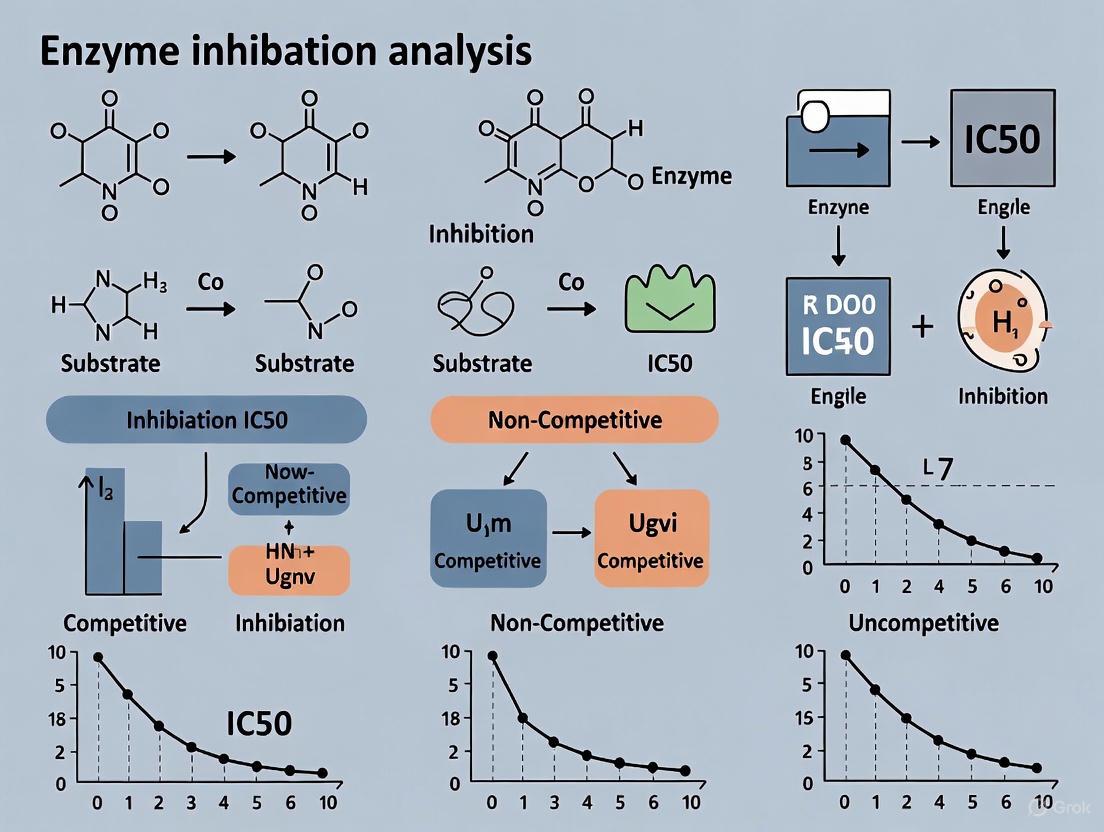
This article provides a comprehensive guide to IC50 estimation, a cornerstone metric for evaluating compound potency in enzymatic assays.
IC50 Estimation in Enzyme Inhibition: A Comprehensive Guide from Fundamentals to Advanced Applications in Drug Discovery
Abstract
This article provides a comprehensive guide to IC50 estimation, a cornerstone metric for evaluating compound potency in enzymatic assays. Tailored for researchers, scientists, and drug development professionals, it covers the foundational principles of IC50, including its definition and relationship to binding affinity. The scope extends to detailed methodological protocols for experimental determination and computational prediction, advanced strategies for troubleshooting and optimizing assays, and rigorous frameworks for data validation and cross-study comparison. By synthesizing current best practices and emerging trends, this resource aims to enhance the accuracy, reliability, and interpretability of IC50 data in pharmacological research and lead optimization.
Understanding IC50: The Fundamental Principles of Enzyme Inhibition Potency
Core Definition and Theoretical Foundation
The Half Maximal Inhibitory Concentration (IC50) is a quantitative measure that indicates how much of a particular inhibitory substance (e.g., a drug) is needed to inhibit a given biological or biochemical process by 50% in vitro [1]. It is a standard measure of the potency of an antagonist drug in pharmacological research [1]. The biological component being inhibited could be an enzyme, a cell, a cell receptor, or a microbe, and IC50 values are typically expressed as molar concentration [1].
The Relationship Between IC50, Ki, and the Cheng-Prusoff Equation
It is critical to understand that the IC50 value is an operational value dependent on assay conditions and is not a direct indicator of the intrinsic affinity of an inhibitor [2]. The absolute measure of affinity is the inhibition constant, Ki, which is the equilibrium dissociation constant for the inhibitor binding to its target [1] [2].
The relationship between IC50 and Ki is formally described by the Cheng-Prusoff equation [1]. For enzymatic reactions, the equation is: [ Ki = \frac{IC{50}}{1 + \frac{[S]}{K_m}} ] where:
- ( K_i ) is the binding affinity of the inhibitor.
- ( IC_{50} ) is the functional strength of the inhibitor.
- ( [S] ) is the fixed substrate concentration.
- ( K_m ) is the Michaelis constant (the concentration of substrate at which the enzyme activity is at half maximal) [1].
A similar equation exists for receptor binding assays, accounting for agonist concentration [1]. Whereas the IC50 value for a compound may vary between experiments depending on experimental conditions, the Ki is an absolute value [1].
pIC50 and its Utility
To facilitate easier comparison of compound potency, IC50 values are often converted to the pIC50 scale [1]. The formula for this conversion is: [ pIC{50} = -log{10}(IC_{50}) ] Due to the minus sign, higher values of pIC50 indicate exponentially more potent inhibitors [1].
Experimental Protocols and Methodologies
General Workflow for IC50 Determination
The following diagram illustrates the core workflow for determining IC50, encompassing both traditional and modern approaches.
Detailed Protocol: Surface Plasmon Resonance (SPR) for Specific IC50 Determination
Surface Plasmon Resonance (SPR) can be used to obtain IC50 values for individual ligand-receptor pairings with high molecular resolution, differentiating it from whole-cell assays [3].
Materials & Reagents:
- SPR Instrument (e.g., Biacore 2000)
- Sensor Chip (e.g., CM5)
- Running Buffer: HBS-EP/BSA (0.01 M HEPES, 0.5 M NaCl, 3 mM EDTA, 0.005% (v/v) Tween 20, 0.1% BSA, pH 7.4)
- Target Protein: Purified receptor-Fc fusion protein (e.g., ActRIIA-Fc, BMPRII-Fc)
- Ligand: The cytokine/growth factor of interest (e.g., BMP-4)
- Inhibitor: The pharmacologic agent being tested (e.g., Cerberus)
- Capture Surface: Anti-human IgG (Fc) antibody, immobilized on the sensor chip via amine-coupling chemistry
- Regeneration solution (e.g., MgCl₂)
Methodology:
- Surface Preparation: Immobilize an anti-Fc antibody onto a CM5 sensor chip using standard amine-coupling chemistry [3].
- Receptor Capture: Dilute the receptor-Fc fusion protein in running buffer and inject it over the experimental flow channel to capture it onto the anti-Fc surface. Aim for a low surface loading (approximately 200-300 Response Units, RU) to minimize steric hindrance and mass transport artifacts [3].
- Binding and Inhibition Assay:
- Pre-incubate a fixed concentration of the ligand (e.g., 60 nM BMP-4) with a range of concentrations of the inhibitor (e.g., Fc-free Cerberus) [3].
- Inject these pre-incubated mixtures over the experimental flow channel (with captured receptor) and a control flow channel.
- Use a high flow rate (e.g., 50 µl/min) to minimize mass transport artifacts.
- Data Analysis:
- Analyze sensorgrams by double referencing to account for nonspecific binding and bulk shifts.
- The reduction in the SPR binding response is proportional to the degree of inhibition.
- The data can be analyzed in two ways [3]:
- Plot the response (at a fixed time, e.g., 150 seconds) against the inhibitor concentration and fit the data to a dose-response curve (e.g., using GraphPad Prism) to determine the IC50.
- Fit the association or dissociation phases of the individual binding curves to obtain kinetic parameters (ka, kd), from which the IC50 can also be derived.
Detailed Protocol: The 50-BOA (IC50-Based Optimal Approach) for Efficient Estimation
A 2025 study introduced a method that substantially reduces the number of experiments required for precise estimation of inhibition constants [4] [5].
Materials & Reagents:
- Standard enzymatic assay components: purified enzyme, substrate, inhibitor, buffer, and detection system.
- Software for nonlinear regression analysis (e.g., provided MATLAB or R packages for 50-BOA).
Methodology:
- Preliminary IC50 Estimation: First, determine an approximate IC50 value from % control activity data over a range of inhibitor concentrations ((IT)) using a single substrate concentration, typically at ( [S] = KM ) [4] [5].
- Single-Point Experimental Design: Instead of using multiple inhibitor concentrations, perform initial velocity measurements using a single inhibitor concentration that is greater than the preliminary IC50 value ((IT > IC{50})), across a range of substrate concentrations [4].
- Data Fitting with Harmonic Mean Relationship: Fit the initial velocity data to the mixed inhibition model (Equation 1, below), while incorporating the harmonic mean relationship between the IC50 and the inhibition constants ((K{ic}) and (K{iu})). This integration is key to the method's accuracy and is handled by the provided software packages [4] [5].
The general equation for the initial velocity of product formation under inhibition is: [ V0 = \frac{V{max} \cdot [ST]}{KM \left(1 + \frac{[IT]}{K{ic}}\right) + [ST] \left(1 + \frac{[IT]}{K{iu}}\right)} ] where (K{ic}) and (K_{iu}) are the inhibition constants for the enzyme and enzyme-substrate complex, respectively [4] [5].
Troubleshooting Guides and FAQs
Frequently Asked Questions (FAQs)
Q1: What is the fundamental difference between IC50 and EC50? A: IC50 measures the potency of an inhibitory substance, indicating the concentration needed to inhibit a process by 50%. In contrast, EC50 (Half Maximal Effective Concentration) measures the potency of an excitatory or activatory substance, representing the concentration that produces 50% of the maximum effect in vivo [1] [6].
Q2: My IC50 value seems to change when I use different substrate concentrations. Is this normal? A: Yes, this is expected behavior for certain types of inhibition, particularly competitive inhibition. According to the Cheng-Prusoff equation, the measured IC50 for a competitive inhibitor will increase with increasing substrate concentrations, while the true Ki remains constant [1] [2]. This is a classic indicator of a competitive inhibition mechanism.
Q3: Why should I use a single high inhibitor concentration as in the 50-BOA method? A: Research has shown that data obtained with low inhibitor concentrations ((IT) much less than (K{ic}) and (K_{iu})) provides little information for precise estimation of inhibition constants and can even introduce bias. Using a single concentration greater than the IC50 provides more informative data for accurate and precise estimation, while also reducing experimental effort by over 75% [4] [5].
Q4: How do I handle time-dependent inhibition in my IC50 experiments? A: Time-dependent inhibition is common with reversible covalent inhibitors. If the IC50 decreases with longer pre-incubation or incubation times, it confirms time-dependence. For rigorous characterization, specialized methods like the EPIC-CoRe numerical model or implicit equations have been developed to fit time-dependent IC50 data and extract individual kinetic parameters (Ki, k₅, k₆) [7]. Simply reporting an IC50 at a single time point can be misleading for these inhibitors.
Common Experimental Issues and Solutions
| Problem | Potential Cause | Solution |
|---|---|---|
| Shallow or irregular dose-response curve | - Incorrect substrate concentration- Enzyme instability- Inhibitor solubility issues | - Verify [S] is at or near Km- Check enzyme activity over time- Use appropriate solvent and ensure inhibitor is fully dissolved |
| High variability between replicates | - Liquid handling inaccuracies- Poor cell viability (in cell-based assays)- Edge effects in microplates | - Calibrate pipettes and liquid handlers- Ensure consistent cell passage and health- Use interior wells and account for evaporation |
| IC50 value inconsistent with literature | - Differences in assay conditions (pH, ionic strength)- Different cell lines or enzyme sources- Variability in substrate purity | - Carefully replicate published assay conditions- Use standardized reagents where possible- Confirm substrate identity and quality |
| Poor fit to the logistic model | - The inhibitor does not follow a simple one-site binding model- Significant inhibitor depletion- Presence of allosteric or other complex mechanisms | - Check for stoichiometry; use lower enzyme concentration- Consider alternative models (e.g., for allosteric inhibitors) |
The Scientist's Toolkit: Essential Research Reagent Solutions
The following table details key reagents and materials essential for conducting robust IC50 estimation experiments.
| Research Reagent | Function in IC50 Analysis | Key Considerations |
|---|---|---|
| Purified Enzyme / Receptor | The primary target of the inhibitory compound. | Source (recombinant vs. native), purity, and activity (U/mg) are critical for reproducibility. |
| Fluorogenic/Chemogenic Substrate | Allows quantification of enzymatic activity through a detectable signal (e.g., fluorescence, absorbance). | Select for specificity, signal-to-noise ratio, and compatibility with the inhibitor (no spectral overlap). |
| Reference Inhibitor (Control Compound) | A well-characterized inhibitor of the target used as a positive control to validate the assay. | Its known IC50/Ki in the system serves as a benchmark for assay performance. |
| High-Quality Chemical Library | A collection of compounds for screening in drug discovery. | Quality control is vital; inaccuracies in public compound data collections have been reported [6]. |
| SPR Sensor Chips (e.g., CM5) | The surface for immobilizing one interactant (e.g., receptor) in label-free binding studies. | The immobilization chemistry (amine, streptavidin) must be compatible with the target protein. |
| COSMO Solvation Model (in MOPAC) | An implicit solvation model used in computational chemistry to account for solvent effects when predicting protein-ligand interaction energies [8] [9]. | Considered robust and accurate for modelling solvent effects in computational docking studies. |
Advanced Concepts and Limitations
Moving Beyond IC50 in Drug Resistance
While IC50 is a valuable measure of potency, it has limitations in predicting clinical outcomes, especially in complex scenarios like drug resistance. A 2024 computational study on Chronic Myeloid Leukemia (CML) treatment contested the use of "fold-IC50" (the ratio of mutant IC50 to wild-type IC50) as the sole guide for treatment selection in resistant disease [10]. The study proposed that a parameter called "inhibitory reduction prowess"—the relative decrease of the product formation rate—could be a better indicator of a drug's efficacy against resistant mutants, as it incorporates more information about the system's dynamics [10].
Limitations of IC50 in High-Throughput Screening
In high-throughput drug discovery, several factors can limit the accuracy of IC50 values [6]:
- Variability in liquid handling can lead to concentration inaccuracies.
- Interactions between reagents and the assay can produce artifacts.
- Assay design and quality significantly influence the data.
- The basic assumption that percent inhibition and IC50 values correlate reasonably can sometimes break down, leaving room for error, especially when using the 4-parameter logistic Hill equation for fitting [6].
Core Concepts: Frequently Asked Questions
What is the fundamental difference between IC50, EC50, Ki, and LD50?
These parameters measure distinct concepts in pharmacology and toxicology. IC50 (Half-Maximal Inhibitory Concentration) is the concentration of an inhibitor that reduces a biological or biochemical process by 50% [11] [12]. EC50 (Half-Maximal Effective Concentration) is the concentration of a drug or agonist that induces a 50% response [11] [12]. Ki (Inhibition Constant) is an intrinsic measure of the binding affinity between an inhibitor and its enzyme or receptor, representing the dissociation constant [11] [13]. LD50 (Median Lethal Dose) is the dose of a substance that causes death in 50% of a test animal population [14] [15].
When should I use IC50 instead of Ki?
Use IC50 for a functional, operational measure of inhibitor potency under specific assay conditions; it is highly dependent on experimental setup, such as substrate concentration and incubation time [11] [16]. Use Ki to understand the true, intrinsic binding affinity between the inhibitor and the target; it is a more fundamental constant that describes the enzyme-inhibitor dissociation equilibrium [11] [13]. Ki is independent of enzyme concentration, while IC50 is dependent on it [13].
My IC50 value shifted when I changed my substrate concentration. Is this normal?
Yes, this is expected and actually reveals the mechanism of inhibition. The relationship between IC50 and substrate concentration [S] is determined by the inhibitor's mechanism [11]:
- Competitive Inhibition: IC50 increases with increasing [S] [11].
- Uncompetitive Inhibition: IC50 decreases with increasing [S] [11].
- Non-competitive Inhibition: IC50 is independent of [S] [11]. This dependency is why Ki is often a more reliable parameter for comparing inhibitors, as it can be derived from IC50 while accounting for the substrate concentration and inhibition mode [11].
Can IC50 and EC50 values ever be the same?
Yes, but only in the specific case where a drug at high concentrations completely inhibits a biological activity. In this scenario, the EC50 (concentration for 50% of the maximum effect) and IC50 (concentration for 50% inhibition) are identical [11]. However, if a drug only partially inhibits an activity even at high concentrations (partial inhibition), the IC50 may be undefined (if 50% inhibition is never reached), while the EC50 can still be reported to quantify the dose-response [11].
How does LD50 relate to these other parameters? Is it a measure of drug potency?
LD50 is fundamentally different from IC50, EC50, and Ki. While the others measure biochemical or pharmacological activity, LD50 is a measure of acute toxicity [14] [15]. It does not directly measure a drug's desired therapeutic potency but its lethal potential. A more relevant measure for a drug's safety is its therapeutic index, which is the ratio between its toxic dose (e.g., LD50) and its effective dose (ED50) [15].
Experimental Protocols & Troubleshooting
Precise Estimation of IC50 and Ki
Background: Traditional IC50 estimation can be resource-intensive and results may vary between studies. A modern approach, the 50-BOA (IC50-Based Optimal Approach), substantially reduces the number of experiments required while improving precision [4].
Protocol: 50-BOA Method for Inhibition Constant Estimation [4]
- Preliminary IC50 Estimation: First, estimate the IC50 from % control activity data across a range of inhibitor concentrations using a single substrate concentration, typically at the Km value [4].
- Optimal Experimental Design: Instead of multiple inhibitor concentrations, use a single inhibitor concentration greater than the estimated IC50.
- Velocity Measurement: Measure the initial reaction velocity (V0) at this optimal inhibitor concentration across multiple substrate concentrations.
- Data Fitting: Incorporate the relationship between IC50 and the inhibition constants (Kic and Kiu) during the fitting of the data to the velocity equation for mixed inhibition to derive the precise inhibition constants.
Troubleshooting Guide:
| Problem | Potential Cause | Solution |
|---|---|---|
| IC50 value is highly variable between replicates | Enzyme concentration is too high, affecting free inhibitor concentration in "tight binding" inhibition [11]. | Ensure enzyme concentration [E]T is much less than the apparent Ki. Apply a tight-binding correction if necessary [11]. |
| Incomplete inhibition, IC50 is undefined | The compound is a partial inhibitor; it cannot fully suppress activity even at high concentrations [11]. | Report the data using EC50 and the maximum % inhibition (efficacy) instead [11]. |
| IC50 decreases with longer pre-incubation time | The inhibitor is time-dependent (e.g., a slow-binding or reversible covalent inhibitor) [7]. | Characterize the IC50 at multiple time points. Use specialized methods (e.g., EPIC-CoRe modeling) to derive the individual inhibition and rate constants [7]. |
| Poor precision in estimated Ki | Sub-optimal choice of substrate and inhibitor concentrations in experimental design [4]. | Adopt the 50-BOA method, which uses a single, optimal inhibitor concentration to reduce bias and improve precision [4]. |
Workflow for Enzyme Inhibition Analysis
The diagram below outlines a generalized workflow for characterizing enzyme inhibitors, integrating traditional and modern approaches.
Advanced Methodologies in IC50 Estimation
Handling Time-Dependent Inhibition with Reversible Covalent Inhibitors
Many potent inhibitors, particularly reversible covalent inhibitors, show time-dependent behavior because they slowly establish a covalent modification equilibrium. This makes their IC50 values dependent on the incubation time [7].
Protocol for Time-Dependent IC50 Analysis [7]:
- Pre-incubation Time-Course: Pre-incubate the enzyme with a range of inhibitor concentrations for varying time periods (tpre).
- Residual Activity Measurement: Initiate the reaction with substrate and measure the initial velocity of product formation to determine the % activity remaining at each tpre and [I].
- IC50 Shift Analysis: Plot IC50 values against pre-incubation time. A decreasing IC50 with longer tpre confirms time-dependent inhibition.
- Global Fitting: Use a numerical modelling method, such as EPIC-CoRe, to fit the time-dependent IC50 data globally. This fitting estimates the fundamental constants:
- Ki: The initial non-covalent inhibition constant.
- k5/k6: The rate constants for the covalent bond formation and breakage.
- Ki^cov: The overall inhibition constant for the covalent equilibrium (calculated as Ki^cov = K_i / (1 + k5/k6)) [7].
Relationship Between Key Parameters
The table below summarizes the core definitions, interpretations, and dependencies of each key parameter.
| Parameter | Full Name | Definition | Key Interpretation | Primary Dependencies |
|---|---|---|---|---|
| IC50 | Half-Maximal Inhibitory Concentration | Concentration of inhibitor that reduces biological activity by 50% [11] [12]. | Functional potency under specific assay conditions. | Substrate concentration, incubation time, enzyme concentration, assay conditions [11] [7]. |
| EC50 | Half-Maximal Effective Concentration | Concentration of an agonist that induces a 50% of its maximum response [11] [12]. | Functional potency for activators/agonists. | Assay conditions, cell type (for cellular assays). |
| Ki | Inhibition Constant | Dissociation constant for the enzyme-inhibitor complex; measures binding affinity [11] [13]. | Intrinsic binding strength between inhibitor and target. | Temperature, pH, inhibition mechanism (defines relationship to IC50) [11]. |
| LD50 | Median Lethal Dose | Single dose that causes death in 50% of a test animal population [14] [15]. | Acute toxicity, not therapeutic effect. | Route of administration, animal species, duration of observation [14]. |
The Scientist's Toolkit: Essential Research Reagent Solutions
| Reagent / Tool | Function in IC50/Ki Research |
|---|---|
| Purified Enzyme Target | The primary macromolecule for in vitro inhibition studies. Essential for mechanistic studies and deriving Ki [4]. |
| Specific Substrate | The natural or synthetic molecule turned over by the enzyme. Its concentration is critical for determining inhibition modality and converting IC50 to Ki [11]. |
| Fluorescent/Chemiluminescent Probes | Enable continuous, high-throughput monitoring of enzyme activity for robust IC50 determination [16]. |
| Positive Control Inhibitors | Compounds with known potency and mechanism. Used to validate assay performance and as benchmarks [16]. |
| Tight-Binding Correction Equations | Mathematical corrections required when inhibitor affinity is so high that the concentration of enzyme significantly depletes the free inhibitor concentration, which would otherwise lead to inaccurate IC50 values [11]. |
For researchers in drug development, accurately assessing a compound's inhibitory potency is fundamental. The IC50 (half-maximal inhibitory concentration) is a frequently determined parameter from experimental binding assays, representing the concentration of an inhibitory ligand that reduces the biological activity of a target by half [17]. However, a significant limitation of the IC50 is its dependence on specific assay conditions, particularly substrate concentration [S], making cross-experiment comparisons problematic [17] [18].
The Cheng-Prusoff equation provides the critical theoretical relationship to convert the experimentally-derived, condition-dependent IC50 into the Ki (inhibitory constant), an absolute measure of binding affinity. The Ki is defined as the equilibrium concentration of an inhibitory ligand required to occupy 50% of the receptor sites in the absence of a competing substrate [17]. Unlike the IC50, the Ki is an intrinsic property of the inhibitor-target interaction, allowing for direct comparison of inhibitor potency across different experimental setups [17] [18].
The fundamental relationship is expressed as: Ki = IC50 / (1 + [S]/Km) [17]
Where:
- Ki: Inhibitory constant (absolute measure of affinity)
- IC50: Half-maximal inhibitory concentration (experimentally measured)
- [S]: Concentration of the substrate used in the binding assay
- Km: Affinity constant of the substrate (Michaelis constant), defined as the equilibrium concentration that results in substrate occupying 50% of the receptor sites in the absence of competition [17]
The equation corrects the apparent IC50 by accounting for the degree of substrate saturation in the assay, thereby revealing the true underlying affinity between the inhibitor and its target.
Figure 1: The experimental workflow for converting a measured IC50 value into a comparable Ki value using the Cheng-Prusoff equation, highlighting the essential assay parameters required for the calculation.
Frequently Asked Questions (FAQs)
What is the fundamental difference between Ki and IC50?
The key difference lies in their dependency and interpretability. The following table summarizes the core distinctions:
| Parameter | Definition | Dependence | Interpretability |
|---|---|---|---|
| IC50 | Operational concentration causing 50% activity inhibition under specific assay conditions [13]. | Depends on substrate concentration ([S]), enzyme concentration ([E]), and assay conditions [17] [13]. | Condition-dependent; cannot be directly compared unless all conditions are identical. |
| Ki | Equilibrium dissociation constant describing the inherent affinity between the inhibitor and the enzyme [13]. | An intrinsic property, independent of substrate and enzyme concentrations (for competitive inhibitors) [17] [13]. | Absolute measure of binding affinity; can be directly compared across different studies and assays. |
A critical operational distinction is that IC50 is always larger than Ki [13]. At 50% inhibition, the total inhibitor concentration ([I]t, i.e., IC50) equals the sum of the free inhibitor ([I]f, i.e., Ki) and the inhibitor bound to the enzyme ([I]b). Therefore, IC50 = [E]/2 + Ki, demonstrating its dependence on enzyme concentration [13].
When is it invalid to use the Cheng-Prusoff equation?
The Cheng-Prusoff relationship is a powerful tool but comes with specific assumptions. Its application is invalid or requires modification in these common scenarios:
- Non-competitive and Uncompetitive Inhibition: The standard equation is derived for competitive inhibition mechanics. Other inhibition types involve different binding sites and mechanisms that alter the relationship between IC50 and Ki.
- Irreversible and Mechanism-Based Inhibition (MBI): For inhibitors that permanently inactivate the enzyme (e.g., many cytochrome P450 inhibitors), the IC50 becomes time-dependent [19] [20]. The Cheng-Prusoff equation does not account for this. For MBIs, the inhibitory potential is more accurately described by the inhibition constant (KI) and the inactivation rate constant (kinact) [19] [20].
- Enzymes with Complex Mechanisms: The equation is designed for simple, single-substrate enzyme kinetics. It cannot be directly applied to bisubstrate enzymes (e.g., histone acetyltransferases like KAT8) without more elaborate kinetic evaluations [18].
- Non-Unity Slope of Agonist Curve: In functional assays, if the concentration-response curve of the agonist has a slope factor (K) significantly different from 1, applying the standard Cheng-Prusoff equation will yield an inaccurate Ki. Modified "power equations" that incorporate the slope function are required for accuracy [21].
Troubleshooting an unexpected Ki value should involve verifying these critical experimental parameters:
- Incorrect Km Value: The Km must be accurately determined under the exact same conditions (pH, temperature, buffer) as the IC50 assay. An inaccurate Km will directly propagate an error into the Ki calculation.
- Inaccurate Substrate Concentration ([S]): The Cheng-Prusoff correction is highly sensitive to [S]. Verify the stock concentration and dilution accuracy of your substrate.
- Misidentified Inhibition Mechanism: Applying the competitive Cheng-Prusoff equation to a non-competitive inhibitor will yield an incorrect Ki. Determine the mechanism of inhibition (e.g., via Dixon plot) before selecting the correct equation.
- Assay Non-Equilibrium: The equation assumes equilibrium conditions. If the inhibitor pre-incubation time is insufficient for the system to reach equilibrium, the measured IC50 will not be valid for Ki conversion.
- High Enzyme Concentration ([E]): The fundamental relationship IC50 = [E]/2 + Ki shows that if the enzyme concentration is too high, the IC50 will significantly overestimate the true Ki, leading to an underestimation of potency [13].
Troubleshooting Guide: Common Experimental Pitfalls
| Problem | Potential Cause | Solution | Key Reference |
|---|---|---|---|
| High variability in calculated Ki | Inaccurate determination of the substrate Km. | Re-determine Km using a Michaelis-Menten experiment under identical assay conditions (pH, T, buffer). | [17] |
| IC50 decreases with pre-incubation time | Time-dependent inhibition, suggesting irreversible or mechanism-based inhibition. | Do not use Cheng-Prusoff. Characterize time-dependence and derive KI and kinact instead [19]. | [19] [20] |
| Ki values not comparable across different labs | Assay conditions (e.g., [S], pH, temperature) are not standardized. | Report all assay conditions in detail. Use Ki, not IC50, for cross-study comparisons. | [17] [22] |
| Curve slope in analysis is not unity | The agonist concentration-response curve has a Hill coefficient ≠ 1. | Use a modified power equation: KB = IC50 / [1 + (A/EC50)K] to account for the slope (K) [21]. | [21] |
| Inhibitor is potent in assay but weak in cells | The inhibitor may be a bisubstrate competitor; IC50 is misleading. | Perform full kinetic characterization to determine Ki for different enzyme forms (e.g., free vs. acetylated KAT8) [18]. | [18] |
Advanced Applications and Protocols
Protocol: Determining KI and kinact for Mechanism-Based Inhibitors
For time-dependent inhibitors, follow this established methodology [19] [20]:
- Time-Course Experiment: Measure IC50 values at multiple time points (e.g., 0, 5, 15, 30 minutes) of pre-incubation of the enzyme with the inhibitor.
- Data Transformation: Plot the observed IC50 values against the pre-incubation time. You will observe a decrease in IC50 over time.
- Model Fitting: Fit the time-dependent IC50 data to a relevant kinetic model derived for mechanism-based inhibition to directly estimate the inactivation constant (KI) and the maximum inactivation rate (kinact).
- Validation: This method allows for the direct estimation of KI and kinact from IC50 values without the need for additional, more complex pre-incubation experiments, streamlining the screening process for irreversible inhibitors [19].
Case Study: Ki Determination for a Bisubstrate Enzyme (KAT8)
Research on KAT8, a histone acetyltransferase, highlights the limitations of IC50 and the necessity of full kinetic characterization for complex systems [18]:
- Fragment Screening: A screen identified 4-amino-1-naphthol as a hit with an IC50 of 9.7 ± 3.0 μM.
- Kinetic Analysis: Further investigation went beyond the IC50 to calculate the Ki values for the inhibitor binding to different enzymatic forms: the free enzyme (Ki1 = 2.6 μM) and the acetylated enzyme intermediate (Ki2 = 0.017 μM).
- Critical Insight: The Ki2 value revealed an exceptionally high potency for the acetylated enzyme that was entirely obscured by the IC50 value. This demonstrates that for bisubstrate enzymes, comprehensive kinetic characterization is crucial to uncover the true binding affinities and mechanism of inhibition, which cannot be captured by IC50 alone [18].
Figure 2: A decision tree for selecting the correct analytical path to convert an IC50 value into a meaningful inhibition constant, accounting for time-dependent inhibition, complex enzyme mechanisms, and non-ideal data slopes.
The Scientist's Toolkit: Essential Reagents and Materials
| Reagent / Material | Function in Inhibition Assays | Critical Consideration |
|---|---|---|
| Purified Enzyme Target | The biological macromolecule whose activity is being modulated. | Purity, stability, and concentration ([E]) must be precisely known and controlled [13] [22]. |
| Inhibitory Ligand | The test compound whose binding affinity (Ki) is being determined. | Solubility, stability in assay buffer, and absence of chemical reactivity are key. |
| Labeled Substrate | The molecule converted by the enzyme; often radiolabeled or fluorogenic for detection. | The substrate's Km must be predetermined. The concentration [S] used in the IC50 assay must be accurately known [17]. |
| Appropriate Buffer System | Maintains optimal pH and ionic strength for enzyme activity. | The pH and ionic composition can affect enzyme Km and inhibitor binding; must be standardized [22]. |
In enzyme inhibition analysis and drug discovery, the half maximal inhibitory concentration (IC50) is a fundamental metric used to quantify the potency of a substance. It represents the concentration of an inhibitor required to reduce a biological or biochemical process by half [1]. Traditionally reported in molar units (e.g., nM, μM), IC50 values can span several orders of magnitude, presenting challenges for data analysis and interpretation. The pIC50 is defined as the negative logarithm (base 10) of the IC50 molar concentration: pIC50 = -log10(IC50) [23] [1]. This transformation shifts potency measurement from an arithmetic to a logarithmic scale, which more accurately reflects the underlying biological phenomena. Dose-dependent inhibition is inherently a logarithmic process, making pIC50 a more natural and intuitive scale for reporting and analyzing potency data [23] [24]. This technical guide explores the advantages of this transformation and provides practical solutions for common experimental challenges.
Key Advantages and Troubleshooting FAQs
1FAQ: Why should I switch from IC50 to pIC50 for reporting my data?
Answer: Using pIC50 transforms your data to a scale that aligns with the logarithmic nature of concentration-response relationships, leading to clearer data presentation and more robust statistical analysis [23] [24].
- Simplified Communication: pIC50 allows you to represent potency using approximately two significant figures, covering both micromolar and nanomolar ranges efficiently (e.g., pIC50 6.0 for 1 μM, pIC50 9.0 for 1 nM). This eliminates mental gymnastics for your audience and helps them focus on the structure-activity relationships (SAR) [23].
- Intuitive Potency Ranking: On the pIC50 scale, higher values always indicate greater potency. This eliminates the potential confusion with IC50, where lower numerical values indicate higher potency [23] [25].
- Correct Averaging of Replicates: IC50 values should be averaged using the geometric mean, not the arithmetic mean, because they are exponential values. With pIC50, you can simply use the arithmetic mean because the data is already in a logarithmic space [23].
Table: Comparison of IC50 and pIC50 Values for Common Potency Ranges
| Potency | IC50 | pIC50 |
|---|---|---|
| Very High | 1 nM | 9.0 |
| High | 10 nM | 8.0 |
| Moderate | 100 nM | 7.0 |
| Low | 1 μM | 6.0 |
| Very Low | 10 μM | 5.0 |
2FAQ: How do I correctly average replicate IC50 measurements?
Problem: Incorrectly using arithmetic mean for IC50 values, which are log-normally distributed. Solution: Convert IC50 values to pIC50, calculate the arithmetic mean of the pIC50 values, and then convert back if needed [23].
Example: You have three replicate IC50 determinations: 1 nM (10⁻⁹ M), 10 nM (10⁻⁸ M), and 5 nM (~5×10⁻⁹ M).
- Incorrect Method: Arithmetic mean of IC50 = (1 + 10 + 5) / 3 = 5.33 nM
- Correct Method:
- Convert to pIC50: -log10(10⁻⁹) = 9.0, -log10(10⁻⁸) = 8.0, -log10(5×10⁻⁹) ≈ 8.3
- Calculate arithmetic mean: (9.0 + 8.0 + 8.3) / 3 ≈ 8.43
- Convert back to IC50 if needed: 10^(-8.43) ≈ 3.7 nM
Table: Correct vs. Incorrect Averaging of Replicate Data
| Method | Average IC50 | Average pIC50 | Notes |
|---|---|---|---|
| Arithmetic Mean (IC50) | 5.33 nM | ~8.27 | Incorrect, statistically unsound |
| Geometric Mean (IC50) | ~3.7 nM | ~8.43 | Correct but requires complex calculation |
| Arithmetic Mean (pIC50) | ~3.7 nM | ~8.43 | Correct & mathematically simple |
3FAQ: How can logarithmic thinking improve my experimental design?
Problem: Poorly spaced dilution series points leading to clumped data on logarithmic plots. Solution: Design dilution series using logarithmic spacing for optimal data point distribution [23].
A common mistake is using half-decade dilutions like 1,000, 500, 100 nM, which appear evenly spaced on a linear scale but clump together on a logarithmic scale. The number halfway between 1 and 10 on a log scale is approximately 3 (10^0.5). A better dilution series is: 1,000 nM, 300 nM, 100 nM, 30 nM, 10 nM. This approach ensures points are evenly spaced when plotted on a log-scale concentration axis, providing more reliable data from the same number of experimental points [23].
Diagram: Impact of Dilution Series Design on Data Distribution
4FAQ: What are the implications of pIC50 for statistical analysis and data reliability?
Problem: Incorrect interpretation of confidence intervals and standard errors for IC50 values. Solution: Understand that curve-fitting software typically reports 95% confidence intervals for IC50 rather than standard error because standard error of an arithmetic value doesn't make sense with logarithmic data [23].
Attempting to calculate standard error on raw IC50 values can lead to biologically impossible results, such as negative IC50 values, when the error bars extend below zero. This occurs when applying linear statistical methods to exponential data. The pIC50 scale provides a more appropriate foundation for statistical testing and reliability reporting, as the values are normally distributed and conform better to the assumptions of parametric statistics [23].
Practical Implementation Guide
Conversion Formulas and Calculations
Essential conversion formulas:
- IC50 to pIC50: pIC50 = -log10(IC50) where IC50 is in molar concentration [23] [1]
- pIC50 to IC50: IC50 = 10^(-pIC50) [23]
- Handling different units: First convert IC50 to molar units, then apply the formula (e.g., for 10 nM: 10 nM = 10×10⁻⁹ M = 10⁻⁸ M; pIC50 = -log10(10⁻⁸) = 8.0)
Table: pIC50 Conversion Examples for Common Units
| IC50 Value | Units | Molar Concentration | pIC50 |
|---|---|---|---|
| 1 | nM | 1 × 10⁻⁹ M | 9.0 |
| 10 | nM | 1 × 10⁻⁸ M | 8.0 |
| 100 | nM | 1 × 10⁻⁷ M | 7.0 |
| 1 | μM | 1 × 10⁻⁶ M | 6.0 |
| 10 | μM | 1 × 10⁻⁵ M | 5.0 |
Data Presentation Guidelines
When presenting pIC50 data in publications or reports:
- Consistent Significant Figures: Report pIC50 values with one digit before and one after the decimal point (e.g., 6.3, 8.1) [23] [26]
- Table Formatting: Express all values with the same number of decimal places in a given table, with the standard error of the mean (SEM) having the same number of decimal places as the mean value [26]
- Context: Always indicate that values represent pIC50 and reference the original IC50 values in supplementary materials if needed for absolute concentration information
The Scientist's Toolkit: Research Reagent Solutions
Table: Essential Resources for Enzyme Inhibition Analysis
| Resource / Tool | Function / Application | Notes |
|---|---|---|
| GOLD Docking Software | Protein-ligand docking to generate putative binding conformations | Used in computational prediction of enzyme inhibition [9] |
| MOPAC Program | Semiempirical quantum mechanics calculations for geometry optimization and energy prediction | Implements methods like PM6-ORG for protein-ligand interaction energies [9] |
| COSMO Solvent Model | Implicit solvation model accounting for desolvation penalties in binding | Robust and accurate method for modeling solvent effects [9] |
| 50-BOA Framework | Efficient estimation of inhibition constants using single inhibitor concentration >IC50 | Reduces experimental requirements by >75% while maintaining precision [4] |
| pIC50 Calculator | Instant conversion between IC50 and pIC50 values | Online tools available for quick transformations [25] |
Advanced Concepts: Integrating pIC50 in Modern Research
Computational Prediction of Enzyme Inhibition
Modern approaches to enzyme inhibition analysis combine computational and experimental methods. A typical workflow involves:
- Ligand Docking: Using programs like GOLD to generate multiple ligand conformations within the protein binding site [9]
- Geometry Optimization: Refining these structures using semiempirical quantum mechanics methods (e.g., PM6-ORG in MOPAC) [9]
- Energy Calculation: Predicting binding energies that correlate with experimental IC50 values [9]
- Validation: Comparing computational predictions with experimentally determined pIC50 values
Diagram: Computational Prediction of Enzyme Inhibition
Emerging Methodologies
Recent research has introduced innovative approaches to enzyme inhibition analysis:
- 50-BOA (IC50-Based Optimal Approach): This methodology demonstrates that precise estimation of inhibition constants is possible using a single inhibitor concentration greater than the IC50, substantially reducing experimental requirements while maintaining accuracy [4]
- Harmonic Mean Relationship: Incorporating the relationship between IC50 and inhibition constants into the fitting process improves precision even with reduced datasets [4]
- Error Landscape Analysis: Systematic analysis of estimation error landscapes helps identify optimal experimental designs for different inhibition types [4]
The adoption of pIC50 represents more than a simple unit conversion—it embodies a fundamental shift toward logarithmic thinking that aligns with the nature of dose-response relationships. This transformation enables clearer communication of structure-activity relationships, statistically sound data averaging, improved experimental design, and appropriate interpretation of data reliability. As enzyme inhibition analysis continues to evolve with new computational and experimental methodologies, the pIC50 scale provides a consistent, intuitive framework for reporting and comparing compound potency across studies and disciplines. By integrating pIC50 into routine practice, researchers can enhance the quality, reliability, and impact of their scientific communications in drug discovery and biochemical research.
For researchers in drug discovery and development, accurately determining the half-maximal inhibitory concentration (IC₅₀) is a fundamental step in characterizing compound potency. However, the IC₅₀ is not an absolute value; it is highly dependent on the experimental conditions, particularly the mechanism of enzyme inhibition and the substrate concentration present in the assay [16] [27]. Misinterpretation of IC₅₀ data without understanding these relationships can lead to flawed conclusions about a compound's true efficacy and potential. This guide provides troubleshooting advice and foundational knowledge to help scientists navigate the complexities of enzyme inhibition analysis, ensuring more reliable and interpretable results for your research.
The IC₅₀ represents the concentration of an inhibitor required to reduce enzyme activity by 50% under a specific set of assay conditions [2]. It is an operational parameter, whereas the inhibition constant (Ki) is a thermodynamic constant defining the absolute binding affinity between the enzyme and the inhibitor [27]. The core challenge is that the relationship between IC₅₀ and Ki is governed by the inhibitor's mechanism of action.
The table below summarizes how the IC₅₀ is affected for different types of reversible inhibitors as substrate concentration [S] changes.
Table 1: Relationship Between Inhibition Type, Kinetic Parameters, and IC₅₀
| Inhibition Type | Binding Site | Effect on Km (app) | Effect on Vmax (app) | IC₅₀ vs. [S] Relationship |
|---|---|---|---|---|
| Competitive | Free Enzyme (E) only [28] | Increases [28] [29] | No change [28] [29] | IC₅₀ increases with increasing [S] [27]. |
| Non-Competitive | E and ES with equal affinity [29] | No change [29] | Decreases [29] | IC₅₀ is independent of [S] [27]. |
| Uncompetitive | Enzyme-Substrate Complex (ES) only [28] | Decreases [28] [29] | Decreases [28] [29] | IC₅₀ decreases with increasing [S] [27]. |
| Mixed | E and ES with different affinity [29] | Increases or Decreases [28] | Decreases [28] | Dependent on which constant (Ki or αKi) dominates; typically decreases with [S] [27]. |
The following diagram illustrates the logical workflow for determining the mechanism of action based on enzyme kinetics data.
Experimental Protocols & Best Practices
Standard Protocol for IC₅₀ Determination
This protocol outlines the canonical method for determining IC₅₀ and gathering preliminary data on the mechanism of inhibition.
Preliminary IC₅₀ Estimation:
- Run an initial inhibition assay at a single substrate concentration, typically at or below the Km value for that substrate [28].
- Use a wide range of inhibitor concentrations (e.g., from pM to μM) in a dose-response curve.
- Fit the data to a four-parameter logistic model to calculate the initial IC₅₀ value [2].
Expanded Experimental Matrix for Mechanism:
- Design: Establish an experimental design using substrate concentrations at least at 0.2Km, Km, and 5Km [4]. For each substrate concentration, test a range of inhibitor concentrations, typically including 0, ¹/³ IC₅₀, IC₅₀, and 3x IC₅₀ (based on the initial estimate) [4].
- Measurement: For each combination of substrate and inhibitor concentration, measure the initial velocity of the enzymatic reaction [28] [4].
- Data Fitting: Fit the collective initial velocity data to the appropriate inhibition model (e.g., the general equation for mixed inhibition) to estimate the inhibition constants (Kic and Kiu) and identify the inhibition type [4].
Advanced & Optimized Protocol (50-BOA)
Recent research suggests a more efficient framework called the IC₅₀-Based Optimal Approach (50-BOA) for estimating inhibition constants, which requires significantly fewer experiments [4].
Initial IC₅₀: Determine the IC₅₀ value at a single substrate concentration (e.g., [S] = Km) as in the preliminary step above.
Single Inhibitor Concentration Experiment:
- Using a single inhibitor concentration greater than the estimated IC₅₀, measure the initial reaction velocity across a range of substrate concentrations [4].
- Key Innovation: This method incorporates the harmonic mean relationship between IC₅₀ and the inhibition constants (Kic and Kiu) into the fitting process, allowing for precise estimation of these constants from a drastically reduced dataset [4].
Data Analysis: Use provided software packages (available in MATLAB and R) to fit the data from step 2 and directly estimate the inhibition constants and identify the inhibition type [4].
Frequently Asked Questions (FAQs)
Q1: Why do I get different IC₅₀ values for the same inhibitor when I use different substrate concentrations in my assay? This is a classic indicator that your inhibitor is likely competitive. As shown in Table 1, for competitive inhibitors, the IC₅₀ increases as you increase the substrate concentration because the substrate and inhibitor are competing for the same binding site. A higher substrate concentration requires more inhibitor to achieve the same level of inhibition [27]. If your IC₅₀ is constant across substrate concentrations, it suggests a non-competitive mechanism.
Q2: My compound is a potent inhibitor in a biochemical assay (low IC₅₀) but shows no activity in a cell-based assay. What could be the reason? This common issue can have several causes, but the mechanism of inhibition can be a key factor. If the inhibitor is competitive with a substrate that is present at high intracellular concentrations, it may show poor cellular activity because the high substrate levels out-compete the inhibitor [28]. Other common reasons include poor cellular permeability, efflux by transporters, or extensive metabolic degradation [28].
Q3: When should I use Ki instead of IC₅₀ to report my results? You should use Ki when your goal is to report the true, intrinsic binding affinity of the inhibitor for the enzyme. The Ki is a constant that is independent of assay conditions [27]. The IC₅₀ is more appropriate when you want to report the functional potency under a specific, defined set of experimental conditions (e.g., "at a substrate concentration of 10 μM") [16] [27]. For publication and accurate comparison between compounds, determining the Ki is considered best practice.
Q4: What are "tight-binding" inhibitors and why are they problematic for IC₅₀ determination? Tight-binding inhibitors are characterized by an apparent affinity (Ki) that is near the concentration of enzyme ([E]T) present in the assay [28]. This leads to significant depletion of the free inhibitor concentration, violating a key assumption of standard Michaelis-Menten kinetics and causing the observed IC₅₀ to be higher than the true value. In these cases, the standard Cheng-Prusoff equation for converting IC₅₀ to Ki is invalid, and tight-binding equations must be applied for accurate analysis [28] [27].
The Scientist's Toolkit: Key Research Reagents
Table 2: Essential Materials for Enzyme Inhibition Assays
| Reagent / Material | Function in Inhibition Analysis |
|---|---|
| Recombinant Target Enzyme | The protein of interest against which inhibitors are screened. Purity and activity are critical. |
| Natural Substrate(s) | Used to characterize the enzyme's natural kinetic parameters (Km, Vmax) and for running inhibition assays under physiologically relevant conditions. |
| Inhibitor Compounds | The molecules being tested. Should be dissolved in a compatible solvent (e.g., DMSO) at a stock concentration that does not interfere with the assay. |
| Cofactors (e.g., Mg²⁺, NADPH) | Essential for the activity of many enzymes. Their concentration must be optimized and kept constant. |
| Detection Reagents | Used to monitor product formation or substrate depletion (e.g., chromogenic/fluorogenic substrates, coupled enzyme systems, fluorescent probes). |
| Buffers | To maintain a stable pH throughout the experiment. The buffer composition can sometimes affect inhibitor binding. |
Further Analysis
Once you have used IC₅₀ data to hypothesize an inhibition mechanism, the next step is to perform a full steady-state kinetic analysis. This involves measuring initial velocities at multiple substrate and inhibitor concentrations and fitting the data to linearized plots (e.g., Lineweaver-Burk) or directly to nonlinear regression models of the Michaelis-Menten equation modified for different inhibition types [28]. This analysis allows for the determination of the true Ki value and confirms the binding mechanism. For more complex cases, such as time-dependent or irreversible inhibition, more specialized experimental designs are required [28].
Methods for IC50 Determination: From Experimental Assays to Computational Prediction
Enzyme inhibition analysis is a cornerstone of drug development, food processing, and fundamental biochemical research. It is essential for predicting drug-drug interactions, understanding metabolic pathways, and designing effective therapeutic agents. This technical support resource, framed within the context of advanced IC50 estimation research, provides scientists with practical troubleshooting guides and detailed methodologies to enhance the robustness and reliability of their enzyme inhibition assays.
Key Variables in Enzyme Inhibition Assays
The accuracy of an enzyme inhibition assay is highly dependent on several critical variables. Precise control and standardization of these parameters are fundamental to obtaining reproducible results.
Table 1: Key Variables and Their Optimal Ranges in Enzyme Inhibition Assays
| Variable | Impact on Assay | Recommended Range / Conditions | Rationale & Considerations |
|---|---|---|---|
| Temperature | Directly affects reaction rate; instability causes high variability. | Typically 25°C or 37°C; must be stable within ±0.1°C. | A 1°C change can alter enzyme activity by 4-8% [30]. 37°C is physiological, but 25°C is often used for experimental convenience [22]. |
| pH | Affects enzyme and substrate charge/shape, impacting binding and catalysis. | Enzyme-specific optimal pH (often near pH 7.5 for mammalian enzymes) [22]. | Alters protonation states of key catalytic residues. Buffer type and ionic strength must be consistently controlled [30]. |
| Enzyme Concentration | Must be within the linear range for accurate velocity measurement. | Must be determined empirically; low enough to not deplete substrate. | High enzyme concentrations can lead to non-linear kinetics and rapid substrate depletion [22]. |
| Substrate Concentration ([S]) | Critical for defining the inhibition mechanism and calculating Ki. | Should span a range above and below the Km value [28]. | Running assays at or below the Km is common in screening, but full mechanistic studies require a wider range [28]. |
| Inhibitor Concentration ([I]) | Determines the dose-response relationship and IC50 calculation. | A single concentration >IC50 can be sufficient for precise Ki estimation [4]. | Traditional methods use multiple concentrations (e.g., 0, 1/3 IC50, IC50, 3 IC50), but new methods show this can introduce bias [4]. |
| Ionic Strength & Buffer | Can influence enzyme stability, activity, and inhibitor binding. | Must be optimized for the specific enzyme and be consistent [31]. | High salt can inhibit certain enzymes; purification methods can leave salts that carry over into the reaction [32]. |
Troubleshooting Guide: Common Experimental Issues
This section addresses specific problems researchers may encounter during inhibition assays, their likely causes, and evidence-based solutions.
Table 2: Troubleshooting Common Enzyme Inhibition Assay Problems
| Problem | Potential Cause | Solution |
|---|---|---|
| No or Low Activity | • Incorrect buffer or wrong pH• Enzyme denaturation• Inhibition by contaminants (e.g., salts from spin columns) [32]• Missing essential cofactor | • Verify buffer composition and pH.• Ensure proper enzyme storage and handling.• Clean up DNA/protein to remove contaminants; ensure reaction volume is not >25% DNA solution to dilute salts [32]. |
| Inconsistent Results (High Well-to-Well Variation) | • Temperature instability [30]• "Edge effects" in microplates due to evaporation [30]• Improper or inconsistent pipetting technique | • Use an instrument with superior temperature control.• Use a discrete analyzer with disposable cuvettes to avoid edge effects [30].• Calibrate pipettes and train users. |
| Unexpected Kinetics (Non-Michaelis-Menten) | • Time-dependent inhibition (slow binding) [28]• Tight-binding inhibition (where [I] ≈ [E]) [28]• Enzyme instability during the assay | • Pre-incubate enzyme and inhibitor; analyze progress curves for slow onset [28].• Use lower enzyme concentrations or account for tight-binding in data analysis [28].• Shorten assay duration or add stabilizing agents. |
| Inhibition Pattern Does Not Match Expectations | • Misidentification of inhibition mechanism.• Presence of "star activity" (altered specificity) in restriction enzymes [32].• Substrate depletion at low concentrations. | • Re-run assays with a wider range of [S] and [I]. Use models (e.g., mixed inhibition) that do not require prior mechanistic knowledge [4].• Use High-Fidelity (HF) enzymes; reduce units and incubation time [32].• Ensure initial velocity conditions where <10% substrate is consumed. |
| Extra Bands or Smears in Gel-Based Assays | • Restriction enzyme bound to DNA [32].• Nuclease contamination. | • Lower the number of enzyme units; add SDS (0.1-0.5%) to the loading dye [32].• Use fresh running buffer and agarose gel; clean up DNA [32]. |
Frequently Asked Questions (FAQs)
1. What are the fundamental types of reversible enzyme inhibition, and how do I distinguish between them kinetically?
There are three primary types of reversible inhibition, classified by how the inhibitor interacts with the enzyme:
- Competitive Inhibition: The inhibitor (I) binds only to the free enzyme (E) at the active site, competing directly with the substrate (S). This increases the apparent K~M~ without changing V~max~ [28] [33].
- Noncompetitive Inhibition: The inhibitor binds to both the free enzyme and the enzyme-substrate complex (ES) with equal affinity at a site other than the active site. This decreases the apparent V~max~ without changing the K~M~ [28].
- Uncompetitive Inhibition: The inhibitor binds only to the ES complex. This decreases both the apparent V~max~ and the apparent K~M~ [28].
Mixed inhibition, where the inhibitor binds to both E and ES but with different affinities, is also common. The type of inhibition is distinguished by running a series of reactions with varying substrate concentrations in the presence of different fixed concentrations of inhibitor and analyzing the data on a Lineweaver-Burk (double-reciprocal) plot [34].
2. My compound is a potent inhibitor in a biochemical assay but shows no activity in cells. What could explain this discrepancy?
This common issue can have several causes:
- Cellular Permeability: The inhibitor may not effectively cross the cell membrane to reach its intracellular target [28].
- High Intracellular Substrate Concentration: If the inhibitor is competitive, a high local concentration of the natural substrate inside the cell can outcompete the inhibitor, reducing its apparent potency [28].
- Plasma Protein Binding: The inhibitor may be highly bound to proteins in the culture medium or serum, reducing the free concentration available to enter cells.
- Metabolic Instability: The inhibitor could be rapidly degraded or modified by cellular metabolism before it can act on the target.
3. What is IC50, and how does it relate to the inhibition constant (Ki)?
The IC50 (Half-Maximal Inhibitory Concentration) is the concentration of an inhibitor required to reduce the enzyme's activity by half under a specific set of experimental conditions (e.g., a fixed substrate concentration). It is an empirical measure of potency. The K~i~ (Inhibition Constant) is a thermodynamic constant representing the dissociation constant of the enzyme-inhibitor complex. It is independent of assay conditions. The relationship between IC50 and Ki depends on the mechanism of inhibition and the substrate concentration. For a competitive inhibitor, IC50 = K~i~ (1 + [S]/K~M~). Therefore, the Ki is always less than or equal to the IC50 [4].
4. New research suggests a simplified method for estimating inhibition constants. How does it work?
A recent advanced method, termed the 50-BOA (IC50-Based Optimal Approach), demonstrates that precise and accurate estimation of inhibition constants (K~ic~ and K~iu~) for all types of inhibition (including mixed) is possible using data from a single inhibitor concentration that is greater than the IC50 value [4]. This approach incorporates the known relationship between IC50 and the inhibition constants into the fitting process. It can reduce the number of required experiments by over 75% compared to traditional multi-concentration designs, while also avoiding bias introduced by data from low inhibitor concentrations [4].
Essential Reagents and Materials
Table 3: Research Reagent Solutions for Enzyme Inhibition Assays
| Reagent / Material | Function in the Assay | Key Considerations |
|---|---|---|
| Purified Target Enzyme | The biological catalyst whose activity is being measured and inhibited. | Source (recombinant vs. native), purity, stability, and concentration are critical. Must be free of contaminants. |
| Specific Substrate | The molecule converted to product by the enzyme; its transformation is monitored. | Choose a substrate with high specificity for the target enzyme. Concentration must be carefully chosen relative to Km. |
| Inhibitor Compounds | The molecules being tested for their ability to reduce enzyme activity. | Solubility in assay buffer is crucial. DMSO is a common solvent, but final concentration must be kept low to not denature the enzyme. |
| Assay Buffer | Provides the optimal chemical environment (pH, ionic strength) for the enzyme. | Buffer type (e.g., phosphate, Tris), pH, and ionic strength must be optimized and controlled for each enzyme [31] [22]. |
| Cofactors / Cations | Essential for the activity of many enzymes (e.g., Mg2+ for kinases). | Required concentration must be determined and included in the assay mixture. |
| Detection Reagents | Used to monitor the reaction, e.g., chromogenic/fluorogenic probes, or reagents for coupled assays. | Must be compatible with the enzyme reaction and not inhibitory. The signal should be linear with product formation. |
Visualizing Inhibition Mechanisms and Workflows
Diagram 1: Biochemical Mechanisms of Enzyme Inhibition
This diagram illustrates the fundamental mechanisms of reversible enzyme inhibition, showing the interactions between enzyme (E), substrate (S), and inhibitor (I).
Diagram 2: Optimized Experimental Workflow for IC50/Ki Estimation
This workflow outlines the streamlined 50-BOA protocol for efficient estimation of inhibition parameters, reducing experimental burden while maintaining precision [4].
Designing robust enzyme inhibition assays requires meticulous attention to biochemical variables, a deep understanding of inhibition kinetics, and awareness of common pitfalls. By applying the troubleshooting guidelines, optimized protocols, and theoretical frameworks presented here, researchers can significantly improve the quality and reliability of their data. The adoption of advanced methods like the 50-BOA can further streamline the process, accelerating research in drug discovery and biochemical analysis.
Core Concepts and Thesis Context
This guide details the practical application of Functional Antagonist Assays and Competition Binding Assays, two pivotal techniques in modern drug discovery. These assays are fundamental for quantifying compound efficacy and potency, particularly within enzyme inhibition analysis and IC50 estimation research. The accurate determination of a half-maximal inhibitory concentration (IC50) is a cornerstone in vitro measurement for advancing pharmacological candidates. Recent research underscores the critical relationship between IC50 values and fundamental inhibition constants (Kic and Kiu), with novel methodologies like the "IC50-Based Optimal Approach" (50-BOA) demonstrating that precise estimation of these constants is achievable with significantly streamlined experimental designs, reducing the required number of experiments by over 75% [4]. This guide integrates these advanced concepts with hands-on troubleshooting to empower researchers in generating robust, reproducible data.
Troubleshooting Guides and FAQs
Frequently Asked Questions
Q1: What is the fundamental difference between a competitive binding assay and a functional antagonist assay?
- A1: A competitive binding assay directly measures the binding interaction between a ligand and its target, typically using a labeled analyte to compete with an unlabeled test compound for a limited number of binding sites [35]. The amount of bound labeled analyte is inversely proportional to the concentration of the competing unlabeled analyte [35]. In contrast, a functional antagonist assay measures the downstream biological consequence of that binding, such as the inhibition of an enzyme's ability to convert a substrate to a product, which is then used to calculate an IC50 value.
Q2: Why is my IC50 value inconsistent with reported literature values for the same compound?
- A2: Discrepancies in IC50 values often originate from methodological differences. Key factors include:
- Stock Solution Preparation: Differences in the preparation of 1 mM stock solutions are a primary reason for EC50/IC50 variations between labs [36].
- Assay Conditions: Parameters like Mg²⁺ concentration, NaCl concentration, GDP concentration (for GPCR assays), and membrane protein amount per well can drastically affect the signal and calculated potency [37].
- Enzyme Source and Form: The compound may be targeting an inactive form of the kinase in a cell-based assay, whereas a biochemical assay uses the active form [36].
- A2: Discrepancies in IC50 values often originate from methodological differences. Key factors include:
Q3: How does the Z'-factor relate to my assay window, and what is acceptable?
- A3: The Z'-factor is a key statistical parameter that assesses assay quality and robustness by incorporating both the assay window (the difference between the maximum and minimum signals) and the variability (standard deviation) of the data [36]. A large assay window with high noise can have a poorer Z'-factor than a small window with low noise. Assays with a Z'-factor > 0.5 are considered excellent and suitable for screening [37] [36]. The formula is:
Z' = 1 - [3*(SD_max) + 3*(SD_min)] / (Mean_max - Mean_min)[36].
- A3: The Z'-factor is a key statistical parameter that assesses assay quality and robustness by incorporating both the assay window (the difference between the maximum and minimum signals) and the variability (standard deviation) of the data [36]. A large assay window with high noise can have a poorer Z'-factor than a small window with low noise. Assays with a Z'-factor > 0.5 are considered excellent and suitable for screening [37] [36]. The formula is:
Troubleshooting Common Problems
The table below summarizes common issues, their potential causes, and solutions.
Table 1: Troubleshooting Guide for Assay Performance Issues
| Problem | Potential Causes | Recommended Solutions |
|---|---|---|
| No or Weak Signal | ||
| High Background Signal | ||
| High Variability Between Replicates | ||
| Poor Dynamic Range / No Assay Window |
Essential Experimental Protocols
Protocol 1: Flow Cytometry-Based Functional Assay
This protocol is a general guide for assessing cellular functions like apoptosis, oxidative stress, and phagocytosis [39].
Solutions and Reagents: Phosphate buffer (PBS), staining buffer, blocking buffer, primary and secondary antibodies, antibody dilution buffer, fixative, permeabilizer, and washing buffer [39].
Procedure:
- Sample Preparation: Obtain a homogeneous single-cell suspension from adherent cells, non-adherent cells, or tissue samples. Gently mix the suspension, obtain a cell count, and resuspend cells in staining buffer to the appropriate concentration [39].
- Blocking: Incubate cells with a blocking agent to prevent non-specific antibody binding. No washing is required after this step to maintain blocking throughout the procedure [39].
- Functional Assay Staining: Select specific reagents (e.g., antibodies, fluorescent dyes) for the key cellular process you are investigating. Incubate cells with these reagents under optimized conditions (e.g., 4°C) [39].
- Detection and Analysis: Run samples on a flow cytometer, collect the data, and analyze it using appropriate flow cytometry data analysis software [39].
Protocol 2: GTPγS Binding Assay for GPCR Targets
This functional assay measures G-protein activation, a proximal event to GPCR activation, and is useful for differentiating agonists and antagonists [37].
Materials and Reagents:
- Membranes: Crude homogenates, plasma membrane preparations, or commercially available membranes [37].
- Assay Buffer: Typically contains HEPES or Tris HCl, NaCl, and MgCl₂ [37].
- Key Reagents: GTPγ³⁵S, WGA SPA beads or antibody-coated SPA beads, GDP, and detergents like NP-40 for antibody capture assays [37].
Procedure (Whole Membrane Assay using WGA SPA beads):
- Incubation: In a 96-well plate, incubate membranes, GTPγ³⁵S, and test compounds in a 200 µL reaction volume at room temperature for 30-60 minutes [37].
- Bead Addition: Add 50 µL per well of suspended WGA SPA beads (1 mg/well) [37].
- Capture and Counting: Seal the plates, incubate for one hour at room temperature, centrifuge at 200 x g, and count the plates in a suitable counter (e.g., Wallac microbeta) [37].
Critical Optimization Steps:
- Membrane and GDP: Determine the optimal membrane protein (5-50 µg/well) and GDP concentration (0-300 µM). Gi/o-coupled receptors require higher GDP than Gs or Gq-coupled receptors [37].
- Mg²⁺ and NaCl: Titrate Mg²⁺ (1-10 mM) and NaCl (0-200 mM) to achieve the best signal-to-noise ratio [37].
- Saponin: Explore the effect of saponin (3-100 µg/ml) to increase the signal, but note it may compromise the quality of concentration-response curves [37].
The Scientist's Toolkit: Research Reagent Solutions
Table 2: Essential Reagents for Functional and Binding Assays
| Reagent / Material | Function / Application | Examples & Notes |
|---|---|---|
| Antibodies | High-specificity binding components for detection and capture in immunoassays [35]. | Monoclonal: Offer unlimited, consistent supply and epitope specificity [35]. Polyclonal: A mixture of clones, but supply is limited [35]. |
| Labeled Analogs | Serve as the detectable competitor in competitive binding assays [35]. | Radioisotopes (e.g., I¹²⁵), chemiluminescent, colorimetric, or fluorometric labels. Nonisotopic signals are now common, offering biosafety and simpler automation [35]. |
| SPA Beads | Enable homogeneous, "no-wash" radioisotope-based assays by capturing membrane-bound radioactivity [37]. | Wheat Germ Agglutinin (WGA) beads for whole membranes; Anti-species IgG beads for antibody capture assays [37]. |
| GTPγS | A non-hydrolyzable GTP analog used to measure GPCR activation by quantifying Gα subunit binding [37]. | Resistant to GTPase activity, allowing accumulation of measurable signal. Often used as [³⁵S]GTPγS [37]. |
| Detection Substrates | Generate a measurable signal (color, light, fluorescence) upon enzymatic reaction. | TMB (colorimetric) for ELISA; reagents for TR-FRET, Luminescence, or Fluorescence [36] [38]. |
| Blocking Agents | Reduce non-specific binding by saturating unoccupied sites on plates or cells. | BSA, Casein, Gelatin, or serum (FBS) [39] [38]. |
Signaling Pathways and Experimental Workflows
Competitive Binding Assay Workflow
IC50 Estimation & Relationship to Inhibition Constants
G Protein-Coupled Receptor (GPCR) Signaling Pathway
Surface Plasmon Resonance (SPR) is a powerful, label-free technology for studying biomolecular interactions in real-time. While traditionally used for determining binding affinity (KD) and kinetic parameters (ka and kd), SPR also provides a robust platform for the direct estimation of half-maximal inhibitory concentration (IC50). This is particularly valuable in pharmacological research and drug development for quantifying the potency of antagonist drugs. IC50 represents the concentration of an inhibitor required to reduce a specific biological or binding activity by half. This technical support center outlines how SPR can be leveraged for direct IC50 determination of individual ligand-receptor pairs, a method that offers molecular resolution superior to traditional whole-cell assay systems [3].
Frequently Asked Questions (FAQs)
1. Why use SPR for IC50 determination instead of traditional cell-based assays? Cell-based assays provide excellent potency information in a physiological context but can yield variable IC50 results depending on the experimental cell line used. More importantly, they often cannot differentiate an inhibitor's effect on a specific protein-protein interaction. SPR provides interaction-specific resolution, allowing you to determine the IC50 for a particular ligand-receptor pairing, free from the complexity of entire cell surfaces. This helps identify inhibitors that target specific complexes versus those that broadly inhibit multiple interactions [3].
2. What are the basic components needed for an SPR-based IC50 experiment? A typical setup requires:
- An SPR instrument (e.g., Biacore systems).
- A sensor chip (e.g., CM5 for covalent coupling, SA for streptavidin-biotin capture, NTA for His-tagged proteins).
- Purified ligand and analyte (e.g., a receptor-Fc fusion and its ligand).
- A high-affinity inhibitor.
- Suitable running and regeneration buffers [41] [42].
3. How is the IC50 value derived from SPR data? The IC50 is determined by pre-incubating a fixed concentration of the ligand (e.g., BMP-4) with a series of increasing concentrations of the inhibitor (e.g., Cerberus). These mixtures are then injected over the receptor-coated sensor surface. The reduction in the binding response is plotted against the inhibitor concentration. The resulting dose-response curve is fitted with a nonlinear regression model (e.g., a four-parameter logistic equation) to calculate the IC50, which is the concentration at which the binding signal is reduced by half [3].
4. Can I use a single inhibitor concentration to estimate IC50? Emerging methodologies, such as the "50-BOA" (IC50-Based Optimal Approach), suggest that precise estimation of inhibition constants might be possible using data from a single inhibitor concentration that is greater than the IC50. This can substantially reduce the number of experiments required. However, for a full and traditional IC50 curve, a dilution series of the inhibitor is recommended [4].
Troubleshooting Guides
Poor Reproducibility Between Experimental Runs
| Possible Cause | Diagnostic Signs | Solution |
|---|---|---|
| Inconsistent surface regeneration | Baseline does not return to original level; drifting response over multiple cycles. | Scout for optimal regeneration buffer (e.g., 10 mM glycine pH 2.0, 10 mM NaOH). Use short contact times and ensure it is mild enough to preserve ligand activity [41] [43]. |
| Variable ligand activity/immobilization | Fluctuating maximum response (Rmax) for the same analyte concentration. | Use the purest ligand possible. Standardize immobilization protocols. Regularly check ligand activity with a positive control injection [44] [45]. |
| Sample or buffer inconsistencies | High baseline drift or variable bulk shift. | Use high-quality, purified samples. Ensure buffer components are matched exactly between sample and running buffers [45]. |
Inaccurate or Skewed IC50 Values
| Possible Cause | Diagnostic Signs | Solution |
|---|---|---|
| Mass transport limitation | Association phase is linear instead of curved; observed rate constant (kobs) changes with flow rate. | Use a high flow rate (e.g., 50-100 µL/min) and a low surface ligand density to enhance analyte diffusion [3] [41]. |
| Non-specific binding (NSB) | Significant binding signal on the reference flow cell; higher signal than theoretically expected. | Include a matched reference surface. Add blocking agents like BSA (0.1%) or mild detergents (e.g., 0.005% Tween 20) to the buffer [41] [43]. |
| Incomplete dissociation or analyte rebinding | Slow or incomplete dissociation, even after injection stop. | Optimize the regeneration step to fully remove bound analyte between cycles [41]. |
| Incorrect analyte concentration | Saturation at low inhibitor concentrations or a shallow response curve. | Ensure the analyte (ligand) concentration is around its Kd for the receptor. The inhibitor concentration series should span values below and above the expected IC50 [3] [4]. |
Low Binding Signal or Signal-to-Noise Ratio
| Possible Cause | Diagnostic Signs | Solution |
|---|---|---|
| Low ligand immobilization level | Overall response (RU) is very low, even with high analyte concentration. | Increase the ligand concentration during immobilization. For covalent coupling, ensure the surface is properly activated [41] [45]. |
| Inactive ligand or analyte | No binding signal despite adequate surface density. | Check protein integrity and functionality. Consider using a different immobilization strategy (e.g., capture coupling) to improve orientation and activity [43]. |
| Suboptimal sensor chip choice | High non-specific binding or low immobilization efficiency. | Select a sensor chip compatible with your molecule. Use CM5 for general use, SA for biotinylated molecules, or NTA for His-tagged proteins [42] [45]. |
Experimental Protocols
Protocol 1: Direct IC50 Determination via In-Solution Competition
This protocol is adapted from research using SPR to determine the IC50 of Cerberus for inhibiting BMP-4 binding to its receptors [3].
Key Steps:
- Immobilize the Receptor: Capture the receptor (e.g., ActRIIA-Fc) onto a sensor chip (e.g., CMS) that has been pre-immobilized with an anti-Fc antibody. Aim for a low surface density (150-300 RU) to minimize mass transport effects and steric hindrance [3].
- Prepare Inhibitor Dilution Series: Serially dilute the inhibitor (e.g., Fc-free Cerberus) in the running buffer. A typical series might include 8-10 concentrations spanning several orders of magnitude.
- Pre-incubate Ligand and Inhibitor: Mix a fixed, known concentration of the ligand (e.g., 60 nM BMP-4) with each concentration of the inhibitor. Allow the mixture to reach equilibrium in solution.
- Inject Mixtures: Inject each pre-incubated mixture over the receptor surface and a reference surface using a high flow rate (e.g., 50 µL/min).
- Regenerate Surface: After each injection, use a regeneration buffer (e.g., MgCl2) to remove all bound material and prepare the surface for the next cycle.
- Data Analysis: For each inhibitor concentration, measure the binding response at a fixed time point during the association phase. Normalize the responses relative to the signal with no inhibitor (0%) and full inhibition (100%). Plot the normalized response against the inhibitor concentration and fit the data to a dose-response curve (e.g., log(inhibitor) vs. response -- Variable slope (four parameters)) in software like GraphPad Prism to calculate the IC50 value [3].
Protocol 2: Key Experimental Optimization Steps
1. Surface Preparation:
- Ligand Selection: Choose the smaller, purer, and monovalent binding partner as the ligand to maximize signal-to-noise ratio and ensure proper orientation [41].
- Immobilization Level: Use a low ligand density to avoid mass transport limitation and steric hindrance, which can skew kinetic and IC50 data [3] [41].
2. Buffer and Sample Preparation:
- Buffer Matching: To minimize bulk shift, ensure the running buffer and analyte/inhibitor sample buffers are identical. Consider the use of additives like BSA (0.1%) or Tween 20 (0.005%) to reduce non-specific binding [41] [45].
- Analyte Quality: Use purified, monodisperse analyte and inhibitor samples to prevent artifacts from aggregates or impurities [44] [45].
3. Regeneration Scouting:
- Test a range of regeneration solutions (e.g., low pH, high salt, mild detergent) starting from the mildest condition. The goal is to find a solution that completely removes the bound analyte without damaging the immobilized ligand [41] [43].
The Scientist's Toolkit: Essential Research Reagents & Materials
| Item | Function in SPR-based IC50 Assay | Key Considerations |
|---|---|---|
| CM5 Sensor Chip | A carboxymethylated dextran matrix for covalent immobilization of ligands via amine coupling. | Versatile and widely used; excellent chemical stability [42]. |
| SA Sensor Chip | Pre-immobilized streptavidin for capturing biotinylated ligands. | Provides a uniform orientation; gentle capture method [42] [45]. |
| NTA Sensor Chip | Nitrilotriacetic acid functionalized surface for capturing His-tagged ligands. | Allows for controlled orientation and easy surface regeneration [41] [42]. |
| Anti-Fc Antibody | Used to capture Fc-tagged proteins (e.g., receptor-Fc fusions). | Enables analysis of ligands that are difficult to immobilize directly [3]. |
| HEPES Buffered Saline with EDTA & Surfactant (HBS-EP/BSA) | A common running buffer for SPR. HEPES maintains pH, salts provide ionic strength, EDTA prevents metal-dependent interactions, and surfactant (Tween 20) reduces NSB. BSA helps block the surface [3] [41]. | |
| Regeneration Buffers | Solutions used to remove bound analyte from the ligand without denaturing it. | Common options include: 10 mM Glycine (pH 2.0-3.0), 10 mM NaOH, 2-4 M MgCl2, or 10-100 mM HCl [41] [43]. |
Experimental Workflow and Data Analysis Visualization
The Four-Parameter Logistic (4PL) regression model is a cornerstone of quantitative bioassay analysis, particularly in enzyme inhibition studies for IC50 estimation. This model is exceptionally suited for fitting the sigmoidal dose-response relationships commonly observed in biological systems, providing robust estimates of compound potency [46]. Unlike simpler linear models, the 4PL model captures the asymptotic plateaus and nonlinear transition regions that characterize real-world enzymatic data, making it indispensable for accurate IC50 determination in drug development research [47].
Core Concepts: Understanding the 4PL Model
The 4PL Equation and Parameters
The standard 4PL model is described by the following equation, where X is the logarithm of concentration and Y is the response [48]:
Y = Bottom + (Top - Bottom) / (1 + 10^((LogIC50 - X) * HillSlope))
The four critical parameters estimated by this model are:
- Top: The maximum response asymptote (upper plateau)
- Bottom: The minimum response asymptote (lower plateau)
- LogIC50: The logarithm of the concentration that produces a response halfway between Top and Bottom
- HillSlope: The steepness of the curve at its inflection point
For enzyme inhibition assays, the HillSlope typically has a negative value for decreasing response curves, while agonist assays show positive HillSlope values [49].
IC50 Interpretation in 4PL Context
In 4PL analysis, the IC50 represents the concentration at which the response is midway between the Top and Bottom asymptotes, which may not correspond to a 50% response value in your raw data units [48]. This distinction is crucial for accurate interpretation of potency measurements in enzyme inhibition research.
Frequently Asked Questions (FAQs)
Model Selection and Application
Q: When should I choose a 4PL model over simpler linear or 3PL models for my enzyme inhibition data?
A: The 4PL model is preferred when your data exhibits sigmoidal characteristics with observable upper and lower plateaus. Unlike linear regression, it accounts for the natural asymptotes in biological systems [46]. Compared to the Three-Parameter Logistic (3PL) model, which fixes one asymptote to a predetermined value, the 4PL estimates both asymptotes from your data, providing greater flexibility and accuracy when dealing with assay variability [50]. Use 3PL only when you have strong theoretical justification for fixing an asymptote value across all experimental runs.
Q: How does the 4PL model relate to the Hill equation commonly referenced in enzymology?
A: The 4PL model is mathematically identical to the Hill equation, just parameterized differently for practical curve-fitting applications [51]. The Hill coefficient corresponds to the steepness parameter in the 4PL model, providing information about cooperativity in enzyme inhibition mechanisms.
Experimental Design and Data Collection
Q: What are the optimal experimental design considerations for reliable 4PL fitting?
A: Your experimental design should ensure adequate characterization of all curve regions:
- Include concentrations that clearly define both upper and lower asymptotes
- Space concentrations logarithmically rather than linearly
- Include sufficient replicates (at least 3) for robust statistical analysis [46]
- Ensure your concentration range brackets the expected IC50 value
- Include control measurements (positive and negative controls) for proper normalization and fitting [47]
Q: How many data points are required for reliable 4PL regression?
A: While technically possible with as few as 5-6 points, we recommend 8-12 well-spaced concentrations for reliable parameter estimation. More points are particularly valuable in the steep portion of the curve around the IC50 where parameter sensitivity is highest.
Troubleshooting Common 4PL Implementation Issues
Convergence and Fitting Problems
Problem: "Optimization failed to converge" or "maximum number of iterations exceeded" errors.
These errors indicate the fitting algorithm cannot find optimal parameter values within the allowed iterations [52] [53].
Solutions:
- Improve initial parameter estimates: Use data-driven initial guesses:
- Bottom ≈ minimum observed response
- Top ≈ maximum observed response
- HillSlope ≈ -1.0 for standard inhibition (or +1.0 for activation)
- LogIC50 ≈ logarithm of concentration near the midpoint response [54]
- Increase maximum iterations: Increase maxiter parameter to 1000+ for difficult datasets
- Try different fitting algorithms: Switch between algorithms (e.g., Levenberg-Marquardt, BFGS, Nelder-Mead)
- Constrain parameters: Apply physiologically reasonable bounds to parameters
Problem: "Hessian inversion failed" or NaN standard errors.
This occurs when the model cannot estimate parameter uncertainty, often due to low-frequency factor levels or multicollinearity [53].
Solutions:
- Collapse low-frequency categories: Combine sparse factor levels
- Check for multicollinearity: Calculate Variance Inflation Factors (VIF) and remove redundant variables
- Ensure adequate data coverage: Verify all curve regions are sufficiently sampled
Model Fit and Validation Issues
Problem: Poor visual fit despite statistical convergence.
The model converges mathematically but produces biologically implausible curves.
Solutions:
- Verify data linearity on log scale: Ensure your response follows a sigmoidal pattern when X is log(concentration)
- Inspect residual patterns: Systematic patterns indicate model misspecification
- Consider asymmetric models: If curve steepness differs between upper and lower portions, consider Five-Parameter Logistic (5PL) models [49]
Problem: Implausible parameter estimates (e.g., extremely steep HillSlope).
Solutions:
- Constrain parameters: Apply biologically reasonable bounds (e.g., HillSlope between -5 and 5)
- Review data quality: Check for outliers or experimental artifacts
- Increase data density: Add more concentrations in problematic regions
Experimental Protocol: IC50 Determination Using 4PL Regression
Workflow for Enzyme Inhibition Analysis
The following diagram illustrates the complete experimental and computational workflow for IC50 determination using 4PL regression:
Step-by-Step Computational Implementation
Step 1: Data Preprocessing and Normalization
- Normalize response data using positive and negative controls: Normalized Response = (Raw Response - Negative Control) / (Positive Control - Negative Control)
- Transform concentration values to log10(concentration)
- Identify and document potential outliers, but retain for initial analysis [47]
Step 2: Initial Parameter Estimation Generate sensible starting values for the fitting algorithm:
- Bottom: Minimum observed response value
- Top: Maximum observed response value
- HillSlope: -1.0 for standard inhibition (negative for decreasing curves)
- LogIC50: Logarithm of concentration producing response near (Top + Bottom)/2 [54]
Step 3: Model Fitting Procedure Using Python's scipy.optimize.curve_fit as an example:
Step 4: Model Validation and Diagnostics
- Visual inspection: Plot observed data with fitted curve
- Residual analysis: Check for systematic patterns in residuals
- Parameter plausibility: Verify estimates are biologically reasonable
- Goodness-of-fit: Use appropriate metrics (not R² for nonlinear models) [49]
Step 5: IC50 Calculation and Reporting
- Extract LogIC50 from fitted parameters
- Calculate IC50 = 10^LogIC50
- Determine confidence intervals using bootstrap or asymptotic methods
- Report HillSlope value to inform mechanistic interpretation [51]
Research Reagent Solutions for Enzyme Inhibition Assays
Table: Essential Reagents for IC50 Determination Studies
| Reagent/Category | Function in 4PL Analysis | Implementation Considerations |
|---|---|---|
| Enzyme Preparation | Biological target for inhibition studies | Purity and activity verification critical for assay reproducibility |
| Inhibitor Compound Series | Test agent for dose-response characterization | Solubility, stability, and serial dilution accuracy essential [46] |
| Positive Control Inhibitor | Reference compound for assay validation | Provides benchmark for maximum inhibition (Bottom asymptote) [47] |
| Negative Control (Vehicle) | Baseline activity reference | Defines uninhibited response (Top asymptote) [47] |
| Substrate Cofactor Systems | Enzymatic reaction components | Concentration optimization needed to ensure linear signal detection |
| Detection Reagents | Signal generation and measurement | Compatibility with inhibition mechanism and linear dynamic range |
Advanced Applications and Methodological Considerations
Incorporating Control Data in 4PL Fitting
Recent methodological advances demonstrate that including control data points directly in the 4PL fitting procedure, rather than just using them for normalization, improves parameter precision—especially for incomplete curves [47]. This 4PL+C (4PL with controls) approach uses maximum likelihood estimation to fit both curve and control data simultaneously, providing more accurate IC50 estimates with lower asymptotic standard errors.
Comparing 3PL, 4PL, and 5PL Models
Table: Logistic Model Selection Guide for Enzyme Inhibition Studies
| Model | Parameters | Best Application Context | Limitations |
|---|---|---|---|
| 3PL | Bottom, Top, LogIC50 (HillSlope fixed) | When one asymptote is known with certainty | Inflexible for variable asymptotes; potential bias [50] |
| 4PL | Bottom, Top, LogIC50, HillSlope | Standard choice for complete sigmoidal curves | Assumes curve symmetry around IC50 [46] |
| 5PL | Adds asymmetry parameter | Asymmetric dose-response relationships | Increased complexity; potential overfitting [55] |
Mechanistic Interpretation of HillSlope Parameters
The HillSlope parameter in 4PL analysis provides valuable insight into inhibition mechanisms. While traditionally interpreted as indicating cooperativity, HillSlope values different from 1 may suggest more complex mechanisms, including multiple ligand binding or allosteric effects [51]. In enzyme inhibition studies, HillSlope < 1 may indicate that ternary enzyme-inhibitor complexes retain partial activity, while HillSlope > 1 may suggest multiple binding sites or denaturation mechanisms.
Frequently Asked Questions (FAQs)
Q1: What are the most common sources of error when combining docking with quantum mechanics for IC₅₀ prediction, and how can I mitigate them?
The primary sources of error originate from both the docking and quantum mechanics (QM) refinement stages [56] [57]. These can be categorized as follows:
- Pose Generation Error: This is the difference between the geometry of the docked pose and the true binding pose. While often a concern, studies suggest its impact on final binding affinity prediction can be smaller than presumed, especially when using error-correcting procedures [57].
- Inaccurate Electrostatics: Classical force fields used in docking can provide an inadequate description of electronic interactions, such as charge transfer and polarization, which are critical for accurate binding energy estimation [58].
- Incomplete Conformational Sampling: Relying on a single, top-ranked docked pose for QM refinement can be misleading, as the true binding mode might be in a different, low-energy conformation [56] [58].
- Methodological inconsistencies: The initial docking score and the subsequent QM calculation may not be consistent, leading to a poor correlation between predicted energies and experimental IC₅₀ values [56].
Q2: My QM-refined binding energies show a poor correlation with experimental IC₅₀ values. What steps should I take?
This is a common challenge, and several troubleshooting steps are recommended:
- Verify Your Poses: Do not rely solely on the top-scored docking pose. Perform your QM refinement on multiple low-energy poses (e.g., the most probable conformers that collectively represent a high probability of the binding mode) [56] [58]. Manually inspect these poses for sensible chemical interactions.
- Check for Outliers: Systematically analyze your dataset. Remove ligands whose predicted behavior is highly inconsistent with experimental results, as they may have issues with their experimental data or represent edge cases your model cannot handle [56].
- Apply a Scaling Factor: The absolute binding free energy is often overestimated. Using a universal scaling factor (e.g., 0.2) on the calculated QM/MM energies can dramatically improve agreement with experimental values [58].
- Improve Electrostatic Models: Replace standard force field charges with electrostatic potential (ESP) charges derived from QM/MM calculations on the protein-ligand complex. This better captures polarization effects [58].
Q3: How can I reduce the high computational cost of QM calculations without sacrificing too much accuracy?
Several strategies can make these workflows more tractable:
- Semi-Empirical Methods: Utilize fast semi-empirical quantum mechanics methods (like PM6) for initial geometry optimizations and screening [56] [59].
- Fragmentation Schemes: Employ quantum-chemical fragmentation methods, such as the Molecular Fractionation with Conjugate Caps (MFCC) or its many-body expansion extensions (MFCC-MBE). These methods break the protein into smaller amino acid fragments that are calculated separately, significantly reducing the cost while maintaining high accuracy [60].
- Focused Conformational Sampling: Instead of running expensive QM calculations on hundreds of poses, use faster classical methods to identify a small set of the most promising conformers (e.g., 4 poses covering >80% probability) for subsequent QM refinement [58].
- Machine Learning Integration: Newer deep learning models, such as Interformer, are designed to capture key interactions like hydrogen bonds and hydrophobic effects directly, which can reduce the need for expensive post-docking QM refinement [61].
Q4: For experimental IC₅₀ validation, what is the most efficient way to design my inhibition assays?
Recent research has demonstrated a paradigm shift in experimental design. The conventional approach uses multiple substrate and inhibitor concentrations. However, the IC₅₀-Based Optimal Approach (50-BOA) has been shown to be highly efficient and precise [4].
- Traditional Method: Uses substrate concentrations at 0.2Kₘ, Kₘ, and 5Kₘ and inhibitor concentrations at 0, (1/3)IC₅₀, IC₅₀, and 3IC₅₀.
- Recommended 50-BOA Method:
- First, determine the IC₅₀ value using a single substrate concentration (typically at Kₘ).
- Then, perform initial velocity measurements using a single inhibitor concentration greater than the estimated IC₅₀ across a range of substrate concentrations.
- Incorporate the harmonic mean relationship between IC₅₀ and the inhibition constants (Kᵢc and Kᵢᵤ) during the curve fitting process [4]. This method can reduce the number of required experiments by over 75% while improving the accuracy and precision of the estimated inhibition constants [4].
Troubleshooting Guides
Poor Pose Prediction and Handling
Problem: The docked ligand poses are unrealistic or show incorrect binding modes, leading to unreliable starting structures for QM refinement.
| Symptom | Possible Cause | Solution |
|---|---|---|
| High root-mean-square deviation (RMSD) from a known crystal structure. | Inadequate sampling by the docking algorithm; incorrect configuration of the protein binding site. | Increase the exhaustiveness of the docking search; ensure the protein structure is properly prepared (correct protonation states, resolved missing side chains). |
| Chemically implausible interactions (e.g., ligand clashing with protein). | Inaccurate scoring function; lack of specific interaction modeling. | Use a docking tool that explicitly models key interactions (e.g., hydrogen bonds, hydrophobic contacts) [61]. Visually inspect top poses and consider using multiple poses for further analysis, not just the top-ranked one [56]. |
| High steric clashes in the QM-optimized structure. | The docking pose was already too strained for the QM method to reasonably correct. | Start the QM optimization from a different, low-energy docked pose. Implement a pre-optimization step using a classical molecular mechanics force field to remove severe clashes before the more expensive QM run. |
Addressing Quantum Mechanical Calculation Failures
Problem: QM calculations fail to converge, produce unrealistic energies, or are prohibitively expensive for the system.
| Symptom | Possible Cause | Solution |
|---|---|---|
| SCF (Self-Consistent Field) calculation does not converge. | System is too large or has a poor initial guess for the electron density. | Use a smaller QM region or a more robust (but potentially slower) SCF convergence algorithm. Switch to a semi-empirical method (e.g., PM6) for initial scans and optimizations [56] [59]. |
| Interaction energies are significantly overestimated. | Lack of dispersion corrections; overestimation of electrostatic interactions. | Apply an empirical dispersion correction if using Density Functional Theory (DFT). Use a QM/MM approach where the ligand and key residues are treated with QM and the rest of the protein with a molecular mechanics force field [58]. |
| Calculation is too slow for practical use. | The QM region is too large. | Implement a fragmentation approach like MFCC-MBE, which calculates interactions piecewise [60]. Reduce the size of the QM region to only the ligand and directly interacting residues. |
Correcting for Errors in Final IC₅₀ Estimation
Problem: After a successful computational pipeline, the final predicted IC₅₀ or binding energies do not correlate well with experimental values.
| Symptom | Possible Cause | Solution |
|---|---|---|
| Poor correlation (low R-value) between predicted and experimental values across a series of ligands [56]. | Systemic error in the energy calculation; issues with the experimental dataset; pose generation error affecting multiple ligands. | Apply a universal scaling factor to the calculated binding energies [58]. Check the experimental data for consistency and remove clear outliers [56]. Use a machine-learning scoring function calibrated on docked poses to correct for pose generation error [57]. |
| Good correlation but a constant offset in predicted values. | The method systematically over- or under-estimates the absolute binding affinity. | Apply a linear regression to correct the systematic offset. This is effectively what the universal scaling factor achieves [58]. |
| High mean absolute error (MAE). | Inadequate treatment of solvation/entropic effects; insufficient conformational sampling; poor charge model. | Ensure you are using a validated protocol, such as QCharge-MC-FEPr, which uses QM/MM-derived charges on multiple conformers [58]. Consider if more advanced solvation models are needed. |
Experimental Protocols & Workflows
Integrated Docking and QM Refinement Protocol for IC₅₀ Prediction
This protocol outlines a robust method for predicting IC₅₀ values, based on recent literature [56] [58].
Step-by-Step Guide:
System Preparation:
- Protein: Obtain the 3D structure from a database (e.g., PDB). Prepare it by adding hydrogen atoms, assigning protonation states of key residues, and removing water molecules unless they are part of the binding site.
- Ligands: Obtain or draw the 2D structures of the ligands. Generate 3D conformations and minimize their energy. Prepare files in the required format (e.g., PDBQT for AutoDock Vina).
Molecular Docking:
Pose Selection and Clustering:
- Cluster the generated poses based on structural similarity (e.g., using RMSD).
- Select a representative set of poses for QM refinement. Best practice is to select multiple low-energy conformers that represent a significant portion of the probability distribution (e.g., the most probable poses that sum to >80% probability) [58].
Quantum Mechanical Refinement:
- For each selected protein-ligand pose, perform a QM-based geometry optimization.
- Method 1 (Semi-Empirical): Use a fast semi-empirical method like PM6 for initial optimization [56].
- Method 2 (QM/MM): Use a hybrid QM/MM approach, where the ligand and key binding site residues are treated with a QM method (e.g., DFT) and the rest of the protein with an MM force field [58].
- Key Action: Replace the standard force field atomic charges of the ligand with Electrostatic Potential (ESP) charges derived from the QM/MM calculation [58].
Binding Free Energy Calculation:
- Use a method like Mining Minima (VM2) or free energy perturbation (FEP) on the QM-refined poses to calculate the final binding free energy (ΔG) [58].
- Critical Step: Apply a universal scaling factor (USF), found to be optimal at 0.2, to the calculated ΔG values to correct for systematic overestimation:
ΔG_offset,scaled = γΔG_calc - (1/N) * Σ(γΔG_calc - ΔG_exp)where γ is the scaling factor (0.2) [58].
IC₅₀ Conversion and Validation:
- Convert the scaled binding free energy to a predicted IC₅₀ value using the relationship IC₅₀ ≈ Kᵢ * (1 + [S]/Kₘ) for competitive inhibitors, or more general equations for other types.
- Validate the predictions against a set of experimentally determined IC₅₀ values.
The workflow for this protocol is summarized in the following diagram:
Protocol for Correcting Pose Generation Error in Affinity Prediction
This protocol uses machine learning to correct for errors introduced during the docking phase, improving the final affinity prediction [57].
Step-by-Step Guide:
- Docking: Perform docking with a tool like AutoDock Vina to generate multiple poses for each ligand in your training set.
- Feature Extraction: For each docked pose, extract the classical scoring function terms (e.g., Vina's Gauss, Repulsion, Hydrogen Bonding terms). Add additional features if available.
- Model Training: Train a machine-learning model (e.g., Random Forest) to learn the relationship between the features of the docked poses and the experimental binding affinities. Crucially, this model is trained on docked poses, not crystal structures.
- Affinity Prediction: For new ligands, generate poses via docking, extract their features, and use the trained ML model to predict the binding affinity. This bypasses the inherent error in the classical scoring function.
The workflow for this error correction is as follows:
The Scientist's Toolkit: Essential Research Reagents & Materials
The following table details key software tools and computational methods essential for conducting research in this field.
| Category | Tool Name / Method | Key Function & Application |
|---|---|---|
| Docking Software | GOLD [56] | Protein-ligand docking program used for generating initial binding pose conformations. |
| AutoDock Vina [57] | A widely used, open-source docking program for pose generation and scoring. | |
| Quantum Mechanics Code | MOPAC [56] | A software package for semi-empirical quantum chemistry calculations, used for geometry optimization and energy calculations. |
| Free Energy Calculator | VeraChem Mining Minima (VM2) [58] | A statistical mechanics framework for calculating binding free energies from multiple conformers. |
| Advanced ML Model | Interformer [61] | A deep learning model (Graph-Transformer) for protein-ligand docking and affinity prediction that explicitly models non-covalent interactions. |
| Fragmentation Method | MFCC-MBE [60] | A quantum-chemical fragmentation scheme that breaks proteins into amino acid fragments to make high-level QM calculations on entire complexes feasible. |
| Experimental Analysis | 50-BOA (IC₅₀-Based Optimal Approach) [4] | An efficient experimental protocol for estimating enzyme inhibition constants using a single, well-chosen inhibitor concentration. |
Optimizing IC50 Assays: Troubleshooting Common Pitfalls and Enhancing Data Quality
Critical Experimental Design Flaws and How to Avoid Them
Frequently Asked Questions (FAQs)
1. What is the fundamental difference between IC₅₀ and Kᵢ? The IC₅₀ (Half-Maximal Inhibitory Concentration) is the concentration of an inhibitor required to reduce enzyme activity by 50% under a specific set of experimental conditions. It is a practical measure of potency but is highly dependent on assay conditions, particularly substrate concentration. In contrast, the Kᵢ (Inhibition Constant) is a true thermodynamic constant representing the dissociation constant for the enzyme-inhibitor complex. It directly measures the binding affinity and is independent of substrate concentration or assay conditions [11] [16].
2. Why can using a single substrate concentration lead to an incorrect determination of the inhibition mechanism? The relationship between IC₅₀ and Kᵢ is dependent on both the inhibition mechanism and the substrate concentration. For example, in competitive inhibition, the IC₅₀ value increases with increasing substrate concentration, whereas in uncompetitive inhibition, it decreases. If you only use a single substrate concentration, you cannot observe these diagnostic shifts and may misclassify the mechanism of inhibition [11] [62].
3. What is a major flaw in traditional experimental designs for estimating inhibition constants, and what is a more efficient alternative? Traditional designs often use multiple inhibitor concentrations (e.g., 0, ⅓ IC₅₀, IC₅₀, 3 IC₅₀) across several substrate concentrations. Recent research shows that nearly half of this conventional data can be dispensable and even introduce bias. An optimized approach, termed 50-BOA (IC₅₀-Based Optimal Approach), demonstrates that precise estimation of inhibition constants is possible using a single inhibitor concentration greater than the IC₅₀, integrated into the fitting process. This can reduce the number of required experiments by over 75% while improving accuracy [4].
4. How can systematic errors in enzyme inhibition assays be identified and corrected? Systematic errors are consistent biases that can arise from flawed experimental design or instrument limitations. To identify and correct them:
- Regular Calibration: Perform routine calibration of instruments according to manufacturer guidelines.
- Control Tests: Use control tests and blank experiments to isolate and measure specific error sources.
- Method Comparison: Compare results with a validated method or an external standard.
- Peer Review: Have your experimental design reviewed by colleagues to uncover potential oversights [63].
Troubleshooting Guides
Issue 1: Misinterpretation of IC₅₀ Values
Problem: Reporting an IC₅₀ value without specifying the experimental context, leading to misleading potency comparisons.
Solution:
- Always report the specific substrate concentration and type used in the assay.
- Understand and document the relationship between your measured IC₅₀ and the true inhibition constant (Kᵢ). The table below summarizes these relationships for different mechanisms [11] [62].
Table 1: Relationship between IC₅₀ and Kᵢ for Common Reversible Inhibition Mechanisms
| Inhibition Mechanism | Relationship between IC₅₀ and Kᵢ | Dependence on [Substrate] |
|---|---|---|
| Competitive | ( IC{50} = Ki \times (1 + \frac{[S]}{K_m}) ) | Increases with [S] |
| Non-Competitive | ( IC{50} = Ki ) | Independent of [S] |
| Uncompetitive | ( IC{50} = Ki \times (1 + \frac{K_m}{[S]}) ) | Decreases with [S] |
| Mixed | Complex, depends on both Kᵢᶜ and Kᵢᵤ | Varies |
Issue 2: Inefficient and Potentially Biased Experimental Design
Problem: Following traditional, resource-intensive experimental designs that use multiple inhibitor and substrate concentrations, which can be inefficient and may not yield the most precise parameters.
Solution: Adopt the 50-BOA (IC₅₀-Based Optimal Approach) [4]. This method involves:
- Prior estimation of the IC₅₀ using a single substrate concentration (typically at Kₘ).
- Measuring initial reaction velocities using a single inhibitor concentration greater than the estimated IC₅₀ across a range of substrate concentrations.
- Incorporating the harmonic mean relationship between IC₅₀ and the inhibition constants (Kᵢᶜ and Kᵢᵤ) during the non-linear fitting of the data to the velocity equation.
This workflow is visualized below, highlighting the significant reduction in experimental load compared to the canonical method.
Issue 3: High Risk of Type I Errors (False Positives)
Problem: Concluding that an inhibitor has a significant effect when it does not, often due to multiple comparisons or poorly defined hypotheses.
Solution:
- Refine Hypotheses: Pre-define clear, specific, and testable hypotheses before experimentation. Avoid vague or broad hypotheses that are open to multiple interpretations [64].
- Adjust Significance Levels: For multiple comparisons, use correction methods like the Bonferroni correction, which adjusts the significance level (α) by dividing it by the number of tests performed (e.g., α_adjusted = 0.05 / 10 tests = 0.005) [64].
- Increase Sample Size: Larger sample sizes provide more precise parameter estimates and reduce the impact of random errors, helping to distinguish true effects from noise [64] [63].
- Validate Experimental Design: Have your design peer-reviewed and include replication to verify that protocols yield consistent results [64].
Issue 4: Failure to Account for the Error Landscape in Parameter Estimation
Problem: Experimental data collected at low inhibitor concentrations may provide little to no information for precisely estimating inhibition constants, particularly for mixed inhibition which involves two constants (Kᵢᶜ and Kᵢᵤ).
Solution: Focus experimental efforts on the most informative conditions. Analysis of the "error landscape" reveals that data obtained using an inhibitor concentration greater than the IC₅₀ is crucial for constraining the values of the inhibition constants and achieving a precise fit. The following diagram conceptualizes how the precision of estimating Kᵢᶜ and Kᵢᵤ changes with the experimental condition.
The Scientist's Toolkit: Essential Reagents and Materials
Table 2: Key Research Reagent Solutions for Enzyme Inhibition Studies
| Reagent / Material | Function in Experiment |
|---|---|
| Purified Target Enzyme | The biological macromolecule whose activity is being measured and inhibited. Source and purity are critical. |
| Inhibitor Compound(s) | The small molecule(s) being investigated for their ability to bind to the enzyme and reduce its catalytic activity. |
| Natural Substrate | The physiological molecule upon which the enzyme acts. Essential for determining mechanistically relevant kinetics. |
| Synthetic Chromogenic/Fluorogenic Substrate | An artificial substrate that produces a measurable signal (color or fluorescence) upon enzyme turnover, enabling high-throughput activity measurement. |
| Cofactors (e.g., NADH, Metal Ions) | Required by many enzymes for catalytic activity. Must be present at physiologically relevant concentrations. |
| Activity Assay Buffer | Maintains the optimal pH and ionic environment for enzyme function and stability. |
| Positive Control Inhibitor | A well-characterized inhibitor of the enzyme used to validate the experimental assay and protocol. |
Within the broader context of enzyme inhibition analysis and IC50 estimation research, the analysis of enzyme progress curves represents a sophisticated methodological approach that moves beyond traditional initial velocity measurements. While initial velocity-based IC50 determinations remain common in drug development, progress curve analysis provides superior capability for identifying optimal experimental observation windows and substrate conversion levels [65]. This technical framework is particularly valuable for researchers investigating time-dependent inhibition phenomena, which are increasingly recognized as crucial for understanding drug-target residence times and overall therapeutic efficacy [66]. The simulation of progress curves enables scientists to pre-emptively optimize assay conditions, maximizing the signal-to-background ratio while maintaining the mechanistic integrity of inhibition constant determinations essential for accurate IC50 estimation [65].
The fundamental challenge addressed by progress curve simulation tools stems from the limitations of classical Michaelis-Menten kinetics when applied to high-throughput screening environments. Traditional initial velocity approximations become unreliable under conditions of significant substrate depletion, product inhibition, or when studying inhibitors with slow-binding characteristics [65]. Progress curve analysis overcomes these limitations by modeling the entire time course of the enzymatic reaction, thereby providing a more robust foundation for determining critical parameters such as IC50 values, inhibition constants, and mechanism of action – information vital for structure-activity relationship studies in pharmaceutical development.
Theoretical Foundation: Progress Curves in Enzyme Inhibition Analysis
Fundamental Mathematical Relationships
Enzyme progress curves describe the time-dependent formation of product in an enzymatic reaction, providing a comprehensive picture of enzyme activity under various inhibition conditions. The simulation of these curves relies on numerical integration of rate-law equations that account for multiple reaction components, including substrate depletion, product accumulation, and inhibitor binding kinetics [65]. For reversible inhibition models, the general equation describing the initial velocity (V0) of product formation incorporates both competitive and uncompetitive inhibition components:
$${V}{0}=\frac{{V}{\max }{S}{T}}{{K}{M}\left(1+\frac{{I}{T}}{{K}{{ic}}}\right)+{S}{T}\left(1+\frac{{I}{T}}{{K}_{{iu}}}\right)}$$
Where ST and IT represent total substrate and inhibitor concentrations, Kic and Kiu represent inhibition constants for enzyme and enzyme-substrate complex binding, respectively, KM is the Michaelis constant, and Vmax is the maximal velocity [4].
For time-dependent inhibitors, particularly reversible covalent inhibitors, more complex models are required that incorporate additional kinetic constants (k5 and k6) representing covalent bond formation and breakdown [66]. These extended models are essential for accurate IC50 estimation for inhibitors that display slow-binding characteristics, as traditional single-timepoint IC50 determinations may misrepresent the true potency and mechanism of such compounds.
Relationship Between Progress Curves and IC50 Determination
The half-maximal inhibitory concentration (IC50) represents the concentration of inhibitor required to reduce enzyme activity by 50% under specific assay conditions. In progress curve analysis, IC50 values can show time-dependency, particularly for slow-binding inhibitors where the apparent IC50 decreases with longer incubation times as the system approaches equilibrium [66]. This relationship is crucial for accurate potency ranking in drug discovery programs, as single-timepoint IC50 determinations may provide misleading structure-activity relationships if the temporal component is not properly considered.
Progress curve simulations enable researchers to identify the timepoint at which the maximum difference in product concentration (Δmax[P]) occurs between inhibited and uninhibited reactions [65]. This optimal observation window typically corresponds with high substrate conversion levels (often >75%), contrary to traditional initial velocity measurements that utilize minimal substrate turnover. By targeting this optimal window, researchers can maximize assay sensitivity and resolution while maintaining the quantitative relationship between observed inhibition and true inhibitor potency.
Technical Support Center: Troubleshooting Guides and FAQs
Frequently Asked Questions
Table: Common Issues in Progress Curve Experiments and Their Solutions
| Problem | Potential Causes | Recommended Solutions |
|---|---|---|
| Poor distinction between inhibited and uninhibited reactions | Sub-optimal observation window; incorrect substrate concentration; insufficient incubation time | Simulate progress curves to identify Δmax[P]; use substrate concentrations at KM; extend incubation time to approach equilibrium [65] |
| IC50 values inconsistent between experiments | Varying degrees of substrate conversion between assays; time-dependent inhibition; product inhibition | Standardize substrate conversion level at observation point (>75%); perform time-dependent IC50 studies; include controls for product inhibition [65] [66] |
| Non-linear or distorted progress curves | Enzyme instability; significant substrate depletion; product inhibition | Include enzyme half-life in simulations; limit maximum substrate conversion in assay design; model product inhibition parameters [65] |
| Inadequate signal-to-background ratio | Low substrate conversion; suboptimal detection method; incorrect substrate concentration | Allow reaction to proceed to higher substrate conversion (>75%); validate detection method linear range; optimize substrate concentration through simulation [65] |
Q1: Why do my progress curves show poor separation between inhibited and uninhibited reactions, making it difficult to determine accurate IC50 values?
This common issue typically stems from suboptimal observation windows or incorrect substrate concentrations. According to simulation studies, the maximum difference in product concentration (Δmax[P]) between inhibited and uninhibited reactions consistently occurs at high levels of substrate conversion, typically exceeding 75% [65]. Traditional approaches that measure activity at low substrate conversion may inadvertently minimize observable inhibition. To resolve this, utilize progress curve simulation tools to identify the precise timepoint corresponding to Δmax[P] for your specific experimental conditions. Additionally, ensure substrate concentrations are properly optimized – while low substrate concentrations (near KM) are traditionally recommended to avoid missing competitive inhibitors, this must be balanced against the need for sufficient signal development at the chosen observation point [65].
Q2: How does substrate conversion level affect observed IC50 values, and why does this matter for my inhibition studies?
The degree of substrate conversion at which measurements are taken significantly impacts observed IC50 values, particularly for different inhibition mechanisms. Research demonstrates that the relationship between observed inhibition and substrate conversion varies considerably between competitive, uncompetitive, and mixed inhibition mechanisms [65]. For time-dependent inhibitors, this relationship becomes even more complex, as apparent IC50 values decrease with longer incubation times as the system approaches equilibrium [66]. This has critical implications for accurate potency ranking in drug discovery, as compounds measured at different substrate conversion levels or incubation times may be improperly compared. To ensure consistent results, standardize the substrate conversion level at which measurements are taken (>75% recommended for maximum resolution) and for time-dependent inhibitors, perform comprehensive time-course studies rather than single-timepoint determinations [65] [66].
Q3: What are the best practices for designing progress curve experiments to ensure accurate Ki and IC50 determination?
Optimal experimental design for progress curve analysis incorporates several key principles. First, utilize simulation tools during assay development to predict optimal substrate concentrations, observation windows, and expected dynamic range [65]. Second, for reversible covalent inhibitors or other time-dependent inhibitors, employ specialized modeling approaches such as the implicit equation method for incubation time-dependent IC50 values or the EPIC-CoRe method for pre-incubation time-dependent data [66]. Third, consider the error structure of your data – multiplicative log-normal errors often provide better fit for enzyme kinetic data than additive Gaussian errors, particularly for simulation purposes [67]. Finally, when studying inhibitors without prior mechanism knowledge, consider the 50-BOA (IC50-Based Optimal Approach) which incorporates the relationship between IC50 and inhibition constants into the fitting process, allowing precise estimation with reduced experimental data [4].
Advanced Troubleshooting Guide
Issue: Inconsistent IC50 Values for Time-Dependent Inhibitors
Problem: Reversible covalent inhibitors show dramatically different IC50 values depending on pre-incubation and incubation times, making potency ranking difficult.
Solution:
- Implement comprehensive time-course studies: Instead of single-timepoint determinations, measure IC50 values at multiple timepoints to establish the progression toward equilibrium [66].
- Utilize specialized fitting methods: Apply the newly developed implicit equation for incubation time-dependent IC50 values or the EPIC-CoRe empirical global fitting method for pre-incubation time-dependent data [66].
- Extract fundamental parameters: These advanced fitting methods allow determination of Ki (initial non-covalent binding constant), k5 (covalent bond formation rate constant), k6 (covalent bond breakdown rate constant), and K_i^{rev} (overall reversible inhibition constant) from time-dependent IC50 data [66].
- Validate with known standards: Include control inhibitors with established mechanisms (e.g., saxagliptin for DPPIV inhibition) to verify method performance [66].
Issue: Low Signal-to-Background Ratio in High-Throughput Screening
Problem: Weak signals and high variability compromise assay quality (as measured by Z-factor) in high-throughput screening campaigns.
Solution:
- Target high substrate conversion: Contrary to traditional initial velocity measurements, allow reactions to proceed to high substrate conversion (>75%) where Δmax[P] typically occurs [65].
- Optimize substrate concentration through simulation: Use progress curve simulation tools to identify substrate concentrations that maximize signal development while maintaining sensitivity to inhibition mechanism.
- Balance incubation time with signal strength: While extended incubations enhance signals, they may also increase susceptibility to enzyme degradation or non-specific effects – simulate progress curves incorporating enzyme half-life to identify optimal compromise [65].
- Validate detection method linear range: Ensure your detection method provides linear response across the full range of product concentrations generated, particularly at high conversion levels [65].
Experimental Protocols and Methodologies
Core Protocol: Progress Curve Simulation for Observation Window Optimization
Purpose: To identify the optimal observation window and substrate conversion level for enzyme inhibition assays through progress curve simulation.
Materials:
- Progress curve simulation tool (spreadsheet-based or custom software) [65]
- Experimentally determined kinetic parameters (KM, kcat, enzyme concentration)
- Preliminary inhibition data (inhibitor concentration range, estimated Ki values)
Procedure:
- Parameter Input: Enter known kinetic parameters into the simulation tool, including enzyme concentration, initial substrate concentration, KM, kcat, and where available, estimated Ki values for different inhibition mechanisms [65].
- Reaction Simulation: Simulate progress curves for uninhibited reactions and reactions inhibited across a range of inhibitor concentrations.
- Δ[P] Calculation: For each inhibition mechanism (competitive, uncompetitive, mixed), calculate the difference in product concentration (Δ[P]) between inhibited and uninhibited reactions over time.
- Identify Δmax[P]: Determine the timepoint at which Δmax[P] occurs for each inhibition mechanism [65].
- Substrate Conversion Analysis: Note the percentage of substrate conversion at which Δmax[P] occurs for each mechanism.
- Optimal Window Determination: Select an observation window that provides robust Δ[P] across multiple inhibition mechanisms, typically at high substrate conversion levels (>75%).
Validation:
- Compare simulated progress curves with experimental data for control inhibitors
- Confirm that observed inhibition at the selected timepoint provides adequate dynamic range for accurate IC50 determination
- Verify that Z-factor for high-throughput screening applications exceeds 0.5, indicating robust assay quality [65]
Advanced Protocol: Time-Dependent IC50 Analysis for Reversible Covalent Inhibitors
Purpose: To fully characterize the kinetic parameters of time-dependent reversible covalent inhibitors using incubation time-dependent IC50 data.
Materials:
- Enzyme preparation and appropriate activity assay
- Reversible covalent inhibitor compounds
- Implementation of implicit equation fitting method or EPIC-CoRe modeling approach [66]
Procedure:
- Time-Course IC50 Determination: Measure IC50 values at multiple incubation times (without pre-incubation) covering the transition from initial to equilibrium inhibition.
- Data Fitting with Implicit Equation: Fit the time-dependent IC50 data to the implicit equation relating IC50 values to Ki, k5, and k6 [66].
- Parameter Extraction: Determine Ki (initial non-covalent binding constant), k5 (covalent bond formation rate constant), and k6 (covalent bond breakdown rate constant) from the fitted data.
- Calculation of Overall Affinity: Calculate the overall inhibition constant K_i^{rev} = Ki / (1 + k5/k6) representing the equilibrium from free enzyme to covalently bound enzyme [66].
- Validation with Progress Curves: Confirm obtained parameters by comparing experimental progress curves with simulations using the determined constants.
Interpretation:
- Large k5/k6 ratio indicates favorable covalent complex formation
- Small k6 values correspond to long residence times
- Time-dependent decreases in IC50 reflect slow establishment of covalent equilibrium
- Comparison of Ki and K_i^{rev} reveals contribution of covalent binding to overall potency [66]
Essential Research Reagent Solutions
Table: Key Reagents and Materials for Progress Curve Analysis
| Reagent/Material | Specification Guidelines | Critical Function in Experiment |
|---|---|---|
| Enzyme Preparation | High purity (>90%); known concentration; validated activity | Catalytic component; source of kinetic parameters KM and kcat [65] |
| Substrate | High purity; compatible with detection method; minimal background interference | Reactant converted to measurable product; concentration optimization critical for assay performance [65] |
| Inhibitor Compounds | Known solubility in assay buffer; stability under assay conditions; appropriate storage conditions | Molecules being characterized for potency (IC50) and mechanism (Ki, kinetic constants) [4] [66] |
| Detection System Components | Linear response across expected product concentration range; minimal interference with reaction components | Enables quantification of reaction progress; fluorescence, absorbance, or luminescence-based [65] |
| Simulation Software | Capable of numerical integration of differential rate equations; customizable parameters | Predicts optimal assay conditions; models different inhibition mechanisms; saves experimental resources [65] |
Workflow Visualization: Progress Curve Analysis for IC50 Estimation
This workflow illustrates the integrated computational and experimental approach for optimizing observation windows in enzyme inhibition studies. The process begins with parameter definition and progress curve simulation, identifying the point of maximum difference between inhibited and uninhibited reactions (Δmax[P]), which typically occurs at high substrate conversion levels (>75%) [65]. The optimized observation window is then applied experimentally, with specialized approaches for time-dependent inhibitors that may require extended characterization methods [66].
The simulation of progress curves represents a powerful methodology for optimizing experimental conditions in enzyme inhibition studies, particularly in the context of IC50 estimation research. By identifying optimal observation windows and substrate conversion levels, researchers can significantly enhance the quality and reliability of their kinetic data, leading to more accurate determination of inhibition constants and mechanisms. The integration of these computational approaches with experimental validation provides a robust framework for advancing drug discovery efforts, especially for challenging target classes such as time-dependent and reversible covalent inhibitors.
As enzyme inhibition research continues to evolve, the adoption of progress curve analysis and simulation tools offers the potential to reduce experimental effort while increasing data quality. The 50-BOA approach demonstrates that strategic experimental design informed by kinetic principles can achieve precise parameter estimation with significantly reduced data requirements [4]. Similarly, new methodologies for analyzing time-dependent IC50 data address longstanding challenges in characterizing reversible covalent inhibitors [66]. Together, these advances contribute to a more sophisticated and efficient paradigm for enzyme inhibition analysis that aligns with the increasing demands of modern drug discovery.
Troubleshooting Guide: Common IC50 Experimental Issues
Q1: My IC50 values are inconsistent between experiments. What could be causing this?
A: Inconsistent IC50 values are often due to unoptimized or variable assay conditions. The two most common culprits are substrate concentration and enzyme stability.
- Substrate Concentration: The IC50 value of an inhibitor is not an absolute constant; it varies with substrate concentration depending on the inhibition mechanism [11].
- Enzyme Stability: If the enzyme loses activity during the assay, it can lead to an overestimation of inhibitor potency (lower IC50) and poor reproducibility [69]. Always establish initial velocity conditions where less than 10% of the substrate has been converted to product to ensure enzyme stability and linear reaction rates [69].
Q2: How does the mechanism of inhibition affect my choice of substrate concentration?
A: The mechanism dictates the substrate concentration that will maximize the signal difference between uninhibited and inhibited reactions (vo - vi), thereby increasing assay sensitivity [70]. The table below summarizes optimal conditions.
| Inhibition Mechanism | Relationship between IC50 and [S] | Recommended [S] for IC50 assays | Rationale |
|---|---|---|---|
| Competitive [11] | IC50 = Ki * (1 + [S]/Km) [11] [68] | At or below Km (e.g., 0.2-1.0 Km) [69] | Maximizes sensitivity for identifying competitive inhibitors. |
| Uncompetitive [11] | IC50 = Ki * (1 + Km/[S]) [11] | Above Km | Higher [S] increases the vo - vi difference, enhancing sensitivity [70]. |
| Mixed-Type [11] | IC50 = (αKi * [S]) / (Km + [S]) [11] | Depends on factor α; often ~2-3 Km for linear mixed-type [70] | Chosen to maximize the observable rate difference. |
| Non-Competitive [11] | IC50 = Ki (independent of [S]) [11] | Any concentration can be used. | The degree of inhibition is not affected by substrate levels. |
Q3: What are the critical steps to ensure my enzyme is stable throughout the IC50 assay?
A: Follow this protocol to maintain enzyme stability:
- Confirm Initial Velocity Conditions: Perform a time course experiment at several enzyme concentrations to define the linear range of product formation. The enzyme concentration should be low enough that less than 10% of the substrate is consumed during the measurement period [69].
- Control Assay Conditions: Keep temperature, pH, and ionic strength constant across all experiments [69].
- Validate Enzyme Lots: Determine the specific activity of different enzyme lots and check for contaminating activities that could interfere [69].
- Include Proper Controls: Always include a t=0 background control (omitting enzyme or substrate) and an uninhibited control (v0) to monitor enzyme activity throughout the experiment [69].
Experimental Protocols
Protocol 1: Determining Initial Velocity Conditions for Enzyme Stability
Objective: To establish the linear time range for product formation, ensuring data is collected under initial velocity conditions where enzyme is stable.
Materials:
- Purified enzyme
- Substrate
- Assay buffer
- Necessary co-factors
- Equipment for detecting product (e.g., plate reader)
Method:
- Prepare a reaction mixture containing a fixed, saturating concentration of substrate.
- In separate reactions, add at least three different concentrations of enzyme (e.g., 0.5x, 1x, 2x relative to a starting guess).
- Immediately initiate the reactions and measure product formation at multiple time points until the signal clearly plateaus.
- Plot the product concentration versus time for each enzyme level.
Interpretation: The initial velocity is the linear portion of the curve where product formation increases steadily over time. The highest enzyme concentration that maintains linearity for the desired assay duration should be selected for all subsequent IC50 experiments [69]. A failure of different enzyme levels to reach the same maximum product plateau suggests enzyme instability during the reaction [69].
Protocol 2: Estimating Km and Vmax for Substrate Optimization
Objective: To determine the Michaelis-Menten constant (Km) and maximum velocity (Vmax) for your enzyme-substrate system, which is essential for choosing the correct substrate concentration for IC50 assays.
Materials: Same as Protocol 1.
Method:
- Using the initial velocity conditions established in Protocol 1, set up a series of reactions with substrate concentrations ranging from 0.2 to 5.0 times the estimated Km (use 8 or more concentrations) [69].
- Measure the initial velocity at each substrate concentration.
- Plot the velocity (V) versus substrate concentration ([S]). The data should fit a hyperbolic curve.
- Linearization for Precision: Use a Lineweaver-Burk (double-reciprocal) plot to determine Km and Vmax more accurately [68].
- Plot 1/V against 1/[S].
- The Y-intercept is equal to 1/Vmax.
- The X-intercept is equal to -1/Km.
- The slope is equal to Km/Vmax [68].
The Scientist's Toolkit: Research Reagent Solutions
| Essential Material | Function in IC50 Analysis |
|---|---|
| High-Purity Enzyme | The target protein; consistency in source, purity, and specific activity between lots is critical for reproducible kinetics [69]. |
| Native or Surrogate Substrate | The molecule converted by the enzyme; should mimic the natural substrate. Purity and known concentration are essential for accurate Km determination [69]. |
| Cofactors / Cations | Essential for the catalytic activity of many enzymes; must be identified and included in the assay buffer at optimal concentrations [69]. |
| Appropriate Buffer System | Maintains constant pH and ionic strength. The buffer composition can influence enzyme activity and must be optimized [69]. |
| Control Inhibitors | Well-characterized inhibitors with known mechanisms are used as positive controls to validate the assay system [69]. |
Workflow and Relationship Diagrams
This workflow outlines the key steps for developing a robust enzymatic assay for reliable IC50 estimation.
This diagram illustrates the core relationship between assay conditions and the resulting IC50 value, which is fundamental to accurate data interpretation.
FAQs and Troubleshooting for Dilution Series in IC50 Assays
Q1: Why are my IC50 values inconsistent between experiments? Inconsistent IC50 values often stem from pipetting errors during serial dilution that accumulate across dilution steps [71] [72]. The accuracy of your final results is highly dependent on the precision of the first dilution steps. To improve consistency:
- Use calibrated pipettes and fresh tips for each transfer to prevent cross-contamination [72].
- Mix each dilution thoroughly after preparation to ensure a uniform concentration [71] [72].
- Plan your dilution series carefully before starting, knowing that the highest dilutions will be the least accurate [71].
Q2: What is the difference between IC50 and Ki, and which should I use? IC50 (Half-Maximal Inhibitory Concentration) is the functional strength of an inhibitor, representing the concentration required to produce 50% inhibition under a given set of experimental conditions [73]. Its value can vary with changes in substrate concentration or assay conditions. Ki (Inhibition Constant) is an absolute measure of the binding affinity between the enzyme and the inhibitor; it is a constant value [73]. For enzyme inhibition research, Ki is often a more informative and robust parameter because it is a true constant. The Cheng-Prusoff equation can be used to relate IC50 to Ki, especially for competitive inhibitors: Ki = IC50 / (1 + [S]/Km), where [S] is the substrate concentration and Km is the Michaelis constant [73].
Q3: When should I use a 2-fold versus a 10-fold serial dilution for IC50 determination? The choice depends on the desired balance between precision and efficiency.
- Use 10-fold serial dilutions for a quick, broad exploration to determine the approximate range of compound activity [71]. This method gets from a very high to a low concentration in few steps.
- Use 2-fold serial dilutions for a more precise determination of the IC50 value once the active range is known [71]. This method provides finer resolution around the critical inhibitory concentration. A common strategy is to use an initial 10-fold dilution to find the approximate range, followed by a 2-fold dilution series for a precise measurement [71].
Q4: How does logarithmic thinking simplify the design of a dilution series? Logarithms transform multiplicative (geometric) dilution processes into simple, linear, and more intuitive calculations [74] [75]. A 10-fold serial dilution results in a linear decrease in concentration on a log scale (e.g., 10⁻¹, 10⁻², 10⁻³, etc.) [74] [76]. This makes it easier to:
- Visualize Data: Plotting inhibitor response against the log of concentration typically produces a sigmoidal curve, from which the IC50 can be easily determined as the midpoint.
- Communicate Dilutions: A 1:1000 dilution can be concisely referred to as a "log₃" or "minus-three" dilution [74].
- Handle Large Ranges: It simplifies working with the vast concentration ranges often needed in drug discovery.
Key Parameters in Enzyme Inhibition Studies
The table below summarizes critical quantitative parameters you will encounter in IC50 estimation research [73].
| Parameter | Definition | Units | Significance in Experiment Design |
|---|---|---|---|
| IC50 | The concentration of an inhibitor required to reduce enzyme activity by half. | Molar (M) | A functional measure of inhibitor potency under specific assay conditions; not a binding constant. |
| Ki | The enzyme-inhibitor dissociation constant; a measure of binding affinity. | Molar (M) | An absolute value for inhibitor affinity; used for comparative analysis across different inhibitors. |
| Km | The Michaelis constant; substrate concentration at half Vmax. | Molar (M) | Defines enzyme-substrate affinity. Crucial for designing assays and applying the Cheng-Prusoff equation. |
| Vmax | The maximum reaction rate when the enzyme is saturated with substrate. | mol/s or ΔA/min | Helps characterize the mode of inhibition (e.g., competitive vs. non-competitive). |
Detailed Protocol: Determining IC50 Using a 2-Fold Serial Dilution
This protocol provides a step-by-step methodology for preparing a dilution series to determine the half-maximal inhibitory concentration (IC50) of a compound.
Materials Needed:
- Stock solution of the inhibitor compound
- Appropriate diluent (e.g., assay buffer or DMSO)
- Pipettes and sterile tips
- Microcentrifuge tubes or a 96-well microplate
- Vortex mixer or plate shaker
Procedure:
- Label Tubes/Well: Label a series of tubes or wells to correspond to each dilution step in your series (e.g., 1, 2, 3...).
- Add Diluent: Add a calculated volume of diluent to each tube. For a 2-fold dilution in a final volume of 100 µL, you would add 50 µL of diluent to each tube.
- Perform First Dilution: Add 50 µL of the inhibitor stock solution to the first tube, containing 50 µL of diluent. Vortex or mix thoroughly. This is your first 2-fold (1:1) dilution.
- Perform Serial Dilution: Mix the first dilution thoroughly. Transfer 50 µL from the first tube to the second tube (which already contains 50 µL diluent). Mix thoroughly. Continue this process of transferring and mixing 50 µL from the previous tube to the next until the desired number of dilutions is achieved [71] [72].
- Discard from Last Tube: After mixing the last tube in the series, discard 50 µL from it so that all tubes contain an equal volume (50 µL in this example) [71].
- Add Enzyme and Substrate: Add enzyme and substrate solutions to each tube/well to initiate the reaction, following your specific assay conditions.
- Measure and Analyze: Measure the reaction velocity (e.g., via absorbance). Plot the measured activity (%) against the log of the inhibitor concentration. Fit a sigmoidal dose-response curve to determine the IC50, which is the concentration at the curve's inflection point (50% activity) [3].
Experimental Workflow and Key Relationships
The following diagrams illustrate the core workflows and logical relationships in setting up a dilution series for IC50 determination.
Serial Dilution Setup Workflow
IC50 Determination Logic
The Scientist's Toolkit: Essential Research Reagents and Materials
This table details key materials required for conducting enzyme inhibition and IC50 estimation studies.
| Item | Function/Application |
|---|---|
| Enzyme (e.g., SARS-CoV-2 Mpro) | The biological target whose activity is being modulated and studied [8]. |
| Inhibitor Compound | The small molecule or biologic whose potency and binding affinity are being quantified [73] [3]. |
| Substrate | The molecule upon which the enzyme acts; its concentration relative to Km is critical for IC50 interpretation [73]. |
| Assay Buffer | Provides the optimal pH, ionic strength, and cofactors for maintaining enzyme activity and stability during the assay. |
| DMSO (Dimethyl Sulfoxide) | A common solvent for dissolving hydrophobic inhibitor compounds; final concentration should be kept low (<1%) to avoid affecting enzyme activity. |
| 96-Well Microplates | Standard format for high-throughput screening, allowing for multiple replicates and concentration points in a single experiment [72]. |
| Multi-Channel Pipettes | Essential for efficient and reproducible liquid handling when using microplates [71] [72]. |
| Plate Reader (Spectrophotometer) | Instrument used to measure the output of the assay (e.g., absorbance, fluorescence) to quantify reaction velocity [76]. |
Frequently Asked Questions (FAQs)
FAQ 1: Why is my IC50 estimation inconsistent between experimental runs?
Inconsistent IC50 estimation often arises from suboptimal experimental design, particularly the use of inhibitor concentrations (I_T) that are too low. Data obtained at I_T values below the half-maximal inhibitory concentration (IC_50) can introduce significant bias and measurement error, compromising the precision of your inhibition constant (K_ic and K_iu) estimation [4] [77]. The conventional approach uses I_T at 0, (1/3)IC_50, IC_50, and 3IC_50, but nearly half of this data can be dispensable or even introduce bias [4].
FAQ 2: What is the minimal number of inhibitor concentrations needed for precise estimation of inhibition constants?
Recent research demonstrates that using a single inhibitor concentration greater than the observed IC_50 value can be sufficient for precise and accurate estimation of inhibition constants, reducing the number of required experiments by over 75% compared to conventional methods [4] [77]. This approach, known as the IC_50-Based Optimal Approach (50-BOA), incorporates the harmonic mean relationship between IC_50 and the inhibition constants into the fitting process to ensure reliability [4].
FAQ 3: How should I handle outliers in my initial velocity measurements?
First, ensure outliers are not due to incorrect I_T selection. Visually inspect the error landscape of your estimations; data points obtained with I_T < IC_50 often reside in a flat, low-information region highly sensitive to measurement error, making them potential candidates for exclusion [77]. The 50-BOA method inherently reduces the risk of outliers by focusing experimental efforts on the most informative high-inhibitor concentration region [4].
FAQ 4: What is the correct way to average replicate IC50 values?
Do not average replicate IC_50 values directly. Instead, pool the raw initial velocity (V_0) data from all replicates and technical repeats, then fit the inhibition model (Equation 1) to the entire, aggregated dataset [4]. This method, used in the 50-BOA framework, avoids propagation of error and provides a more robust estimate of the inhibition constants and their confidence intervals. The model fitting should incorporate the IC_50 as a regularization term to guide the parameter estimation [77].
FAQ 5: How can I assess the reliability of my final estimated inhibition constants?
Evaluate the confidence intervals of your estimated K_ic and K_iu. The 50-BOA method produces confidence intervals that are similar to or narrower than those from the conventional multi-concentration approach, indicating improved precision [4] [77]. Furthermore, you can assess the error landscape around the optimal parameter values; a well-defined, sharp minimum indicates a precise and reliable estimate, while a flat plane suggests high uncertainty [4].
Troubleshooting Guides
Problem: Wide confidence intervals on estimated inhibition constants.
- Potential Cause: The experimental design uses inhibitor concentrations that are too low (
I_T<<IC_50), resulting in data with low information content and high sensitivity to measurement noise [77]. - Solution:
- Re-design your experiment using the 50-BOA principle [4].
- Use a single inhibitor concentration
I_Tthat is greater than your pre-determinedIC_50value. - For the fitting process, use the following objective function that includes a regularization term based on the
IC_50[77]:Total error = fitting error + λ × ( (IC_50 - H(K_ic, K_iu) ) / IC_50 )^2whereH(K_ic, K_iu)is the harmonic mean relationship:1/H(K_ic, K_iu) = α/K_ic + (1-α)/K_iuandα = K_M / (S_T + K_M).
Problem: Inconsistent identification of inhibition type (e.g., mixed vs. competitive) between replicates.
- Potential Cause: This is a classic sign of imprecise parameter estimation, often stemming from an uninformative experimental setup. The relative magnitude of
K_icandK_iudetermines the mechanism, and if their estimates are unstable, the inferred type will flip [4]. - Solution:
- Apply the 50-BOA, which is specifically designed to provide precise estimation for mixed inhibition models without prior knowledge of the type [4].
- Ensure your substrate concentrations (
S_T) are chosen at informative points. The conventional design of0.2*K_M,K_M, and5*K_Mremains valid and can be used with the single, highI_T[4]. - Use a ready-to-use software package (MATLAB or R) provided by the developers of 50-BOA to automate the estimation and identification process [4].
Data Presentation: Quantitative Data Comparison
The table below compares the performance of the conventional method and the 50-BOA for estimating inhibition constants.
Table 1: Comparison of Conventional and 50-BOA Experimental Approaches for Inhibition Constant Estimation
| Feature | Conventional Approach | 50-BOA (IC50-Based Optimal Approach) |
|---|---|---|
Minimum Inhibitor Concentrations (I_T) |
Four (e.g., 0, ( \frac{1}{3}{IC}{50} ), ( {IC}{50} ), ( 3{IC}_{50} )) [4] | One (Single I_T ≥ IC_50) [4] |
| Estimated Data Reduction | Baseline (0%) | >75% [4] |
| Estimation Precision | Can be imprecise and biased due to low-I_T data [4] |
High precision; similar or narrower 95% confidence intervals than conventional method [4] [77] |
| Primary Advantage | Established, widely used protocol | Dramatically reduced experimental workload with improved accuracy/precision [4] |
| Key Requirement | Standard curve design | Pre-determination of IC_50 and use of harmonic mean relationship in model fitting [77] |
Experimental Protocols
Protocol 1: Implementing the 50-BOA for Precise IC50 Estimation
This protocol details the steps for applying the IC_50-Based Optimal Approach to estimate enzyme inhibition constants [4].
Preliminary
IC_50Determination:- Using a single substrate concentration (typically
S_T = K_M), measure the initial reaction velocity (V_0) across a range of inhibitor concentrations (I_T). - Fit a dose-response curve to estimate the
IC_50value, which is the inhibitor concentration that reduces the enzyme activity by 50% compared to the control with no inhibitor.
- Using a single substrate concentration (typically
Optimal Experimental Design:
Data Collection:
- Perform experiments (with appropriate replicates) to measure the initial velocity (
V_0) for each of the threeS_TandI_Tcombinations, plus control reactions without inhibitor.
- Perform experiments (with appropriate replicates) to measure the initial velocity (
Model Fitting and Parameter Estimation:
- Fit the mixed inhibition model (Equation 1) to the collected
V_0data. - Incorporate the harmonic mean relationship between
IC_50and the inhibition constants into the fitting process using a regularization term to constrain the solution, as shown in Equation 3 [4] [77]. - The output includes the precisely estimated inhibition constants
K_icandK_iu, from which the inhibition type can be determined.
- Fit the mixed inhibition model (Equation 1) to the collected
Experimental Workflow Visualization
The diagram below illustrates the logical workflow and key decision points for applying the 50-BOA method.
50-BOA Workflow
The Scientist's Toolkit
Table 2: Essential Research Reagents and Computational Tools for Enzyme Inhibition Analysis
| Item / Reagent | Function / Description | Relevance to IC50 Estimation & Data Reliability |
|---|---|---|
| Enzyme & Substrate | Core components of the reaction system. | Purity and stability are critical for obtaining reproducible initial velocity (V_0) measurements. |
| Inhibitor Compound | The molecule whose inhibitory potency is being quantified. | Must be solubilized correctly, and its concentration verified accurately for reliable IC_50 and K_i values. |
| IC50-Based Optimal Approach (50-BOA) | An optimized experimental and computational framework [4]. | Reduces experimental burden by >75% and improves estimation precision by focusing on informative, high-concentration inhibitor data. |
| MATLAB / R Package | User-friendly software provided for the 50-BOA [4]. | Automates the fitting process with IC_50 regularization, reducing manual calculation errors and ensuring correct implementation. |
| Harmonic Mean Relationship (H) | Mathematical model: 1/IC50 = α/Kic + (1-α)/Kiu [77]. |
Serves as a constraint during model fitting to enhance the precision and accuracy of K_ic and K_iu estimation from limited data. |
| Protein-Ligand Docking (e.g., GOLD) | Computational method to predict how a small molecule (ligand/inhibitor) binds to a protein target [9]. | Used in silico studies to predict binding poses and relative energies, which can complement experimental IC_50 estimation efforts. |
| Semiempirical QM (e.g., MOPAC, PM6-ORG) | Computational chemistry methods for geometry optimization and energy calculation [9]. | Used to predict protein-ligand interaction energies, which can be correlated with experimental IC_50 values in drug discovery projects. |
Validating and Comparing IC50 Data: Ensuring Reliability and Cross-Study Relevance
The half-maximal inhibitory concentration (IC50) is a cornerstone metric in pharmacological research and enzyme inhibition analysis. It quantifies the potency of a compound by indicating the concentration required to inhibit a biological or biochemical process by half. Within a thesis on enzyme inhibition, understanding the statistical robustness and inherent variability of public IC50 data is paramount. This guide addresses the specific challenges researchers face when working with this data, providing troubleshooting advice and methodologies to enhance the reliability of their conclusions.
Troubleshooting Guides and FAQs
Issue: Combining IC50 data from different assays and laboratories, as is common when using public databases like ChEMBL, introduces significant variability and noise.
Explanation: Unlike the inhibition constant (Ki), which is a true thermodynamic constant, IC50 is an assay-dependent measurement. Its value is influenced by specific experimental conditions, including substrate concentration, assay technology, buffer composition, and cell type [3] [78]. A statistical analysis of public IC50 data reveals the extent of this variability:
| Data Curation Level | % of Pairs Differing by > 0.3 log units | % of Pairs Differing by > 1.0 log units | Kendall's τ (Correlation) |
|---|---|---|---|
| Minimal Curation (Mixed assays) | ~65% | ~27% | 0.51 |
| Maximal Curation (Matched metadata) | ~48% | ~13% | 0.71 |
Source: Adapted from [78]
The table above shows that even with careful curation, nearly half of all IC50 pairs from independent sources differ by more than a factor of two (0.3 log units). Minimal curation leads to poor agreement, making combined data sets unreliable for modeling [78].
Solution:
- Implement Maximal Curation: Do not combine data from different assays without careful checks. Use available metadata (e.g., target organism, assay type, substrate) to ensure compatibility before merging data sets [78].
- Assess Compatibility Automatically: When possible, identify compounds tested in multiple assays. A difference in pIC50 (-logIC50) of less than 0.3 between assays suggests they may be compatible [78].
FAQ 2: What are the minimum requirements for a reliable IC50 estimate from my own experiments?
Issue: Ambiguous or poorly designed dose-response experiments lead to inaccurate IC50 estimates with wide confidence intervals.
Explanation: The accuracy of an IC50 value depends heavily on the experimental design. The guidelines below define the minimum requirements for reportable IC50 values [79]:
| IC50 Type | Definition | Minimum Data Requirement for Reporting |
|---|---|---|
| Relative IC50 | Concentration at a response midway between the lower and upper plateaus of the curve. | At least two assay concentrations beyond the lower and upper "bend points" of the sigmoidal curve. |
| Absolute IC50 | Concentration at a response of 50% control (the mean of 0% and 100% controls). | At least two concentrations with a predicted response <50% and two with a predicted response >50%. |
Source: Adapted from [79]
Solution:
- Choose the Right Model: Use the relative IC50 (from a 4-parameter logistic model) if your assay lacks a stable 100% control. Use the absolute IC50 only if you can demonstrate a stable 100% control and less than 5% error in the estimate of the 50% control mean [79].
- Design Experiments to Define the Curve: Ensure your tested concentration range adequately captures both the upper and lower plateaus and the linear portion of the dose-response relationship. Prism (GraphPad) recommends a minimum of three replicates for stable estimation [80] [81].
FAQ 3: Are there robust statistical methods to account for uncertainty in IC50 estimation?
Issue: Traditional curve-fitting methods often produce a single IC50 value without quantifying its uncertainty, which can lead to overconfident conclusions, especially in high-throughput screens with no replicates.
Explanation: Experimental noise is inherent in dose-response data. Ignoring the uncertainty of the IC50 estimate can severely limit the utility of these values for downstream applications like machine learning and biomarker discovery [82].
Solution:
- Adopt Probabilistic Modeling: Employ Gaussian Process (GP) regression to fit dose-response curves. Instead of producing a single curve, a GP model generates a posterior distribution of curves that are consistent with the data. This allows for direct sampling of IC50 values and the calculation of their standard deviation, providing a built-in uncertainty estimate for each experiment, even without replicates [82].
- Leverage Uncertainty in Analysis: These uncertainty estimates can be incorporated into biomarker discovery frameworks. For example, a Bayesian hierarchical model can down-weight associations with high uncertainty, leading to more reliable identification of true biomarkers [82].
FAQ 4: What alternative parameters can be used instead of the time-dependent IC50?
Issue: The IC50 index is time-dependent, as it relies on the ratio between a treated sample and a control population that are both evolving over time at different growth rates. This can lead to different results with different experimental endpoints [83].
Explanation: In cell viability assays, population growth can be modeled exponentially. A more fundamental parameter is the effective growth rate (r), which is the exponent in the exponential growth function and is time-independent over short timeframes [83].
Solution:
- Calculate the Effective Growth Rate: For a range of drug concentrations, model cell population as ( N(t) = N_0 \cdot e^{r \cdot t} ), where ( r ) is the effective growth rate.
- Use New, Time-Independent Parameters:
- ICr0: The drug concentration at which the effective growth rate is zero (growth is completely halted).
- ICrmed: The drug concentration that reduces the control population's growth rate by half [83]. These parameters are derived from the concentration dependence of the growth rate and offer a more precise way to compare treatments across different conditions.
Experimental Protocols
Protocol 1: A Method for Estimating Time-Independent Viability Parameters (ICr0 and ICrmed)
This protocol provides an alternative to the traditional IC50 for cell viability assays [83].
Key Research Reagent Solutions:
| Reagent/Material | Function in the Protocol |
|---|---|
| HCT116, MCF7, or other cancer cell lines | Model systems for studying drug sensitivity. |
| DMEM with 10% FBS, L-glutamine, penicillin/streptomycin | Cell culture medium to maintain optimal growth conditions. |
| Oxaliplatin or Cisplatin | Chemotherapeutic drugs used as model inhibitors. |
| Thiazolyl blue tetrazolium bromide (MTT) | A colorimetric reagent used to measure cell metabolic activity. |
| 96-well plates | Platform for high-throughput cell culture and treatment. |
| Spectrophotometer | Instrument to measure absorbance, which correlates with cell viability. |
Methodology:
- Cell Seeding and Treatment: Seed cells in 96-well plates at a standardized density (e.g., 100,000 cells/mL). Treat with a range of drug concentrations, using at least three replicates per condition.
- Time-Course Measurement: At multiple time points (e.g., 0, 24, 48, 72 hours), perform an MTT assay. Remove medium, add MTT solution, incubate to allow formazan crystal formation, then solubilize crystals with DMSO.
- Data Collection: Measure absorbance at 546 nm. The absorbance is proportional to the number of viable cells.
- Calculate Effective Growth Rate: For each drug concentration and the control, plot the natural logarithm of absorbance versus time. The slope of the linear regression fit is the effective growth rate (r) for that condition.
- Derive ICr Parameters: Plot the calculated growth rates against the drug concentration. Fit a curve to this data.
- ICr0 is the concentration where the fitted curve crosses the x-axis (r=0).
- ICrmed is the concentration where the growth rate is half of the control value [83].
Protocol 2: IC50-Based Optimal Approach (50-BOA) for Enzyme Inhibition Constants
This protocol allows for precise estimation of enzyme inhibition constants (Kic and Kiu) using a drastically reduced number of experiments [4].
Workflow Diagram:
Methodology:
- Preliminary IC50 Estimation: First, determine the IC50 value using a single substrate concentration, typically at the Michaelis-Menten constant (KM) [4].
- Optimal Experimental Design: Establish an experimental setup using a single inhibitor concentration that is greater than the estimated IC50. At this concentration, measure the initial reaction velocity (V₀) across a series of substrate concentrations [4].
- Model Fitting with 50-BOA: Fit the mixed inhibition model (Equation 1) to the collected data. The key to the 50-BOA is incorporating the known relationship between IC50 and the inhibition constants (Kic and Kiu) directly into the fitting process. This harmonic mean relationship allows for precise estimation even with reduced data [4].
- Constant Estimation: The fitting procedure will yield accurate and precise estimates for the two inhibition constants, which also allows for the identification of the inhibition type (competitive, uncompetitive, or mixed) [4].
Advanced Statistical Visualization
The following diagram illustrates the core statistical concepts of observation versus estimation uncertainty in dose-response analysis, as modeled by Gaussian Processes.
Statistical Uncertainty in Dose-Response Curves
Criteria for Comparing IC50 Values Across Different Assays and Laboratories
Why is there variability in IC50 values when experiments are repeated in different labs?
IC50 values, the concentration of an inhibitor that reduces a biological response by 50%, are highly susceptible to variation across different laboratories and assay setups. This variability can stem from multiple sources, which are summarized in the table below.
| Source of Variability | Impact on IC50 Determination |
|---|---|
| Assay Conditions & Design [84] [85] | IC50 values are assay-specific. Differences in substrate concentration, cell lines, or incubation times can directly alter the measured IC50. |
| Data Calculation Methods [85] | The use of different equations, parameters (e.g., percent inhibition vs. percent control), or software programs to calculate IC50 from the same raw data can yield different results. |
| Reagent & Solution Preparation [36] | Differences in how stock solutions are prepared are a primary reason for differing IC50 values between labs. |
| Instrumentation [36] | Variations in instrument settings (e.g., filter selection, gain) and the use of different instrument models can affect the raw readout and subsequent IC50 calculation. |
What are the key experimental details I must document to enable meaningful IC50 comparisons?
To allow for critical assessment and comparison of IC50 values, your experimental documentation should be comprehensive. The following checklist outlines the essential information to report.
- Assay Type and Conditions: Specify the type of assay (e.g., biochemical enzyme activity, cell-based, TR-FRET) [36]. Report critical conditions such as substrate concentration (
[S]), its relationship to the Michaelis constant (Km), and inhibitor pre-incubation time [4] [7]. - Cell and Reagent Information: For cell-based assays, document the cell line, passage number, and culture conditions [85]. For all assays, record the sources and lot numbers of key reagents [36].
- Data Processing Steps: Clearly state the parameters used for the IC50 calculation (e.g., efflux ratio, net secretory flux) [85]. Indicate how data was normalized and which software and equation (e.g., 4-parameter logistic model) was used for curve fitting [85] [81].
- Raw Data Quality Controls: Always report quality metrics like the Z'-factor, which assesses the robustness of an assay by considering both the assay window and data variability. An assay with a Z'-factor > 0.5 is considered suitable for screening [36].
With appropriate filtering, mixed public IC50 data can be used for large-scale analysis, though it introduces some noise. A statistical analysis of the ChEMBL database found that the standard deviation of mixed IC50 data from different labs and assays is only about 25% larger than that of more consistent Ki data [84]. This suggests that mixing IC50 data adds a moderate amount of noise but does not preclude its use for large-scale modeling efforts like chemogenomics or off-target prediction models [84].
Key considerations for using public data:
- Apply Rigorous Filtering: Remove duplicates, values with unclear units, and entries likely to have unit-conversion errors [84].
- Convert Ki to IC50 Cautiously: If augmenting IC50 data with Ki values, apply a conversion factor. A factor of 2 was found to be reasonable for the broad ChEMBL dataset [84].
- Acknowledge the Limitations: Understand that some variability is inherent, and conclusions should be drawn with this in mind [84].
How can I troubleshoot a completely absent or poor assay window?
A lack of assay window—the difference between the maximum and minimum signals in your assay—is often due to fundamental setup issues [36].
- Verify Instrument Configuration: For techniques like TR-FRET, the most common reason for failure is an incorrect choice of emission filters. Confirm your instrument is set up according to the manufacturer's guidelines [36].
- Test Development Reagents: If you suspect an issue with the assay chemistry, you can perform a control development reaction. For example, in a Z'-LYTE assay, testing a 100% phosphopeptide control and a substrate with a high concentration of development reagent should show a significant difference in ratio. If not, the reagent concentrations may need optimization [36].
Advanced Topic: How should I handle time-dependent IC50 values for reversible covalent inhibitors?
Reversible covalent inhibitors often show time-dependent inhibition, where the IC50 value decreases with longer incubation times. Simply reporting an IC50 at a single time point can be misleading [7].
Best Practices:
- Report Incubation Times: Always state the pre-incubation and incubation times used in the assay [7].
- Use New Modeling Methods: Employ newly developed methods, such as implicit equations or the EPIC-CoRe numerical model, which are designed to analyze time-dependent IC50 data. These methods allow you to derive the underlying inhibition constants (
Ki,K_i) and covalent reaction rate constants (k5,k6), providing a more complete characterization of the inhibitor [7].
The Scientist's Toolkit: Key Reagent Solutions for IC50 Assays
| Research Reagent / Material | Function in IC50 Determination |
|---|---|
| Caco-2 Cell Monolayers [85] | A well-established in vitro model for evaluating drug permeability and inhibition of efflux transporters like P-glycoprotein. |
| Digoxin (³H-labeled) [85] | A commonly used probe substrate for P-gp inhibition studies in transporter assays. |
| LanthaScreen TR-FRET Reagents [36] | Reagents used in homogeneous, non-radioactive assays for studying protein-protein interactions or kinase activity. The TR-FRET signal is distance-dependent. |
| Z'-LYTE Assay Kits [36] | Fluorescence-based kinase assay kits that use a coupled enzyme system to detect peptide phosphorylation and calculate IC50 values. |
| Known Inhibitor Controls (e.g., Spironolactone, Itraconazole) [85] | Compounds with established inhibitory profiles used to validate the performance and sensitivity of a newly established assay. |
FAQs on Core Concepts
What is the fundamental difference between IC₅₀ and Kᵢ?
The IC₅₀ (Half Maximal Inhibitory Concentration) is an operational measure. It is the total concentration of an inhibitor required to reduce enzyme activity by half under a specific set of assay conditions. Its value is dependent on factors like enzyme concentration, substrate concentration, and incubation time [13] [1].
The Kᵢ (Inhibition Constant) is an intrinsic measure of the binding affinity between the inhibitor and the enzyme. It is defined as the dissociation constant for the enzyme-inhibitor complex and, for reversible inhibitors, is independent of enzyme and substrate concentrations, though it varies with the mechanism of inhibition [13] [1].
When is it appropriate to convert an IC₅₀ value to a Kᵢ value?
Conversion is most appropriate and valid for direct, reversible inhibitors when the assay conditions are well-defined and follow the assumptions of the Cheng-Prusoff equation [86] [1]. This conversion is crucial for lead optimization in drug discovery because Kᵢ provides a mechanism-independent measure of affinity, allowing for a more accurate comparison of inhibitor potency across different experimental setups [87] [86].
What are the most common pitfalls when converting IC₅₀ to Kᵢ?
The most significant pitfalls include:
- Incorrect Mechanism of Inhibition: Applying the competitive Cheng-Prusoff equation to noncompetitive or uncompetitive inhibitors will yield incorrect Kᵢ values. For noncompetitive inhibition, the relationship is Kᵢ = IC₅₀, not IC₅₀/2 [86].
- Irreversible or Time-Dependent Inhibition: The standard Cheng-Prusoff relationship does not apply to irreversible covalent inhibitors, whose potency is characterized by two parameters (Kᵢ and kᵢₙₐcₜ) derived from time-dependent assays [87].
- Incorrect Substrate Concentration: Using a substrate concentration
[S]that is not equal to the Kₘ of the enzyme, or not accounting for the[S]/Kₘratio in the Cheng-Prusoff equation, will lead to inaccurate Kᵢ estimates [1].
Troubleshooting Guides
Guide 1: Inconsistent Kᵢ Values from Different Conversion Methods
| Step | Problem | Solution |
|---|---|---|
| 1 | Using linearized methods (e.g., Dixon plot) for data analysis. | Use Simultaneous Nonlinear Regression (SNLR). A comparative study found SNLR to be the most robust, fastest, and easiest method for reliable Kᵢ estimation, unlike linear methods which can produce substantial errors [88]. |
| 2 | Single-point IC₅₀ measurement with unknown assay parameters. | Ensure all assay conditions are recorded. The substrate concentration [S] and its Kₘ are absolute prerequisites for a valid conversion. Never attempt conversion without these values [89] [1]. |
| 3 | High variability in replicate experiments. | Use low enzyme concentrations (e.g., ≤0.1 mg/ml for microsomal systems) to maximize the unbound fraction of the inhibitor and minimize artifacts from tight binding [86]. |
Guide 2: Handling Mixed IC₅₀ Data from Public Databases
| Issue | Consideration | Recommendation |
|---|---|---|
| Assay Variability | IC₅₀ values for the same protein-ligand system can vary between labs. | Statistical analysis shows that while mixing public IC₅₀ data adds noise, the standard deviation is only about 25% larger than for Kᵢ data. For large-scale analyses, this can be acceptable [90] [91]. |
| Mixing Kᵢ and IC₅₀ | Combining these different data types directly is invalid. | Apply a conversion factor to make datasets comparable. For broad datasets like ChEMBL, a general conversion factor of Kᵢ = IC₅₀ / 2 has been found to be reasonable [90] [91]. |
| Missing Assay Details | Public entries often lack crucial details like [S] and Kₘ. |
Treat all IC₅₀ data without full assay details as semi-quantitative. Use them for initial trend analysis but not for deriving precise structure-activity relationships (SAR) [91]. |
Experimental Protocols
Protocol 1: Determining Kᵢ from IC₅₀ for Reversible Inhibition
Methodology: This protocol is based on a retrospective analysis of 343 experiments which confirmed that Kᵢ can be reliably estimated from IC₅₀ under appropriate conditions [86].
Workflow:
Step-by-Step Procedure:
- Set Assay Conditions:
- Determine Kₘ: Perform a Michaelis-Menten experiment to determine the Kₘ of the substrate for your specific enzyme system.
- Run IC₅₀ Assay: Generate a dose-response curve for the inhibitor using a substrate concentration
[S]equal to the determined Kₘ value. - Calculate Kᵢ: Use the Cheng-Prusoff equation for competitive inhibition [1]:
( Ki = \frac{IC{50}}{1 + \frac{[S]}{K_m}} )
Since
[S] = Kₘ, the equation simplifies to: Kᵢ = IC₅₀ / 2. - Verification (Gold Standard): For a more robust determination, measure velocity at multiple substrate and inhibitor concentrations and analyze the full dataset using Simultaneous Nonlinear Regression (SNLR) [88].
Protocol 2: Characterizing Irreversible Covalent Inhibitors
Methodology: For irreversible inhibitors, inhibition is time-dependent, and a simple IC₅₀ is insufficient. Complete characterization requires determining the inactivation constant (Kᵢ) and the maximum rate of inactivation (kᵢₙₐcₜ) using progress curve analysis [87].
Workflow:
Step-by-Step Procedure:
- Choose an Assay Method:
- Direct Observation: Quantify covalently modified protein over time using specialized Mass Spectrometry (e.g., RapidFire MS). This is ideal when no convenient activity assay exists [87].
- Continuous Assay (Kitz & Wilson): Monitor enzyme activity in real-time in the simultaneous presence of inhibitor and substrate. This is applicable when a rapid detection method (e.g., spectrophotometry) is available [87].
- Discontinuous Assay (Time-dependent IC₅₀): Incubate enzyme with inhibitor for varying times, then add substrate to measure residual activity at each endpoint. This is practical when continuous monitoring is not possible [87].
- Data Analysis: Fit the time- and concentration-dependent activity data to the appropriate model for irreversible inhibition to derive the apparent affinity (Kᵢ) and the rate constant for covalent bond formation (kᵢₙₐcₜ) [87].
Research Reagent Solutions
The following table lists key reagents and their critical functions in experiments designed for IC₅₀ to Kᵢ conversion.
| Reagent / Material | Function in the Experiment |
|---|---|
| Recombinant Enzyme | The protein target of interest. The source and purity can significantly affect Kₘ and Kᵢ measurements and must be consistent [87]. |
| Kₘ Substrate | A well-characterized substrate for the target enzyme. Its Kₘ value must be pre-determined under your specific assay conditions for use in the Cheng-Prusoff equation [89] [1]. |
| Inhibitor Compounds | The molecules being tested. For reversible inhibitors, high purity is essential. For covalent inhibitors, they must contain an electrophilic "warhead" [87]. |
| LC-MS/MS System | A highly specific and sensitive method for detecting substrates and products, especially in discontinuous assays or when using non-UV-active compounds [87] [89]. |
| RapidFire MS System | A specialized instrument for high-throughput mass spectrometry, enabling direct observation of covalent modification for irreversible inhibitors without the need for an activity assay [87]. |
This technical support guide provides researchers with practical methodologies for using the half-maximal inhibitory concentration (IC50) to determine inhibition mechanisms, specifically focusing on tyrosinase's diphenolase activity. Accurately distinguishing between competitive, non-competitive, uncompetitive, and mixed inhibition is crucial in drug development and enzyme kinetics research. The following FAQs and troubleshooting guides are designed within the context of advanced IC50 estimation research to help scientists avoid common pitfalls and strengthen their experimental conclusions.
FAQs on IC50 and Inhibition Mechanisms
What is the fundamental relationship between IC50 and the inhibition constant (KI)?
The IC50 value (the inhibitor concentration that reduces enzyme activity by 50%) is related to the apparent inhibition constant ((KI^{app})), but this relationship varies depending on the mechanism of inhibition and the substrate concentration ([S]0) [62].
For a monosubstrate reaction under rapid equilibrium conditions, the analytical expressions are:
- Competitive Inhibition: (IC{50} = KI^{app}(1 + \frac{[S]0}{Km}))
- Non-competitive Inhibition: (IC{50} = KI^{app})
- Uncompetitive Inhibition: (IC{50} = KI^{app}(1 + \frac{Km}{[S]0}))
In non-competitive inhibition, the IC50 is equal to the (KI^{app}) and is independent of the substrate concentration. For other mechanisms, the dependence of IC50 on ([S]0) is a critical diagnostic tool [62].
How can I use IC50 values to distinguish between different types of inhibition?
The variation of IC50 with substrate concentration ([S]_0) allows you to distinguish between inhibition types [62]. The following workflow outlines the diagnostic process:
What are the latest methodological advances in IC50 estimation?
Recent research introduces the 50-BOA (IC50-Based Optimal Approach), which substantially reduces the number of experiments required while ensuring precision [4]. This method incorporates the relationship between IC50 and inhibition constants into the fitting process. It has been demonstrated that using a single inhibitor concentration greater than the IC50 can suffice for precise estimation of inhibition constants for all inhibition types, including mixed inhibition, without prior knowledge of the mechanism [4]. This contrasts with canonical approaches that use multiple substrate and inhibitor concentrations.
Why is it critical to work under initial velocity conditions?
Initial velocity is the linear portion of the reaction when less than 10% of the substrate has been depleted [69]. Working outside this range invalidates the steady-state kinetic treatment due to:
- Significant product inhibition
- Substrate depletion, leading to non-linear reaction rates
- An increasing contribution from the reverse reaction
- Potential enzyme inactivation over time [69] For reliable IC50 and (K_I) determination, all assays must be conducted within the initial velocity phase.
Troubleshooting Guides
Problem: Inconsistent IC50 values across substrate concentrations
Potential Cause: Misidentification of the inhibition mechanism. Solution:
- Determine IC50 at a minimum of three different substrate concentrations (e.g., (0.2Km), (Km), and (5K_m)).
- Analyze the trend as shown in the FAQ diagram.
- For mixed inhibitors, determine both (K{I1}^{app}) (affinity for Em/Eox) and (K{I2}^{app}) (affinity for EmD/EoxD) from the dependence of the degree of inhibition ((iD)) on (n = [D]0/K_m^D) [62].
Problem: High variability in IC50 estimates for mixed inhibition
Potential Cause: Conventional experimental designs using low inhibitor concentrations can introduce bias and imprecision for models with two inhibition constants [4]. Solution: Implement the 50-BOA protocol [4]:
- First, estimate the IC50 value using a single substrate concentration (typically ([S] = K_m)).
- Then, for the main experiment, use a single inhibitor concentration greater than the estimated IC50 across multiple substrate concentrations.
- Fit the data to the mixed inhibition model (Eq. 1), incorporating the harmonic mean relationship between IC50 and the inhibition constants.
Problem: Data does not fit classical inhibition models well
Potential Cause: The enzyme mechanism may be more complex than simple Michaelis-Menten kinetics. Tyrosinase diphenolase activity, for instance, involves multiple enzymatic forms (met-tyrosinase, Em, and oxy-tyrosinase, Eox) and their complexes with substrate (EmD, EoxD) [62]. Solution:
- Ensure your kinetic model accounts for the specific mechanism of your enzyme.
- For tyrosinase, the general inhibition scheme includes binding to both free enzyme forms and enzyme-substrate complexes. Confirm whether your inhibitor is binding preferentially to one state (e.g., competitive inhibitors bind Em/Eox, uncompetitive bind EmD/EoxD) [62].
Experimental Protocols
Protocol 1: Determining IC50 and Confirming Mechanism for Tyrosinase Diphenolase
This protocol outlines the steps for characterizing a tyrosinase inhibitor using L-dopa as the substrate [62].
Objective: To determine the IC50 of an inhibitor and use the dependence on L-dopa concentration to elucidate its mechanism of action.
Workflow for Tyrosinase Inhibition Analysis:
Materials:
- Purified tyrosinase enzyme.
- L-dopa (L-3,4-dihydroxyphenylalanine) substrate solution.
- Inhibitor stock solution (in suitable solvent like DMSO, ensuring final solvent concentration <1% v/v).
- Buffer (typically phosphate buffer, pH ~6.8, optimal for tyrosinase).
- Spectrophotometer to measure dopachrome formation at 475-490 nm.
Procedure:
- Establish Initial Velocity Conditions: Vary enzyme concentration and measure product formation over time. Select an enzyme concentration and time window where the reaction progress curve is linear (less than 10% substrate conversion) [69].
- Determine (Km) for L-dopa: Vary L-dopa concentration (e.g., 8 concentrations between 0.2-5.0 (Km)) under initial velocity conditions. Plot initial velocity ((V0)) vs. [L-dopa] and fit the data to the Michaelis-Menten equation to determine (Km) and (V_{max}) [69].
- Measure IC50: At fixed, non-saturating L-dopa concentrations (e.g., (0.2Km), (Km), (5Km)), vary the inhibitor concentration. For each [L-dopa], measure (V0) at multiple [I].
- Calculate and Fit: For each [L-dopa] dataset, calculate the degree of inhibition (iD = 1 - (V{0,i}/V0)), where (V{0,i}) is the inhibited rate and (V0) is the uninhibited rate. Perform non-linear regression of (iD) vs. [I] to determine the IC50 at that specific substrate concentration [62].
- Diagnose Mechanism: Use the table in the "Key Quantitative Relationships" section to diagnose the mechanism based on how the calculated IC50 values change with [L-dopa].
Protocol 2: Simplified Estimation Using the 50-BOA Method
This modern protocol minimizes experimental workload while maximizing precision for estimating inhibition constants [4].
Objective: To accurately and precisely estimate inhibition constants using a single, optimally chosen inhibitor concentration.
Procedure:
- Preliminary IC50 Estimation: Perform a basic inhibition assay at a single substrate concentration ([S] = (K_m)). Measure activity across a range of inhibitor concentrations to get an initial IC50 estimate.
- Optimal Experimental Setup: Set up reactions using a single inhibitor concentration ([I] > IC50) (e.g., ([I] = 2 \times IC50)) across a series of substrate concentrations (e.g., from (0.2Km) to (5Km)).
- Data Fitting and Analysis: Fit the collected initial velocity data to the mixed inhibition model (Equation 1 from [4]), incorporating the known relationship between IC50, (K{ic}), and (K{iu}) during the fitting process to yield precise estimates of the inhibition constants.
Key Quantitative Relationships
The following table summarizes the analytical expressions for IC50 for different inhibition types of tyrosinase diphenolase activity. These relationships allow for the calculation of the apparent inhibition constant once the mechanism is diagnosed [62].
Table 1: Relationship Between IC50 and Apparent Inhibition Constant for Tyrosinase Diphenolase Inhibition
| Inhibition Type | Binding Preference of Inhibitor | IC50 Analytical Expression | Diagnostic Pattern of IC50 vs. [L-dopa] |
|---|---|---|---|
| Competitive | Free enzyme forms (Em, Eox) | (IC{50} = K{I1}^{app}(1 + \frac{[D]0}{Km^D})) | IC50 increases with increasing [L-dopa] |
| Non-competitive | Free enzyme and complexes with equal affinity | (IC{50} = K{I}^{app}) | IC50 is constant, independent of [L-dopa] |
| Uncompetitive | Enzyme-substrate complexes (EmD, EoxD) | (IC{50} = K{I2}^{app}(1 + \frac{Km^D}{[D]0})) | IC50 decreases with increasing [L-dopa] |
| Mixed Type 1 | Free enzyme and complexes, but (K{I1}^{app} < K{I2}^{app}) | Complex; depends on both constants | IC50 increases with [L-dopa], but curve shape differs from pure competitive |
| Mixed Type 2 | Free enzyme and complexes, but (K{I2}^{app} < K{I1}^{app}) | Complex; depends on both constants | IC50 decreases with [L-dopa], but curve shape differs from pure uncompetitive |
The Scientist's Toolkit: Research Reagent Solutions
Table 2: Essential Reagents for Tyrosinase Diphenolase Inhibition Assays
| Reagent / Material | Function in the Experiment | Key Considerations for Use |
|---|---|---|
| Tyrosinase Enzyme | The target enzyme catalyzing the oxidation of L-dopa to dopaquinone. | Source (e.g., mushroom, human recombinant) and purity are critical. Specific activity should be determined for each lot [69]. |
| L-dopa Substrate | Natural substrate for the diphenolase activity. Used to determine (K_m) and study inhibition. | Prepare fresh solutions in degassed buffer to prevent auto-oxidation. Chemical purity is essential [62] [69]. |
| Oxygen-Saturated Buffer | The second substrate in the tyrosinase reaction cycle. | Tyrosinase has a high affinity for O₂. Ensure buffers are saturated with air or oxygen for consistent activity [62]. |
| Spectrophotometer | To measure the initial velocity of the reaction by tracking dopachrome formation. | Must be capable of kinetic measurements at 475-490 nm. The detection system must have a linear response with product concentration [69]. |
| Reference Inhibitors | Used as positive controls to validate the experimental system. | Benzoate/Cinnamate: Well-characterized inhibitors for tyrosinase; useful for method validation [62]. |
Benchmarking Computational Predictions Against Experimental IC50 Results
Troubleshooting Common IC50 Estimation Issues
Why does my computational model perform well on random splits but poorly on unseen compounds?
This is a common phenomenon observed in benchmark studies. Deep learning models like DeepCDR, DrugCell, PaccMann, Precily, and tCNN have demonstrated excellent performance when tested on randomly split data or unseen cell lines. However, their performance often declines sharply when predicting activity for truly novel compounds not represented in the training data [92]. This occurs because:
- Chemical space limitations: Models learn patterns from existing compound libraries but struggle to generalize to scaffolds with significantly different physicochemical properties.
- Overfitting to training distribution: Even robust models may overfit to specific structural patterns prevalent in training data.
- Data quality issues: Inconsistencies in experimental data used for training compound activity models can significantly impact real-world performance. Studies have found almost no correlation between IC50 values reported for the same compounds in different publications [93].
Solution: Implement rigorous train-test splitting strategies that separate compounds by structural scaffolds rather than randomly. Use the Experimental Variability-Aware Prediction Accuracy metric to better assess real-world performance [92].
How can I improve the precision of my enzyme inhibition constants with limited experimental data?
Traditional inhibition constant estimation requires multiple substrate and inhibitor concentrations, but recent research demonstrates that precise estimation is possible with significantly reduced experimentation [4].
The 50-BOA (IC50-Based Optimal Approach): This innovative method incorporates the relationship between IC50 and inhibition constants into the fitting process. By using a single inhibitor concentration greater than the IC50 value, you can achieve precise estimation while reducing experimental requirements by >75% [4].
Implementation steps:
- First, determine IC50 using a single substrate concentration (typically at KM)
- Use a single inhibitor concentration > IC50 with multiple substrate concentrations
- Apply the harmonic mean relationship between IC50 and inhibition constants during fitting
- Utilize the provided MATLAB/R packages for automated estimation [4]
Why do my IC50 values show poor correlation between different experimental assays?
Poor inter-assay correlation stems from multiple methodological factors:
- Assay condition variability: Differences in experimental protocols across laboratories introduce significant variability [93].
- Compound artifacts: Micromolar activities detected in extracts may result from unspecific aggregation rather than true inhibition [94].
- Experimental design limitations: Conventional experimental designs using multiple inhibitor concentrations may introduce bias rather than improve precision [4].
Troubleshooting steps:
- Implement counter-screening enzymes like β-lactamase and malate dehydrogenase to identify artifactual readouts [94]
- Standardize experimental conditions across all assays
- Use the 50-BOA method to minimize experimental variables while maintaining precision [4]
Frequently Asked Questions (FAQs)
What are the most reliable computational models for IC50 prediction?
Benchmarking studies have evaluated multiple deep learning models using standardized GDSC datasets. The performance ranking varies by metric, but overall trends indicate [92]:
Table: Performance Comparison of Deep Learning Models for IC50 Prediction
| Model | Strengths | Limitations | Best Use Cases |
|---|---|---|---|
| DeepCDR | High performance across multiple metrics | Performance declines on unseen compounds | Predictions on similar chemical scaffolds |
| DrugCell | Top performer on several benchmarks | Requires significant computational resources | Cell line-specific predictions |
| PaccMann | Good general performance | Like all models, struggles with novel compounds | Large-scale screening applications |
| tCNN | Competitive performance | Less accurate on certain cell lines | Initial compound prioritization |
DrugCell and DeepCDR generally outperform other models across several metrics, but all models exhibit comparable performance trends [92].
How can I properly validate my computational predictions against experimental results?
Proper validation requires careful experimental design and appropriate benchmarking strategies:
- Use relevant splitting strategies: Implement time-based splits or scaffold-based splits rather than random splits to better simulate real-world performance [95].
- Assess against multiple metrics: Combine conventional error statistics with absolute percentage error, three-sigma limits, and Experimental Variability-Aware Prediction Accuracy [92].
- Participate in blind challenges: Organizations like OpenADMET host regular blind challenges that provide objective assessment of prediction accuracy [93].
- Evaluate applicability domain: Systematically analyze the relationship between training data and compounds being predicted to identify where models are likely to succeed or fail [93].
What are the common pitfalls in experimental IC50 determination and how can I avoid them?
Table: Common Experimental Pitfalls and Solutions in IC50 Determination
| Pitfall | Impact | Solution |
|---|---|---|
| Using too many low inhibitor concentrations | Introduces bias without improving precision | Implement 50-BOA method with single inhibitor concentration > IC50 [4] |
| Insufficient counter-screening for artifacts | False positives from nonspecific aggregation | Include β-lactamase and malate dehydrogenase counter-screens [94] |
| Inconsistent assay conditions | Poor reproducibility between labs | Standardize protocols and use reference compounds |
| Ignoring experimental variability | Overconfidence in predictions | Incorporate Experimental Variability-Aware Prediction Accuracy [92] |
| Improper data splitting during benchmarking | Overestimation of model performance | Use scaffold-based or time-based splits [95] |
Experimental Protocols for IC50 Estimation
Standard Protocol for Enzyme Inhibition Analysis Using 50-BOA Method
Background: Traditional enzyme inhibition analysis requires multiple substrate and inhibitor concentrations, but the 50-BOA method enables precise estimation with significantly reduced experimentation [4].
Materials:
- Purified enzyme preparation
- Substrate stocks
- Inhibitor compounds
- Reaction buffer system
- Detection system (spectrophotometer, fluorometer, etc.)
- MATLAB/R with 50-BOA package [4]
Procedure:
- Determine Michaelis-Menten Constant (KM):
- Measure initial velocity (V0) at varying substrate concentrations (0.1-10× estimated KM)
- Fit data to Michaelis-Menten equation to determine KM
- Perform in triplicate
Estimate IC50 Value:
- Measure % control activity at multiple inhibitor concentrations with single substrate concentration (typically at KM)
- Fit dose-response curve to determine IC50
- Perform in duplicate
Apply 50-BOA Method:
- Use single inhibitor concentration > IC50 (typically 2-3× IC50)
- Measure initial velocity at multiple substrate concentrations (0.2KM, KM, 5KM)
- Input data into 50-BOA package for precise inhibition constant estimation
- Perform complete set in triplicate
Validation:
- Compare results with traditional method for known inhibitors
- Assess precision through confidence intervals provided by 50-BOA package
- Verify with reference compounds when available
Workflow Diagram: IC50 Estimation and Validation
Table: Key Research Reagent Solutions for IC50 Estimation Research
| Resource | Type | Function | Access Information |
|---|---|---|---|
| GDSC Datasets | Reference Data | Standardized cancer drug sensitivity data for benchmarking | Publicly available datasets [92] |
| 50-BOA Package | Software Tool | Implements IC50-based optimal approach for inhibition constant estimation | MATLAB/R packages [4] |
| ChEMBL Database | Chemical Database | Curated bioactive molecules with drug-like properties | https://www.ebi.ac.uk/chembl/ [95] |
| BRENDA | Enzyme Database | Comprehensive enzyme information including functional data | https://www.brenda-enzymes.org/ [94] |
| M-CSA Mechanism and Catalytic Site Atlas | Database | Enzyme mechanisms and catalytic sites | http://www.ebi.ac.uk/thornton-srv/m-csa/ [94] |
| OpenADMET Platform | Data & Models | Open science initiative for ADMET prediction and benchmarking | https://openadmet.org/ [93] |
| CARA Benchmark | Benchmarking Dataset | Compound Activity benchmark for Real-world Applications | Refer to Nature Communications Chemistry [95] |
| Guide to Pharmacology | Database | Curated pharmacological targets including enzymes | https://www.guidetopharmacology.org/ [94] |
Conclusion
IC50 estimation remains an indispensable, yet nuanced, tool in enzyme inhibition analysis. A deep understanding of its foundational principles, coupled with robust methodological execution, is paramount. Successful application requires careful attention to assay design, informed by progress curve analysis, and a commitment to logarithmic data handling, as exemplified by the use of pIC50. Furthermore, the inherent variability in public IC50 data necessitates rigorous validation and a cautious approach to cross-study comparisons. Future directions point toward greater integration of high-quality experimental data with advanced computational predictions, the development of standardized reporting for assay conditions, and the application of these refined IC50 estimation strategies to complex biological systems. This holistic approach will undoubtedly enhance the efficiency of lead optimization and accelerate the discovery of novel therapeutic agents.
References
- 1. IC50 [https://en.wikipedia.org/wiki/IC50]
- 2. IC50 - an overview | ScienceDirect Topics [https://www.sciencedirect.com/topics/chemistry/ic50]
- 3. Determination of half-maximal inhibitory concentration ... [https://pmc.ncbi.nlm.nih.gov/articles/PMC4955526/]
- 4. Optimizing enzyme inhibition analysis: precise estimation ... [https://www.nature.com/articles/s41467-025-60468-z]
- 5. Optimizing enzyme analysis: precise inhibition with... estimation [https://pmc.ncbi.nlm.nih.gov/articles/PMC12141731/]
- 6. IC50's: An Approach to High-Throughput Drug Discovery [https://htds.wordpress.ncsu.edu/topics/ic50s/]
- 7. Methods for kinetic evaluation of reversible covalent inhibitors ... [https://pubs.rsc.org/en/content/articlehtml/2025/md/d5md00050e]
- 8. Prediction of enzyme inhibition (IC50) using a combination ... [https://pmc.ncbi.nlm.nih.gov/articles/PMC12255584/]
- 9. Prediction of enzyme ( inhibition ) using a combination of... IC 50 [https://link.springer.com/article/10.1007/s00894-025-06423-7]
- 10. A computational dynamic model of drug resistance in enzyme ... [https://journals.plos.org/ploscompbiol/article?id=10.1371/journal.pcbi.1012570]
- 11. The difference between Ki, Kd, IC50, and EC50 values [https://www.sciencesnail.com/science/the-difference-between-ki-kd-ic50-and-ec50-values]
- 12. IC50, EC50 and Kd: What is the Difference and Why Do ... [https://www.promegaconnections.com/ic50-ec50-and-kd-what-is-the-difference-and-why-do-they-matter/]
- 13. What is the difference between Ki and IC50 in enzyme ... [https://www.aatbio.com/resources/faq-frequently-asked-questions/What-is-the-difference-between-Ki-and-IC50-in-enzyme-inhibition]
- 14. What is a LD₅₀ and LC₅₀? [https://www.ccohs.ca/oshanswers/chemicals/ld50.html]
- 15. Median lethal dose [https://en.wikipedia.org/wiki/Median_lethal_dose]
- 16. Assessment of Enzyme Inhibition: A Review with Examples ... [https://pmc.ncbi.nlm.nih.gov/articles/PMC6152246/]
- 17. Cheng-Prusoff Equation [https://pharmacologycanada.org/Cheng-Prusoff-equation]
- 18. The relevance of Ki calculation for bi-substrate enzymes ... [https://pmc.ncbi.nlm.nih.gov/articles/PMC5720340/]
- 19. deriving K(I) and k(inact) directly from time-dependent IC ... [https://pubmed.ncbi.nlm.nih.gov/19675314/]
- 20. Mechanism-Based Inhibition: Deriving KI and kinact ... [https://www.sciencedirect.com/science/article/pii/S2472555222081175]
- 21. The power issue: determination of KB or Ki from IC50. A ... [https://pubmed.ncbi.nlm.nih.gov/12481843/]
- 22. Enzyme assays [https://www.sciencedirect.com/science/article/pii/S2213020914000068]
- 23. Why Changing from IC50 to pIC50 Will Change Your Life [https://www.collaborativedrug.com/cdd-blog/why-changing-from-ic50-to-pic50-will-change-your-life]
- 24. pIC50: The Advantages of Thinking Logarithmically [https://offers.the-scientist.com/pic50-the-advantages-of-thinking-logarithmically-cdd]
- 25. pIC50 & ICx Calculator [https://drughunter.com/icx-calculator]
- 26. Basic Guidelines for Reporting Non-Clinical Data - NCBI - NIH [https://www.ncbi.nlm.nih.gov/sites/books/NBK550206/]
- 27. The difference between Ki, Kd, IC50, and EC50 values [https://www.sciencesnail.com/science/previous/10]
- 28. Mechanism of Action Assays for Enzymes - NCBI [https://www.ncbi.nlm.nih.gov/books/NBK92001/]
- 29. Enzyme inhibitor [https://en.wikipedia.org/wiki/Enzyme_inhibitor]
- 30. Enzyme Assay Analysis: What Are My Method Choices? [https://www.thermofisher.com/blog/analyteguru/enzyme-assay-analysis-what-are-my-method-choices/]
- 31. A General Guide for the Optimization of Enzyme Assay ... [https://www.sciencedirect.com/science/article/pii/S247255522206779X]
- 32. Restriction Enzyme Troubleshooting Guide [https://www.neb.com/en-us/tools-and-resources/troubleshooting-guides/restriction-enzyme-troubleshooting-guide?srsltid=AfmBOopdIYaaoADkNeOuONWtqV5pshlaoI0SVaQgpHIAP35VwNPbYrNt]
- 33. 5.4: Enzyme Inhibition [https://chem.libretexts.org/Courses/University_of_Arkansas_Little_Rock/CHEM_4320_5320%3A_Biochemistry_1/05%3A_Michaelis-Menten_Enzyme_Kinetics/5.4%3A_Enzyme_Inhibition]
- 34. 6.4: Enzyme Inhibition [https://bio.libretexts.org/Bookshelves/Biochemistry/Fundamentals_of_Biochemistry_(Jakubowski_and_Flatt)/01%3A_Unit_I-_Structure_and_Catalysis/06%3A_Enzyme_Activity/6.04%3A_Enzyme_Inhibition]
- 35. Competitive Binding Assay - an overview [https://www.sciencedirect.com/topics/medicine-and-dentistry/competitive-binding-assay]
- 36. Drug Discovery Assays Support—Troubleshooting [https://www.thermofisher.com/us/en/home/technical-resources/technical-reference-library/drug-discovery-development-support-center/drug-discovery-assays-support/drug-discovery-assays-support-troubleshooting.html]
- 37. GTPγS Binding Assays - Assay Guidance Manual - NCBI - NIH [https://www.ncbi.nlm.nih.gov/books/NBK92011/]
- 38. ELISA Troubleshooting Guide [https://www.bio-techne.com/resources/protocols-troubleshooting/elisa-troubleshooting]
- 39. Functional Assay Protocol & Troubleshooting - Creative Biolabs [https://www.creativebiolabs.net/functional-assay.htm]
- 40. Competitive ELISA troubleshooting tips [https://www.abcam.com/en-us/technical-resources/troubleshooting/competitive-elisa]
- 41. Top 10 tips for high quality SPR data | SPR Guide [https://nicoyalife.com/blog/spr-tips/top-10-tips-for-high-quality-spr-data/]
- 42. Principle and Protocol of Surface ( Plasmon ) Resonance SPR [https://www.creativebiomart.net/resource/principle-protocol-principle-and-protocol-of-surface-plasmon-resonance-spr-361.htm]
- 43. Surface Plasmon Resonance Troubleshooting - SPR ... [https://bitesizebio.com/31665/spr-instrument-troubleshooting-surface-plasmon-resonance-assay-technology/]
- 44. Artefacts [https://www.sprpages.nl/best-results/artefacts]
- 45. Troubleshooting and Optimization Tips for SPR Experiments [https://www.creative-proteomics.com/resource/troubleshooting-optimization-tips-for-spr-experiments.htm]
- 46. Four Parameter Logistic (4PL) Regression [https://www.myassays.com/four-parameter-logistic-regression.html]
- 47. Inclusion of Control Data in Fits to Concentration–Response ... [https://pmc.ncbi.nlm.nih.gov/articles/PMC10544339/]
- 48. Equation: log(inhibitor) vs. response -- Variable slope [https://www.graphpad.com/guides/prism/latest/curve-fitting/reg_dr_inhibit_variable.htm]
- 49. IC50 Calculator [https://www.aatbio.com/tools/ic50-calculator]
- 50. Examining the Three-Parameter Logistic (3PL) curve for ... [https://www.quantics.co.uk/blog/3pl/]
- 51. Hill coefficients, dose–response curves and allosteric ... [https://pmc.ncbi.nlm.nih.gov/articles/PMC2816740/]
- 52. How to improve 4-parameter logistic regression curve_fit? [https://stackoverflow.com/questions/75075897/how-to-improve-4-parameter-logistic-regression-curve-fit]
- 53. Best Practices for Debugging Errors in Logistic Regression ... [https://towardsdatascience.com/how-to-fix-errors-in-logistic-regression-32b8dd9fe6d7/]
- 54. 4PL and 5PL curve fit #96 - Tom-Alexander/regression-js [https://github.com/Tom-Alexander/regression-js/issues/96]
- 55. Parallel logistic potency assays (3PL, 4PL, 5PL) [https://www.bioassay.de/analytical-methods/experiments/parallel-logistic-potency-assays-3pl-4pl-5pl]
- 56. Prediction of enzyme inhibition (IC50) using a combination ... [https://pubmed.ncbi.nlm.nih.gov/40650762/]
- 57. Correcting the impact of docking pose generation error on ... [https://pmc.ncbi.nlm.nih.gov/articles/PMC5046193/]
- 58. Accurate protein-ligand binding free energy estimation ... [https://www.nature.com/articles/s42004-024-01328-7]
- 59. Quick-and-Easy Validation of Protein–Ligand Binding ... [https://chemrxiv.org/engage/chemrxiv/article-details/671cf3771fb27ce124a9ce01]
- 60. Protein–Ligand Interaction Energies from Quantum ... [https://pmc.ncbi.nlm.nih.gov/articles/PMC11613497/]
- 61. Interformer: an interaction-aware model for protein-ligand ... [https://www.nature.com/articles/s41467-024-54440-6]
- 62. The Relationship between the IC50 Values and ... [https://www.mdpi.com/1420-3049/27/10/3141]
- 63. Top Tips for Improving Experiment Accuracy | Ultimate Guide... [https://www.cnlabglassware.com/how-to-improve-accuracy-of-experiment.html]
- 64. Discover 8 Ways to Mitigate Type I Error in Experiments [https://www.numberanalytics.com/blog/discover-8-ways-to-mitigate-type-i-error-in-experiments]
- 65. Improved Inhibitor Screening Experiments by Comparative... | PLOS One [https://journals.plos.org/plosone/article?id=10.1371/journal.pone.0046764]
- 66. Methods for kinetic evaluation of reversible covalent inhibitors ... [https://pmc.ncbi.nlm.nih.gov/articles/PMC11951164/]
- 67. Impact of the Error Structure on the Design and Analysis of ... [https://pmc.ncbi.nlm.nih.gov/articles/PMC10008308/]
- 68. Enzyme Inhibitor Terms and Calculations [https://www.sigmaaldrich.com/US/en/technical-documents/technical-article/protein-biology/interrogation-protein-pathways/enzyme-inhibitor-terms-calculations?srsltid=AfmBOoo8d5h2Y1EqlCvuJZz9q8P1491P6Y_eZCVnuuicgcT2_ePEkccm]
- 69. Basics of Enzymatic Assays for HTS - NCBI - NIH [https://www.ncbi.nlm.nih.gov/books/NBK92007/]
- 70. A Practical Consideration for the Substrate Concentration ... [https://pubmed.ncbi.nlm.nih.gov/41118672/]
- 71. How to do serial dilutions (including calculations) | INTEGRA [https://www.integra-biosciences.com/united-states/en/blog/article/how-do-serial-dilutions-including-calculations]
- 72. Serial Dilution Protocol [https://bpsbioscience.com/serial-dilution-protocol]
- 73. Enzyme Inhibitor Terms and Calculations [https://www.sigmaaldrich.com/US/en/technical-documents/technical-article/protein-biology/interrogation-protein-pathways/enzyme-inhibitor-terms-calculations?srsltid=AfmBOopuo2sKj9LPLa_8C3aqmk-UrRUqLmqzw_0AoUzMZAf0ZfM17so1]
- 74. Logarithms and dilutions [http://www.vetbact.org/popup/popup.php?id=135]
- 75. Serial dilution [https://en.wikipedia.org/wiki/Serial_dilution]
- 76. 1.8: Serial Dilutions and Standard Curve [https://bio.libretexts.org/Bookshelves/Biotechnology/Lab_Manual%3A_Introduction_to_Biotechnology/01%3A_Techniques/1.08%3A_Serial_Dilutions_and_Standard_Curve]
- 77. A Model-informed Shortcut to Estimate Inhibition Constants [https://www.siam.org/publications/siam-news/articles/a-model-informed-shortcut-to-estimate-inhibition-constants/]
- 78. Combining IC50 or Ki Values from Different Sources Is a ... [https://pmc.ncbi.nlm.nih.gov/articles/PMC10934815/]
- 79. Guidelines for accurate EC50/IC50 estimation [https://pubmed.ncbi.nlm.nih.gov/22328315/]
- 80. Logistic Model for IC25 and IC50 Estimation - ToxGenie [https://toxgenie.com/logistic-model-for-ic25-and-ic50-estimation/]
- 81. How Do I Estimate the IC50 and EC50? - FAQ 2187 [https://www.graphpad.com/support/faq/how-do-i-estimate-the-ic50-and-ec50/]
- 82. A statistical framework for assessing pharmacological ... [https://elifesciences.org/articles/60352]
- 83. Assessment of Cell Viability in Drug Therapy: IC50 and ... [https://pmc.ncbi.nlm.nih.gov/articles/PMC11859577/]
- 84. Comparability of Mixed IC50 Data – A Statistical Analysis - PMC [https://pmc.ncbi.nlm.nih.gov/articles/PMC3628986/]
- 85. Use of Different Parameters and Equations for Calculation ... [https://pmc.ncbi.nlm.nih.gov/articles/PMC3889528/]
- 86. The Reliability of Estimating Ki Values for Direct, ... [https://pubmed.ncbi.nlm.nih.gov/26354951/]
- 87. A practical guide for the assay-dependent characterisation ... [https://pmc.ncbi.nlm.nih.gov/articles/PMC11544421/]
- 88. Estimation of Ki in a Competitive Enzyme-Inhibition Model [https://pubmed.ncbi.nlm.nih.gov/10348808/]
- 89. IC50 to Ki Converter Tool | HSLS [https://www.hsls.pitt.edu/obrc/index.php?page=URL1253895599]
- 90. Comparability of mixed IC data - a statistical analysis ₅₀ [https://pubmed.ncbi.nlm.nih.gov/23613770/]
- 91. Comparability of Mixed IC Data – A Statistical Analysis | PLOS One 50 [https://journals.plos.org/plosone/article?id=10.1371/journal.pone.0061007]
- 92. Benchmarking Deep Learning Models for Predicting ... [https://sciety-labs.elifesciences.org/articles/by?article_doi=10.21203/rs.3.rs-7023097/v1]
- 93. Time For a New Adventure - Practical Cheminformatics [https://patwalters.github.io/Time-For-a-New-Adventure/]
- 94. Computational Approaches to Enzyme Inhibition by Marine ... [https://pmc.ncbi.nlm.nih.gov/articles/PMC9961086/]
- 95. Benchmarking compound activity prediction for real-world ... [https://www.nature.com/articles/s42004-024-01204-4]