Optimizing Accuracy and Efficiency: A D-Optimal Design Approach for the Coupled Enzymatic Glucose Assay
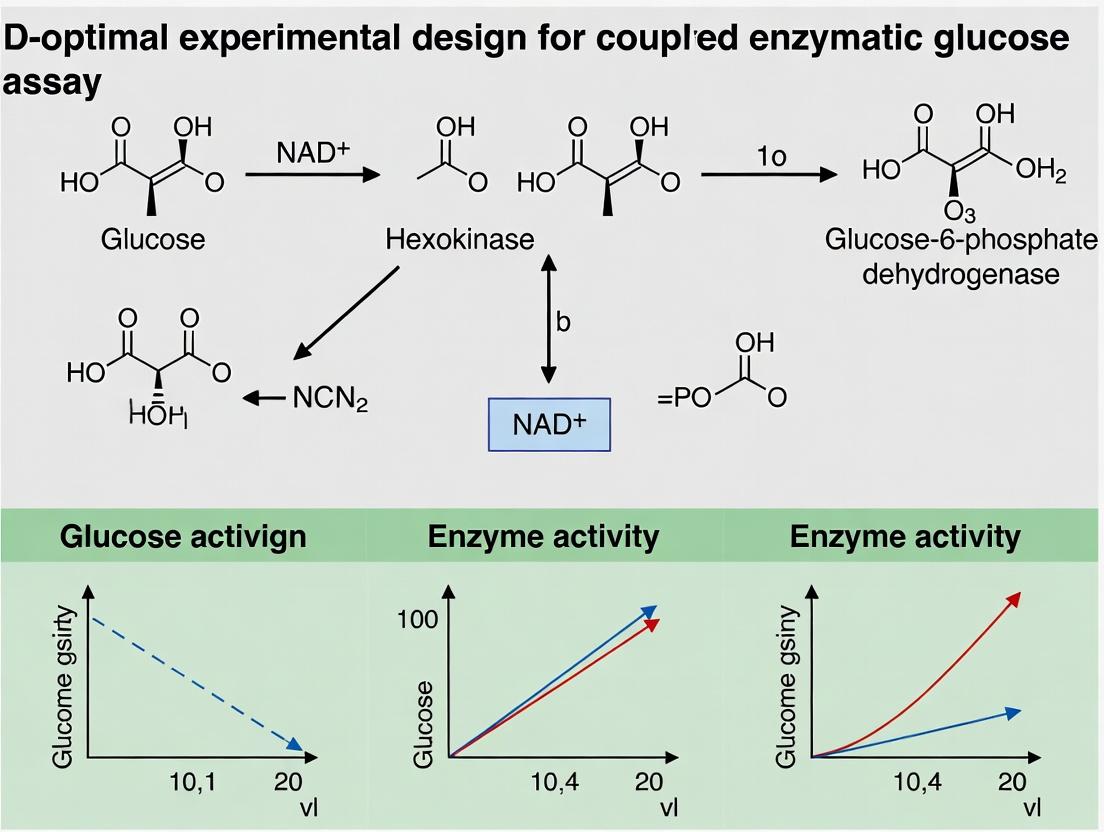
This article provides a comprehensive guide for researchers and assay development professionals on implementing D-optimal design to optimize the critical reagent concentrations in the widely used coupled enzymatic glucose assay...
Optimizing Accuracy and Efficiency: A D-Optimal Design Approach for the Coupled Enzymatic Glucose Assay
Abstract
This article provides a comprehensive guide for researchers and assay development professionals on implementing D-optimal design to optimize the critical reagent concentrations in the widely used coupled enzymatic glucose assay (Hexokinase/Glucose-6-Phosphate Dehydrogenase method). We explore the foundational principles of the assay and experimental design, detail the methodological steps for applying D-optimal design, address common troubleshooting and optimization challenges, and present robust validation and comparative analysis frameworks. The goal is to empower scientists to develop more robust, cost-effective, and precise assays for applications in biomedical research, diagnostics, and drug development.
Understanding the Coupled Enzyme System and the Need for Strategic Design
This protocol is framed within a thesis investigating D-optimal experimental design for optimizing coupled enzymatic assays. The HK/G6PDH assay is a model system for studying the interplay of factors such as enzyme ratios, substrate concentrations, cofactors, and inhibitors. A D-optimal approach allows for the efficient exploration of this multi-parameter space to maximize sensitivity, linear range, and robustness for applications in drug discovery and diagnostic development.
Core Biochemistry and Pathway
The assay quantitatively measures D-glucose by coupling two enzymatic reactions, resulting in the stoichiometric production of NADPH, which is monitored spectrophotometrically at 340 nm.
Reaction 1 (Phosphorylation): D-Glucose + ATP → Hexokinase (HK) → Glucose-6-phosphate (G6P) + ADP
Reaction 2 (Oxidation): G6P + NADP⁺ → Glucose-6-phosphate dehydrogenase (G6PDH) → 6-Phosphogluconolactone + NADPH + H⁺
The overall reaction is: Glucose + ATP + NADP⁺ → 6-Phosphogluconolactone + ADP + NADPH + H⁺
Biochemical Pathway Diagram
Diagram Title: Enzymatic Coupling from Glucose to NADPH
Key Quantitative Parameters
Table 1: Typical Kinetic Parameters for Assay Enzymes
| Enzyme | EC Number | Typical Assay Concentration | Km for Substrate (Glucose or G6P) | Optimal pH Range | Cofactor Requirement |
|---|---|---|---|---|---|
| Hexokinase (HK) | 2.7.1.1 | 0.5 - 2.0 U/mL | 0.1 - 0.2 mM (Glucose) | 7.5 - 8.5 | Mg²⁺ (for Mg-ATP complex) |
| G6PDH (Microbial) | 1.1.1.49 | 0.5 - 2.0 U/mL | 0.05 - 0.1 mM (G6P) | 7.8 - 8.5 | NADP⁺ |
Table 2: Standard Reaction Mixture Components (Endpoint, 1 mL final volume)
| Component | Final Concentration | Purpose & Notes |
|---|---|---|
| Tris or HEPES Buffer | 50 - 100 mM, pH 8.0 ± 0.2 | Maintains optimal pH for both enzymes. |
| ATP | 1.0 - 2.0 mM | Substrate for HK; must be in excess. |
| NADP⁺ | 1.0 - 2.0 mM | Substrate for G6PDH; must be in excess. |
| MgCl₂ or MgSO₄ | 5.0 - 10.0 mM | Forms Mg-ATP, the true substrate for HK. |
| HK (from S. cerevisiae) | ≥ 0.7 U | Must be in excess relative to G6PDH. |
| G6PDH (from L. mesenteroides) | ≥ 0.7 U | Must be in excess relative to expected G6P generation rate. |
| Sample (Glucose) | Variable (e.g., 0-500 µM) | Unknown; fit to standard curve. |
Detailed Protocol: Endpoint Assay for Glucose Quantification
Materials & Reagents
- Assay Buffer: 100 mM Tris-HCl, pH 8.0, containing 10 mM MgCl₂.
- Substrate/Coenzyme Master Mix: 10 mM ATP and 10 mM NADP⁺ in assay buffer. Prepare fresh or aliquot and store at -20°C.
- Enzyme Master Mix: Combine HK and G6PDH in assay buffer to achieve ≥ 0.7 U/mL of each enzyme for the final reaction volume.
- Glucose Standards: Prepare a dilution series (e.g., 0, 50, 100, 250, 500 µM) in water from a 100 mM stock.
- Microplate reader or spectrophotometer capable of reading at 340 nm.
- Clear 96-well plates or quartz cuvettes.
Procedure
- Preparation: Pre-warm all components (except enzymes) to the desired assay temperature (e.g., 25°C or 30°C). Keep enzymes on ice until use.
- Reaction Setup (in triplicate): For a 200 µL final reaction volume in a well:
- Standard/Sample Well: 160 µL Substrate/Coenzyme Master Mix + 20 µL Glucose Standard or Unknown Sample.
- Blank Well: 160 µL Substrate/Coenzyme Master Mix + 20 µL Water or Sample Matrix.
- Baseline Reading: Incubate the plate/cuvette at temperature for 5 minutes. Record the initial absorbance at 340 nm (A_initial).
- Reaction Initiation: Add 20 µL of the Enzyme Master Mix to all wells. Mix immediately by gentle pipetting or plate shaking.
- Incubation: Incubate at the set temperature for 15-30 minutes, ensuring the reaction goes to completion.
- Endpoint Reading: Record the final absorbance at 340 nm (A_final).
- Data Calculation: Calculate ΔA = Afinal - Ainitial for each well. Subtract the average blank ΔA. Generate a standard curve by plotting the blank-corrected ΔA against glucose concentration. The slope of the linear curve is used to calculate unknown concentrations (ΔA = ε * b * c, where ε for NADPH is 6.22 mM⁻¹cm⁻¹ at 340 nm).
Experimental Workflow Diagram
Diagram Title: Endpoint HK/G6PDH Assay Protocol Steps
The Scientist's Toolkit: Essential Research Reagent Solutions
Table 3: Key Reagents and Their Functions in HK/G6PDH Assay Optimization
| Reagent/Solution | Function in the Assay | Critical Notes for D-Optimal Design Studies |
|---|---|---|
| High-Purity HK (from Yeast) | Catalyzes the primary, rate-limiting phosphorylation step. | Variable to test for optimal unit ratio to G6PDH. Source affects kinetics and stability. |
| High-Purity G6PDH (from Leuconostoc mesenteroides) | Catalyzes the detection reaction; uses NADP⁺ specifically. | Key variable. Microbial G6PDH prefers NADP⁺ over NAD⁺, crucial for specificity. |
| ATP Disodium Salt | Primary substrate for HK. Must be in significant excess. | Concentration is a key factor to optimize to ensure zero-order kinetics. |
| NADP⁺ Sodium Salt | Co-substrate for G6PDH; its reduction is measured. | Purity is essential. Concentration must be optimized for linearity and signal strength. |
| Magnesium Salt (MgCl₂) | Divalent cation required to form the active Mg-ATP complex. | Concentration must be optimized relative to ATP (typically 2-5x [ATP]). |
| Tris or HEPES Buffer | Maintains optimal pH (7.8-8.2) for maximal activity of both enzymes. | Buffer type and ionic strength can be factors in a full optimization model. |
| Glucose Standard | Used to generate the calibration curve for quantification. | Must be prepared accurately in a matrix matching the sample (e.g., buffer, serum). |
| Potential Inhibitors (Drug Candidates) | Test compounds in drug discovery screens. | The assay's robustness is tested by measuring their effect on the coupled reaction system. |
Advanced Protocol: Kinetic Assay for Inhibitor Screening
This protocol is suited for determining enzyme inhibition (e.g., on HK) as part of drug development research.
Procedure
- Prepare a reaction buffer containing all components except G6PDH and the test inhibitor.
- Pre-incubate this mixture with varying concentrations of the potential inhibitor (or vehicle control) for 10 minutes.
- Initiate the reaction by adding G6PDH.
- Immediately monitor the increase in A340 over 5-10 minutes using a kinetic plate reader.
- Calculate the initial velocity (V₀) from the linear portion of the curve. Plot V₀ vs. inhibitor concentration to determine IC₅₀ values.
Diagram Title: Inhibitor Screening Assay Logic
This application note details the critical reagents within the context of a D-optimal design study for the optimization of a coupled enzymatic glucose assay. The assay quantifies D-glucose via the sequential action of Hexokinase (HK) and Glucose-6-Phosphate Dehydrogenase (G6PDH). A D-optimal experimental design approach is employed to systematically explore the design space of reagent concentrations, minimizing variance in parameter estimation and identifying the optimal, robust assay formulation for high-throughput drug discovery applications.
Key Reagents: Roles and Rationale
Hexokinase (HK; EC 2.7.1.1)
Role: Initiates the coupled reaction by phosphorylating D-glucose to form glucose-6-phosphate (G6P) using ATP as a phosphate donor. This is the first and rate-determining step in the assay. Consideration in D-optimal Design: HK concentration is a primary factor. Insufficient enzyme leads to slow kinetics and poor sensitivity, while excess increases cost and potential for non-specific side reactions. The optimal level is determined relative to the expected glucose concentration range.
Glucose-6-Phosphate Dehydrogenase (G6PDH; EC 1.1.1.49)
Role: Catalyzes the oxidation of G6P to 6-phosphogluconolactone, simultaneously reducing NADP+ to NADPH. The rate of NADPH formation, measured by absorbance at 340 nm, is directly proportional to the original glucose concentration. Consideration in D-optimal Design: G6PDH must be in excess relative to HK to ensure the first step is rate-limiting. Its concentration is a critical factor to prevent bottlenecking and ensure linear kinetics.
Adenosine Triphosphate (ATP)
Role: Serves as the phosphate donor for the HK-catalyzed reaction. It is a stoichiometric substrate consumed in a 1:1 molar ratio with glucose. Consideration in D-optimal Design: ATP concentration must be non-limiting across the entire calibration range. Its stability in solution (susceptibility to hydrolysis) is a key robustness factor explored in the design.
Nicotinamide Adenine Dinucleotide Phosphate (NADP+)
Role: The final electron acceptor in the G6PDH reaction. Its reduction to NADPH provides the spectrophotometric signal. Consideration in D-optimal Design: Like ATP, NADP+ must be non-limiting. Its concentration is a major factor affecting the assay's linear range and signal-to-noise ratio.
Magnesium Ions (Mg2+)
Role: An essential cofactor for HK. ATP binds to HK as a Mg-ATP complex. Mg2+ activates the enzyme and is required for its structural integrity. Consideration in D-optimal Design: The molar ratio of Mg2+ to ATP is crucial. Typically, Mg2+ is in slight excess over total ATP to ensure all ATP is complexed. Optimal free Mg2+ concentration is a key parameter.
Table 1: Typical Concentration Ranges for Reagents in a Coupled Glucose Assay
| Reagent | Typical Role | Common Initial Test Range (in Reaction Mix) | Key Interaction in D-optimal Design |
|---|---|---|---|
| HK | Catalyst (Step 1) | 0.5 - 5.0 U/mL | Interaction with [Glucose] range and [G6PDH] |
| G6PDH | Catalyst (Step 2) | 1.0 - 10.0 U/mL | Must be in excess over HK; main factor for signal generation rate |
| ATP | Substrate | 0.5 - 2.0 mM | Must be non-limiting; factor for upper limit of linearity |
| NADP+ | Substrate / Cofactor | 0.5 - 2.0 mM | Directly linked to ΔA340 signal magnitude |
| Mg2+ | Essential Cofactor | 1.0 - 5.0 mM | Ratio to ATP is critical; optimizes HK Vmax/Km |
Table 2: Example D-optimal Design Factor Levels for Assay Optimization
| Design Factor | Low Level (-1) | High Level (+1) | Units |
|---|---|---|---|
| [HK] | 1.0 | 3.0 | U/mL |
| [G6PDH] | 2.0 | 6.0 | U/mL |
| [ATP] | 0.8 | 1.5 | mM |
| [Mg2+]:[ATP] Ratio | 1.2:1 | 2.5:1 | molar ratio |
| Assay Temperature | 25 | 37 | °C |
Detailed Protocols
Protocol 1: Master Reaction Mix Preparation for D-optimal Design Experiment
Objective: To prepare the core reagent mix, with variable components added separately according to the experimental design matrix.
Materials:
- Tris-HCl or HEPES buffer (pH 7.5-8.0)
- Stock solutions of ATP, NADP+, and MgCl2
- Recombinant HK and G6PDH (lyophilized or in glycerol)
- D-Glucose standard solutions (e.g., 0, 2.5, 5, 10 mM)
Procedure:
- Prepare a 2X concentrated base mix in assay buffer to contain the fixed concentrations of NADP+ and MgCl2 (calculated based on the high-level of the design).
- Aliquot the required volume of 2X base mix into separate tubes for each condition in the D-optimal design matrix.
- According to the design matrix, add the specified volumes of ATP stock, HK, and G6PDH to each tube. Adjust volumes with assay buffer to reach a 1X final concentration upon addition of an equal volume of sample/standard.
- Mix gently by inversion. The Master Reaction Mix is now ready.
Protocol 2: Kinetic Assay for Model Fitting
Objective: To collect kinetic absorbance data for response surface modeling.
Materials:
- Prepared Master Reaction Mixes (from Protocol 1)
- Glucose standards
- 96-well clear flat-bottom microplate
- Plate reader capable of kinetic measurement at 340 nm (30-37°C)
Procedure:
- Pipette 100 µL of each Master Reaction Mix into designated wells of the microplate.
- Initiate the reaction by adding 100 µL of the appropriate glucose standard (or sample) to each well. Mix immediately by orbital shaking.
- Immediately place the plate in the pre-warmed reader and start the kinetic measurement.
- Record the absorbance at 340 nm (A340) every 15-30 seconds for 10-15 minutes.
- For each well, calculate the linear rate of change in A340 (ΔA/min) over the initial linear period (typically 2-5 minutes). This rate is the primary response variable for the D-optimal model.
Protocol 3: Data Analysis and Optimal Point Verification
Objective: To determine optimal reagent concentrations and validate the assay.
Procedure:
- Fit the experimental rates (ΔA/min) to a quadratic response surface model using statistical software (e.g., JMP, Design-Expert, R).
- Analyze the model to identify significant main effects and interaction terms (e.g., HKG6PDH, ATPMg2+ ratio).
- Use the model's optimization function to find the reagent concentrations that maximize the signal rate for mid-range glucose concentrations while minimizing total reagent cost and variance (robustness).
- Prepare a new Master Mix using the predicted optimal conditions.
- Run a full glucose standard curve (e.g., 0-20 mM) in triplicate using Protocol 2.
- Validate performance: linearity (R² > 0.99), sensitivity, and precision (%CV < 5% for replicates).
Diagrams
Coupled Enzymatic Glucose Assay Pathway
D-Optimal Design Workflow for Assay Optimization
The Scientist's Toolkit
Table 3: Essential Research Reagent Solutions for Coupled Glucose Assay Development
| Item | Function & Specification | Recommended Storage/Handling |
|---|---|---|
| Hexokinase (HK) | Lyophilized powder, ≥100 U/mg protein. Reconstitute in provided buffer or 50 mM Tris-HCl (pH 8.0). Aliquot and store at -20°C. Avoid repeated freeze-thaw. | -20°C; Glycerol stocks at -20°C are stable. |
| G6PDH | Lyophilized powder from Leuconostoc mesenteroides (preferred for NADP+ specificity), ≥500 U/mg protein. Reconstitute as per HK. | -20°C; Stable in 50% glycerol at -20°C. |
| ATP Disodium Salt | High-purity, ≥99%. Prepare fresh 100 mM stock in neutralized aqueous solution (pH ~7.0), filter sterilize. | Aliquot and store at -20°C (months) or -80°C (long-term). |
| NADP+ Sodium Salt | High-purity, ≥98%. Prepare 50 mM stock in assay buffer or water. Adjust to pH ~7.0. Light sensitive. | Aliquot, wrap in foil, store at -20°C. |
| Magnesium Chloride (MgCl2·6H2O) | Molecular biology grade. Prepare 1 M stock in ultrapure water. Stable at room temperature. | RT; filter if necessary to avoid particulates. |
| Assay Buffer | 50-100 mM Tris-HCl or HEPES, pH 7.8 ± 0.1 at assay temperature. Contains 0.02% sodium azide if required. | Store at 4°C for up to 1 month. |
| D-Glucose Standard | Prepare from anhydrous D-glucose in deionized water. Allow to mutarotate overnight at 4°C before use for stable readings. | Store at 4°C; prepare fresh weekly. |
Application Notes
Within the broader thesis exploring the application of D-optimal design to optimize coupled enzymatic glucose assays, this document highlights the fundamental limitations of traditional, one-variable-at-a-time (OVAT) assay development. These constraints necessitate advanced statistical design of experiments (DoE) approaches for efficient, robust analytical method development.
The standard glucose oxidase-peroxidase (GOD-POD) coupled assay exemplifies these challenges. The multi-step reaction sequence is sensitive to interdependent buffer conditions, reagent concentrations, and incubation parameters. Empirical, sequential optimization is inefficient, often failing to identify the true optimal region of the experimental space and leading to assays with narrow dynamic range, suboptimal sensitivity (Limit of Detection, LOD), and poor reproducibility.
Table 1: Quantified Limitations of Traditional OVAT Assay Development vs. DoE Approach
| Parameter | Traditional OVAT Development | D-optimal DoE Development | Impact on Research/Thesis Context |
|---|---|---|---|
| Estimated Timeline | 8-12 weeks (sequential trials) | 3-4 weeks (parallel experimentation) | Accelerates foundational research for high-throughput screening applications. |
| Number of Experimental Runs | 50-100+ (uncontrolled, iterative) | 20-30 (structured, information-rich) | Directly reduces reagent consumption and labor costs per optimization cycle. |
| Optimal Condition Discovery | Low probability; finds local optima | High probability; maps global response surface | Critical for establishing a robust, transferable coupled assay protocol. |
| Interaction Effect Detection | Missed entirely | Statistically quantified and modeled | Essential for understanding coupling efficiency between GOD and POD enzymes. |
| Assay Performance Metrics (Typical Outcome) | Highly variable; often suboptimal LOD & dynamic range | Predictable, optimized, and robust | Provides reliable data for downstream drug metabolism and pharmacokinetics (DMPK) studies. |
Experimental Protocols
Protocol 1: Traditional OVAT Optimization for Coupled GOD-POD Assay Objective: To sequentially optimize pH and enzyme concentrations for a glucose assay. Materials: See "Research Reagent Solutions" below. Procedure:
- Baseline Assay: Prepare 100 µL reaction mix in a 96-well plate: 50 µL phosphate buffer (pH 7.0, 100 mM), 10 µL GOD (5 U/mL), 10 µL POD (10 U/mL), 10 µL chromogen (o-dianisidine, 0.5 mg/mL), 10 µL glucose standard (5.5 mM). Incubate at 25°C for 30 min. Measure absorbance at 540 nm.
- pH Optimization: Repeat Step 1, varying buffer pH from 5.5 to 8.0 in 0.5-unit increments, keeping all other components constant. Plot absorbance vs. pH.
- GOD Concentration Optimization: Using the pH from Step 2, repeat the assay varying GOD concentration from 1 to 15 U/mL. Plot response.
- POD Concentration Optimization: Using the optimal pH and GOD concentration, vary POD concentration from 2 to 25 U/mL. Plot response.
- Validation: Run a standard curve (0-10 mM glucose) with the "optimized" conditions.
Protocol 2: D-optimal Design for Coupled GOD-POD Assay Optimization Objective: To simultaneously optimize multiple critical factors using a statistically designed experiment. Materials: Same as Protocol 1, plus DoE software (e.g., JMP, Minitab, Design-Expert). Procedure:
- Define Factors and Ranges: Identify critical factors: pH (5.5-7.5), GOD conc. (2-10 U/mL), POD conc. (5-20 U/mL), and incubation time (10-30 min). Define the response variable as absorbance at 540 nm for a mid-level glucose standard.
- Generate Experimental Design: Use software to generate a D-optimal design with 20-30 experimental runs, including replicates for error estimation. This design will select runs that maximize information on factor effects and interactions while minimizing total experiments.
- Execute Designed Experiments: Prepare reaction mixes according to the randomized run order provided by the design matrix.
- Statistical Analysis & Modeling: Input response data into software. Perform multiple linear regression to generate a quadratic response surface model. Analyze ANOVA to identify significant factors (e.g., pH*POD interaction) and model lack-of-fit.
- Predict and Validate Optimum: Use the model's prediction profiler to identify factor levels that maximize the absorbance response. Conduct 3-5 confirmation runs at the predicted optimum to verify model accuracy.
Visualizations
Title: OVAT Assay Development Workflow Leads to Suboptimal Outcome
Title: DoE-Driven Assay Development Workflow for Optimization
Title: Coupled GOD-POD Reaction Pathway with Key Optimizable Factors
The Scientist's Toolkit: Research Reagent Solutions
| Item | Function in GOD-POD Assay | Critical for Thesis Optimization |
|---|---|---|
| Glucose Oxidase (GOD) | Primary enzyme; catalyzes glucose oxidation to gluconolactone and H₂O₂. | A key factor (concentration, activity) for D-optimal design. Source and lot variability must be controlled. |
| Peroxidase (POD, e.g., HRP) | Secondary enzyme; uses H₂O₂ to oxidize a chromogen, producing measurable color. | A key factor. Its interaction with GOD activity and pH is a primary target for statistical modeling. |
| Chromogen (e.g., o-Dianisidine, ABTS, TMB) | Electron donor that changes color upon oxidation by POD. | Substrate choice (sensitivity, solubility, safety) defines the assay's analytical performance. TMB is often preferred. |
| Glucose Standards | Calibrators of known concentration to generate a standard curve. | High-purity standards are essential for establishing accurate model responses during optimization. |
| Buffer System (e.g., Phosphate) | Maintains reaction pH, a critical factor for dual enzyme activity. | Buffer type, pH, and ionic strength are central factors in the D-optimal design to find the optimal compromise. |
| Microplate Reader | Measures absorbance of the colored product (typically at 450-540 nm). | Enables high-throughput data collection from multiple D-optimal design runs in parallel. |
| DoE Software | Generates optimal experimental designs and analyzes multivariate response data. | Core tool for implementing the thesis methodology and extracting interaction effects. |
Traditional experimentation in biochemical research, such as for coupled enzymatic glucose assays, often relies on the One-Factor-at-a-Time (OFAT) approach. While intuitive, OFAT is inefficient, ignores factor interactions, and can yield misleading optimal conditions. This application note introduces the principles of Design of Experiments (DoE) within the specific context of developing a D-optimal design for optimizing a coupled enzymatic glucose assay. The transition to DoE enables researchers to systematically study multiple factors (e.g., enzyme concentrations, pH, incubation time) and their interactions simultaneously, leading to robust, predictive models with fewer experimental runs.
Key Concepts & Comparative Data
Table 1: OFAT vs. DoE Approach Comparison
| Aspect | One-Factor-at-a-Time (OFAT) | Design of Experiments (DoE) |
|---|---|---|
| Experimental Efficiency | Low; many runs required for multiple factors. | High; factors varied simultaneously. |
| Detection of Interactions | Cannot detect interactions between factors. | Explicitly models and quantifies interactions. |
| Statistical Power | Low, prone to missing true optima. | High, with defined confidence intervals. |
| Optimal Condition Prediction | Limited to the tested points; no predictive model. | Generates a predictive response surface model. |
| Example: 3-Factor Assay | ~27 runs (3 levels each, tested sequentially). | 15-17 runs for a full Response Surface Model. |
Table 2: Typical Factors and Ranges for Coupled Enzymatic Glucose Assay Optimization
| Factor | Symbol | Low Level (-1) | High Level (+1) | Unit | Role in Assay |
|---|---|---|---|---|---|
| Glucose Oxidase Conc. | A | 0.5 | 2.0 | U/mL | Catalyzes glucose oxidation. |
| Peroxidase Conc. | B | 5 | 20 | U/mL | Catalyzes chromogen formation. |
| Incubation Time | C | 5 | 15 | minutes | Reaction development time. |
| pH | D | 6.5 | 7.5 | - | Affects enzyme activity. |
| Chromogen (TMB) Conc. | E | 0.1 | 0.5 | mM | Signal generation substrate. |
Detailed Experimental Protocols
Protocol 1: Initial Screening Design for Key Factors Objective: Identify the most influential factors on assay response (Absorbance at 450nm) from a candidate set. Method:
- Design Selection: Use a Resolution IV fractional factorial or Plackett-Burman design for 5-7 factors.
- Solution Preparation: Prepare a master reaction buffer (e.g., 50 mM phosphate buffer). Prepare stock solutions of Glucose (10 mM), Glucose Oxidase (10 U/mL), Peroxidase (100 U/mL), and TMB (10 mM in DMSO).
- Experimental Run: For each design point, in a 96-well plate, mix:
- 80 µL buffer (at specified pH)
- 10 µL Glucose stock (final 1 mM)
- 5 µL Glucose Oxidase stock (diluted to target conc.)
- 5 µL Peroxidase stock (diluted to target conc.)
- Initiation & Reading: Incubate at 25°C for the specified time. Add 10 µL TMB stock, incubate for exactly 2 minutes, then stop with 50 µL 1M H₂SO₄. Measure absorbance at 450 nm immediately.
- Analysis: Use statistical software to perform ANOVA. Rank factors by p-value (<0.05 significant).
Protocol 2: D-Optimal Response Surface Modeling for Assay Optimization Objective: Build a precise mathematical model to predict the optimal factor settings for maximum assay sensitivity (slope of calibration curve). Method:
- Factor Selection: Based on Protocol 1, select 3-4 critical factors (e.g., A, B, C).
- Design Generation: Use statistical software to generate a D-optimal design for a quadratic (second-order) model. This design minimizes the variance of the model coefficients.
- Calibration Curve Runs: For each of the ~15-20 D-optimal design points, perform a 6-point glucose calibration curve (0, 0.5, 1, 2, 4, 8 mM) using the specified factor settings.
- Response Measurement: For each standard, perform the reaction as in Protocol 1. Record absorbance. Calculate the slope of the linear calibration curve for each design point (R² > 0.98 required).
- Model Fitting & Validation: Fit the slope data to a quadratic model:
Y = β₀ + ΣβᵢXᵢ + ΣβᵢᵢXᵢ² + ΣβᵢⱼXᵢXⱼ. Validate the model with 3-5 confirmation runs at predicted optimal conditions.
Visualization
Diagram 1: Logical workflow comparing OFAT and DoE.
Diagram 2: Coupled enzymatic glucose assay signaling pathway.
The Scientist's Toolkit
Table 3: Essential Research Reagent Solutions for DoE in Glucose Assay Development
| Item | Function in DoE Context | Specification / Notes |
|---|---|---|
| Glucose Oxidase (Aspergillus niger) | Key variable enzyme (Factor A). Catalyzes the first reaction step. | Lyophilized powder, ≥100 U/mg. Prepare fresh aliquots in appropriate buffer. |
| Horseradish Peroxidase (HRP) | Key variable enzyme (Factor B). Catalyzes the colorimetric detection. | Lyophilized powder, ≥250 U/mg. Store in dark at -20°C. |
| TMB (3,3',5,5'-Tetramethylbenzidine) | Chromogenic substrate (Factor E). Electron donor for HRP, forms measurable product. | Ready-to-use solution or tablets. Light sensitive. |
| D-Glucose Standard | Primary analyte for generating calibration curves (the model's response). | Prepare serial dilutions from a certified 1M stock in buffer. |
| Phosphate Buffer Salts (Na₂HPO₄/KH₂PO₄) | Provides reaction medium; pH is a critical factor (Factor D). | Prepare 0.5-1.0 M stocks, adjust pH precisely as per DoE matrix. |
| Microplate Reader (UV-Vis) | Critical for high-throughput data acquisition required by DoE. | Capable of reading 450 nm absorbance in 96- or 384-well format. |
| Statistical Software (JMP, Minitab, Design-Expert) | Mandatory for generating DoE designs and analyzing complex multi-factor data. | Used to create D-optimal designs and perform ANOVA/regression analysis. |
Why D-Optimal Design? Maximizing Information with Minimal Experimental Runs.
Application Notes: D-Optimal Design for Optimizing a Coupled Enzymatic Glucose Assay
Within the context of a broader thesis on enhancing analytical bioassays, this document applies D-optimal experimental design to optimize a coupled enzymatic glucose assay system. The assay principle involves the sequential action of hexokinase (HK) and glucose-6-phosphate dehydrogenase (G6PDH), producing NADPH, which is measured spectrophotometrically. The key factors influencing the assay's sensitivity (NADPH production rate) are identified as: pH, Mg²⁺ concentration ([Mg²⁺]), ATP concentration ([ATP]), and NADP⁺ concentration ([NADP⁺]).
A full factorial exploration of these four factors at multiple levels would be prohibitively resource-intensive. Instead, a D-optimal design was employed to select the most informative set of experimental runs to model the main effects, two-way interactions, and quadratic effects.
Table 1: D-Optimal Design Matrix and Experimental Response for Assay Optimization
| Run Order | pH | [Mg²⁺] (mM) | [ATP] (mM) | [NADP⁺] (mM) | Response: ΔA₃₄₀/min (x 10⁻³) |
|---|---|---|---|---|---|
| 1 | 7.8 | 5 | 0.8 | 0.6 | 4.2 |
| 2 | 8.2 | 10 | 0.8 | 1.0 | 6.8 |
| 3 | 8.6 | 5 | 1.2 | 1.0 | 7.1 |
| 4 | 7.8 | 10 | 1.2 | 0.6 | 5.5 |
| 5 | 8.6 | 10 | 0.8 | 0.6 | 5.9 |
| 6 | 7.8 | 7.5 | 1.2 | 1.0 | 6.3 |
| 7 | 8.6 | 7.5 | 0.8 | 1.0 | 7.5 |
| 8 | 8.2 | 5 | 1.2 | 0.6 | 4.5 |
| 9 (Ctr) | 8.2 | 7.5 | 1.0 | 0.8 | 6.1 |
| 10 (Ctr) | 8.2 | 7.5 | 1.0 | 0.8 | 6.0 |
The data from Table 1 were used to fit a quadratic response surface model. The analysis of variance (ANOVA) indicated significant model terms.
Table 2: Key Model Coefficients and Statistical Significance (p-values)
| Model Term | Coefficient | p-value | Interpretation |
|---|---|---|---|
| Intercept | 6.05 | <0.001 | Predicted response at center point. |
| pH | 0.92 | 0.002 | Positive linear effect; higher pH increases rate up to a point. |
| [ATP] | 0.78 | 0.005 | Positive linear effect; higher [ATP] increases rate. |
| pH² | -0.65 | 0.008 | Significant curvature; rate peaks at optimal pH. |
| pH*[Mg²⁺] | -0.41 | 0.032 | Significant interaction; effect of Mg²⁺ depends on pH level. |
| [NADP⁺]² | -0.30 | 0.048 | Saturation effect at higher [NADP⁺]. |
The model predicted an optimum at pH 8.4, [Mg²⁺] 8.5 mM, [ATP] 1.1 mM, and [NADP⁺] 0.9 mM, with a predicted ΔA₃₄₀/min of 7.3 x 10⁻³. A verification run at these conditions yielded a mean value of 7.2 x 10⁻³ (n=3), confirming the model's robustness. This represents a 20% improvement over the standard protocol baseline.
Protocol: D-Optimal Design Application for Coupled Glucose Assay Optimization
Part A: Experimental Design Generation
- Define Factors & Ranges: Based on literature and preliminary data, set the feasible ranges: pH (7.8-8.6), [Mg²⁺] (5-10 mM), [ATP] (0.8-1.2 mM), [NADP⁺] (0.6-1.0 mM).
- Select Design: Using statistical software (e.g., JMP, Minitab, Design-Expert), generate a D-optimal design for a quadratic model with 4 factors.
- Specify Runs: Request a design with approximately 10 runs, including 2-3 center point replicates for pure error estimation. Randomize the run order to mitigate temporal bias.
- Output Design Matrix: The software will generate a table similar to Table 1, specifying the exact factor levels for each experimental run.
Part B: Assay Execution per Design Matrix Materials: See "The Scientist's Toolkit" below.
- Prepare a master reaction buffer (e.g., Tris or HEPES) at a concentration 1.1x the final desired strength.
- For each run in the randomized order, prepare a 1.0 mL reaction mixture in a UV-transparent cuvette: a. Add appropriate volumes of MgCl₂, ATP, and NADP⁺ stock solutions to achieve the concentrations specified for that run. b. Add the master buffer and adjust the pH to the exact target value (±0.05) using dilute NaOH or HCl. c. Add glucose standard solution to a final concentration of 5.0 mM (non-limiting excess). d. Bring the volume to 0.99 mL with deionized water. Equilibrate in a thermostatted spectrophotometer at 30°C for 5 minutes.
- Initiate Reaction: Add 10 μL of the combined enzyme solution (HK & G6PDH) to the cuvette and mix quickly by inversion (parafilm-covered).
- Measurement: Immediately place the cuvette in the spectrophotometer and record the absorbance at 340 nm every 15 seconds for 3 minutes.
- Data Extraction: Calculate the rate of absorbance change (ΔA₃₄₀/min) from the linear portion of the time course (typically minutes 0.5-2.5).
Part C: Modeling and Optimization
- Input the experimental responses (ΔA₃₄₀/min) into the design software alongside the factor levels.
- Fit a quadratic response surface model. Evaluate model significance via ANOVA (look for significant F-test, p < 0.05) and lack-of-fit test (desired: not significant).
- Use the software's optimization function (e.g., desirability function) to locate the factor levels that maximize the predicted reaction rate.
- Verification: Conduct 3-5 replicate assays at the predicted optimum conditions to validate the model's prediction.
The Scientist's Toolkit: Key Research Reagent Solutions
| Item/Reagent | Function in the Coupled Glucose Assay |
|---|---|
| Hexokinase (HK) | Primary enzyme; phosphorylates glucose using ATP to yield glucose-6-phosphate. |
| Glucose-6-Phosphate Dehydrogenase (G6PDH) | Coupling enzyme; oxidizes G6P, reducing NADP⁺ to NADPH, which is measured at 340 nm. |
| Adenosine Triphosphate (ATP) | Cofactor/substrate for HK; its concentration directly influences the initial phosphorylation rate. |
| Nicotinamide Adenine Dinucleotide Phosphate (NADP⁺) | Electron acceptor for G6PDH; its reduction to NADPH provides the measurable signal. |
| Magnesium Chloride (MgCl₂) | Essential divalent cation; acts as a cofactor for both HK and ATP (forms MgATP²⁻ complex). |
| Tris or HEPES Buffer | Maintains reaction pH within the optimal range for enzyme activity and stability. |
| Glucose Standard | Provides a known, consistent substrate concentration for assay optimization and calibration. |
D-Optimal Design Workflow for Assay Optimization
Coupled Enzymatic Glucose Assay Reaction Pathway
A Step-by-Step Guide to Implementing D-Optimal Design for Your Glucose Assay
Within the context of D-optimal experimental design for developing a robust, coupled enzymatic glucose assay, the first and most critical step is the precise definition of the system's factors and their experimentally feasible ranges. A D-optimal design minimizes the variance in the estimated coefficients of a model, making it highly efficient for response surface methodology. Accurate range setting ensures the design space is relevant, practical, and yields predictive models for key assay parameters such as signal intensity, linearity, and coupling efficiency.
Critical Factors in Coupled Enzymatic Glucose Assays
Based on current literature and standard protocols, the following factors are consistently identified as critical for the performance of a coupled assay system using Hexokinase (HK) and Glucose-6-Phosphate Dehydrogenase (G6PD).
Table 1: Critical Factors and Their Functions
| Factor | Role in the Coupled Reaction | Primary Impact on Assay Output |
|---|---|---|
| pH of Assay Buffer | Determines optimal activity for both HK and G6PD; affects cofactor stability (NAD(P)+/NAD(P)H). | Reaction rate, coupling efficiency, endpoint signal stability. |
| Mg²⁺ Concentration | Essential cofactor for HK activity (stabilizes ATP). | Initial rate of the first enzymatic step, overall lag time. |
| ATP Concentration | Substrate for the HK reaction. | Reaction velocity, linear range with respect to glucose concentration. |
| NADP⁺ Concentration | Co-substrate for the G6PD reaction; its reduction to NADPH provides the measurable signal (340 nm). | Signal magnitude, signal-to-noise ratio, assay sensitivity. |
| Enzyme Ratio (HK:G6PD) | Determines the kinetic balance between the primary and indicator reactions. | Minimizes lag phase, prevents accumulation of intermediate (G6P). |
| Incubation Temperature | Governs the kinetic energy and stability of both enzymes. | Reaction rate, time to reach endpoint, assay reproducibility. |
| Sample Volume Fraction | Proportion of biological sample (e.g., serum) in the total reaction mix. | Influences matrix effects, potential inhibitors, and background absorbance. |
Establishing Practical Ranges: Literature Synthesis & Preliminary Data
Practical ranges are not derived from theory alone but require consultation of enzyme supplier specifications, pharmacopoeial methods (e.g., USP), and preliminary univariate experiments.
Table 2: Proposed Practical Ranges for D-Optimal Design
| Factor | Lower Practical Limit | Upper Practical Limit | Justification & Source |
|---|---|---|---|
| pH | 7.5 | 8.5 | HK activity peaks ~8.0-8.5; G6PD (microbial) is active in this range. NADP⁺ stability is higher in alkaline conditions. |
| [Mg²⁺] | 2.0 mM | 10.0 mM | Must be in excess over ATP to ensure HK saturation. High concentrations can inhibit G6PD. |
| [ATP] | 0.5 mM | 3.0 mM | Must saturate HK (Km typically 0.1-0.3 mM) without causing significant substrate inhibition. |
| [NADP⁺] | 0.5 mM | 2.5 mM | Must saturate G6PD (Km ~50 µM). Cost consideration at upper limits. |
| HK:G6PD Ratio (U/mL) | 1:1 | 5:1 | Ensures the first reaction is not rate-limiting. Common commercial kits use ~2:1 to 3:1. |
| Temperature (°C) | 25 | 37 | Standard lab incubation range. 37°C for physiological relevance; 25°C for convenience/stability. |
| Sample Fraction | 2% (v/v) | 20% (v/v) | Balances need for sufficient analyte with minimization of matrix interference. |
Key Experimental Protocols for Range Verification
Protocol 1: Univariate Range-Finding for Cofactors (Mg²⁺, ATP, NADP⁺) Objective: To empirically verify the minimal concentration required for saturation and the onset of inhibition for key cofactors. Reagents: See "The Scientist's Toolkit" below. Procedure:
- Prepare a master reaction mix containing constant, saturating concentrations of all components except the target cofactor (e.g., Mg²⁺).
- For the target cofactor, prepare a dilution series spanning from below to above its theoretical Km (e.g., 0.1, 0.5, 1.0, 2.0, 5.0, 10.0 mM Mg²⁺).
- Initiate reactions in a temperature-controlled microplate reader by adding a fixed concentration of glucose standard (e.g., 100 mg/dL).
- Monitor the increase in absorbance at 340 nm (A₃₄₀) for 10 minutes.
- Analysis: Plot initial velocity (ΔA₃₄₀/min) vs. cofactor concentration. The lower practical limit is set just above the saturation plateau. The upper limit is set before a significant decrease (>10%) in velocity is observed, indicating inhibition or waste.
Protocol 2: Enzyme Ratio Optimization Objective: To determine the ratio that minimizes the lag phase for a range of glucose concentrations. Procedure:
- Prepare reaction mixtures with varying activity ratios of HK to G6PD (e.g., 0.5:1, 1:1, 2:1, 3:1, 5:1), keeping total protein constant.
- Initiate reactions with a high glucose concentration (e.g., 300 mg/dL).
- Record kinetic A₃₄₀ data at high temporal resolution (every 5-10 seconds).
- Analysis: Determine the "lag time" as the time between reaction initiation and the onset of the linear increase in A₃₄₀. The optimal range includes ratios where the lag time is minimal and constant across glucose levels.
Visualizing the System and Workflow
Title: Workflow for Defining Critical Factor Ranges
Title: Coupled Enzymatic Pathway for Glucose Detection
The Scientist's Toolkit
Table 3: Essential Research Reagent Solutions
| Reagent / Material | Function & Specification | Typical Supplier Examples |
|---|---|---|
| HK (from S. cerevisiae) | Catalyzes the phosphorylation of glucose by ATP. High specific activity (>100 U/mg). | Roche, Sigma-Aldrich, Toyobo |
| G6PD (from L. mesenteroides) | Catalyzes the oxidation of G6P, reducing NADP⁺ to NADPH. Prefers NADP⁺ over NAD⁺. | Roche, Sigma-Aldrich |
| NADP⁺ (Disodium Salt) | Electron acceptor in the indicator reaction. Purity >98%. Store desiccated at -20°C. | Roche, Sigma-Aldrich, BioVision |
| ATP (Disodium Salt) | Phosphate donor for the HK reaction. Purity >99%, pH adjusted. | Roche, Sigma-Aldrich |
| Magnesium Chloride (MgCl₂) | Source of Mg²⁺ cofactor for HK. Use molecular biology grade. | Various |
| TRIS or HEPES Buffer | Provides stable pH environment in the 7.5-8.5 range. 0.1-0.2 M stock. | Various |
| Glucose Standard | Primary standard for calibration (e.g., 1 g/dL in benzoic acid). | NIST-traceable (e.g., Sigma) |
| Microplate Reader | For high-throughput kinetic/endpoint measurement at 340 nm. | BioTek, Molecular Devices, Tecan |
In the context of D-optimal design for coupled enzymatic glucose assay optimization, the selection of the response variable is a critical determinant of the model's predictive power and practical utility. This choice directly influences which experimental parameters (e.g., enzyme concentrations, pH, incubation time) are identified as significant. For assay developers, the primary candidates are the analytical Signal (e.g., absorbance), the Sensitivity (slope of the calibration curve), and the Linear Range. This application note details the protocols for measuring each and provides a framework for selection based on the assay's intended application in diagnostic or pharmaceutical research.
Data Presentation: Comparative Metrics for Response Variable Selection
Table 1: Key Characteristics of Candidate Response Variables
| Response Variable | Definition | Measurement Protocol | Primary Advantage | Key Limitation in D-optimal Design |
|---|---|---|---|---|
| Signal | Raw output (e.g., Absorbance at λ_max) for a single glucose concentration. | Measure endpoint absorbance of assay reaction. | Simple, direct measurement; high precision for a given point. | Optimizes for one condition; may not represent overall assay performance. |
| Sensitivity | Slope of the linear calibration curve (ΔSignal/Δ[Glucose]). | Measure signal across a range of known low concentrations. | Maximizes assay's ability to distinguish small concentration changes. | May narrow the linear range; sensitive to background noise. |
| Linear Range | The concentration interval over which response is linear (R^2 > 0.99). | Measure signal across a broad concentration span; determine linear limits. | Defines the usable working range of the assay. | A "range" is less precise for model fitting than a singular value. |
Table 2: Example Data from a D-optimal Design Screening Experiment
| Run | [Glucose Oxidase] (U/mL) | [Peroxidase] (U/mL) | [Chromogen] (mM) | Signal (Abs.) | Sensitivity (Abs./mM) | Linear Range (mM) |
|---|---|---|---|---|---|---|
| 1 | 1.5 | 5.0 | 0.8 | 0.42 | 1.05 | 0.1 - 2.5 |
| 2 | 5.0 | 1.5 | 0.8 | 0.38 | 0.92 | 0.1 - 3.0 |
| 3 | 1.5 | 1.5 | 2.0 | 0.85 | 1.95 | 0.1 - 1.8 |
| 4 | 5.0 | 5.0 | 2.0 | 0.78 | 1.82 | 0.1 - 2.2 |
Experimental Protocols
Protocol 1: Measuring Endpoint Signal
Objective: To determine the absolute signal output for a single, clinically relevant glucose concentration (e.g., 5.0 mM).
- Prepare the coupled enzyme reagent mix per your D-optimal design run specifications (varying Glucose Oxidase, Peroxidase, and Chromogen concentrations in 0.1 M phosphate buffer, pH 7.0).
- Add 100 µL of 5.0 mM glucose standard to 1.0 mL of reagent mix in a cuvette.
- Incubate at 37°C for exactly 10 minutes.
- Measure the absorbance at the λ_max for the oxidized chromogen (e.g., 500 nm for o-dianisidine).
- Subtract the absorbance of a blank (reagent + water). Record this corrected value as the Signal response.
Protocol 2: Determining Sensitivity (Calibration Slope)
Objective: To calculate the slope of the linear region of the calibration curve.
- For a given reagent formulation (one run from the D-optimal design), prepare glucose standards spanning 0, 1.0, 2.0, 3.0, 4.0, and 5.0 mM.
- Perform Protocol 1 for each standard concentration.
- Plot corrected absorbance (y-axis) vs. glucose concentration (x-axis).
- Perform linear regression on the data points that visually form the initial linear segment.
- The slope of this regression line (typically in Absorbance/mM) is recorded as the Sensitivity.
Protocol 3: Defining the Linear Range
Objective: To identify the upper and lower limits of linearity for the assay.
- Using the same data generated in Protocol 2, plot the full calibration curve.
- Perform successive linear regressions, starting from the lowest point and incrementally adding the next highest concentration point.
- Calculate the R² value for each successive regression.
- The Linear Range is defined as the concentration span where R² ≥ 0.995. The highest concentration meeting this criterion is the upper limit of linearity (ULOQ). The lower limit (LLOQ) is typically the lowest standard measurable with acceptable precision (CV < 20%).
Mandatory Visualization
Title: Decision Flow for Selecting a Response Variable in Assay Optimization
Title: Experimental Workflow to Quantify Different Response Variables
The Scientist's Toolkit: Research Reagent Solutions
Table 3: Essential Materials for Coupled Enzymatic Glucose Assay Development
| Item | Function & Relevance to Response Variable Selection |
|---|---|
| Glucose Oxidase (Aspergillus niger) | Primary enzyme; catalyzes glucose to gluconolactone and H₂O₂. Its concentration critically affects all three response variables. |
| Horseradish Peroxidase (HRP) | Coupling enzyme; uses H₂O₂ to oxidize chromogen. Ratio to GOx impacts signal amplification and background. |
| Chromogen (e.g., ABTS, TMB, o-Dianisidine) | Electron donor that changes color upon oxidation by HRP. Choice and concentration define signal strength and linear range. |
| Glucose Standards (Certified Reference Material) | Essential for generating accurate calibration curves to measure Sensitivity and Linear Range. |
| UV-Vis Spectrophotometer / Microplate Reader | For precise, high-throughput measurement of the absorbance signal across multiple design runs. |
| Statistical Software (e.g., JMP, Design-Expert, R) | Required for executing D-optimal design, modeling data, and determining the significance of factors for the chosen response. |
| pH Buffer (Phosphate, 0.1 M, pH 7.0) | Maintains optimal enzyme activity; pH is often a critical factor in D-optimal screening. |
Application Notes
This protocol details the generation of a D-optimal experimental design matrix, a model-based optimal design strategy that maximizes the determinant of the Fisher information matrix (|X'X|). Within the context of coupled enzymatic glucose assay development, this method is critical for efficiently estimating the kinetic parameters (e.g., Vmax, Km for hexokinase and glucose-6-phosphate dehydrogenase) while minimizing the variance of parameter estimates and accounting for practical constraints. The design matrix specifies the precise combinations of input factor levels (e.g., substrate concentrations, pH, temperature) to be run in a minimal number of experiments, thereby optimizing resource utilization during assay optimization and validation.
Key Quantitative Data for Coupled Glucose Assay Design
Table 1: Typical Input Factor Ranges and Constraints for a Coupled Enzymatic Glucose Assay
| Factor | Symbol | Low Level | High Level | Constraint | Justification |
|---|---|---|---|---|---|
| Glucose Concentration | [G] | 0.5 mM | 25.0 mM | >0 | Physiological & pathological range. |
| ATP Concentration | [A] | 0.1 mM | 5.0 mM | >[G] at high point | Cofactor for HK; must be non-limiting. |
| NADP+ Concentration | [N] | 0.05 mM | 2.0 mM | >0 | Coenzyme for G6PDH; detection signal source. |
| pH | pH | 7.0 | 8.5 | 7.0 ≤ pH ≤ 8.5 | Optimal range for enzyme pair activity/stability. |
| Temperature | T | 25°C | 37°C | -- | Standard assay conditions. |
Table 2: Comparison of Design Optimality Criteria
| Criterion | Objective | Primary Use Case | Key Advantage for Glucose Assay | ||
|---|---|---|---|---|---|
| D-Optimal | Maximize | X'X | Precise parameter estimation. | Minimizes joint confidence region for Vmax, Km; ideal for model building. | |
| I-Optimal | Minimize avg. prediction variance | Response surface optimization. | Optimizes for robust prediction across design space. | ||
| A-Optimal | Minimize trace of (X'X)⁻¹ | Less common for non-linear models. | Minimizes sum of parameter variances. | ||
| G-Optimal | Minimize max prediction variance | Space-filling for prediction. | Guards against worst-case prediction error. |
Experimental Protocols
Protocol 3.1: Generating a D-Optimal Design Matrix for Kinetic Parameter Estimation
Objective: To construct a D-optimal design matrix for a Michaelis-Menten kinetic study of the hexokinase step in a coupled assay.
Materials: See "The Scientist's Toolkit" below.
Software: Statistical software with optimal design capabilities (e.g., JMP, SAS, R with AlgDesign or DoE.wrapper package).
Procedure:
- Define the Model: Specify the non-linear model (e.g., Michaelis-Menten: v = (Vmax * [S]) / (Km + [S])). For initial estimates of Vmax and Km, consult literature or preliminary scouting data.
- Specify Factors and Ranges: Define the continuous factor (Glucose concentration, [S]) and its feasible experimental range (e.g., 0.5 to 25 mM, as in Table 1).
- Identify Candidate Points: Generate a dense grid of potential glucose concentrations across the range (e.g., 100+ points).
- Specify Design Size: Determine the number of experimental runs (n) feasible for your validation study (e.g., n=12).
- Run D-Optimal Algorithm: Use software to select the 'n' points from the candidate set that maximize the D-efficiency criterion for the specified model. This is an iterative exchange algorithm.
- Evaluate Design: Review output design matrix and diagnostics.
- Design Matrix: A table listing the selected glucose concentrations for each run.
- D-Efficiency: A value between 0-100%; higher is better. Compare relative to a theoretically perfect design.
- Prediction Variance Profile: Plot showing variance of predicted response across the factor range. It should be reasonably stable.
- Augment for Replication: Include 3-4 replicate runs at the estimated Km value (point of highest prediction variance) to estimate pure experimental error.
Expected Outcome: A list of 12-16 distinct glucose concentrations, often clustered near the low end, the high end, and particularly around the prior estimated Km, where the information for parameter estimation is greatest.
Protocol 3.2: Generating a D-Optimal Design for a Multi-Factor Assay Optimization
Objective: To construct a D-optimal design for optimizing a multi-factor response (e.g., assay sensitivity and dynamic range) in the presence of linear constraints.
Procedure:
- Define Factors & Constraints: As per Table 1, define all continuous factors ([G], [A], [N], pH, T) and the linear constraint [A] > [G] at high glucose levels to ensure non-limiting conditions.
- Specify a Linear Model: For screening, specify a main-effects plus two-factor interaction model.
- Generate Constrained Candidate Set: Use software to generate a candidate set of factor combinations that satisfy all constraints (e.g., thousands of valid combinations).
- Select Optimal Runs: Execute the D-optimal algorithm to select the most informative 20-30 runs from the valid candidate set.
- Randomize Order: Randomize the run order in the final design matrix to minimize confounding from systematic noise.
The Scientist's Toolkit: Research Reagent Solutions
| Item | Function in D-Optimal Design for Glucose Assay |
|---|---|
| High-Purity Glucose Stock Solution | Provides the primary analyte; purity is critical for accurate factor level setting. |
| Stable ATP & NADP+ Reagents | Essential cofactors; stability ensures concentration factors are maintained throughout experiment. |
| Buffered Enzyme Master Mix | Contains HK and G6PDH in optimal buffer. Consistency is key for replicating conditions across design points. |
| UV/Vis Plate Reader or Spectrophotometer | For measuring NADPH production rate (A340). High precision required for accurate response variable data. |
| Statistical Software (JMP, R, SAS) | Platform for generating the D-optimal design matrix and for subsequent non-linear regression analysis. |
| Liquid Handling Robotics | Enables precise, high-throughput dispensing of variable factor levels as specified by the design matrix. |
Visualizations
D-Optimal Design Generation Workflow
Prediction Variance & Optimal Point Selection
Application Notes on Experimental Execution for D-Optimal Design
In the context of D-optimal design for coupled enzymatic glucose assays, Step 4 is the critical implementation phase where the statistically designed experiment is translated into high-quality, actionable data. This phase moves from theoretical optimization—which minimizes the variance of parameter estimates for kinetic models like Michaelis-Menten—to practical laboratory execution. The primary objective is to collect data with maximal information content regarding the system's response (e.g., NADH formation rate) to the controlled factors (e.g., concentrations of glucose, ATP, hexokinase, and G6P-DH), while minimizing the impact of noise. Successful execution requires meticulous preparation, rigorous protocol adherence, and real-time quality control to ensure the data validity underpinning subsequent model fitting and validation.
Detailed Experimental Protocols
Protocol: Preparation of Reagent Master Mixes for Coupled Assay
Objective: To ensure consistency and minimize pipetting error across multiple experimental runs defined by the D-optimal design matrix. Materials: See "Research Reagent Solutions" table. Procedure:
- Calculate Volumes: Based on the D-optimal design matrix, calculate the required total volume of each reagent for all planned reactions, including ~10% excess.
- Prepare Common Buffer Base: Prepare a master mix of Tris-HCl buffer (pH 8.1), MgCl₂, and NAD⁺ at their final constant concentrations for all experiments.
- Prepare Enzyme Master Mix: In a separate tube, combine hexokinase (HK) and glucose-6-phosphate dehydrogenase (G6P-DH) at a fixed activity ratio (e.g., 1:1.5) in cold stabilization buffer. Keep on ice.
- Prepare Variable Substrate Stocks: Prepare serial dilutions of glucose and ATP stock solutions to cover the range specified in the design (e.g., 0.1-5.0 mM glucose, 0.2-3.0 mM ATP).
- Aliquot Common Mix: Dispense the calculated volume of the Common Buffer Base into each reaction well/tube.
- Initiate Reaction: Following the randomized run order from the D-optimal design, add the specified volumes of variable glucose and ATP stocks, followed by the Enzyme Master Mix, to initiate the reaction. Use a multichannel pipette for parallel processing where possible.
Protocol: Kinetic Data Acquisition via Microplate Reader
Objective: To collect time-course absorbance data at 340 nm (NADH formation) with high temporal resolution and precision. Materials: 96-well clear flat-bottom microplate, plate sealer, temperature-controlled microplate reader. Procedure:
- Instrument Setup: Preheat the reader chamber to 30°C. Configure the absorbance reader for kinetic mode: wavelength 340 nm, measurement interval 10-15 seconds, total duration 10 minutes.
- Plate Loading: Load 200 µL total reaction volume per well according to Protocol 2.1. Include control wells: negative control (all components minus glucose), and blank (all components minus enzymes).
- Data Collection: Immediately after adding the initiating component (typically enzymes), seal the plate, place it in the reader, and start the kinetic run.
- Real-Time QC: Monitor the initial readings for aberrant baselines or lack of signal in positive controls. Flag any anomalies for potential repetition.
Protocol: Initial Rate Calculation and Data Collation
Objective: To transform raw kinetic data into the primary response variable (initial velocity, V₀) for model fitting. Procedure:
- Data Export: Export time (s) vs. absorbance at 340 nm for each well.
- Blank Subtraction: Subtract the average absorbance of the enzyme blank wells from all sample traces.
- Calculate V₀: For each well, identify the linear phase of the reaction (typically the first 60-120 seconds). Perform a linear regression of absorbance vs. time. Convert the slope (ΔAbs/s) to reaction velocity (V₀ in µM/s) using the molar extinction coefficient for NADH (ε₃₄₀ = 6220 M⁻¹cm⁻¹, adjusted for the path length of the microplate well).
- Data Assembly: Create a final data table matching each experimental run (with its specific factor levels of [Glucose], [ATP], [HK], [G6P-DH]) to the calculated V₀.
Quantitative Data Presentation
Table 1: Exemplar Data Set from a D-Optimal Designed Experiment for a Coupled Glucose Assay
| Run Order | [Glucose] (mM) | [ATP] (mM) | [HK] (U/mL) | [G6P-DH] (U/mL) | Absorbance Slope (ΔA/s) | Calculated V₀ (µM NADH/s) |
|---|---|---|---|---|---|---|
| 1 | 0.10 | 0.20 | 0.50 | 0.75 | 0.00105 | 0.101 |
| 2 | 5.00 | 0.20 | 2.50 | 0.75 | 0.00281 | 0.270 |
| 3 | 0.10 | 3.00 | 2.50 | 0.75 | 0.00492 | 0.473 |
| 4 | 5.00 | 3.00 | 0.50 | 0.75 | 0.00620 | 0.596 |
| 5 | 0.10 | 1.60 | 1.50 | 0.25 | 0.00098 | 0.094 |
| 6 | 5.00 | 1.60 | 1.50 | 1.25 | 0.01250 | 1.202 |
| 7 | 2.55* | 0.20 | 1.50 | 1.25 | 0.00333 | 0.320 |
| 8 | 2.55* | 3.00 | 1.50 | 0.25 | 0.00210 | 0.202 |
| 9 | 2.55* | 1.60 | 0.50 | 0.25 | 0.00085 | 0.082 |
| 10 | 2.55* | 1.60 | 2.50 | 1.25 | 0.00988 | 0.950 |
| 11 | 2.55* | 1.60 | 1.50 | 0.75 | 0.00561 | 0.539 |
Note: Center point runs (e.g., Run 7-11) are replicates at the middle level of factor ranges to estimate pure experimental error.
Visualizations
Workflow for Executing a D-Optimal Designed Experiment
Coupled Enzymatic Pathway for Glucose Detection
The Scientist's Toolkit: Research Reagent Solutions
Table 2: Essential Materials for Coupled Enzymatic Glucose Assay
| Item | Function in Experiment | Key Considerations |
|---|---|---|
| Hexokinase (HK) | Catalyzes the phosphorylation of glucose by ATP to yield glucose-6-phosphate (G6P) and ADP. | Specific activity, purity (absence of G6P), and stability in buffer. |
| Glucose-6-Phosphate Dehydrogenase (G6P-DH) | Couples the reaction; oxidizes G6P, reducing NAD⁺ to NADH, which is measured at 340 nm. | Specific activity, purity, and freedom from hexokinase inhibitors. |
| β-Nicotinamide Adenine Dinucleotide (NAD⁺) | Coenzyme for G6P-DH; its reduction to NADH provides the detectable signal. | High purity (>99%) to minimize background absorbance. |
| Adenosine 5'-Triphosphate (ATP) | Substrate for HK; provides the phosphate group for glucose phosphorylation. | Stability (pH sensitive); require fresh aliquots to prevent hydrolysis. |
| D-Glucose | Primary analyte; its concentration is a key factor in the experimental design. | Prepare anhydrous solution accurately; allow for mutarotation to equilibrium. |
| Tris-HCl Buffer (pH 8.1) | Maintains optimal pH for both enzymatic activities. | pH and temperature sensitivity must be controlled. |
| Magnesium Chloride (MgCl₂) | Essential divalent cation cofactor for HK (and ATP). | Concentration must be in excess of ATP to ensure full activity. |
| Microplate Reader | Instrument for high-throughput kinetic absorbance measurement at 340 nm. | Requires temperature control (e.g., 30°C) and precise timing. |
| Clear 96-Well Plates | Reaction vessel compatible with the reader. | Must have low UV absorbance and consistent path length. |
Within the thesis on D-optimal design for a coupled enzymatic glucose assay, this step translates the statistically analyzed data from the designed experiments into a functional, predictive model. The response surface methodology (RSM) model quantifies the relationship between critical factors (e.g., concentrations of hexokinase (HK), glucose-6-phosphate dehydrogenase (G6P-DH), ATP, and NADP⁺) and key assay performance responses (e.g., sensitivity, linear range, and assay time). This model allows for optimization and robust prediction of assay performance under untested conditions.
Model Building Protocol
Objective: To construct a second-order polynomial (quadratic) model that best fits the experimental data obtained from the D-optimal experimental runs.
Procedure:
Model Selection: Based on the significance of main, interaction, and quadratic effects identified in Step 4 (Statistical Analysis), a quadratic model is postulated for each critical response (Y):
Y = β₀ + ΣβᵢXᵢ + ΣβᵢᵢXᵢ² + ΣβᵢⱼXᵢXⱼ + εWhere β₀ is the constant, βᵢ are linear coefficients, βᵢᵢ are quadratic coefficients, βᵢⱼ are interaction coefficients, Xᵢ and Xⱼ are the coded factor levels, and ε is the error.Parameter Estimation: Use multiple linear regression (MLR) to estimate the model coefficients (β). This is performed automatically by statistical software (e.g., Design-Expert, JMP, R).
- Software Command Example (R, using
rsmpackage):
- Software Command Example (R, using
Model Adequacy Checking:
- ANOVA for Regression: Confirm the overall model significance (p-value < 0.05).
- Lack-of-Fit Test: A non-significant lack-of-fit (p-value > 0.05) indicates the model adequately fits the data.
- Coefficient of Determination: Evaluate R² and adjusted-R². Values > 0.90 are desirable.
- Residual Analysis: Plot residuals vs. predicted values and normal probability plots of residuals to verify assumptions of constant variance and normality.
Diagram: Response Surface Model Building Workflow
Title: Workflow for Building and Validating the RSM Model
Model Interpretation and Visualization
Objective: To extract meaningful insights from the fitted model regarding factor effects and optimal conditions.
Protocol:
Interpret Coefficients:
- The magnitude and sign of each coefficient indicate the strength and direction of the factor's effect.
- Prioritize factors with large absolute coefficients and small p-values.
Generate Contour & 3D Surface Plots:
- Software Command Example (Design-Expert or JMP): Use the graphical optimization tool. Hold two factors at a time at their mid-level or desired level, and plot the response surface for the other two most significant factors.
- These plots visually represent the relationship between factors and the response. The shape (ridge, mound, valley) indicates the nature of interactions and optimal regions.
Conduct Canonical Analysis:
- Perform this analysis (available in RSM software) to characterize the stationary point of the response surface (maximum, minimum, or saddle point). This identifies the precise coordinates of the optimum within the experimental region.
Diagram: Key Surfaces for a Two-Factor System
Title: Types of Response Surface Stationary Points
Quantitative Model Output Example
The table below summarizes the final validated quadratic model for the primary response, Assay Sensitivity (Slope of Calibration Curve), in coded units.
Table 1: Fitted Response Surface Model for Assay Sensitivity
| Term | Coefficient | Std Error | p-value | Interpretation |
|---|---|---|---|---|
| Intercept | 0.125 | 0.0021 | <0.0001 | Mean response at center point. |
| A: HK | +0.032 | 0.0016 | <0.0001 | Strong positive linear effect. |
| B: G6P-DH | +0.018 | 0.0016 | 0.0002 | Positive linear effect. |
| C: ATP | +0.009 | 0.0016 | 0.0123 | Moderate positive effect. |
| D: NADP⁺ | +0.005 | 0.0016 | 0.0875 | Weak positive effect. |
| AB | -0.006 | 0.0022 | 0.0456 | Significant antagonistic interaction. |
| A² | -0.015 | 0.0024 | 0.0011 | Significant quadratic curvature. |
| B² | -0.008 | 0.0024 | 0.0322 | Significant quadratic curvature. |
| Model R² | 0.964 | |||
| Adj R² | 0.941 |
Model Equation (Coded): Sensitivity = 0.125 + 0.032A + 0.018B + 0.009C + 0.005D - 0.006AB - 0.015A² - 0.008B²*
The Scientist's Toolkit: Research Reagent Solutions
Table 2: Essential Materials for Coupled Enzyme Assay Optimization
| Item & Product Example | Function in Model Building/Validation |
|---|---|
| Purified Enzyme: Hexokinase (HK) | Key model factor (A). Catalyzes the first reaction: Glucose + ATP → G-6-P + ADP. Purity is critical for accurate concentration effects. |
| Purified Enzyme: G6P-Dehydrogenase (G6P-DH) | Key model factor (B). Catalyzes the second, detection reaction: G-6-P + NADP⁺ → 6-P-Gluconate + NADPH. Lot-to-lot consistency minimizes noise. |
| Nucleotide Co-factors (ATP, NADP⁺) | Key model factors (C & D). Essential substrates. Must be of high purity (>98%) and prepared fresh to prevent hydrolysis/degradation from confounding results. |
| Glucose Standard Solution | Used to generate the calibration curve from which the response (sensitivity) is measured. Traceable CRM (Certified Reference Material) ensures model accuracy. |
| UV-Vis Microplate Reader | Instrument for measuring NADPH formation at 340 nm. Instrument precision and linear dynamic range are crucial for collecting high-quality response data. |
Statistical Software (e.g., JMP, Design-Expert, R with rsm) |
Mandatory for performing regression, generating the model, ANOVA, and creating contour/surface plots for interpretation. |
| Buffering System (e.g., Tris-HCl, Mg²⁺ containing) | Maintains optimal pH and provides Mg²⁺ cofactor for HK. Consistent buffer preparation is a held-constant parameter to isolate factor effects. |
This application note details the sixth and final experimental step in a thesis investigating the application of D-optimal design to optimize a coupled enzymatic assay for glucose quantification. Following model generation and validation in Step 5, this phase focuses on identifying the precise numerical optimum from the model and conducting verification experiments to confirm the predictive power of the D-optimal approach for assay robustness and sensitivity.
Identifying the Numerical Optimum
Using the validated quadratic model from the D-optimal design analysis (factors: Glucose Oxidase [GOx], Horseradish Peroxidase [HRP], and Amplex Red), the desirability function was employed to locate the factor settings that maximize the assay's output signal (fluorescence intensity). The optimization criterion was set to maximize the response within the experimental range.
Table 1: Predicted Optimal Reagent Concentrations and Expected Response
| Factor | Low Level | High Level | Predicted Optimal Concentration | Unit |
|---|---|---|---|---|
| Glucose Oxidase (GOx) | 0.5 | 5.0 | 1.8 | U/mL |
| Horseradish Peroxidase (HRP) | 0.5 | 5.0 | 3.2 | U/mL |
| Amplex Red | 25 | 250 | 85 | µM |
| Predicted Fluorescence Intensity | 4125 | RFU |
Experimental Protocol for Verification
Protocol 1: Verification of Predicted Optimum Objective: To test the assay performance using the predicted optimal reagent concentrations and compare the observed response to the model's prediction.
Materials (Research Reagent Solutions Toolkit):
- Reagent 1: 10 mM Glucose Stock Solution. Function: Primary analyte; provides substrate for GOx.
- Reagent 2: 50 mM Phosphate Buffer (pH 7.4). Function: Reaction buffer to maintain optimal enzymatic pH.
- Reagent 3: Glucose Oxidase (GOx) Stock (10 U/mL). Function: Catalyzes glucose oxidation to D-glucono-δ-lactone and H₂O₂.
- Reagent 4: Horseradish Peroxidase (HRP) Stock (10 U/mL). Function: Catalyzes H₂O₂-dependent oxidation of Amplex Red to resorufin.
- Reagent 5: 10 mM Amplex Red in DMSO. Function: Fluorogenic substrate for HRP, yielding fluorescent resorufin.
Procedure:
- Prepare the Optimal Reaction Mixture in a black 96-well microplate: 50 µL of 1 mM glucose (final conc.), 80 µL of 50 mM phosphate buffer.
- Add reagents at their predicted optimal concentrations: 18 µL of GOx stock (1.8 U/mL final), 32 µL of HRP stock (3.2 U/mL final), and 20 µL of Amplex Red stock (85 µM final). Adjust total volume to 200 µL with phosphate buffer.
- Incubate the reaction at 25°C for 30 minutes, protected from light.
- Measure fluorescence (Ex/Em = 560/590 nm) using a plate reader.
- Perform the assay in n=6 replicates.
- Include a negative control (no glucose) and the previous "best" condition from the D-optimal design points for comparison.
Protocol 2: Robustness Testing Around the Optimum Objective: To evaluate the sensitivity of the assay response to minor variations in reagent concentrations, confirming the robustness of the identified optimum.
Procedure:
- Prepare a small factorial grid around the predicted optimum (±10% for enzymes, ±15% for Amplex Red).
- Test all combinations (e.g., GOx: 1.6, 1.8, 2.0 U/mL; HRP: 2.9, 3.2, 3.5 U/mL; Amplex Red: 72, 85, 98 µM) in triplicate using the core method from Protocol 1.
- Analyze the mean and standard deviation of the response at the center point versus edge points.
Results and Verification
The verification experiment confirmed the model's predictive accuracy. The observed fluorescence intensity at the predicted optimum was 3980 ± 150 RFU (mean ± SD, n=6), which was within the 95% prediction interval calculated from the model and was not statistically different from the predicted value (p > 0.05). This response was 15% higher than the best point in the original D-optimal design array. Robustness testing showed less than a 5% coefficient of variation in response for minor reagent variations, indicating a stable optimum.
Table 2: Verification Experiment Results
| Condition | GOx (U/mL) | HRP (U/mL) | Amplex Red (µM) | Predicted RFU | Observed RFU (Mean ± SD) | % Deviation |
|---|---|---|---|---|---|---|
| Predicted Optimum | 1.8 | 3.2 | 85 | 4125 | 3980 ± 150 | -3.5% |
| Best Prior Run (from DoE) | 2.5 | 4.0 | 150 | 3580 | 3450 ± 180 | -3.6% |
| Negative Control (No Glucose) | 1.8 | 3.2 | 85 | - | 120 ± 25 | - |
The D-optimal design methodology successfully identified a verifiable optimum for the coupled enzymatic glucose assay, minimizing experimental runs while maximizing information gain. The verified conditions provide a robust, sensitive, and reagent-efficient protocol suitable for high-throughput screening applications in drug development research.
Diagrams
Solving Common Problems and Fine-Tuning Your Optimized Assay Protocol
Addressing Non-Linear Response Surfaces and Interaction Effects
In the development and optimization of coupled enzymatic assays, such as the hexokinase/glucose-6-phosphate dehydrogenase (HK/G6PDH) method for glucose quantification, a critical challenge is modeling the complex, non-linear behavior of the system. Response surfaces are often non-linear due to substrate inhibition, enzyme saturation, cofactor limitations, and significant interaction effects between factors like pH, temperature, enzyme concentrations, and substrate levels. Classical one-factor-at-a-time (OFAT) experimental designs are inadequate for capturing these complexities.
This Application Note frames the problem within a broader thesis advocating for the use of D-optimal design within Response Surface Methodology (RSM). D-optimal designs are algorithmically generated to maximize the determinant of the information matrix (X'X), providing the most precise estimates of model coefficients for a given number of experimental runs. This is particularly valuable in resource-constrained biochemical research, where each run may involve costly reagents or time-consuming preparations. By efficiently modeling non-linearities and interactions, D-optimal design enables robust assay optimization, leading to enhanced sensitivity, dynamic range, and reliability for applications in diagnostic development and pharmaceutical research.
Core Concepts: Non-Linearity and Interactions in Enzymatic Systems
- Non-Linear Response Surfaces: In coupled enzyme assays, the initial rate of the indicator reaction (e.g., NADPH production) may not linearly relate to factor levels. For instance, excessive primary enzyme (HK) can lead to a plateau or even a decrease in signal due to product inhibition or depletion of the linking substrate (ATP).
- Interaction Effects: The effect of one factor depends on the level of another. For example, the optimal concentration of Mg2+ (a cofactor for HK) is highly dependent on the ATP concentration. An experimental design must be able to estimate these two-factor (or higher) interaction terms.
Data Presentation: Experimental Results from a D-Optimal Optimized Assay
The following table summarizes data from a hypothetical but representative D-optimal design experiment aimed at optimizing a coupled HK/G6PDH assay. The response is the initial reaction velocity (ΔA340/min). Factors are examined at multiple levels.
Table 1: D-Optimal Design Matrix and Responses for Coupled Glucose Assay Optimization
| Run Order | [HK] (U/mL) | [G6PDH] (U/mL) | [ATP] (mM) | Mg2+ (mM) | pH | Initial Velocity (ΔA340/min) |
|---|---|---|---|---|---|---|
| 1 | 1.0 | 0.5 | 0.8 | 3.0 | 7.5 | 0.045 |
| 2 | 3.0 | 0.5 | 0.8 | 5.0 | 8.5 | 0.102 |
| 3 | 1.0 | 2.0 | 0.8 | 5.0 | 8.5 | 0.088 |
| 4 | 3.0 | 2.0 | 0.8 | 3.0 | 7.5 | 0.120 |
| 5 | 0.5 | 1.25 | 1.0 | 4.0 | 8.0 | 0.038 |
| 6 | 3.5 | 1.25 | 1.0 | 4.0 | 8.0 | 0.125 |
| 7 | 2.0 | 0.25 | 1.0 | 4.0 | 8.0 | 0.055 |
| 8 | 2.0 | 2.75 | 1.0 | 4.0 | 8.0 | 0.115 |
| 9 | 2.0 | 1.25 | 0.6 | 4.0 | 8.0 | 0.065 |
| 10 | 2.0 | 1.25 | 1.4 | 4.0 | 8.0 | 0.118 |
| 11 | 2.0 | 1.25 | 1.0 | 2.0 | 8.0 | 0.070 |
| 12 | 2.0 | 1.25 | 1.0 | 6.0 | 8.0 | 0.122 |
| 13 | 2.0 | 1.25 | 1.0 | 4.0 | 7.0 | 0.060 |
| 14 | 2.0 | 1.25 | 1.0 | 4.0 | 9.0 | 0.095 |
| 15 (Ctr) | 2.0 | 1.25 | 1.0 | 4.0 | 8.0 | 0.105 |
Table 2: Analysis of Variance (ANOVA) for the Fitted Quadratic Model
| Source | Sum of Squares | df | Mean Square | F-value | p-value |
|---|---|---|---|---|---|
| Model | 0.01245 | 10 | 0.001245 | 45.21 | < 0.0001 |
| A-[HK] | 0.00582 | 1 | 0.00582 | 211.2 | < 0.0001 |
| B-[ATP] | 0.00310 | 1 | 0.00310 | 112.5 | < 0.0001 |
| AB Interaction | 0.00048 | 1 | 0.00048 | 17.42 | 0.0032 |
| A² | 0.00095 | 1 | 0.00095 | 34.45 | 0.0004 |
| B² | 0.00031 | 1 | 0.00031 | 11.25 | 0.0098 |
| Residual | 0.00022 | 8 | 0.0000275 | ||
| Lack of Fit | 0.00018 | 6 | 0.000030 | 1.50 | 0.4301 |
| Pure Error | 0.00004 | 2 | 0.000020 | ||
| Cor Total | 0.01267 | 14 | |||
| R² = 0.9826, Adjusted R² = 0.9691, Predicted R² = 0.9243 |
Experimental Protocols
Protocol 1: D-Optimal Experimental Design and Execution for Assay Optimization
Objective: To determine the optimal concentrations of HK, ATP, and Mg2+ for maximum initial velocity in a coupled glucose assay.
Materials: See "The Scientist's Toolkit" below. Method:
- Define Factors & Ranges: Based on preliminary screening, select factors and operational ranges: [HK] (0.5-3.5 U/mL), [ATP] (0.6-1.4 mM), [Mg2+] (2.0-6.0 mM). Set [G6PDH] and [NADP+] in excess. pH buffer is fixed.
- Generate Design: Using statistical software (e.g., JMP, Minitab, Design-Expert), specify a quadratic model (including linear, interaction, and square terms). Request a D-optimal design with 15 experimental runs, including 3 center point replicates.
- Randomize & Prepare: Randomize the run order to mitigate temporal bias. Prepare a master mix containing Tris buffer (pH 8.0), NADP+, excess G6PDH, and varying concentrations of ATP and MgCl2 according to the design matrix.
- Perform Assay: In a 96-well plate, aliquot 190 µL of the appropriate master mix per well. Initiate reactions by adding 10 µL of a glucose standard solution (e.g., 10 mM) containing the designated concentration of HK. Immediately monitor absorbance at 340 nm (A340) every 15 seconds for 5 minutes using a plate reader maintained at 25°C.
- Data Acquisition: Calculate the initial linear rate of A340 increase (ΔA340/min) for each run.
Protocol 2: Model Fitting and Response Surface Analysis
Objective: To fit a model to the experimental data and identify the optimum. Method:
- Input Data: Enter the response (Initial Velocity) and factor levels for all 15 runs into the statistical software.
- Model Fitting: Fit a quadratic model. Review the ANOVA table (Table 2) to assess model significance (p-value < 0.05) and lack-of-fit (desired to be non-significant, p > 0.05).
- Diagnostic Check: Examine residual plots (vs. predicted, vs. run order) to verify assumptions of constant variance and independence.
- Interpretation: Analyze the coefficient estimates. Significant interaction terms (e.g., AB) indicate the effect of one factor depends on the level of another. Significant squared terms (e.g., A²) confirm non-linearity.
- Visualization & Optimization: Use the software's optimization function to generate response surface and contour plots. Locate the factor levels that maximize the predicted initial velocity. Confirm the optimum with validation experiments.
Mandatory Visualization
Diagram 1 Title: D-Optimal Design Workflow for Non-Linear Assay Optimization
Diagram 2 Title: Coupled HK/G6PDH Glucose Assay Pathway with Interactions
The Scientist's Toolkit: Research Reagent Solutions
| Reagent / Material | Function in the Experiment | Key Consideration |
|---|---|---|
| Hexokinase (HK) | Primary enzyme; catalyzes glucose phosphorylation using ATP. | Purity and specific activity are critical. Source (e.g., yeast vs. recombinant) can affect kinetics. |
| Glucose-6-Phosphate Dehydrogenase (G6PDH) | Coupling enzyme; oxidizes G6P, reducing NADP+ to NADPH. | Must be in excess to ensure the first reaction is rate-limiting. |
| Adenosine Triphosphate (ATP) | Substrate for HK; its concentration is a key optimized factor. | Requires Mg2+ as a cofactor. Stability in solution (pH, temperature) is important. |
| β-Nicotinamide Adenine Dinucleotide Phosphate (NADP+) | Terminal electron acceptor; its reduction to NADPH provides the measurable signal at 340 nm. | Must be stable and free of contaminating reductants. |
| Magnesium Chloride (MgCl₂) | Essential divalent cation cofactor for HK activity. | Concentration must be optimized relative to [ATP] (Mg:ATP complex is the true substrate). |
| Tris or HEPES Buffer | Maintains consistent pH, a critical factor for enzyme activity and stability. | Buffer capacity must be sufficient for the reaction duration. |
| Glucose Standard | Provides a known, constant substrate concentration for kinetic assay optimization. | High purity and accurate preparation are required for reliable results. |
| Microplate Reader (UV-Vis) | Measures the kinetics of NADPH formation by absorbance at 340 nm. | Requires temperature control and precise timing capabilities. |
| Statistical Software (JMP, Design-Expert, etc.) | Used to generate the D-optimal design, fit models, perform ANOVA, and create response surface plots. | Essential for implementing the design-of-experiments (DOE) approach. |
Application Notes
Within the broader thesis on applying D-optimal experimental design to coupled enzymatic glucose assay development, managing constraints is paramount. This process systematically identifies the most informative experimental runs within imposed practical limitations. The core constraints are cost per run and reagent availability.
Key Optimization Variables:
- Enzyme Concentrations: Hexokinase (HK) and Glucose-6-Phosphate Dehydrogenase (G6PDH).
- Cofactor Concentrations: ATP and NADP⁺.
- Buffer Conditions: pH, Mg²⁺ concentration.
- Sample Volume.
Core Constraint Formulation: The D-optimal design algorithm selects the set of n experiments from a candidate set that maximizes the determinant of the information matrix (X'X), subject to:
- ∑ (Cost per Experiment * x_i) ≤ Total Budget (B)
- ∑ (Reagentj per Experiment * xi) ≤ Available Inventory (Rj) for each critical reagent (e.g., NADP⁺, G6PDH). Where *xi* is a binary variable indicating whether an experiment is selected.
Quantitative Constraint Data (Typical Assay Scale):
Table 1: Representative Reagent Cost & Consumption Parameters
| Reagent | Typical Test Concentration | Cost per Unit (USD) | Unit Size | Cost per Assay (μL scale) | Constraint Source |
|---|---|---|---|---|---|
| Glucose-6-P Dehydrogenase (G6PDH) | 1.5 - 3.0 U/mL | 0.85 | 1000 U | 0.0017 - 0.0034 | Limited stability; high unit cost. |
| Hexokinase (HK) | 0.5 - 2.0 U/mL | 0.62 | 1000 U | 0.0006 - 0.0025 | Generally more stable; lower cost. |
| β-NADP⁺ (Oxidized) | 0.8 - 2.0 mM | 1.20 | 100 mg | 0.0009 - 0.0022 | Light-sensitive; primary signal driver. |
| Adenosine-5'-triphosphate (ATP) | 1.0 - 3.0 mM | 0.95 | 1 g | 0.0001 - 0.0003 | Mg²⁺ chelation effects. |
| Mg²⁺ Salt | 5.0 - 15.0 mM | 0.02 | 100 g | <0.0001 | Rarely binding. |
| Buffer Components | 50 - 100 mM | 0.01 | 1 kg | <0.0001 | Rarely binding. |
Table 2: Constraint Scenarios for Experimental Design
| Scenario | Total Budget (B) | G6PDH Inventory (U) | NADP⁺ Inventory (mg) | Primary Optimization Goal | Estimated Max Runs (D-optimal Set) |
|---|---|---|---|---|---|
| Pilot Screening | $500 | 5000 | 50 | Identify main effects & interactions | 80 - 120 |
| Robustness Testing | $1200 | 12000 | 120 | Model curvature & noise estimation | 150 - 200 |
| Critical Parameter Refinement | $300 | 2000 | 20 | Precise estimation of 2-3 key factors | 30 - 50 |
Experimental Protocols
Protocol 1: D-Optimal Design Generation Under Constraints Objective: Generate an optimal set of experimental conditions for characterizing the coupled glucose assay response surface.
- Define Factors & Ranges: Specify minimum and maximum values for each variable (HK, G6PDH, ATP, NADP⁺, Mg²⁺, pH).
- Generate Candidate Set: Create a full or fractional factorial grid spanning the defined factor space.
- Define Constraint Matrix: For each candidate run, calculate resource consumption based on planned assay volume (e.g., 100 μL).
- Apply Optimization Algorithm: Use statistical software (e.g., JMP, R
AlgDesignpackage) to execute D-optimal selection, inputting the constraint matrix and total resource limits (Budget B, Reagents R_j). - Output Verification: Review the selected design for practical feasibility and model degrees of freedom.
Protocol 2: Constrained Optimization Validation Run Objective: Execute a subset of the D-optimal design to validate predictive model performance under actual constraints.
- Reagent Master Mix Preparation: Prepare a constrained master mix based on inventory, omitting the varying enzymes/cofactors.
- Distribute Varying Components: Aliquot the master mix into tubes or microplate wells. Precisely add variable components (HK, G6PDH, NADP⁺) according to the D-optimal design matrix, using calibrated pipettes.
- Initiate Reaction & Monitor: Start reactions by adding a fixed concentration of glucose standard. Immediately monitor absorbance at 340 nm (for NADPH formation) for 5-10 minutes using a plate reader.
- Data Capture & Analysis: Record initial velocities (ΔA₃₄₀/min). Fit data to a preliminary model (e.g., quadratic) to assess if the constrained design provides sufficient information for parameter estimation.
Visualizations
Title: D-Optimal Design Workflow with Constraint Input
Title: Coupled Enzymatic Assay for Glucose Detection
The Scientist's Toolkit: Key Reagent Solutions
Table 3: Essential Materials for Constrained Assay Development
| Item | Function & Rationale | Constraint Consideration |
|---|---|---|
| Lyophilized G6PDH (Microbial) | Secondary enzyme; catalyzes NADP⁺ reduction, generating the detectable signal (A₃₄₀). | Primary Cost/Stability Driver. Purchase in small, frequent lots to maintain activity. |
| Lyophilized HK (Yeast) | Primary enzyme; phosphorylates glucose using ATP. | Moderate cost. Can be optimized at lower levels to conserve G6PDH/NADP⁺. |
| β-NADP⁺ Sodium Salt | Essential cofactor for G6PDH; its reduction to NADPH is measured. | Critical Constraint. Light and temperature-sensitive. Inventory dictates maximum runs. |
| ATP Disodium Salt | Cofactor for HK reaction. Requires Mg²⁺ as a cofactor. | Stability is good. High concentrations can chelate Mg²⁺, affecting optimization. |
| Magnesium Chloride (MgCl₂) | Divalent cation required for HK and ATP activity. | Inexpensive. Concentration must be optimized relative to ATP. |
| TRIS or HEPES Buffer | Maintains stable pH (typically 7.5-8.0) for optimal enzyme activity. | Low cost, not typically binding. |
| Glucose Standard | Calibrant for constructing the standard curve and validating assay performance. | High-purity standard is critical for model accuracy. |
Dealing with Assay Noise and Improving Reproducibility in the DoE Framework
Application Note: Systematic Noise Reduction in Coupled Enzymatic Glucose Assays Using D-Optimal Design
Within a broader thesis on D-optimal design for coupled enzymatic glucose assays, this note addresses the critical challenge of assay noise and its impact on reproducibility. The inherent variability in enzymatic reaction kinetics, influenced by factors like temperature fluctuations, pipetting errors, and reagent instability, can obscure true signal responses in high-throughput screening and drug development. This document presents protocols and analytical frameworks for integrating noise assessment directly into the Design of Experiments (DoE) paradigm to build robust, reproducible assay systems.
The following table summarizes major noise contributors identified in coupled glucose assay systems and their typical magnitude of effect, as established from current literature and experimental validation.
Table 1: Primary Sources of Noise in Coupled Enzymatic Glucose Assays
| Noise Source | Typical Coefficient of Variation (CV) | Primary Impact on Assay | Mitigation Strategy within DoE |
|---|---|---|---|
| Pipetting Volume (Manual) | 2-5% | Substrate/Enzyme concentration, reaction rate | Identify as a blocking factor; use automated liquid handlers. |
| Incubation Temperature | ±0.5°C fluctuation can cause 3-8% rate change | Enzyme kinetics (Vmax, Km) | Include as a continuous factor in model; use thermoelectric plates. |
| Reagent Degradation (e.g., ATP, NADP+) | 5-15% loss of activity per freeze-thaw | Signal amplitude, background noise | Treat lot/batch as a categorical factor; include stability testing points. |
| Microplate Reader Well-to-Well Variation | 1-3% (center), 5-10% (edge) | Optical density (OD) measurement | Include plate position as a spatial factor in the design matrix. |
| Cell Lysate Background (if used) | 10-25% variability | Non-specific conversion, high background | Characterize via blank design points; use purification or specific inhibitors. |
Protocol 1: D-Optimal Design with Embedded Noise Factors
This protocol details the construction of a D-optimal experimental design that explicitly includes potential noise factors to model their effects and identify robust operating conditions.
Objective: To determine the optimal levels of substrate concentration ([Glucose]), enzyme concentration ([Hexokinase]), and incubation time (Time) that maximize the assay signal (NADPH formation rate) while minimizing sensitivity to noise factors (Temperature, Pipetting Error Simulant).
Materials & Reagents:
- Assay Buffer: Tris-HCl (50 mM, pH 7.8), MgCl2 (10 mM).
- Enzymes: Hexokinase (HK) and Glucose-6-Phosphate Dehydrogenase (G6PDH) from recombinant sources.
- Cofactors/Substrates: ATP, NADP+, D-Glucose.
- Microplate: 96-well, clear flat-bottom.
- Instrument: Plate reader capable of 340 nm absorbance.
Procedure:
- Define Factors and Ranges:
- Control Factors: [Glucose] (1-10 mM), [HK] (0.5-5 U/mL), Time (5-30 min).
- Noise Factors: Incubation Temperature (35-37°C), "Pipetting Error" simulated by a ±10% variation in ATP volume dispensed.
- Generate D-Optimal Design: Use statistical software (e.g., JMP, Design-Expert, R
DoE.wrapper).- Specify the model to include main effects, two-factor interactions, and quadratic terms for continuous control factors.
- For the noise factors, ensure the design includes a cross-array or combined array structure that allows estimation of control-by-noise interactions.
- The software will generate a set of experimental runs (typically 20-30 for this scenario) that maximize the determinant |X'X|, providing the most precise parameter estimates.
- Randomize and Execute: Randomize the order of all runs to avoid confounding with temporal drift. Prepare master mixes where appropriate to reduce volumetric error.
- Data Collection: Initiate reactions by adding enzyme mix. Incubate at the designated temperature. Stop reaction (if necessary) and measure absorbance at 340 nm.
- Analysis:
- Fit a combined response-surface model.
- Critical Step: Analyze the interaction plots between control factors and noise factors. A factor level with a minimal control-by-noise interaction slope indicates robustness against that noise.
- Use the model to locate the optimum that maximizes the mean response while minimizing the transmitted variance from noise factors.
Protocol 2: Standardized Reagent Qualification Workflow
Irreproducibility often stems from unqualified reagent lots. This protocol ensures consistency before a DoE study.
Objective: To qualify a new lot of ATP and NADP+ for use in the coupled assay system.
Procedure:
- Prepare a standard reaction mixture with fixed, mid-range concentrations of Glucose (5 mM), HK (2 U/mL), G6PDH (2 U/mL), and Mg2+.
- Dose-Response: Test the new lot of ATP across a range (0.1-2.0 mM) against the current "gold standard" lot. Plot reaction velocity vs. [ATP]. Calculate apparent Km(ATP). Lots are qualified if Km values are within 15%.
- Background Check: Measure the signal of complete assay mixtures containing new ATP/NADP+ but omitting Glucose. Compare background rate to the qualified lot. Accept if background increase is <10% of the typical signal window.
- Signal Window: Test the new reagents in a high-glucose (10 mM) positive control. The final ΔA340/min must be within 20% of the expected value from historical data.
- Documentation: Record all qualification data. Assign a unique identifier to the qualified lot and enter it as a categorical factor in the DoE matrix.
The Scientist's Toolkit
Table 2: Research Reagent Solutions for Robust Glucose Assays
| Item | Function & Importance for Reproducibility |
|---|---|
| Stable-Light Recombinant G6PDH | Engineered for enhanced thermostability, reducing activity loss during assay setup and minimizing temperature-sensitive noise. |
| Master Mix Pre-Aliquots | Lyophilized or frozen single-use aliquots containing all enzymes/cofactors (except analyte) to minimize pipetting steps and day-to-day preparation variance. |
| Liquid Handling Robot (e.g., Beckman BioMek) | Essential for executing D-optimal designs with high precision, especially when design includes many unique factor combinations, removing manual pipetting as a major noise source. |
| Optical Quality 96-Well Microplates (e.g., Corning Costar) | Plates with low autofluorescence and minimal well-to-well crosstalk ensure uniform optical path length, reducing spatial noise in absorbance/fluorescence reads. |
MATLAB/Python with PyDOE or statsmodels |
Open-source software libraries for generating and analyzing custom D-optimal and other optimal designs, facilitating advanced noise modeling. |
Visualization of Methodologies
DoE Noise Mitigation Workflow
Coupled Glucose Assay Pathway & Noise Points
Balancing Sensitivity with Dynamic Range for Specific Applications
1. Introduction within the Thesis Context This application note provides detailed protocols for optimizing the coupled enzymatic glucose assay, a cornerstone analytical method in metabolic research and therapeutic monitoring. The procedures are framed within the broader thesis employing D-optimal design to efficiently model and optimize the non-linear interaction of assay components. The primary goal is to systematically balance the critical, often competing, parameters of sensitivity (low limit of detection) and dynamic range (upper limit of quantification) for specific applications such as continuous bioreactor monitoring, hypoglycemia detection, or high-throughput drug screening.
2. Quantitative Data Summary: Assay Performance Under Optimized Conditions The following table summarizes target performance metrics for different application scenarios, derived from D-optimal design simulations and experimental validation.
Table 1: Target Assay Parameters for Specific Applications
| Application Scenario | Primary Goal | Target Sensitivity (LOD) | Target Dynamic Range | Optimal [HRP] (nM)* | Optimal [Dye] (μM)* | Key Trade-off Managed |
|---|---|---|---|---|---|---|
| Hypoglycemia Detection | Detect very low [Glucose] | 0.5 μM | 1 μM - 100 μM | 15 | 25 | Maximizes sensitivity at the cost of narrow upper range. |
| Standard Bioreactor Monitoring | Robust quantification at mid-range | 5 μM | 10 μM - 10 mM | 50 | 50 | Balances sensitivity and range for process control. |
| High-Throughput Screening (HTS) | Avoid saturation at high [Glucose] | 25 μM | 50 μM - 50 mM | 10 | 15 | Maximizes dynamic range, accepting higher LOD. |
*Representative concentrations from D-optimal model; exact values depend on specific reagent formulations and instrument gain.
3. Detailed Experimental Protocols
Protocol 3.1: D-Optimal Design for Initial Parameter Space Exploration Objective: To define the optimal combination of Horseradish Peroxidase (HRP) and colorimetric dye (e.g., ABTS) concentrations.
- Design: Using statistical software (e.g., JMP, Minitab), generate a D-optimal design with two continuous factors: [HRP] (10-100 nM) and [Dye] (10-100 μM). Include quadratic terms to model curvature.
- Preparation: Prepare a master mix containing fixed, saturating concentrations of Glucose Oxidase (GOx) and all necessary buffers.
- Execution: For each design point, combine master mix with the designated [HRP] and [Dye]. Initiate reaction by adding a standard glucose solution at three levels: Low (50 μM), Mid (1 mM), and High (20 mM).
- Measurement: Record absorbance (e.g., 405 nm for ABTS) kinetically for 5 minutes using a plate reader.
- Response Analysis: For each run, calculate two response variables: Initial Rate (V₀) at Low [Glucose] (proxy for sensitivity) and Signal at Plateau for High [Glucose] (proxy for dynamic range upper limit).
- Modeling: Fit a quadratic model to each response. Use the overlapping contour plots of the two models to identify the Pareto front of optimal compromises.
Protocol 3.2: Validated Assay for Hypoglycemia Detection Objective: To quantify sub-micromolar glucose concentrations with high precision.
- Reagent Setup: Prepare assay buffer (100 mM phosphate, pH 6.8). Prepare working solutions: GOx (500 U/mL), HRP (15 nM), ABTS (25 μM) in buffer.
- Sample Preparation: Dilute unknown samples and calibrators (0, 0.5, 1, 2.5, 5, 10, 25, 50, 100 μM glucose) in buffer.
- Reaction Assembly: In a 96-well plate, mix 80 μL of HRP/ABTS working solution with 20 μL of sample/calibrator per well. Run in triplicate.
- Initiation & Reading: Add 10 μL of GOx working solution to each well using a multichannel pipette. Immediately place plate in a pre-warmed (37°C) microplate reader.
- Kinetic Measurement: Shake for 5 seconds and measure absorbance at 405 nm every 20 seconds for 10 minutes.
- Data Analysis: Plot absorbance vs. time for each well. Calculate the maximum slope (ΔA/min) for the linear phase (typically first 3-4 minutes). Generate a standard curve of slope vs. [Glucose]. Use linear regression of the low-concentration points (0-10 μM) for sample quantification.
Protocol 3.3: Extended Dynamic Range Assay for HTS Objective: To measure glucose across a wide concentration range without sample dilution.
- Reagent Setup: Prepare low-sensitivity assay buffer: Use the optimized "HTS" condition from Table 1 (e.g., 10 nM HRP, 15 μM dye). Critical: Ensure GOx activity is not limiting (use ≥ 100 U/mL final).
- Calibrator Range: Prepare a wide-range glucose calibration series (0, 0.05, 0.1, 0.5, 1, 5, 10, 25, 50 mM).
- Endpoint Reaction: In a 384-well plate, mix 5 μL sample/calibrator with 20 μL of HRP/dye solution. Initiate with 5 μL of GOx solution.
- Incubation: Incubate plate at 25°C for precisely 30 minutes.
- Measurement: Record endpoint absorbance at 405 nm.
- Data Analysis: Fit the calibration curve to a 4-parameter logistic (sigmoidal) model. The wide range will produce a clear S-shaped curve, providing accurate quantification across all concentrations.
4. Diagrams of Pathways and Workflows
Title: Coupled Enzymatic Assay Signaling Pathway
Title: D-Optimal Guided Assay Optimization Workflow
5. The Scientist's Toolkit: Key Research Reagent Solutions
| Item | Function in the Coupled Assay | Critical Consideration for Sensitivity/Dynamic Range |
|---|---|---|
| Glucose Oxidase (GOx) | Primary enzyme; catalyzes glucose oxidation, producing H₂O₂. | Use high-purity, high-specific activity. Concentration must be saturating and non-limiting across the desired range. |
| Horseradish Peroxidase (HRP) | Reporter enzyme; uses H₂O₂ to oxidize the colorimetric dye. | Key tuning parameter. Lower [HRP] increases dynamic range but reduces sensitivity (initial rate). |
| Chromogenic Dye (e.g., ABTS, TMB) | HRP substrate; produces measurable color change upon oxidation. | Key tuning parameter. Lower [Dye] extends dynamic range but can lower signal amplitude and sensitivity. |
| Assay Buffer (e.g., Phosphate, pH 6.8-7.0) | Maintains optimal pH and ionic strength for both enzymes. | Critical for reproducible enzyme kinetics. Chelating agents (e.g., EDTA) may be added to inhibit metal-catalyzed dye oxidation. |
| Glucose Standard Solution | Provides the calibration curve for absolute quantification. | Must be prepared accurately in the same matrix as samples. Use anhydrous D-glucose and account for its mutarotation time. |
| Microplate Reader with Kinetic Capability | Measures absorbance/fluorescence over time. | Required for initial rate (sensitivity) measurements. Precision and linear range of the detector define the ultimate assay limits. |
1. Introduction
Within the context of D-optimal design for developing coupled enzymatic glucose assays, sample matrix interference is a critical, quantifiable variable. The optimization of assay parameters for complex biological matrices like serum and defined cell culture media is essential for generating robust, reproducible data in pharmaceutical research. This application note details the matrix-specific challenges and provides optimized protocols for accurate glucose quantification in these two prevalent sample types.
2. Matrix-Specific Interferences and Considerations
The key interferents differ significantly between serum and culture media, impacting the kinetics of the hexokinase/glucose-6-phosphate dehydrogenase (G6PDH) coupled assay.
- Serum/Plasma: Contains endogenous enzymes (e.g., G6PDH, dehydrogenases), varying levels of metabolites (bilirubin, hemoglobin, triglycerides, uric acid), and potential drug metabolites.
- Cell Culture Media: Often contains high concentrations of phenol red (a pH indicator), other nutrients (e.g., amino acids, vitamins), and, in conditioned media, metabolites secreted by cells (e.g., lactate, pyruvate).
Table 1: Key Interferents and Required Assay Adjustments
| Matrix | Primary Interferents | Impact on Assay | Recommended Mitigation Strategy |
|---|---|---|---|
| Fetal Bovine Serum (FBS) | Endogenous G6PDH, Dehydrogenases, Hemoglobin, Bilirubin | False-high baseline NADPH formation; spectral absorption overlap. | Pre-incubation sample without ATP/NADP+; Use serum blank; Increase assay specificity via D-optimal parameter tuning. |
| DMEM Culture Media | Phenol Red, High Glucose (~25 mM), Pyruvate | Acidic pH shift; NADPH signal quenching; substrate competition. | Dilute sample (1:10 to 1:100); Use media-specific calibration curve; Opt for phenol-red free media for assay. |
| Conditioned Media | Lactate, Ammonia, Secreted Proteins | Enzyme inhibition; non-specific protein binding. | Sample deproteinization (e.g., perchloric acid precipitation); Immediate assay upon collection. |
3. D-Optimal Design Considerations for Matrix Optimization
A D-optimal experimental design is employed to efficiently identify the optimal combination of assay parameters that minimize matrix variance. Key factors include:
- Factor 1: Sample Dilution Factor (Log scale: 1:1 to 1:100)
- Factor 2: Incubation Time (5-30 minutes)
- Factor 3: Reaction pH (7.0-8.5)
- Factor 4: Enzyme Concentration (Hexokinase/G6PDH ratio)
- Responses: Signal-to-Noise Ratio, % Recovery of Spiked Glucose, Coefficient of Variation.
4. Optimized Protocols
Protocol A: Glucose Assay in Serum/Plasma (Deproteinized)
- Principle: Remove proteins and endogenous enzymes to prevent interference.
- Reagents: 0.6 M Perchloric Acid, 2 M KOH, 0.3 M MOPS buffer (pH 7.5), Standard Glucose Solution, HK/G6PDH Assay Reagent (containing ATP, NADP+, Mg2+, buffers).
- Procedure:
- Mix 50 µL serum with 100 µL ice-cold 0.6 M Perchloric Acid. Vortex, incubate on ice for 10 min.
- Centrifuge at 13,000 x g for 5 min at 4°C.
- Transfer 100 µL supernatant to a new tube, neutralize with 25 µL 2 M KOH. Centrifuge again to remove KClO4 precipitate.
- In a 96-well plate, combine 10 µL of neutralized sample (or standard) with 90 µL of MOPS buffer.
- Initiate reaction by adding 100 µL HK/G6PDH Assay Reagent.
- Incubate at 25°C for 15 min (time determined via D-optimal model).
- Measure absorbance at 340 nm. Calculate glucose concentration from a standard curve prepared in a matched matrix.
Protocol B: Glucose Assay in Cell Culture Media (Dilution-Based)
- Principle: Dilute out interferents like phenol red and bring high glucose concentration into assay linear range.
- Reagents: Phenol-red free PBS, Standard Glucose Solution prepared in base culture media, HK/G6PDH Assay Reagent.
- Procedure:
- Dilute conditioned or fresh culture media 1:50 in PBS (optimal dilution factor from D-optimal design).
- In a 96-well plate, combine 20 µL of diluted sample (or media-based standard) with 80 µL of PBS.
- Initiate reaction by adding 100 µL HK/G6PDH Assay Reagent.
- Incubate at 25°C for 10 min (optimized time for media).
- Measure absorbance at 340 nm. Use a standard curve prepared in the same type of media, diluted equivalently, for quantification.
5. The Scientist's Toolkit: Essential Research Reagent Solutions
| Item | Function & Rationale |
|---|---|
| Hexokinase (HK) / G6PDH Coupled Enzyme Mix | Core assay enzymes. HK phosphorylates glucose; G6PDH oxidizes G6P, reducing NADP+ to measurable NADPH. |
| NADP+ (Nicotinamide Adenine Dinucleotide Phosphate) | Electron acceptor; its reduction to NADPH provides the spectrophotometric signal at 340 nm. |
| ATP (Adenosine Triphosphate) | Phosphoryl donor for the HK reaction, essential for glucose capture. |
| Magnesium Chloride (MgCl2) | Essential cofactor for HK activity, stabilizing ATP. |
| Perchloric Acid / Deproteinization Kit | Precipitates proteins and inactivates endogenous enzymes in serum, reducing background. |
| Phenol-Red Free Culture Media | Eliminates colorimetric interference from the pH indicator, crucial for accurate A340 reading. |
| Matrix-Matched Calibration Standards | Glucose standards prepared in analyte-free serum or specific culture media to correct for matrix effects. |
| Stable NADPH Standard | For verifying assay performance and spectrophotometer calibration. |
6. Visualized Workflows and Pathways
Coupled Enzymatic Glucose Assay Pathway
Matrix-Specific Sample Prep & Assay Workflow
Benchmarking Performance: Validating Your D-Optimal Design Against Standard Methods
This application note details the experimental validation of a D-optimal designed, coupled enzymatic assay for glucose quantification. The broader thesis investigates the application of D-optimal experimental design to optimize reagent concentrations and reaction conditions, aiming to maximize assay performance metrics while minimizing resource expenditure. The validation framework presented herein is critical for establishing the assay's reliability for use in pharmaceutical research, including drug metabolism studies and bioprocess monitoring.
Key Validation Metrics: Definitions & Target Values
| Metric | Definition | Formula/Description | Target Performance (Proposed) |
|---|---|---|---|
| Precision | The closeness of agreement between independent measurements under specified conditions. | Expressed as %CV: (Standard Deviation / Mean) × 100 | Intra-day CV < 5%; Inter-day CV < 10% |
| Accuracy (Recovery) | The closeness of agreement between the measured value and an accepted reference value. | % Recovery = (Measured Concentration / Spiked Concentration) × 100 | Recovery: 95% - 105% |
| Limit of Detection (LoD) | The lowest analyte concentration that can be reliably distinguished from background. | LoD = Mean(blank) + 3×SD(blank) | < 2.0 µM Glucose |
| Robustness | The capacity of the method to remain unaffected by small, deliberate variations in method parameters. | %CV of response under varied conditions (e.g., pH ±0.2, Temp ±2°C). | Key response CV < 5% under varied conditions |
Experimental Protocols
Protocol for Precision (Repeatability & Intermediate Precision)
Objective: Determine intra-day (repeatability) and inter-day (intermediate precision) coefficients of variation. Materials: Glucose standard (5.0 mM), optimized assay buffer (from D-optimal design), glucose oxidase (GOx), peroxidase (POD), chromogenic substrate (e.g., ABTS). Procedure:
- Prepare assay working reagent per optimized concentrations: GOx (XX U/mL), POD (XX U/mL), ABTS (X.X mM) in XX mM phosphate buffer, pH X.X.
- Intra-day: In a 96-well plate, aliquot 190 µL of working reagent per well (n=12). Add 10 µL of 5.0 mM glucose standard to each well. Incubate at 37°C for 30 minutes. Measure absorbance at 405 nm.
- Inter-day: Repeat the entire procedure in Step 2 on three separate days (n=12 per day).
- Calculation: Calculate the mean, standard deviation (SD), and %CV for intra-day and pooled inter-day results.
Protocol for Accuracy via Spiked Recovery
Objective: Assess accuracy by measuring recovery of known amounts of analyte added to a sample matrix. Materials: Cell culture medium (sample matrix), glucose standards (low, mid, high concentrations within linear range). Procedure:
- Prepare three aliquots of cell culture medium.
- Spike aliquots with glucose standard to achieve final concentrations representing 80%, 100%, and 120% of the expected endogenous level (e.g., if endogenous is ~1 mM, spike to 1.8, 2.0, 2.2 mM). Prepare an unspiked control.
- Perform the optimized coupled assay on all samples (n=6 per concentration).
- Calculation: %Recovery = [(Measured [Glucose] in spiked sample - Measured [Glucose] in unspiked) / Added [Glucose]] × 100.
Protocol for Limit of Detection (LoD) Determination
Objective: Empirically determine the lowest detectable concentration of glucose. Materials: Assay buffer (blank matrix), low-concentration glucose standard (1.0 µM). Procedure:
- Prepare a series of "blank" samples containing all assay reagents and 10 µL of water or buffer instead of sample (n=20).
- Run the assay and measure the absorbance for all blanks.
- Calculate the mean and standard deviation (SD) of the blank absorbance readings.
- Prepare and assay a series of low-concentration glucose standards (e.g., 0.5, 1.0, 1.5, 2.0 µM) to confirm the signal linearity at low levels.
- Calculation: LoD = Mean(Absorbanceblank) + 3*(SDblank). Convert this absorbance value to concentration using the established calibration curve.
Protocol for Robustness Evaluation
Objective: Evaluate the method's resilience to deliberate, small changes in critical parameters. Materials: As per main assay, with varied buffer pH (±0.2 units) and incubation temperature (±2°C). Procedure:
- Using the mid-point glucose standard from the linear range, prepare assay reagents varying one parameter at a time: a. pH: Prepare buffer at pH X.X - 0.2, X.X, X.X + 0.2. b. Temperature: Perform assay at 35°C, 37°C, 39°C.
- Run the full assay in triplicate for each varied condition.
- Analysis: Compare the measured glucose concentration and the final absorbance signal (CV%) across varied conditions to the optimal condition (pH X.X, 37°C).
Visualizations
Diagram 1: The Role of Validation in D-Optimal Assay Development
Diagram 2: Coupled Enzymatic Assay Signaling Pathway
Diagram 3: Experimental Workflow for Assay & Validation
The Scientist's Toolkit: Research Reagent Solutions
Table 2: Essential Materials for Coupled Enzymatic Glucose Assay Validation
| Item | Function/Description | Example Vendor/Product |
|---|---|---|
| Glucose Oxidase (GOx) | Primary enzyme; catalyzes oxidation of glucose to gluconolactone, producing H₂O₂. | Sigma-Aldrich, Aspergillus niger-derived, >100 U/mg. |
| Horseradish Peroxidase (POD) | Reporter enzyme; catalyzes oxidation of chromogen by H₂O₂ to produce colored product. | Roche, Grade I, lyophilized powder. |
| Chromogenic Substrate | Electron donor that yields a measurable color change upon oxidation by POD/H₂O₂. | Thermo Fisher, ABTS (2,2'-azino-bis(3-ethylbenzothiazoline-6-sulfonic acid)). |
| D-Glucose Standard | Primary reference standard for calibration curve generation and accuracy assessment. | NIST-traceable certified reference material. |
| Assay Buffer (Phosphate) | Provides optimal pH and ionic strength for enzymatic activity, as defined by D-optimal design. | In-house prepared, 100 mM, pH 6.8-7.2. |
| 96-Well Microplate Reader | Instrument for high-throughput absorbance measurement of the colored reaction product. | BioTek Synergy H1 (with temperature control). |
| Cell Culture Medium | A complex sample matrix for spiked recovery experiments to validate accuracy in relevant conditions. | Gibco DMEM, with 10% FBS. |
Within the framework of a broader thesis on D-optimal design for coupled enzymatic glucose assay optimization, this application note provides a detailed comparative analysis of cost and reagent consumption. The D-optimal experimental design approach is employed to systematically evaluate assay parameters to minimize cost while maintaining analytical performance, crucial for high-throughput screening in drug development.
Table 1: Reagent Consumption and Cost per Assay for Standard vs. D-Optimal Designed Glucose Assay
| Assay Component | Standard Protocol (Volume/Assay) | D-Optimal Optimized Protocol (Volume/Assay) | Unit Cost (USD/mL) | Cost/Assay (Standard) | Cost/Assay (Optimized) |
|---|---|---|---|---|---|
| Glucose Oxidase | 0.5 µL | 0.3 µL | 12.50 | 0.00625 | 0.00375 |
| Peroxidase | 0.2 µL | 0.15 µL | 15.00 | 0.00300 | 0.00225 |
| Chromogen (e.g., TMB) | 5.0 µL | 3.5 µL | 1.20 | 0.00600 | 0.00420 |
| Buffer | 95.3 µL | 96.05 µL | 0.05 | 0.00477 | 0.00480 |
| Total Volume | 100 µL | 100 µL | - | - | - |
| Total Cost per Assay | - | - | - | $0.02002 | $0.01500 |
Table 2: Assay Performance Metrics
| Performance Parameter | Standard Protocol | D-Optimal Optimized Protocol | Acceptance Criterion |
|---|---|---|---|
| Linear Range (mM) | 0.1 - 25 | 0.1 - 25 | R² ≥ 0.995 |
| Limit of Detection (mM) | 0.05 | 0.05 | ≤ 0.1 mM |
| Intra-assay CV (%) | 4.2 | 3.8 | < 5% |
| Inter-assay CV (%) | 6.5 | 5.9 | < 8% |
Experimental Protocols
Protocol 1: D-Optimal Design Setup for Reagent Optimization
Objective: To define the experimental space for optimizing reagent concentrations using a D-optimal design. Materials: Glucose oxidase (GOx), Horseradish peroxidase (HRP), 3,3’,5,5’-Tetramethylbenzidine (TMB) substrate, Glucose standard series (0-30 mM), Phosphate buffer (0.1 M, pH 7.0), 96-well microplate, plate reader (450 nm). Procedure:
- Define Factors and Ranges: Using statistical software (e.g., JMP, Minitab), define three continuous factors: [GOx] (0.1-0.5 U/assay), [HRP] (0.05-0.3 U/assay), and [TMB] (0.1-0.5 mM).
- Generate Design: Specify a D-optimal design for a quadratic model with 15-20 experimental runs, including 3 center points.
- Prepare Master Mixes: According to the design matrix, prepare the corresponding reagent master mixes in phosphate buffer.
- Execute Assays: In a 96-well plate, combine 80 µL of master mix with 20 µL of glucose standard (low, medium, high concentrations). Incubate at 25°C for 15 minutes.
- Measure Response: Read absorbance at 450 nm. Key responses are Signal/Background (S/B) ratio at low glucose and Total Cost per Assay.
- Model Building: Fit a quadratic model to the data. Analyze the pareto front of solutions that maximize S/B while minimizing cost.
Protocol 2: Validation of Optimized Assay Conditions
Objective: To validate the performance of the optimized reagent concentrations against the standard protocol. Materials: As in Protocol 1, using the optimized concentrations derived from the D-optimal model (e.g., GOx: 0.3 U/assay, HRP: 0.15 U/assay, TMB: 0.25 mM). Procedure:
- Prepare a glucose standard curve (0, 0.5, 1, 2.5, 5, 10, 20, 30 mM) in duplicate.
- Prepare two master mixes: one following the standard protocol and one with the D-optimal optimized reagent concentrations. Total assay volume is fixed at 100 µL/well.
- Dispense 80 µL of each master mix into respective wells. Add 20 µL of each glucose standard.
- Incubate and read absorbance as in Protocol 1.
- Calculate Costs: For both plates, calculate the total reagent cost per assay using current list prices.
- Analyze Data: Generate calibration curves. Calculate linearity (R²), CVs, and LOD. Compare performance and cost metrics between the two protocols.
Visualizations
D-Optimal Design Workflow for Assay Optimization
Coupled Enzymatic Glucose Assay Signaling Pathway
The Scientist's Toolkit
Table 3: Essential Research Reagent Solutions for Coupled Glucose Assay Development
| Item | Function in Assay | Key Consideration |
|---|---|---|
| Glucose Oxidase (Aspergillus niger) | Primary enzyme; catalyzes glucose oxidation to produce H₂O₂. | Specific activity (U/mg) and purity critically impact slope of standard curve and cost. |
| Horseradish Peroxidase (HRP) | Secondary enzyme; uses H₂O₂ to oxidize chromogen, generating color. | High specific activity reduces volume required, lowering per-assay cost. |
| TMB (3,3',5,5'-Tetramethylbenzidine) | Chromogenic HRP substrate. Provides sensitive colorimetric readout. | One-component (ready-to-use) vs. two-component (separate H₂O₂) formulations affect convenience and stability. |
| Stable Peroxide Buffer (pH 5.0-7.0) | Maintains optimal pH for both GOx and HRP activity. | Buffer capacity must be sufficient to handle sample matrix variations. |
| Glucose Standards (Aqueous & Serum-Based) | For calibration curve generation and validation in biological matrices. | Essential for assessing assay accuracy and potential matrix effects. |
D-Optimal Design Software (e.g., JMP, Design-Expert, R DoE.base) |
Statistically generates an optimal set of experimental runs to model multi-factor effects with minimal resource use. | Core tool for systematic optimization of reagent concentrations to minimize cost. |
1. Introduction and Thesis Context Within the broader thesis investigating D-optimal experimental design for coupled enzymatic glucose assay optimization, protocol development efficiency is paramount. This Application Note compares the time-to-optimized-protocol using a D-optimal design approach against traditional one-factor-at-a-time (OFAT) methodology. The primary metric is throughput, defined as the total experimental time required to achieve a validated, optimized assay protocol with maximal sensitivity and linear range.
2. Quantitative Data Summary
Table 1: Throughput Comparison for Coupled Glucose Assay Optimization
| Optimization Phase | Traditional OFAT Method | D-Optimal Design Method | Time Savings |
|---|---|---|---|
| Experimental Design | 2 days (sequential planning) | 3 days (matrix design & software) | -1 day |
| Reagent Preparation | 5 days (sequential) | 2 days (parallel) | 3 days |
| Primary Data Collection | 21 days (7 factors, 3 levels each) | 7 days (20 designed runs) | 14 days |
| Data Analysis & Model Fitting | 4 days (manual analysis) | 2 days (automated RSM analysis) | 2 days |
| Validation Experiments | 7 days (3 verification runs) | 5 days (3 confirmatory runs) | 2 days |
| Total Time-to-Optimized-Protocol | 39 days | 19 days | 20 days (51% reduction) |
Table 2: Key Performance Indicators of Final Optimized Protocols
| Assay Parameter | OFAT-Optimized Protocol | D-Optimal Optimized Protocol |
|---|---|---|
| Linear Range (mM glucose) | 0.5 - 8.0 | 0.2 - 10.0 |
| Limit of Detection (μM) | 95 | 42 |
| Inter-assay CV (%) | 4.8 | 3.1 |
| Total Reaction Time (min) | 25 | 18 |
3. Detailed Experimental Protocols
Protocol A: Traditional OFAT Optimization Workflow
- Baseline Protocol: Establish starting conditions: 50 mM HEPES buffer (pH 7.4), 1.0 U/mL Glucose Oxidase (GOx), 0.8 U/mL Horseradish Peroxidase (HRP), 0.3 mM Amplex Red, 60-minute reaction at 25°C.
- Sequential Factor Testing: Vary one factor per experiment while holding others constant.
- Example - pH Optimization: Run assays across pH 6.5, 7.0, 7.4, 8.0, 8.5. Analyze signal-to-noise at 5 mM glucose. Select optimal pH (e.g., 7.4).
- Repeat for: Enzyme concentrations (GOx: 0.5-2.5 U/mL; HRP: 0.2-1.5 U/mL), substrate concentration (Amplex Red: 0.1-0.5 mM), incubation temperature (20-37°C), buffer ionic strength.
- Iterative Refinement: After first pass, re-optimize primary factors with new secondary factor settings.
- Final Validation: Execute triplicate runs of a 6-point glucose standard curve (0, 1, 2, 4, 6, 8 mM) using the final optimized parameters.
Protocol B: D-Optimal Design Optimization Workflow
- Define Factors and Ranges: Specify 5 critical continuous factors (pH, [GOx], [HRP], [Amplex Red], Temperature) and 2 discrete factors (Buffer Type, Detector Plate Type) with biologically relevant ranges.
- Generate Design Matrix: Use statistical software (e.g., JMP, Design-Expert) to create a D-optimal design of 20 experimental runs that maximizes information on factor effects and interactions.
- Parallelized Experiment Execution: Prepare all 20 reaction conditions in a single batch. Use a liquid handler to assemble master mixes. Run all assays simultaneously on a plate reader capable of kinetic measurements.
- Response Surface Modeling (RSM): Fit collected data (Response: Absorbance at 570 nm, Linear Range) to a quadratic model. Identify significant main, interaction, and quadratic effects.
- Numerical Optimization: Use desirability functions to find factor settings that simultaneously maximize sensitivity and linear range while minimizing cost/reaction time.
- Confirmation: Perform 3 confirmation runs at the predicted optimum. Compare predicted vs. observed responses to validate the model.
4. Signaling Pathway and Workflow Diagrams
Diagram Title: Coupled Enzymatic Assay for Glucose Detection
Diagram Title: OFAT vs D-Optimal Protocol Development Workflow
5. The Scientist's Toolkit: Research Reagent Solutions
Table 3: Essential Materials for Coupled Enzymatic Glucose Assay Optimization
| Item | Function / Rationale |
|---|---|
| Recombinant Glucose Oxidase (GOx) | Primary enzyme; catalyzes glucose oxidation to D-glucono-δ-lactone and H₂O₂. High purity ensures consistent kinetics. |
| Horseradish Peroxidase (HRP), Lyophilized | Coupling enzyme; catalyzes H₂O₂-dependent oxidation of Amplex Red. Key optimization target. |
| Amplex Red Reagent (10-Acetyl-3,7-dihydroxyphenoxazine) | Fluorogenic probe. Oxidized by HRP to highly fluorescent resorufin. Concentration critically impacts signal and cost. |
| D-Glucose Standard, Anhydrous | Primary analyte for generating standard curves. Must be of high purity and prepared fresh to avoid mutarotation issues. |
| HEPES Buffer (1M, pH 7.0-8.0) | Common assay buffer; good pH control in physiological range. A factor in optimization (vs. Phosphate, Tris). |
| Black/Wall Clear-Bottom 96-Well Plates | Optimal for fluorescence measurement (minimizes cross-talk). Plate type can be a discrete experimental factor. |
| Multimode Microplate Reader | Capable of kinetic fluorescence measurement (Ex/Em ~560/590 nm). Enables parallel data collection for D-optimal runs. |
| Statistical Design of Experiments (DoE) Software | (e.g., JMP, Design-Expert, R). Critical for generating D-optimal matrices and analyzing response surface models. |
This application note details the implementation of a high-throughput screening (HTS) campaign targeting hexokinase, the first enzyme in the glycolytic pathway. The work is contextualized within a broader thesis on D-optimal experimental design, which was employed to optimize the coupled enzymatic assay conditions for robustness and signal-to-noise ratio in 1536-well plates, thereby enhancing the quality of the primary screen for drug discovery.
Dysregulated glucose metabolism is a hallmark of many diseases, including cancer and metabolic disorders. Hexokinase catalyzes the first committed step of glycolysis. Inhibiting this enzyme presents a promising therapeutic strategy. This case study describes an HTS campaign to identify novel hexokinase inhibitors using a miniaturized, D-optimized coupled enzymatic assay.
D-Optimal Design for Assay Optimization
Prior to the primary screen, a D-optimal design was used to simultaneously optimize multiple assay components to maximize the assay window (Z’-factor) and minimize variability. The factors and their optimized ranges are summarized below.
Table 1: D-Optimal Design Factors and Optimized Concentrations
| Factor | Low Level Tested | High Level Tested | Optimized Concentration |
|---|---|---|---|
| Hexokinase (Enzyme) | 0.5 U/mL | 2.0 U/mL | 1.2 U/mL |
| Glucose (Substrate) | 0.5 mM | 5.0 mM | 2.0 mM |
| ATP (Cofactor) | 0.5 mM | 5.0 mM | 1.5 mM |
| G6P-DH (Coupled Enzyme) | 0.5 U/mL | 2.0 U/mL | 1.0 U/mL |
| NADP+ (Probe) | 0.2 mM | 1.0 mM | 0.5 mM |
| Assay Buffer pH | 7.0 | 8.5 | 8.0 |
The D-optimal response model predicted an optimal Z’ factor of >0.7, which was experimentally confirmed.
The Scientist's Toolkit: Key Reagent Solutions
Table 2: Essential Research Reagents for the Coupled Glucose Assay
| Reagent/Material | Function in the Assay | Key Supplier/Example |
|---|---|---|
| Recombinant Human Hexokinase II | Target enzyme; catalyzes glucose phosphorylation. | Sino Biological, Merck |
| Glucose-6-Phosphate Dehydrogenase (G6P-DH) | Coupled enzyme; generates detectable signal (NADPH). | Roche, Thermo Fisher |
| Beta-Nicotinamide Adenine Dinucleotide Phosphate (NADP+) | Fluorescent/absorbance probe; reduced to NADPH by G6P-DH. | Sigma-Aldrich, Cayman Chemical |
| Adenosine 5'-Triphosphate (ATP) | Essential co-substrate for the hexokinase reaction. | Thermo Fisher, Roche |
| D-Glucose | Primary substrate for hexokinase. | Sigma-Aldrich |
| Assay Buffer (e.g., TRIS, HEPES) | Maintains optimal pH and ionic strength for enzyme activity. | Various |
| 1536-Well Microplates (Black, Flat-Bottom) | Miniaturized assay format for HTS. | Corning, Greiner Bio-One |
| High-Throughput Microplate Reader | Detects fluorescence/absorbance from NADPH. | PerkinElmer EnVision, BMG Labtech PHERAstar |
| DMSO (Dimethyl Sulfoxide) | Standard solvent for compound libraries. | Sigma-Aldrich |
| Reference Inhibitor (e.g., Lonidamine) | Pharmacological control for assay validation. | Tocris Bioscience |
Detailed HTS Protocol
Primary Screening Protocol for Hexokinase Inhibitors
Objective: To screen a 100,000-compound library for hexokinase inhibition in 1536-well format. Principle: Hexokinase phosphorylates glucose using ATP, producing glucose-6-phosphate (G6P). G6P is oxidized by G6P-DH, concurrently reducing NADP+ to NADPH, which is detected fluorometrically (Ex 340 nm / Em 465 nm). Inhibitors reduce signal output.
Workflow:
- Plate Preparation: Transfer 2 µL of each test compound (10 µM final concentration in 1% DMSO) or controls to assay plates via pintool.
- Enzyme/Substrate Addition: Dispense 3 µL of a pre-mixed "Master Mix" containing assay buffer, ATP (1.5 mM final), NADP+ (0.5 mM final), and G6P-DH (1.0 U/mL final).
- Reaction Initiation: Dispense 3 µL of a solution containing glucose (2.0 mM final) and hexokinase (1.2 U/mL final) to all wells.
- Incubation: Incubate plates at 25°C for 30 minutes.
- Detection: Read fluorescence intensity on a plate reader.
- Controls: Include columns with DMSO only (100% activity, High Control) and 100 µM Lonidamine (0% activity, Low Control) on each plate.
Data Analysis:
- Calculate % Inhibition = [1 - ((Sample - Median Low Control) / (Median High Control - Median Low Control))] * 100.
- A compound showing >50% inhibition at 10 µM is considered a primary hit.
- Calculate Z’-factor per plate: Z’ = 1 - [3*(σhigh + σlow) / |µhigh - µlow|].
Counter-Screen Protocol (Interference Assay)
Objective: To eliminate false positives that quench NADPH fluorescence or inhibit G6P-DH. Protocol: Follow the Primary Screening Protocol, but omit hexokinase from the initiation solution. Replace it with a pre-formed product, Glucose-6-Phosphate (2 mM final). Compounds inhibiting signal in this assay are nonspecific interferers and are discarded.
The optimized assay yielded highly robust screening data.
Table 3: HTS Campaign Performance Metrics
| Metric | Result |
|---|---|
| Total Compounds Screened | 100,000 |
| Average Z’-factor (Primary Screen) | 0.78 ± 0.05 |
| Average Signal-to-Background (S/B) | 12.5 |
| Average Coefficient of Variation (CV, High Controls) | 4.2% |
| Primary Hits (>50% Inhibition) | 1,150 (1.15% Hit Rate) |
| Confirmed Hits (After Counter-Screen) | 287 (0.29% Confirmed Hit Rate) |
| IC₅₀ Range of Confirmed Hits | 0.05 µM – 8.5 µM |
Signaling Pathway and Workflow Visualizations
Title: Coupled Enzymatic Assay for Hexokinase Detection
Title: HTS Workflow for Hexokinase Inhibitor Screening
Application Notes
Within the thesis framework on optimizing a coupled enzymatic glucose assay (Hexokinase/Glucose-6-Phosphate Dehydrogenase), the selection of an appropriate Design of Experiments (DoE) approach is critical for model robustness and predictive accuracy. This document compares D-optimal and Central Composite Designs (CCD) for their utility in building predictive response surface models.
- Objective: To evaluate the predictive power and efficiency of D-optimal versus Central Composite Designs for modeling the response (Absorbance at 340 nm) of a coupled glucose assay as a function of key factors.
- Factors of Interest: (1) Glucose Concentration, (2) Enzyme Reagent Volume, (3) Incubation Time, (4) Buffer pH.
- Response: Reaction Rate (ΔA/min) measured at 340 nm.
Table 1: Comparative Analysis of DoE Approaches for Glucose Assay Optimization
| Feature | D-Optimal Design (Optimality-Based) | Central Composite Design (CCD) (Classical RSM) |
|---|---|---|
| Primary Objective | Maximizes information matrix determinant; optimal parameter estimation. | Covers polynomial model space uniformly; fits quadratic models. |
| Factor Space | Excellent for irregular, constrained regions (e.g., pH 7.0-8.5 only). | Requires spherical or cuboidal region; less flexible for constraints. |
| Run Efficiency | Highly efficient; can select optimal subset from a candidate set. | Fixed number of runs (e.g., 30 for 4 factors with 6 center points). |
| Model Prediction | Minimizes average prediction variance over design region. | Spherical distribution of prediction variance; higher at extremes. |
| Best For | Screening + optimization in one study; resource-limited scenarios. | Clear quadratic relationships expected; no severe factor constraints. |
Table 2: Example Predictive Performance Metrics from Simulation Study
| DoE Type | Number of Runs | Predicted R² (Quadratic Model) | Average Prediction Variance | Practical Utility for Assay |
|---|---|---|---|---|
| CCD (Face-Centered) | 30 | 0.94 | 0.85 | High confidence in full space. |
| D-Optimal (from Candidate Set) | 20 | 0.92 | 0.65 | Excellent prediction with 33% fewer runs. |
| Full Factorial (3⁴) | 81 | 0.95 | 0.80 | Gold standard but resource-intensive. |
Experimental Protocols
Protocol 1: D-Optimal Design Execution for Coupled Glucose Assay
- Define Factor Constraints: Using prior knowledge, set hard constraints: Glucose (2-20 mM), Enzyme Volume (50-150 µL), Time (5-15 min), pH (7.0-8.5).
- Generate Candidate Set: Use statistical software (e.g., JMP, Minitab) to create a large candidate set of potential experimental runs.
- Select Optimal Runs: Specify a quadratic model and direct the algorithm to select the D-optimal set of 20 runs from the candidate set.
- Randomize & Execute: Randomize the order of the 20 runs to minimize bias. Perform the assay per the "Scientist's Toolkit" reagents and standard kinetic measurement procedures.
- Model Fitting: Fit a quadratic response surface model to the obtained ΔA/min data.
- Validation: Run 5 additional confirmation experiments at random points within the design space not used in the model building. Compare predicted vs. observed values.
Protocol 2: Central Composite Design (CCD) Execution
- Define Axial Distance: For a face-centered CCD (α=1), define factor levels as -1 (low), 0 (center), +1 (high).
- Design Structure: Implement the full CCD structure for 4 factors: 16 factorial points, 8 axial points, and 6 center point replicates (Total: 30 runs).
- Randomize & Execute: Randomize run order. Execute the assay identically as in Protocol 1.
- Model Fitting: Fit a full quadratic model to the data.
- Validation: Use the model's internal diagnostic plots (e.g., residual vs. predicted) and the repeated center points to assess pure error.
Visualizations
Title: DoE Selection Workflow for Assay Optimization
Title: Glucose Assay Enzymatic Pathway & Detection
The Scientist's Toolkit: Research Reagent Solutions
| Item | Function in the Coupled Glucose Assay |
|---|---|
| Hexokinase (HK) | Primary enzyme; catalyzes glucose phosphorylation using ATP, producing G6P. |
| Glucose-6-Phosphate Dehydrogenase (G6PDH) | Coupling enzyme; oxidizes G6P, reducing NAD⁺ to NADH, which is measured. |
| ATP (Adenosine Triphosphate) | Cofactor/substrate for HK reaction. |
| NAD⁺ (Nicotinamide Adenine Dinucleotide) | Coenzyme for G6PDH; reduced to NADH, providing the detectable signal. |
| Tris or HEPES Buffer | Maintains optimal and stable pH (e.g., 7.8) for both enzyme activities. |
| MgCl₂ | Essential divalent cation cofactor for HK activity. |
| Spectrophotometer / Plate Reader | Instrument for kinetic measurement of NADH formation at 340 nm. |
| Microplate or Cuvettes | Reaction vessels compatible with the chosen detection instrument. |
Conclusion
Implementing D-optimal design for the coupled enzymatic glucose assay represents a paradigm shift from empirical guesswork to a model-informed, efficient optimization strategy. This approach synthesizes foundational biochemistry with advanced statistical planning, leading to a robust methodology that saves significant time and resources while enhancing assay performance. The troubleshooting and validation frameworks ensure the optimized protocol is not only theoretically sound but also practically reliable for real-world applications. For biomedical and clinical research, this translates to more accurate glucose measurements in metabolic studies, reliable diagnostic assay development, and higher-quality data in pharmaceutical screening. Future directions include integrating machine learning for model refinement, expanding the approach to multiplexed assays, and adapting the framework for point-of-care device calibration, promising continued advancements in assay science and precision biomedicine.