The EC Number System: A Comprehensive Guide for Researchers and Drug Developers
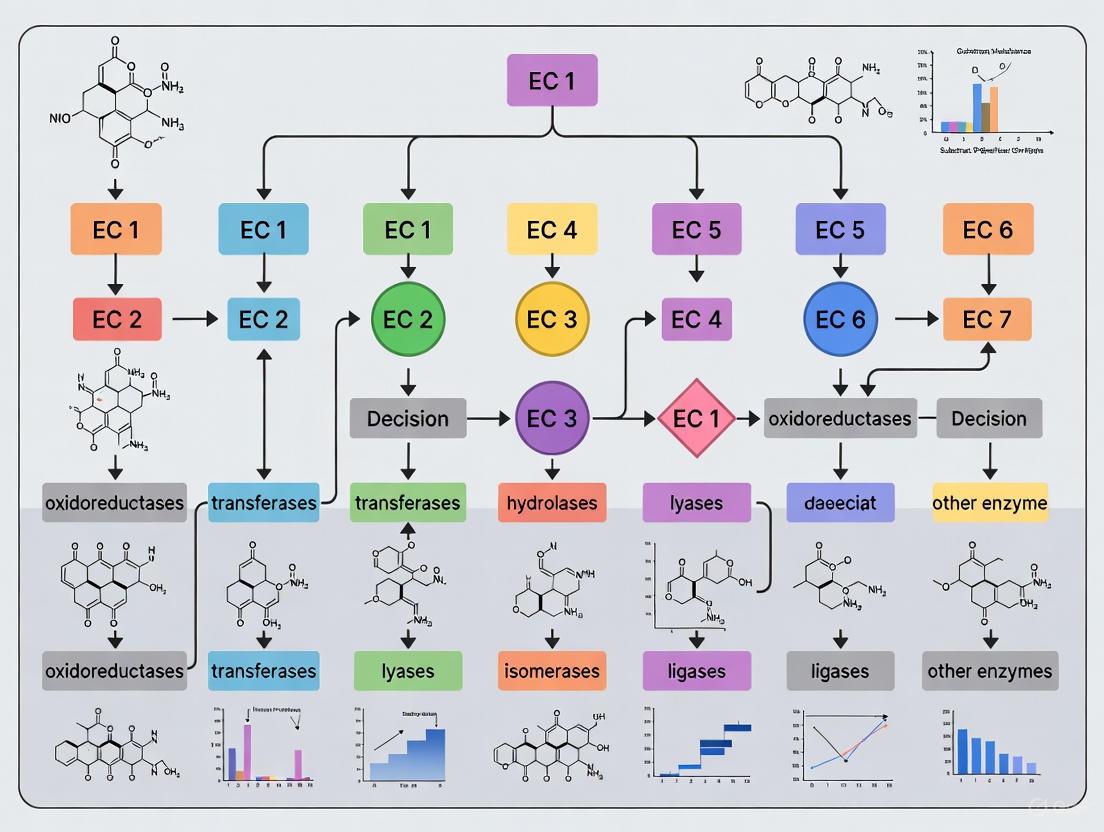
This article provides a thorough exploration of the Enzyme Commission (EC) number system, the universal standard for classifying enzymes based on the reactions they catalyze.
The EC Number System: A Comprehensive Guide for Researchers and Drug Developers
Abstract
This article provides a thorough exploration of the Enzyme Commission (EC) number system, the universal standard for classifying enzymes based on the reactions they catalyze. Tailored for researchers, scientists, and drug development professionals, it covers the system's foundational principles, from its hierarchical structure and seven main classes to its critical role in organizing biochemical knowledge. The scope extends to practical applications in databases and metabolic reconstruction, addresses common challenges and computational prediction tools, and offers a critical validation of the system against alternatives like the Gene Ontology. By integrating historical context with current developments and real-world case studies, this guide serves as an essential resource for leveraging enzyme classification in modern biomedical research.
What is an EC Number? Decoding the Universal Language of Enzymes
In the early days of biochemistry, enzyme nomenclature was characterized by inconsistency and arbitrariness that threatened to undermine scientific communication. Researchers used names like "old yellow enzyme" and "malic enzyme" that provided little insight into the actual chemical reactions being catalyzed [1]. This naming approach worked adequately when only a few enzymes were known, but became completely unsustainable as the number of discovered enzymes grew into the thousands [2]. The field faced a critical juncture where the lack of a rational classification system risked creating a myriad of names and synonyms that no one could systematically track [3]. This chaos necessitated the development of a standardized classification system that could keep pace with the rapid discovery of new enzymes and provide a common language for researchers worldwide.
The Turning Point: Establishing a Systematic Approach
Historical Development and Key Milestones
The urgent need for standardization culminated in the 1950s when the international biochemical community took decisive action. Following earlier classification proposals from scientists like Hoffman-Ostenhof [1] and Dixon and Webb [1], the International Congress of Biochemistry in Brussels established the Commission on Enzymes in 1955 under the chairmanship of Malcolm Dixon [1]. This commission undertook the monumental task of creating a logical and comprehensive classification system.
The first official version of the enzyme classification system was published in 1961, after which the original Enzyme Commission was dissolved, though its legacy continues through the EC number system [1]. The current classification system is maintained by the Nomenclature Committee of the International Union of Biochemistry and Molecular Biology (IUBMB), which continues to refine and expand the system as new enzymes are discovered and characterized [4]. A significant recent development occurred in August 2018 when the IUBMB added an entirely new top-level category, EC 7 (Translocases), demonstrating the system's capacity for evolution and expansion [1].
Core Principles of the EC Classification System
The EC number system was built on several foundational principles that distinguished it from previous naming conventions. First, the system classifies enzymes based on the chemical reactions they catalyze, not the specific enzymes themselves [1]. This means that different enzymes from different organisms that catalyze the same reaction receive the same EC number [1]. Second, the system employs a four-tiered numerical hierarchy that provides progressively finer classification of each enzyme-catalyzed reaction [1]. Third, each enzyme receives both a systematic name that precisely describes the reaction and a recommended name for common usage [3]. This dual naming system balances precision with practical utility for researchers.
The EC Number System: Architecture and Interpretation
The Four-Component Classification Hierarchy
The EC number consists of four numbers separated by periods (e.g., EC 1.1.1.1), with each component representing a different level of classification specificity [1]. The first number indicates one of seven main enzyme classes, the second specifies the enzyme subclass, the third defines the enzyme sub-subclass, and the fourth is a serial number that uniquely identifies the specific enzyme within its sub-subclass [2]. This hierarchical structure allows researchers to understand the general type of reaction catalyzed by an enzyme simply by examining the first digit, while the subsequent numbers provide increasingly specific information about the exact nature of the reaction.
Table 1: The Seven Main Enzyme Classes in the EC System
| EC Number | Class Name | Type of Reaction Catalyzed | Typical Reaction | Example Enzymes |
|---|---|---|---|---|
| EC 1 | Oxidoreductases | Oxidation/reduction reactions; transfer of H and O atoms or electrons | AH + B → A + BH (reduced); A + O → AO (oxidized) | Dehydrogenase, Oxidase [1] |
| EC 2 | Transferases | Transfer of a functional group from one substance to another | AB + C → A + BC | Transaminase, Kinase [1] |
| EC 3 | Hydrolases | Formation of two products from a substrate by hydrolysis | AB + H₂O → AOH + BH | Lipase, Amylase, Peptidase [1] |
| EC 4 | Lyases | Non-hydrolytic addition or removal of groups from substrates; cleavage of C-C, C-N, C-O or C-S bonds | RCOCOOH → RCOH + CO₂ | Decarboxylase [1] |
| EC 5 | Isomerases | Intramolecular rearrangement; isomerization changes within a single molecule | ABC → BCA | Isomerase, Mutase [1] |
| EC 6 | Ligases | Joining of two molecules with simultaneous breakdown of ATP | X + Y + ATP → XY + ADP + Pi | Synthetase [1] |
| EC 7 | Translocases | Movement of ions or molecules across membranes or their separation within membranes | Transfer from 'side 1' to 'side 2' | Transporter [5] |
Interpreting EC Numbers: Practical Examples
The logical structure of EC numbers becomes clear when examining specific examples. For instance, alcohol dehydrogenase (EC 1.1.1.1) can be interpreted as follows: the first '1' identifies it as an oxidoreductase; the second '1' specifies that it acts on the CH-OH group of donors; the third '1' indicates that NAD+ or NADP+ is the acceptor; and the final '1' is the serial number for alcohol dehydrogenase specifically [2].
Another example is tyrosine—arginine ligase (EC 6.3.2.24): the '6' identifies it as a ligase; the '3' specifies that it forms carbon-nitrogen bonds; the '2' indicates it bonds acids and amino acids; and the '24' is the serial number identifying the specific tyrosine-arginine joining activity [2]. This systematic approach allows researchers to understand the basic biochemical function of an enzyme even if they are unfamiliar with its specific common name.
Current State and Research Applications
Maintenance and Updates to the Classification System
The EC classification system remains a dynamically maintained resource that continues to evolve with biochemical research. The authoritative source for enzyme nomenclature is the ExplorEnz database, which serves as the official IUBMB Enzyme Nomenclature list [4] [5]. This open-access database is produced by the Nomenclature Committee in consultation with the IUPAC-IUBMB Joint Commission on Biochemical Nomenclature [5]. The maintenance process involves regular supplements—with over 30 supplements published to date—that incorporate newly discovered enzymes and revisions to existing classifications [4].
The criteria for inclusion in the database are stringent, requiring direct experimental evidence that an enzyme catalyzes the proposed reaction [4]. Close sequence similarity alone is insufficient for classification without biochemical evidence of function, as minor sequence changes can significantly alter enzyme activity or specificity [4]. This evidence-based approach ensures the reliability and accuracy of the classification system for research applications.
The EC classification system serves as a fundamental framework for multiple bioinformatics resources and research applications. Structural biologists use EC numbers in the RCSB Protein Data Bank (PDB) to browse enzymes that perform similar functions, explore structures of enzymes with similar functions but different shapes, and identify conserved catalytic mechanisms [6]. The PDB assigns EC numbers to relevant protein chains based on information from UniProtKB, GenBank, KEGG, or author specifications [6].
The Rhea database provides another critical resource by translating the textual descriptions of IUBMB reactions into standardized chemical reactions that can be used for computational analysis [5]. Reaction similarity between enzymes can be calculated using tools like EC-BLAST (now part of the EMBL-EBI Enzyme Portal), which enables researchers to compare enzymatic reactions based on bond changes, reaction centers, or substructure metrics [1]. These computational tools leverage the standardized EC classification to enable large-scale comparative studies and metabolic modeling.
Table 2: Essential Research Tools and Databases for Enzyme Classification
| Resource Name | Type | Primary Function | Research Application |
|---|---|---|---|
| ExplorEnz | Database | Definitive IUBMB Enzyme Nomenclature list | Authoritative reference for enzyme classification and nomenclature [4] |
| RCSB PDB Enzyme Browser | Database | Browse structures by EC classification | Explore enzyme structures with similar functions; identify catalytic mechanisms [6] |
| ENZYME @ ExPASy | Database | Enzyme nomenclature database | Quick reference for enzyme properties and classifications [1] |
| Rhea | Database | Expert-curated biochemical reactions | Connect EC classifications to standardized chemical reactions [5] |
| EC-BLAST | Tool | Enzyme reaction similarity search | Compare enzymatic reactions; study enzyme evolution and function [1] |
The transition from arbitrary names to the standardized EC number system represents a cornerstone of modern biochemical research. What began as a solution to the chaos of inconsistent nomenclature has evolved into a comprehensive, logically-structured framework that enables precise scientific communication and computational analysis across disciplines. The continued maintenance and development of this system by the international biochemical community ensures that it remains relevant in an era of rapid discovery, serving as an indispensable tool for researchers, scientists, and drug development professionals worldwide. The EC classification system stands as a testament to the importance of standardization in scientific progress, providing a common language that transcends disciplinary and geographical boundaries in the pursuit of biochemical knowledge.
The Enzyme Commission number (EC number) is a numerical classification scheme for enzymes, based exclusively on the chemical reactions they catalyze [1]. Developed by the International Union of Biochemistry and Molecular Biology (IUBMB), this system provides a standardized, rational framework for enzyme nomenclature, addressing the historical chaos that once enveloped the field when enzymes were given arbitrary names with little indication of their function [1] [3]. The EC number system is foundational to modern enzymology, enabling researchers, drug development professionals, and bioinformaticians to communicate with precision about enzymatic activity across diverse organisms and scientific disciplines. Each EC number functions as a unique identifier that describes the reaction type without being tied to any specific enzyme protein sequence, meaning that different enzymes from different organisms that catalyze the same reaction receive the identical EC number [1]. This systematic approach is vital for organizing the growing list of known enzymes and for facilitating the functional annotation of newly discovered enzymes in the era of high-throughput sequencing and synthetic biology [7].
Within the context of enzyme classification research, the EC number system represents a robust, hierarchical ontology that maps the landscape of biochemical catalysis. The system's structure allows for both broad categorization and fine-grained specificity, making it an indispensable tool for database curation, metabolic pathway modeling, and computer-aided drug and synthesis planning [7] [6]. The continued development of computational tools, such as machine learning models for EC number prediction, underscores the system's enduring relevance and its central role in structuring our understanding of enzyme function [7] [8]. This guide provides an in-depth technical breakdown of the EC number system, detailing the meaning of each digit and its significance for research applications.
The Hierarchical Structure of an EC Number
An EC number is composed of four numbers separated by periods, following the format EC A.B.C.D, where each level represents a progressively finer classification of the enzyme-catalyzed reaction [1]. This hierarchical structure systematically narrows the definition of the reaction from a very general class to a highly specific chemical transformation.
- First Digit (A): Class - This top-level category defines the general type of reaction catalyzed. There are seven main classes, numbered 1 through 7, each representing a fundamental kind of chemical reaction [1] [9].
- Second Digit (B): Sub-class - This digit provides more detail within the class, typically indicating the general group or bond upon which the enzyme acts. For example, within the hydrolase class, the sub-class specifies the type of bond being hydrolyzed [1] [3].
- Third Digit (C): Sub-sub-class - This level further specifies the reaction, often indicating the specific substrate or acceptor/donor group involved. It provides a more precise description of the chemical nature of the reaction [1] [3].
- Fourth Digit (D): Serial Identifier - The final digit is a serial number assigned to the enzyme with a specific substrate in sequential order. It uniquely identifies a particular reaction within the sub-sub-class [7] [1].
It is critical to distinguish Enzyme Commission numbers from European Community numbers, which are identifiers for chemical substances regulated in the European Union and follow a different format (e.g., 2XX-XXX-X) [10] [1]. The two systems are unrelated and serve entirely different regulatory and scientific purposes.
Table 1: The seven major classes of enzymes and their quantitative distribution as of March 2025 [9].
| EC Number | Class Name | Reaction Catalyzed | Enzyme Count |
|---|---|---|---|
| EC 1 | Oxidoreductases | Oxidation-reduction reactions | 2,010 |
| EC 2 | Transferases | Transfer of functional groups | 2,069 |
| EC 3 | Hydrolases | Bond cleavage via hydrolysis | 1,357 |
| EC 4 | Lyases | Non-hydrolytic bond cleavage | 773 |
| EC 5 | Isomerases | Intramolecular rearrangement | 320 |
| EC 6 | Ligases | Joining of two molecules with ATP hydrolysis | 249 |
| EC 7 | Translocases | Movement of ions/molecules across membranes | 98 |
A Detailed Analysis of Each Digit and Its Meaning
First Digit – The Reaction Class
The first digit is the most general classifier, placing the enzyme into one of seven fundamental categories based on the overall chemistry of the reaction it catalyzes. This top-level classification is crucial for initial functional grouping and for understanding the enzyme's role in metabolic pathways.
- EC 1: Oxidoreductases catalyze oxidation-reduction reactions, which involve the transfer of electrons or hydrogen atoms from one molecule to another. At least one substrate becomes oxidized while another becomes reduced. These enzymes are pivotal in energy production pathways like cellular respiration and photosynthesis. Typical reactions follow the form:
AH + B → A + BH(reduced) orA + O → AO(oxidized) [1] [9]. Examples include dehydrogenases, reductases, and oxidases. A specific example is lactate dehydrogenase (EC 1.1.1.27) [9]. - EC 2: Transferases catalyze the transfer of a specific functional group from one molecule to another. The transferred group can be methyl, acyl, amino, or phosphate, among others. The general reaction is
AB + C → A + BC[1] [9]. Kinases, which transfer phosphate groups from ATP to a substrate, are a prominent sub-class of transferases. Hexokinase (EC 2.7.1.1), which initiates glycolysis, is a classic example [9]. - EC 3: Hydrolases catalyze the cleavage of chemical bonds by adding water, a process known as hydrolysis. They act on various bonds including C-O, C-N, and C-S. The general reaction is
AB + H2O → AOH + BH[1] [9]. Digestive enzymes like lipases, amylases, and peptidases fall into this class. Trypsin (EC 3.4.21.4) is a key proteolytic hydrolase [9]. - EC 4: Lyases catalyze the non-hydrolytic removal or addition of groups from substrates to form double bonds, or the reverse reaction. They cleave C-C, C-N, C-O, or C-S bonds without hydrolysis or oxidation. The general form can be
RCOCOOH → RCOH + CO2or[X-A+B-Y] → [A=B + X-Y][1] [9]. Decarboxylases are a common type of lyase. - EC 5: Isomerases catalyze intramolecular rearrangements, changing the structure of a molecule without altering its atomic composition. These isomerization reactions include racemization, epimerization, and cis-trans isomerization. The general form is
ABC → BCA[1] [9]. Isomerases and mutases are examples of this class. - EC 6: Ligases catalyze the joining of two molecules, coupled with the hydrolysis of a nucleoside triphosphate. They form new C-O, C-S, C-N, or C-C bonds. The general reaction is
X + Y + ATP → XY + ADP + Pi[1] [9]. Synthetases are typically ligases. - EC 7: Translocases catalyze the movement of ions or molecules across membranes or their separation within membranes. This class was added more recently, in 2018, to account for these specialized enzymatic activities [1].
Second and Third Digits – Defining Sub-class and Sub-sub-class
The second and third digits work in tandem to add increasing layers of specificity to the broad reaction class defined by the first digit. They describe the chemistry with respect to the specific compounds, groups, bonds, or products involved.
- Second Digit (Sub-class): This digit further refines the nature of the reaction within its class. For oxidoreductases, the second digit indicates the group in the donor that undergoes oxidation. For hydrolases, it specifies the type of bond being hydrolyzed. For transferases, it denotes the functional group being transferred.
- Third Digit (Sub-sub-class): This digit provides even finer detail. For oxidoreductases, it often specifies the acceptor group. For hydrolases acting on peptide bonds, the third digit can indicate the peptidase's catalytic mechanism or specificity. For other classes, it may specify cofactors or precise molecular contexts.
Table 2: Example of hierarchical classification for the Type II restriction enzyme, HindIII [3].
| EC Number Segment | Classification Level | Meaning and Specific Description |
|---|---|---|
| EC 3 | Class | Hydrolase (cleaves bonds with water) |
| EC 3.1 | Sub-class | Acts on ester bonds |
| EC 3.1.21 | Sub-sub-class | Endodeoxyribonuclease producing 5'-phosphomonoesters |
| EC 3.1.21.4 | Serial ID | Type II site-specific deoxyribonuclease (HindIII) |
Fourth Digit – The Serial Identifier
The fourth and final digit in an EC number is a serial identifier that uniquely pinpoints a single enzymatic reaction within its sub-sub-class. While the first three digits define a group of enzymes that catalyze the same general type of reaction on the same general type of substrate, the fourth digit distinguishes between individual reactions based on specific substrate identity and reaction particulars [7] [1]. For instance, within the sub-sub-class EC 3.4.21 (Serine endopeptidases), different enzymes are distinguished by their fourth digit: EC 3.4.21.1 is chymotrypsin, EC 3.4.21.4 is trypsin, and EC 3.4.21.5 is thrombin [8]. Each of these enzymes shares a common catalytic mechanism but acts on distinct physiological substrates and plays different biological roles.
Experimental and Computational Methodologies in EC Number Research
The accurate determination and prediction of EC numbers are active areas of research, combining traditional biochemical assays with advanced computational models. The process of manually assigning an EC number requires extensive experimental characterization, which remains the gold standard.
Traditional Biochemical Assay Workflow
The classical approach to assigning an EC number involves a systematic experimental protocol to characterize the enzyme's activity, substrate specificity, and reaction products.
- Step 1: Enzyme Purification. The enzyme is isolated from its native source or expressed recombinantly in a host system and purified to homogeneity using techniques like chromatography to ensure that observed activities are due to the enzyme in question.
- Step 2: Reaction Characterization. The overall chemical transformation is determined. Researchers analyze substrates and products to identify the type of reaction, which allows for preliminary assignment of the first EC digit (the class).
- Step 3: Determination of Specificity. The enzyme's specificity for its substrate(s) and cofactors is rigorously tested. This involves kinetic assays with potential substrate analogs to define the exact chemical group acted upon, informing the second and third digits of the EC number.
- Step 4: Product Identification and Mechanism Elucidation. The products of the reaction are unequivocally identified using analytical methods. The catalytic mechanism may also be studied. This fine-grained detail is essential for defining the serial number, the fourth digit.
- Step 5: Submission and Review. The collected data is submitted to the Nomenclature Committee of the IUBMB, which reviews the evidence and, if sufficient, officially assigns a new EC number.
Diagram 1: Traditional biochemical workflow for EC number assignment.
Computational Prediction Using Machine Learning
To address the challenge of annotating the vast number of newly discovered enzymes, machine learning models have been developed for in silico EC number prediction. These models overcome limitations of manual curation, such as data scarcity and class imbalance [7]. The CLAIRE (Contrastive Learning-based AnnotatIon for Reaction's EC) framework represents a state-of-the-art approach for predicting the EC numbers of chemical reactions, which is crucial for computer-aided synthesis planning [7].
- Data Curation and Augmentation: CLAIRE is trained on the ECREACT dataset, which combines reaction-EC pairs from multiple databases like Rhea and BRENDA. To improve model robustness, data augmentation is performed by shuffling the order of reactants and products in the reaction SMILES strings, effectively increasing the training set size and variability [7].
- Feature Engineering: Each enzymatic reaction, represented in SMILES format, is converted into a numerical feature vector. CLAIRE uses two complementary representations:
- Rxnfp Embeddings: A pre-trained transformer model generates these embeddings, effectively capturing the reaction's context and category within a learned chemical space [7].
- Differential Reaction Fingerprints: This method converts a reaction SMILES into a binary fingerprint by comparing the symmetric difference of circular molecular fragments from the reactants and products [7].
- Model Architecture and Training: The core of CLAIRE is a contrastive learning framework. This architecture is particularly effective for handling imbalanced datasets where some EC numbers have many known examples and others have very few. The model learns to minimize the distance between reactions with the same EC number while maximizing the distance between reactions with different EC numbers in the embedding space. This allows it to generalize well even for EC classes with limited training data [7].
Diagram 2: Computational workflow of the CLAIRE model for EC number prediction.
Another advanced method, EC2Vec, addresses the challenge of encoding EC numbers themselves for machine learning tasks. Instead of treating EC digits as simple numbers, which implies a false numerical order, EC2Vec uses a multimodal autoencoder to represent each digit as a categorical token [8]. The model learns meaningful vector embeddings that capture the hierarchical relationships within the EC number system, which has been shown to improve performance in downstream prediction tasks compared to naive encoding methods [8].
Table 3: Key databases and computational tools for EC number research.
| Resource Name | Type | Primary Function in Research | Access |
|---|---|---|---|
| EXPASY ENZYME [11] | Database | The primary repository for official IUBMB-approved enzyme nomenclature, providing detailed information for each EC number. | Web-based |
| BRENDA [8] | Database | A comprehensive enzyme information system providing functional data like kinetics, specificity, and organismal sources for EC numbers. | Web-based |
| Rhea [7] | Database | A expert-curated resource of biochemical reactions focused on enzyme catalysis, used for mapping reactions to EC numbers. | Web-based |
| UniProtKB [1] | Database | A central hub for protein sequence and functional data, extensively cross-referenced with EC numbers. | Web-based |
| CLAIRE [7] | Software Tool | A contrastive learning-based model for predicting the EC number of a chemical reaction from its SMILES string. | GitHub |
| EC2Vec [8] | Algorithm | A method for generating meaningful vector embeddings of EC numbers for use in machine learning models. | N/A |
The Enzyme Commission number system, with its logical, hierarchical structure of four digits, provides an indispensable code for deciphering enzyme function. From the broad reaction class defined by the first digit down to the specific serial identifier of the fourth, each segment of the code adds a critical layer of meaning, enabling precise communication among researchers. As the field of enzymology advances, the integration of traditional biochemical methods with powerful computational predictors like CLAIRE and sophisticated encoding schemes like EC2Vec is accelerating our ability to classify and understand the vast universe of enzymatic reactions. This synergy between classic experimental rigor and modern bioinformatics ensures that the EC number system will continue to be a cornerstone of enzyme research, drug discovery, and synthetic biology.
The Enzyme Commission number (EC number) is a numerical classification scheme for enzymes, established by the Nomenclature Committee of the International Union of Biochemistry and Molecular Biology (IUBMB) [1] [12]. This system categorizes enzymes based exclusively on the chemical reactions they catalyze, rather than on their amino acid sequences or structural features [1]. The EC number system was developed to address the historical chaos in enzyme naming, where arbitrary names like "old yellow enzyme" provided little information about the catalyzed reaction [1]. The first version was published in 1961, and the system has been continuously updated since, with the most significant recent change being the addition of the EC 7 class in 2018 [1] [12].
Each EC number consists of four numbers separated by periods (e.g., EC 1.1.1.1) representing a progressively finer classification of the enzyme [1]. It is crucial to recognize that EC numbers identify enzyme-catalyzed reactions, not individual enzyme proteins. Therefore, completely different proteins from different organisms that catalyze the same reaction receive the identical EC number [1]. This systematic approach allows researchers to unambiguously refer to enzymatic functions across biological databases and scientific literature, facilitating genomic annotation, metabolic pathway reconstruction, and comparative enzymology [12] [13].
The Hierarchy and Structure of EC Numbers
The EC number system employs a four-level hierarchical structure that provides increasing specificity at each level [1] [14]:
- First digit represents one of the seven major classes of enzymes (EC 1-EC 7)
- Second digit indicates the subclass, specifying the general type of substrate or the nature of the chemical reaction more precisely
- Third digit denotes the sub-subclass, providing additional details about the specific reaction mechanism or the exact substrate characteristics
- Fourth digit is the serial number that uniquely identifies the specific enzyme within its sub-subclass
This logical hierarchy enables researchers to understand the general catalytic mechanism of an enzyme even from partial EC numbers. For example, the enzyme hexokinase (EC 2.7.1.1) can be interpreted as: EC 2 (transferase) → EC 2.7 (transferring phosphorus-containing groups) → EC 2.7.1 (phosphotransferases with an alcohol group as acceptor) → EC 2.7.1.1 (specifically hexokinase) [6] [14].
The table below illustrates how this hierarchical system applies across different enzyme classes:
| EC Number | Enzyme Name | Class | Subclass | Sub-subclass | Serial Number |
|---|---|---|---|---|---|
| EC 1.1.1.1 | Alcohol dehydrogenase | Oxidoreductases (1) | Acting on CH-OH group (1) | With NAD+/NADP+ as acceptor (1) | Specific enzyme (1) |
| EC 2.7.1.1 | Hexokinase | Transferases (2) | Transferring phosphorus-containing (7) | Phosphotransferases with alcohol acceptor (1) | Specific enzyme (1) |
| EC 3.4.11.4 | Tripeptide aminopeptidase | Hydrolases (3) | Acting on peptide bonds (4) | Aminopeptidases (11) | Specific enzyme (4) |
Table 1: Examples of EC number hierarchy for different enzyme classes [1] [14]
The Seven Major Enzyme Classes
EC 1: Oxidoreductases
Oxidoreductases catalyze oxidation-reduction reactions involving the transfer of hydrogen atoms, oxygen atoms, or electrons from one molecule (the reductant) to another (the oxidant) [1] [14]. These enzymes are fundamental to biological energy conversion processes such as cellular respiration and photosynthesis. The typical reaction catalyzed is: AH + B → A + BH (reduction) or A + O → AO (oxidation) [1].
Oxidoreductases are further categorized based on their donors and acceptors. Key subclasses include:
- EC 1.1: Acting on the CH-OH group of donors (e.g., alcohol dehydrogenases)
- EC 1.2: Acting on the aldehyde or oxo group of donors
- EC 1.3: Acting on the CH-CH group of donors
- EC 1.4: Acting on the CH-NH₂ group of donors
- EC 1.5: Acting on the CH-NH group of donors
- EC 1.6: Acting on NADH or NADPH as donors [4]
Examples of clinically relevant oxidoreductases include cytochrome c oxidase (EC 1.9.3.1) in the electron transport chain and glucose oxidase (EC 1.1.3.4) used in biosensors for blood glucose monitoring [1] [14].
EC 2: Transferases
Transferases catalyze the transfer of specific functional groups (e.g., methyl, acyl, amino, glycosyl, or phosphate groups) from a donor molecule to an acceptor molecule [1] [14]. The general reaction is: AB + C → A + BC [1].
These enzymes play crucial roles in metabolic pathways, signal transduction, and epigenetic regulation. Significant subclasses include:
- EC 2.1: Transferring one-carbon groups (methyltransferases)
- EC 2.2: Transferring aldehyde or ketonic groups (transketolases, transaldolases)
- EC 2.3: Acyltransferases
- EC 2.4: Glycosyltransferases
- EC 2.7: Transferring phosphorus-containing groups (kinases) [4]
Notable examples include DNA methyltransferases (EC 2.1.1.37) in epigenetic regulation and protein kinases (EC 2.7.11.1) in cellular signaling cascades [1] [14].
EC 3: Hydrolases
Hydrolases catalyze the cleavage of chemical bonds through the addition of water (hydrolysis) [1] [14]. These enzymes are among the most diverse and have widespread industrial applications in detergent, food, and pharmaceutical industries. The general reaction is: AB + H₂O → AOH + BH [1].
Key subclasses of hydrolases include:
- EC 3.1: Acting on ester bonds (esterases, lipases, nucleases)
- EC 3.2: Glycosylases (carbohydrates-degrading enzymes)
- EC 3.4: Acting on peptide bonds (proteases and peptidases)
- EC 3.5: Acting on carbon-nitrogen bonds (non-peptide) [4]
Digestive enzymes like pepsin (EC 3.4.23.1) and amylase (EC 3.2.1.1) are common examples, as are diagnostic enzymes such as alkaline phosphatase (EC 3.1.3.1) [1] [14].
EC 4: Lyases
Lyases catalyze the non-hydrolytic cleavage or formation of chemical bonds by means other than oxidation or reduction [1] [12]. These enzymes typically remove a group from a substrate to form a double bond or add a group to a double bond. The general reaction is: RCOCOOH → RCOH + CO₂ or [X-A+B-Y] → [A=B + X-Y] [1].
Lyases are categorized based on the type of bond they cleave or form:
- EC 4.1: Carbon-carbon lyases (decarboxylases, aldolases)
- EC 4.2: Carbon-oxygen lyases (dehydratases)
- EC 4.3: Carbon-nitrogen lyases
- EC 4.4: Carbon-sulfur lyases
- EC 4.5: Carbon-halide lyases
- EC 4.6: Phosphorus-oxygen lyases [4]
Important examples include pyruvate decarboxylase (EC 4.1.1.1) in alcoholic fermentation and carbonic anhydrase (EC 4.2.1.1), which is crucial for maintaining acid-base balance in the blood [1] [14].
EC 5: Isomerases
Isomerases catalyze intramolecular rearrangements, meaning they change the structure of a molecule without altering its atomic composition [1] [14]. These enzymes convert a substrate from one isomer to another through various mechanisms including racemization, epimerization, cis-trans isomerization, and intramolecular oxidoreductions. The general reaction is: ABC → BCA [1].
Major subclasses of isomerases include:
- EC 5.1: Racemases and epimerases
- EC 5.2: Cis-trans isomerases
- EC 5.3: Intramolecular oxidoreductases
- EC 5.4: Intramolecular transferases (mutases)
- EC 5.5: Intramolecular lyases
- EC 5.99: Other isomerases [4]
A clinically relevant example is triosephosphate isomerase (EC 5.3.1.1), a critical enzyme in glycolysis, whose deficiency causes a severe genetic disorder [1] [14]. Recently, a new subclass (EC 5.6) has been added for enzymes that alter the conformations of proteins and nucleic acids [12].
EC 6: Ligases
Ligases catalyze the joining of two molecules coupled with the hydrolysis of a high-energy phosphate bond, typically from ATP [1] [14]. These enzymes are essential for DNA replication, repair, and various biosynthetic pathways. The general reaction is: X + Y + ATP → XY + ADP + Pi [1].
Ligases are classified based on the type of bond they form:
- EC 6.1: Forming carbon-oxygen bonds
- EC 6.2: Forming carbon-sulfur bonds
- EC 6.3: Forming carbon-nitrogen bonds (including aminoacyl-tRNA synthetases)
- EC 6.4: Forming carbon-carbon bonds
- EC 6.5: Forming phosphoric ester bonds
- EC 6.6: Forming nitrogen-metal bonds [4]
DNA ligase (EC 6.5.1.1), essential for DNA replication and repair, and aminoacyl-tRNA synthetases (EC 6.1.1.-), crucial for protein synthesis, are prominent examples [1] [14].
EC 7: Translocases
Translocases represent the newest addition to the enzyme classification system, established in 2018 [1] [12]. These enzymes catalyze the movement of ions or molecules across membranes or their separation within membranes [1]. The translocation process may be linked to various energy sources, including oxidoreductase reactions, hydrolysis of nucleoside triphosphates, or decarboxylation reactions [15].
Translocases are categorized based on the substances they translocate:
- EC 7.1: Catalyzing the translocation of hydrons (H⁺, D⁺, T⁺)
- EC 7.2: Catalyzing the translocation of inorganic cations and their chelates
- EC 7.3: Catalyzing the translocation of inorganic anions
- EC 7.4: Catalyzing the translocation of amino acids and peptides
- EC 7.5: Catalyzing the translocation of carbohydrates and their derivatives
- EC 7.6: Catalyzing the translocation of other compounds [15]
Notable examples include ATP synthase (EC 7.1.2.2), which couples proton translocation to ATP synthesis, and cytochrome c oxidase (EC 7.1.1.9), which translocates protons across the mitochondrial membrane during electron transfer [15] [14].
Experimental and Computational Methodologies in Enzyme Classification
Traditional Biochemical Approaches
The classical assignment of EC numbers requires direct experimental evidence that a purified enzyme catalyzes a specific chemical reaction [4]. The IUBMB Nomenclature Committee emphasizes that "close sequence similarity is not sufficient without evidence for the reaction catalyzed, because only a small change in sequence is sufficient to change the activity or specificity of an enzyme" [4]. The existence of a gap in a biochemical pathway is also insufficient grounds for classification without direct enzymatic evidence [4].
Standard biochemical characterization includes:
- Enzyme purification to homogeneity to ensure the observed activity stems from a single protein
- Kinetic analysis to determine substrate specificity, catalytic efficiency (kcat/KM), and inhibition patterns
- Stoichiometric measurements to verify the exact chemical transformation
- Cofactor requirements identification when applicable
- Optimal pH and temperature profiling to understand physiological relevance
Only after such comprehensive characterization can a new enzyme be proposed for inclusion in the official enzyme list through submission to the IUBMB Nomenclature Committee [4].
Computational Prediction of EC Numbers
With the explosion of genomic data, computational methods have become indispensable for preliminary EC number assignments. These methods can be broadly categorized into sequence-based, structure-based, and reaction-based approaches.
Sequence-based methods leverage homology and machine learning:
- EFICAz2 combines multiple methods including conservation-controlled HMM iterative procedures and functionally discriminating residue identification [16]
- DEEPre employs deep neural networks using both sequence-length dependent (one-hot encoding, PSSM) and independent features (functional domains) [16]
- ECPred uses an ensemble of machine learning classifiers with individual models for each EC number and a hierarchical prediction approach [16]
Reaction-based methods focus on chemical transformations:
- ECAssigner uses reaction difference fingerprints (RDF) calculated as the difference between molecular fingerprints of reactants and products [13]
- Reaction similarity is computed using Euclidean distance between RDF vectors, with the EC number of the most similar known reaction assigned to the query [13]
- Cross-validation shows accuracies of 83.1%, 86.7%, and 92.6% at the sub-subclass, subclass, and main class levels, respectively [13]
The following diagram illustrates a typical workflow for computational EC number prediction:
Figure 1: Computational EC Number Prediction Workflow
Reaction Similarity and Classification Metrics
Quantifying reaction similarity is fundamental to computational enzyme classification. The Reaction Difference Fingerprint (RDF) approach has proven particularly effective [13]. RDF is calculated as:
RFP = MFPreactants - MFPproducts
where MFP represents molecular fingerprints of reactants and products. The similarity between two reactions is then computed as the Euclidean distance between their RDF vectors [13]:
Di,j = ED(RFPi, RFP_j)
Smaller distances indicate greater similarity, and the EC number of the closest training reaction is assigned to the query reaction [13].
The performance of different fingerprint lengths in EC number prediction is summarized below:
| Fingerprint Length | Sub-subclass Accuracy | Subclass Accuracy | Main Class Accuracy |
|---|---|---|---|
| 0 (atom types only) | 61.4% | 67.1% | 85.6% |
| 0-1 (including bonds) | 74.2% | 78.5% | 90.1% |
| 0-2 (including short paths) | 82.2% | 85.9% | 92.3% |
| 0-3 (optimal) | 83.1% | 86.7% | 92.6% |
Table 2: Cross-validation accuracies of reaction difference fingerprints with different lengths [13]
Research Reagent Solutions for Enzyme Characterization
The following table provides key reagents and resources essential for experimental enzyme classification research:
| Reagent/Resource | Function in Enzyme Research | Example Applications |
|---|---|---|
| Purified Enzyme Samples | Direct characterization of catalytic activity | Kinetic parameter determination, substrate specificity profiling |
| Specific Substrates & Inhibitors | Probe enzyme function and mechanism | Active site mapping, reaction stoichiometry determination |
| Cofactor Analogs (NAD+, ATP, etc.) | Support oxidoreductase, kinase, and ligase activities | Cofactor requirement assays, enzyme activation studies |
| UniProtKB/Swiss-Prot Database | Reference database for validated enzyme sequences | Sequence homology analysis, functional annotation transfer |
| KEGG Reaction Database | Repository of enzymatic reactions with EC numbers | Reaction similarity analysis, metabolic pathway reconstruction |
| ExplorEnz Database | Primary source of the official IUBMB enzyme list | EC number verification, nomenclature standardization |
| PDB (Protein Data Bank) | Structural information for enzyme-substrate complexes | Structure-function relationship studies, active site analysis |
Table 3: Essential research reagents and resources for enzyme classification studies [1] [6] [16]
Applications in Research and Drug Development
The EC classification system provides an essential framework for genome annotation and metabolic reconstruction [17] [13]. By linking genomic sequences to enzymatic functions through EC numbers, researchers can predict organismal metabolic capabilities and identify potential drug targets [16] [13].
In pharmaceutical research, EC numbers facilitate:
- Target identification by pinpointing enzymes essential to pathogen viability or human disease pathways
- Selectivity screening by comparing enzyme classes across species
- Mechanism of action studies for enzyme inhibitors
- Off-target effect prediction by identifying similar enzymes in host organisms
The hierarchical nature of the EC system enables multi-level drug discovery strategies. For instance, broad-spectrum antimicrobials might target an entire enzyme class (e.g., EC 2.7 kinases), while highly specific drugs might focus on individual enzymes (e.g., EC 2.7.1.1 hexokinase 2 in cancer) [1] [14].
The relationship between enzyme classification and drug development can be visualized as:
Figure 2: EC System in Drug Development Workflow
Future Directions and Challenges
The EC classification system continues to evolve with several emerging trends and challenges:
Expanding enzyme diversity: Newly discovered enzymes, particularly those from extreme environments and microbial sources, continue to challenge the existing classification framework [12]. The recent addition of EC 7 (translocases) demonstrates the system's capacity for expansion [1] [15] [12].
Computational predictions vs. experimental validation: While computational methods have achieved impressive accuracies (83-93% across EC levels [13]), the IUBMB maintains strict requirements for direct experimental evidence before official EC number assignment [4]. This creates a growing gap between computationally predicted and biochemically validated enzymes.
Multi-functional and promiscuous enzymes: Many enzymes display catalytic promiscuity, catalyzing secondary reactions with lower efficiency [12]. The EC system currently provides limited mechanisms for representing such multi-functional enzymes.
Structural vs. functional classification: The existence of non-homologous isofunctional enzymes (proteins with different folds catalyzing the same reaction) and analogous enzymes (similar folds catalyzing different reactions) creates challenges for purely sequence-based functional predictions [1] [12].
The enzyme classification field is moving toward integrated approaches that combine sequence, structural, chemical, and mechanistic information to develop more comprehensive functional predictions, potentially leading to an expanded classification system that better captures the complexity of enzyme function and evolution [12] [16] [13].
The precise and unambiguous identification of enzymes is a fundamental requirement in biochemical research, metabolic engineering, and drug development. The Enzyme Commission (EC) number system, established by the International Union of Biochemistry and Molecular Biology (IUBMB), provides a standardized numerical classification scheme for enzymes based on the chemical reactions they catalyze [1] [5]. This system operates alongside a dual naming convention—systematic and recommended names—to ensure clarity and precision in scientific communication [3]. Within the broader context of enzyme classification research, understanding this nomenclature is crucial for database annotation, metabolic network reconstruction, and cross-disciplinary collaboration [18] [19]. This guide details the core terminology and structural logic of the EC system, which has classified over 8,000 enzymatic reactions to date [2].
The Enzyme Commission (EC) Number System
Structural Hierarchy of EC Numbers
An EC number is a four-element code (e.g., EC a.b.c.d) where each digit represents a progressively finer level of classification [1] [2]. The system is hierarchical:
- Class (First Digit): Designates one of the seven fundamental types of enzyme-catalyzed reactions [20].
- Subclass (Second Digit): Indicates the general nature of the substrate or the type of group transferred in the reaction [3].
- Sub-subclass (Third Digit): Specifies the exact substrate or cofactor involved, providing further precision [3] [2].
- Serial Number (Fourth Digit): A unique identifier for the specific enzyme within its sub-subclass [2].
This classification is based solely on the reaction catalyzed, not on the amino acid sequence or structural fold of the enzyme. Consequently, non-homologous isofunctional enzymes from different organisms that catalyze the identical reaction receive the same EC number [1].
The Seven Major Enzyme Classes
The first digit of an EC number assigns the enzyme to one of seven primary classes, detailed in Table 1 [1] [5] [20].
Table 1: The Seven Major Enzyme Classes of the EC Number System
| EC Number | Class Name | Reaction Catalyzed | Example Reaction | Example Enzyme (Trivial Name) |
|---|---|---|---|---|
| EC 1 | Oxidoreductases | Catalyzes oxidation-reduction reactions; transfers H and O atoms or electrons. | ( AH + B \rightarrow A + BH ) (reduced) | Dehydrogenase, Oxidase |
| EC 2 | Transferases | Transfers a functional group (e.g., methyl, acyl, amino, phosphate). | ( AB + C \rightarrow A + BC ) | Transaminase, Kinase |
| EC 3 | Hydrolases | Catalyzes bond cleavage by hydrolysis. | ( AB + H_2O \rightarrow AOH + BH ) | Lipase, Amylase, Peptidase |
| EC 4 | Lyases | Non-hydrolytic removal of groups to form double bonds, or addition of groups to double bonds. | ( RCOCOOH \rightarrow RCOH + CO_2 ) | Decarboxylase |
| EC 5 | Isomerases | Catalyzes intramolecular rearrangement (isomerization). | ( ABC \rightarrow BCA ) | Isomerase, Mutase |
| EC 6 | Ligases | Joins two molecules with simultaneous hydrolysis of a diphosphate bond in ATP or a similar triphosphate. | ( X + Y + ATP \rightarrow XY + ADP + P_i ) | Synthetase |
| EC 7 | Translocases | Catalyzes the movement of ions or molecules across membranes or their separation within membranes. | – | Transporter |
The following diagram illustrates the logical decision hierarchy for classifying an enzyme into its correct EC number based on the reaction it catalyzes.
Figure 1: Decision hierarchy for EC number classification. The path marked with an asterisk indicates that the classification process may require re-evaluation or that the enzyme may belong to a different category not listed, as the seven classes are comprehensive for known enzymes [1] [20].
EC Number in Practice: Example Deconstruction
To illustrate the application of the hierarchical system, consider Alcohol dehydrogenase (EC 1.1.1.1) [2]:
- EC 1: The first digit identifies it as an Oxidoreductase.
- EC 1.1: The second digit specifies that it acts on the CH-OH group of donors.
- EC 1.1.1: The third digit indicates that NAD+ or NADP+ is the acceptor.
- EC 1.1.1.1: The fourth digit is the serial number for alcohol dehydrogenase.
Systematic and Recommended Names
Definition and Function
The EC system provides two complementary names for each enzyme to facilitate clear communication [3].
- Recommended Name: This is the common, everyday name for the enzyme, often derived by adding the suffix "-ase" to the substrate name (e.g., urease) or a description of its action (e.g., alcohol dehydrogenase). While practical, these names can sometimes be ambiguous [3] [2].
- Systematic Name: This is an unambiguous, chemically descriptive name. It is formed from the names of all substrates and the reaction type, also ending in "-ase". For example, the systematic name for alcohol dehydrogenase is "alcohol:NAD+ oxidoreductase" [3].
Comparative Analysis of Naming Conventions
The distinct roles and formats of the three primary enzyme identifiers are summarized in Table 2.
Table 2: Comparative Overview of Enzyme Identifiers
| Identifier | Primary Function | Format Example | Key Characteristic | Use Case |
|---|---|---|---|---|
| EC Number | Classification | EC 1.1.1.1 | Hierarchical code based on reaction mechanism; universal for all enzymes catalyzing the same reaction [1]. | Database searching, metabolic pathway modeling, bioinformatics [18]. |
| Recommended Name | Common reference | Alcohol dehydrogenase | Short, memorable name; derived from substrate or reaction type; potential for ambiguity [3]. | Routine scientific discourse, laboratory jargon. |
| Systematic Name | Unambiguous description | Alcohol:NAD+ oxidoreductase | Chemically precise and descriptive; includes all substrates and the reaction type [3]. | Publications, definitive documentation, resolving ambiguity. |
Experimental Validation and EC Number Assignment
Methodologies for Validating EC Classifications
The assignment of a new EC number requires direct experimental evidence that the proposed enzyme catalyzes the claimed reaction. Close sequence similarity alone is not sufficient, as minor sequence changes can alter activity or specificity [4]. The process for validating and correcting EC assignments has been enhanced by computational tools.
A landmark study developed an automatic classification strategy for validating EC numbers by analyzing the chemical structures of substrates and products [18] [19]. The experimental workflow is as follows:
- Reaction Data Curation: A set of 3,788 enzyme-catalyzed biochemical reactions from the IUBMB database was compiled.
- Substructure Analysis: The approach involved decomposing each reaction formula and analyzing the transformation using chemical knowledge.
- Automatic Assignment: Reactions were automatically assigned to EC sub-subclasses based on the chemical transformation, independent of the existing classification.
- Validation and Discrepancy Categorization: The automated assignments were compared against the official IUBMB classification. Discrepancies were categorized into nine subsets for further analysis [19].
The experimental validation of enzyme function and the maintenance of classification databases rely on specific reagents and resources, as detailed in Table 3.
Table 3: Essential Research Reagent Solutions for Enzyme Nomenclature Research
| Reagent/Resource | Function in EC Research | Example Sources / Databases |
|---|---|---|
| Definitive Enzyme List | Authoritative reference for approved EC numbers, names, and reactions. | ExplorEnz [4] [5] |
| Protein Sequence Databases | Provides protein sequences annotated with EC numbers; used for homology searches. | UniProt [1] [18] |
| Metabolic Pathway Databases | Contextualizes enzymes within biochemical pathways; aids in functional prediction. | KEGG, MetaCyc [18] [19] |
| Enzyme Kinetics Databases | Offers functional data (e.g., substrates, inhibitors) to support enzyme characterization. | BRENDA [18] [19] |
| Computational Validation Tools | Automates the assignment of EC numbers and validates existing classifications. | EC-BLAST (via EMBL-EBI Enzyme Portal) [1] |
Research Outcomes and Impact on Enzyme Nomenclature
The automated validation of 3,788 reactions revealed that over 80% were in agreement with the official EC classification [18] [19]. However, it also identified several categories of inconsistencies:
- Incorrect Sub-subclass Assignment: 61 reactions (2.5%) were found to be assigned to the wrong sub-subclass according to the NC-IUBMB rules. For instance, UDP-N-acetylmuramate dehydrogenase (EC 1.1.1.158) was reclassified from sub-subclass 1.1.1 to 1.3.1 [19].
- Bifunctional Enzymes: Enzymes like choline oxidase (EC 1.1.3.17), which catalyze two different types of reactions, were identified as needing two distinct EC numbers [18] [19].
- Ambiguous Reactions: A number of reactions could be assigned to multiple, overly similar sub-subclasses, suggesting opportunities for merging categories to reduce ambiguity [19].
These findings demonstrate that the EC system is a living, evolving framework. The research provides a mechanism for initiating corrections and continuous improvement, which is vital for its application in fields like drug design and systems biology, where data consistency is critical [18].
The systematic classification of enzymes is a cornerstone of modern biochemistry and molecular biology, enabling researchers and drug development professionals to unambiguously identify enzymatic functions across biological systems. The Enzyme Commission (EC) number system, developed under the auspices of the International Union of Biochemistry and Molecular Biology (IUBMB), provides a rigorous framework for classifying enzymes based on the chemical reactions they catalyze rather than their structural characteristics [21] [1]. This critical distinction means that enzymes from different biological sources, or even those with completely different protein folds resulting from convergent evolution, receive the identical EC number if they catalyze the same chemical reaction [1]. This functional classification system has become the universal language for enzyme research, facilitating clear communication and data integration across diverse scientific disciplines and databases.
The IUBMB Nomenclature Committee (NC-IUBMB), in association with the IUPAC-IUBMB Joint Commission on Biochemical Nomenclature (JCBN), maintains overall responsibility for the maintenance and development of the Enzyme List [22]. This governance ensures that the classification system remains robust, accurate, and responsive to new scientific discoveries. The ExplorEnz database, developed at Trinity College Dublin, serves as the primary repository for this curated enzyme nomenclature, providing the scientific community with the most up-to-date and authoritative resource on enzyme classification [23] [22]. The critical importance of this system extends throughout biological research, from metabolic network reconstruction and systems biology to drug discovery and synthetic biology applications [7] [13].
The IUBMB Governance Framework
Historical Development and Governance Structure
The development of the EC number system emerged from a pressing need to address the chaotic and arbitrary naming conventions for enzymes that prevailed in the early to mid-20th century. Before its establishment, enzymes were known by names that provided little information about their function, such as "old yellow enzyme" and "malic enzyme" [1]. By the 1950s, this situation had become untenable for the growing field of biochemistry. In response, the International Congress of Biochemistry in Brussels established the Commission on Enzymes in 1955 under the chairmanship of Malcolm Dixon [1]. The first official version of the enzyme nomenclature was published in 1961, after which the original Commission was dissolved, though its work continues through the NC-IUBMB [12] [1].
The current governance structure involves a continuous curation process where newly reported enzymes are regularly added to the list only after rigorous validation [12]. This meticulous process ensures the integrity and reliability of the classification system. When new scientific information affects the classification of an existing entry, a new EC number is created, while the old one is never reused, preserving the historical record and preventing confusion in the literature [12]. The IUBMB modified the system as recently as August 2018 by adding the new top-level EC 7 category for translocases, demonstrating the system's capacity for evolution in response to scientific advances [12] [1].
Principles of Enzyme Classification
The IUBMB classification system follows several fundamental principles that govern how enzymes are categorized and named. The first general principle states that names ending in "-ase" should be used only for single catalytic entities, not systems containing more than one enzyme [21]. For multi-enzyme systems, the term "system" should be included in the name, such as "succinate oxidase system" rather than "succinate oxidase" [21].
The second principle establishes that enzymes are classified and named according to the reaction they catalyze [21]. The chemical reaction catalyzed is the specific property that distinguishes one enzyme from another, providing the logical basis for classification. This reaction-based approach offers significant advantages over alternative classification bases that had been considered, such as the chemical nature of the enzyme (e.g., flavoprotein, hemoprotein) or the chemical nature of the substrate (e.g., nucleotides, carbohydrates) [21]. These alternatives were rejected because they could not serve as a general basis for classification—only a minority of enzymes have identifiable prosthetic groups, and substrate-based classification is not sufficiently informative without also specifying the type of reaction [21].
A third principle addresses the directionality of reactions for classification purposes. To simplify the classification system, the direction chosen is the same for all enzymes in a given class, even if this direction has not been experimentally demonstrated for all members [21]. The systematic names, which form the basis for classification and code numbers, may therefore be derived from a written reaction even when only the reverse reaction has been experimentally demonstrated [21].
Table: Fundamental Principles of Enzyme Classification According to IUBMB
| Principle | Description | Practical Implication |
|---|---|---|
| Single Enzyme Principle | Names ending in "-ase" apply only to single catalytic entities | Multi-enzyme complexes must be designated as "systems" |
| Reaction-Based Classification | Enzymes classified according to chemical reaction catalyzed | Focus on functional capability rather than structural features |
| Comprehensive Reaction View | Classification based on overall reaction as expressed by formal equation | Intimate mechanism and intermediate complexes not considered |
| Standardized Directionality | Reaction direction standardized within classes | Systematic names may represent thermodynamically favorable direction regardless of physiological direction |
ExplorEnz: The Primary IUBMB Enzyme Database
Database Architecture and Development
ExplorEnz was developed in 2005 as a new way to access the data of the IUBMB Enzyme Nomenclature List, implementing a MySQL relational database to store enzyme data and associated literature references [23] [24]. This represented a significant advancement over the previous flat-file storage system, which lacked comprehensive search capabilities and a systematic change-tracking mechanism [22]. The current database architecture comprises six tables containing information divided into two main categories: enzyme data and supporting literature references [24].
A key innovation in ExplorEnz is its handling of chemical nomenclature. The system employs a regular-expression-based pattern-matching system to automatically generate the correct formatting of chemical names and formulae according to IUPAC standards [22] [24]. This ensures that users can search using plain text while receiving correctly formatted output with proper subscripts, superscripts, and italicization of locants [24]. The database also includes a curatorial interface that allows members of the reviewing panel real-time access to data on new or amended enzymes, significantly speeding up the classification process [24].
Content and Scope
As of the most recent statistics, ExplorEnz contains comprehensive data on thousands of validated enzymes across all main classes. The distribution of current enzyme entries across the main EC classes is shown in the table below:
Table: Current Enzyme Entries in ExplorEnz by EC Class
| EC Class | Class Name | Number of Current Entries | Transferred Entries | Deleted Entries |
|---|---|---|---|---|
| EC 1 | Oxidoreductases | 1,119 | 146 | 63 |
| EC 2 | Transferases | 1,179 | 51 | 59 |
| EC 3 | Hydrolases | 1,127 | 276 | 98 |
| EC 4 | Lyases | 371 | 64 | 23 |
| EC 5 | Isomerases | 165 | 3 | 7 |
| EC 6 | Ligases | 141 | 2 | 4 |
| EC 7 | Translocases | Data not specified | Data not specified | Data not specified |
| All Classes | 4,102 | 542 | 254 |
In addition to the core classification data, each enzyme entry in ExplorEnz contains multiple fields of information that provide comprehensive functional details. The accepted name is typically the most commonly used name for the enzyme, provided it is not misleading or ambiguous [22]. The reaction field describes the chemical transformation catalyzed, which may sometimes include two or more sequential reactions [22]. Systematic names provide a formal, unambiguous description composed of two parts: the name of the substrate(s) followed by a term ending in "-ase" that describes the type of reaction, sometimes qualified by an additional term in parentheses [22]. Other valuable information includes synonyms, explanatory comments on the nature of the reaction catalyzed, metal-ion requirements, and links to associated enzymes and external databases [22].
Search Capabilities and Interface
ExplorEnz provides both simple and advanced search functionalities that allow users to query all or a selected subset of the fields in the database [22] [24]. The interface supports Boolean algebra operations for complex queries, enabling users to search for up to four different text patterns simultaneously while including or excluding specific terms from the results [24]. This sophisticated search capability is unavailable in many other enzyme databases and represents a significant advantage for researchers requiring precise information retrieval.
Searching can be performed by EC number, either completely or partially using wildcard characters, or by text matching across various fields including accepted names, systematic names, and comments [22] [24]. The database also features a dynamically generated table of contents that displays the class, subclass, sub-subclass, and accepted names of each whole or partial EC number [24]. This hierarchical browsing functionality facilitates exploratory research and serendipitous discovery of related enzymes.
The EC Number Classification System
Hierarchical Structure and Logic
The EC number classification system uses a four-level hierarchical structure represented by numbers separated by periods (e.g., EC 1.2.3.4) [24]. Each level provides progressively more specific information about the enzymatic reaction. The first digit denotes one of the seven main enzyme classes, representing the fundamental type of reaction catalyzed [7] [1]. The second digit indicates the subclass, typically specifying the general type of group or bond acted upon [7]. The third digit represents the sub-subclass, providing additional specificity about the exact nature of the reaction or the specific donors and acceptors involved [7]. Finally, the fourth digit is a serial number that uniquely identifies the enzyme within its sub-subclass [7] [24].
This hierarchical classification system enables logical grouping of enzymes with related functions while allowing for precise identification of specific enzymatic activities. For example, the enzyme with EC number 3.4.21.1 can be interpreted as follows: the "3" identifies it as a hydrolase; the "4" specifies that it acts on peptide bonds; the "21" indicates that it is a serine endopeptidase (serine proteases); and the "1" uniquely identifies chymotrypsin within this group [1].
The Seven Enzyme Classes
The EC system originally recognized six main classes of enzymes, with a seventh class (translocases) added in 2018 to account for enzymes that catalyze movement across membranes [12] [1]. The table below summarizes the key characteristics of each main enzyme class:
Table: The Seven Main Enzyme Classes in the EC Number System
| EC Class | Class Name | Type of Reaction Catalyzed | Typical Reaction | Enzyme Examples |
|---|---|---|---|---|
| EC 1 | Oxidoreductases | Oxidation/reduction reactions; transfer of H and O atoms or electrons | AH + B → A + BH (reduced); A + O → AO (oxidized) | Dehydrogenase, oxidase |
| EC 2 | Transferases | Transfer of a functional group from one substance to another | AB + C → A + BC | Transaminase, kinase |
| EC 3 | Hydrolases | Formation of two products from a substrate by hydrolysis | AB + H₂O → AOH + BH | Lipase, amylase, peptidase, phosphatase |
| EC 4 | Lyases | Non-hydrolytic addition or removal of groups from substrates; cleaving C-C, C-N, C-O or C-S bonds | RCOCOOH → RCOH + CO₂ or [X-A+B-Y] → [A=B + X-Y] | Decarboxylase |
| EC 5 | Isomerases | Intramolecular rearrangement; isomerization changes within a single molecule | ABC → BCA | Isomerase, mutase |
| EC 6 | Ligases | Join two molecules with synthesis of new C-O, C-S, C-N or C-C bonds with simultaneous ATP breakdown | X + Y + ATP → XY + ADP + Pi | Synthetase |
| EC 7 | Translocases | Catalyze movement of ions or molecules across membranes or their separation within membranes | Not specified | Transporter |
The addition of EC 7 for translocases represents a significant evolution of the classification system, addressing what had been a notable gap in the scheme [12]. Furthermore, a new subclass of isomerases has been included for enzymes that alter the conformations of proteins and nucleic acids, reflecting ongoing refinement of the classification to accommodate new scientific understanding [12].
Experimental and Computational Methodologies
Traditional EC Number Assignment
The official assignment of EC numbers is performed manually by experts based on published experimental data characterizing individual enzymes [13]. This rigorous process requires substantial biochemical evidence that a purified enzyme catalyzes a specific chemical reaction that differs from all previously classified enzymes [24]. The requirement for full enzyme characterization before official EC number assignment means that many reactions known to exist in metabolic pathways lack official EC numbers [13]. This evidence-based approach ensures the high accuracy and reliability of the Enzyme List but creates a significant annotation gap that computational methods aim to address.
The manual classification process involves multiple steps of verification and review through the curatorial interface of ExplorEnz [24]. When researchers discover a new enzyme, they can submit suggestions for new entries or modifications to existing ones using forms provided on the ExplorEnz website [23] [22]. These submissions undergo review by the NC-IUBMB, and if approved, are assigned official EC numbers and added to the database [22]. This curated process maintains the integrity of the classification system but cannot keep pace with the rapid discovery of new enzymes through genomic and metagenomic sequencing.
Computational EC Number Prediction
To address the limitations of manual curation, several computational approaches have been developed to predict EC numbers for enzymatic reactions and protein sequences. These methods leverage machine learning algorithms and reaction similarity metrics to automatically assign EC numbers based on chemical and structural features. The following table summarizes key computational tools and their methodologies:
Table: Computational Methods for EC Number Prediction
| Tool Name | Approach | Features Used | Reported Accuracy |
|---|---|---|---|
| CLAIRE (2025) | Contrastive learning with pre-trained language model | RxnFP embeddings, Differential Reaction Fingerprints (DRFP) | Weighted F1 scores: 0.861 (test set), 0.911 (yeast metabolic model) |
| ECAssigner | Reaction similarity using Reaction Difference Fingerprints (RDF) | Molecular fingerprints, Euclidean distance | 83.1% (sub-subclass), 86.7% (subclass), 92.6% (main class) |
| EC2Vec (2025) | Multimodal autoencoder for EC number embedding | Categorical token embedding, 1D convolutional layers | Outperforms naïve encoding and one-hot encoding methods |
| Theia | Deep learning-based multi-class model | Structural and chemical reaction features | Lower performance than CLAIRE due to data imbalance issues |
The CLAIRE (Contrastive Learning-based AnnotatIon for Reaction's EC) framework represents the state-of-the-art in EC number prediction, specifically addressing challenges of data scarcity and class imbalance through contrastive learning and data augmentation techniques [7]. CLAIRE uses both DRFP fingerprints and embeddings derived from a pre-trained language model (rxnfp) to represent chemical reactions, then employs a contrastive learning architecture to classify these representations into the appropriate EC categories [7]. The model demonstrated substantial performance improvements, outperforming the previous state-of-the-art model (Theia) by 3.65 folds on a standard testing set and 1.18 folds on an independent dataset derived from yeast's metabolic model [7].
EC2Vec takes a different approach by focusing on creating meaningful embeddings of EC numbers themselves rather than predicting them from reaction data [8]. This method treats each digit of the EC number as a categorical token and uses a multimodal autoencoder to generate vector representations that capture the hierarchical relationships within the EC number structure [8]. These embeddings can then be used for various downstream machine learning tasks in bioinformatics and enzyme research.
Experimental Reagents and Research Tools
Table: Essential Research Reagent Solutions for Enzyme Classification Studies
| Reagent/Resource | Function/Application | Example Sources/Databases |
|---|---|---|
| Enzyme Databases | Reference for validated enzyme functions | ExplorEnz, BRENDA, UniProt, KEGG |
| Reaction Similarity Tools | Calculate similarity between enzymatic reactions | EC-BLAST (now EMBL-EBI Enzyme Portal) |
| Molecular Fingerprinting | Encode chemical structures for computational analysis | DRFP (Differential Reaction Fingerprints), RDM patterns |
| Sequence Databases | Provide protein sequences for enzyme function prediction | UniProt, GenBank |
| Metabolic Pathway Databases | Contextualize enzymes within biological pathways | KEGG, MetaNetX, Rhea |
| Machine Learning Frameworks | Develop predictive models for EC number assignment | TensorFlow, PyTorch (for models like CLAIRE, EC2Vec) |
Research Applications and Future Directions
Applications in Drug Development and Synthetic Biology
The EC number system and ExplorEnz database play crucial roles in drug development, particularly in target identification and validation. By understanding the specific reactions catalyzed by enzymes, researchers can identify essential metabolic pathways in pathogens or disease processes and develop inhibitors that selectively target these enzymes without affecting human metabolism. The clear classification system enables researchers to quickly identify related enzymes and assess potential off-target effects during drug development.
In synthetic biology and metabolic engineering, the EC number system facilitates the design and optimization of biosynthetic pathways. Researchers can search for enzymes with specific catalytic activities using ExplorEnz, then source corresponding genes from biological databases [7]. Tools like CLAIRE further enhance this process by enabling automated EC number annotation for candidate reactions generated by computer-aided synthesis planning (CASP) systems [7]. This integration of enzyme classification with synthetic biology approaches accelerates the development of microbial factories for producing desired compounds, from pharmaceuticals to biofuels.
ExplorEnz serves as the primary source for enzyme classification data integrated into many major bioinformatics resources, including BRENDA, ExPASy-ENZYME, GO, and KEGG [22] [24]. This integration ensures consistency across databases while allowing each resource to add value through specialized annotations and analysis tools. The download facilities provided by ExplorEnz, offering daily updates in SQL and XML formats, significantly reduce the workload for database providers and ensure they have access to the most current enzyme nomenclature [22].
The replication facility provided by MySQL enables real-time updates of enzyme data for curators of other databases, promoting data consistency across the bioinformatics landscape [22]. This interconnected ecosystem of databases creates a powerful infrastructure for biological research, with the authoritative enzyme classification from ExplorEnz serving as a fundamental component.
Future Developments and Challenges
The field of enzyme classification faces several important challenges and opportunities for development. One significant challenge is the annotation gap between the rapidly increasing number of enzyme sequences discovered through genomics and the relatively slow process of experimental characterization and official EC number assignment [13]. Computational methods like CLAIRE and EC2Vec show promise in bridging this gap, but further refinement is needed to achieve the accuracy required for reliable automated annotation.
Another emerging direction is the development of more sophisticated methods for representing and comparing enzymatic reactions. The recent introduction of EC 7 for translocases and new isomerase subclasses demonstrates the system's capacity for evolution [12]. Future revisions may incorporate additional structural and mechanistic information while maintaining the reaction-based classification principle that has made the system so valuable and enduring.
As machine learning approaches continue to advance, we can anticipate more accurate and comprehensive systems for enzyme function prediction that integrate sequence, structure, and reaction data. These developments will further enhance the utility of the EC number system as a foundational framework for organizing and accessing knowledge about enzymatic functions across the biological sciences.
Leveraging EC Numbers in Research: From Databases to Drug Discovery
Enzyme classification (EC) numbers, established by the International Union of Biochemistry and Molecular Biology (IUBMB), provide a critical framework for categorizing enzymes based on the chemical reactions they catalyze. Research within this system necessitates access to comprehensive, interconnected data spanning sequence, structure, and function. Three databases form an essential infrastructure for this research: UniProt (Universal Protein Resource) for protein sequence and functional information, the RCSB Protein Data Bank (RCSB PDB) for 3D structural data, and BRENDA (BRaunschweig ENzyme DAtabase) as the primary repository for comprehensive enzymatic functional data. This guide provides a technical overview of these resources, framed within the context of EC number research, detailing their interconnections and offering practical methodologies for their integrated use by researchers and drug development professionals. The synergistic use of these databases enables researchers to move seamlessly from a gene sequence to a 3D structure to detailed kinetic parameters and metabolic context, thereby accelerating hypothesis generation and experimental design in enzymology.
Core Database Specifications
Table 1: Core Database Specifications for Enzyme Research
| Database | Primary Focus | Data Scope | Key Strengths | Access |
|---|---|---|---|---|
| UniProt | Protein sequence and functional annotation [25] | Comprehensive, high-quality, freely accessible protein database [25] | Central repository for protein sequence data; provides functional information, evolutionary insights, and PTM details [25] | www.uniprot.org [25] |
| RCSB PDB | Experimentally-determined 3D structures [26] | >210,000 experimental structures; >1 million Computed Structure Models (CSMs) [27] | Visualization, exploration, and analysis of 3D biomolecular structures; integrates experimental and AI-predicted models [26] [27] | www.rcsb.org [26] |
| BRENDA | Functional and molecular enzyme data [28] | World's most comprehensive enzyme database; covers >8,300 EC numbers [28] | Manually curated data on kinetics, substrates, inhibitors, organisms, and pathways; linked to disease information [28] [29] | www.brenda-enzymes.org [28] |
Data Content and Interconnections
UniProt serves as the foundational sequence resource, providing expertly annotated protein information including function, domain architecture, and post-translational modifications. Its collaboration between the European Bioinformatics Institute (EBI), the Swiss Institute of Bioinformatics (SIB), and the Protein Information Resource (PIR) ensures high data quality and consistency [25]. The RCSB PDB provides the critical structural dimension, archiving 3D structures determined by X-ray crystallography, NMR, and cryo-EM. Recent advances have expanded its scope to include Computed Structure Models (CSMs) from AlphaFold DB and ModelArchive, dramatically increasing structural coverage of proteomes [27]. BRENDA specializes in functional data, compiling a representative overview of enzymes using current research data from primary scientific literature. It contains meticulously curated information on enzyme kinetics, specificity, stability, and organism-specific expression, making it an indispensable tool for biochemical and medical research [28] [29].
The power of these resources is magnified through their interconnections. Protein sequences from UniProt are linked to 3D structures in the PDB and functional parameters in BRENDA. Conversely, PDB structures are mapped to UniProt sequences, and BRENDA entries are cross-referenced with both UniProt and PDB, creating a seamless data network [28] [30]. This interconnectedness is crucial for EC number research, as it allows scientists to traverse from a known enzymatic reaction to its molecular mechanisms and structural basis.
An Integrated Workflow for EC Number Research
The following diagram visualizes a strategic workflow for utilizing UniProt, RCSB PDB, and BRENDA in enzyme research, centered around the EC number system.
Diagram 1: Integrated workflow for enzyme research using three core databases. The process begins with identifying the EC Number, which is used to query all three databases in parallel. The interconnected nature of the databases facilitates comprehensive data retrieval for integrated analysis.
Practical Experimental Protocols
Protocol 1: From EC Number to Comprehensive Enzyme Profile
Objective: To gather a complete functional, structural, and sequential profile of an enzyme starting only with its EC number.
Methodology:
- BRENDA Query: Initiate the investigation by querying BRENDA using the known EC number (e.g., EC 1.1.1.1 for alcohol dehydrogenase). Navigate to the Enzyme Summary Page to retrieve core data [28].
- Data Extraction from BRENDA:
- Record natural substrates, products, and cofactors from the "Enzyme–ligand interactions" table.
- Extract kinetic parameters (Km, kcat) for relevant substrates across different organisms.
- Identify potent inhibitors and activators.
- Note the PDB IDs and UniProt accession codes linked from the summary page. These are the critical links to the other databases.
- UniProt Query: Use the UniProt accession codes obtained from BRENDA to query the UniProt database.
- Data Extraction from UniProt:
- Obtain the full amino acid sequence of the enzyme.
- Review annotated functional domains, active sites, and binding regions.
- Examine any documented post-translational modifications.
- Note any disease associations and subcellular localization data.
- RCSB PDB Query: Use the PDB IDs from BRENDA or query RCSB PDB directly using the EC number or UniProt accession code.
- Data Extraction from RCSB PDB:
- Examine the 3D structure(s) using the integrated NGL viewer.
- Identify the biological assembly as defined by the PDB.
- Analyze the active site architecture and residues involved in substrate binding and catalysis.
- If multiple structures exist (e.g., apoenzyme, holoenzyme, inhibitor-bound complexes), use the "Group by UniProt" feature to organize them for comparative analysis [27].
Protocol 2: Structural Comparison of Enzyme Isoforms
Objective: To compare the structural features of the same enzyme (same EC number) from different organisms to understand functional conservation or divergence.
Methodology:
- Identify Isoforms: In BRENDA, query the EC number and use the organism filter to identify the enzyme in your organisms of interest (e.g., human versus yeast). Note the respective UniProt accession codes [28].
- Retrieve Structures: In RCSB PDB, perform an advanced search using the UniProt accession codes or search by EC number. The results can be clustered into "UniProt Groups," which gather structures that share the same UniProt ID, facilitating the identification of all available structures for each isoform [27].
- Structural Alignment: Select representative structures for each organism. Use the RCSB PDB "Pairwise Alignment Tool" or "3D Structure Align" tool to superimpose the structures.
- Active Site Analysis: Focus the analysis on the conservation of active site residues. Note any significant structural variations in loops or domains that might affect substrate specificity or catalytic efficiency.
- Correlate with Kinetic Data: Cross-reference the structural findings with the kinetic parameters (e.g., Km, kcat) for each isoform recorded from BRENDA. This integration can provide a mechanistic explanation for observed functional differences.
Protocol 3: Leveraging Computed Structure Models for Enzymes Without Experimental Structures
Objective: To generate and analyze a 3D model for an enzyme that lacks an experimentally determined structure in the PDB.
Methodology:
- Sequence Retrieval: Obtain the amino acid sequence from UniProt using the protein's accession code.
- Access Computed Structure Models (CSMs): On RCSB.org, search for the UniProt ID. If no experimental structure exists, the portal may provide access to CSMs from AlphaFold DB or ModelArchive directly on the Structure Summary Page [27].
- Model Quality Assessment: Evaluate the predicted model's quality by examining the per-residue confidence score (pLDDT). Residues with pLDDT > 90 are considered high accuracy, while scores < 50 indicate low confidence regions that should be interpreted with caution.
- Functional Annotation Transfer: For enzymes with unknown structure but known EC number, use the "UniProt Groups" feature on RCSB.org. This allows you to find and align your CSM to experimentally determined structures of the same enzyme from other organisms or related enzymes within the same EC class. Annotations from well-studied structures (e.g., active site residues) can be transferred to your model based on this structural alignment [27].
- Ligand Docking: Use the high-confidence regions of the model, particularly the active site, for in silico docking studies with substrates or inhibitors listed in BRENDA to form testable hypotheses about substrate binding and specificity.
Table 2: Key Research Reagent Solutions for Enzyme Database Research
| Tool/Resource | Function | Application in EC Research |
|---|---|---|
| PDBrenum | Webserver and program that renumbers PDB files according to their corresponding UniProt sequences [30]. | Solves the critical problem of inconsistent residue numbering across PDB entries for the same protein, enabling reliable comparative studies and mutation mapping. |
| SIFTS Database | Provides the residue-level mapping between PDB entries and UniProt sequences [30]. | Serves as the authoritative source for cross-referencing structural data (PDB) with sequence and functional data (UniProt), which is fundamental for data integration. |
| BRENDA Tissue Ontology (BTO) | A structured, hierarchical ontology of tissue, organ, and anatomical terms [28]. | Enables precise organism-specific queries in BRENDA, allowing researchers to find enzyme expression data in specific tissues or cell types. |
| JSME Molecule Editor | A JavaScript-based chemical structure editor integrated into BRENDA [28]. | Allows researchers to draw a chemical compound and search the BRENDA ligand database for substrates, products, or inhibitors with similar structures. |
| EnzymeDetector | A BRENDA tool that integrates manually curated and text-mined data from multiple resources [28]. | Provides a comprehensive overview of enzymatic annotations for a given organism, combining data from BRENDA, UniProt, KEGG, and other databases. |
| RCSB PDB Grouping Tools | Tools to cluster search results by sequence identity or UniProt ID [27]. | Essential for managing structural redundancy and efficiently comparing multiple structures of the same protein or protein family. |
| BKMS-react | An integrated biochemical reaction database within BRENDA [28]. | Summarizes known enzyme-catalyzed reactions from multiple sources, aiding in metabolic pathway reconstruction and analysis. |
UniProt, RCSB PDB, and BRENDA are not isolated repositories but form a powerful, interconnected ecosystem for enzyme research grounded in the EC number system. UniProt provides the foundational genetic and protein sequence information, RCSB PDB offers three-dimensional structural insights from both experiments and AI predictions, and BRENDA delivers the rich context of biochemical function and kinetics. For today's researcher, proficiency in navigating and integrating data from these resources is no longer optional but essential. The workflows and protocols outlined in this guide provide a concrete roadmap for leveraging these databases to connect sequence to structure to function, thereby driving discovery in enzymology, metabolic engineering, and rational drug design.
EC Numbers in Metabolic Pathway Analysis and Systems Biology
The Enzyme Commission (EC) number is a numerical classification scheme for enzymes, established by the International Union of Biochemistry and Molecular Biology (IUBMB), that categorizes enzymes based on the chemical reactions they catalyze [1]. This system provides a standardized nomenclature, with each EC number associated with a recommended name for the corresponding enzyme-catalyzed reaction. A fundamental principle of the EC classification is that it describes enzyme-catalyzed reactions rather than the enzymes themselves; thus, different enzymes from different organisms that catalyze the same reaction receive the identical EC number [1] [31]. This reaction-centric approach means that even enzymes with completely different protein folds (non-homologous isofunctional enzymes) that catalyze an identical reaction are assigned the same EC number, highlighting the system's focus on biochemical function over sequence or structural similarity [1].
The EC number system was developed to address the chaos of arbitrary enzyme naming that existed prior to the 1950s [1]. The first version was published in 1961 by the Commission on Enzymes, and the system has been updated regularly since, with a significant addition in 2018 being the EC 7 (translocases) category [1]. The hierarchical nature of the EC number provides a logical framework for organizing enzymatic knowledge, which has become indispensable for fields like genomics, metabolomics, and systems biology, where it serves as a critical link between genomic information and biochemical function.
The Hierarchical Structure of EC Numbers
Format and Classification Levels
Every EC number consists of the letters "EC" followed by four numbers separated by periods (e.g., EC 3.4.11.4) [1]. These numbers represent a progressively finer classification of the enzyme-catalyzed reaction:
- First Digit (Class): Defines the broad type of reaction catalyzed. There are seven main classes.
- Second Digit (Subclass): Provides more detail on the nature of the reaction or the general type of bond acted upon.
- Third Digit (Sub-subclass): Further specifies the type of substrate or the specific group involved.
- Fourth Digit (Serial Number): A unique serial number that precisely defines the substrate specificity of the enzyme [1] [32].
For example, the enzyme tripeptide aminopeptidase (EC 3.4.11.4) can be broken down as follows: EC 3 are hydrolases; EC 3.4 are hydrolases acting on peptide bonds; EC 3.4.11 are those cleaving off the amino-terminal amino acid from a polypeptide; and EC 3.4.11.4 are those specifically cleaving the amino-terminal end from a tripeptide [1].
The Seven Top-Level Enzyme Classes
The following table outlines the seven main enzyme classes, their functions, and representative examples.
Table 1: The Seven Main Enzyme Classes of the EC Number System
| EC Class | Reaction Catalyzed | Typical Reaction | Example Enzymes |
|---|---|---|---|
| EC 1: Oxidoreductases | Oxidation/reduction reactions; transfer of H and O atoms or electrons | AH + B → A + BH (reduced);A + O → AO (oxidized) | Dehydrogenase, Oxidase |
| EC 2: Transferases | Transfer of a functional group from one substance to another | AB + C → A + BC | Transaminase, Kinase |
| EC 3: Hydrolases | Formation of two products from a substrate by hydrolysis | AB + H₂O → AOH + BH | Lipase, Amylase, Peptidase, Phosphatase |
| EC 4: Lyases | Non-hydrolytic addition or removal of groups from substrates | RCOCOOH → RCOH + CO₂ | Decarboxylase |
| EC 5: Isomerases | Intramolecular rearrangement (isomerization) | ABC → BCA | Isomerase, Mutase |
| EC 6: Ligases | Join two molecules with simultaneous breakdown of ATP | X + Y + ATP → XY + ADP + Pᵢ | Synthetase |
| EC 7: Translocases | Catalyze the movement of ions or molecules across membranes | --- | Transporter [1] |
Figure 1: Hierarchical structure of an EC number. Each level provides more specific information about the catalyzed reaction.
The Role of EC Numbers in Metabolic Pathway Analysis
Bridging Genomic Information and Metabolic Networks
In metabolic pathway analysis, EC numbers serve as the crucial link between genomic annotations and biochemical network models. They allow researchers to translate a list of enzyme-coding genes in a genome into a set of biochemical reactions that can be assembled into metabolic pathways [33] [19]. This process is fundamental to metabolic network reconstruction, which aims to build a complete, genome-scale model of an organism's metabolism [33]. A well-reconstructed network provides a unified platform to integrate information on genes, enzymes, metabolites, and drugs, enabling systems-level studies of the relationship between metabolism and disease [33] [19]. The reliability of this reconstruction is critically dependent on the consistency and accuracy of the underlying EC number annotations [33].
Identifying Key Enzymes in Human Metabolism
Analysis of human metabolic pathways using databases like the Kyoto Encyclopedia of Genes and Genomes (KEGG) has revealed that certain enzymes are hubs, acting in multiple pathways. A 2020 study analyzing human KEGG metabolic pathways found that a small set of EC numbers are involved in an exceptionally high number of pathways [34]. The most frequently involved enzymatic activities were:
Table 2: Most Frequent Enzymatic Activities in Human KEGG Metabolic Pathways
| EC Number | Enzyme Name | Frequency in Pathways |
|---|---|---|
| EC 1.2.1.3 | Aldehyde dehydrogenase (NAD⁺) | Involved in at least 11 pathways |
| EC 1.14.14.1 | Unspecific monooxygenase | Involved in at least 11 pathways |
| EC 2.3.1.9 | Acetyl-CoA C-acetyltransferase | Involved in at least 11 pathways |
| EC 2.6.1.1 | Aspartate transaminase | Involved in at least 11 pathways |
| EC 4.2.1.17 | Enoyl-CoA hydratase | Involved in at least 11 pathways [34] |
The study further associated these EC numbers with specific human enzyme proteins and found that these frequently involved proteins also possessed the highest numbers of protein-protein interaction partners and predicted interaction sites, highlighting their critical roles as central nodes in the cellular metabolic network [34]. For example, the protein ALDH7A1, which performs the aldehyde dehydrogenase activity (EC 1.2.1.3), is associated with pyridoxine-dependent epilepsy, while ACAT1 and ACAT2 perform the Acetyl-CoA C-acetyltransferase activity (EC 2.3.1.9) [34].
Challenges in Database Integration
Despite their utility, the use of EC numbers in pathway databases presents significant challenges. A systematic comparison of five major human metabolic pathway databases (BiGG, EHMN, HumanCyc, KEGG, and Reactome) revealed a surprisingly low consensus [32]. The overlap between these databases was only 18% for full EC numbers (1410 EC numbers in the union) and 51% for the first three digits of the EC numbers [32]. This lack of agreement stems from differing database reconstruction methodologies, conceptualizations of pathways, and curation styles [32]. Consequently, the choice of database can significantly influence the outcome of computational analyses, a critical consideration for researchers in the field.
Computational Assignment and Prediction of EC Numbers
The Need for Automatic Assignment
The traditional assignment of EC numbers is a manual process performed by the IUBMB Nomenclature Committee, requiring full biochemical characterization of an enzyme [33] [13]. This creates a bottleneck, as the pace of protein discovery from high-throughput sequencing far outpaces the speed of manual annotation [35]. For instance, in December 2022 alone, over 800,000 sequences were added to the UniProt TrEMBL database, while only 388 were manually reviewed and added to Swiss-Prot [35]. This has driven the development of computational methods to automatically assign EC numbers, which are essential for drug design, metabolic engineering, and systems biology applications [33] [19].
Methodological Approaches
Computational methods for EC number assignment generally fall into two categories: those based on the chemical similarity of the catalyzed reactions and those based on protein sequence or structural features.
Reaction-Centric Methods: These approaches rely solely on the chemical transformations between substrates and products. A key method involves the use of Reaction Difference Fingerprints (RDF) [13]. The protocol for this method is as follows:
- Molecular Fingerprinting: The linear molecular fragments (up to 7 atoms) are computed for all reactant and product molecules using a tool like OpenBabel.
- Calculate RDF: The Reaction Difference Fingerprint is defined as the vector difference between the molecular fingerprints of the reactants and the products:
RFP = MFP_reactants - MFP_products. - Similarity Calculation: The Euclidean distance between the RDF of a query reaction and all reactions in a training database is calculated.
- EC Assignment: The EC number of the training reaction with the smallest Euclidean distance (i.e., the most similar reaction) is assigned to the query reaction [13]. This method achieved cross-validation accuracies of 83.1% at the sub-subclass level for 5120 balanced enzymatic reactions [13].
Sequence-Centric Methods: With the advent of deep learning, new frameworks now use protein sequences as input. The Hierarchical Dual-core Multitask Learning Framework (HDMLF) is a state-of-the-art example [35]:
- Embedding Core: A protein language model (e.g., Evolutionary Scale Modeling - ESM) converts the input protein sequence into a numerical vector representation (embedding).
- Learning Core: A gated recurrent unit (GRU) network with an attention mechanism processes the embedding in a multi-task learning setup with three hierarchical objectives: a. Predict whether the protein is an enzyme. b. Predict if it is a multifunctional enzyme. c. Predict the exact EC number(s) [35]. This framework improved accuracy and F1 scores by 60% and 40%, respectively, over previous state-of-the-art methods [35].
Figure 2: Workflows for computational EC number prediction. Two primary approaches use either protein sequence or reaction chemistry as input.
Advanced Representation Learning with EC2Vec
To directly address the challenge of encoding EC numbers for machine learning, the EC2Vec method was developed [8]. Unlike simple numerical or one-hot encoding, EC2Vec treats each digit of an EC number as a categorical token and uses a multimodal autoencoder to create dense, meaningful vector embeddings that preserve the hierarchical relationships within the EC number structure [8]. This approach has been shown to outperform simpler encoding methods in downstream tasks like reaction-EC pair classification, providing a more robust foundation for building predictive models in enzyme research [8].
Essential Databases and Tools
Table 3: Key Research Reagent Solutions for EC Number and Metabolic Pathway Analysis
| Resource Name | Type | Primary Function | Relevance to EC Number Research |
|---|---|---|---|
| BRENDA | Database | Comprehensive enzyme information | Reference database for enzymatic reactions, kinetics, and substrate specificity linked to EC numbers [34] [33]. |
| KEGG | Database | Integrated pathway knowledgebase | Mapping genes to pathways via EC numbers; resource for metabolic network reconstruction [34] [33] [13]. |
| UniProt | Database | Protein sequence and functional information | Source of manually annotated (Swiss-Prot) and automatically annotated (TrEMBL) protein sequences with EC numbers [1] [35]. |
| ExplorEnz | Database | Enzyme nomenclature | Primary source of the official IUBMB enzyme list [1]. |
| ECAssigner | Tool | EC number prediction | Automatically assigns EC numbers to enzymatic reactions based on reaction difference fingerprints [13]. |
| HDMLF (ECRECer) | Tool | EC number prediction | Web platform for predicting EC numbers from protein sequences using a deep learning framework [35]. |
| EC-BLAST/Enzyme Portal | Tool | Reaction similarity search | Calculates similarity between enzymatic reactions based on bond changes, reaction centres, or substructure metrics [1]. |
| EC2Vec | Tool | EC number embedding | Generates machine-learning-ready vector representations of EC numbers that capture their hierarchical meaning [8]. |
Protocol for Validating EC Number Assignments in Metabolic Networks
Based on the work of Egelhofer et al. (2010), the following protocol can be used to validate the consistency of EC number assignments in a metabolic network reconstruction [33] [19]:
- Data Compilation: Gather a set of enzymatic reactions with their assigned EC numbers from sources like BRENDA, KEGG, and MetaCyc.
- Reaction Standardization: Represent each reaction in a standardized chemical format, ensuring correct reaction direction and balanced atoms.
- Classification Rule Application: For each reaction, algorithmically determine its expected EC sub-subclass based on the IUBMB rules, analyzing the chemical transformation (e.g., functional groups changed, bonds broken/formed).
- Consistency Check: Compare the computationally derived EC sub-subclass with the officially assigned EC number from the database.
- Categorization of Discrepancies: Flag and categorize inconsistencies. Common categories include:
- Reverse Direction: The database lists the reverse direction of the reaction.
- Wrong Sub-subclass: The assignment is inconsistent with IUBMB rules.
- Ambiguous Reaction: The reaction fits the criteria for more than one sub-subclass.
- Bifunctional Enzyme: A single enzyme catalyzes two different types of reactions, potentially requiring two EC numbers [33] [19].
- Curation and Reporting: Manually review flagged entries and submit necessary corrections to the relevant databases and the IUBMB.
This process, applied to 3788 reactions, found over 80% agreement with the official classification, but also identified a small but significant number (2.5%) of incorrectly assigned reactions, demonstrating the value of automated validation for maintaining data quality [33] [19].
The EC number system remains an indispensable framework for organizing and accessing knowledge about enzymatic functions. Its role as a bridge between genomics and biochemistry makes it a cornerstone of modern metabolic pathway analysis and systems biology. While challenges such as database discrepancies and the need for manual curation persist, ongoing advances in computational prediction, validation, and representation learning—such as deep learning frameworks and methods like EC2Vec—are steadily enhancing the accuracy and scope of enzyme function annotation. As these tools evolve, they will further empower researchers and drug development professionals to unravel the complexities of cellular metabolism and develop new therapeutic strategies.
Linking Genomic Information to Chemical Reactions via EC Numbers
The Enzyme Commission (EC) number is a numerical classification scheme for enzymes, based exclusively on the chemical reactions they catalyze [1]. This system provides a standardized hierarchical framework, which is fundamental for organizing the vast functional space of enzymes discovered in genomic sequences. Its development by the International Union of Biochemistry and Molecular Biology (IUBMB) in the 1960s brought order to a previously chaotic field where enzymes were arbitrarily named [1]. The EC number's critical feature is that it identifies catalytic reactions, not the enzymes themselves; distinct enzymes from different organisms that catalyze the same reaction are assigned the identical EC number [1]. This duality makes EC numbers powerful bridges, linking the genomic repertoire of enzyme genes to the chemical repertoire of metabolic pathways in a process known as metabolic reconstruction [17].
The EC number system is structured as a four-level hierarchy, with each level representing a progressively finer degree of classification: EC L1 (Class), EC L2 (Subclass), EC L3 (Sub-subclass), and EC L4 (Serial number) [36] [1]. The first level categorizes all enzymes into one of seven primary classes based on the general type of reaction catalyzed [1]. This precise, reaction-based classification is immensely valuable for modern biological research, with applications spanning biotechnology, healthcare, and metagenomics [36]. It enables researchers to computationally infer the functional role of a newly sequenced gene product, thereby connecting raw genomic data to a specific biochemical activity within the cell.
Computational Assignment of EC Numbers from Genomic Data
The experimental determination of enzyme function through biochemical assays is resource-intensive, requiring significant investments in costly reagents, extensive experimental time, and expert researchers [36]. This approach is unsustainable in the omics era, where large-scale genome projects continuously add millions of new enzyme sequences to databases. As of May 2024, the UniProtKB/Swiss-Prot database contained only 283,902 manually annotated enzyme sequences, a mere 0.64% of the total 43.48 million enzyme sequences in the database [36]. This vast annotation gap has driven the development of sophisticated computational tools for high-throughput EC number prediction, which provide valuable guidance for targeted experimental validation.
Foundational Concepts and Early Methods
Early computational methods established the core paradigm of predicting enzyme function from sequence or reaction data. One foundational approach introduced the Reaction Classification (RC) number, a computerized method to assign EC numbers up to the sub-subclasses (the first three levels) given pairs of substrates and products [17]. This method operates by structurally aligning reactant pairs to identify the reaction center, the matched region, and the difference region. The RC number represents the conversion patterns of atom types in these three regions, achieving an accuracy of approximately 90% in assigning EC sub-subclasses through jackknife cross-validation tests [17]. This work confirmed a correlation not only with elementary reaction mechanisms but also with protein families, directly linking genomic information (KEGG Ortholog clusters) to chemical transformations.
Modern Machine Learning Frameworks
Recent advances leverage machine learning (ML) to predict EC numbers directly from an enzyme's primary amino acid sequence, offering unprecedented scale and accuracy.
SOLVE (Soft-Voting Optimized Learning for Versatile Enzymes) is an interpretable ML method that uses only combinations of tokenized subsequences from the protein's primary sequence [36]. Its framework integrates an ensemble of random forest (RF), light gradient boosting machine (LightGBM), and decision tree (DT) models with an optimized weighted strategy. A key innovation is its use of 6-mer feature descriptors, which were found to optimally capture local sequence patterns that differentiate enzyme functional classes [36]. SOLVE's architecture is designed to distinguish enzymes from non-enzymes, predict the main enzyme class (EC L1), and provide fine-grained annotation up to the substrate level (EC L4) for both mono-functional and multi-functional enzymes. It also addresses the critical challenge of class imbalance through a focal loss penalty, refining functional annotation accuracy [36].
ProteEC-CLA is another state-of-the-art model that enhances EC number prediction through contrastive learning and an Agent Attention mechanism [37]. This model utilizes the pre-trained protein language model ESM2 to generate informative sequence embeddings. The contrastive learning framework constructs positive and negative sample pairs, which enhances sequence feature extraction and improves the utilization of unlabeled data. The integrated Agent Attention mechanism boosts the model's ability to comprehensively capture both local details and global features in complex sequences [37].
Table 1: Performance Comparison of Modern EC Number Prediction Tools
| Model | Key Features | Reported Accuracy | Key Advantages |
|---|---|---|---|
| SOLVE [36] | Ensemble model (RF, LightGBM, DT) with 6-mer features | High accuracy across all EC levels on independent datasets | High interpretability via Shapley analyses; identifies functional motifs; distinguishes enzymes from non-enzymes |
| ProteEC-CLA [37] | ESM2 embeddings, Contrastive Learning, Agent Attention | 98.92% at EC4 level (standard dataset); 93.34% accuracy on challenging clustered dataset | Effectively utilizes unlabeled data; excels at capturing local and global sequence features |
These tools demonstrate that computational methods can now achieve high accuracy in connecting a protein sequence (genomic information) to a specific biochemical reaction, thereby fulfilling the core premise of this whitepaper.
Practical Workflow for Computational EC Number Assignment
The following diagram illustrates a generalized, high-level workflow for linking a novel genomic sequence to a chemical reaction via its predicted EC number.
Experimental Validation of Computational Predictions
While computational predictions are powerful, their biological relevance must be confirmed through experimental validation. A common and critical step is the use of restriction enzyme digests to verify the identity and integrity of plasmid constructs containing the cloned gene of interest before further functional assays [38].
Protocol: Analytical Restriction Enzyme Digestion
This protocol is used to confirm the presence of an insert (e.g., a putative enzyme gene) within a plasmid vector [38].
Materials and Reagents:
- Restriction Enzymes (REs): Specific enzymes (e.g., NdeI, PvuI, XhoI) that cleave DNA at unique recognition sites within the plasmid multiple cloning site and/or insert.
- 10X RE Buffer: A solution providing optimal pH and ion concentration (often containing Mg²⁺) for enzyme activity. The correct buffer must be selected for compatibility, especially for double digests [38].
- Plasmid DNA: The purified plasmid containing the cloned gene (100 ng/µL).
- Sterile Water: To adjust the reaction volume.
- 6X DNA Loading Buffer: Contains dyes (e.g., bromophenol blue) and glycerol to track DNA migration during electrophoresis.
Methodology:
- Reaction Setup: Set up separate digestion reactions in 1.5 mL microcentrifuge tubes. A typical double-digest reaction to excise an insert might include:
- 10 µL Plasmid DNA
- 2 µL 10X RE Buffer R
- 1 µL NdeI
- 0.5 µL XhoI
- 6.5 µL Sterile H₂O
- Total Volume: 20 µL A single digest control should be set up in parallel [38].
- Incubation: Mix the reactions by gentle pipetting and incubate at 37 °C for 30 minutes [38].
- Visualization: After incubation, add 3 µL of 6X DNA loading buffer to each digest. The samples are then resolved by agarose gel electrophoresis (e.g., using a 1% gel). Comparison of the resulting DNA fragment sizes against a DNA ladder and control digests confirms whether the plasmid contains the expected genetic construct.
In-depth Analysis of a Featured Computational Method: The SOLVE Framework
To provide a concrete example of a modern computational tool, we delve deeper into the SOLVE framework, its optimized workflow, and its interpretability features.
The SOLVE Workflow and Model Optimization
The SOLVE framework represents a significant advancement by extending accurate prediction from a simple enzyme/non-enzyme binary classification to the complex task of multi-label EC number prediction up to the fourth level (substrate specificity) [36]. The following diagram details its optimized workflow.
SOLVE's performance is heavily dependent on the choice of the k-mer value, which determines the length of the tokenized subsequences used as features. Through systematic analysis, a 6-mer value was found to be optimal, providing the best median accuracy scores for distinguishing enzymes from non-enzymes compared to other k-mer lengths [36]. The research demonstrated that 6-mer feature descriptors create a more separated feature space for different enzyme functional classes compared to 5-mers, thereby capturing crucial functional patterns that enhance predictive performance [36].
Key Research Reagents and Computational Tools
This section details essential resources for researchers working in the field of computational enzyme function annotation.
Table 2: Essential Research Reagent Solutions for EC Number Research
| Resource Name | Type | Function in Research |
|---|---|---|
| SOLVE [36] | Software Tool | An interpretable ML ensemble for end-to-end EC number prediction, from enzyme/non-enzyme classification to EC L4. |
| ProteEC-CLA [37] | Software Tool | A deep learning model using contrastive learning and Agent Attention for high-accuracy EC number prediction. |
| Restriction Enzymes (e.g., NdeI, XhoI) [38] | Wet-lab Reagent | Used for analytical digests to verify plasmid constructs containing genes of interest prior to functional characterization. |
| ESM2 [37] | Computational Resource | A pre-trained protein language model used to generate informative sequence embeddings for deep functional analysis. |
| UniProtKB/Swiss-Prot [36] | Database | A high-quality, manually annotated protein sequence database providing a ground-truth benchmark for model training and testing. |
| BRENDA [1] | Database | The comprehensive enzyme information system, used for retrieving detailed functional data linked to EC numbers. |
The EC number system remains an indispensable framework for bridging the worlds of genomics and biochemistry. The ability to connect a gene sequence to a specific chemical reaction via its EC number is foundational to systems biology, metabolic engineering, and drug discovery. While classical methods for EC number assignment rely on laborious experimental characterization, modern computational tools like SOLVE and ProteEC-CLA have revolutionized the field. These tools leverage advanced machine learning techniques to provide accurate, high-throughput functional annotations directly from sequence data, dramatically accelerating research. The integration of these computational predictions with targeted experimental validation creates a powerful, efficient workflow for elucidating the functional landscape of genomes, thereby deepening our understanding of cellular processes and opening new avenues for therapeutic intervention.
The Enzyme Commission (EC) number system provides a critical framework for the rational identification and classification of enzyme targets in drug development. This numerical classification scheme categorizes enzymes based on the chemical reactions they catalyze rather than their amino acid sequences, creating a standardized language for researchers worldwide [1]. Every EC number consists of the letters "EC" followed of four numbers separated by periods, representing a progressively finer classification of the enzyme. For example, the code "EC 3.4.11.4" identifies a hydrolase (EC 3) that acts on peptide bonds (EC 3.4), specifically cleaving off the amino-terminal amino acid from a polypeptide (EC 3.4.11), and more precisely from a tripeptide (EC 3.4.11.4) [1]. This systematic approach has brought order to what was previously an "intolerable" chaos of arbitrary enzyme naming conventions before its development in 1961 [1].
The fundamental principle of the EC system—that different enzymes catalyzing the same reaction receive the same EC number—makes it particularly valuable for drug discovery [1]. Enzymes represent one of the most important classes of drug targets, with 47% of all marketed small-molecule drugs functioning as enzyme inhibitors [39]. This predominance stems from the essential roles enzymes play in life processes and pathophysiology, where dysfunctional or over/under-expressed enzymes frequently contribute to disease mechanisms [39]. The EC system enables researchers to systematically navigate this complex landscape, identifying potential therapeutic targets across the seven main enzyme classes.
The EC Number Framework for Target Selection
The international classification system recognizes seven primary classes of enzymes, each representing a distinct type of chemical transformation. Understanding these categories provides the foundation for rational target selection in drug development programs.
Table 1: Primary Enzyme Classes in the EC Number System
| EC Class | Class Name | Reaction Catalyzed | Therapeutic Examples |
|---|---|---|---|
| EC 1 | Oxidoreductases | Oxidation/reduction reactions; transfer of H and O atoms or electrons | Dehydrogenase inhibitors |
| EC 2 | Transferases | Transfer of a functional group from one substance to another | Kinase inhibitors in oncology |
| EC 3 | Hydrolases | Formation of two products from a substrate by hydrolysis | Protease, lipase, amylase inhibitors |
| EC 4 | Lyases | Non-hydrolytic addition or removal of groups from substrates | Decarboxylase inhibitors |
| EC 5 | Isomerases | Intramolecular rearrangement; isomerization changes within a single molecule | Isomerase, mutase inhibitors |
| EC 6 | Ligases | Join two molecules with simultaneous breakdown of ATP | Synthetase inhibitors |
| EC 7 | Translocases | Movement of ions or molecules across membranes or their separation within membranes | Transporter inhibitors |
The system continues to evolve, with the recent addition of EC 7 (translocases) in 2018 representing a significant expansion to include enzymes that catalyze the movement of ions or molecules across membranes [1] [12]. Furthermore, a new subclass of isomerases has been included for enzymes that alter the conformations of proteins and nucleic acids, reflecting advances in our understanding of enzyme functions [12]. This dynamic nature of the classification system ensures its continued relevance to modern drug discovery efforts.
The classification hierarchy enables researchers to approach target identification systematically. At the broadest level, drug discovery programs can focus on enzyme classes particularly relevant to disease pathways, such as kinases (EC 2.7.-.-) in cancer or proteases (EC 3.4.-.-) in inflammatory conditions. The fourth digit in the EC number provides the most specific classification, often distinguishing between isoenzymes with different substrate specificities that may be targeted for selective inhibition to minimize off-target effects [1].
High-Throughput Screening Methodologies
Once potential enzyme targets are identified and classified, the drug discovery process advances to screening for inhibitory compounds. High-throughput screening (HTS) represents the approach of choice for identifying initial active chemical compounds from large libraries, with enzyme assays remaining a mainstay of pharmaceutical development [40].
Conventional Screening Platforms
Traditional HTS for enzyme targets has relied heavily on fluorescent- or absorbance-based readouts, which benefit from extensive standardization and validation guidelines developed through both industrial and academic experience [40]. These assays typically fall into several categories:
- Surrogate substrate assays: Using chromogenic or fluorogenic substrates that generate detectable signals upon enzyme conversion
- Coupled enzyme systems: Employing additional enzymes that convert the product of the target reaction into a detectable signal
- Label-based detection: Utilizing fluorescent, luminescent, or radioactive labels to monitor reaction progress
These conventional approaches, while widely implemented, face significant limitations including the need for extensive assay development, potential compound interference (e.g., autofluorescence or quenching), and the frequent necessity of using surrogate substrates that may not accurately reflect native enzyme kinetics [40] [39]. These limitations have driven the development of more direct screening methodologies.
Mass Spectrometry-Based Screening
Mass spectrometry (MS) has emerged as a powerful alternative for enzyme-inhibitor screening, offering several distinct advantages for drug discovery [39]. MS performs label-free enzyme assays that utilize native substrates, eliminating the need for cumbersome derivatization and avoiding potential artifacts introduced by surrogate substrates or labels [39]. The ability to directly detect reaction products based on mass-to-charge ratio (m/z) provides unparalleled specificity, while simultaneously detecting multiple assay components (substrate, products, cofactors, and potential inhibitors) in a single analysis [39].
Table 2: Comparison of Enzyme Screening Platforms
| Platform | Throughput | Key Advantages | Limitations |
|---|---|---|---|
| Fluorescence-Based | High (seconds per sample) | High sensitivity, well-established protocols | Susceptible to compound interference, requires surrogate substrates |
| Absorbance-Based | High (seconds per sample) | Cost-effective, simple instrumentation | Lower sensitivity, limited dynamic range |
| Radioactive | Medium | Highly sensitive, uses native substrates | Safety concerns, specialized disposal |
| Mass Spectrometry | Medium to High | Label-free, uses native substrates, multiplexing capability | Instrument cost, requires optimization |
Recent advances in MS technology have substantially improved throughput, addressing what was traditionally a rate-limiting factor. Modern platforms include:
- MALDI MS imaging: Enables rapid profiling of spatially defined arrays of enzyme reactions on a surface at a rate of <5 seconds per sample [41]
- Automated ESI-MS systems: Systems like the Agilent RapidFire automate sample aspiration, solid-phase extraction desalting, and ESI-MS injection to achieve cycle times of ~10 seconds [41]
- Acoustic loading systems: Utilize acoustic liquid handlers to eject nanoliter droplets from microtiter plates into an open port probe interfaced with ESI-MS [41]
- Microfluidic droplets: Employ femto- to nanoliter reactions in aqueous droplets dispersed in an immiscible fluid, interfaced directly with ESI sources for screening rates of <1 second per sample [41]
These technological advances have transformed MS into a viable platform for primary screening campaigns while providing the inherent advantages of direct product detection and minimal assay development requirements.
Experimental Protocols for Target Validation
Enzyme Activity Measurement
Comprehensive protocols for enzyme activity measurement form the foundation of target validation. The following represents a generalized approach applicable across enzyme classes:
- Reaction Optimization: Determine optimal pH, temperature, ionic strength, and cofactor requirements using a matrix approach
- Kinetic Parameter Determination: Measure initial reaction rates at varying substrate concentrations to calculate Km and Vmax
- Inhibition Profiling: Test known inhibitors to establish pharmacological relevance
- Specificity Assessment: Evaluate activity against related enzyme subtypes to establish selectivity
For high-throughput adaptation, these assays are miniaturized to microtiter plate formats (384- or 1536-well), with careful attention to liquid handling precision, mixing efficiency, and signal stability [40]. Validation includes determination of Z-factor statistics to quantify assay quality, with values >0.5 considered excellent for HTS [40].
Mechanistic Investigation Protocols
Understanding catalytic mechanism is essential for rational inhibitor design. Detailed mechanistic protocols include:
- Active Site Mapping: Utilizing site-directed mutagenesis of conserved residues combined with activity measurements
- Isotope Labeling Studies: Employing stable isotopes to track atom movement through catalytic pathways
- Intermediate Trapping: Using rapid-quench techniques combined with analytical detection to capture transient intermediates
- Structural-Functional Analysis: Integrating kinetic data with high-resolution structural information from X-ray crystallography or cryo-EM
Recent computational approaches have advanced to the point where graph transformation systems can propose hypothetical catalytic mechanisms by combining individual steps from known enzymatic reactions [42]. This methodology, derived from curated mechanisms in the Mechanism and Catalytic Site Atlas (M-CSA), enables systematic exploration of catalytic space and provides testable hypotheses for experimental validation [42].
Computational and Structural Approaches
The integration of computational methods with experimental enzymology has revolutionized target identification and validation. Graph transformation frameworks now enable the systematic construction of catalytic mechanisms by applying reaction rules derived from known enzymatic transformations [42]. This approach represents enzymatic catalysis as a network of chemical steps that must form a complete cycle, regenerating the enzyme to its initial state upon reaction completion [42].
Reaction coordinate diagrams provide another essential tool for understanding enzyme catalysis and inhibition. These diagrams plot the changes in Gibbs free energy (ΔG) during the conversion of substrates to products, illustrating the activation energy (ΔG‡) required to form transition states and how enzyme active sites stabilize these transition states to enhance reaction rates [43]. For drug discovery, these diagrams help visualize how inhibitors affect the energy landscape of enzymatic reactions, distinguishing between transition state analogs, ground state binders, and allosteric modulators.
Structural biology provides the atomic-resolution insights necessary for structure-based drug design. X-ray crystallography and cryo-electron microscopy reveal precise interactions between enzymes and their substrates or inhibitors, enabling rational optimization of compound potency and selectivity. The integration of these structural insights with the classification framework of the EC system creates a powerful paradigm for target-informed drug discovery.
The Scientist's Toolkit: Research Reagent Solutions
Successful identification and validation of enzyme targets requires specialized research reagents and tools. The following table summarizes essential materials and their applications in enzyme-focused drug discovery programs.
Table 3: Essential Research Reagents for Enzyme Target Validation
| Reagent Category | Specific Examples | Research Application |
|---|---|---|
| Recombinant Enzymes | High-purity enzyme preparations (≥95%) with defined specific activity | Primary screening and kinetic characterization |
| Native Substrates | Physiological enzyme substrates with >98% chemical purity | Mechanistic studies and authentic activity assays |
| Chemical Inhibitors | Known inhibitors with well-characterized potency (IC50 values) | Assay validation and positive controls |
| Cofactors/Additives | ATP, NADH, metal ions, reducing agents | Reaction optimization and physiological relevance |
| Specialized Substrates | Chromogenic (pNA, pNP), fluorogenic (AMC, MCA) derivatives | HTS assay development and optimization |
| MS-Compatible Buffers | Volatile salts (ammonium acetate, bicarbonate) | Mass spectrometry-based screening |
| Stabilizing Agents | Glycerol, trehalose, cyclodextrins, protease inhibitors | Enzyme storage and assay performance |
The selection of appropriate reagents is critical for generating physiologically relevant data. The trend toward using native substrates rather than surrogates, enabled by detection methods like mass spectrometry, provides more accurate assessment of inhibitor efficacy and mechanism [39] [41]. Furthermore, the availability of high-purity enzyme preparations, often recombinant proteins with >95% purity and well-defined specific activity, ensures reproducible results across screening campaigns and follow-up studies [44].
The integration of the EC classification system with modern drug discovery platforms provides a robust framework for enzyme target identification and validation. This systematic approach enables researchers to navigate the complex landscape of enzymatic reactions, selecting the most promising targets for therapeutic intervention based on both chemical rationale and biological relevance.
Future developments in this field will likely focus on several key areas. First, the continued expansion and refinement of the EC number system, particularly through the addition of new subclasses for recently discovered catalytic mechanisms, will enhance its utility for target identification [12]. Second, the increasing adoption of label-free screening technologies like mass spectrometry will enable more physiologically relevant assessment of enzyme inhibition using native substrates [39] [41]. Finally, the integration of computational approaches for mechanism prediction and reaction network analysis promises to accelerate both target identification and inhibitor design [42].
As these advances mature, the systematic classification of enzymes through the EC number system will remain foundational to drug discovery, providing the common language and conceptual framework necessary for rational therapeutic development. The continued evolution of this system, coupled with innovative screening and validation technologies, ensures that enzyme targets will remain at the forefront of pharmaceutical research for the foreseeable future.
This case study elucidates the application of the Enzyme Commission (EC) number classification system in the identification and validation of a novel drug target. We trace the pathway of Human Lanosterol 14α-Demethylase, a crucial enzyme in cholesterol biosynthesis, from its initial functional annotation (EC 1.14.19.46) through to experimental validation and inhibitor screening. The study provides a detailed technical guide, incorporating quantitative data comparisons, standardized experimental protocols, and visual workflows designed for research scientists and drug development professionals. By framing this investigation within the broader context of enzyme classification research, we demonstrate the indispensable role of the EC number system in structuring biological knowledge for therapeutic discovery.
The Enzyme Commission (EC) number system, established by the International Union of Biochemistry and Molecular Biology (IUBMB), provides a rigorous numerical classification for enzymes based on the chemical reactions they catalyze [4] [1]. This system is foundational to bioinformatics and pharmaceutical research, as it enables the precise organization of enzymatic knowledge and the functional annotation of gene products across species. In drug discovery, the EC number serves as a universal key for linking genomic data to metabolic pathway databases, thereby facilitating the systematic identification of potential drug targets. For example, enzymes exclusive to pathogenic organisms or those controlling rate-limiting steps in disease-associated pathways are often prioritized for therapeutic intervention. This case study examines the pathway from EC number assignment to target validation, using a specific enzyme central to cholesterol metabolism as a model. The process underscores how the EC system's structured hierarchy—from general reaction class (first digit) to specific substrate and product specificity (fourth digit)—enables researchers to navigate complex biochemical networks and predict the functional consequences of enzymatic inhibition [4] [45].
Case Study Background: Lanosterol 14α-Demethylase (EC 1.14.19.46)
Target Rationale and Biological Context
Lanosterol 14α-demethylase (CYP51A1) is a cytochrome P450 enzyme that catalyzes a key oxidative step in the post-squalene pathway of cholesterol biosynthesis in humans. It is also present in fungi and plants, where it performs a similar essential function in ergosterol and phytosterol production, respectively. The enzyme's reaction, classified under EC 1.14.19.46, involves the removal of the 14α-methyl group from lanosterol, a critical demethylation event required for the production of all sterols [4]. The rationale for selecting this enzyme as a drug target is twofold. First, in humans, its inhibition offers a potential therapeutic strategy for managing hypercholesterolemia, a major risk factor for cardiovascular disease. Second, due to its conservation and essentiality in pathogenic fungi, the fungal ortholog (EC 1.14.19.46) is the established target of the widely used azole class of antifungal drugs (e.g., fluconazole). The high degree of functional conservation across kingdoms, anchored by a shared EC number, allows for comparative studies but also necessitates careful selectivity screening to avoid off-target effects in human therapies. This case focuses on the human enzyme as a prospective target for novel cholesterol-lowering agents.
EC Number Classification and Reaction
The formal classification of this enzyme within the EC hierarchy is as follows [4] [1]:
- EC 1: Oxidoreductases
- EC 1.14: Acting on paired donors, with incorporation or reduction of molecular oxygen
- EC 1.14.19: With oxidation of a pair of donors resulting in the reduction of O₂ to two molecules of water
- EC 1.14.19.46: lanosterol 14α-demethylase
The precise reaction catalyzed is: Lanosterol + 3 O₂ + 3 NADPH + 3 H⁺ → 4,4-dimethyl-5α-cholesta-8,14,24-trien-3β-ol + formate + 3 CO₂ + 3 NADP⁺ + 4 H₂O
This three-step monooxygenation reaction is critical for shaping the sterol nucleus, and its blockade leads to the accumulation of toxic methylated sterol precursors, disrupting membrane integrity and function.
Methodology: From In Silico Identification to Experimental Validation
In Silico Pathway Mapping and Target Identification
The initial identification and contextualization of Lanosterol 14α-Demethylase within the cholesterol biosynthesis pathway relies on bioinformatics resources that leverage the EC number system.
- KEGG Pathway Database: The enzyme's entry (EC 1.14.19.46) in the KEGG ENZYME database provides direct links to the global metabolic map "map00100: Steroid biosynthesis" and the organism-specific pathway "hsa00100: Biosynthesis of terpenoids and steroids" for Homo sapiens [45]. This allows for the visualization of the enzyme's position downstream of squalene epoxidase (EC 5.4.99.7) and upstream of sterol C14-reductase (EC 1.3.1.70).
- BRENDA Enzyme Database: This comprehensive enzyme information system provides detailed functional data on the enzyme, including kinetic parameters, substrate specificity, inhibitors, and organismal distribution, all searchable via the EC number.
- UniProtKB: Protein sequence databases like UniProt use EC numbers as core functional attributes. Searching for EC 1.14.19.46 returns the primary amino acid sequence for the human protein (UniProt ID Q16850), its domain architecture, and relevant post-translational modifications.
Experimental Protocol for Enzyme Expression and Purification
Objective: To produce and purify recombinant human Lanosterol 14α-Demethylase for functional characterization and high-throughput screening.
Materials:
- Expression Vector: pFastBac1 (or similar baculovirus vector) for high-level protein expression in eukaryotic cells.
- Host Cell Line: Spodoptera frugiperda (Sf9) insect cells. These are preferred for correctly folding and incorporating heme into cytochrome P450 enzymes.
- Culture Medium: Sf-900 III SFM (Thermo Fisher Scientific).
- Chromatography: Ni-NTA Superflow resin (Qiagen) for immobilised metal affinity chromatography (IMAC), leveraging a genetically engineered N-terminal 6xHis-tag.
- Buffers: Lysis Buffer (50 mM Tris-HCl pH 7.4, 150 mM NaCl, 10% glycerol, 1 mM PMSF), Wash Buffer (Lysis Buffer + 20 mM Imidazole), Elution Buffer (Lysis Buffer + 250 mM Imidazole).
- Cofactors: NADPH (for activity assays).
Procedure:
- Gene Cloning: The cDNA for human CYP51A1 is codon-optimized for expression in Sf9 cells and cloned into the pFastBac1 vector.
- Recombinant Bacmid Generation: The construct is transformed into DH10Bac E. coli cells for transposition into the bacmid. The isolated bacmid DNA is used to transfert Sf9 cells.
- Virus Amplification: The P1 viral stock is harvested and used to generate a high-titer P2 stock for large-scale protein expression.
- Protein Expression: Sf9 cells at a density of 2.0 x 10⁶ cells/mL are infected with the P2 baculovirus stock and incubated for 72 hours at 27°C.
- Cell Harvesting and Lysis: Cells are pelleted by centrifugation, resuspended in Lysis Buffer, and lysed by sonication on ice. The membrane fraction containing the enzyme is solubilized by adding 1% (w/v) sodium cholate.
- Purification: The solubilized fraction is loaded onto a Ni-NTA column. The column is washed with 10 column volumes of Wash Buffer, and the protein is eluted with Elution Buffer.
- Buffer Exchange and Storage: The eluted protein is dialyzed into a storage buffer (50 mM Tris-HCl pH 7.4, 10% glycerol) to remove imidazole, concentrated, flash-frozen in liquid nitrogen, and stored at -80°C. Purity is assessed by SDS-PAGE, and concentration is determined by carbon monoxide difference spectroscopy.
Functional Assay Protocol: Spectrophotometric Activity Measurement
Objective: To quantify the enzymatic activity of purified CYP51A1 and determine the IC₅₀ of candidate inhibitors.
Principle: The assay indirectly measures the NADPH consumption coupled to the lanosterol monooxygenation reaction. The rate of decrease in NADPH absorbance at 340 nm is proportional to enzyme activity.
Reaction Setup:
- Prepare a 1 mL reaction mixture containing 50 mM Potassium Phosphate Buffer (pH 7.4), 0.1 nM purified CYP51A1, 50 µM lanosterol (substrate, delivered in 2% β-cyclodextrin), and an NADPH-regenerating system (1.3 mM NADP⁺, 3.3 mM glucose-6-phosphate, and 0.4 U/mL glucose-6-phosphate dehydrogenase).
- Pre-incubate the reaction mixture (minus NADP⁺) at 37°C for 5 minutes.
- For inhibition assays, pre-incubate the enzyme with the candidate inhibitor for 10 minutes.
Kinetic Measurement:
- Initiate the reaction by adding the NADPH-regenerating system.
- Immediately transfer the reaction mixture to a quartz cuvette and monitor the absorbance at 340 nm (A₃₄₀) for 5 minutes using a spectrophotometer.
- Calculate the reaction rate from the linear portion of the A₃₄₀ decrease. One unit of enzyme activity is defined as the amount of enzyme that consumes 1 µmol of NADPH per minute at 37°C.
- For IC₅₀ determination, repeat the assay with a range of inhibitor concentrations (e.g., 1 pM to 100 µM). Plot the percentage of residual enzyme activity against the logarithm of inhibitor concentration and fit the data with a four-parameter logistic model to derive the IC₅₀ value.
Data Presentation and Analysis
Quantitative Profiling of Lead Inhibitor Candidates
The following table summarizes the in vitro pharmacological data for three candidate inhibitors of human Lanosterol 14α-Demethylase, identified from a high-throughput screen. The data highlights the critical parameters for lead compound selection.
Table 1: In Vitro Pharmacological Profile of Lead Inhibitor Candidates
| Compound ID | IC₅₀ (nM) | Ki (nM) | Mechanism of Action | Cytotoxicity (CC₅₀ in HepG2, µM) | Therapeutic Index (CC₅₀/IC₅₀) |
|---|---|---|---|---|---|
| LDI-265 | 12.5 ± 1.8 | 6.2 | Reversible, Competitive | >100 | >8,000 |
| LDI-301 | 1.8 ± 0.3 | 0.9 | Reversible, Competitive | 45.2 | 25,111 |
| LDI-488 | 85.0 ± 9.5 | 42.0 | Non-competitive | >100 | >1,176 |
Data Interpretation: While LDI-301 demonstrates the highest potency (lowest IC₅₀ and Kᵢ), its lower cytotoxicity threshold necessitates further investigation into its selectivity and potential off-target effects. LDI-265 presents a favorable profile with high potency and an excellent therapeutic index, marking it as a prime candidate for further development.
The Scientist's Toolkit: Essential Research Reagents
The table below details the key reagents and materials essential for the experimental workflows described in this case study.
Table 2: Research Reagent Solutions for EC Number-Driven Drug Target Research
| Reagent / Material | Function / Application | Example Product / Specification |
|---|---|---|
| Sf9 Insect Cell Line | Eukaryotic host for functional expression of human cytochrome P450 enzymes. | Thermo Fisher Scientific, Gibco Sf9 Cells. |
| Bac-to-Bac Baculovirus System | Platform for generating recombinant baculovirus for high-yield protein production in Sf9 cells. | Thermo Fisher Scientific, Bac-to-Bac Topo. |
| Ni-NTA Superflow Resin | Immobilized metal affinity chromatography for purifying recombinant 6xHis-tagged proteins. | Qiagen, Ni-NTA Superflow Cartridge. |
| Lanosterol (Substrate) | The natural substrate for the target enzyme (EC 1.14.19.46) used in activity and inhibition assays. | Sigma-Aldrich, ≥98% purity (delivered in cyclodextrin). |
| NADPH Regenerating System | Provides a continuous supply of the essential cofactor NADPH for cytochrome P450 activity assays. | Promega, NADP/NADPH-Glo Assay. |
| CYP51A1 (Human) Assay Kit | Commercial kit providing optimized buffers, substrates, and controls for standardized high-throughput screening. | Cayman Chemical, Item No. 700420. |
Advanced Research: Computational Prediction of Enzyme Function
The field of enzyme annotation is being revolutionized by machine learning (ML). A significant challenge is predicting multiple EC numbers for multifunctional enzymes directly from amino acid sequences. A recent study introduced ProtDETR, a novel framework that treats enzyme function prediction as a detection problem [46].
Unlike traditional methods that create a single, global representation of an enzyme for classification, ProtDETR uses a transformer-based encoder-decoder architecture. It employs a small set of learnable "functional queries" (e.g., 10) that adaptively scan the sequence of residue-level features to locate distinct functional regions corresponding to different EC numbers [46]. This approach not only achieves state-of-the-art prediction accuracy, particularly for multifunctional enzymes, but also provides residue-level interpretability. The cross-attention mechanisms between the queries and the protein sequence can highlight potential active sites or other functionally critical residues for each predicted EC number, offering deep insights for rational drug design and understanding catalytic mechanisms [46].
The following diagram illustrates the conceptual workflow of ProtDETR compared to traditional classification methods.
This case study has systematically traced the pathway of a drug target, Lanosterol 14α-Demethylase (EC 1.14.19.46), from its classification within the IUBMB-sanctioned EC number system through to its experimental validation and inhibitor profiling. The structured hierarchy of the EC number provided an unambiguous link between genetic sequence, biochemical function, and metabolic pathway context, proving its enduring value as a foundational framework for organizing biological knowledge in pharmaceutical research. The integration of standardized wet-lab protocols with emerging computational tools like ProtDETR, which offers residue-level interpretability for multi-functional enzyme prediction, highlights the evolving sophistication of target identification and characterization [46]. Future research in this domain will increasingly rely on the synergy between precise, machine-readable enzyme nomenclature and advanced AI models to deconvolute complex enzymatic functions, thereby accelerating the discovery of novel, selective, and efficacious therapeutic agents for a wide range of diseases.
Beyond the Basics: Navigating Common Pitfalls and Computational Tools
The Enzyme Commission (EC) number system, established by the Nomenclature Committee of the International Union of Biochemistry and Molecular Biology, represents a foundational hierarchical framework for classifying enzymes based on the chemical reactions they catalyze [6]. This system provides a universal language for researchers to organize and communicate enzymatic functions, with each four-digit EC number specifying a progressively more precise catalytic activity [16]. Within this structured classification landscape exists a fascinating evolutionary phenomenon: non-homologous isofunctional enzymes (NISEs). These are evolutionarily unrelated proteins that catalyze the identical biochemical reaction, representing striking cases of convergent evolution at the molecular level [47].
NISEs present both a challenge and opportunity for the scientific community. For researchers engaged in genomic interpretation and metabolic pathway reconstruction, their existence complicates automated annotation pipelines, as standard sequence homology-based methods cannot detect these functionally analogous proteins [48] [49]. For drug development professionals, understanding NISEs reveals alternative biological pathways that could serve as therapeutic targets when primary pathways develop resistance [47]. This technical guide explores the core concepts, experimental methodologies, and research applications of non-homologous isofunctional enzymes within the broader context of EC number system research.
Core Concepts and Quantitative Landscape
Definitions and Evolutionary Context
Non-homologous isofunctional enzymes are defined as evolutionarily unrelated proteins that catalyze the same chemical reaction, meaning they share no detectable sequence similarity and often possess different tertiary structures [47]. This distinguishes them from homologous enzymes that share common ancestry and may have diverged in function over evolutionary time. The existence of NISEs represents a clear case of convergent evolution at the molecular level, where distinct genetic lineages independently arrive at similar functional solutions to identical biochemical challenges [50] [51].
The evolutionary mechanism behind NISE formation typically involves recruitment of existing enzymes that acquire new functions through modification of substrate specificity or adaptation of existing catalytic mechanisms [47]. This recruitment often occurs from enzyme families active against related substrates that possess sufficient structural flexibility to accommodate changes in specificity [49] [52]. Physical and chemical constraints on reaction mechanisms have frequently led evolution to converge on equivalent catalytic solutions independently and repeatedly, as observed in protease active sites where identical triad arrangements have evolved independently more than 20 times across different enzyme superfamilies [50].
Statistical Prevalence and Functional Distribution
Systematic searches have revealed the significant extent of NISE occurrence across the enzymatic spectrum. Initial analysis in 1998 identified 105 EC nodes containing putative non-homologous enzymes, with 34 nodes confirmed to have structurally distinct folds [47]. By 2010, comprehensive analysis expanded this catalog to 185 EC nodes with two or more experimentally characterized or predicted structurally unrelated proteins, representing a substantial increase in recognized NISE sets [49] [52]. The distribution of these NISEs across the six main enzyme classes shows distinctive patterns of enrichment, as detailed in Table 1.
Table 1: Distribution of Non-Homologous Isofunctional Enzymes Across EC Classes
| EC Main Class | Class Name | Number of NISE EC Nodes | Notable Examples |
|---|---|---|---|
| EC 1 | Oxidoreductases | ~16% of total | Superoxide dismutase (EC 1.15.1.1) |
| EC 2 | Transferases | ~15% of total | Histone lysine methyltransferases |
| EC 3 | Hydrolases | ~35% of total | Cellulase (EC 3.2.1.4) |
| EC 4 | Lyases | ~12% of total | - |
| EC 5 | Isomerases | ~10% of total | - |
| EC 6 | Ligases | ~12% of total | - |
The table reveals a significant enrichment of NISEs among hydrolases, particularly carbohydrate hydrolases, and enzymes involved in defense against oxidative stress [49] [52]. Structural analysis indicates over-representation of proteins with the TIM barrel fold and the nucleotide-binding Rossmann fold among identified NISEs [49].
Experimental Characterization and Validation Methodologies
Comprehensive Workflow for NISE Identification and Characterization
The reliable identification and validation of non-homologous isofunctional enzymes requires an integrated multi-method approach, combining computational predictions with experimental validation. The following workflow diagram illustrates the sequential stages of this process:
Diagram Title: NISE Identification Workflow
Detailed Experimental Protocols
Enzyme Activity Assays for MetA and MetX Families
The experimental validation of NISEs requires rigorous activity profiling. A representative protocol from the study of MetA and MetX enzyme families—non-homologous enzymes involved in methionine biosynthesis—illustrates this approach [48]:
Objective: Determine the enzymatic activities of 100 candidate enzymes from diverse species to establish their specificities for acetyl-CoA versus succinyl-CoA substrates and identify potential misannotations.
Reagents and Solutions:
- Purified enzyme candidates: Heterologously expressed and purified MetA/MetX family proteins
- Substrate solutions: 10mM acetyl-CoA and succinyl-CoA in assay buffer
- Reaction buffer: 50mM Tris-HCl (pH 8.0), 1mM EDTA, 1mM DTT
- Detection reagent: DTNB (5,5'-dithio-bis-(2-nitrobenzoic acid)) in ethanol for thiol group detection
- Stop solution: 10% SDS (w/v)
Procedure:
- Set up reaction mixtures containing 50μL assay buffer, 10μL substrate solution (acetyl-CoA or succinyl-CoA), and 10μL purified enzyme (0.1-1.0 mg/mL)
- Incubate at 37°C for 10 minutes to allow enzymatic conversion
- Terminate reactions by adding 20μL stop solution
- Add 50μL DTNB solution and incubate 5 minutes at room temperature
- Measure absorbance at 412nm to quantify free thiol groups produced
- Calculate enzymatic activity using molar extinction coefficient of 14,150 M⁻¹cm⁻¹ for TNB
- Perform negative controls without enzyme and without substrate
- Determine substrate specificity by comparing reaction rates with acetyl-CoA versus succinyl-CoA
Interpretation: Enzymes preferentially using acetyl-CoA are classified as MetX-like, while those using succinyl-CoA are MetA-like. This experimental approach revealed that >60% of the 10,000 sequences from these families in databases were incorrectly annotated, demonstrating the critical need for experimental validation beyond computational predictions [48].
Structural Analysis Protocol for NISE Confirmation
Objective: Confirm non-homology through structural comparison of candidate NISEs.
Methodology:
- Protein crystallization: Purified enzymes are crystallized using vapor diffusion methods
- X-ray diffraction data collection: Collect complete datasets at synchrotron sources
- Structure determination: Solve phases by molecular replacement or experimental phasing
- Structural alignment: Compare tertiary structures using DALI or SSM algorithms
- Active site analysis: Identify catalytic residues and compare spatial arrangements
Application: This approach confirmed the non-homologous relationship between human EZH2 (part of PRC2 complex) and viral vSET protein, both catalyzing H3K27 methylation but with distinct structural folds and active site architectures [53].
Computational Tools for NISE Prediction
Table 2: Computational Tools for Enzyme Function Prediction and NISE Identification
| Tool Name | Methodology | EC Prediction Level | Application to NISE Research |
|---|---|---|---|
| EFICAz2.5 | Combination of methods including CHIEFc, SVM, PROSITE patterns | Complete 4-digit EC number | Identifies functionally analogous enzymes through family-specific models [16] |
| ECPred | Ensemble machine learning using multiple feature types | All levels (0-4) | Predicts enzymatic functions for 858 EC numbers; useful for anomaly detection [16] |
| BLAST/HMM | Sequence similarity search and profile hidden Markov models | Homology-based inference | Initial screening for non-homology; identifies sequences without detectable similarity [49] [47] |
| DEEPre | Deep neural networks using sequence and structural features | All levels (0-4) | Sequence-based prediction that can identify unusual functional assignments [16] |
| COFACTOR | Structure-based template alignment | EC numbers and GO terms | Directly identifies structurally distinct enzymes with similar functions [16] |
Research Reagent Solutions for NISE Investigation
Table 3: Essential Research Reagents for Experimental Characterization of NISEs
| Reagent Category | Specific Examples | Research Application | Technical Considerations |
|---|---|---|---|
| Cloning & Expression | pET expression vectors, E. coli BL21(DE3) cells | Heterologous protein production for enzymatic characterization | Codon optimization for divergent species; solubility enhancement tags |
| Enzyme Assays | Acetyl-CoA, succinyl-CoA, DTNB, synthetic peptide substrates | Functional characterization of substrate specificity | Substrate concentration ranges; positive and negative controls |
| Crystallization | Hampton Research screens, microplate crystallization plates | Structural determination by X-ray crystallography | Optimization for membrane proteins; cryoprotectant screening |
| Kinetic Analysis | Stopped-flow instruments, spectrophotometric systems | Determination of Km, kcat, and catalytic efficiency | Multiple substrate concentrations; initial rate measurements |
| Inhibitor Screening | Compound libraries, fragment-based screening sets | Drug discovery targeting pathogen-specific NISEs | Selectivity profiling against human homologs |
Implications for Drug Discovery and Therapeutic Development
The existence of non-homologous isofunctional enzymes presents significant opportunities for therapeutic intervention, particularly in antimicrobial and antiparasitic drug development. Pathogen-specific NISEs that catalyze essential metabolic reactions represent promising drug targets when the host organism utilizes a homologous enzyme with different structure.
Case Study: Targeting Histone Methylation in Cancer
The convergent evolution of H3K27 methylation activity between human EZH2 (polycomb repressive complex 2) and viral vSET protein provides a compelling example. Although both enzymes catalyze the same histone modification, they display distinct structural folds, active site architectures, and sensitivity to small-molecule inhibitors [53]. This structural divergence enables the development of selective inhibitors that target pathogen-specific NISEs without affecting host enzyme function.
Therapeutic Strategy:
- Identify essential metabolic pathways in pathogens
- Discover pathogen-specific NISEs distinct from host enzymes
- Develop selective inhibitors exploiting structural differences
- Optimize for drug-like properties while maintaining selectivity
Database Curation and Annotation Challenges
The prevalence of NISEs complicates genomic annotation and metabolic reconstruction. Studies indicate that computational annotations incorrectly assign functions to approximately 60% of sequences in certain enzyme families [48]. This high error rate stems from automated pipelines that rely solely on sequence similarity without experimental validation. Improved annotation strategies incorporating structural information and experimental data are essential for accurate pathway reconstruction and target identification.
Non-homologous isofunctional enzymes represent both a challenge and opportunity within the framework of enzyme classification and drug discovery. Their existence demonstrates the remarkable capacity of evolution to arrive at similar functional solutions through distinct structural trajectories. For researchers working with the EC number system, NISEs necessitate integrated approaches combining computational prediction with experimental validation. For drug development professionals, they offer promising therapeutic targets when pathogen-specific enzymes differ structurally from host counterparts. As structural genomics continues to expand and functional annotation improves, the catalog of known NISEs will likely grow, further illuminating the extent of convergent evolution in enzyme function and creating new avenues for therapeutic intervention.
The Enzyme Commission (EC) number is a numerical classification scheme for enzymes, established by the Nomenclature Committee of the International Union of Biochemistry and Molecular Biology (IUBMB) to create a standardized system for enzyme-catalyzed reactions [1]. Developed in the 1950s and first published in 1961, this system emerged in response to the increasingly arbitrary and chaotic naming of enzymes, which threatened to overwhelm the field of enzymology with a myriad of names and synonyms [3] [1]. Before its development, enzymes carried uninformative names like "old yellow enzyme" and "malic enzyme" that provided little insight into the actual reactions they catalyzed [1]. The EC number system introduced a rational, hierarchical framework that classifies enzymes based on the chemical reactions they catalyze rather than their sequence or structure, providing researchers, scientists, and drug development professionals with a universal language for precise scientific communication [3] [1].
In contemporary research, EC numbers serve as critical connectors across diverse bioinformatics platforms and databases, including KEGG, BRENDA, UniProt, and MetaCyc, enabling consistent annotation of enzymatic functions across genomic and metabolic studies [54] [33]. For drug design, metabolic network reconstruction, and systems biology applications, the EC number provides an indispensable reference point for unambiguous communication about enzyme function [33] [19]. However, a comprehensive understanding of both the capabilities and limitations of this classification system is essential for its proper application in research and development contexts. This technical guide examines the EC number system through a critical lens, exploring what information it reliably conveys and where its descriptive power ends.
The Architecture of Enzyme Classification: Hierarchical Structure
The EC number system organizes enzymatic knowledge through a four-level hierarchical structure, with each level providing increasingly specific information about the catalyzed reaction. Every enzyme code consists of the letters "EC" followed by four numbers separated by periods, representing a progressively finer classification of the enzyme [1]. This structured approach allows researchers to understand enzyme function at different levels of specificity, from broad reaction categories to highly specific substrate transformations.
The Six Primary Enzyme Classes
The first digit in the EC number specifies one of the six (originally seven) main classes of enzyme-catalyzed reactions, representing the most general categorization of enzymatic function [1]. A seventh top-level category (EC 7) was added in 2018 to cover translocases [1]. The table below details these primary classes, their reaction types, and representative examples:
Table 1: The Six Primary Enzyme Classes in the EC Number System
| EC Number | Class Name | Reaction Catalyzed | Typical Reaction | Enzyme Example |
|---|---|---|---|---|
| EC 1 | Oxidoreductases | Oxidation/reduction reactions; transfer of H and O atoms or electrons | AH + B → A + BH (reduced); A + O → AO (oxidized) | Dehydrogenase, oxidase [1] |
| EC 2 | Transferases | Transfer of a functional group from one substance to another | AB + C → A + BC | Transaminase, kinase [1] |
| EC 3 | Hydrolases | Formation of two products from a substrate by hydrolysis | AB + H₂O → AOH + BH | Lipase, amylase, peptidase [1] |
| EC 4 | Lyases | Non-hydrolytic addition or removal of groups from substrates; cleavage of C-C, C-N, C-O or C-S bonds | RCOCOOH → RCOH + CO₂ or [X-A+B-Y] → [A=B + X-Y] | Decarboxylase [1] |
| EC 5 | Isomerases | Intramolecular rearrangement; isomerization changes within a single molecule | ABC → BCA | Isomerase, mutase [1] |
| EC 6 | Ligases | Join two molecules with synthesis of new C-O, C-S, C-N or C-C bonds with simultaneous breakdown of ATP | X + Y + ATP → XY + ADP + Pi | Synthetase [1] |
| EC 7 | Translocases | Catalyze the movement of ions or molecules across membranes or their separation within membranes | - | Transporter [1] |
Progressive Specification in the Classification Hierarchy
The subsequent digits in the EC number provide increasingly specific information about the reaction. The second digit (subclass) further defines the general type of group acted upon or the general nature of the group transferred. The third digit (sub-subclass) specifies more precise substrates, products, or reaction mechanisms. The fourth digit is a serial number that uniquely identifies a specific enzyme within its sub-subclass [3] [1].
For example, the enzyme tripeptide aminopeptidase (EC 3.4.11.4) can be broken down as follows [1]:
- EC 3: Hydrolases (enzymes that use water to break up some other molecule)
- EC 3.4: Hydrolases that act on peptide bonds
- EC 3.4.11: Hydrolases that cleave off the amino-terminal amino acid from a polypeptide
- EC 3.4.11.4: Enzymes that cleave off the amino-terminal end from a tripeptide
This hierarchical organization creates a logical framework for navigating enzymatic functions, allowing researchers to locate enzymes within a functional taxonomy and understand relationships between different catalysts.
What EC Numbers Do Tell You: The Scope of Classification
Reaction Specificity and Catalytic Function
EC numbers provide precise information about the chemical transformation catalyzed by an enzyme, offering researchers a standardized way to describe enzymatic activity. Each EC number is associated with both a recommended name (typically the common name used in everyday scientific discourse) and a systematic name (which provides a more detailed chemical description of the reaction) [3]. The systematic name is particularly valuable as it precisely defines the catalytic activity without ambiguity.
For instance, the enzyme with the recommended name "malate dehydrogenase" and EC number 1.1.1.37 has the systematic name "L-malate:NAD⁺ oxidoreductase," which immediately informs researchers that the enzyme catalyzes the oxidation of L-malate using NAD⁺ as a cofactor [3]. This level of specificity allows for precise communication about enzyme function across different organisms and research contexts.
Functional Annotation Across Biological Systems
A fundamental strength of the EC system is its ability to classify enzymes based solely on the reactions they catalyze, independent of their amino acid sequences or organismal origin [1]. This means that completely different proteins from different organisms—or even non-homologous isofunctional enzymes resulting from convergent evolution—will receive the same EC number if they catalyze the same chemical transformation [1]. This feature makes EC numbers particularly valuable for comparative genomics and metabolic reconstruction across diverse species.
In bioinformatics and systems biology, EC numbers facilitate the automatic prediction of enzymatic functions for uncharacterized proteins [16]. Tools like ECPred leverage the hierarchical structure of the EC nomenclature to develop machine learning classifiers that can assign putative EC numbers to protein sequences, enabling high-throughput annotation of genomic data [16]. The EC number thus serves as a critical bridge between genomic information and metabolic capability in organismal studies.
What EC Numbers Do Not Tell You: Critical Limitations
Lack of Structural and Sequence Information
EC numbers classify catalytic reactions rather than proteins themselves [1]. This represents a significant limitation because the same EC number can be associated with entirely different protein folds and sequences that have evolved independently to catalyze the same reaction (non-homologous isofunctional enzymes) [1]. Conversely, enzymes with similar sequences and structures may evolve to catalyze different reactions and thus have different EC numbers.
This limitation has practical implications for research and drug development. For instance, identifying potential off-target effects in drug design requires understanding specific enzyme structures and active sites—information not provided by the EC number alone. Similarly, evolutionary studies of enzyme relationships cannot rely solely on EC numbers but must incorporate structural and sequence analyses.
Absence of Organism-Specific Functional Data
The EC system does not capture organism-specific variations in enzyme substrate specificity, regulation, or physiological context [33]. As noted in research on automatic EC number assignment, "the different substrate specificity of enzymes in different organisms [is] a fact that cannot be really accounted for by any classification system" [33]. An enzyme with the same EC number may exhibit different kinetic properties, regulatory mechanisms, or secondary functions in different organisms.
For drug development professionals, this limitation is particularly significant. An inhibitor designed to target a specific enzyme in a pathogen must account for potential differences in that enzyme's structure and function compared to the human ortholog with the same EC number. The EC classification alone does not provide this critical therapeutic information.
Inconsistencies and Errors in Classification
Research has revealed that a small but significant percentage of EC number assignments contain inconsistencies or errors. A comprehensive study analyzing 3,788 enzymatic reactions found that while over 80% of assignments were consistent with IUBMB rules, 61 reactions (2.5%) were assigned to incorrect sub-subclasses, and many others showed various types of classification issues [33] [19].
Table 2: Identified Inconsistencies in EC Number Classification
| Subset | Number of Reactions | Description of Issue | Representative Example |
|---|---|---|---|
| 1 | 3,115 | Agreement with EC classification | - |
| 2 | 12 | Reverse direction of reaction was listed | Arsenate reductase (EC 1.20.4.1) [19] |
| 3 | 86 | Ambiguous, fits more than one sub-subclass | Pyridoxal 4-dehydrogenase [19] |
| 4 | 61 | Reaction assigned to wrong sub-subclass | UDP-N-acetylmuramate dehydrogenase (EC 1.1.1.158) [19] |
| 5 | 18 | Catalysis of two or more different reaction types | Choline oxidase (EC 1.1.3.17) [19] |
| 6 | 92 | Unclear assignment | Enzymes in subclass 1.10.3 with atypical mechanisms [19] |
| 7 | 17 | Ambiguous, fits similar sub-subclasses | Sterol 14-demethylase (EC 1.14.13.70) [19] |
| 8 | 9 | Does not fit any defined sub-subclass | Trimethylamine dehydrogenase [19] |
| 9 | 378 | Different sub-subclasses assigned for identical reaction | Various [19] |
These inconsistencies can propagate through databases and annotations, potentially leading to errors in metabolic reconstruction and functional prediction. The presence of such issues underscores the importance of treating EC numbers as useful but imperfect descriptors of enzyme function.
Incomplete Characterization and Partial EC Numbers
Many proteins in databases are annotated with incomplete EC numbers (e.g., "1.-.-.-") because their full catalytic function has not been experimentally characterized [33]. This situation often arises when "an enzymatic function is inferred from the existence of a certain pair of metabolites or only experimentally shown from a cell extract without a full characterization of the enzyme with biochemical methods" [33]. In the UniProt database alone, there are more than 800 proteins annotated with such incomplete EC numbers [33].
For researchers, this partial annotation presents a significant challenge when attempting to reconstruct complete metabolic pathways or assign specific functions to orphan enzymes. The absence of the fourth digit in an EC number indicates that the specific substrate or product specificity remains undetermined, leaving a critical gap in functional understanding.
Experimental Approaches for EC Number Validation and Assignment
Computational Methods for EC Number Prediction
Bioinformatics approaches for EC number assignment typically employ machine learning classifiers trained on known enzyme sequences and their validated EC numbers. The ECPred tool, for example, uses an ensemble of classifiers where "each EC number constituted an individual class and therefore, had an independent learning model" [16]. This method incorporates a hierarchical prediction approach that exploits the tree structure of the EC nomenclature, providing predictions for 858 EC numbers across all levels of the hierarchy [16].
Other tools like EFICAz2.5 combine multiple methods including "CHIEFc family and multiple PFAM based functionally discriminating residue (FDR) identification, CHIEFc SIT evaluation, high-specificity multiple PROSITE pattern identification, CHIEFc and multiple PFAM family based SVM evaluation" [16]. These computational approaches enable high-throughput annotation of putative enzymatic functions in newly sequenced genomes.
Diagram 1: Hierarchical workflow for computational EC number prediction, illustrating the multi-stage classification process from sequence to full EC number assignment.
Biochemical Validation of Enzyme Function
The gold standard for EC number assignment remains experimental characterization of the enzyme-catalyzed reaction according to specific biochemical criteria established by the IUBMB Nomenclature Committee [33]. This process typically involves:
Enzyme Purification: Isolating the enzyme to demonstrate that the observed catalytic activity is intrinsic to the protein rather than a contaminant.
Kinetic Characterization: Determining substrate specificity, kinetic parameters (Km, Vmax), and cofactor requirements under standardized conditions.
Reaction Stoichiometry: Verifying the complete balanced chemical equation for the catalyzed reaction, including all substrates and products.
Mechanistic Studies: Investigating the chemical mechanism of the reaction, often through isotope labeling, inhibitor studies, or structural analysis.
KEGG ENZYME is based on the ExplorEnz database at Trinity College Dublin and is maintained with "additional annotation of reaction hierarchy and sequence data links" [54]. Efforts are being made to identify protein sequences used in original experiments based on references in the Enzyme Nomenclature list to strengthen the connection between sequence and function [54].
Addressing Classification Inconsistencies
Research by Egelhofer et al. has developed tools for validating the EC number classification scheme by automatically assigning reactions based on the chemical structure of involved substrates and products [33] [19]. Their approach identified nine distinct categories of classification issues, from simple reversals of reaction direction to fundamentally ambiguous assignments that could fit multiple sub-subclasses [19].
This validation work has led to corrections in the official EC number database, such as the transfer of UDP-N-acetylmuramate dehydrogenase from EC 1.1.1.158 to the appropriate sub-subclass [19]. Such efforts highlight the dynamic and evolving nature of the classification system and the importance of ongoing curation.
Research Reagents and Tools for Enzyme Characterization
Table 3: Essential Research Reagents and Tools for Experimental EC Number Determination
| Reagent/Tool | Function in Enzyme Characterization | Application Context |
|---|---|---|
| Purified Enzyme | Isolated protein for functional studies | Essential for demonstrating intrinsic catalytic activity independent of cellular contaminants [33] |
| Specific Substrates | Reactants for the enzymatic reaction | Determination of substrate specificity and kinetic parameters [33] |
| Cofactors | Non-protein chemical compounds required for activity | Identification of NAD⁺, NADP⁺, ATP, metal ion requirements [3] [1] |
| Stopped-Flow Spectrophotometer | Apparatus for monitoring rapid enzymatic reactions | Measurement of initial reaction rates and pre-steady-state kinetics |
| Mass Spectrometer | Instrument for detecting reaction products | Verification of reaction stoichiometry and product identification [19] |
| Bioinformatics Tools | Computational prediction of enzyme function | Tools like ECPred, EFICAz, DEEPre for preliminary EC number assignment [16] |
| Crystallization Reagents | Materials for protein structure determination | X-ray crystallography to elucidate enzyme mechanism [54] |
The EC number system represents an invaluable tool for organizing and communicating knowledge about enzyme function, providing a standardized language that transcends organismal boundaries and disciplinary silos. Its hierarchical structure enables logical navigation of enzymatic functions, from broad reaction classes to highly specific transformations. For researchers reconstructing metabolic networks, comparing enzymatic capabilities across organisms, or annotating genomic data, EC numbers provide an essential framework for organizing functional information.
However, the limitations of the EC number system demand careful consideration in research and drug development contexts. EC numbers do not specify protein sequences, structural folds, organism-specific variations, regulatory mechanisms, or physiological context. They represent a classification of chemical transformations rather than a comprehensive description of biological function. Furthermore, documented inconsistencies in classification and the prevalence of incomplete annotations highlight the need for critical evaluation of EC number data.
For the research community, the most effective approach involves using EC numbers as part of a multi-dimensional understanding of enzyme function that incorporates structural data, genomic context, phylogenetic relationships, and experimental validation. By recognizing both the power and the limits of this classification system, scientists and drug development professionals can leverage EC numbers as one vital tool among many in the quest to understand and utilize enzymatic diversity.
The exponential growth of genomic sequence data has far outpaced the capacity for experimental characterization of enzyme function. Within the context of a broader thesis on the Enzyme Commission (EC) number system, this whitepaper examines the critical role of computational tools in bridging this annotation gap. The EC number system, established by the International Union of Biochemistry and Molecular Biology (IUBMB), provides a hierarchical numerical classification scheme for enzymes based on the chemical reactions they catalyze [1]. Each EC number consists of four components (e.g., EC 3.4.11.4) representing progressively finer classification levels: main class, subclass, sub-subclass, and substrate-specific serial number [16] [1]. This systematic framework enables precise communication and organization of enzymatic knowledge, forming the foundation for computational prediction efforts.
Automated EC number prediction has become indispensable for annotating newly sequenced genomes, understanding metabolic pathways, and identifying potential drug targets [55] [56]. This document provides researchers, scientists, and drug development professionals with a technical overview of contemporary prediction methodologies, their experimental frameworks, and quantitative performance assessments, with particular attention to the challenge of ensuring prediction accuracy in computational enzymology.
The EC Number System: Foundation for Classification
The EC system organizes enzymes into seven primary classes based on the type of reaction they catalyze, as detailed in Table 1 [1]. This hierarchical ontology enables both human interpretation and machine-readable functional definitions, with each level adding increasing specificity to the enzymatic description.
Table 1: The Seven Main Enzyme Classes (EC Level 1)
| EC Number | Class Name | Reaction Catalyzed | Typical Reaction Example |
|---|---|---|---|
| EC 1 | Oxidoreductases | Oxidation/reduction reactions; transfer of H and O atoms or electrons | AH + B → A + BH (reduced) |
| EC 2 | Transferases | Transfer of a functional group from one substance to another | AB + C → A + BC |
| EC 3 | Hydrolases | Formation of two products from a substrate by hydrolysis | AB + H₂O → AOH + BH |
| EC 4 | Lyases | Non-hydrolytic addition or removal of groups from substrates | RCOCOOH → RCOH + CO₂ |
| EC 5 | Isomerases | Intramolecular rearrangement (isomerization changes) | ABC → BCA |
| EC 6 | Ligases | Join two molecules with simultaneous breakdown of ATP | X + Y + ATP → XY + ADP + Pi |
| EC 7 | Translocases | Catalyze the movement of ions or molecules across membranes | Ion movement across membranes |
The hierarchical prediction workflow typically follows the structure of the EC number system itself, beginning with enzyme versus non-enzyme discrimination before progressing through successive EC levels [16] [55]. This systematic approach mirrors the logical organization of enzymatic functions within biological databases and metabolic networks.
Diagram Title: Hierarchical EC Number Prediction Workflow
Computational Tools for EC Number Prediction
Tool Architectures and Methodologies
Computational approaches for EC number prediction have evolved from similarity-based methods to sophisticated machine learning and deep learning architectures. Early methods primarily relied on sequence homology tools like BLAST and PSI-BLAST to transfer annotations from characterized enzymes to query sequences with significant similarity [56]. While useful, these methods suffered from limited coverage, particularly for distantly related homologs and sequences with low identity to characterized proteins [56].
Contemporary tools employ various feature extraction strategies and learning algorithms:
- Sequence-based features: Amino acid composition, pseudo-amino acid composition (PseAAC), and functional domain information [55] [56]
- Structural features: Secondary structure content, solvent accessibility, and protein-ligand interactions [56]
- Evolutionary features: Position-Specific Scoring Matrices (PSSM) and hidden Markov models [16]
- Hybrid approaches: Integration of multiple feature types to improve predictive performance [16] [56]
Table 2: Computational Tools for EC Number Prediction
| Tool | Prediction Level | Methodology | Key Features | Availability |
|---|---|---|---|---|
| ECPred | All 5 levels (0-4) | Ensemble machine learning | 858 EC numbers; individual model per EC; hierarchical approach | Stand-alone tool & webserver [16] |
| DEEPre | All EC levels | Deep learning (CNN + RNN) | End-to-end feature selection; raw sequence encoding | Webserver [57] |
| CLEAN | EC 1-4 levels | Contrastive learning + protein language model | Addresses data imbalance; superior to BLASTp | Not specified [7] |
| CLAIRE | Chemical reaction to EC | Contrastive learning + reaction embeddings | Predicts EC from reaction data; data augmentation | GitHub [7] |
| EzyPred | Levels 0-2 | Functional domain + evolution | Top-down 3-layer prediction; >90% accuracy | Not specified [55] |
| COFACTOR | EC numbers + GO terms | Structural similarity | Global and local structure alignment | Webserver [16] |
Quantitative Accuracy Assessment
Tool performance varies significantly based on prediction level, dataset size, and class balance. Independent evaluations demonstrate that modern machine learning approaches consistently outperform traditional homology-based methods, particularly for distant evolutionary relationships.
Table 3: Quantitative Accuracy Assessment of Prediction Tools
| Tool | Dataset Size | Performance Metrics | Comparative Advantage |
|---|---|---|---|
| ECPred | 858 EC numbers | Comprehensive testing on temporal hold-out datasets | Individual prediction models per EC number [16] |
| DEEPre | Two large-scale datasets | Outperformed 5 other servers on main class prediction | Superior feature selection from raw sequences [57] |
| CLEAN | Not specified | Significantly outperformed BLASTp | Effective handling of data imbalance [7] |
| CLAIRE | 61,817 EC-reaction entries | Weighted F1: 0.861 (test), 0.911 (independent validation) | 3.65x improvement over Theia (state-of-the-art) [7] |
| EzyPred | Stringent benchmark datasets | >90% accuracy all three levels | 91% accuracy with functional domain information [56] |
| GO-PseAA Predictor | 39,989 protein sequences | 93% enzyme/non-enzyme ID; 94% main class ID | Hybridization of GO and pseudo-amino acid composition [55] |
Recent advances in deep learning and contrastive learning have demonstrated particular effectiveness in addressing the data imbalance problem inherent to EC number prediction, where some EC numbers have tens of thousands of sequences while others have only a handful [7]. Tools like CLEAN and CLAIRE leverage pre-trained language models and data augmentation techniques to achieve state-of-the-art performance even for under-represented EC classes.
Experimental Protocols and Methodologies
Model Training and Validation Frameworks
Robust experimental design is crucial for developing accurate EC prediction tools. Standard protocols typically involve the following stages, implemented in tools such as ECPred and CLAIRE [16] [7]:
Data Curation and Preprocessing
- Collect experimentally validated enzyme sequences from UniProtKB/Swiss-Prot
- Map sequences to their official EC annotations
- Remove sequences with incomplete EC numbers or ambiguous annotations
- Address class imbalance through data augmentation or sampling strategies
Feature Engineering
- For sequence-based tools: Generate feature vectors representing physicochemical properties, domain composition, or evolutionary information
- For structure-based tools: Extract structural attributes including secondary structure, solvent accessibility, and binding site geometries
- For reaction-based tools (e.g., CLAIRE): Compute reaction fingerprints (DRFP) and embeddings from pre-trained models
Model Architecture Implementation
- Implement classifier algorithms (SVM, Random Forest, Neural Networks, etc.)
- For deep learning models: Design appropriate network architectures (CNN, RNN, transformers)
- For contrastive learning: Develop similarity metrics and loss functions tailored to EC hierarchy
Validation and Benchmarking
- Employ temporal hold-out validation where models trained on older data are tested on newer annotations
- Utilize independent test sets with no sequence similarity to training data
- Compare against baseline methods and existing state-of-the-art tools
Diagram Title: EC Prediction Model Development Workflow
Successful development and implementation of EC prediction tools requires leveraging numerous biological data resources and computational libraries, forming an essential toolkit for researchers in this domain.
Table 4: Essential Research Reagent Solutions for EC Prediction
| Resource | Type | Function in EC Prediction | Access |
|---|---|---|---|
| UniProtKB/Swiss-Prot | Protein Database | Source of curated enzyme sequences with EC annotations | Public database [16] |
| Rhea Database | Reaction Database | EC-reaction pairs for training reaction-based predictors | Public database [7] |
| Pfam/InterPro | Domain Database | Functional domain composition features | Public database [56] |
| BRENDA | Enzyme Database Comprehensive enzyme functional data | Public database [56] | |
| TensorFlow/PyTorch | ML Framework | Deep learning model implementation | Open-source [57] |
| rxnfp | Pre-trained Model | Reaction embeddings for reaction-EC prediction | GitHub [7] |
| DRFP | Fingerprint Method | Differential reaction fingerprints for reaction representation | Algorithm [7] |
Applications in Research and Drug Development
Accurate EC number prediction enables critical applications across biological research and pharmaceutical development. In metabolic engineering and synthetic biology, tools like CLAIRE facilitate enzyme mining for biosynthetic pathways by predicting EC numbers for candidate reactions in computer-aided synthesis planning [7]. This capability accelerates the design of microbial cell factories for chemical production.
In pharmaceutical research, EC prediction supports drug target identification by revealing essential metabolic enzymes in pathogens or disease-associated human pathways [55] [56]. The annotation of metagenomic sequences with EC numbers further enables discovery of novel enzymes from unculturable microorganisms, expanding the available chemical space for drug development [57].
As the volume of sequence data continues to grow, computational EC number prediction will remain indispensable for leveraging the full potential of genomic information. Future directions include improved methods for predicting enzyme functions not yet captured in the EC system, integration of multi-omics data for contextual functional annotations, and enhanced accuracy for rare EC classes through advanced few-shot learning techniques.
The Enzyme Commission (EC) number system, established by the International Union of Biochemistry and Molecular Biology (IUBMB), provides a hierarchical classification for enzymes based on the chemical reactions they catalyze [1] [9]. This system uses a four-component number (e.g., EC 3.4.11.4) representing progressively finer classification levels from general reaction type to specific substrate preference [1]. While this framework has successfully organized enzymatic knowledge for decades, a fundamental limitation emerges when confronting newly discovered enzymes with potentially novel functions: by design, supervised machine learning models cannot predict the function of true unknowns [58].
The exponential growth of genomic sequencing has revealed millions of uncharacterized enzymes, creating an urgent need for accurate functional annotation [59]. Traditional computational methods, including homology-based tools like BLAST, excel at propagating known function labels to enzymes within well-characterized families but fail when sequence similarity to annotated proteins is low [59]. This limitation has prompted researchers to explore machine learning (ML) as a potential solution. However, a critical distinction must be made between two fundamentally different problems: (1) propagating known function labels within established families, and (2) discovering genuinely novel enzymatic functions not represented in training data [58]. This review examines the current state of machine learning approaches addressing this "true unknowns" problem, evaluating methodological innovations, persistent challenges, and potential pathways forward.
Current Machine Learning Approaches for Enzyme Function Prediction
Sequence-Based Function Prediction
Early ML approaches primarily utilized enzyme sequences to predict EC numbers through conventional classification frameworks. Methods such as mlDEEPre employed hierarchical multi-label deep learning to handle both mono-functional and multi-functional enzymes, addressing the challenge that enzymes may catalyze multiple distinct reactions [60]. These methods typically learned a fixed global representation for each enzyme and performed classification against the known EC number taxonomy.
More recent approaches have introduced significant architectural innovations. ProtDETR reframes enzyme function prediction as a detection problem rather than a pure classification task [59]. Inspired by object detection models in computer vision, this method uses learnable functional queries to adaptively extract different local representations from residue-level features, enabling the identification of function-specific residue fragments. This approach demonstrates particular strength for multifunctional enzyme prediction, achieving a 25% improvement in recall over previous state-of-the-art methods on benchmark datasets [59].
The SOLVE framework utilizes an ensemble learning approach integrating random forest, LightGBM, and decision tree models with an optimized weighted strategy [61]. By leveraging only tokenized subsequences from primary protein sequences and incorporating a focal loss penalty to address class imbalance, SOLVE achieves high prediction accuracy while providing interpretability through Shapley analyses that identify functional motifs [61].
Reaction-Centric Prediction Models
An alternative approach shifts focus from enzyme sequences to the chemical reactions they catalyze. BEC-Pred utilizes a BERT-based multiclassification model to predict EC numbers solely from the SMILES sequences of substrates and products [62]. By leveraging transfer learning from general organic chemistry reactions, this method achieves 91.6% accuracy in EC number prediction, outperforming other sequence and graph-based methods by 5.5% [62]. This reaction-centric paradigm demonstrates particular utility for identifying enzymes capable of catalyzing specific reactions of industrial or pharmaceutical interest.
Structured output prediction with reaction kernels represents another innovative approach [63]. Rather than treating EC number prediction as classification against a fixed taxonomy, this method uses fine-grained representations of enzyme function that allow interpolation and extrapolation in the output (reaction) space. This enables prediction of enzymatic reactions from sequence motifs even when the exact function may not be contained in the training set [63].
Table 1: Comparison of Machine Learning Approaches for Enzyme Function Prediction
| Method | Input Data | Core Approach | Key Innovation | Reported Performance |
|---|---|---|---|---|
| ProtDETR [59] | Protein sequence | Detection-based framework | Functional queries for residue-level detection | 25% recall improvement on multifunctional enzymes |
| BEC-Pred [62] | Reaction SMILES | BERT-based classification | Transfer learning from organic reactions | 91.6% accuracy |
| SOLVE [61] | Protein sequence | Ensemble learning | Focal loss for class imbalance | Outperforms existing tools across all metrics |
| Reaction Kernels [63] | Sequence motifs | Structured output prediction | Interpolation in reaction space | Effective in remote homology case |
| CLEAN [59] | Protein sequence | Contrastive learning | Clusters enzymes by EC numbers | High performance but limited interpretability |
Experimental Protocols and Validation Methodologies
Dataset Curation and Preparation
Robust experimental evaluation requires carefully curated datasets that simulate real-world prediction scenarios. The New-392 and Price-149 benchmarks have emerged as standard evaluation datasets [59]. New-392 contains 392 enzyme sequences with 177 unique EC numbers extracted from SwissProt versions released after model training, simulating the realistic scenario of predicting functions for newly discovered sequences. Price-149 contains experimentally verified annotations that challenge models due to inconsistencies in automatic annotations from other methods [59].
For reaction-centric prediction, datasets comprising labeled chemical reactions are curated with SMILES representations of substrates and products. These typically include diverse reaction types across all seven EC classes, with careful attention to data balance and representation [62]. The split100 dataset, composed of approximately 220,000 instances from the expert-reviewed SwissProt section of UniProt, provides a comprehensive training resource for sequence-based methods [59].
Model Training and Evaluation Protocols
Training protocols must address the sparse multi-label classification nature of enzyme function prediction, where each enzyme is typically associated with few labels out of more than 6,000 possible EC numbers [59]. ProtDETR addresses this through bipartite graph matching during training, establishing direct linkages between predictions and true functions [59]. SOLVE implements a focal loss penalty to mitigate class imbalance, refining functional annotation accuracy for underrepresented EC numbers [61].
Evaluation typically employs precision, recall, and F1 scores across different EC number hierarchies. Crucially, performance is measured not only on standard test splits but also on the New-392 and Price-149 benchmarks to assess generalization to novel sequences [59]. For reaction-centric models, performance is evaluated through cross-validation and external test sets containing reactions not seen during training [62].
Diagram 1: Experimental workflow for developing and validating enzyme function prediction models
Experimental Validation Techniques
Rigorous experimental validation is essential for confirming model predictions, particularly for novel functions. In vitro assays measure catalytic activity of purified enzymes on predicted substrates, quantifying reaction rates and catalytic efficiency [58]. For example, validation of Novozym 435-induced hydrolysis and lipase-catalyzed synthesis confirmed BEC-Pred's ability to accurately predict enzymatic classification for experimentally verified reactions [62].
Biological context analysis provides critical complementary validation by examining genomic neighborhood, gene co-occurrence in metabolic pathways, and phylogenetic distribution [58]. This approach exposed errors in a Transformer model that predicted E. coli YjhQ as a mycothiol synthase despite mycothiol not being synthesized by E. coli at all [58]. Similarly, analysis of gene essentiality demonstrated that a predicted function for yciO was biologically implausible, as the known essential function of TsaC was not complemented by yciO presence [58].
Table 2: Research Reagent Solutions for Experimental Validation
| Reagent/Resource | Function in Validation | Application Example |
|---|---|---|
| UniProt Database | Source of protein sequences and functional annotations | Training data curation; ground truth comparison [58] [59] |
| ESM-1b Embeddings | Pre-trained protein language model for feature extraction | Generating residue-level features in ProtDETR [59] |
| Novozym 435 | Commercial immobilized lipase preparation | Validating hydrolysis reaction predictions [62] |
| In Vitro Assay Kits | Measure enzymatic activity and kinetics | Confirm catalytic function of predicted enzymes [58] |
| BRENDA Database | Comprehensive enzyme information resource | Cross-reference reaction specificity data [64] |
| KEGG Pathway Database | Metabolic pathway mapping | Contextual validation of predicted functions [58] |
Case Studies: Successes and Failures in Novel Function Prediction
Success Stories: Validated Novel Predictions
Several studies demonstrate machine learning's potential for genuine functional discovery. The BEC-Pred model successfully predicted EC numbers for Novozym 435-induced hydrolysis of BuDLa and BuLLa substrates, with predictions subsequently validated through in vitro experiments [62]. The model also accurately predicted the lipase-catalyzed single-step synthesis of 4-OI, demonstrating utility for identifying enzymes capable of catalyzing specific synthetically valuable reactions [62].
The ProtDETR framework shows remarkable performance on the New-392 benchmark, achieving a recall of 0.6083, which represents a 25% improvement over previous state-of-the-art methods [59]. This enhanced recall is particularly valuable for identifying potential multifunctional enzymes and uncovering comprehensive functions of poorly studied enzymes, addressing a key challenge in the "true unknowns" problem.
High-Profile Failures: The Transformer Case Study
A cautionary case study emerged when a Transformer model published in Nature Communications made hundreds of "novel" predictions that subsequent analysis revealed to be seriously flawed [58]. Despite impressive performance on standard test splits (suggesting possible data leakage), the model produced biologically implausible predictions including:
- 135 predictions that were not novel but already listed in UniProt
- 148 predictions showing unreasonable repetition of the same specific functions up to 12 times for E. coli genes
- Functionally impossible predictions such as E. coli YjhQ as a mycothiol synthase, despite E. coli not synthesizing mycothiol
- Misassignment of yciO function despite previous in vivo evidence showing it does not share function with TsaC
This case highlights the critical importance of biological context and domain expertise in evaluating predictions. The yciO error was particularly instructive: while yciO and TsaC share structural similarities and evolutionary history, decades of research on enzyme evolution have shown that new functions often evolve via gene duplication followed by functional diversification [58]. The reported activity for yciO was more than four orders of magnitude weaker than TsaC, suggesting the model had captured structural similarity but failed to recognize functional divergence [58].
Diagram 2: Error analysis workflow for validating novel enzyme function predictions
Critical Limitations and Fundamental Challenges
The "True Unknowns" Paradox
A fundamental philosophical paradox underlies machine learning for novel enzyme discovery: supervised learning requires examples of what we hope to discover [58]. By definition, truly novel enzymatic functions are not represented in training data, creating an inherent limitation for supervised approaches. This paradox manifests practically in models' tendency to force predictions into existing taxonomic categories rather than recognizing genuinely new functions.
The EC number system itself compounds this challenge. As a hierarchical classification based on known reactions, it provides no framework for representing or cataloging truly novel functions [1]. Models trained to predict EC numbers are therefore constrained to the existing taxonomic structure and cannot propose functions outside this framework.
Data Quality and Annotation Bias
Error propagation presents another critical challenge. Incorrect functional annotations in databases like UniProt are perpetuated when used as training data, potentially leading to cascading errors [58]. The case study of the Transformer model revealed that 135 of its "novel" predictions were already present in UniProt, highlighting how database errors can create false positives in novelty assessment [58].
Substrate specificity prediction remains particularly challenging. Current compound-protein interaction (CPI) models show surprising inability to learn meaningful interactions between enzymes and substrates, often performing no better than simple single-task baselines [64]. This limitation severely restricts models' utility for predicting enzyme activity on novel substrates, a key requirement for applications in synthetic biology and drug metabolism.
Interpretability and Biological Plausibility
Many high-performing deep learning models operate as "black boxes," providing limited insight into their predictive mechanisms [59]. This lack of interpretability makes it difficult for domain experts to assess biological plausibility or understand the residue-level basis for predictions. While methods like ProtDETR and SOLVE incorporate interpretability through cross-attention mechanisms and Shapley analyses, directly linking predictions to catalytic mechanisms remains challenging [61] [59].
Biological context integration represents another significant hurdle. Effective function prediction requires considering not just sequence or reaction similarity but also genetic context, metabolic pathways, phylogenetic distribution, and physiological constraints [58]. Most current ML models lack mechanisms for incorporating this multifaceted contextual information, leading to biologically impossible predictions like enzymes synthesizing compounds not present in their host organisms.
Future Directions and Methodological Recommendations
Technical Innovations
Several technical innovations show promise for addressing current limitations. Detection-based frameworks like ProtDETR, which reframe function prediction as local residue fragment detection rather than global classification, offer improved performance for multifunctional enzymes and enhanced interpretability [59]. Reaction-centric approaches that learn from chemical transformations rather than sequence similarities show potential for generalizing beyond known enzyme families [63] [62].
Transfer learning from general chemistry represents another promising direction. BEC-Pred's success leveraging knowledge from organic reactions suggests that pre-training on broad chemical transformations could enhance generalization to novel enzymatic functions [62]. Similarly, few-shot and zero-shot learning techniques could help address the "true unknowns" paradox by enabling prediction for classes with few or no training examples.
Integration of Biological Context
Future methods must better integrate diverse biological evidence. Multi-modal learning approaches that combine sequence, structural, genomic context, and metabolic pathway information could address current limitations in biological plausibility [58]. Uncertainty quantification mechanisms would help identify low-confidence predictions requiring experimental validation, reducing false novel discoveries.
The development of novel evaluation frameworks specifically designed for assessing novelty prediction is crucial. Current benchmarks like New-392 and Price-149 represent important first steps, but more sophisticated frameworks measuring models' ability to distinguish truly novel functions from variations of known ones are needed [59].
Community Practices and Data Curation
Addressing the "true unknowns" challenge requires not just algorithmic advances but also improved community practices. Increased investment in data work rather than exclusively model development is essential, as current limitations often stem from data quality issues rather than algorithmic deficiencies [58]. Expert curation and error correction in databases like UniProt would significantly improve training data quality and reduce error propagation.
Greater integration of domain expertise throughout model development and evaluation is crucial. As demonstrated by the case study where a microbiology expert identified numerous errors missed by standard evaluation [58], domain knowledge remains essential for validating novel predictions and assessing biological plausibility.
Machine learning holds significant promise for addressing the "true unknowns" problem in enzyme function prediction, but substantial challenges remain. Current approaches demonstrate impressive performance on standard benchmarks but often fail when confronted with genuinely novel functions or require integration of diverse biological context. The case study of the Transformer model's erroneous predictions serves as a cautionary tale about the limitations of current methods and evaluation practices.
Technical innovations in detection-based frameworks, reaction-centric models, and transfer learning offer promising directions for future research. However, addressing the fundamental paradox of supervised learning for novel discovery will require moving beyond current paradigms. Success will depend not only on algorithmic advances but also on improved data curation, integration of biological context, and collaboration between machine learning researchers and domain experts. As the field progresses, developing rigorous evaluation frameworks specifically designed for assessing novelty prediction will be essential for translating computational predictions into genuine biological insights.
This case study examines a high-profile failure in machine learning (ML) application for enzyme classification, where a model published in a prestigious journal produced hundreds of erroneous predictions. We analyze how a transformer-based deep learning model for Enzyme Commission (EC) number prediction achieved top-tier publication and significant attention despite fundamental errors that were later uncovered through meticulous domain expertise. This incident reveals critical limitations in current ML methodologies for biological discovery and highlights the indispensable role of domain knowledge in validating and guiding computational approaches. The lessons learned provide a framework for developing more robust, reliable ML systems in enzyme informatics and computational biology broadly.
Enzyme classification using the Enzyme Commission (EC) number system represents a hierarchical framework for understanding enzyme function, with each four-digit number (e.g., 3.4.21.1 for chymotrypsin) specifying the chemical reaction catalyzed [8]. The EC system provides clearly defined inputs and outputs that seem custom-made for machine learning applications, with rich datasets available through resources like UniProt containing over 22 million enzymes and their EC numbers [58].
The integration of ML and deep learning (DL) techniques in enzyme classification has demonstrated superior performance compared to conventional methods, particularly through convolutional and recurrent neural networks that recognize complex patterns within amino acid sequences [65]. Transformers, a state-of-the-art architecture adapted from natural language processing, have shown particular promise for their ability to model biological sequences and relationships [62].
However, this case reveals how seemingly successful applications of these advanced techniques can mask fundamental errors that only domain expertise can uncover, with significant implications for research validity and resource contamination.
Case Analysis: The Transformer Enzyme Prediction Failure
The Original Study and Apparent Success
A research team developed a transformer deep learning model to predict functions of enzymes with previously unknown functions, publishing their results in Nature Communications [58]. Their approach appeared methodologically sound:
- Model Architecture: Two transformer encoders, two convolutional layers, and a linear layer adopted from BERT
- Dataset: Trained, validated, and tested on a dataset of 22 million enzymes from UniProt
- Interpretability: Examination of regions with high attention suggested biologically significant patterns
- Experimental Validation: Three randomly selected novel predictions were tested in vitro with confirmed accuracy
The paper achieved significant recognition, being viewed 22,000 times and scoring in the top 5% of all research outputs by Altmetric [58]. Superficially, it represented a successful application of cutting-edge AI to biological discovery.
Domain Expertise Uncovers Critical Flaws
The errors came to light when Dr. de Crécy-Lagard, a microbiologist with extensive laboratory experience, read that the model had predicted the enzyme yciO had the same function as TsaC [58]. From her domain knowledge, she knew this was incorrect based on multiple lines of evidence:
- Genetic Evidence: TsaC is essential in E. coli even when yciO is present in the same genome and overexpressed
- Activity Disparity: The yciO activity reported was more than four orders of magnitude (10,000 times) weaker than TsaC
- Biological Context: While yciO evolved from a TsaC ancestor, gene duplication and diversification typically lead to functional specialization
This single identified error prompted a comprehensive re-evaluation of all 450 "novel" predictions in the original paper, revealing systematic failures.
Quantitative Analysis of Errors
Table 1: Categorization and Quantification of Errors in Enzyme Prediction Study
| Error Category | Count | Description | Implication |
|---|---|---|---|
| Lack of Novelty | 135 predictions | Functions already listed in UniProt database used for training | Questionable contribution, potential data leakage |
| Biologically Implausible Repetition | 148 predictions | Same highly specific functions appearing up to 12 times for E. coli genes | Model forcing common labels due to bias or poor calibration |
| Contextual Implausibility | Multiple cases | Predictions incompatible with biological context (e.g., mycothiol synthase in organism that doesn't synthesize mycothiol) | Failure to incorporate systems-level biological knowledge |
| Contradiction with Established Literature | Multiple cases | Predictions contradicting previously published in vivo results | Insufficient literature integration |
The error analysis revealed that supervised ML models face inherent limitations in predicting "true unknowns"—they excel at propagating known function labels but struggle with genuine functional discovery [58]. This fundamental constraint was overlooked in the original study design.
Methodological Analysis: Root Causes of ML Failure
Technical Limitations in ML Approach
The failure stemmed from multiple technical and methodological shortcomings:
- Data Leakage: Potential contamination between training and evaluation datasets
- Bias Amplification: Model tendencies to "force" the most common labels from training data
- Architectural Limitations: Inability to capture complex biological constraints and relationships
- Poor Uncertainty Calibration: Failure to appropriately quantify prediction uncertainty
- Evaluation Gaps: Over-reliance on standard metrics without domain-informed validation
The "True Unknowns" Problem in Enzyme Classification
A critical conceptual flaw was the conflation of two distinct problems [58]:
- Propagating known function labels to enzymes in the same functional family
- Discovering truly unknown functions
By design, supervised ML models cannot predict functions truly absent from their training data. This fundamental limitation was not adequately addressed in the original study's claims about predicting "novel" functions.
Workflow Comparison: Flawed vs. Robust Approach
Experimental Protocols for Robust Enzyme ML
Comprehensive Validation Protocol
To prevent similar failures, researchers should implement a multi-stage validation protocol:
Systematic Novelty Assessment
- Cross-reference all "novel" predictions against major databases (UniProt, BRENDA, Expasy ENZYME)
- Implement automated database queries with manual verification of ambiguous cases
- Document evidence for novelty claims for each prediction
Biological Plausibility Screening
- Evaluate organism-specific metabolic capabilities (e.g., absence of mycothiol synthesis in E. coli)
- Assess gene essentiality and expression patterns in relevant organisms
- Analyze evolutionary relationships and functional divergence patterns
Literature Consistency Checking
- Conduct comprehensive literature reviews for each prediction target
- Prioritize in vivo experimental evidence over computational predictions
- Document contradictory evidence and justify reconciliation approaches
Experimental Design for Validation
- Select predictions for experimental validation based on error analysis, not random sampling
- Include positive and negative controls from known functions
- Design assays with sufficient sensitivity to detect relevant activity levels
- Consider functional redundancy and conditional essentiality in experimental systems
Domain-Informed Model Evaluation Metrics
Standard ML metrics like accuracy and F1-score insufficiently capture biological validity. Researchers should develop custom evaluation metrics that incorporate domain knowledge [66]:
- Asymmetric Error Weighting: Penalize biologically implausible errors more heavily
- Contextual Consistency Scores: Quantify compatibility with biological systems context
- Novelty Verification Metrics: Measure true vs. claimed novelty
- Literature Agreement Scores: Assess consistency with established knowledge
These metrics should guide model selection and hyperparameter tuning, not just final evaluation.
Table 2: Key Research Reagents and Databases for Enzyme Classification Research
| Resource | Type | Function | Relevance to ML Validation |
|---|---|---|---|
| UniProt | Database | Comprehensive protein sequence and functional annotation | Ground truth data for training and novelty assessment |
| BRENDA | Database | Detailed enzyme functional data, kinetic parameters | Biological plausibility checking and functional validation |
| Expasy ENZYME | Database | Enzyme nomenclature repository | Reference standard for EC number assignments |
| EC2Vec | Encoding Method | Multimodal autoencoder for meaningful EC number embeddings | Addresses limitations of naive encoding methods [8] |
| BEC-Pred | Prediction Model | BERT-based EC number prediction from reaction SMILES | Alternative approach using chemical reaction data [62] |
| In Vitro Assay Systems | Experimental | Functional validation of enzyme activity | Essential for confirming computational predictions |
Implementation Framework: Integrating Domain Expertise
Systematic Integration of Domain Knowledge
To prevent similar failures, research teams should implement structured domain knowledge integration throughout the ML pipeline:
- Feature Design: Incorporate biologically meaningful features beyond raw sequences (e.g., structural motifs, phylogenetic profiles, metabolic context)
- Model Constraints: Enforce biological constraints (e.g., taxonomic specificity, cofactor requirements, subcellular localization) directly in model architecture [66]
- Evaluation Integration: Include domain experts in iterative model evaluation, not just final validation
- Error Analysis: Conduct systematic error analysis guided by domain knowledge before publication
Organizational and Incentive Structures
The case reveals fundamental problems in research incentives and recognition [58]:
- Recognition Disparity: Flashy AI work receives disproportionately more rewards than meticulous validation
- Expertise Devaluation: Domain expertise is often undervalued compared to technical ML expertise
- Publication Bias: Positive results with apparent breakthroughs are favored over critical examinations
Addressing these structural issues requires:
- Funding specifically for reproducibility and validation studies
- Academic recognition for error detection and correction
- Collaborative teams with balanced ML and domain expertise
- Journals requiring comprehensive validation for computational predictions
This case study demonstrates that sophisticated ML models can produce seemingly impressive results while containing fundamental errors detectable only through deep domain expertise. The failure highlights several critical principles for ML applications in enzyme classification and biological discovery more broadly:
- Domain expertise is irreplaceable—not just for validation but throughout the ML pipeline
- Biological context is fundamental—sequence patterns alone are insufficient for functional prediction
- "True unknowns" require different approaches—supervised ML has inherent limitations for genuine discovery
- Incentive structures matter—current systems disproportionately reward flashy AI over careful validation
Future progress requires tighter integration of domain knowledge into ML systems, development of biologically-aware model architectures, and cultural shifts that value meticulous validation alongside technical innovation. By learning from failures like this one, the research community can develop more robust, reliable approaches to one of biology's most fundamental challenges: understanding enzyme function.
EC Numbers in Context: A Critical Comparison with Other Classification Systems
The functional annotation of enzymes is a cornerstone of bioinformatics, enabling researchers to interpret omics data and understand biological systems. Two primary systems have emerged as standards for this task: the Enzyme Commission (EC) number and the Gene Ontology (GO). While both provide structured vocabularies for describing enzyme function, they originate from different philosophies and serve complementary roles. The EC number system, established by the International Union of Biochemistry and Molecular Biology (IUBMB), is a hierarchical classification based specifically on the biochemical reactions enzymes catalyze [4]. In contrast, the Gene Ontology provides a comprehensive framework for describing gene products across three independent domains: Molecular Function (MF), Biological Process (BP), and Cellular Component (CC) [67] [68]. Understanding the relationship between these systems, their respective strengths, and their limitations is crucial for accurate functional annotation, particularly in enzyme research and drug development.
Structural Foundations: Hierarchical Architectures Compared
The EC Number Framework
The EC number system employs a four-level hierarchy of the form A.B.C.D, where each level conveys specific information about the catalyzed reaction [67] [4]:
First level (A) defines the general class of enzyme, with six primary divisions:
- EC 1: Oxidoreductases - Catalyze oxidation-reduction reactions
- EC 2: Transferases - Transfer functional groups between molecules
- EC 3: Hydrolases - Catalyze bond cleavage by hydrolysis
- EC 4: Lyases - Cleave bonds by means other than hydrolysis or oxidation
- EC 5: Isomerases - Catalyze geometric or structural changes within a molecule
- EC 6: Ligases - Join two molecules with covalent bonds
Second level (B) typically describes the general type of chemical group acted upon.
- Third level (C) provides further chemical specificity.
- Fourth level (D) is a serial number that distinguishes enzymes within the same sub-subclass.
A critical foundation of the EC system is that inclusion requires direct experimental evidence that an enzyme catalyzes the claimed reaction; sequence similarity alone is insufficient [4].
The Gene Ontology Framework
The Gene Ontology organizes terms into three independent, structured controlled vocabularies that form a directed acyclic graph (DAG) where terms can have multiple parent and child terms, allowing for richer relationships than a strict hierarchy [69] [68]:
- Molecular Function (MF): Describes elemental activities at the molecular level, such as catalytic or binding activities. This ontology contains definitions for approximately 70% of all EC numbers [70].
- Biological Process (BP): Represents broader biological objectives accomplished by multiple molecular functions.
- Cellular Component (CC): Describes locations within cells where gene products are active.
Table 1: Structural Comparison of EC Number and Gene Ontology Frameworks
| Feature | EC Number System | Gene Ontology |
|---|---|---|
| Structure | Strict 4-level hierarchy | Directed acyclic graph (DAG) |
| Scope | Enzyme-catalyzed reactions only | All gene products across biology |
| Classification Basis | Chemical reaction catalyzed | Multiple aspects of gene function |
| Primary Focus | Molecular function only | Molecular function, biological process, cellular component |
| Annotation Granularity | Reaction-specific | Varies from broad to highly specific |
Coverage and Compatibility: Mapping the Overlap
While both systems annotate enzyme function, their coverage and mapping reveal important gaps and challenges. Currently, only about 70% of active EC numbers have equivalent GO terms in the Molecular Function ontology [67]. This coverage gap occurs for several reasons: some EC numbers lack corresponding GO terms (e.g., D-arabinitol dehydrogenase, EC 1.1.1.287), some EC entries have been transferred or orphaned, and "pseudo" EC terms created by UniProt await formal inclusion in the official classification [67].
The relationship between enzymes and their functional annotations is notably complex. Analysis reveals that approximately 30% of all known EC numbers are linked to more than one reaction in secondary databases like KEGG [71]. This complexity arises from various biological phenomena:
- Enzyme promiscuity: Many enzymes catalyze multiple distinct biochemical reactions [71]
- Generic reactions: Some EC numbers represent reactions defined with R-groups rather than specific substrates [71]
- Multifunctional enzymes: Individual enzymes may be annotated with multiple EC numbers [70]
Table 2: Quantitative Comparison of EC and GO Coverage
| Metric | EC Number System | Gene Ontology (Molecular Function) |
|---|---|---|
| Total Annotations | 6,510 approved EC numbers (5,560 active) | Vast vocabulary covering molecular functions |
| Cross-Mapping | ~70% of active EC numbers have GO equivalents | Contains full definition of ~70% of EC numbers |
| Annotation Challenges | ~30% of EC numbers link to multiple reactions; orphan EC numbers | Electronic inference without curator input |
| Evidence Standards | Direct experimental evidence required for inclusion | Manually curated and computationally inferred annotations |
Methodologies for Functional Similarity Measurement
Semantic Similarity Measures in Gene Ontology
Multiple computational approaches have been developed to measure gene functional similarity using GO, which can be broadly classified into two categories [68]:
Group-wise methods calculate gene-to-gene similarity directly based on statistical frameworks considering all terms annotated to target genes. The Yu measure calculates probabilistic similarity based on functional groups: GeneSimYu(g1,g2) = -ln(n_g1,g2/N), where n_g1,g2 is the number of gene pairs sharing the same lowest common ancestors (LCAs), and N is the total number of gene pairs [68].
Pair-wise methods compute gene-to-gene similarity indirectly using term-to-term semantic similarities. Key measures include:
- Resnik measure:
TermSimResnik(t1,t2) = IC(LCA12), where IC (Information Content) is defined as-log(|G_t|/|G_root|)[68] - Schlicker measure: Enhances the Resnik measure by considering distances from terms to their LCA:
TermSimSchlicker(t1,t2) = [2×IC(LCA12)]/[IC(t1)+IC(t2)] × [1-|G_LCA12|/|G_root|][68] - Wang measure: Considers all parent terms of target terms rather than just the LCA [68]
Advanced integrative methods like InteGO and network-based approaches like NETSIM2 have demonstrated significant improvements in accuracy by combining multiple similarity measures or incorporating global gene-gene interactions from co-functional networks [69] [68].
Reaction Similarity Measures for EC Numbers
Unlike GO, the EC number system itself cannot be used directly for automated quantitative comparisons between annotations [67]. To address this limitation, tools like EC-Blast have been developed to compare reactions based on their chemistry using atom-atom mapping to identify bond changes and reaction centers [67] [71]. These comparisons can reveal significant divergences from GO-based semantic similarities; for example, EC 2.1.2.9 compared to EC 2.1.2.11 shows a bond change similarity of 0.22 via EC-Blast versus a semantic similarity of 0.73 between equivalent GO terms [67].
Experimental Protocols for Functional Annotation
Automated Annotation of EST Datasets with annot8r
The annot8r pipeline provides a robust methodology for the high-throughput annotation of Expressed Sequence Tag (EST) datasets with GO terms, EC numbers, and KEGG pathways [72]:
Reference Database Construction: Automated download of latest UniProt entries and associated GO, EC, and KEGG annotations into a PostgreSQL reference database.
Sequence Subset Generation: Creation of three specialized BLAST-searchable databases from UniProt:
- GO-specific subset (filtering optionally includes electronically inferred annotations)
- EC-specific subset
- KEGG-specific subset
Similarity Searching: BLAST searches (BLASTP for protein sequences, BLASTX for nucleotide sequences) of query sequences against the three specialized databases.
Annotation Assignment: Parsing BLAST results with user-defined stringency cutoffs (E-value or score-based) to assign functional annotations supported by significant hits.
This strategy reduces search time by approximately 80% compared to searching the complete UniProt database while ensuring only informative sequences (those with associated functional annotations) are considered [72].
Deep Learning-Based Function Prediction with ProteInfer
ProteInfer employs deep dilated convolutional neural networks to predict functional properties directly from amino acid sequences [73]:
Input Representation: Raw amino acid sequences are converted to one-hot encoded matrices.
Feature Extraction: A series of residual convolutional layers with increasing dilation rates detect hierarchical patterns from local amino acid motifs to global domain architectures.
Functional Classification: The final layers simultaneously predict thousands of functional labels (EC numbers or GO terms).
Embedding Generation: The penultimate layer produces a 1100-dimensional embedding vector for each protein, capturing functional relationships in a continuous space.
This approach enables rapid client-side prediction in web browsers and demonstrates particular strength in capturing the hierarchical nature of EC classification, with embedding space organization reflecting EC hierarchy [73].
Visualization of Annotation Workflows and Relationships
EC Number to GO Term Annotation Pipeline
Network-Based Semantic Similarity Measurement with NETSIM2
Table 3: Key Resources for Enzyme Functional Annotation and Analysis
| Resource | Type | Primary Function | Relevance to EC/GO |
|---|---|---|---|
| IUBMB Enzyme Nomenclature | Reference Database | Official repository of EC numbers and classifications | Definitive source for EC numbers and reaction definitions [4] |
| Gene Ontology (GO) Consortium | Ontology Resource | Maintains and develops the Gene Ontology | Central resource for GO terms and relationships [68] |
| UniProt Knowledgebase | Protein Database | Comprehensive protein sequence and functional information | Links sequences to both EC numbers and GO terms [72] |
| EC-BLAST | Analysis Tool | Computes similarity between enzyme reactions | Enables quantitative comparison of EC numbers based on chemistry [67] [71] |
| NETSIM2 | Algorithm | Measures GO-based gene functional similarity | Integrates co-functional networks with ontology structure [69] |
| annot8r | Pipeline Tool | Automated annotation of sequences with GO, EC, and KEGG | Facilitates high-throughput functional annotation [72] |
| ProteInfer | Deep Learning Model | Predicts protein function from sequence | Simultaneously predicts EC numbers and GO terms [73] |
| InteGO | Similarity Measure | Integrated semantic similarity calculation | Combines multiple GO similarity measures for improved accuracy [68] |
The EC number system and Gene Ontology represent complementary rather than competing frameworks for enzyme functional annotation. The reaction-specific focus of EC numbers provides chemical precision and direct experimental validation, while the multi-dimensional nature of GO captures broader biological context and relationships. The observed discordance in similarity measurements between these systems (e.g., EC-Blast versus GO semantic similarity) reflects their different perspectives on enzyme function rather than deficiencies in either approach [67].
For researchers in enzyme classification and drug development, strategic integration of both frameworks offers the most robust approach to functional annotation. The EC system remains indispensable for detailed biochemical characterization and reaction-specific analyses, while GO provides powerful capabilities for comparative genomics, pathway analysis, and systems biology applications. Emerging methodologies that combine these complementary views—such as network-based similarity measures that integrate GO with co-functional networks [69] or deep learning approaches that simultaneously predict both annotation types [73]—represent promising directions for future research. As the volume of sequence data continues to grow, the development and application of these integrated approaches will be crucial for extracting meaningful functional insights from enzyme research.
Within enzyme classification research, two primary identification systems serve distinct but complementary roles. The Enzyme Commission (EC) number provides a systematic classification of the chemical reactions catalyzed by enzymes, while UniProt identifiers specify individual protein sequences. This technical guide delineates the conceptual and practical differences between these systems, underscoring the critical principle that EC numbers define reaction chemistry, and are thus shared by non-homologous enzymes catalyzing the same reaction, whereas UniProt IDs are unique to a specific amino acid sequence. Framed within the context of accurate functional annotation for drug development and metabolic engineering, this document provides researchers with detailed methodologies for leveraging these identifiers, supported by comparative data and practical workflow visualizations.
The systematic classification of enzymes is foundational to modern biochemistry and molecular biology, enabling researchers to navigate the vast functional space of proteins. Two systems have become paramount: the Enzyme Commission (EC) number and the UniProt identifier. The EC number system, established in 1961 by the International Union of Biochemistry and Molecular Biology (IUBMB), was created to bring order to the arbitrary and chaotic naming of enzymes that existed previously [1]. Its purpose is to classify enzymes based solely on the chemical reactions they catalyze. In contrast, the UniProt database provides a central repository of protein sequence and functional data, where each entry is assigned a unique identifier that is specific to its amino acid sequence [74]. The coexistence of these two systems reflects the dual nature of enzymatic research: one focused on biochemical activity (reaction) and the other on molecular entity (sequence). For scientists in drug development, understanding the distinction is critical; a drug targeting a specific enzyme in a pathogen must be designed against a unique protein sequence (UniProt ID), whereas understanding its mode of action involves comprehending the reaction it inhibits (EC number).
Core Conceptual Differences: Reaction vs. Sequence
The fundamental distinction between an EC number and a UniProt identifier lies in what they represent. An EC number is a numerical classification scheme for enzyme-catalyzed reactions [1]. It describes the chemistry of the transformation, not the catalyst itself. Consequently, if different enzymes from different organisms, or even entirely different protein folds, catalyze the identical chemical reaction, they are assigned the very same EC number [1]. These are sometimes termed non-homologous isofunctional enzymes [1]. For example, the EC number 3.4.21.4 is assigned to the reaction catalyzed by trypsin, which cleaves peptide bonds at the C-terminal side of lysine or arginine residues. This reaction can be catalyzed by multiple, phylogenetically unrelated proteins, all of which share the same EC number.
Conversely, a UniProt identifier is a unique alphanumeric code that specifies an individual protein by its exact amino acid sequence [1] [75]. The identifier points to a specific entry in the UniProt Knowledgebase (UniProtKB), which contains detailed information about that protein's sequence, domains, post-translational modifications, and function [74]. Even a single amino acid change resulting from a genetic polymorphism can define a different protein sequence and may therefore be represented by a different UniProt accession. This makes UniProt identifiers essential for research into sequence-specific phenomena, such as the functional impact of single nucleotide polymorphisms (SNPs) in disease [75].
Table 1: Core Characteristics of EC Numbers and UniProt Identifiers
| Feature | EC Number | UniProt Identifier |
|---|---|---|
| Classifies | Chemical reaction catalyzed | Specific protein amino acid sequence |
| Basis of Assignment | Type of chemical transformation | Unique amino acid sequence |
| Uniqueness | One number per unique reaction; shared by all enzymes catalyzing that reaction | One identifier per unique sequence (or sequence variant) |
| Format | Four numbers separated by periods (e.g., EC 3.4.21.4) | Alphanumeric code (e.g., P07477) |
| Primary Use | Understanding biochemistry, metabolic pathways, and reaction chemistry | Studying protein structure, evolution, genetics, and specific molecular entities |
| Stability | Can change with improved knowledge of reaction specificity [76] | Stable for a given sequence; new identifiers for significant variants |
The EC Number System: A Hierarchical Framework
The EC number is a four-element code with a hierarchical structure, where each level describes the reaction with increasing specificity [1] [4].
- First Digit (Class): Defines the general type of reaction. The six main classes are oxidoreductases (EC 1), transferases (EC 2), hydrolases (EC 3), lyases (EC 4), isomerases (EC 5), and ligases (EC 6). A seventh class, translocases (EC 7), was added in 2018 for enzymes catalyzing the movement of ions or molecules across membranes [1].
- Second Digit (Subclass): Provides more detail on the general type of chemical group involved or the nature of the transformed substrate.
- Third Digit (Sub-subclass): Further specifies the nature of the reaction, often indicating the precise substrate or acceptor.
- Fourth Digit (Serial Number): A sequential number to uniquely identify the specific enzyme within the sub-subclass.
For example, the enzyme trypsin has the EC number 3.4.21.4.
- EC 3: denotes it is a hydrolase (uses water to break a molecule).
- EC 3.4: acts on peptide bonds.
- EC 3.4.21: is a serine endopeptidase (uses a serine residue in the catalytic mechanism and cleaves internal peptide bonds).
- EC 3.4.21.4: specifically identifies trypsin.
This hierarchical system allows researchers to understand the broad functional class of an enzyme and drill down to its specific catalytic activity. The official IUBMB recommendations and the definitive Enzyme List are maintained online [4].
UniProt Identifiers: A Gateway to Protein-Specific Data
The UniProt database is a comprehensive resource for protein sequence and annotation data, comprising two main sections: Swiss-Prot (manually annotated and reviewed) and TrEMBL (automatically annotated) [74] [77]. A UniProt identifier provides access to a wealth of information about a specific protein sequence, far beyond its catalytic function. This includes its amino acid sequence, gene name, organism, protein domains and families, secondary and tertiary structure, post-translational modifications, and involvement in diseases or pathways [74] [75].
The relationship between a UniProt entry and an EC number is one of annotation. A UniProt entry for an enzyme will list the EC number(s) for the reaction(s) it catalyzes. However, a single UniProt entry is specific to one protein sequence, while a single EC number can be linked to thousands of different UniProt entries from diverse organisms and with different sequences [77]. This many-to-one relationship is a key conceptual point for researchers to grasp.
Experimental and Bioinformatics Workflows
Determining Enzyme Function: From Sequence to EC Number
A common challenge in genomics is inferring the function of a newly identified protein sequence. The following workflow, leveraging tools from UniProt, is a standard approach for this annotation process.
Diagram 1: From protein sequence to EC number annotation. The final experimental validation is critical for reliable annotation.
Protocol: Basic Local Alignment Search Tool (BLAST) in UniProt
- Access the Tool: Navigate to the UniProt website (http://www.uniprot.org) and click on the 'BLAST' link in the header bar [74].
- Input Sequence: Paste your protein sequence of unknown function (in FASTA format or plain text) into the input box.
- Select Target Database: Choose the appropriate database to search against. For finding well-annotated proteins to infer function, "UniProtKB Swiss-Prot" (reviewed entries) is recommended. To find closely related sequences quickly, searching against UniRef clusters (e.g., UniRef90) reduces redundancy [74].
- Set Parameters (Optional): Adjust advanced parameters as needed. The expectation value (E-threshold) is a key statistical measure; lower E-values (e.g., <0.001) indicate more significant matches. The BLOSUM62 matrix is typically effective for detecting weak protein similarities [74].
- Run and Interpret: Execute the search. Review the resulting alignments. A high-quality match to a reviewed (Swiss-Prot) entry with a known EC number provides a strong, though putative, functional annotation for your query sequence [74].
It is crucial to note that this is a predictive method. The initial annotation of the matched entry may itself be erroneous, a common problem with automated annotation by sequence similarity [76]. Direct experimental evidence is required for definitive classification of a new enzyme [4].
Advanced Annotation and Change Prediction
As enzyme databases evolve, annotations are refined and EC numbers may be changed, removed, or added. The ENZYMAP tool exemplifies a sophisticated, supervised learning approach that uses existing annotations in UniProt/Swiss-Prot to predict such EC number changes, helping to improve database quality and reliability [76]. This is vital for drug development, where acting on outdated annotation can lead to failed experiments.
Another advanced method, Enzyme Reaction Prediction (ERP), deduces enzyme reactions from protein domain architecture rather than full-sequence similarity. This method calculates frequency relationships between domain combinations (architectures) and known reactions to predict the function of uncharacterized proteins [77] [78].
Table 2: Key Research Reagent Solutions for Enzyme Annotation
| Tool / Resource | Type | Primary Function in Annotation |
|---|---|---|
| UniProt BLAST [74] | Bioinformatics Tool | Finds sequences similar to a query to infer function and potential EC number. |
| ID Mapping [79] | Bioinformatics Tool | Converts identifiers between UniProt and external databases (e.g., RefSeq, PDB). |
| ENZYMAP [76] | Computational Prediction Model | Predicts likely corrections to EC number annotations in databases. |
| ERP Method [77] | Computational Prediction Model | Predicts enzyme reactions from protein domain architecture fingerprints. |
| IUBMB Enzyme List [4] | Authoritative Database | The definitive source for official EC numbers and classified reactions. |
| RCSB PDB EC Browser [6] | Structural Database | Browses and explores 3D structures of enzymes by their EC classification. |
Challenges and Implications for Research
The distinction between EC numbers and UniProt identifiers is the source of several key challenges in bioinformatics and systems biology.
- Error Propagation: A significant source of error in biological databases is the automatic, transitive annotation of enzyme function based solely on sequence similarity, without experimental validation [76]. This can lead to misannotations, as seen with the Glycoprotein G of the Nipah virus, which was initially misclassified as a hydrolase due to sequence and structural similarity before experimental evidence corrected its annotation to a non-enzymatic hemagglutinin [76].
- Partial EC Numbers: The use of partial EC numbers (e.g., EC 1.14.13.-) can be misinterpreted, leading to the incorrect assignment of a gene product to all reactions within that sub-subclass, even when its actual specificity is different or unknown [76].
- One Reaction, Multiple Numbers: Inconsistencies in the classification system itself can sometimes lead to the same reaction being correctly annotated with different EC numbers, creating confusion [76].
For drug development professionals, these challenges carry direct implications. A drug candidate designed to inhibit a specific enzyme based on an erroneous EC annotation or an incorrectly inferred active site may fail in later stages of development, resulting in significant financial and temporal costs. Therefore, verifying the accuracy of enzyme annotation for a drug target through multiple lines of evidence, including structural data and experimental literature, is a critical step in target validation.
EC numbers and UniProt identifiers are complementary pillars of enzyme informatics. The EC number system provides a powerful, hierarchical framework for organizing knowledge based on chemical reactivity, essential for metabolic modeling and understanding biochemical pathways. UniProt identifiers anchor this functional information to specific molecular entities, enabling research into protein evolution, structure-function relationships, and genetic variation. For researchers and drug developers, a precise understanding of this dichotomy—between the reaction catalyzed and the protein sequence—is not merely academic. It is a fundamental prerequisite for accurate database interrogation, robust experimental design, and the successful development of therapies that target specific enzymatic proteins. Future advances will rely on integrated approaches that combine sequence analysis, structural biology, and machine learning, like ENZYMAP, to continuously improve the quality and reliability of functional annotation.
In modern biosciences, systematic classification is paramount for managing the complexity of biological data. For researchers and drug development professionals, navigating the intricate landscape of proteins and their functions requires robust, standardized systems. Three classification frameworks are particularly fundamental: the Enzyme Commission (EC) number system for enzymatic reactions, the KEGG Orthology (KO) for functional orthologs in pathway contexts, and the Transporter Classification (TC) system for membrane transport proteins. Each system serves a distinct purpose, yet together they provide complementary layers of functional annotation essential for comprehensive genomic and metabolic analysis. Understanding their specific applications, strengths, and interrelationships is critical for effective research in functional genomics, metabolic engineering, and drug discovery.
This guide provides an in-depth technical examination of these systems, detailing their structures, applications, and methodologies for practical implementation. By framing this discussion within the broader context of enzyme classification research, we aim to equip scientists with the knowledge to select the appropriate tool for their specific research questions, from annotating novel genome sequences to reconstructing metabolic networks for synthetic biology applications.
Understanding the Classification Systems
The Enzyme Commission (EC) Number System
The Enzyme Commission (EC) number is a numerical classification scheme for enzymes, based solely on the chemical reactions they catalyze [1]. Developed by the International Union of Biochemistry and Molecular Biology (IUBMB), this system provides a systematic framework that organizes enzymatic activities into a hierarchy of four numbers, each representing a progressively finer level of classification [3].
The first digit represents the main reaction class, of which there are seven, as shown in Table 1. The second number denotes the subclass, indicating the general type of substrate or group involved. The third number specifies the sub-subclass, which describes the precise nature of the reaction or the specific substrate. The fourth and final number is a serial identifier for the individual enzyme within its sub-subclass [7] [1].
Table 1: The Top-Level EC Number Classification
| EC Class | Name | Reaction Catalyzed | Typical Reaction | Enzyme Example |
|---|---|---|---|---|
| EC 1 | Oxidoreductases | Oxidation/reduction reactions; transfer of H and O atoms or electrons | AH + B → A + BH (reduced) | Dehydrogenase, Oxidase |
| EC 2 | Transferases | Transfer of a functional group from one substance to another | AB + C → A + BC | Transaminase, Kinase |
| EC 3 | Hydrolases | Formation of two products from a substrate by hydrolysis | AB + H₂O → AOH + BH | Lipase, Amylase, Peptidase |
| EC 4 | Lyases | Non-hydrolytic addition or removal of groups from substrates; cleaving C-C, C-N, C-O, or C-S bonds | RCOCOOH → RCOH + CO₂ | Decarboxylase |
| EC 5 | Isomerases | Intramolecular rearrangement, i.e., isomerization changes within a single molecule | ABC → BCA | Isomerase, Mutase |
| EC 6 | Ligases | Join two molecules with new C-O, C-S, C-N, or C-C bonds with simultaneous breakdown of ATP | X + Y + ATP → XY + ADP + Pi | Synthetase |
| EC 7 | Translocases | Catalyze the movement of ions or molecules across membranes or their separation within membranes | Transporter |
A critical principle of the EC system is that it classifies catalytic reactions, not individual enzyme proteins [1]. If different enzymes from different organisms catalyze the same reaction, they receive the same EC number. Conversely, a single enzyme protein with multiple different catalytic activities will have multiple EC numbers.
KEGG Orthology (KO)
The KEGG Orthology (KO) database is a collection of functional orthologs, known as KO entries, each identified by a K number (e.g., K00973) [80]. Unlike the EC system, which is reaction-centered, the KO system is gene-centric. It defines molecular functions in the context of KEGG molecular networks, including pathway maps, BRITE hierarchies, and KEGG modules [81] [80].
A functional ortholog is manually defined as a group of genes from different organisms that share the same functional characteristics and can be considered equivalent in the context of these molecular networks [80]. The primary purpose of the KO system is to enable genome annotation and KEGG mapping—the process of linking genes in a genome to KEGG pathways and other networks [80]. When K numbers are assigned to genes in a genome, the entire repertoire of KEGG pathways can be automatically reconstructed, allowing for the interpretation of high-level cellular and organismal functions [80].
Transporter Classification (TC) System
The Transporter Classification (TC) system is a comprehensive classification system for membrane transport proteins, analogous to the EC system for enzymes. While not explicitly detailed in the provided search results, it is a critical system in functional genomics. Based on the user's requirement for a comparative analysis, its inclusion is necessary for a complete toolkit.
The TC system classifies transporters based on criteria such as:
- Mechanism (channel, carrier, primary active transporter)
- Energy source used for transport
- Phylogenetic relationships
- Substrate specificity
Comparative Analysis: Structure, Scope, and Application
A direct comparison of the EC, KO, and TC systems reveals their complementary nature and clarifies their specific use cases in research and drug development.
Table 2: Comparative Analysis of EC, KO, and TC Classification Systems
| Feature | EC Number | KEGG Orthology (KO) | TC Number |
|---|---|---|---|
| Classification Target | Chemical reaction | Gene/Protein (functional ortholog) | Membrane transport protein |
| Identifier Format | EC X.X.X.X (4-level hierarchy) | K number (e.g., K00973) | X.X.X.X (4-level hierarchy) |
| Basis of Classification | Type of chemical reaction catalyzed | Functional role in molecular networks (pathways, modules) | Transport mechanism, energy coupling, phylogeny |
| Scope | Enzymatic reactions only | Genes involved in all molecular functions (enzymatic & non-enzymatic) | Membrane transport processes only |
| Relationship to Genes | Indirect; multiple genes can have the same EC number | Direct; K numbers are assigned directly to gene sequences | Indirect; multiple genes can share a TC category |
| Primary Application | Standardizing enzyme nomenclature; predicting enzyme function from sequence | Genome annotation; pathway reconstruction and mapping; metagenomics | Classifying and predicting transporter function |
| Key Strength | Universal standard for biochemical reactions | Enables systems biology and network-based analysis | Specialist system for membrane transport |
The diagram below illustrates the workflow for classifying a gene and placing its product within a functional and pathway context using these systems.
Experimental Protocols and Methodologies
Protocol 1: Automated KO Assignment and KEGG Mapping
The standard methodology for annotating a genome or metagenome with K numbers involves using KEGG's suite of tools, primarily KofamKOALA and BlastKOALA [82].
Detailed Methodology:
Data Preparation: Prepare the input protein sequences in FASTA format. Ensure sequences are of high quality and non-redundant. Tools like CD-HIT can be used to cluster and remove redundant sequences [82].
Tool Selection:
- KofamKOALA: Uses a database of profile Hidden Markov Models (KOfam) and the HMMER software suite. It is recommended for large-scale datasets (e.g., metagenomes) due to its speed and comparable accuracy [82].
- BlastKOALA: Utilizes BLAST search against a database of KEGG reference genomes and functionally characterized sequences. Suitable for annotating a complete genome.
Execution:
- For KofamKOALA, run the
exec_annotationcommand with parameters set (e.g., E-value ≤ 1×10⁻⁵). The output will list K number assignments. Assignments with scores above the predefined threshold are considered reliable and are typically highlighted with an asterisk (*) [82]. - Submit the FASTA file to the BlastKOALA web server, selecting an appropriate protein database closest to the taxonomic group of your sample.
- For KofamKOALA, run the
Post-processing and Extraction:
- The raw output is a list of genes and their assigned K numbers. To facilitate downstream analysis, use extraction and classification tools like KEGG_Extractor [82].
- KEGG_Extractor employs an iterative keyword matching algorithm to parse the KofamKOALA output, extract the corresponding nucleotide or amino acid sequences, and classify them by KO group and species. This generates species-specific gene sets for each KO assignment [82].
KEGG Mapping: Upload the final list of K numbers to the KEGG Mapper tool to reconstruct the organism-specific or community-specific pathways, BRITE hierarchies, and modules.
Protocol 2: Predicting EC Numbers for Chemical Reactions
Predicting EC numbers for chemical reactions, rather than protein sequences, is crucial for applications like computer-aided synthesis planning. The CLAIRE (Contrastive Learning-based AnnotatIon for Reaction's EC) framework represents a state-of-the-art methodology for this task [7].
Detailed Methodology:
Data Curation:
- Obtain a dataset of biochemical reactions with known EC number annotations. Sources include the Rhea and ECREACT databases. The ECREACT dataset, which combines data from Rhea, BRENDA, PathBank, and MetaNetX, provides over 60,000 EC-reaction entries [7].
- Pre-process the data by removing EC numbers with insufficient representatives (e.g., fewer than 10 reaction entries) to mitigate class imbalance issues.
Data Augmentation:
- To improve model robustness, perform data augmentation by systematically shuffling the order of reactants and the order of products in the reaction SMILES strings. For example, the reaction
A + B = C + Dcan be augmented toB + A = C + D,A + B = D + C, andB + A = D + C[7]. - This step can triple the effective size of the training dataset.
- To improve model robustness, perform data augmentation by systematically shuffling the order of reactants and the order of products in the reaction SMILES strings. For example, the reaction
Feature Engineering:
- Convert each chemical reaction into a numerical feature vector. CLAIRE uses a dual-feature approach:
- rxnfp Embeddings: Utilize a pre-trained transformer-based model (rxnfp) to convert the reaction SMILES into a 256-dimensional embedding. This model captures deep semantic information about the reaction [7].
- DRFP Fingerprints: Generate Differential Reaction Fingerprints (DRFP), which is a binary fingerprint based on the symmetric difference of circular n-grams from the molecules on the left and right of the reaction arrow, resulting in another 256-dimensional vector [7].
- Concatenate these two vectors to form a final 512-dimensional feature set for each reaction.
- Convert each chemical reaction into a numerical feature vector. CLAIRE uses a dual-feature approach:
Model Training with Contrastive Learning:
- Employ a contrastive learning architecture. This approach is particularly effective for overcoming data scarcity and class imbalance, as it learns to map reactions with the same EC number closer in the embedding space while pushing apart reactions from different EC numbers [7].
- The model is trained to minimize a contrastive loss function, refining its ability to distinguish between fine-grained EC classes.
Validation:
- Validate the model's performance on a held-out test set and an independent dataset (e.g., derived from a known metabolic model like yeast's iMM904). CLAIRE has demonstrated weighted average F1 scores of 0.861 and 0.911 on such test sets, significantly outperforming previous state-of-the-art models [7].
Successful implementation of the protocols and analyses described above relies on a suite of key databases, software tools, and computational resources.
Table 3: Essential Research Reagents and Resources for Classification and Pathway Analysis
| Item Name | Type | Function / Application | Access / Example |
|---|---|---|---|
| KEGG Database | Integrated Database | Primary source for KO definitions, pathway maps, modules, and chemical compounds. | https://www.kegg.jp/ [81] |
| KofamKOALA | Web Server / Software | Assigns K numbers (KOs) to protein sequences using profile HMMs. Optimized for large datasets. | https://www.genome.jp/tools/kofamkoala/ [82] |
| BlastKOALA | Web Server | Annotates a genome with K numbers via BLAST search against KEGG reference genomes. | https://www.kegg.jp/tools/blastkoala/ [80] |
| KEGG Mapper | Web Tool | Reconstructs KEGG pathways, BRITE hierarchies, and modules from a list of K numbers. | https://www.kegg.jp/kegg/mapper.html [83] |
| CLAIRE | Software Tool | Predicts EC numbers for chemical reactions using contrastive learning and reaction embeddings. | https://github.com/zishuozeng/CLAIRE [7] |
| KEGG_Extractor | Software Tool | Extracts and classifies gene sequences and species information from KofamKOALA results. | https://github.com/.../KEGG_Extractor [82] |
| Rhea Database | Curated Database | Resource of biochemical reactions with expert-curated EC numbers; used for training models like CLAIRE. | https://www.rhea-db.org/ [7] |
| Expasy Enzyme Database | Curated Database | Gateway to the IUBMB's official enzyme nomenclature, including EC numbers. | https://enzyme.expasy.org/ [1] |
| rxnfp | Pre-trained Model | Generates semantic embeddings for chemical reactions from SMILES strings. | [7] |
| DRFP | Algorithm | Generates differential reaction fingerprints from reaction SMILES for machine learning. | [7] |
The EC number, KEGG Orthology, and TC number systems are not competing standards but specialized tools designed for distinct yet complementary jobs. The EC number remains the gold standard for describing the chemistry of enzymatic reactions. The KEGG Orthology system transcends a simple functional list by providing a network-based framework that links genes to systemic functions, making it indispensable for pathway-centric genomics and metagenomics. The TC system offers the necessary granularity for the specialized world of membrane transport.
For researchers in drug development and functional genomics, the strategic integration of these systems is key. Accurately predicting an enzyme's EC number is a first step, but understanding its role in the cellular network via its KO assignment and visualizing its position in the KEGG pathway map reveals its true biological significance and potential as a therapeutic target. Mastery of these different tools for their different jobs is fundamental to driving innovation in biological research and drug discovery.
The Enzyme Commission (EC) number system, established by the International Union of Biochemistry and Molecular Biology (IUBMB), serves as the fundamental framework for classifying enzymes based on the chemical reactions they catalyze [1] [21]. This numerical scheme provides a critical standardized vocabulary for researchers, scientists, and drug development professionals, enabling clear communication and data organization across diverse scientific disciplines [2] [3]. Within the broader context of enzyme classification research, understanding the precise applications and inherent constraints of the EC system is paramount for effective experimental design and data interpretation. This guide examines the core strengths and limitations of EC numbers, providing a strategic framework for their use in contemporary biochemical research.
The EC Number System: Core Principles and Strengths
Foundational Concepts
The EC classification system assigns a unique four-element code (e.g., EC 1.1.1.1) to each distinct enzyme-catalyzed reaction [1]. The code's structure provides a hierarchical description of the reaction type:
- The First Digit indicates one of seven main enzyme classes (e.g., EC 1: Oxidoreductases, EC 2: Transferases) [1] [9].
- The Second and Third Digits describe the subclasses and sub-subclasses, specifying finer details like the specific functional group or molecule involved [2] [3].
- The Fourth Digit is a serial number that provides the specific enzyme identity within its sub-subclass [2] [3].
A key principle is that EC numbers classify reactions, not proteins [1] [31]. Different enzymes from various organisms that catalyze the same chemical reaction receive the identical EC number [1].
Key Strengths and Appropriate Applications
The EC number system offers several compelling strengths that make it an indispensable tool in specific research contexts.
Table 1: Strengths of the EC Number System and Their Research Applications
| Strength | Description | When to Rely on EC Numbers |
|---|---|---|
| Standardized Nomenclature | Replaces arbitrary, common names with a universal, logical, and self-explanatory numerical system [3] [84]. | Interpreting literature, database searches, and communicating findings unambiguously across different labs and organisms [2]. |
| Reaction-Centric Classification | Focuses on the chemical transformation itself, independent of the enzyme's amino acid sequence or organismal source [1]. | Studying metabolic pathways, comparing catalytic function across phylogenetically diverse organisms, and inferring reaction chemistry from gene annotation [13]. |
| Hierarchical Information | The tiered number structure systematically describes the reaction type, specificity, and substrates/cofactors [1] [2]. | Gaining a quick, high-level understanding of an enzyme's biochemical function from its first EC digit or a detailed view from the full number. |
| Database Integration | Serves as a primary key for linking enzymatic data across major biological databases [35] [13]. | Metabolic model reconstruction, systems biology studies, and cross-referencing genomic (UniProt) with chemical (KEGG Reaction) information [13]. |
The system's robust, reaction-based foundation is ideal for metabolic engineering and pathway analysis. When reconstructing a metabolic network, researchers can use EC numbers to identify all genes encoding enzymes that catalyze specific, required reactions, regardless of sequence homology [13]. Furthermore, for functional annotation of newly sequenced genes, an assigned EC number provides an immediate, testable hypothesis about the biochemical reaction the gene product catalyzes [35].
Inherent Limitations and When to Seek Supplementation
Despite its widespread utility, the EC classification system has inherent limitations that researchers must acknowledge to avoid misinterpretation of data.
Table 2: Limitations of the EC Number System and Necessary Supplemental Approaches
| Limitation | Description | When to Supplement EC Numbers |
|---|---|---|
| Protein Ambiguity | A single EC number does not equate to a single protein sequence; it can refer to numerous, non-homologous enzymes (isofunctional enzymes) that catalyze the same reaction [1] [21]. | Studying specific protein families, enzyme evolution, or structural biology. Supplement with sequence databases (UniProt) and phylogenetic analysis. |
| Lack of Structural & Mechanistic Detail | EC numbers describe the overall chemical reaction but not the atomic-level mechanism, protein structure, or active site architecture [84]. | Investigating enzyme mechanism, kinetics, or inhibitor design. Supplement with structural data (PDB) and mechanistic studies. |
| Manual Curation Lag | The official assignment of EC numbers relies on manual curation of published experimental data, creating a bottleneck [35] [13]. | Working with newly discovered enzymes or poorly characterized reactions. Supplement with computational predictions and experimental validation. |
| No Specificity for Isoenzymes | Different isoenzymes (multiple forms of an enzyme within an organism with the same reaction) share the same EC number [21]. | Differentiating the roles of specific isoenzymes in cellular compartmentalization or regulation. Supplement with tissue-specific or subcellular localization data. |
| Absence of Kinetic Parameters | The classification contains no information on catalytic efficiency ((k{cat})), substrate affinity ((Km)), or stability [84]. | Comparing enzymes for industrial biocatalysis or therapeutic applications. Supplement with kinetic characterization and biochemical assays. |
These limitations are particularly critical in drug development and protein engineering. For instance, two enzymes from a pathogenic bacterium and the human host may share an EC number, but their protein sequences and structures will differ. Effective drug discovery requires moving beyond the EC number to identify unique, targetable features in the bacterial enzyme [84]. Similarly, in enzyme promiscuity research, a single enzyme protein might catalyze multiple reactions with different EC numbers, a functional complexity that a single EC assignment cannot capture [35].
Current Research and Methodological Advances
The field of enzyme classification is being advanced through computational methods designed to address the system's limitations, particularly the curation bottleneck and the need for more precise functional predictions.
Computational EC Number Prediction
Machine learning and deep learning frameworks are now being developed to predict EC numbers directly from protein sequences, accelerating the annotation of novel enzymes discovered through sequencing projects [35]. The Hierarchical Dual-core Multitask Learning Framework (HDMLF) is one such advanced method.
Table 3: Research Reagent Solutions for Computational EC Number Prediction
| Research Reagent / Resource | Function in the Prediction Workflow |
|---|---|
| Protein Language Model (e.g., ESM) | Converts raw amino acid sequences into meaningful numerical vector representations (embeddings) that capture structural and functional patterns [35]. |
| Gated Recurrent Unit (GRU) | A type of neural network architecture that processes sequence embeddings to learn and model complex dependencies within the protein data [35]. |
| Attention Mechanism | Helps the model identify and "pay attention" to the most informative regions of the protein sequence (e.g., active sites) for making the EC number prediction [35]. |
| Standardized Benchmark Datasets | Chronologically split datasets (e.g., from Swiss-Prot) used to train and fairly evaluate model performance, simulating real-world annotation of new proteins [35]. |
Another approach, ECAssigner, bypasses sequence information altogether and assigns EC numbers based purely on chemical information. It uses Reaction Difference Fingerprints (RDF), which calculate the difference between the molecular fingerprints of reactants and products to quantify reaction similarity [13].
Experimental Protocols for EC Number Assignment and Validation
The following methodologies are central to establishing and verifying enzyme function.
Protocol 1: In Silico EC Number Prediction Using a Deep Learning Framework (e.g., HDMLF)
- Input Protein Sequence: Obtain the amino acid sequence of the uncharacterized enzyme.
- Sequence Embedding: Convert the sequence into a numerical feature vector using a protein language model like ESM. This step replaces traditional handcrafted features like PSSM [35].
- Hierarchical Prediction: Process the embedding through a multi-task learning model:
- Task 1 (Enzyme/Non-enzyme): The model first predicts whether the sequence is an enzyme [35].
- Task 2 (Multifunctionality): If it is an enzyme, the model predicts the number of distinct reactions (EC numbers) it may catalyze [35].
- Task 3 (EC Assignment): The model assigns the specific EC number(s) for each function, often using a hierarchical classifier that mirrors the EC system's structure [35].
- Output: The model returns the predicted EC number(s) along with confidence metrics.
Protocol 2: Classical Biochemical Validation of a Predicted EC Number
- Gene Cloning and Protein Purification: Clone the gene encoding the enzyme into a suitable expression system (e.g., E. coli). Purify the recombinant protein to homogeneity using chromatography techniques (e.g., affinity, size-exclusion) [84].
- In Vitro Enzyme Assay: Incubate the purified enzyme with its predicted substrate(s) under optimized buffer conditions (pH, temperature, ionic strength). Include all necessary cofactors identified by the EC sub-subclass (e.g., NAD+ for EC 1.1.1.-) [84].
- Product Detection and Kinetics: Use analytical methods (e.g., spectrophotometry, HPLC, mass spectrometry) to detect and quantify the formation of the expected product(s). Determine kinetic parameters ((Km), (k{cat})) to characterize catalytic efficiency [84].
- Confirmation: The experimental observation of the predicted chemical transformation confirms the EC number assignment. This validated data can then be submitted for official inclusion in the IUBMB enzyme list [4].
The following diagram illustrates the logical workflow and decision points in the computational prediction and experimental validation of an EC number.
The EC number system remains a cornerstone of biochemical research, providing an indispensable, standardized language for describing enzyme function based on catalyzed reactions. Its strengths are most pronounced in metabolic modeling, database integration, and ensuring clear scientific communication. However, its limitations—including protein ambiguity, lack of structural and kinetic data, and reliance on manual curation—require that researchers use it as a starting point, not an endpoint, for functional characterization. A modern, robust research strategy involves leveraging EC numbers for their intended purpose while actively supplementing them with computational predictions, structural data, sequence analysis, and direct experimental validation. This multi-faceted approach is essential for driving innovation in genomics, systems biology, and drug development.
The Enzyme Commission (EC) number system, established by the Nomenclature Committee of the International Union of Biochemistry and Molecular Biology (IUBMB), provides a fundamental framework for classifying enzymes based on the chemical reactions they catalyze [3] [4]. This systematic approach has brought order to enzymology by categorizing enzymes into six main classes (oxidoreductases, transferases, hydrolases, lyases, isomerases, and ligases) followed by progressively specific sub-classes, with the complete four-number series (e.g., EC 3.1.21.4) precisely defining the catalytic activity [3]. In contemporary research, this system faces dual challenges: it must administratively adapt to practical constraints while simultaneously evolving scientifically to incorporate novel enzymes and functional insights discovered through advanced technologies.
The ongoing curation and expansion of the enzyme list remain active processes. The Nomenclature Committee regularly publishes supplements—with Supplement 31 released in 2025—that introduce new entries and revise existing classifications based on emerging experimental evidence [4]. This continuous refinement ensures the system maintains its relevance and accuracy as our understanding of enzymatic functions deepens. For researchers in drug development and biotechnology, accurately classified enzymes serve as critical tools for understanding metabolic pathways, identifying drug targets, and developing enzyme inhibitors for therapeutic applications [85].
Recent Administrative and Technical Updates
EC Number Format Transition
A significant administrative update announced in February 2025 concerns the technical format of EC numbers within regulatory systems. The European Chemicals Agency (ECHA) will transition from the current 7-digit numerical format (e.g., "xxx-xxx-x") to an alphanumeric format (e.g., "A00-000-0") in its REACH-IT system [86]. This change, scheduled for implementation in early summer 2025, addresses the imminent exhaustion of available numerical combinations due to the growing number of classified enzymes. While this adjustment does not alter the biochemical classification principles, it necessitates updates to internal record-keeping systems in industry and academia to ensure continued compliance and data accuracy in regulatory submissions [86].
Database Reorganization and Curation Challenges
Substantial changes are also underway in major bioinformatics databases that support enzyme classification. The UniProtKB database, a fundamental resource for enzyme sequence and functional data, is undergoing significant reorganization scheduled for completion in Spring 2026 [87]. This restructuring will reduce the number of protein accessions from approximately 253 million to 141 million, primarily through the removal of redundant and poorly annotated entries [87]. Such curation efforts enhance data quality but necessitate adjustments in research workflows that rely on stable database identifiers.
The rigorous evidence standards required for EC number assignment present ongoing challenges in classification. The IUBMB Nomenclature Committee mandates direct experimental evidence of catalytic function before assigning official EC numbers, explicitly excluding assignments based solely on sequence similarity or inferred metabolic pathways [4]. This stringent requirement ensures classification accuracy but creates a classification gap for the multitude of enzymes discovered through genomic sequencing whose specific functions remain experimentally uncharacterized.
Table 1: Key Recent and Upcoming Technical Updates Affecting Enzyme Classification
| Component | Update Description | Timeline | Impact on Research |
|---|---|---|---|
| EC Number Format | Transition from numerical (xxx-xxx-x) to alphanumeric (A00-000-0) format | Implementation expected early summer 2025 [86] | Requires updates to data management systems; no change to biochemical classification |
| UniProtKB Database | Major reorganization reducing entries from ~253M to ~141M accessions | Spring 2026 (2026_02 release) [87] | Improved data quality but potential disruption to existing database queries and annotations |
| EFI Tools | Provision of previous 2025_03 release during UniProt transition | Available until Spring 2026 reorganization complete [87] | Maintains continuity for sequence similarity network and genomic enzymology studies |
Scientific Advancements Driving Classification Evolution
Machine Learning and Benchmarking with CARE
The emerging application of machine learning (ML) to enzyme function prediction represents a transformative development in classification methodologies. Unlike traditional similarity-based approaches such as BLAST, ML models can identify complex patterns in sequence and structural data to predict enzyme function beyond simple homology [88]. However, the absence of standardized evaluation frameworks has historically impeded progress in this field.
The recently introduced CARE benchmark (Classification And Retrieval of Enzymes) addresses this critical need by providing a standardized dataset and evaluation suite specifically designed for enzyme classification ML models [88]. CARE formalizes two complementary tasks:
- Task 1: Enzyme Classification - Predicting EC numbers from protein sequences
- Task 2: Enzyme Retrieval - Identifying appropriate EC numbers based on chemical reaction representations [88]
The benchmark incorporates carefully designed train-test splits that evaluate model performance on sequences and reactions with varying similarity to training data, specifically testing generalization capabilities relevant to real-world applications where enzymes may have novel features not present in characterized examples [88].
CARE Benchmark Evaluation Framework
Structural Informatics and Space-Filling Curves
Advances in structural bioinformatics have enabled novel approaches to enzyme function prediction that complement sequence-based methods. Research published in 2023 demonstrated the application of space-filling curves (SFCs), including Hilbert and Morton curves, to create compact three-dimensional feature representations of enzyme structures [89]. This methodology generates reversible mappings from discretized 3D structures to 1D representations that efficiently encode spatial relationships within the enzyme's active site and overall fold.
When applied to enzyme substrate prediction for short-chain dehydrogenase/reductases (SDRs) and S-adenosylmethionine-dependent methyltransferases (SAM-MTases) using AlphaFold2-generated structures, SFC-based representations achieved impressive performance metrics [89]. Gradient-boosted tree classifiers utilizing these features yielded binary prediction accuracy of 0.77-0.91 and area under curve (AUC) characteristics of 0.83-0.92 for classification tasks involving cofactor and substrate selectivity [89]. This geometry-based approach provides a valuable complement to evolutionary scale modeling (ESM) sequence embeddings and may be particularly useful for identifying functional analogies between structurally similar enzymes with divergent sequences.
Natural Product Discovery and Enzyme Inhibition
The ongoing discovery of novel enzyme inhibitors from natural products represents another frontier driving classification system evolution. Between 2022-2024 alone, 226 novel enzyme inhibitors were isolated from plants, microorganisms, and marine organisms [85]. These discoveries frequently reveal new aspects of enzyme mechanism and specificity that can inform classification.
Table 2: Recently Discovered Natural Product Enzyme Inhibitors (2022-2024)
| Natural Product Category | Percentage of Total | Example Enzymes Targeted | Representative Compounds |
|---|---|---|---|
| Terpenoids | 31% (70/226) [85] | α-Glucosidase, Tyrosinase, Pancreatic Lipase | Specifinal A (1), Neurotrophic scrobiculin A (8) |
| Alkaloids | 13% (30/226) [85] | α-Amylase, Acetylcholinesterase | Kopsia teoi indole alkaloids (75-77) |
| Flavonoids | 18% (41/226) [85] | α-Glucosidase, Protein Tyrosine Phosphatase 1B | Licoagrochalcones A-D (103-106) |
| Phenylpropanoids | 14% (31/226) [85] | Diacylglycerol Acyltransferase 1 (DGAT1) | Akebia quinata sesquineolignans (142-147) |
| Polyketides | 5% (11/226) [85] | Tyrosinase | Neuropyrones A-E (173-177) |
| Peptides | 4% (9/226) [85] | Elastase, SARS-CoV-2 3CLPro | Cyclotheonellazoles D-I (184-189) |
Natural products with α-glucosidase inhibitory activity constitute the most prevalent category (27.9%, 63/226), reflecting the therapeutic importance of these enzymes in managing type 2 diabetes [85]. The structural diversity of these inhibitors highlights the complex relationship between enzyme structure and function, providing valuable data for refining classification criteria, particularly regarding substrate specificity and inhibition mechanisms.
Experimental Methodologies in Modern Enzyme Research
Enzyme Function Characterization Protocols
The definitive assignment of EC numbers requires rigorous experimental characterization of enzyme function. The following protocol outlines key methodologies for establishing catalytic activity and specificity, which represent the foundational evidence required for classification.
Objective: To determine the catalytic activity, substrate specificity, and kinetic parameters of an uncharacterized enzyme for classification purposes.
Materials and Reagents:
- Purified enzyme preparation (homogeneous)
- Potential substrate compounds (high purity)
- Appropriate assay buffers and cofactors
- Spectrophotometer/fluorometer for monitoring reactions
- HPLC-MS system for product identification
- Stopped-flow apparatus for rapid kinetics (where applicable)
Procedure:
- Initial Activity Screening:
- Test the enzyme against potential substrates structurally related to suspected function
- Use discontinuous assays with HPLC or MS detection to identify reaction products
- Include positive and negative controls with known enzymes and boiled enzyme preparations
Kinetic Characterization:
- Determine initial velocity patterns by varying substrate concentrations
- Establish linear range for enzyme concentration and time course
- Calculate kinetic parameters (kcat, KM, kcat/KM) using nonlinear regression to appropriate equations
Product Identification:
- Isolate and structurally characterize reaction products using NMR and MS
- Establish stoichiometry of reaction by quantifying substrates and products
- Identify any cofactors or cosubstitutes required for activity
Specificity Profiling:
- Test a panel of related substrates to establish specificity constants (kcat/KM)
- Compare relative activities to determine primary natural substrate
- Investigate inhibition patterns with potential inhibitors
Data Interpretation: Consistent catalytic efficiency and clear product identification across multiple substrate concentrations provide evidence for specific function. The reaction is compared to existing EC classes to determine appropriate classification [4].
Cocktail Probe Assays for Enzyme Activity Phenotyping
The cocktail probe approach represents an important methodology for simultaneously assessing multiple enzyme activities in clinical pharmacology and drug development settings. This method enables efficient evaluation of cytochrome P450 (CYP) enzyme activities using specific probe substrates [90].
Cocktail Probe Drug Assessment Workflow
This methodology enables researchers to efficiently profile the activity of multiple cytochrome P450 enzymes (including CYP1A2, CYP2C9, CYP2C19, CYP2D6, and CYP3A4) using a single biological sample [90]. For most CYP enzymes, activity indexing is achieved through single time-point plasma determination of the metabolite to parent ratio, while CYP3A4/5 assessment requires multiple time points for exposure measurement of midazolam and its metabolite [90]. This approach provides critical data for understanding enzyme function in physiological contexts and predicting drug-drug interactions.
Essential Research Reagents and Tools
Table 3: Key Research Reagent Solutions for Enzyme Classification Studies
| Reagent/Tool | Function in Enzyme Research | Application Examples |
|---|---|---|
| IUCLID Software | Preparation of regulatory submission dossiers | Required for submitting enzyme inquiries to ECHA via REACH-IT system [86] |
| EFI Web Tools | Generating sequence similarity networks (SSNs) and genome neighborhood networks (GNNs) | Functional assignment of unknown enzymes discovered in genome projects [87] |
| AlphaFold2 | Protein structure prediction from sequence | Generation of 3D structural models for SFC-based feature representation [89] |
| Cocktail Probe Substrates | Simultaneous phenotyping of multiple CYP enzyme activities | Clinical pharmacology studies assessing drug interaction potential [90] |
| CREEP (Contrastive Reaction-EnzymE Pretraining) | Baseline model for enzyme retrieval task in CARE benchmark | Associating chemical reactions with appropriate EC numbers [88] |
| UniProtKB Database | Central repository of enzyme sequence and functional data | Reference data for enzyme classification and functional annotation [87] |
The enzyme classification system continues to evolve along multiple parallel tracks: administrative updates to accommodate growing numbers of characterized enzymes, scientific refinements based on new structural and functional insights, and methodological innovations leveraging machine learning and structural bioinformatics. The ongoing development of benchmarks like CARE and methodologies like space-filling curve representations will likely accelerate the accurate classification of enzymes discovered through genomic and metagenomic sequencing [89] [88].
For researchers and drug development professionals, these advancements offer increasingly powerful tools for enzyme function prediction while simultaneously raising the standards for experimental validation. The integration of structural data, genomic context, and sophisticated machine learning models promises to enhance our ability to navigate the expanding landscape of enzymatic diversity. However, the fundamental requirement for direct experimental evidence of catalytic function remains the cornerstone of reliable enzyme classification [4]. As the system continues to evolve, this balance between innovative computational approaches and rigorous biochemical validation will ensure that the EC number system maintains its relevance and accuracy as an essential resource for the scientific community.
Conclusion
The EC number system remains an indispensable, robust framework that provides a common language for biochemistry, seamlessly connecting genomic data with chemical reaction knowledge. Its hierarchical, reaction-based classification is fundamental to database curation, metabolic network reconstruction, and target identification in drug discovery. However, as the field advances, it is crucial to recognize the system's boundaries; it classifies catalytic reactions, not individual enzyme sequences, and its effective application requires careful integration with other tools and deep domain expertise. Future directions will likely involve tighter integration with systems like Gene Ontology, enhanced computational methods that respect biological context for predicting enzyme function, and continued manual curation to address the complex reality of enzyme evolution and specificity. For biomedical research, a nuanced understanding of the EC system is not just academic—it is a practical necessity for driving innovation in understanding disease mechanisms and developing new therapeutics.
References
- 1. Enzyme Commission - Wikipedia number [https://en.wikipedia.org/wiki/Enzyme_Commission_number]
- 2. What's an EC & how to interpret it Number [https://www.linkedin.com/pulse/whats-ec-number-how-interpret-ana-lozano-del-campo-6dlwe]
- 3. Understand EC in 5 minutes Part I: How numbers work EC numbers [https://bitesizebio.com/10683/understand-ec-numbers-in-5-minutes-part-i-how-ec-numbers-work/]
- 4. Enzyme Nomenclature [https://iubmb.qmul.ac.uk/enzyme/]
- 5. An expert-curated knowledgebase of chemical and transport reactions... [https://www.rhea-db.org/help/rhea-EC-number]
- 6. Enzyme Classification [https://www.rcsb.org/docs/search-and-browse/browse-options/enzyme-classification]
- 7. CLAIRE: a contrastive learning-based predictor for EC of... number [https://jcheminf.biomedcentral.com/articles/10.1186/s13321-024-00944-8]
- 8. 2Vec: A Machine Learning Method to Embed Enzyme EC ... Commission [https://pmc.ncbi.nlm.nih.gov/articles/PMC11898066/]
- 9. 6.2: Enzyme Commission Number - Biology LibreTexts [https://bio.libretexts.org/Courses/Roosevelt_University/BCHM_355_455_Biochemistry_(Roosevelt_University)/06:_Enzyme_Thermodynamics/6.02:_Enzyme_Commission_Number]
- 10. - Wikipedia European Community number [https://en.wikipedia.org/wiki/European_Community_number]
- 11. Expasy - ENZYME [https://enzyme.expasy.org/]
- 12. nomenclature and Enzyme : the state of the art classification [https://pubmed.ncbi.nlm.nih.gov/34773359/]
- 13. Assignment of EC Numbers to Enzymatic Reactions with Reaction Difference Fingerprints - PMC [https://pmc.ncbi.nlm.nih.gov/articles/PMC3532301/]
- 14. Classification of enzymes | PPTX [https://www.slideshare.net/slideshow/classification-of-enzymes-249379257/249379257]
- 15. of List ( EC ) - Wikipedia numbers EC 7 [https://en.wikipedia.org/wiki/List_of_EC_numbers_(EC_7)]
- 16. ECPred: a tool for the prediction of the enzymatic functions of protein sequences based on the EC nomenclature | BMC Bioinformatics | Full Text [https://bmcbioinformatics.biomedcentral.com/articles/10.1186/s12859-018-2368-y]
- 17. Computational assignment of the EC numbers for genomic-scale analysis of enzymatic reactions - PubMed [https://pubmed.ncbi.nlm.nih.gov/15600352/]
- 18. Automatic Assignment of EC Numbers - PMC [https://www.ncbi.nlm.nih.gov/pmc/articles/PMC2813261/]
- 19. Automatic Assignment of EC Numbers | PLOS Computational Biology [https://journals.plos.org/ploscompbiol/article?id=10.1371/journal.pcbi.1000661]
- 20. 6.2: Enzyme - Biology LibreTexts Commission Number [https://bio.libretexts.org/Courses/Roosevelt_University/BCHM_355_455_Biochemistry_(Roosevelt_University)/06%3A_Enzyme_Thermodynamics/6.02%3A_Enzyme_Commission_Number]
- 21. Enzyme Classification [https://iubmb.qmul.ac.uk/enzyme/rules.html]
- 22. ExplorEnz: the primary source of the IUBMB enzyme list - PMC [https://pmc.ncbi.nlm.nih.gov/articles/PMC2686581/]
- 23. : Search the Official IUBMB Enzyme List ExplorEnz [https://www.enzyme-database.org/]
- 24. : a MySQL ExplorEnz of the IUBMB enzyme nomenclature database [https://bmcbiochem.biomedcentral.com/articles/10.1186/1471-2091-8-14]
- 25. Uni prot presentation | PPTX [https://www.slideshare.net/slideshow/uni-prot-presentation/47958912]
- 26. : Homepage RCSB PDB [https://www.rcsb.org/]
- 27. RCSB Protein Data Bank: visualizing groups of experimentally determined PDB structures alongside computed structure models of proteins - PMC [https://pmc.ncbi.nlm.nih.gov/articles/PMC10726007/]
- 28. BRENDA - Wikipedia [https://en.wikipedia.org/wiki/BRENDA]
- 29. BRENDA, enzyme data and metabolic information - PMC [https://pmc.ncbi.nlm.nih.gov/articles/PMC99121/]
- 30. PDBrenum: A webserver and program providing Protein ... | PLOS One [https://journals.plos.org/plosone/article?id=10.1371/journal.pone.0253411]
- 31. _ EC number [https://www.bionity.com/en/encyclopedia/EC_number.html]
- 32. Critical assessment of human metabolic databases... pathway [https://bmcsystbiol.biomedcentral.com/articles/10.1186/1752-0509-5-165]
- 33. Automatic Assignment of EC Numbers - PMC [https://pmc.ncbi.nlm.nih.gov/articles/PMC2813261/]
- 34. Highlighting Human Enzymes Active in Different Metabolic ... Pathways [https://pmc.ncbi.nlm.nih.gov/articles/PMC7459455/]
- 35. Enzyme Commission Number Prediction and Benchmarking with Hierarchical Dual-core Multitask Learning Framework - PMC [https://pmc.ncbi.nlm.nih.gov/articles/PMC10232324/]
- 36. Prediction of enzyme function using an interpretable optimized... [https://pubs.rsc.org/en/content/articlehtml/2025/sc/d5sc04513d]
- 37. Enhancing Enzyme Prediction With Contrastive... Commission Number [https://pubmed.ncbi.nlm.nih.gov/40171777/]
- 38. for Protocol DNA with restriction mapping – BBS OER Lab... enzymes [https://ecampusontario.pressbooks.pub/biochem2l06/chapter/5-2-1-protocol-for-restriction-enzyme-digestion/]
- 39. Mass spectrometry-based biochemical assays for enzyme-inhibitor screening - ScienceDirect [https://www.sciencedirect.com/science/article/abs/pii/S0165993607001690]
- 40. Assay Design for Enzyme - High | SpringerLink Throughput Screening [https://link.springer.com/protocol/10.1007/978-1-60327-258-2_5]
- 41. Recent advances in high-throughput mass spectrometry that accelerates enzyme engineering for biofuel research | BMC Energy | Full Text [https://bmcenergy.biomedcentral.com/articles/10.1186/s42500-020-0011-8]
- 42. Graph transformation for enzymatic mechanisms - PMC [https://pmc.ncbi.nlm.nih.gov/articles/PMC8686676/]
- 43. Compare and contrast the reaction coordinate diagrams for chemical reactions and cytoskeletal force generators - PMC [https://pmc.ncbi.nlm.nih.gov/articles/PMC3571866/]
- 44. Target Enzyme Identification [https://www.creative-enzymes.com/service/target-enzyme-identification_603.html]
- 45. KEGG ENZYME Database [https://www.genome.jp/kegg/annotation/enzyme.html]
- 46. Interpretable Enzyme Prediction via Residue-Level Detection Function [https://arxiv.org/html/2501.05644v2]
- 47. Non-homologous isofunctional enzymes - Wikipedia [https://en.wikipedia.org/wiki/Non-homologous_isofunctional_enzymes]
- 48. Parallel evolution of non - homologous in... isofunctional enzymes [https://www.nature.com/articles/nchembio.2397?error=cookies_not_supported&code=e30231a8-602e-4ebd-8f4b-0c65f29804f1]
- 49. - Non : A systematic analysis of... homologous isofunctional enzymes [https://biologydirect.biomedcentral.com/articles/10.1186/1745-6150-5-31]
- 50. - Wikipedia Convergent evolution [https://en.wikipedia.org/wiki/Convergent_evolution]
- 51. sciencedirect.com/topics/medicine-and-dentistry/ convergent - evolution [https://www.sciencedirect.com/topics/medicine-and-dentistry/convergent-evolution]
- 52. Non-homologous isofunctional enzymes: a systematic analysis of alternative solutions in enzyme evolution - PubMed [https://pubmed.ncbi.nlm.nih.gov/20433725/]
- 53. of chromatin modification by structurally distinct... Convergent evolution [https://pubmed.ncbi.nlm.nih.gov/23679895/]
- 54. KEGG ENZYME Database [https://www.kegg.jp/kegg/annotation/enzyme.html]
- 55. Enzyme classification integrating LSTM and Prot-BERT sequence encoding - ScienceDirect [https://www.sciencedirect.com/science/article/abs/pii/S1568494625010877]
- 56. Computational Approaches for Automated Classification of Enzyme Sequences - PMC [https://pmc.ncbi.nlm.nih.gov/articles/PMC3221388/]
- 57. DEEPre: sequence-based enzyme EC number prediction by deep learning - PubMed [https://pubmed.ncbi.nlm.nih.gov/29069344/]
- 58. Rachel Thomas, PhD - Deep learning gets the glory, deep fact... [https://rachel.fast.ai/posts/2025-06-04-enzyme-ml-fails/]
- 59. Interpretable Enzyme Function Prediction via Residue-Level Detection [https://arxiv.org/html/2501.05644v1]
- 60. mlDEEPre: Multi- Functional With... Enzyme Function Prediction [https://pubmed.ncbi.nlm.nih.gov/30723495/]
- 61. of Prediction using an interpretable optimized... enzyme function [https://pubs.rsc.org/en/content/articlelanding/2025/sc/d5sc04513d]
- 62. A general model for predicting enzyme functions based on enzymatic reactions | Journal of Cheminformatics | Full Text [https://jcheminf.biomedcentral.com/articles/10.1186/s13321-024-00827-y]
- 63. Structured Output Prediction of Novel with... Enzyme Function [https://link.springer.com/chapter/10.1007/978-3-642-18472-7_29]
- 64. Machine learning modeling of family wide enzyme-substrate specificity screens | PLOS Computational Biology [https://journals.plos.org/ploscompbiol/article?id=10.1371/journal.pcbi.1009853]
- 65. Exploration of Computational Approaches in Enzyme ... Classification [https://link.springer.com/article/10.1007/s11831-025-10377-7]
- 66. 8 Domain Knowledge – Supervised Machine Learning for Science [https://ml-science-book.com/domain.html]
- 67. Complementary Sources of Protein Functional Information: The Far Side of GO | SpringerLink [https://link.springer.com/protocol/10.1007/978-1-4939-3743-1_19]
- 68. Towards integrative gene functional similarity measurement - PMC [https://pmc.ncbi.nlm.nih.gov/articles/PMC4015993/]
- 69. Improving the measurement of semantic similarity by combining gene ... [https://bmcsystbiol.biomedcentral.com/articles/10.1186/s12918-018-0539-0]
- 70. Evaluating Functional Annotations of Enzymes Using the Gene Ontology - PMC [https://pmc.ncbi.nlm.nih.gov/articles/PMC5837055/]
- 71. Characterising Complex Enzyme Reaction Data - PMC [https://pmc.ncbi.nlm.nih.gov/articles/PMC4740462/]
- 72. annot8r: GO, EC and KEGG annotation of EST datasets [https://link.springer.com/article/10.1186/1471-2105-9-180]
- 73. ProteInfer, deep networks for protein functional inference [https://google-research.github.io/proteinfer/]
- 74. UniProt Tools: BLAST, Align, Peptide search and ID mapping - PMC [https://pmc.ncbi.nlm.nih.gov/articles/PMC10034637/]
- 75. Comprehensive Guide to Protein Sequences: From Structure to Applications - Creative Proteomics [https://www.creative-proteomics.com/proteinseq/resource/comprehensive-guide-to-protein-sequences.htm]
- 76. ENZYMAP: Exploiting Protein Annotation for Modeling and... | PLOS One [https://journals.plos.org/plosone/article?id=10.1371/journal.pone.0089162]
- 77. Enzyme Reaction Annotation Using Cloud Techniques - PMC [https://pmc.ncbi.nlm.nih.gov/articles/PMC3814047/]
- 78. Enzyme reaction annotation using cloud techniques - PubMed [https://pubmed.ncbi.nlm.nih.gov/24222895/]
- 79. Batch retrieval & ID mapping | UniProt [https://www.ebi.ac.uk/training/online/courses/uniprot-exploring-protein-sequence-and-functional-info/how-to-use-uniprot-tools-clone/batch-retrieval-id-mapping/]
- 80. KO (KEGG ORTHOLOGY) Database [https://www.genome.jp/kegg/ko.html]
- 81. Overview KEGG [https://www.kegg.jp/kegg/kegg1a.html]
- 82. KEGG_Extractor: An Effective Extraction Tool for KEGG Orthologs - PMC [https://pmc.ncbi.nlm.nih.gov/articles/PMC9956942/]
- 83. Pathway Analysis & Enrichment – Step-by-Step Guide + Tools... KEGG [https://www.metwarebio.com/kegg-pathway-analysis-complete-guide/]
- 84. : principles and biotechnological applications - PMC Enzymes [https://pmc.ncbi.nlm.nih.gov/articles/PMC4692135/]
- 85. Recent progress in chemistry and bioactivity of novel enzyme inhibitors from natural products: A comprehensive review - ScienceDirect [https://www.sciencedirect.com/science/article/abs/pii/S0223523425002466]
- 86. ECHA to Update /List EC Format in... - CIRS Group Number Number [https://www.cirs-group.com/en/chemicals/echa-to-update-ec-number-or-list-number-format-in-reach-it-system]
- 87. Enzyme Function Initiative Tools [https://efi.igb.illinois.edu/]
- 88. Advances in Enzyme with CARE Benchmark Classification [https://scisimple.com/en/articles/2025-07-22-advances-in-enzyme-classification-with-care-benchmark--a982lzq]
- 89. Enzyme Substrate Prediction from Three-Dimensional Feature Representations Using Space-Filling Curves - PubMed [https://pubmed.ncbi.nlm.nih.gov/36802628/]
- 90. Use of Cocktail Probe Drugs for Indexing Cytochrome P450 Enzymes in Clinical Pharmacology Studies - Review of Case Studies - PubMed [https://pubmed.ncbi.nlm.nih.gov/30451124/]