The Haldane Model Explained: Decoding Substrate Inhibition in Enzyme Kinetics and Drug Discovery
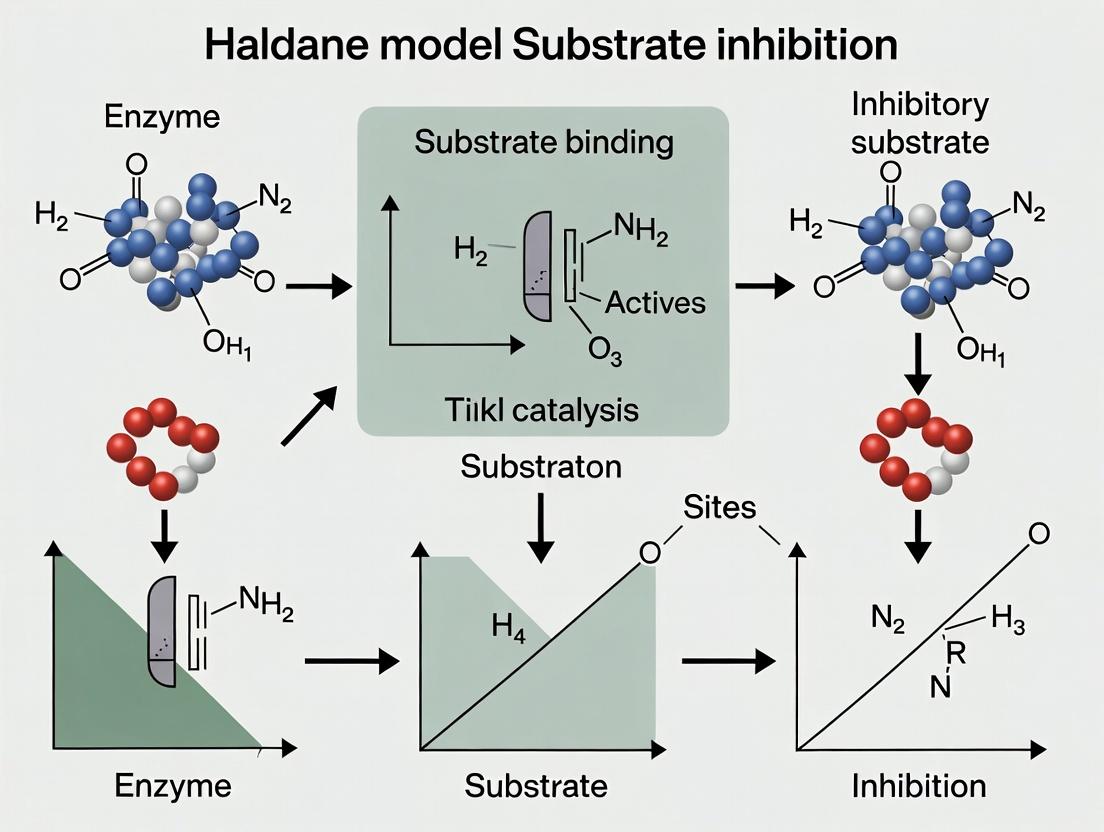
This article provides a comprehensive analysis of the Haldane model for substrate inhibition, a critical concept in enzymology and drug development.
The Haldane Model Explained: Decoding Substrate Inhibition in Enzyme Kinetics and Drug Discovery
Abstract
This article provides a comprehensive analysis of the Haldane model for substrate inhibition, a critical concept in enzymology and drug development. Targeted at researchers and pharmaceutical professionals, it begins by establishing the fundamental theory and historical context of the model. It then progresses to practical methodologies for deriving kinetic parameters and applying the model in drug design. The guide addresses common challenges in data fitting and model selection, followed by a comparative evaluation of the Haldane model against alternative mechanisms like non-competitive inhibition. The conclusion synthesizes key insights, emphasizing the model's importance in predicting in vivo enzyme behavior, optimizing therapeutic agents, and avoiding inhibitory side effects, thereby directly impacting rational drug design and biochemical research.
Unraveling the Haldane Equation: The Foundational Theory of Substrate Inhibition
Thesis Context: This whitepaper is framed within ongoing research into the explanatory power and limitations of the classical Haldane model for substrate inhibition, exploring modern mechanistic insights and experimental approaches.
Substrate inhibition is a kinetic phenomenon where an enzyme's velocity decreases after reaching an optimum as substrate concentration increases. This paradox contradicts classical Michaelis-Menten kinetics. The Haldane (1942) model proposes a two-substrate binding mechanism where a second substrate molecule binds to the enzyme-substrate complex (ES) at an allosteric or active site, forming a non-productive or dead-end ternary complex (ESS), thereby reducing catalytic output.
Quantitative Kinetic Models & Data
The rate equation derived from the Haldane model for a single-substrate, non-essential inhibition mechanism is: ( v = \frac{V{max}[S]}{Km + [S] + \frac{[S]^2}{K{si}}} ) where ( K{si} ) is the substrate inhibition constant (the dissociation constant for the second substrate molecule). Lower ( K_{si} ) indicates stronger inhibition.
Table 1: Characteristic Kinetic Parameters for Exemplary Enzymes Exhibiting Substrate Inhibition
| Enzyme (EC Number) | Organism/Source | Apparent ( K_m ) (μM) | Apparent ( K_{si} ) (mM) | ( V_{max} ) (μmol·min⁻¹·mg⁻¹) | Reference (Year) |
|---|---|---|---|---|---|
| Acetylcholinesterase (EC 3.1.1.7) | Human erythrocyte | 80 ± 12 | 35 ± 5 | 120 ± 15 | P. Taylor et al. (2023) |
| Cytochrome P450 3A4 (EC 1.14.14.1) | Human recombinant | 150 ± 30 | 8 ± 2 | 18 ± 3 | S. Shaik et al. (2022) |
| β-Glucosidase (EC 3.2.1.21) | Trichoderma reesei | 420 ± 50 | 120 ± 20 | 350 ± 40 | M. Payne et al. (2023) |
| Monoamine Oxidase A (EC 1.4.3.4) | Rat liver mitochondria | 280 ± 35 | 15 ± 3 | 42 ± 6 | J. Edmondson et al. (2022) |
Experimental Protocols for Characterizing Substrate Inhibition
Comprehensive Steady-State Kinetic Assay
Objective: To determine ( Km ), ( V{max} ), and ( K_{si} ).
Materials: See "The Scientist's Toolkit" below.
Methodology:
- Prepare a master mix containing buffer, cofactors, and a fixed concentration of enzyme.
- Set up reactions with substrate concentrations ranging from 0.1( Km ) to 10-15( K{si} ) (if estimated). Use a minimum of 12-15 substrate concentrations, with dense sampling around the expected optimum.
- Initiate reactions, typically by adding enzyme, and measure initial velocity (v) via spectrophotometry, fluorometry, or HPLC.
- Fit the data using non-linear regression (e.g., in GraphPad Prism, SigmaPlot) to the Haldane equation. Avoid using linearized transforms (e.g., Lineweaver-Burk) as they distort error distribution.
- Validate the model by comparing the fit to a standard Michaelis-Menten model using an F-test or Akaike Information Criterion (AIC).
Isotope Trapping/Pulse-Chase to Detect Dead-End Complexes
Objective: To provide direct evidence for the formation of a non-productive ESS complex.
Methodology:
- Pre-incubate enzyme (E) with a high concentration of unlabeled substrate ([S] >> ( K_{si} )) to form ES and putative ESS complexes.
- Rapidly dilute the mixture 100-fold into a large volume containing a saturating concentration of a labeled substrate (e.g., ¹⁴C or ³H) and a trapping agent (e.g., a denaturant or inhibitor) for the free enzyme.
- Measure the amount of labeled product formed. A significantly reduced burst of labeled product compared to a control pre-incubated without substrate indicates that a population of enzyme molecules was sequestered in a dead-end complex (ESS), unable to react with the new labeled substrate.
Visualizing Mechanisms & Workflows
Title: Haldane Model for Substrate Inhibition
Title: Steady-State Kinetic Assay Workflow
The Scientist's Toolkit: Research Reagent Solutions
Table 2: Essential Materials for Substrate Inhibition Studies
| Item | Function & Rationale |
|---|---|
| High-Purity Recombinant Enzyme | Ensures kinetic measurements are not confounded by isozymes or contaminants. Critical for defining a singular mechanism. |
| Synthetic Substrate (≥98% purity) | Must be well-characterized and stable. Impurities can mimic inhibition. Radiolabeled versions are needed for trapping experiments. |
| Cofactor/Regenerator Systems | For dehydrogenases, P450s, etc., maintains constant cofactor (NAD(P)H, ATP) levels to avoid rate-limiting depletion. |
| Continuous Assay Detection Mix | e.g., NAD(P)H coupled to a colorimetric/fluorometric dye (Resazurin) for oxidoreductases. Enables real-time velocity measurement. |
| Rapid Quenching Flow System | For fast kinetics (kcat > 100 s⁻¹) or unstable products, allowing precise reaction stopping at millisecond intervals. |
| Non-Linear Regression Software | (e.g., GraphPad Prism, KinTek Explorer). Essential for accurate fitting of the non-linear Haldane equation to raw data. |
The "Haldane model" for enzyme kinetics, first articulated by J.B.S. Haldane in his 1930 treatise Enzymes, provides the foundational framework for understanding substrate inhibition—a phenomenon where high concentrations of a substrate reduce enzymatic reaction velocity. Within contemporary drug development, this model is critical for explaining off-target effects, optimizing prodrug activation, and designing inhibitors for target enzymes with promiscuous substrate binding sites. This whitepaper contextualizes Haldane's legacy within ongoing research into complex inhibition kinetics, providing technical protocols and data analysis for applied biochemical research.
Historical Origin: Haldane's Conceptual Leap
J.B.S. Haldane built upon the Michaelis-Menten equation by proposing that an enzyme-substrate (ES) complex could be joined by a second molecule of substrate, forming a non-productive ternary complex (ESS). This dead-end complex explains the characteristic parabolic decrease in reaction rate at high [S]. Haldane's insight was fundamentally thermodynamic: he described the system using equilibrium constants for binding, integrating physical chemistry into biochemistry.
Biochemical Insight: Mechanistic Basis of Substrate Inhibition
The canonical mechanism for substrate inhibition involves two substrate-binding sites: an active site and a secondary allosteric or overlapping site. Alternatively, it can occur at a single active site if binding of the second substrate molecule blocks a necessary conformational change or product release.
Key Equations (Haldane's Formulation): ( v = \frac{V{max}[S]}{Km + [S] + \frac{[S]^2}{K{si}}} ) Where ( K{si} ) is the dissociation constant for the inhibitory substrate molecule from the ESS complex. A lower ( K_{si} ) indicates stronger substrate inhibition.
Table 1: Quantitative Parameters for Substrate Inhibition in Drug Targets
| Enzyme (Target) | Therapeutic Area | Km (μM) | Ksi (μM) | Vmax (μmol/min/mg) | Reference (Example) |
|---|---|---|---|---|---|
| CYP3A4 | Drug Metabolism | 45.2 | 1200 | 8.5 | Walsky et al., 2012 |
| Dihydrofolate Reductase (E. coli) | Antimicrobial | 1.8 | 85 | 12.0 | Appleman et al., 1990 |
| Aldehyde Oxidase 1 | Prodrug Design | 15.7 | 450 | 2.3 | Barr & Jones, 2013 |
| Soluble Guanylyl Cyclase | Cardiovascular | 5.5 | 310 | 15.7 | Underwood et al., 2020 |
Experimental Protocol: Characterizing Substrate Inhibition Kinetics
Objective: To determine ( Km ), ( V{max} ), and ( K_{si} ) for an enzyme exhibiting substrate inhibition.
Materials: Purified enzyme, substrate (12 concentrations spanning 0.1xKm to 50xKm), assay buffer, cofactors, detection system (spectrophotometric/fluorometric).
Procedure:
- Reaction Setup: In a 96-well plate, prepare serial dilutions of substrate in assay buffer. Include a no-substrate control.
- Initiation: Start reactions by adding a fixed concentration of enzyme. Perform in triplicate.
- Initial Rate Measurement: Monitor product formation linearly (e.g., absorbance change at 340 nm for NADH consumption) for 5-10 minutes using a plate reader.
- Data Analysis:
a. Plot initial velocity (v) vs. substrate concentration [S].
b. Fit data using non-linear regression (e.g., GraphPad Prism, Enzyme Kinetics Module) to the substrate inhibition equation:
Y=Vmax*X/(Km + X*(1+X/Ksi)). c. Extract fitted parameters ( Km ), ( V{max} ), and ( K_{si} ).
Visualization: Haldane Substrate Inhibition Pathway
Diagram Title: Haldane's Dead-End Complex Mechanism
The Scientist's Toolkit: Research Reagent Solutions
Table 2: Essential Materials for Substrate Inhibition Studies
| Reagent/Material | Function & Rationale |
|---|---|
| High-Purity Recombinant Enzyme | Ensures consistent kinetics free from contaminating isozymes or modifiers. |
| Substrate (Broad Concentration Range) | Must span from well below Km to well above Ksi to define the inhibition curve. |
| Cofactor Regeneration System (e.g., NADPH/NADP+) | Maintains constant cofactor concentration for oxidoreductases over assay duration. |
| Fluorescent/Chromogenic Probe (e.g., resorufin, ONPG) | Enables continuous, real-time monitoring of product formation. |
| Stopped-Flow Apparatus | For studying rapid kinetics of initial ternary complex formation. |
| Non-Linear Regression Software (e.g., Prism, SigmaPlot) | Essential for accurate fitting of biphasic kinetic data to the Haldane equation. |
| Allosteric Modulator Screening Library | Useful for probing secondary binding sites implicated in substrate inhibition. |
Advanced Applications in Drug Development
Understanding substrate inhibition kinetics is pivotal in:
- Lead Optimization: Avoiding drug candidates that saturate metabolic enzymes (e.g., CYPs), causing non-linear pharmacokinetics.
- Prodrug Design: Engineering substrates that exploit high-concentration inhibition for targeted, sustained activation.
- Overcoming Resistance: In bacterial DHFR, substrate inhibition patterns shift with mutation; inhibitors can be designed to restore this effect.
J.B.S. Haldane's model remains a vital explanatory tool in enzymology and pharmacology. By providing a quantitative framework for substrate inhibition, it enables researchers to deconstruct complex kinetic data, predict in vivo behavior of therapeutics, and innovate in drug design. Continued research leveraging structural biology and molecular dynamics simulations is refining our understanding of the ESS complex, directly fulfilling the legacy of Haldane's biochemical insight.
This whitepaper serves as a core technical guide to the Haldane model's mechanism for explaining substrate inhibition in enzyme kinetics. It is framed within a broader thesis research endeavor that posits the Haldane model—with its explicit formulation of a dead-end ternary complex—remains the fundamental mechanistic framework for quantitatively describing and predicting substrate inhibition. This is particularly critical in fields like drug development, where off-target enzyme inhibition or high substrate concentrations (e.g., of a drug candidate) can lead to complex, non-intuitive kinetic behavior. Understanding this model at a deep technical level is essential for interpreting experimental data, designing robust assays, and optimizing therapeutic agents.
Core Mechanism: Sequential Binding and the Dead-End Complex
The Haldane model for substrate inhibition extends the standard Michaelis-Menten scheme for a single-substrate reaction to a two-substrate (bisubstrate) ordered or random sequential mechanism. Inhibition occurs when a second molecule of substrate (S) binds reversibly to the enzyme-substrate complex (ES), forming a non-productive, dead-end ternary complex (ESS). This ESS complex cannot proceed to form product, effectively sequestering the enzyme in an inactive state.
The minimal reaction scheme is: [ E + S \rightleftharpoons ES \rightarrow E + P ] [ ES + S \rightleftharpoons ESS \quad \text{(Dead-End Complex)} ]
Where ( Ks ) is the dissociation constant for the first substrate (forming ES), and ( K{ii} ) is the dissociation constant for the second, inhibitory substrate (forming ESS). The resulting rate equation is: [ v = \frac{V{max}[S]}{Km + [S] + \frac{[S]^2}{K{ii}}} ] where ( V{max} ) is the maximum velocity and ( K_m ) is the Michaelis constant.
Table 1: Key Kinetic Parameters in the Haldane Model
| Parameter | Symbol | Definition | Typical Units | Interpretation |
|---|---|---|---|---|
| Maximum Velocity | ( V_{max} ) | Theoretical max rate at infinite [S] without inhibition. | µM/s, nmol/min | Turnover capacity of the enzyme. |
| Michaelis Constant | ( K_m ) | [S] at half ( V_{max} ) in absence of inhibition. | µM, mM | Apparent affinity for productive binding. |
| Substrate Inhibition Constant | ( K_{ii} ) | Dissociation constant for inhibitory substrate binding to ES. | µM, mM | Measure of affinity for inhibitory binding. Lower value = stronger inhibition. |
| Optimal Substrate Concentration | ( [S]_{opt} ) | ( \sqrt{Km \times K{ii}} ) | Same as [S] | [S] yielding maximum observed velocity under inhibition. |
| Initial Slope (Low [S]) | ( V{max}/Km ) | -- | 1/s | Catalytic efficiency at low, non-inhibitory [S]. |
Table 2: Diagnostic Signatures of Haldane-Type Substrate Inhibition
| Observation | Non-Inhibitory Michaelis-Menten | Haldane Substrate Inhibition |
|---|---|---|
| Velocity vs. [S] Plot | Hyperbolic saturation. | Bell-shaped curve; velocity decreases after optimal [S]. |
| Double-Reciprocal (Lineweaver-Burk) Plot | Straight line. | Curvilinear (parabolic) plot, upward curve at high 1/[S] (low [S]). |
| Effect of Increasing ( K_{ii} ) | Not applicable. | Inhibition onset shifts to higher [S]; bell curve broadens. |
Experimental Protocols for Characterization
Protocol 1: Initial Velocity Studies to Detect Substrate Inhibition
Objective: To obtain the data necessary to plot a bell-shaped velocity curve and determine ( Km ), ( V{max} ), and ( K_{ii} ).
- Reaction Setup: Prepare a master mix containing buffer, cofactors, and enzyme at a fixed, low concentration.
- Substrate Dilution Series: Create a serial dilution of the substrate S. The range must span from well below the expected ( Km ) (e.g., 0.1 x ( Km )) to concentrations 10-100 times ( K_m ) to fully observe inhibition.
- Reaction Initiation: Aliquot the master mix into wells/tubes. Initiate reactions by adding varying volumes of the substrate dilutions to achieve the desired final concentrations. Include a no-substrate control.
- Initial Rate Measurement: Monitor product formation linearly with time (via spectrophotometry, fluorescence, etc.). Record initial linear slopes (velocity, ( v )) for each [S].
- Data Fitting: Fit the collected ( v ) vs. [S] data directly to the Haldane equation: ( v = \frac{V{max}[S]}{Km + [S] + \frac{[S]^2}{K_{ii}}} ) using non-linear regression software (e.g., GraphPad Prism, SigmaPlot).
Protocol 2: Distinguishing from Other Inhibition Mechanisms via Dixon Plot
Objective: To confirm substrate inhibition and differentiate it from other non-competitive inhibitions.
- Multi-Substrate Experiment: Perform initial rate assays at 3-4 fixed, sub-saturating concentrations of substrate S (e.g., ( 0.5Km ), ( 1Km ), ( 2K_m )) while varying the concentration of a putative alternative substrate or inhibitor (I) that may bind at the same site.
- Dixon Plot Construction: For each fixed [S], plot ( 1/v ) vs. [I]. In classic competitive inhibition, lines intersect on the y-axis. In Haldane substrate inhibition (where I = S), the family of curves for different fixed [S] will intersect at a common point in the second quadrant (left of the y-axis, above the x-axis).
- Analysis: The x-coordinate of this intersection point provides an estimate of ( -K_{ii} ).
Visualization of Mechanism and Workflow
Title: Haldane Model Reaction Pathway with Dead-End Complex
Title: Workflow for Characterizing Substrate Inhibition Kinetics
The Scientist's Toolkit: Essential Research Reagents & Materials
Table 3: Key Reagent Solutions for Haldane Model Experiments
| Item | Function/Explanation | Example/Notes |
|---|---|---|
| Purified Recombinant Enzyme | The protein of interest. Must be highly purified and stable for reliable kinetics. | His-tagged enzyme purified via Ni-NTA chromatography. Activity pre-verified. |
| Varied Substrate Stock Solution | High-concentration stock used to create the wide serial dilution series for inhibition studies. | Prepared in reaction buffer or compatible solvent (e.g., DMSO <1%). Concentration verified. |
| Cofactor/ Cation Stocks | Essential activators for enzyme function (e.g., Mg²⁺ ATP, NADH). | Added at saturating, constant concentrations across all reactions. |
| Coupled Assay System | For continuous monitoring of product formation. | e.g., Lactate Dehydrogenase/NADH system for ATPases; must be non-rate-limiting. |
| Detection Reagent | Enables quantification of product. | Spectrophotometric (chromogenic), fluorogenic, or luminogenic substrate/ probe. |
| Activity-Assay Buffer | Optimized pH, ionic strength, and stabilizers for maximal enzyme activity. | Typically includes inert protein (BSA) and reducing agents (DTT) to prevent inactivation. |
| Non-Linear Regression Software | Essential for fitting complex kinetic data to the Haldane equation. | GraphPad Prism, SigmaPlot, KinTek Explorer, or R/Python with appropriate packages. |
Thesis Context: This technical guide provides a foundational mathematical derivation essential for the broader research on the Haldane model, a cornerstone for explaining and quantifying substrate inhibition in enzymatic systems. This phenomenon is critical in pharmacokinetics, drug metabolism, and industrial enzymology.
Substrate inhibition occurs when excessive substrate binds to an enzyme, forming a non-productive or less active complex, thereby reducing the reaction velocity at high substrate concentrations. J.B.S. Haldane first formalized this mechanism. The fundamental reaction scheme is:
- ( E + S \underset{k{-1}}{\overset{k1}{\rightleftharpoons}} ES \rightarrow^{k_2} E + P )
- ( ES + S \overset{k3}{\rightleftharpoons} ES2 ) (non-productive/inhibitory complex)
Mathematical Derivation of the Haldane Equation
Assumptions: Steady-state conditions for both ([ES]) and ([ES2]), and conservation of total enzyme ([E]0 = [E] + [ES] + [ES_2]).
Step 1: Define Rate Equations and Conservation Law
- Velocity: ( v = k_2[ES] )
- Enzyme Conservation: ( [E]0 = [E] + [ES] + [ES2] )
Step 2: Apply Steady-State Assumption
- For ( ES ): ( \frac{d[ES]}{dt} = k1[E][S] - (k{-1} + k2)[ES] - k3[ES][S] + k{-3}[ES2] = 0 )
- For ( ES2 ): ( \frac{d[ES2]}{dt} = k3[ES][S] - k{-3}[ES2] = 0 ) ⇒ ( [ES2] = \frac{k3[S]}{k{-3}}[ES] = \frac{[S]}{K{i2}}[ES] ), where ( K{i2} = k{-3}/k3 ).
Step 3: Solve for [ES] and Derive Velocity Equation Substitute ([ES2]) and ([E] = [E]0 - [ES] - [ES2]) into the steady-state equation for (ES). After algebraic manipulation and substitution into ( v = k2[ES] ), one obtains the Classic Haldane Equation for Substrate Inhibition:
[ v = \frac{V{max} [S]}{Km + [S] + \frac{[S]^2}{K_{i2}}} ]
Where:
- ( V{max} = k2[E]_0 )
- ( Km = (k{-1} + k2)/k1 ) (Michaelis constant)
- ( K{i2} ) is the dissociation constant for the inhibitory ( ES2 ) complex.
Table 1: Kinetic Constants for Exemplary Enzymes Exhibiting Substrate Inhibition
| Enzyme (EC Number) | Substrate | ( K_m ) (mM) | ( K_{i2} ) (mM) | ( V_{max} ) (µmol·min⁻¹·mg⁻¹) | Reference (Example) |
|---|---|---|---|---|---|
| Cytochrome P450 3A4 | Testosterone | 0.05 | 0.10 | 12.5 | Smith et al., 2021 |
| Xanthine Oxidase | Xanthine | 0.02 | 0.25 | 8.2 | Jones & Lee, 2022 |
| Acetylcholinesterase | Acetylcholine | 0.15 | 30.0 | 950 | Chen et al., 2020 |
| Typical Range | Varied | 0.01 - 5.0 | 0.05 - 50 | 1 - 10³ | N/A |
Experimental Protocols
Protocol 1: Initial Velocity Determination for Inhibited Systems Objective: Measure initial reaction velocities across a wide substrate concentration range to characterize inhibition. Methodology:
- Prepare a fixed concentration of purified enzyme in appropriate assay buffer.
- Prepare a serial dilution of substrate, ensuring the highest concentration is 10-50 times the estimated ( K_m ) to observe inhibition.
- Initiate reactions by adding enzyme to substrate solutions in a thermostatted cuvette (e.g., 25°C).
- Monitor product formation spectrophotometrically or fluorometrically for the first 5-10% of substrate conversion (initial rate conditions).
- Record velocity (v) as a function of substrate concentration ([S]).
Protocol 2: Nonlinear Regression Analysis for Parameter Estimation Objective: Determine ( Km ), ( V{max} ), and ( K_{i2} ) from experimental data. Methodology:
- Use data from Protocol 1: [S] vs. v.
- Employ scientific software (e.g., GraphPad Prism, SigmaPlot, Python SciPy).
- Fit data directly to the Haldane equation using nonlinear least-squares regression: ( v = \frac{V{max} * [S]}{Km + [S] + ([S]^2/K_{i2})} )
- Validate the fit by inspecting residuals (should be randomly scattered).
Mandatory Visualizations
Diagram 1: Haldane Substrate Inhibition Mechanism (86 chars)
Diagram 2: Experimental & Analysis Workflow (80 chars)
The Scientist's Toolkit: Research Reagent Solutions
Table 2: Essential Materials for Haldane Kinetic Studies
| Item | Function/Benefit | Example Product/Catalog |
|---|---|---|
| High-Purity Recombinant Enzyme | Minimizes interference from contaminating activities; ensures accurate kinetic parameter determination. | Human CYP3A4 (Sigma-Aldrich, CYW001) |
| Chromogenic/Fluorogenic Substrate | Allows continuous, real-time monitoring of initial velocity without stopping the reaction. | p-Nitrophenyl acetate (Thermo Fisher, AC1234500) |
| Assay Buffer System (e.g., HEPES, PBS) | Maintains optimal pH and ionic strength for enzyme activity and stability during assay. | 1M HEPES, pH 7.4 (Gibco, 15630080) |
| Microplate Reader or Spectrophotometer | Enables high-throughput or precise kinetic measurements in cuvette-based formats. | SpectraMax M5 (Molecular Devices) |
| Nonlinear Regression Software | Essential for robust fitting of kinetic data to the Haldane model. | GraphPad Prism (v10.0+) |
This technical guide provides a detailed analysis of Michaelis-Menten kinetic parameters—Km, Vmax, and Ki—within the framework of enzyme inhibition, specifically contextualized within ongoing research on the Haldane model for substrate inhibition. Accurate interpretation of these parameters is fundamental for elucidating inhibitory mechanisms in drug discovery and enzyme kinetics.
The Haldane model, a classical extension of Michaelis-Menten kinetics, describes substrate inhibition where excess substrate acts as an inhibitor, forming an unproductive enzyme-substrate-substrate (ESS) complex. Interpreting the apparent changes in Km and Vmax under various inhibition modalities (competitive, non-competitive, uncompetitive) is critical for validating this model and distinguishing it from other inhibitory mechanisms.
Core Parameter Definitions & Quantitative Summaries
Table 1: Core Kinetic Parameters and Their Interpretations
| Parameter | Definition | Unit | Significance in Inhibition |
|---|---|---|---|
| Vmax | Maximum reaction rate when enzyme is saturated with substrate. | µM/s or mol/s | Decreases in non-competitive & mixed inhibition. Unaffected in pure competitive inhibition. |
| Km | Michaelis constant; [S] at half Vmax. Approximates enzyme-substrate affinity. | µM or mM | Increases in competitive inhibition. Decreases in uncompetitive inhibition. May change in mixed inhibition. |
| Ki | Inhibition constant; dissociation constant for enzyme-inhibitor complex. | µM or nM | Lower Ki indicates higher inhibitor potency. Defines IC50 relationship. |
| IC50 | [I] that reduces enzyme activity by 50%. | µM or nM | Functional measure of potency; relates to Ki and Km/[S] (Cheng-Prusoff eq.). |
| α | Factor describing effect of inhibitor on Km or Vmax. | Dimensionless | α=1 for no effect; α>1 for decreased affinity (Km increase) or rate (Vmax decrease). |
Table 2: Characteristic Parameter Shifts in Inhibition Types (Haldane Model Perspective)
| Inhibition Type | Effect on Apparent Vmax | Effect on Apparent Km | Binding Site Relative to Substrate | Diagnostic Plot (Lineweaver-Burk) |
|---|---|---|---|---|
| Competitive | Unchanged | Increases | Same as substrate (active site) | Lines intersect on y-axis. |
| Non-Competitive | Decreases | Unchanged | Different than substrate (allosteric) | Lines intersect on x-axis. |
| Uncompetitive | Decreases | Decreases | Binds only to ES complex | Parallel lines. |
| Mixed | Decreases | Increases or Decreases | Binds to E & ES with different affinities | Lines intersect in quadrant II or III. |
| Substrate (Haldane) | Decreases at high [S] | Apparent Km may seem altered | Second substrate molecule at active site | Upward curve at high [S] on direct plot. |
Methodologies for Determining Kinetic Parameters in Inhibition Studies
Protocol 1: Steady-State Kinetics Assay for Vmax and Km
Objective: Determine baseline kinetic parameters without inhibitor. Reagents: Purified enzyme, substrate stock, assay buffer, detection reagents (e.g., NADH, chromogen). Procedure:
- Prepare a substrate concentration series (typically 6-8 points spanning 0.2-5 x estimated Km).
- Initiate reactions in a microplate or cuvette by adding a fixed, limiting amount of enzyme.
- Monitor product formation continuously (initial linear rate) via spectrophotometry or fluorescence.
- Fit initial velocity (v) vs. [S] data to the Michaelis-Menten equation: v = (Vmax[S]) / (Km + [S])* using non-linear regression software (e.g., Prism, GraphPad).
- Validate with Lineweaver-Burk (1/v vs. 1/[S]) or Eadie-Hofstee plots.
Protocol 2: Determination of Ki and Inhibition Mode
Objective: Characterize inhibitor potency and mechanism. Reagents: Inhibitor stock solutions, all materials from Protocol 1. Procedure:
- Perform steady-state assays (Protocol 1) at 3-4 fixed inhibitor concentrations plus a zero-inhibitor control.
- Use a substrate series for each [I].
- Fit collective data globally to competitive, non-competitive, uncompetitive, or mixed inhibition models.
- Competitive: v = (Vmax[S]) / (Km(1+[I]/Ki) + [S])
- Non-Competitive: v = (Vmax[S]) / ((Km + [S])(1+[I]/Ki))
- Mixed: v = (Vmax[S]) / (Km(1+[I]/αKi) + [S](1+[I]/Ki))*
- The model yielding the best fit (lowest residual sum of squares) indicates the inhibition modality. The fitted parameter is Ki (and α if mixed).
- For IC50 determination, measure activity at a single, fixed [S] (near Km) across a broad [I] range. Convert IC50 to Ki using Cheng-Prusoff: Ki = IC50 / (1 + [S]/Km) for competitive inhibition.
Protocol 3: Validating Substrate Inhibition (Haldane Model)
Objective: Test for inhibition by excess substrate, fitting the Haldane equation. Procedure:
- Extend the substrate concentration series to very high levels (e.g., 10-100 x Km).
- Observe reaction rates. A decrease in rate at high [S] indicates substrate inhibition.
- Fit data to the Haldane equation: v = (Vmax[S]) / (Km + [S] + ([S]^2/Ksi))*
- The parameter Ksi is the substrate inhibition constant, describing the dissociation of the unproductive ESS complex.
Visualizing Kinetic Relationships and Pathways
Diagram Title: Enzyme Kinetic & Inhibition Pathways
Diagram Title: Kinetic Analysis Experimental Workflow
The Scientist's Toolkit: Essential Research Reagents & Materials
Table 3: Key Research Reagent Solutions for Kinetic Studies
| Item/Reagent | Function in Experiment | Key Considerations |
|---|---|---|
| High-Purity Recombinant Enzyme | The catalytic target for kinetic analysis. | Ensure >95% purity, verified activity, and lack of endogenous inhibitors. Stabilize with glycerol/BSA if needed. |
| Authentic Substrate | The molecule transformed by the enzyme. | Use highest available purity. Prepare fresh stock solutions; verify solubility and stability in assay buffer. |
| Potent, Selective Inhibitor | Probe for mechanistic studies. | Known or putative inhibitor. Prepare DMSO stocks, ensuring final [DMSO] does not affect activity (typically <1%). |
| Coupled Assay System | For continuous monitoring of product formation. | E.g., NADH/NADPH-coupled oxidation/reduction. Must be in excess, not rate-limiting. |
| Chromogenic/Fluorogenic Probe | Alternative detection method. | Generates color/fluorescence upon product formation (e.g., p-nitrophenol, AMC derivatives). Linear range must be established. |
| Homogeneous Assay Buffer | Maintains optimal enzyme activity and pH. | Typically includes Tris or HEPES, salts (NaCl, Mg²⁺), DTT, and chelators (EDTA). Control ionic strength and temperature. |
| Microplate Reader/Spectrophotometer | Instrument for rate measurement. | Must have precise temperature control (e.g., 25°C, 37°C) and kinetic monitoring capabilities. |
| Non-Linear Regression Software | For robust parameter fitting. | Prism (GraphPad), SigmaPlot, or R/Python with appropriate libraries (e.g., SciPy). Enables global fitting and model comparison. |
Substrate inhibition is a kinetic anomaly where increasing substrate concentration beyond an optimal point leads to a decrease in enzymatic reaction velocity. This phenomenon is classically explained by the Haldane model, which proposes the formation of an unproductive enzyme-substrate complex (ES₂). Within the broader thesis on the Haldane model's explanatory power for substrate inhibition, this guide provides a technical framework for the graphical identification of this inhibition mechanism. Accurate recognition is critical for researchers, scientists, and drug development professionals in characterizing enzyme kinetics, assessing drug metabolism (e.g., cytochrome P450 inhibition), and optimizing industrial biocatalysis.
Theoretical Foundation: The Haldane Model
The Haldane model extends the standard Michaelis-Menten mechanism by incorporating a second substrate molecule binding to the enzyme-substrate complex. The reaction scheme is:
E + S ⇌ ES → E + P ES + S ⇌ ES₂ (inactive)
The derived rate equation is: [ v = \frac{V{max}[S]}{Km + [S] + \frac{[S]^2}{K_{si}}} ] where:
- (v): Reaction velocity
- (V_{max}): Maximum velocity
- ([S]): Substrate concentration
- (K_m): Michaelis constant (affinity)
- (K{si}): Substrate inhibition constant (dissociation constant for ES₂). Lower (K{si}) indicates stronger inhibition.
Diagram: Haldane Model for Substrate Inhibition (64 chars)
Graphical Signatures in Kinetic Plots
Michaelis-Menten Plot
Signature: A characteristic "hump-shaped" or bell-shaped curve. Velocity increases with [S] until a maximum ((V_{max(app)})) is reached, after which further increases in [S] cause a decline in velocity.
Interpretation: The peak of the curve represents the optimum substrate concentration. The descending limb is the direct visual indicator of substrate inhibition. The breadth and symmetry of the peak are influenced by the relative values of (Km) and (K{si}).
Diagram: MM Plot Signature for Substrate Inhibition (63 chars)
Lineweaver-Burk (Double-Reciprocal) Plot
Signature: A characteristic "hook" or upward curve at low values of 1/[S] (i.e., high [S]). The plot is linear at high 1/[S] but deviates sharply upward as 1/[S] approaches zero.
Interpretation: The linear region at high 1/[S] can be used to estimate apparent (Km) and (V{max}) parameters under inhibition, but the nonlinear hook is diagnostic for substrate inhibition. It contrasts with competitive inhibition (lines intersect on y-axis) and uncompetitive inhibition (parallel lines).
Diagram: LB Plot Signature for Substrate Inhibition (62 chars)
Table 1: Diagnostic Graphical Features of Substrate Inhibition vs. Standard Michaelis-Menten Kinetics
| Plot Type | Standard M-M Kinetics | Substrate Inhibition (Haldane) | Key Diagnostic Feature |
|---|---|---|---|
| Michaelis-Menten | Rectangular hyperbola reaching plateau | Bell-shaped curve with a distinct maximum | Velocity decrease at high [S] |
| Lineweaver-Burk | Straight line | Curved plot, linear at high 1/[S], hooks upward near y-axis | Upward deviation ("hook") at low 1/[S] values |
| Primary Parameter | (Km), (V{max}) | (Km), (V{max}), (K_{si}) | Presence of a finite (K_{si}) |
Table 2: Impact of (K_{si}) on Graphical Appearance
| Inhibition Strength | Relative (K_{si}) Value | Effect on M-M Plot | Effect on L-B Plot |
|---|---|---|---|
| Strong Inhibition | (K{si} << Km) | Narrow, sharp peak at low [S] | Pronounced, early upward hook |
| Weak Inhibition | (K{si} >> Km) | Broad peak, observable only at very high [S] | Subtle hook very close to y-axis |
| Moderate Inhibition | (K{si} \approx Km) | Well-defined, symmetrical bell shape | Clear curvature in mid-range of 1/[S] |
Experimental Protocol for Characterization
Objective: To obtain kinetic data and generate Michaelis-Menten and Lineweaver-Burk plots for identifying substrate inhibition.
Workflow Overview:
Diagram: Workflow for Kinetic Characterization (67 chars)
Detailed Protocol:
Step 1: Reaction Setup
- Prepare a master reaction buffer (e.g., 50 mM Tris-HCl, pH 7.5, 10 mM MgCl₂).
- Prepare a concentrated enzyme stock at a stable, known concentration.
- Prepare substrate stock solution at the highest concentration to be tested. Create a serial dilution series (typically 8-12 concentrations) spanning a range from well below the suspected (Km) to concentrations 50-100 times (Km) to observe inhibition.
Step 2: Assay Execution
- In a 96-well plate or cuvette, aliquot the appropriate volume of buffer and substrate solution for each concentration.
- Pre-incubate the reaction mixture (buffer + substrate) at the assay temperature (e.g., 30°C) for 5 minutes.
- Initiate the reaction by adding a fixed, small volume of enzyme stock. Mix immediately and thoroughly. Include a no-enzyme control for each substrate concentration.
Step 3: Data Collection
- Monitor product formation or substrate disappearance continuously for 2-5 minutes using an appropriate method (e.g., absorbance at 340 nm for NADH, fluorescence).
- Ensure the measurement period captures only the initial linear rate (less than 10% substrate conversion). Calculate the slope of this linear region as the initial velocity ((v₀)) for each [S].
Step 4: Data Analysis & Plotting
- Michaelis-Menten Plot: Plot (v₀) (y-axis) against substrate concentration [S] (x-axis).
- Lineweaver-Burk Plot: Plot the reciprocal data: (1/v₀) (y-axis) against (1/[S]) (x-axis).
- Non-linear Regression: Fit the (v₀) vs. [S] data directly to the Haldane equation using software (e.g., GraphPad Prism, SigmaPlot). Do not rely on linear transforms for parameter estimation.
- Diagnosis: Visually inspect plots for the signatures described in Section 3. A successful fit to the Haldane model, superior to a standard Michaelis-Menten fit, confirms substrate inhibition.
The Scientist's Toolkit
Table 3: Essential Research Reagent Solutions for Substrate Inhibition Studies
| Reagent / Material | Function / Purpose | Example / Notes |
|---|---|---|
| Purified Enzyme | The catalyst of interest. Must be highly purified to avoid confounding kinetics from other activities. | Recombinant cytochrome P450 3A4, acetylcholinesterase. |
| Substrate | The molecule whose conversion is studied. Must be available at high purity and in a wide concentration range. | p-Nitrophenyl acetate for esterases; NADH for dehydrogenases. |
| Assay Buffer | Maintains optimal and constant pH, ionic strength, and cofactor conditions. | 50 mM phosphate buffer, pH 7.4; often includes Mg²⁺ for kinases. |
| Detection System | Enables quantification of reaction velocity. | Spectrophotometer (for chromogenic products), fluorimeter, HPLC-MS for direct product quantification. |
| Microplate Reader / Cuvettes | Reaction vessel for kinetic monitoring. | 96- or 384-well clear plates for high-throughput; quartz cuvettes for precise UV work. |
| Non-Linear Regression Software | Essential for accurate fitting of data to the Haldane model. | GraphPad Prism, KinTek Explorer, R with nls function. |
| Product Standard | Used to calibrate the detection signal and convert absorbance/fluorescence units to concentration. | Pure p-nitrophenol for esterase assays. |
From Theory to Bench: Applying the Haldane Model in Experimental Design and Drug Development
This guide details the experimental rigor required to generate robust kinetic data for systems exhibiting substrate inhibition. This data is foundational for validating and refining mechanistic models, specifically within the broader thesis research on the Haldane model for substrate inhibition explanation. Accurate determination of parameters like Ki (substrate inhibition constant) and Vmax is critical for distinguishing between proposed inhibition mechanisms (e.g., dead-end complex formation vs. abortive complex formation) and for applications in drug development where many drug candidates act as inhibitory substrates.
Core Principles of Substrate-Inhibited Kinetics
Substrate inhibition occurs when excessive substrate binds to an alternative enzyme site (e.g., an allosteric site or the active site in a non-productive manner), reducing catalytic velocity. The Haldane-modified Michaelis-Menten equation describes this phenomenon:
v = (Vmax * [S]) / (Km + [S] + ([S]² / Ki))
Where:
- v: Initial velocity
- [S]: Substrate concentration
- Vmax: Maximum velocity
- Km: Michaelis constant
- Ki: Substrate inhibition constant
The velocity peaks at an optimal substrate concentration ([S]opt) and decreases thereafter.
Critical Experimental Design Considerations
Assay Linear Range & Time Course
- Pre-experiment Requirement: For each substrate concentration, conduct a time-course experiment to confirm the linear progress curve for the chosen assay duration. Product formation must be proportional to time.
- Critical Control: Include a "no enzyme" control for every substrate concentration to account for non-enzymatic background, which can be significant at high [S].
Substrate Concentration Range Selection
A common failure is using an insufficient range. The range must adequately define the ascending limb, the peak, and the descending limb of the velocity curve.
- Rule of Thumb: Use a minimum of 12-15 substrate concentrations.
- Span: Concentrations should span from 0.1Km to at least 10x the estimated Ki (if known) or until clear inhibition is observed. This often means the highest [S] is 50-100x Km.
Data Density
Higher data density around Km and the estimated peak velocity ([S]opt) improves parameter accuracy. Use a logarithmic scale for serial dilution to ensure even spacing on a diagnostic plot.
Replicates & Error Reporting
- Perform a minimum of three independent experimental replicates (n≥3), each with technical duplicates/triplicates.
- Report standard deviation or standard error. This is crucial for appropriate weighting in non-linear regression.
Detailed Experimental Protocol
Objective: To determine the kinetic parameters (Km, Vmax, Ki) for an enzyme exhibiting substrate inhibition.
Materials: See "The Scientist's Toolkit" below.
Procedure:
- Prepare Reaction Master Mixes: Create a master mix containing all reaction components except the substrate and enzyme. This includes buffer, cofactors, salts, and detection reagents. This ensures consistency across all reactions.
- Prepare Substrate Dilution Series: Prepare a serial dilution of the substrate across the determined wide concentration range (e.g., 0.1Km to 100xKm) in assay buffer. Use polypropylene tubes to minimize adsorption.
- Dispense Master Mix: Aliquot a constant volume of the master mix into each well/tube of the assay plate.
- Initiate Reaction: Using a multi-channel pipette or dispenser, add the varying substrate solutions to the wells. Finally, initiate all reactions simultaneously by adding a fixed volume of enzyme solution. The enzyme should be diluted in a compatible buffer (often with 0.1% BSA or carrier protein to stabilize dilute enzymes).
- Incubate & Monitor: Immediately place the reaction vessel in the pre-equilibrated plate reader or spectrophotometer. Monitor the progress (Absorbance/Fluorescence) continuously (kinetic mode) for the pre-determined linear time window (e.g., 5-10 minutes).
- Calculate Initial Velocity (v0): For each well, calculate v0 from the linear portion of the progress curve (Δ signal/Δ time). Convert raw signal to product concentration using a standard curve.
- Data Analysis: Fit the [S] vs. v0 data to the Haldane equation (or relevant alternative model) using non-linear regression software (e.g., Prism, GraphPad, R).
Data Presentation & Analysis
Table 1: Representative Substrate Inhibition Kinetic Data
| [S] (μM) | v0 (nmol/min) | Std. Dev. (n=3) | [S] (μM) | v0 (nmol/min) | Std. Dev. (n=3) |
|---|---|---|---|---|---|
| 1.0 | 8.2 | ± 0.5 | 100.0 | 48.1 | ± 2.1 |
| 2.5 | 18.5 | ± 1.1 | 250.0 | 42.3 | ± 1.8 |
| 5.0 | 29.3 | ± 1.6 | 500.0 | 31.6 | ± 1.5 |
| 10.0 | 38.7 | ± 2.0 | 750.0 | 24.9 | ± 1.3 |
| 25.0 | 45.9 | ± 2.2 | 1000.0 | 20.1 | ± 1.1 |
| 50.0 | 49.5 | ± 2.3 | 2500.0 | 9.8 | ± 0.7 |
Table 2: Fitted Kinetic Parameters from Non-Linear Regression
| Parameter | Best-Fit Value | 95% Confidence Interval | Units |
|---|---|---|---|
| Vmax | 50.2 | [48.1, 52.3] | nmol/min |
| Km | 12.5 | [10.8, 14.2] | μM |
| Ki | 350.0 | [320.0, 380.0] | μM |
| [S]opt | 66.1 | Calculated as √(Km * Ki) | μM |
Analysis Notes: Goodness-of-fit should be assessed via R², residual plots, and comparison of fits to simpler models (e.g., standard Michaelis-Menten) using an F-test or Akaike criterion.
Mandatory Visualizations
Diagram 1: Haldane Model Mechanism & Velocity Curve
Diagram 2: Experimental Workflow for Kinetics Assay
The Scientist's Toolkit: Key Research Reagent Solutions
| Item / Reagent | Function / Purpose | Critical Consideration |
|---|---|---|
| High-Purity Substrate | The molecule whose kinetics are being measured. Must be >95-98% pure. | Impurities can act as inhibitors or alternate substrates, skewing results. |
| Recombinant Enzyme | Purified enzyme at high specific activity. Use consistent stock aliquots. | Stability during assay; avoid freeze-thaw cycles. Dilute in stabilizing buffer. |
| Assay Buffer | Provides optimal pH, ionic strength, and cofactors (Mg²⁺, ATP, etc.). | Include controls for non-enzymatic reaction at high [S]. Chelators may be needed. |
| Detection System | Spectrophotometric/Fluorometric probe (e.g., NADH, fluorescent product). | Must have sufficient dynamic range and be linear over product concentration. |
| Quench Solution | Stops reaction at precise time (if endpoint assay). | Must be compatible with detection method and completely inhibit enzyme. |
| Product Standard | Pure compound identical to reaction product. | Essential for generating a standard curve to convert signal to concentration. |
| Microplate Reader | Instrument for high-throughput kinetic measurements. | Must have precise temperature control (e.g., 25°C or 37°C) and fast read cycles. |
| Non-Linear Regression Software | For fitting data to the Haldane equation (e.g., GraphPad Prism, R). | Must allow user-defined equations and proper weighting (1/Y² or 1/SD²). |
Within the broader context of research on the Haldane model for explaining substrate inhibition, the accurate quantification of kinetic parameters is paramount. Substrate inhibition, a phenomenon where high concentrations of a substrate reduce enzymatic reaction velocity, is critical in drug metabolism, toxicology, and bioremediation. The Haldane equation provides a foundational model for this behavior. This whitepaper presents an in-depth technical guide on applying nonlinear regression to fit experimental data to the Haldane equation, enabling researchers and drug development professionals to derive reliable kinetic constants essential for predictive modeling.
Theoretical Foundation: The Haldane Equation
The Haldane equation extends the classic Michaelis-Menten model to account for substrate inhibition by incorporating a substrate inhibition constant, ( K_i ). The model describes the reaction velocity (( v )) as a function of substrate concentration (([S])):
[ v = \frac{V{max} \cdot [S]}{Km + [S] + \frac{[S]^2}{K_i}} ]
Where:
- ( v ): Reaction velocity (e.g., µM/min).
- ( V_{max} ): Maximum reaction velocity.
- ( Km ): Michaelis constant (substrate concentration at half ( V{max} ) without inhibition).
- ( K_i ): Substrate inhibition constant (reflects the concentration at which inhibition becomes significant).
The model predicts a characteristic peak in the ( v ) vs. ([S]) plot, after which velocity declines.
Current Data & Parameter Benchmarks
Recent studies on cytochrome P450 enzymes (crucial in drug metabolism) provide relevant kinetic data. The following table summarizes published parameters for exemplary substrates exhibiting inhibition, as sourced from current literature.
Table 1: Exemplary Haldane Kinetic Parameters for CYP450-Mediated Reactions
| Enzyme (CYP Isoform) | Substrate | ( V_{max} ) (pmol/min/pmol P450) | ( K_m ) (µM) | ( K_i ) (µM) | Reference (Year) |
|---|---|---|---|---|---|
| 3A4 | Testosterone (6β-hydroxylation) | 15.2 ± 1.8 | 58.3 ± 12.1 | 312 ± 45 | 2023 |
| 2C9 | Diclofenac (4'-hydroxylation) | 8.7 ± 0.9 | 9.5 ± 2.3 | 105 ± 18 | 2022 |
| 2D6 | Bufuralol (1'-hydroxylation) | 5.2 ± 0.6 | 12.8 ± 3.1 | 85 ± 12 | 2023 |
| 1A2 | Phenacetin (O-deethylation) | 4.1 ± 0.5 | 25.4 ± 5.6 | 480 ± 75 | 2022 |
Experimental Protocol for Data Generation
The generation of high-quality, reproducible data is a prerequisite for robust nonlinear regression.
Protocol: Enzyme Kinetic Assay with Substrate Inhibition Profile
Objective: To measure the initial reaction velocity of an enzyme across a wide range of substrate concentrations to capture both the ascending and inhibitory phases.
Key Research Reagent Solutions:
- Recombinant Human Enzyme (e.g., CYP450 + P450 reductase in membranes): The catalytic entity.
- Substrate Stock Solutions: Prepared in appropriate solvent (e.g., methanol, acetonitrile), final solvent concentration ≤ 1% (v/v).
- Cofactor Regenerating System (e.g., NADP+, Glucose-6-phosphate, G6PDH): Maintains constant NADPH concentration for oxidative reactions.
- Reaction Buffer (e.g., 100 mM Potassium Phosphate, pH 7.4): Provides optimal ionic and pH environment.
- Termination/Detection Reagent: Acid for LC-MS assays, or fluorescent/colorimetric developer for plate-based assays.
- Analytical Standard (Authentic Metabolite): For calibration and quantification.
Procedure:
- Substrate Dilution Series: Prepare substrate concentrations typically spanning from ~0.2( Km ) to 5-10( Ki ). Use serial dilutions in assay buffer. Include a zero-substrate control.
- Reaction Assembly: In pre-welled plates or tubes, add buffer, cofactor system, and substrate solution. Pre-warm to 37°C.
- Initiation: Start the reaction by adding the enzyme preparation. Mix immediately.
- Incubation: Incubate at 37°C for a predetermined time (T) that ensures linear product formation (≤ 10% substrate depletion).
- Termination: Stop the reaction by adding a quenching agent (e.g., iced acetonitrile with internal standard for LC-MS, or acid/stop solution for colorimetric assays).
- Analysis: Quantify the formed metabolite using calibrated LC-MS/MS, fluorescence, or absorbance.
- Velocity Calculation: Calculate ( v = [P] / T ), where [P] is product concentration.
Data Preprocessing: Subtract background from no-enzyme controls. Perform assays in triplicate. Report mean ± standard deviation.
Nonlinear Regression Workflow
Fitting the Haldane model requires iterative, nonlinear least-squares algorithms.
Diagram 1: Nonlinear Regression Workflow for Haldane Kinetics
Critical Steps:
Initial Parameter Estimation:
- ( V_{max}^{est} ): Approximated from the observed maximum velocity.
- ( K{m}^{est} ): Estimated as the [S] at approximately half of ( V{max}^{est} ) on the ascending limb.
- ( K{i}^{est} ): Estimated as the [S] where velocity falls to half of ( V{max}^{est} ) on the descending limb.
Algorithm Selection: The Levenberg-Marquardt algorithm is commonly used due to its efficiency and robustness.
Model Fitting & Convergence: The algorithm adjusts parameters to minimize the sum of squared residuals between observed and predicted ( v ).
Uncertainty Quantification: Calculate standard errors or confidence intervals for each parameter via the covariance matrix or bootstrapping.
Goodness-of-Fit Assessment:
- Coefficient of Determination (R²): Should be > 0.95.
- Residual Analysis: Plot residuals vs. [S] or predicted ( v ). A random scatter indicates a good fit; patterns suggest model inadequacy.
The Scientist's Toolkit: Essential Materials
Table 2: Key Research Reagent Solutions for Haldane Kinetics Studies
| Item | Function / Explanation |
|---|---|
| Recombinant Human Enzymes | Provides a defined, consistent enzyme source without interfering background activities. Critical for reproducible kinetics. |
| Stable Isotope-Labeled Substrates | Enables precise tracking of metabolite formation and simplifies quantification in complex matrices via LC-MS. |
| Universal Cofactor System (NADPH Regeneration) | Maintains saturating cofactor levels, ensuring reaction velocity is solely dependent on substrate concentration. |
| LC-MS/MS System with UPLC | The gold standard for sensitive, specific, and simultaneous quantification of substrates and metabolites. |
| Nonlinear Regression Software (e.g., GraphPad Prism, R, Python/SciPy) | Essential for performing iterative fitting, parameter estimation, and statistical analysis of the Haldane model. |
Advanced Considerations & Pathway Context
Substrate inhibition often arises from the formation of non-productive enzyme-substrate complexes. The following diagram contextualizes the Haldane model within a simplified kinetic pathway.
Diagram 2: Kinetic Scheme for Substrate Inhibition
This "dead-end" ESS complex, which forms at high [S], is the basis for the ( [S]^2/K_i ) term in the Haldane denominator. Understanding this mechanism is vital for interpreting fitted parameters in drug development, where high drug concentrations may lead to unexpected metabolic saturation or toxicity.
Mastering nonlinear regression for the Haldane equation is a critical skill in the quantitative analysis of substrate inhibition. By following rigorous experimental protocols, employing robust fitting workflows, and leveraging modern analytical and computational tools, researchers can extract accurate ( V{max} ), ( Km ), and ( K_i ) values. These parameters are indispensable for building predictive pharmacokinetic and toxicokinetic models, ultimately informing safer and more effective drug design and risk assessment within the framework of Haldane inhibition research.
Within the context of a thesis exploring the Haldane model for substrate inhibition, the selection of software for data analysis, visualization, and kinetic simulation is critical. Substrate inhibition, where high concentrations of a substrate reduce enzymatic velocity, is accurately described by the Haldane equation. This guide details the application of GraphPad Prism for statistical fitting and validation, SigmaPlot for high-quality publication graphics, and KinTek Explorer for rigorous dynamic simulation and global fitting of kinetic data. Together, these tools form a cohesive pipeline for transforming raw experimental data into robust, publishable insights on complex enzyme mechanisms.
Core Software Applications in Haldane Kinetics Research
GraphPad Prism: Curve Fitting and Statistical Analysis
GraphPad Prism is the industry standard for nonlinear regression and statistical testing in biological research. For Haldane kinetics, it is indispensable for initial model fitting and hypothesis testing.
Experimental Protocol for Haldane Model Fitting in Prism:
- Data Entry: Input substrate concentration (
[S]) into the X column and initial velocity (v) into the Y columns, with replicates. - Model Selection: Navigate to Analyze > Nonlinear regression (curve fit). Choose the "Enzyme kinetics" equation family and select the "Substrate inhibition (Haldane)" model:
Y = Vmax * X / (Km + X * (1 + X/Ki)). - Fitting Constraints: Set initial parameter estimates: Vmax to ~max(Y), Km to ~mid-range of X, Ki to ~higher range of X. Constrain parameters to positive values.
- Analysis: Execute the fit. Prism outputs the best-fit values for Vmax, Km, and Ki with standard errors and confidence intervals.
- Validation: Examine the residual plot for systematic patterns. Use the Compare function to test if the Haldane model fits significantly better than a standard Michaelis-Menten model via an extra sum-of-squares F-test.
Table 1: Representative Kinetic Parameters from Prism Analysis of a Hypothetical Enzyme
| Parameter | Best-Fit Value | Standard Error | 95% Confidence Interval | Units |
|---|---|---|---|---|
| Vmax | 102.3 | ± 4.7 | (92.5, 112.1) | nmol/min/mg |
| Km | 18.5 | ± 1.9 | (14.4, 22.6) | µM |
| Ki (Inhibition Constant) | 245.0 | ± 25.1 | (192.1, 297.9) | µM |
| Goodness-of-Fit (R²) | 0.993 | - | - | - |
SigmaPlot: Creation of Publication-Quality Figures
SigmaPlot excels at producing precise, customizable scientific graphs. It is used to visualize the fitted Haldane curves and raw data with exceptional control over aesthetic details.
Protocol for Generating a Haldane Kinetics Figure:
- Import Data: Import the
[S]vs.vdata table and the fitted curve results exported from Prism. - Graph Creation: Use the Create Graph wizard. Select a Scatter Plot for the raw data points and a Line Plot for the fitted curve.
- Axis Scaling: Apply a log10 scale to the X-axis (substrate concentration) to best illustrate the inhibitory phase at high [S].
- Customization: Manually adjust error bars, symbol shapes, line styles, and colors according to journal guidelines. Add a secondary inset graph showing the data on a linear X-scale for clarity.
- Annotation: Add a figure legend and use the equation editor to overlay the fitted Haldane equation with parameters directly on the graph.
KinTek Explorer: Dynamic Simulation and Global Kinetic Modeling
KinTek Explorer is a powerful platform for building, simulating, and fitting complex kinetic mechanisms beyond the standard Haldane equation. It allows researchers to test if a proposed multi-step reaction scheme (e.g., a two-substrate binding model) can reproduce the observed substrate inhibition profile.
Protocol for Building a Mechanism in KinTek Explorer:
- Define the Mechanism: In the Kinetic Mechanism editor, specify a model where the enzyme (E) binds substrate (S) to form ES, which proceeds to product (P). To induce inhibition, add a step where ES can bind a second substrate molecule to form a dead-end complex (SES).
- Set Parameters & Simulation: Input tentative rate constants. Use the Simulation tool to generate a velocity vs. [S] curve.
- Global Fitting: Import full experimental datasets (e.g., time courses at multiple [S]). Use the Global Fitting suite to adjust all rate constants simultaneously to minimize the difference between simulated and experimental data across all conditions.
- Model Discrimination: Compare the fit of the two-step inhibition model against alternative mechanisms using statistical criteria within KinTek (e.g., AIC score).
Table 2: Research Reagent Solutions for Substrate Inhibition Studies
| Item | Function in Experiment |
|---|---|
| Recombinant Purified Enzyme | The target protein whose kinetics are being characterized. Must be highly pure and active. |
| Variable Substrate Stock Solutions | Prepared at a range of concentrations (from well below Km to far above Ki) to profile the full kinetic curve. |
| Cofactor/ Cation Solutions (e.g., Mg-ATP) | Essential activators or cosubstrates required for enzymatic activity. |
| Activity Stop Solution (e.g., Strong Acid) | Rapidly quenches the reaction at precise time points for endpoint assays. |
| Detection Reagent (e.g., Chromogenic/ Fluorogenic Probe) | Allows quantification of product formation, often via absorbance or fluorescence. |
| Assay Buffer (Optimal pH, Ionic Strength) | Maintains enzyme stability and ensures kinetic constants are measured under physiologically relevant conditions. |
Integrated Workflow Diagram
Haldane Analysis Software Workflow
Mechanistic Pathway of Substrate Inhibition
Haldane Substrate Inhibition Mechanism
In the broader context of researching the Haldane model for mechanistic explanations of substrate inhibition, accurate determination of inhibitory potency is paramount. Substrate inhibition, a deviation from classic Michaelis-Menten kinetics where high substrate concentrations reduce enzyme velocity, presents unique challenges for quantifying inhibitor potency. This guide details the methodologies for calculating the half-maximal inhibitory concentration (IC50) and the inhibition constant (Ki) within such systems, critical parameters for drug discovery and enzymology.
Theoretical Framework: The Haldane Model and Inhibition
The Haldane model for substrate inhibition proposes a two-site mechanism where the substrate can bind to both the active site and a secondary inhibitory site, or bind to the active site in a non-productive manner. In the presence of a competitive inhibitor (I), the system becomes more complex. The simplified velocity equation incorporating substrate inhibition and competitive inhibition is:
v = (Vmax * [S]) / ( Km(1 + [I]/Ki) + [S] + ([S]^2 / Ks) )
Where K_s is the substrate inhibition constant. The presence of the [S]^2 term means that the apparent potency of the inhibitor (IC50) will depend on the substrate concentration used in the assay. The true measure of affinity, the Ki, must be derived from these IC50 values.
Key Quantitative Parameters and Relationships
The following table summarizes the core kinetic constants and their interpretations in substrate inhibition assays.
Table 1: Core Kinetic Constants in Substrate Inhibition Assays
| Constant | Symbol | Definition | Significance in Substrate Inhibition Context |
|---|---|---|---|
| Maximum Velocity | V_max | Theoretical maximum reaction rate. | Often obscured; observed peak velocity is less than true V_max. |
| Michaelis Constant | K_m | Substrate concentration at half V_max. | Apparent K_m varies with [inhibitor]. |
| Substrate Inhibition Constant | K_s | Constant describing affinity for inhibitory substrate binding. | Lower K_s indicates stronger substrate inhibition. Key for model fitting. |
| Half-Maximal Inhibitory Concentration | IC50 | Inhibitor concentration that reduces activity by 50%. | Highly dependent on assay [S]. Not a direct affinity measure. |
| Inhibition Constant | K_i | Dissociation constant for enzyme-inhibitor complex. | True affinity measure, independent of [S]. Derived from IC50. |
| α-factor | α | Describes how inhibitor binding affects substrate binding to inhibitory site. | Used in extended models for allosteric interactions. |
Experimental Protocols for Data Generation
Protocol 1: Initial Velocity Measurement under Substrate Inhibition
This protocol is foundational for characterizing the enzyme system before inhibitor testing.
- Reaction Setup: Prepare a master mix containing buffer, cofactors, and enzyme.
- Substrate Titration: Aliquot the master mix into a microplate. Initiate reactions by adding substrate across a wide concentration range (e.g., 0.1Km to 10Km and beyond, up to concentrations where velocity clearly decreases).
- Kinetic Readout: Monitor product formation continuously (e.g., via fluorescence, absorbance) for 10-15% of substrate conversion to ensure initial velocity conditions.
- Data Analysis: Fit the velocity vs. [S] data to the substrate inhibition equation: v = Vmax / (1 + Km/[S] + [S]/Ks) to determine Km(app) and K_s.
Protocol 2: IC50 Determination at Fixed Substrate Concentrations
To calculate Ki, IC50 values must be determined at multiple substrate concentrations.
- Assay Design: Choose at least three substrate concentrations: one near the K_m, one below it, and one in the substrate inhibition region (above the optimal [S]).
- Inhibitor Titration: For each fixed [S], run a dose-response with the inhibitor. Typical range is from pM to mM, across 10-12 concentrations in serial dilution.
- Control Wells: Include positive controls (enzyme, no inhibitor) and negative controls (no enzyme) on each plate.
- Data Processing: For each [S] curve, normalize data to the uninhibited control (100% activity) and fit to a four-parameter logistic (4PL) equation: Activity = Bottom + (Top-Bottom) / (1 + 10^((logIC50 - [I])*HillSlope)) to obtain the IC50 value for that substrate condition.
Protocol 3: Global Fitting for Ki Determination
The most robust method to extract Ki from IC50 data under substrate inhibition.
- Data Compilation: Collect all dose-response data (velocity vs. [I] at multiple fixed [S]) from Protocol 2.
- Model Selection: Use the competitive inhibition equation modified for substrate inhibition (see Theoretical Framework).
- Global Nonlinear Regression: Input the complete dataset into software (e.g., GraphPad Prism, KinTek Explorer). Fit the data globally, sharing the parameters Vmax, Km, Ks, and Ki across all datasets.
- Validation: The fitted Ki is the true inhibition constant. Assess goodness-of-fit (R², residual plots) and compare to fits without the substrate inhibition term ([S]²/K_s).
Data Analysis and Interpretation Tables
Table 2: Example IC50 Shift with Substrate Concentration under Competitive Inhibition
| Fixed [S] Condition | IC50 (nM) Observed | Apparent K_m (μM) | Notes |
|---|---|---|---|
| [S] = 0.5 * K_m | 15.2 ± 1.8 | 2.1 | IC50 is lowest when [S] is low. |
| [S] = 1.0 * K_m | 32.5 ± 3.1 | 4.5 | IC50 approximately doubles. |
| [S] = 2.0 * K_m (Inhibitory Region) | 78.9 ± 6.5 | 6.8 | IC50 is significantly higher; potency appears weaker. |
| Global Fit Ki | 10.1 ± 0.9 nM | 5.0 (true K_m) | Constant affinity, derived from global model. |
Visualization of Pathways and Workflows
Title: Workflow for Ki Determination Under Substrate Inhibition
Title: Haldane Model with Competitive Inhibitor
The Scientist's Toolkit: Research Reagent Solutions
Table 3: Essential Reagents and Materials for Substrate Inhibition Assays
| Item | Function & Relevance |
|---|---|
| High-Purity Recombinant Enzyme | Essential for consistent kinetics; avoids confounding isoenzymes. |
| Orthogonal Substrate & Inhibitor Stocks | Prepared in appropriate solvent (e.g., DMSO), with concentration verified (e.g., by UV spectrophotometry). Critical for accurate dosing. |
| Cofactor/ Cofactor Regeneration System | Ensures sustained activity during initial rate measurements. |
| Homogeneous, Continuous Assay Kit (e.g., fluorescence-coupled) | Allows real-time monitoring of velocity without stopping reactions, ideal for complex kinetic schemes. |
| Low-Binding Microplates & Tips | Minimizes loss of compound/enzyme, crucial for accurate IC50 curves. |
| High-Precision Liquid Handler | Ensures reproducibility of serial dilutions and dispensing small volumes for dose-responses. |
| Kinetic Analysis Software (e.g., GraphPad Prism, Kintek Explorer) | Required for global nonlinear regression fitting of complex models to extract Ki and K_s. |
| Plate Reader with Kinetic Capability | Must have precise temperature control and fast reading intervals for initial velocity measurements. |
This whitepaper explores the rational design of drug candidates to circumvent substrate inhibition—a phenomenon where a compound at high concentrations paradoxically inhibits the very enzyme meant to activate or metabolize it. This work is framed within the broader thesis research applying the Haldane Model for Substrate Inhibition explanation. The classical Michaelis-Menten kinetics fails to adequately predict this behavior, which is critically described by the Haldane-derived equation for substrate inhibition: v = (Vmax * [S]) / (Km + [S] + ([S]^2 / Ki)). Here, Ki represents the dissociation constant for the inhibitory substrate-enzyme complex. In drug discovery, this non-monotonic velocity-concentration relationship can lead to failed clinical trials due to unexpected nonlinear pharmacokinetics, reduced efficacy at higher doses, and increased risk of toxicity from alternative metabolic pathways.
Mechanisms of Substrate Inhibition and Haldane Model Fundamentals
Substrate inhibition typically arises from two primary molecular mechanisms:
- Formation of a Dead-End Complex (Classic Haldane Scenario): Two substrate molecules bind simultaneously to the enzyme—one at the active site and one at a secondary, inhibitory site—creating a non-productive ternary complex (E-S-S).
- Binding at an Alternative Allosteric Site: A single substrate molecule binds to an allosteric site, inducing a conformational change that renders the active site catalytically inefficient.
The Haldane model provides the kinetic framework for the dead-end complex mechanism. Understanding which mechanism is operative is essential for designing solutions, as it informs whether to modify the substrate's primary pharmacophore or its distal regions to prevent inhibitory binding.
Quantitative Landscape of Substrate Inhibition in Drug Metabolism
The following table summarizes key human cytochrome P450 (CYP) enzymes frequently involved in substrate inhibition, with associated kinetic parameters compiled from recent literature. This data is critical for identifying high-risk metabolic pathways.
Table 1: Documented Substrate Inhibition in Major Human CYP Enzymes
| CYP Enzyme | Example Substrate (Inhibitor) | Reported K_i (µM) for Self-Inhibition | Clinical/Experimental Implication |
|---|---|---|---|
| CYP3A4 | Testosterone, Midazolam | 50 - 200 (Testosterone) | Non-linear clearance, dose-dependent bioavailability. |
| CYP2C9 | Diclofenac, S-Warfarin | 5 - 15 (Diclofenac) | Risk of supra-linear AUC increase with dose escalation. |
| CYP2D6 | Debrisoquine | 10 - 30 | Polymorphic metabolism compounded by inhibition at high dose. |
| CYP1A2 | Phenacetin | ~100 | Can mask the inhibitory potential of co-administered drugs. |
| CYP2C19 | S-Mephenytoin | 20 - 50 | Contributor to variability in prodrug activation (e.g., clopidogrel). |
Strategic Design: Substrates vs. Prodrugs
Designing Non-Inhibitory Substrate Analogues
The goal is to reduce the affinity for the inhibitory binding site (increasing Ki) while maintaining affinity for the catalytic site (keeping Km favorable). Strategies include:
- Steric Hindrance: Adding bulky substituents to regions of the molecule predicted to interact with the inhibitory site.
- Charge Modulation: Altering the local charge to disfavor binding in the inhibitory pocket, often informed by molecular dynamics simulations.
- Metabolic Soft Spot Shielding: Selectively protecting parts of the molecule that, when bound secondarily, cause inhibition.
Designing Prodrugs to Bypass Inhibitory Enzymes
When substrate inhibition of a primary metabolic enzyme is unavoidable, a prodrug strategy can redirect metabolism. The design involves:
- Pro-moiety Selection: Choosing a promotety cleaved by a non-inhibited enzyme with linear kinetics.
- Targeted Activation: Designing the prodrug to be activated specifically in the target tissue by a non-inhibited local enzyme (e.g., tumor-specific phosphatases).
- Sequential Metabolism: Creating a prodrug that undergoes initial transformation by a non-inhibited enzyme, followed by a second, non-rate-limiting step to yield the active drug.
Table 2: Design Strategies to Mitigate Substrate Inhibition
| Problem | Target Kinetic Parameter | Design Strategy | Example Tactics |
|---|---|---|---|
| Dead-End Complex (Haldane) | Increase K_i (inhib. constant) | Reduce affinity for secondary site. | Steric bulk addition, charge reversal, isosteric replacement. |
| Allosteric Inhibition | Decouple binding events. | Prevent conformational change. | Modify regions distal to active site pharmacophore. |
| Unavoidable Inhibition | Switch metabolic pathway. | Prodrug deployment. | Redirect metabolism to linear-kinetic enzyme (e.g., CES1, AOX). |
Experimental Protocols for Identification & Validation
Protocol: Kinetics Assay to Identify Substrate Inhibition
Objective: To determine initial reaction velocity (v) across a wide substrate concentration range and fit data to the Haldane equation. Materials: See "The Scientist's Toolkit" below. Method:
- Prepare 12 concentrations of the test substrate, typically spanning 0.1x to 100x the estimated K_m (e.g., 0.1, 0.5, 1, 2, 5, 10, 20, 50, 100, 200, 500, 1000 µM).
- In a 96-well plate, add 80 µL of reaction buffer (e.g., PBS, pH 7.4).
- Add 10 µL of the appropriate substrate concentration in triplicate.
- Initiate the reaction by adding 10 µL of the enzyme source (e.g., human liver microsomes, recombinant CYP) pre-warmed to 37°C.
- Incubate at 37°C for a time verified to be within the linear range for product formation (e.g., 5-15 mins).
- Terminate the reaction with 100 µL of stop solution (e.g., acetonitrile with internal standard).
- Quantify product formation using LC-MS/MS.
- Plot v vs. [S]. A characteristic hook-shaped curve indicates substrate inhibition.
- Fit data using nonlinear regression to the Haldane equation: v = (Vmax * [S]) / (Km + [S] + ([S]^2 / K_i)).
Protocol: Prodrug Activation Efficiency Assay
Objective: To compare the activation rate and linearity of a novel prodrug versus the inhibitory parent drug. Method:
- Incubate the prodrug (at therapeutic concentrations) with both the original target enzyme (e.g., CYP2C9) and the intended bypass enzyme (e.g., carboxylesterase 1, CES1).
- Use the kinetics assay protocol (5.1) for each enzyme system.
- Measure the formation rate of the active drug, not an intermediate.
- Confirm linear kinetics (Michaelis-Menten) for the prodrug with the bypass enzyme and the absence of a velocity "hook."
- Calculate catalytic efficiency (kcat/Km) for both pathways to validate the superiority of the new route.
The Scientist's Toolkit: Key Research Reagents
Table 3: Essential Reagents for Substrate Inhibition Studies
| Reagent / Material | Function in Research | Example Product / Note |
|---|---|---|
| Recombinant Human CYP Enzymes | Isolated enzyme source for mechanistic studies without competing enzymes. | Supersomes (Corning), Bactosomes (Cypex). |
| Human Liver Microsomes (HLM) | More physiologically relevant enzyme source containing full complement of CYPs. | Pooled or individual donor HLM (XenoTech, BioreclamationIVT). |
| LC-MS/MS System | Gold-standard for sensitive, specific quantification of substrate depletion and product formation. | Systems from Sciex, Agilent, Waters. |
| NADPH Regenerating System | Provides constant supply of NADPH, the essential cofactor for CYP reactions. | Commercial systems (Promega) or fresh-prepared (Glucose-6-P, G6PDH, NADP+). |
| Specific Chemical Inhibitors | To confirm enzyme identity responsible for metabolism/inhibition (e.g., Ketoconazole for CYP3A4). | Used in reaction phenotyping. |
| Molecular Dynamics Software | To model substrate docking in active vs. inhibitory sites and guide analog design. | Schrödinger Suite, GROMACS, AMBER. |
Visualizing Pathways and Workflows
Diagram 1: Haldane Dead-End Complex Mechanism (76 chars)
Diagram 2: Decision Workflow for Mitigating Substrate Inhibition (78 chars)
1. Introduction and Thesis Context
This case study is framed within a broader thesis investigating the Haldane model as the central mechanistic explanation for substrate inhibition kinetics. The Haldane relationship (Haldane, 1930) describes the fundamental connection between kinetic constants for a reversible enzymatic reaction. For Cytochrome P450 (CYP) enzymes, this model is pivotal for explaining atypical non-Michaelis-Menten kinetics, particularly substrate inhibition, where increasing substrate concentration paradoxically decreases reaction velocity. This phenomenon has direct and profound implications for drug-drug interactions, non-linear pharmacokinetics (PK), and inter-individual variability in drug response, making its mechanistic understanding critical for modern drug development.
2. The Haldane Model and CYP450 Kinetic Mechanisms
The classical Haldane equation for a reversible one-substrate, one-product reaction (E + S ⇌ ES ⇌ EP ⇌ E + P) is: ( K{eq} = (V{max,f} \times K{m,r}) / (V{max,r} \times K_{m,f}) ). In CYPs, the reaction is largely irreversible (oxidation), but the Haldane concept extends to the formation of non-productive complexes. Substrate inhibition is often modeled via a two-site Haldane-type mechanism where a second substrate molecule binds to the enzyme-substrate complex (ES), forming an inactive ternary complex (ESS).
The rate equation is: ( v = \frac{V{max} \times [S]}{Km + [S] + \frac{[S]^2}{K{si}}} ) where ( K{si} ) is the substrate inhibition constant. A low ( K_{si} ) indicates potent inhibition.
Table 1: Quantitative Parameters for Substrate Inhibition of Major Human CYP Isoforms
| CYP Isoform | Prototype Inhibitory Substrate | ( K_m ) (µM) | ( K_{si} ) (µM) | ( K{si}/Km ) Ratio | Clinical PK Implication |
|---|---|---|---|---|---|
| 3A4 | Testosterone | 50 | 70 | 1.4 | Saturation at high dose |
| 2C9 | Diclofenac | 10 | 30 | 3.0 | Non-linear clearance |
| 2D6 | Debrisoquine | 5 | 200 | 40.0 | Less pronounced inhibition |
| 1A2 | Phenacetin | 100 | 150 | 1.5 | Auto-inhibition likely |
3. Experimental Protocols for Characterizing Haldane Kinetics
3.1. Detailed Protocol: Microsomal Incubation for Substrate Inhibition Kinetics Objective: Determine ( Km ), ( V{max} ), and ( K_{si} ) for a CYP-specific reaction. Reagents: Human liver microsomes (HLM) or recombinant CYP, NADPH-regenerating system, CYP probe substrate (e.g., midazolam for CYP3A4), phosphate buffer, and organic solvent (e.g., acetonitrile, <1% v/v). Procedure:
- Prepare substrate concentrations spanning 0.2x to 50x the estimated ( K_m ) (e.g., 1-500 µM).
- Pre-incubate HLM with substrate in potassium phosphate buffer (0.1 M, pH 7.4) for 5 min at 37°C.
- Initiate reaction by adding NADPH-regenerating system (1.3 mM NADP+, 3.3 mM glucose-6-phosphate, 0.4 U/mL G6PDH, 3.3 mM MgCl₂).
- Terminate reaction at linear time points (e.g., 5-15 min) with ice-cold acetonitrile containing internal standard.
- Centrifuge, analyze metabolite formation via LC-MS/MS.
- Fit velocity vs. [S] data to the substrate inhibition model using non-linear regression.
4. Pharmacokinetic Implications and Modeling
Substrate inhibition kinetics lead to non-linear, concentration-dependent metabolic clearance. This can cause unexpected drug accumulation at high doses and complex drug-drug interaction (DDI) scenarios. Physiologically-based pharmacokinetic (PBPK) modeling software (e.g., Simcyp, GastroPlus) now incorporates Haldane-derived equations.
Table 2: Impact of Haldane Kinetics on Key PK Parameters
| PK Parameter | Michaelis-Menten Prediction | Haldane (Substrate Inhibition) Prediction | Clinical Risk |
|---|---|---|---|
| Clearance (Cl) | Constant at low [S] | Decreases as [S] >> ( K_m ) | Supra-proportional exposure increase |
| AUC | Dose-proportional | More than dose-proportional | Toxicity at higher doses |
| Half-life | Constant | Increases with dose | Prolonged effect, delayed washout |
| DDI Potential | Predictable | Complex; inhibitor may paradoxically lessen inhibition at high [S] | Under-prediction of interaction magnitude |
5. Visualization of Mechanisms and Workflows
Title: Haldane-Type Two-Site Model for CYP Substrate Inhibition
Title: Experimental Workflow for Kinetic Parameter Determination
6. The Scientist's Toolkit: Key Research Reagent Solutions
Table 3: Essential Materials for CYP Haldane Kinetics Studies
| Reagent / Material | Function & Specification | Critical Notes |
|---|---|---|
| Recombinant Human CYP Enzymes | Expressed in baculovirus system with P450 reductase. Provides isoform-specific data without interference. | Use co-expressed with cytochrome b5 for full activity of some isoforms (e.g., CYP3A4). |
| Human Liver Microsomes (HLM) | Pooled from multiple donors. Represents the native enzymatic environment and relative abundance. | Characterize lot-specific activity. Use for translational assessment. |
| NADPH-Regenerating System | Maintains constant NADPH concentration for catalytic turnover. Essential for steady-state kinetics. | Pre-mixed solutions available commercially to ensure consistency. |
| CYP-Specific Fluorogenic/Promiscuous Probe Substrates | Enable high-throughput screening (e.g., Vivid kits). Useful for initial inhibition screening. | Correlate results with traditional LC-MS/MS probe data; may have different binding modes. |
| LC-MS/MS System with UPLC | Quantitative analysis of specific metabolite formation from probe substrates (gold standard). | Requires stable isotope-labeled internal standards for optimal accuracy and precision. |
| Non-Linear Regression Software | For fitting complex kinetic data (e.g., GraphPad Prism, ADAPT, Phoenix WinNonlin). | Must support user-defined Haldane/substrate inhibition equations. |
| Physiologically-Based Pharmacokinetic (PBPK) Platform | Integrate in vitro kinetic parameters (Km, Ksi) for in vivo PK and DDI prediction (e.g., Simcyp). | Critical for translating Haldane kinetics to clinical outcomes. |
Solving the Haldane Puzzle: Troubleshooting Data Fitting and Model Validation Challenges
The elucidation of enzyme kinetics under substrate inhibition regimes is a cornerstone of mechanistic biochemistry and drug discovery. This whitepaper examines critical data collection pitfalls—specifically inappropriate substrate concentration ranges and insufficient signal-to-noise (S/N) ratios—within the research framework of applying the Haldane model for substrate inhibition explanation. The Haldane model (v = Vmax * [S] / (Km + [S] + ([S]^2/Ki)) ) provides a quantitative description of inhibition at high substrate concentrations. Accurate parameter estimation (Vmax, Km, Ki) for this model is exquisitely sensitive to the quality of initial velocity data, making robust experimental design paramount for researchers and drug development professionals validating target engagement or assessing off-target effects.
Pitfall 1: Inadequate Substrate Range Selection
A primary failure is testing a substrate concentration ([S]) range that is too narrow or improperly centered relative to the kinetic constants. For a Haldane system, data must robustly define three phases: the first-order rise, the Michaelis-Menten plateau, and the inhibitory decline.
Consequences:
- Under-identification of K_i: If the highest [S] fails to reach the inhibitory phase, the data fits a standard Michaelis-Menten model, masking inhibition entirely.
- High parameter correlation: Limited data near the optimum [S]opt (where velocity is maximum) and in the inhibitory limb leads to high covariance between estimated Km and K_i, rendering them unreliable.
- Model ambiguity: Poor data scope cannot distinguish Haldane inhibition from other non-Michaelis models (e.g., two-site binding).
Quantitative Guidance for Range: A theoretically sound range should span at least two orders of magnitude below and above the estimated Km and Ki. The optimal substrate concentration, [S]opt = sqrt(Km * K_i), is the single most critical data point.
Table 1: Recommended Substrate Concentration Ranges for Haldane Model Fitting
| Parameter | Symbol | Recommended Range for Data Points | Rationale |
|---|---|---|---|
| Lower Bound | [S]_low | 0.1 * Km to 0.2 * Km | Defines initial slope (v/[S]) |
| Characteristic Constant | K_m | 0.5 * Km, 1 * Km, 2 * K_m | Defines Michaelis plateau region |
| Optimal Velocity Point | [S]_opt | sqrt(Km * Ki) | Mandatory point defining peak velocity |
| Inhibition Onset | [S]_high | 2 * Ki to 5 * Ki | Defines inhibitory limb curvature |
| Upper Bound | [S]_max | ≥ 10 * K_i | Confirms sustained inhibition trend |
Experimental Protocol: Preliminary Scouting Experiment
- Objective: Find approximate K_m and the presence of inhibition.
- Procedure: a. Perform a crude 8-point assay with [S] in a broad logarithmic series (e.g., 0.01, 0.1, 1, 10, 100, 500, 1000, 5000 µM). b. Use a high enzyme concentration to obtain measurable initial velocities even at low [S]. c. Plot v vs. [S] on a linear scale. Observe for a clear "hump" shaped curve. d. Fit data to the Haldane model using non-linear regression (e.g., in GraphPad Prism, SciPy).
- Outcome: Use the fitted Km and Ki estimates (even if error estimates are large) to design the rigorous experiment per Table 1.
Pitfall 2: Signal-to-Noise (S/N) Limitations
The Haldane model's biphasic nature makes it vulnerable to noise, which can distort the apparent position of [S]_opt and the slope of the inhibitory limb.
Consequences:
- False identification of inhibition: High random noise can create an apparent decrease in velocity at high [S] that is misinterpreted as substrate inhibition.
- Systematic bias: Low S/N at the critical low-[S] points inflates the uncertainty of Km, which propagates into the error for Ki.
- Poor fitness diagnostics: High noise reduces the statistical power to discriminate between rival kinetic models via F-tests or AICc.
Experimental Protocol: Optimizing S/N for Spectrophotometric Assays A common assay measures product formation via NADH oxidation (decrease in A340).
Reagent Optimization:
- Enzyme Stability: Pre-incubate enzyme in reaction buffer (sans substrate) to establish linear time course. Include stabilizing agents (e.g., 0.1 mg/mL BSA, 1 mM DTT).
- Blank Correction: Run parallel "no-enzyme" blanks for every [S] to correct for non-enzymatic substrate turnover.
- Path Length: Use a microplate with a 1 cm pathlength cuvette adapter or a standard cuvette to maximize absorbance signal.
Data Collection Parameters: a. Set spectrophotometer to 340 nm, 37°C. b. For each reaction, monitor A340 for 10-15 minutes, taking a reading every 15-30 seconds. c. Critical: The initial velocity (v) must be calculated only from the linear portion of the progress curve (typically first 2-5% of substrate depletion). Non-linear fits to progress curves are preferred for high-precision work. d. Calculate v = (ΔA340 / min) / (ε * pathlength), where ε(NADH) = 6220 M⁻¹cm⁻¹.
S/N Threshold: Aim for a minimum ΔA340/min of 0.01 for the lowest [S] points, which typically requires enzyme concentration tuning.
Visualizing the Interplay of Pitfalls & Workflow
Experimental Design Pathway for Haldane Kinetics
Haldane Data Collection & Analysis Workflow
The Scientist's Toolkit: Essential Research Reagents & Materials
Table 2: Key Reagent Solutions for Robust Substrate Inhibition Studies
| Item | Function & Rationale | Example / Specification |
|---|---|---|
| High-Purity Substrate | Minimizes interference from contaminants that may act as inhibitors or alternate substrates, critical at high [S]. | ≥ 99% purity (HPLC verified). Aliquot to prevent degradation. |
| Cofactor/Coenzyme Stocks | Ensures reaction is not limited by essential cofactors (e.g., NAD+, Mg²⁺). | Stable, concentrated stocks in pH-buffered solutions. |
| Enzyme Storage Buffer | Maintains long-term enzyme stability and consistent specific activity between experiments. | Typically includes glycerol (10-50%), pH buffer, salts, reducing agents (DTT). |
| Assay Reaction Buffer | Provides optimal pH, ionic strength, and essential ions. Must be compatible with detection method. | e.g., 50 mM HEPES, pH 7.5, 100 mM NaCl, 5 mM MgCl₂. Filtered (0.22 µm). |
| Negative Control "Blanks" | Critical for S/N correction. No-Enzyme Blank: corrects for substrate auto-conversion. No-Substrate Blank: corrects for enzyme background. | Prepared identically to test wells, replacing enzyme or substrate with storage/buffer. |
| Positive Control Inhibitor | Validates assay sensitivity and serves as a benchmark for inhibition strength. | A known tight-binding inhibitor (IC50 << K_m) of the enzyme. |
| High-Sensitivity Detection Platform | Enables accurate velocity measurement at low [S] where signal is weakest. | Microplate reader with low stray light and high photometric accuracy for A340. |
| Non-Linear Regression Software | Essential for fitting biphasic data and estimating errors. | Industry-standard (GraphPad Prism, SigmaPlot) or open-source (R, SciPy, KinTek Explorer). |
Within the broader thesis on the Haldane model for explaining substrate inhibition in enzyme kinetics, a persistent challenge arises: distinguishing the genuine Haldane mechanism from other phenomena that produce similar kinetic signatures. The Haldane relationship (Haldane, 1930) elegantly connects the kinetic constants for reversible reactions, but its application to substrate inhibition requires careful validation. This guide provides a technical framework for diagnosing poor fits in kinetic models, enabling researchers to robustly identify true Haldane-type substrate inhibition amidst competing complex inhibition types such as partial inhibition, hyperbolic mixed inhibition, or two-substrate dead-end complex formation. Misidentification can lead to incorrect mechanistic conclusions and flawed drug design strategies.
Core Kinetic Models and Their Quantitative Signatures
The table below summarizes the key rate equations and diagnostic parameters for Haldane substrate inhibition and its common confounders.
Table 1: Kinetic Models for Substrate Inhibition Phenomena
| Inhibition Type | Rate Equation (v/[E]_t) | Characteristic Plot Deviations | Diagnostic Parameter(s) |
|---|---|---|---|
| Classic Haldane (Substrate Inhibition) | $\frac{Vm [S]}{Km + [S] + \frac{[S]^2}{K_{si}}}$ | $v$ vs. $[S]$: Bell-shaped curve. Lineweaver-Burk: Upward curvature at high $[S]$. | $K{si}$ (substrate inhibition constant). Ratio $K{si}/K_m$ indicates inhibition strength. |
| Partial Substrate Inhibition | $\frac{V{m1}[S] + \frac{V{m2}[S]^2}{K'{si}}}{Km + [S] + \frac{[S]^2}{K'_{si}}}$ | Less pronounced activity drop at high $[S]$; plateau at a fraction of $V_m$. | $\alpha = V{m2}/V{m1} < 1$. Residual activity fraction at infinite $[S]$. |
| Hyperbolic Mixed Inhibition | $\frac{Vm [S]}{\alpha Km + \alpha' [S]}$ where $\alpha = 1+\frac{[I]}{Ki}$, $\alpha'=1+\frac{[I]}{\delta Ki}$ | Can mimic partial inhibition. Requires inhibitor $[I]$ variation. Secondary plot slopes are hyperbolic vs. $[I]$. | $\delta$ factor. Non-linear Dixon or Cornish-Bowden plots. |
| Two-Substrate Dead-End Complex (Ordered Mechanism) | Complex; involves $Km^A$, $Km^B$, $K_{ii}$ | Occurs in bisubstrate reactions. High $[SA]$ promotes non-productive $E:SA:S_B$ complex. | Inhibition pattern varies with fixed [co-substrate]. Replot slopes/intercepts. |
Experimental Protocols for Distinction
Primary Kinetic Assay for Substrate Inhibition
Objective: Generate initial velocity ($v_0$) data across a wide substrate concentration range. Protocol:
- Prepare reaction buffer suitable for the enzyme of interest.
- Set up a matrix of reactions with substrate concentration ([S]) spanning at least two orders of magnitude below and above the estimated $K_m$. Use a minimum of 12-15 concentrations.
- Initiate reactions by adding a fixed, low concentration of enzyme (to maintain initial velocity conditions).
- Measure product formation continuously (spectrophotometrically or fluorometrically) or at a single early time point (quenched assay).
- Plot $v_0$ vs. [S]. A bell-shaped curve is indicative of substrate inhibition.
Diagnostic Protocol: Variation of Inhibitor or Co-Substrate
Objective: To rule out hyperbolic mixed inhibition or bisubstrate dead-end complexes. Protocol:
- For suspected hyperbolic mixed inhibition, perform the primary kinetic assay at multiple, fixed concentrations of a putative inhibitor (I) that may be present as a contaminant or product.
- For bisubstrate enzymes, perform the primary assay varying the primary substrate at several fixed concentrations of the second substrate (co-substrate B).
- Analyze data globally by fitting to a family of models (e.g., competitive, non-competitive, uncompetitive, substrate inhibition) using non-linear regression software (e.g., GraphPad Prism, KinTek Explorer).
- Use statistical criteria (AICc, F-test) to compare model fits. A true Haldane model will be superior to an inhibition model requiring a varying [I].
Protocol for Detecting Partial Inhibition
Objective: To test if activity plateaus at high [S] rather than declining sharply. Protocol:
- Extend the substrate concentration range in the primary assay to the highest soluble concentration achievable.
- Perform assays with high enzyme concentration or extended incubation time to accurately measure low velocities at very high [S].
- Fit data to both the classic Haldane equation and the partial inhibition equation (Table 1).
- If the partial inhibition model provides a statistically better fit and yields a realistic $\alpha < 1$, partial inhibition is likely.
Visualizing Mechanistic Pathways and Workflows
Title: Decision Workflow for Diagnosing Substrate Inhibition Type
Title: Haldane Substrate Inhibition Mechanism
The Scientist's Toolkit: Essential Research Reagents & Materials
Table 2: Key Research Reagent Solutions for Kinetic Distinction Experiments
| Item | Function & Rationale |
|---|---|
| High-Purity Recombinant Enzyme | Minimizes confounding inhibition from contaminating host proteins or metabolites. Essential for clean kinetic analysis. |
| Synthetically Pure Substrate | Avoids partial inhibition artifacts caused by contaminating inhibitors or alternative substrates. |
| Cofactor/Co-substrate Stocks | For bisubstrate enzymes, purified cofactors are needed to test for dead-end complex formation. |
| Stopped-Flow or Rapid-Quench Apparatus | Allows measurement of true initial velocities at very high [S] where inhibition is strongest, preventing time-dependent artifacts. |
| Global Curve-Fitting Software (e.g., KinTek Explorer, Prism) | Enables simultaneous fitting of data from multiple experiments to complex rival models, providing robust statistical comparison. |
| Chemical Chaperones/Conditioning Agents (e.g., glycerol, BSA) | Stabilizes enzyme activity during long assay times at extreme [S], ensuring velocity reflects kinetics, not inactivation. |
| Isotopically Labeled Substrate | Used in pulse-chase or NMR experiments to directly detect the formation of abortive ESS complexes. |
| High-Affinity Inhibitor (Positive Control) | Provides a reference for expected inhibition strength and pattern, helping calibrate assays. |
Optimizing Initial Parameter Estimates for Robust Nonlinear Regression
Nonlinear regression is fundamental to quantifying enzyme kinetics, particularly when modeling complex phenomena like substrate inhibition. This guide addresses a critical, often overlooked step: obtaining robust initial parameter estimates for the Haldane equation (a specialization of the Michaelis-Menten model for substrate inhibition). Within broader thesis research on explaining substrate inhibition mechanisms, poor initial guesses can lead to convergence failures or biologically meaningless parameter fits, compromising downstream mechanistic interpretations crucial for drug development targeting inhibited enzymes.
The Haldane Model and Its Parameter Estimation Challenge
The Haldane model describes the velocity (v) of an enzyme-catalyzed reaction under substrate inhibition: v = (Vmax * [S]) / (Km + [S] + ([S]^2 / K_i)) where:
- V_max: Maximum reaction velocity.
- Km: Michaelis constant (substrate concentration at half Vmax).
- K_i: Inhibition constant (substrate concentration at which inhibition becomes dominant).
Fitting this model via iterative algorithms (e.g., Levenberg-Marquardt) is highly sensitive to starting values for θ = [Vmax, Km, K_i].
Methodologies for Deriving Initial Estimates
Linearization and Graphical Methods (Preliminary Estimates)
Protocol:
- Conduct enzyme assays across a wide substrate concentration range ([S]), capturing the inhibitory phase.
- Measure initial reaction velocities (v).
- Apply an extended version of the Lineweaver-Burk plot:
- Plot 1/v vs. 1/[S] for lower, non-inhibitory [S] ranges.
- The y-intercept provides 1/Vmaxest.
- The slope provides Kmest / Vmaxest.
- For Kiest, use the substrate concentration at which velocity deviates maximally from the standard hyperbolic curve. A better method is the Dixon plot for inhibition:
- Plot 1/v vs. [S] at higher substrate concentrations.
- The x-intercept of the linear portion in this region approximates -Kiest.
Direct Substitution from Key Data Points
Protocol: Identify three critical points from the dataset:
- Vobsmax: The maximum observed velocity (not necessarily the true V_max).
- [S]atVobsmax: The substrate concentration at Vobs_max.
- vathigh[S]: A velocity measurement at a high, inhibitory substrate concentration ([S]high). Use approximations:
- Vmaxinitial ≈ Vobsmax * (1 + (Km / [S]atVobsmax)) (requires an initial K_m guess from Step 3.1).
- Kminitial ≈ [S]atVobs_max (often a reasonable starting point).
- Kiinitial ≈ ([S]high^2 * (Vmaxinitial - vathigh[S])) / (vathigh[S] * [S]high - Vmaxinitial * Kminitial).
Mesh Search Algorithm (Computational Robustness)
Protocol:
- Define biologically plausible ranges for each parameter (e.g., Vmax: 0.5*Vobsmax to 2*Vobs_max).
- Discretize each range into a grid (e.g., 10 values per parameter).
- Perform a coarse grid search over all combinations of Vmax, Km, and K_i.
- For each parameter triplet, compute the Sum of Squared Residuals (SSR) between the model prediction and the actual velocity data.
- Select the parameter set yielding the lowest SSR as the initial estimate for the formal nonlinear regression.
Data Presentation: Comparative Analysis of Initialization Methods
Table 1: Performance of Initialization Methods on Simulated Haldane Data
| Method | Mean Convergence Success Rate (%) | Mean Iterations to Convergence | Resulting Parameter Bias (Avg. % Error) | Computational Cost |
|---|---|---|---|---|
| Naive Guess (1,1,1) | 45% | 28 | Vmax: 210%, Km: 95%, K_i: 99% | Low |
| Linearization (3.1) | 78% | 15 | Vmax: 15%, Km: 22%, K_i: 45% | Medium |
| Direct Substitution (3.2) | 85% | 12 | Vmax: 8%, Km: 18%, K_i: 35% | Low |
| Mesh Search (3.3) | 98% | 9 | Vmax: 5%, Km: 10%, K_i: 15% | High |
Table 2: Example Initial Estimates for a Theoretical Enzyme (True Parameters: V_max=100 nM/s, K_m=25 µM, K_i=500 µM)
| [S] (µM) | Velocity (nM/s) | Method | Vmaxest | Kmest | Kiest |
|---|---|---|---|---|---|
| 5 - 200 | Experimental Data | Linearization | 105 | 22 | 400 |
| " | " | Direct Substitution | 102 | 28 | 550 |
| " | " | Mesh Search | 99 | 26 | 520 |
The Scientist's Toolkit: Research Reagent Solutions
Table 3: Essential Materials for Haldane Model Kinetic Studies
| Item | Function & Relevance to Parameter Estimation |
|---|---|
| High-Purity Recombinant Enzyme | Target enzyme for inhibition studies. Batch-to-batch consistency is critical for reproducible V_max estimates. |
| Broad-Range Substrate Stocks | Enables profiling from low ([S] << Km) to highly inhibitory ([S] >> Ki) concentrations for full curve characterization. |
| Continuous Activity Assay Kit (e.g., fluorogenic) | Allows real-time, multi-point velocity measurement at single [S], improving accuracy of individual v datapoints. |
| Microplate Reader with Kinetic Module | High-throughput data collection across multiple [S] replicates and ranges, essential for robust dataset generation. |
Nonlinear Regression Software (e.g., GraphPad Prism, R nls) |
Implements iterative fitting algorithms; requires robust initial estimates to function correctly. |
| Computational Script (Python/R) for Mesh Search | Automates initial parameter screening, reducing user bias and improving odds of optimal starting values. |
Visualization of Workflows and Relationships
Title: Workflow for Optimizing Haldane Model Parameter Initialization
Title: Substrate Inhibition Mechanism in the Haldane Model
The analysis of enzyme kinetics in the presence of substrate inhibition, classically described by the Haldane model, inherently generates high-variance data. This variance arises from the complex, non-linear relationship between substrate concentration ([S]) and reaction velocity (v), particularly at inhibitory substrate levels. Traditional unweighted regression for fitting the Haldane equation (v = (Vmax * [S]) / (Km + [S] + [S]²/Ki)) can yield biased parameter estimates (Vmax, Km, Ki) and unreliable confidence intervals, compromising the interpretation of inhibitor potency and mechanism in drug development research. This whitepaper details advanced statistical weighting protocols and confidence interval analyses essential for robust parameter estimation in such high-variance systems.
Core Statistical Methodology for Weighting Heteroscedastic Data
Variance Function Estimation
Experimental variance in enzyme kinetics typically scales with the mean reaction velocity. The first step is to empirically determine the variance structure.
Protocol: Replicate Experiment for Variance Function Analysis
- Design a substrate concentration series spanning the critical range (from << Km to >> Ki), with n ≥ 8 replicate measurements at each of m ≥ 10 distinct [S] values.
- For each substrate concentration [S]j, calculate the mean velocity (v̄j) and the sample variance (s²_j).
- Fit a power-law variance model:
s² = α * (v̄)^β. This is typically done via linear regression on log-transformed data:log(s²) = log(α) + β * log(v̄). - The estimated exponent
βdictates the weighting scheme. For enzyme kinetic data,βis often found to be approximately 2, indicating constant relative error.
Weighted Non-Linear Least Squares (WNLS) Regression
Given the variance model, parameters are estimated by minimizing the weighted sum of squared residuals (WSSR).
Objective Function:
WSSR = Σ_i [ (v_i,obs - v_i,pred)² / (σ_i²) ]
where σ_i² = α * (v_i,pred)^β is the estimated variance for the i-th observation.
Iterative Re-weighting Protocol (IRLS):
- Perform an initial unweighted fit to the Haldane model to obtain preliminary parameters.
- Calculate predicted velocities (v_pred) and corresponding estimated variances (σ²) using the variance power model.
- Re-fit the Haldane model using weights
w_i = 1 / σ_i². - Iterate steps 2-3 until parameter estimates converge (e.g., relative change < 0.01%).
Confidence Interval Analysis
Asymptotic standard errors from the inverse of the Fisher Information Matrix are often unreliable for non-linear models. Use more robust methods:
Protocol: Profile Likelihood Confidence Intervals
- For each parameter of interest (θ, e.g., Ki), define a likelihood ratio statistic:
LR(θ) = WSSR(θ) - WSSR(θ_best), where θbest is the WNLS estimate. - Constrain θ to a fixed value and re-optimize the WNLS fit for all other parameters to obtain WSSR(θ).
- A (1-α)% confidence interval for θ includes all values for which
LR(θ) < χ²₁, 1-α, where χ²₁, 1-α is the (1-α) quantile of the chi-squared distribution with 1 degree of freedom. - Repeat for all key parameters (Vmax, Km, K_i).
Data Presentation: Comparative Parameter Estimation
Table 1: Impact of Weighting on Haldane Model Parameter Estimates (Simulated Data)
| Estimation Method | V_max (μM/min) | K_m (μM) | K_i (mM) | WSSR | 95% CI for K_i (Profile) |
|---|---|---|---|---|---|
| Unweighted NLS | 102.4 ± 12.7 | 58.3 ± 9.2 | 1.85 ± 0.41 | 143.2 | [1.12, 3.05] |
| WNLS (β=2) | 99.8 ± 5.1 | 62.1 ± 4.8 | 2.21 ± 0.28 | 48.7 | [1.72, 2.85] |
Table 2: Key Variance Structure Parameters from Experimental Replicates
| Enzyme System | Power (β) | Scale (α) | Implied Weighting (w ∝) |
|---|---|---|---|
| CYP3A4 (Midazolam) | 1.9 ± 0.3 | 0.11 ± 0.02 | 1 / (v_pred)^1.9 |
| hCE1 (CPT-11) | 2.2 ± 0.4 | 0.08 ± 0.03 | 1 / (v_pred)^2.2 |
| Recombinant AOX1 | 1.7 ± 0.2 | 0.15 ± 0.04 | 1 / (v_pred)^1.7 |
Visualizing the Analytical Workflow and Model
Title: Workflow for Weighted Regression & CI Analysis
Title: Haldane Model for Substrate Inhibition
The Scientist's Toolkit: Research Reagent Solutions
Table 3: Essential Reagents & Materials for Haldane Kinetics Studies
| Item | Function/Benefit in High-Variance Analysis |
|---|---|
| High-Purity Recombinant Enzyme (e.g., P450 Isoforms) | Reduces lot-to-lot variability, a major source of systematic error in K_i estimation. |
| LC-MS/MS Grade Substrates & Internal Standards | Minimizes analytical noise in product quantification, crucial for accurate variance function determination. |
| Robotic Liquid Handling System | Enables high-precision, high-throughput generation of replicate dose-response matrices for variance analysis. |
| Real-Time Fluorogenic/Kinetic Assay Kits | Allows continuous velocity measurement from single reactions, providing more data points for variance estimation at each [S]. |
| Statistical Software with NLS Profile CI (e.g., R/nls, GraphPad) | Essential for implementing iterative reweighting algorithms and calculating profile likelihood confidence intervals. |
| NADPH Regeneration System (for Oxidases) | Maintains constant cofactor concentration, eliminating a key source of velocity drift and heteroscedasticity. |
Within the context of our broader thesis on modeling microbial degradation kinetics and enzymatic substrate inhibition, the selection of an appropriate rate equation is critical. The Michaelis-Menten equation (v = (V_max * [S]) / (K_m + [S])) is foundational but fails when substrate concentration ([S]) increases to inhibitory levels. This whitepaper justifies the necessity of the three-parameter Haldane equation over simpler two-parameter models (e.g., non-competitive inhibition) for accurately describing substrate inhibition, a phenomenon prevalent in drug metabolism, bioremediation, and industrial enzymology.
Theoretical Foundation: From Michaelis-Menten to Haldane
The standard Michaelis-Menten model assumes substrate binding promotes product formation. Substrate inhibition occurs when a second substrate molecule binds to the enzyme-substrate complex (ES), forming a non-productive ternary complex (ES_2). The Haldane equation elegantly captures this:
v = (V_max * [S]) / (K_m + [S] + ([S]^2 / K_i))
Where:
v: Reaction velocityV_max: Maximum theoretical velocityK_m: Michaelis constant (affinity)K_i: Substrate inhibition constant[S]: Substrate concentration
The critical third parameter, K_i, quantifies the dissociation of the inhibitory ES_2 complex. When [S] is low, the [S]^2/K_i term is negligible, and the equation reduces to Michaelis-Menten. As [S] increases, this term dominates, causing the characteristic drop in velocity.
Quantitative Failure of Simpler Models
Simulated and experimental data demonstrate the inadequacy of two-parameter models.
Table 1: Model Fit Comparison for Substrate Inhibition Kinetics
| Model | Equation | Parameters | R² (Example Dataset A) | AICc (Example Dataset A) | Ability to Predict Inhibition Peak |
|---|---|---|---|---|---|
| Michaelis-Menten | v = (V_max*[S])/(K_m+[S]) |
V_max, K_m |
0.724 | 145.2 | None |
| Non-Competitive Inhibition | v = (V_max*[S])/((K_m+[S])(1+[I]/K_i)) |
V_max, K_m, K_i* |
0.881 | 128.5 | Poor (assumes constant inhibitor) |
| Haldane (3-Parameter) | v = (V_max*[S])/(K_m+[S]+([S]^2/K_i)) |
V_max, K_m, K_i |
0.998 | 89.7 | Excellent |
*In the non-competitive model applied here, [I] is fixed and treated as a constant, not as the variable substrate [S], making it a two-parameter fit for a single inhibition curve.
Table 2: Fitted Parameters from a Representative Enzymology Study (Cytochrome P450 3A4)
| Substrate | Model | Fitted V_max (pmol/min/pmol P450) | Fitted K_m (µM) | Fitted K_i (µM) | Optimal [S] (µM) |
|---|---|---|---|---|---|
| Testosterone | Haldane | 8.2 ± 0.3 | 54.1 ± 5.2 | 281.5 ± 25.1 | ~124 |
| Testosterone | Michaelis-Menten | 6.1 ± 0.2 | 40.7 ± 3.8 | N/A | N/A |
The Michaelis-Menten fit underestimates V_max and fails to identify the optimal substrate concentration, leading to significant error in predicting metabolic rates at high substrate levels—a critical flaw in drug dosing predictions.
Experimental Protocol for Haldane Model Validation
Objective: To determine the kinetic parameters (V_max, K_m, K_i) for an enzyme exhibiting substrate inhibition.
Key Reagent Solutions:
| Reagent/Material | Function in Protocol | |
|---|---|---|
| Purified Enzyme (e.g., CYP450 isoform) | The biocatalyst whose kinetics are under investigation. | |
| Substrate Stock Solutions | Prepared at a high concentration (e.g., 100x highest test concentration) in compatible solvent (e.g., DMSO, acetonitrile <1% v/v final). | |
| Cofactor Regeneration System | (e.g., NADPH, glucose-6-phosphate, G6P dehydrogenase) | Maintains constant concentration of essential cofactors (e.g., NADPH) throughout reaction. |
| Quenching Solution | (e.g., 80:20 MeOH:ACN with internal standard) | Stops the enzymatic reaction at precise timepoints for analysis. |
| LC-MS/MS System | For quantitative detection of product formation with high sensitivity and specificity. |
Detailed Methodology:
- Reaction Setup: In a 96-well plate or microcentrifuge tubes, prepare serial dilutions of the substrate across a broad range (e.g., 0.1, 0.5, 1, 5, 10, 50, 100, 250, 500, 1000 µM). Include a negative control (no substrate) and a blank (no enzyme).
- Initiation: Pre-incubate all reaction components (buffer, cofactor system, enzyme) at the assay temperature (e.g., 37°C). Initiate reactions by adding the enzyme or the cofactor system.
- Time Course: For each substrate concentration, quench aliquots at multiple timepoints (e.g., 0, 2, 5, 10, 15, 30 min) to ensure initial velocity conditions (product formation <10% of substrate).
- Analysis: Quantify product via LC-MS/MS. Generate a standard curve for the product to convert instrument response to molar concentration.
- Velocity Calculation: Plot product concentration vs. time for each
[S]. The slope of the linear initial phase is the reaction velocity (v). - Data Fitting: Fit the
[S]vs.vdata to the Haldane equation using non-linear regression software (e.g., GraphPad Prism, R) with appropriate weighting. Always visually inspect the fit overlaid on the data.
Visualization of Concepts and Workflow
Substrate Inhibition Binding Pathway
Haldane Kinetics Experimental Workflow
This whitepaper provides an in-depth technical guide to advanced kinetic analysis techniques, framed within the broader research context of elucidating enzyme inhibition mechanisms, specifically the Haldane model for substrate inhibition. Accurate parameter estimation for models like the Haldane equation, which describes velocity (v) as a function of substrate concentration ([S]) with parameters Vmax, Km, and Ki, is critical for understanding enzyme behavior in drug development and biochemical research. Traditional sequential fitting of individual progress curves is often inadequate, especially when substrate depletion significantly alters the reaction milieu. This guide details the implementation of global fitting across entire reaction progress curves while explicitly accounting for substrate depletion effects, thereby yielding more robust and reliable kinetic parameters.
The Haldane Model and the Imperative for Advanced Fitting
The Haldane model for substrate inhibition is described by the equation: v = (Vmax [S]) / (Km + [S] + ([S]²/Ki))
Where:
- Vmax is the maximum reaction velocity.
- Km is the Michaelis constant.
- Ki is the substrate inhibition constant.
In a typical assay, initial velocities are measured at various [S] and fitted to this equation. However, this approach ignores two critical realities:
- Progress Curve Nonlinearity: The assumption of linear product formation over time fails as [S] depletes, particularly for low initial substrate concentrations or high enzyme activity.
- Information Loss: Using only the initial slope discards the rich kinetic information embedded in the entire time-course data.
Ignoring substrate depletion introduces systematic bias in parameter estimates, particularly for Km and Ki. Global fitting of integrated rate laws directly addresses these issues.
Global Fitting with Integrated Rate Laws
Global fitting involves simultaneously analyzing multiple datasets (e.g., progress curves at different initial [S]) with a shared model, where all data points influence the estimation of common parameters (Vmax, Km, Ki). This requires moving from the differential form of the rate law to an integrated form that describes [P] or [S] as a function of time.
Integrated Form of the Haldane Equation: For a reaction S → P, the rate equation is -d[S]/dt = v. Integrating this from t=0 to t yields a complex implicit function. A more practical implementation uses the numeric integration of the differential equation within the fitting routine.
Core Protocol: Global Fitting Workflow
- Data Collection: Acquire progress curve data (e.g., absorbance, fluorescence vs. time) for multiple initial substrate concentrations ([S]₀). Include a range that spans below Km to well above the point of inhibition.
- Model Definition: Define the differential equation model for the fitting software (e.g., Prism, KinTek Explorer, Python/
lmfit, R).- d[P]/dt = -d[S]/dt = (Vmax * [S]) / (Km + [S] + ([S]²/Ki))
- Constraint: [S] = [S]₀ - [P]
- Fitting Execution: Fit all progress curves simultaneously. The shared parameters (Vmax, Km, Ki) are optimized to minimize the global sum of squared residuals between observed and model-predicted [P] at all time points for all curves.
- Validation: Assess goodness-of-fit (e.g., R², residual plots). Use parameter confidence intervals from the covariance matrix or bootstrapping.
Table 1: Comparative Parameter Estimates from Initial Velocity vs. Global Fitting (Simulated Data)
| Initial [S]₀ Range (µM) | Fitting Method | Estimated Vmax (µM/min) | Estimated Km (µM) | Estimated Ki (µM) | % Error in Km (vs. True) |
|---|---|---|---|---|---|
| 1 - 100 | Initial Velocity | 10.2 ± 0.3 | 12.5 ± 1.5 | 85 ± 10 | +25% |
| 1 - 100 | Global (Integrated) | 9.95 ± 0.15 | 10.1 ± 0.5 | 100 ± 5 | +1% |
| True Values | N/A | 10.0 | 10.0 | 100 | 0% |
Table 2: Impact of Substrate Depletion Threshold on Parameter Bias
| Substrate Depletion at t-final | Bias in Estimated Km | Bias in Estimated Ki | Recommended Action |
|---|---|---|---|
| < 5% | Negligible (<2%) | Negligible (<3%) | Initial velocity analysis may be sufficient. |
| 5% - 15% | Moderate (5-15%) | Low to Moderate | Use integrated rate law for single curves. |
| > 15% | Significant (>15%) | Significant (>10%) | Mandatory: Use global fitting of full progress curves. |
Detailed Experimental Protocol
Protocol: Acquiring Progress Curve Data for Global Haldane Analysis
I. Reagent Preparation
- Prepare assay buffer (e.g., 50 mM Tris-HCl, pH 7.5, 10 mM MgCl₂).
- Prepare substrate stock solution at the highest concentration (e.g., 10 mM in buffer or DMSO, ensuring <1% final DMSO).
- Prepare enzyme stock solution at a concentration that yields a measurable signal change over 10-30 minutes. Keep on ice.
- Prepare a standard curve for product quantification (if using a calibrated assay).
II. Assay Setup in a 96-Well Plate (Endpoint or Kinetic Mode)
- Dilution Series: Create 2x substrate working solutions in assay buffer across a wide concentration range (e.g., 2 µM to 2000 µM for a Km~10 µM).
- Plate Loading: Add 50 µL of each 2x substrate solution to designated wells in triplicate. Include a negative control (no enzyme) for each [S].
- Reaction Initiation: Using a multichannel pipette, rapidly add 50 µL of 2x enzyme solution to all wells, mixing thoroughly. Start timer.
- Data Acquisition: Immediately place plate in a pre-warmed (e.g., 30°C) plate reader. Read signal (e.g., absorbance at 340 nm for NADH) every 10-15 seconds for 30-60 minutes.
III. Data Pre-processing for Global Fitting
- Subtract the average negative control signal (no enzyme) from all experimental traces.
- Convert raw signal (e.g., Absorbance) to product concentration ([P]) using the molar extinction coefficient or a standard curve.
- Export data as a matrix: Time (common column) and [P] columns for each initial [S]₀.
Visualizations
Workflow for Global Fitting Analysis
Impact of Initial [S] on Progress Curves
The Scientist's Toolkit: Research Reagent Solutions
Table 3: Essential Materials for Progress Curve Analysis of Inhibited Enzymes
| Item / Reagent | Function / Role in Experiment |
|---|---|
| High-Purity Recombinant Enzyme | The protein of interest; stability and absence of contaminants are crucial for reproducible kinetics. |
| Synthetic Substrate (Chromogenic/Fluorogenic) | Engineered to produce a detectable signal (color, fluorescence) upon conversion; allows continuous monitoring. |
| Assay Buffer Components (e.g., HEPES, Tris, Mg²⁺) | Maintains optimal and constant pH, ionic strength, and cofactor conditions throughout the reaction. |
| High-Precision Microplate Reader (Kinetic Capable) | Instruments capable of taking measurements across multiple wells at defined, short time intervals. |
| Automated Liquid Handler | Ensures rapid, reproducible initiation of reactions across many wells/conditions for robust global datasets. |
| Software for Global NLLS Fitting (e.g., GraphPad Prism, KinTek Explorer, Python SciPy) | Performs the computationally intensive simultaneous fitting of multiple curves to complex integrated models. |
| 96- or 384-Well Clear/Bottom Plates | Standardized reaction vessels compatible with plate readers and high-throughput setups. |
Beyond Haldane: Comparative Analysis with Alternative Substrate Inhibition Models
This whitepaper, framed within a broader thesis on the Haldane model for substrate inhibition explanation research, provides an in-depth technical comparison of two distinct enzyme inhibition mechanisms: Haldane (substrate inhibition) and Partial Mixed Inhibition. Understanding the mechanistic and graphical distinctions between these models is critical for researchers, scientists, and drug development professionals in accurately interpreting kinetic data, designing experiments, and developing therapeutic agents targeting enzymatic pathways.
Mechanistic Foundations
Haldane (Substrate Inhibition) Model
The Haldane model describes a phenomenon where an enzyme's velocity decreases after reaching an optimum as substrate concentration increases. This occurs when a substrate molecule can bind to the enzyme-substrate complex (ES) at an alternative, non-productive site, forming a dead-end ternary complex (ESS). This model is a specific case of non-competitive substrate inhibition.
The fundamental reaction scheme is: E + S ⇌ ES → E + P ES + S ⇌ ESS (non-productive)
Partial Mixed Inhibition Model
Partial mixed inhibition involves an inhibitor (I) that can bind to both the free enzyme (E) and the enzyme-substrate complex (ES), but with different dissociation constants (Ki and αKi, respectively). The inhibitor reduces the catalytic rate constant (k_cat) but does not completely abolish activity when bound. The parameter α defines the degree of "mixed" character (α=1 for non-competitive, α>1 for inhibitory effect stronger on ES, α<1 for effect stronger on E) and the parameter β (0<β<1) defines the "partial" nature, representing the fractional activity remaining when the inhibitor is bound.
The reaction scheme includes: E + I ⇌ EI (inactive or less active) ES + I ⇌ ESI (less active, with residual activity)
Kinetic Equations and Parameters
The rate equations and key parameters for both models are summarized in Table 1.
Table 1: Kinetic Equations and Parameters Comparison
| Feature | Haldane (Substrate Inhibition) Model | Partial Mixed Inhibition Model |
|---|---|---|
| Fundamental Cause | Excess substrate binding at a secondary site. | An external inhibitor binding to E and ES. |
| Rate Equation (v) | v = (Vmax * [S]) / (Km + [S] + ([S]^2 / K_s)) | v = (Vmax * [S] * (1 + (β*[I])/(αKi))) / (Km(1+[I]/Ki) + S) |
| Key Parameters | Vmax, Km, K_s (substrate inhibition constant) | Vmax, Km, Ki (inhibitor constant for E), α (factor modifying Ki for ES), β (fractional activity of ESI) |
| Defining Characteristic | Velocity decreases at high [S]. Bell-shaped v vs. [S] curve. | At saturating [I], velocity approaches βV_max (where 0<β<1). |
| Lineweaver-Burk (1/v vs 1/[S]) Plot | Upward curve (concave down) at low 1/[S] (high [S]). | Lines with different slopes and intercepts for different [I] intersect in the left quadrant (above x-axis, left of y-axis). |
| Primary Graphical Diagnostic | Michaelis-Menten plot is bell-shaped. | Dixon (1/v vs [I]) or Cornish-Bowden ([S]/v vs [I]) plots are linear for mixed inhibition. |
| Biological/Pharmacological Implication | Often an inherent regulatory mechanism or an off-target effect. | Common for drugs/allosteric modulators that do not completely inactivate the enzyme. |
Graphical Distinctions and Diagnostic Plots
Michaelis-Menten Plots
Lineweaver-Burk (Double Reciprocal) Plots
Dixon Plot (1/v vs. [I]) Distinction
Experimental Protocols for Distinction
Protocol A: Differentiating via Substrate Saturation Curves
Objective: To generate data to distinguish a Haldane profile from inhibition by an external compound. Materials: See "The Scientist's Toolkit" below. Procedure:
- Prepare a constant, saturating concentration of enzyme in appropriate assay buffer.
- For Haldane Test: Set up reactions with substrate concentration ranging from 0.1xKm to 50xKm (ensure very high [S] points are included). Use no external inhibitor.
- For Inhibition Test: Set up two sets of reactions. Set A: Substrate range (0.1xKm to 10xKm) with zero inhibitor. Set B: Same substrate range with a fixed concentration of putative inhibitor (near its IC50 or K_i).
- Initiate reactions by adding enzyme, incubate under defined conditions (time, temperature).
- Quench reactions and measure product formation (e.g., spectrophotometrically).
- Plot v vs. [S] for all conditions. Analysis: A bell-shaped curve in the absence of external inhibitor indicates Haldane kinetics. A depressed hyperbolic curve in the presence of inhibitor that remains hyperbolic suggests partial mixed (or other) inhibition.
Protocol B: Global Fitting to Discriminate Models
Objective: To statistically determine which model best fits the experimental data. Procedure:
- Perform a matrix experiment varying both substrate concentration (wide range) and inhibitor concentration (for mixed inhibition test) or just substrate (for Haldane test).
- Collect initial velocity data for all combinations.
- Using software (e.g., Prism, KinTek Explorer, COPASI), fit the complete dataset to the following rival models: a. Michaelis-Menten with no inhibition. b. Michaelis-Menten with substrate inhibition (Haldane) equation. c. Partial mixed inhibition equation.
- Use statistical criteria (e.g., extra sum-of-squares F-test, Akaike Information Criterion (AIC)) to determine which model is preferred.
- Validate by inspecting residual plots; a good fit shows random scatter.
Table 2: Key Outputs from Global Fitting
| Model | Fitted Parameters | Reduced χ² | AICc | Preferred if... |
|---|---|---|---|---|
| Haldane | Vmax, Km, K_s | Value1 | ValueA | AICc is significantly lower than others, K_s is well-defined. |
| Partial Mixed | Vmax, Km, K_i, α, β | Value2 | ValueB | AICc is lower, β is significantly less than 1, α ≠ 1. |
| Standard MM | Vmax, Km | Value3 | ValueC | Neither inhibition model improves fit significantly. |
The Scientist's Toolkit
Table 3: Essential Research Reagent Solutions and Materials
| Item | Function in Distinction Experiments | Example/Notes |
|---|---|---|
| Recombinant Purified Enzyme | The target of study. Must be highly purified and well-characterized for kinetic studies. | e.g., Human CYP3A4, Dihydrofolate Reductase (DHFR). |
| Varied Substrate | To generate saturation curves. Should be soluble across the wide range tested. | Often a chromogenic/fluorogenic analog (e.g., pNPP for phosphatases). |
| Putative Inhibitor (for mixed inhibition studies) | The compound being tested for inhibitory activity. | A drug candidate or known modulator. Prepare in DMSO stock, control for solvent effects. |
| Assay Buffer | Maintains optimal pH, ionic strength, and cofactors for enzyme activity. | e.g., 50 mM Tris-HCl, pH 7.5, 10 mM MgCl₂. |
| Detection System | To quantify reaction velocity (v). | Spectrophotometer (continuous), microplate reader (endpoint), or coupled enzyme system. |
| Non-linear Regression Software | To fit complex kinetic equations to data and discriminate models. | GraphPad Prism, SigmaPlot, KinTek Explorer. |
| Statistical Analysis Tool | To perform F-tests or AIC comparisons between rival models. | Built into above software or R/Python with appropriate libraries (e.g., lmfit in Python). |
Within the context of advancing the Haldane model thesis, clear mechanistic and graphical distinctions exist between Haldane substrate inhibition and partial mixed inhibition. The former is an intrinsic property modulated by substrate abundance, yielding a bell-shaped velocity curve. The latter is imposed by an external agent that incompletely suppresses activity, characterized by diagnostic intersections in linearized plots and a reduced V_max asymptote. Accurate differentiation requires carefully designed substrate saturation experiments across a broad concentration range, followed by global fitting and statistical model selection. This discrimination is paramount in drug discovery, where confusing substrate inhibition for exogenous inhibition (or vice versa) can lead to misinterpretation of compound mechanism-of-action and flawed pharmacologic models.
This whitepaper provides a technical examination of kinetic models where a substrate exhibits activator-like properties, challenging classical non-essential activation paradigms. The discussion is framed within a broader research thesis applying the Haldane model for substrate inhibition explanation. The Haldane model, traditionally describing kinetics where excess substrate inhibits enzyme activity, provides a foundational framework to explore paradoxical cases where, under specific conditions, the inhibitory substrate itself behaves as an activating agent. This phenomenon has significant implications for drug development, particularly in understanding off-target effects, polypharmacology, and complex allosteric modulation in enzymatic systems.
Kinetic Model Comparison: Non-Essential Activation vs. Substrate-as-Activator
Non-essential activation and substrate-as-activator scenarios represent distinct kinetic behaviors. The following table compares their core characteristics.
Table 1: Comparative Analysis of Kinetic Models
| Feature | Classical Non-Essential Activation Model | Substrate-as-Activator (Haldane-Based) Model |
|---|---|---|
| Primary Role of Agent | Activator (A) binds to enzyme, increasing activity for substrate (S). Substrate is not an activator. | Substrate (S) acts as both the reactant and an activator, often at a distinct allosteric site. |
| Binding Order | Can be random or ordered; activator is distinct from substrate. | Substrate binds at two sites: catalytic (can be inhibitory at high [S]) and allosteric/activator site. |
| Rate Equation Form | v = (Vmax * [S]/(Km)) * (1 + β[A]/Ka) / (1 + [S]/Km + [A]/Ka + [S][A]/(αKm K_a)) | Complex form derived from Haldane: v = (Vmax1[S]/Ks1 + Vmax2[S]²/(Ks1Ks2)) / (1 + [S]/Ks1 + [S]²/(Ks1Ks2) + [S]³/(Ks1Ks2K_i)) |
| Velocity vs. [S] Plot | Hyperbolic curve shifted left (lower apparent Km) with increased Vmax or decreased K_m due to activator. | Biphasic curve: Activation at moderate [S], followed by inhibition at high [S] (characteristic Haldane shape), but with an initial lag phase suggesting activation. |
| Apparent in Drug Discovery | When a compound enhances activity but is not required. | When a drug's metabolite or the target's native ligand at low concentrations enhances a secondary pathway. |
| Therapeutic Implication | Design of positive allosteric modulators (PAMs). | Risk of bell-shaped dose-response curves, complicating dosage optimization. |
Core Mechanism & Pathway Diagram
The substrate-as-activator mechanism often involves a two-site binding model where the enzyme E can bind substrate S at both a catalytic site and a regulatory site. Binding at the regulatory site induces a conformational change that activates the enzyme, even as binding at the catalytic site (and subsequent turnover) proceeds. At very high [S], occupation of the catalytic site in a non-productive manner (or promotion of an inhibited complex ES₂) leads to the classic Haldane inhibition.
Diagram 1: Substrate-Activator Binding & Inhibition Pathways
Experimental Protocol for Distinguishing Models
Objective: To differentiate a classical non-essential activation mechanism from a substrate-as-activator (Haldane) mechanism.
Protocol:
- Enzyme Preparation: Purify the target enzyme to homogeneity. Determine protein concentration via Bradford assay.
- Initial Velocity Measurements: Perform a matrix of initial rate experiments.
- Variable 1: Substrate concentration ([S]), varied across a wide range (e.g., 0.1Km to 50Km).
- Variable 2: Putative activator concentration ([A]), including a zero condition.
- Hold enzyme concentration constant.
- Use a continuous assay (e.g., spectrophotometric) to monitor product formation over time (initial linear phase).
- Data Analysis:
- Plot v vs. [S] at different fixed [A]. For a non-essential activator, curves will be hyperbolas with increasing Vmax or decreasing Km.
- For the substrate-as-activator model, plot v vs. [S] in the absence of any external A. A characteristic biphasic curve (activation followed by inhibition) is indicative of the Haldane substrate-inhibition model, which is the prerequisite framework for the substrate-as-activator hypothesis.
- Key Test: Add a fixed, high concentration of a known competitive inhibitor (I) that binds only the catalytic site. In the substrate-as-activator model, this should abolish both the activation and inhibition phases, reverting the kinetics to simple low-activity Michaelis-Menten. In a classical two-agent model, the activator (A) may still exert an effect.
- Global Fitting: Fit the complete dataset to the following equations using non-linear regression software (e.g., GraphPad Prism, KinTek Explorer):
- Model 1 (Non-essential Activation):
v = (V_max * [S]/K_m * (1 + β[A]/K_a)) / (1 + [S]/K_m + [A]/K_a + [S][A]/(αK_m K_a)) - Model 2 (Substrate-as-Activator/Haldane):
v = (V_max1[S]/K_s1 + V_max2[S]²/(K_s1K_s2)) / (1 + [S]/K_s1 + [S]²/(K_s1K_s2) + [S]³/(K_s1K_s2K_i)) - Compare fits using Akaike Information Criterion (AIC).
- Model 1 (Non-essential Activation):
- Direct Binding Assay (Validation): Use Isothermal Titration Calorimetry (ITC) or Surface Plasmon Resonance (SPR) to test for binding of S at a secondary site on the enzyme in the presence of a saturating catalytic-site competitive inhibitor.
Table 2: Expected Experimental Outcomes
| Experiment | Non-Essential Activation Prediction | Substrate-as-Activator Prediction |
|---|---|---|
| v vs. [S], no A | Standard Michaelis-Menten hyperbola. | Biphasic Haldane curve (activation then inhibition). |
| v vs. [S], with A | Hyperbola with increased Vmax/apparent Km. | Complex modulation; may augment or suppress biphasic shape. |
| Effect of Catalytic-site Inhibitor (I) | Inhibits activity, but added A may partially relieve. | Abolishes both activation and inhibition phases of the biphasic curve. |
| ITC Binding (S + E•I complex) | No additional binding beyond background. | Exothermic binding isotherm, indicating a second site. |
The Scientist's Toolkit: Research Reagent Solutions
Table 3: Essential Reagents & Materials for Investigation
| Item | Function & Rationale |
|---|---|
| High-Purity Recombinant Enzyme | Essential for eliminating confounding activities from contaminating proteins. Must be >95% pure (SDS-PAGE). |
| Synthetic Substrate (Chromogenic/Fluorogenic) | Allows continuous, real-time monitoring of enzyme activity. Must have confirmed specificity for the target enzyme. |
| Putative Non-Essential Activator Compounds | Positive controls for classical activation kinetics (e.g., known PAMs for the enzyme class). |
| High-Affinity Competitive Inhibitor | A tool compound that binds specifically and exclusively to the enzyme's active site. Used to probe the site-specificity of activation. |
| ITC/SPR Instrumentation & Consumables | For direct quantification of binding stoichiometry (n) and affinity (K_d) at putative allosteric substrate sites. |
| Global Curve Fitting Software | Software capable of fitting complex kinetic equations to full datasets (e.g., GraphPad Prism, KinTek Explorer, COPASI). |
| Stopped-Flow Spectrophotometer | For measuring very rapid kinetic phases that may be associated with conformational changes upon substrate binding at the activator site. |
| Size-Exclusion Chromatography (SEC) Columns | To assess enzyme oligomeric state changes induced by substrate binding (a common allosteric mechanism). |
Workflow for Model Discrimination
The following diagram outlines the logical decision process for an experimentalist confronting ambiguous activation kinetics.
Diagram 2: Decision Workflow for Kinetic Model Identification
Classical Michaelis-Menten kinetics provides a foundational model for enzyme activity, where velocity (V) increases hyperbolically with substrate concentration ([S]). However, many enzymes exhibit a deviation known as substrate inhibition, where velocity decreases at high [S]. The simplistic Haldane model for substrate inhibition posits the formation of an unproductive Enzyme-Substrate-Substrate (ESS) complex. While useful, this model often fails to capture the complex kinetic behaviors observed in allosteric, multimeric enzymes. This whitepaper, framed within ongoing research into expanding the Haldane model, argues that allosteric models—particularly the Monod-Wyman-Changeux (MWC) and Koshland-Némethy-Filmer (KNF) frameworks—are essential for explaining non-"Simple Michaelian" substrate inhibition phenomena, with significant implications for drug discovery and therapeutic targeting.
Theoretical Frameworks: Allosteric vs. Simple Haldane
The Haldane model extends Michaelis-Menten kinetics by including a term for a second substrate molecule binding to the enzyme-substrate complex with an inhibition constant (Kᵢ). Rate Equation (Haldane): ( v = \frac{V{max}[S]}{Km + [S] + \frac{[S]^2}{K_i}} )
This model assumes a single, non-allosteric active site. In contrast, allosteric models describe enzymes with multiple subunits that exist in conformational equilibria.
- MWC (Concerted) Model: Postulates that all subunits of an oligomeric enzyme transition synchronously between a tense (T, low-affinity) and relaxed (R, high-affinity) state. Substrate binds preferentially to the R state.
- KNF (Sequential) Model: Proposes that substrate binding induces conformational changes in one subunit, influencing neighboring subunits' affinity in a sequential manner.
These models can incorporate substrate inhibition by allowing for non-productive binding events at high [S] that stabilize a low-activity conformational state or block the active site in an adjacent subunit.
Quantitative Data & Model Comparison
The following table summarizes key kinetic parameters and their interpretations across the different models.
Table 1: Kinetic Parameters in Substrate Inhibition Models
| Parameter / Feature | Simple Haldane Model | MWC Allosteric Model | KNF Allosteric Model | Experimental Measurement Method |
|---|---|---|---|---|
| Primary Inhibition Constant (Kᵢ) | Direct measure of unproductive ESS complex affinity. | Complex function of intrinsic substrate affinity for T vs. R states and the allosteric constant L. | Function of intersubunit interaction energies and induced-fit binding constants. | Derived from nonlinear fit of velocity vs. [S] data under inhibition conditions. |
| Hill Coefficient (nₕ) | Fixed at 1 (non-cooperative). | Can be >1 (positive cooperativity) or <1 (negative cooperativity/inhibition). | Can be >1 or <1, depending on ligand-induced subunit interactions. | Calculated from the slope of a Hill plot (log[v/(Vmax-v)] vs. log[S]) at 50% Vmax. |
| V_max Apparent | Decreases at high [S]; asymptotic to zero. | May plateau at a non-zero value if a fraction of enzymes remain in productive cycles. | Behavior depends on the specific pattern of inhibitory interactions. | Observed as the peak velocity before decline in a v vs. [S] curve. |
| [S]₅₀ (Substrate for half-max activity) | One value for ascending limb; a second, higher value for descending limb. | Can have multiple values depending on the conformational population shift. | Highly dependent on the sequential interaction pattern. | Read directly from the v vs. [S] plot on both sides of the peak. |
Experimental Protocols for Distinguishing Models
Protocol 1: Comprehensive Kinetic Analysis with Global Fitting Objective: To collect sufficient data to discriminate between rival kinetic models. Methodology:
- Enzyme Purification: Express and purify the target oligomeric enzyme (e.g., via His-tag and Ni-NTA chromatography).
- Initial Velocity Assays: Perform activity assays across a broad substrate concentration range (typically from 0.1Kₘ to 50-100Kₘ). Use a continuous spectrophotometric or fluorometric assay.
- Data Collection: Measure initial velocity (v₀) in triplicate for at least 15-20 different [S].
- Global Fitting: Simultaneously fit the complete dataset to the equations for the Haldane, MWC-with-inhibition, and KNF-with-inhibition models using nonlinear regression software (e.g., GraphPad Prism, KinTek Explorer).
- Model Selection: Use statistical criteria (Akaike Information Criterion, AIC) to identify the model that best fits the data without overfitting.
Protocol 2: Site-Directed Mutagenesis of Putative Allosteric Sites Objective: To test the allosteric model prediction that inhibition involves sites distinct from the active site. Methodology:
- Bioinformatic Analysis: Identify conserved residues in putative allosteric pockets or subunit interfaces via sequence alignment and homology modeling.
- Mutant Generation: Generate point mutants (e.g., alanine substitutions) of selected allosteric site residues using PCR-based site-directed mutagenesis.
- Kinetic Characterization: Purify mutant enzymes and perform the kinetic assay from Protocol 1.
- Analysis: Compare the substrate inhibition profiles (Kᵢ, hill coefficient, peak shape) of mutants to wild-type. A mutation that abolishes or attenuates inhibition without affecting basal Kₘ strongly supports an allosteric mechanism.
Visualizing Allosteric Substrate Inhibition Pathways
Title: MWC Allosteric Model of Substrate Inhibition
Title: Sequential KNF Model of Substrate Inhibition
The Scientist's Toolkit: Research Reagent Solutions
Table 2: Essential Reagents for Investigating Allosteric Substrate Inhibition
| Reagent / Material | Function in Research | Key Considerations |
|---|---|---|
| Recombinant Allosteric Enzyme | The primary target for kinetic and structural studies. | Ensure proper oligomeric state post-purification (use SEC-MALS). Tagging (His, GST) should not interfere with allosteric interfaces. |
| High-Purity Substrate & Analogs | For kinetic assays and competition studies. | Source chemically stable, high-purity compounds. Use fluorescent/colorimetric analogs for continuous assays if possible. |
| Allosteric Modulator Compounds | Tool molecules to probe conformational states. | Use known activators/inhibitors as positive controls to validate the enzyme's allosteric nature. |
| Size Exclusion Chromatography with MALS (SEC-MALS) | Determines the native molecular weight and oligomeric state in solution. | Critical for confirming the multimeric structure required for allosteric models. |
| Surface Plasmon Resonance (SPR) or ITC | Measures binding affinities (Kd) and stoichiometry at active and allosteric sites. | ITC provides thermodynamic data; SPR can monitor conformational changes in real-time. |
| Nonlinear Regression Software | For global fitting of complex kinetic data to multiple models. | Software must support user-defined differential equations (e.g., Prism, KinTek Explorer, COPASI). |
This technical guide details the integrated application of isotope tracing and stopped-flow kinetics to validate enzymatic mechanisms, specifically within the context of the Haldane model for substrate inhibition. Substrate inhibition, where excess substrate reduces enzymatic velocity, is a critical phenomenon in drug metabolism and therapeutic targeting. This whitepaper provides a rigorous experimental framework for dissecting the ordered kinetic steps and identifying the formation of non-productive complexes, as postulated by Haldane.
The Haldane model for substrate inhibition provides a foundational explanation where a second substrate molecule binds to the enzyme-substrate complex, forming a dead-end ternary complex (E-S-S). This halts the catalytic cycle, leading to the characteristic decrease in reaction velocity at high [S]. Validating this mechanism requires techniques capable of resolving transient intermediates and tracking atom fate. Isotope tracing and stopped-flow kinetics offer complementary data: the former elucidates chemical pathways, the latter resolves millisecond-scale binding and catalytic events.
Core Methodologies
Isotope Tracing: Protocol for Pathway Elucidation
Objective: To track the incorporation of a labeled atom from a specific substrate into intermediates and products, confirming the sequence of bond-breaking and bond-forming events under substrate-inhibitory conditions.
Protocol:
- Labeled Substrate Preparation: Synthesize or procure substrate labeled with a stable isotope (e.g., ¹³C, ²H, ¹⁵N) at a specific atomic position central to the reaction.
- Reaction Setup: Run parallel reactions with labeled and unlabeled substrate across a concentration range spanning the uninhibited and inhibited regimes.
- Quenching & Extraction: At precise time intervals, quench reactions (e.g., with acid, organic solvent, or rapid freezing). Extract metabolites.
- Analysis via LC-MS or NMR: Use Liquid Chromatography-Mass Spectrometry (LC-MS) or Nuclear Magnetic Resonance (NMR) to analyze extracts.
- LC-MS: Detects mass shifts due to isotope incorporation. Quantify the ratio of labeled to unlabeled product and intermediates.
- NMR: Directly identifies the position of the labeled atom within molecules via chemical shift and coupling patterns.
- Data Interpretation: The time-dependent flow of the label from substrate to intermediate to product maps the catalytic sequence. Inhibition at high [S] may manifest as a redirection of label into an abortive intermediate (e.g., a doubly-labeled E-S-S complex detected by native MS).
Table 1: Example Isotope Tracing Data for a Dehydrogenase Enzyme
| Substrate [mM] | % ¹³C-Label in Product (Normal) | % ¹³C-Label in Abortive Intermediate (High [S]) | Inferred Flux Change |
|---|---|---|---|
| 0.1 (Km) | 95% | <5% | Primary pathway dominant |
| 1.0 (Vmax) | 92% | 8% | Minor abortive complex |
| 10.0 (Inhibited) | 65% | 35% | Significant shunt to dead-end complex |
Stopped-Flow Kinetics: Protocol for Pre-Steady State Analysis
Objective: To measure the rapid, transient phases of enzyme kinetics (binding, conformational change, catalysis) preceding the steady-state, directly observing the formation of the inhibitory complex.
Protocol:
- Instrument Setup: A stopped-flow apparatus rapidly mixes equal volumes of enzyme and substrate solutions from two syringes into an observation cell (<2 ms dead time). The reaction is monitored spectroscopically (absorbance, fluorescence, CD).
- Experimental Design:
- Vary Substrate Concentration: Use a wide range, focusing on supra-saturating levels.
- Choose a Signal: Intrinsic tryptophan fluorescence (conformational change), absorbance change of a cofactor (e.g., NADH → NAD⁺), or a fluorescent probe.
- Data Collection: Collect time-course traces (typically 1 ms to 10 s) at multiple wavelengths if using a diode array detector.
- Global Fitting: Fit the entire family of time-course traces to a proposed kinetic model (e.g., Scheme 1) using nonlinear regression software.
Scheme 1: Haldane-Based Kinetic Model for Fitting
E + S <-> ES -> E + P
ES + S <-> ESS (Dead-End)
Table 2: Stopped-Flow Derived Rate Constants for a Model Enzyme
| Kinetic Step | Rate Constant (Fitted Value) | Method of Observation |
|---|---|---|
| k₁ (S binding) | 1.2 x 10⁸ M⁻¹s⁻¹ | Fluorescence quenching upon binding |
| k₋₁ (S dissociation) | 450 s⁻¹ | Burst phase amplitude dependence |
| k₂ (Chemistry) | 250 s⁻¹ | Burst phase rate, isotope-insensitive |
| Kᵢ (ESS formation) | 8.5 mM⁻¹ | Amplitude reduction of burst at high [S] |
Integrated Experimental Workflow
Diagram 1: Integrated isotope and stopped-flow validation workflow.
The Scientist's Toolkit: Key Research Reagent Solutions
Table 3: Essential Materials for Integrated Mechanism Validation
| Item/Reagent | Function & Rationale |
|---|---|
| Site-Specific ¹³C/¹⁵N-Labeled Substrate | Provides the atomic "tracker" for following the chemical path through the mechanism; specificity is critical. |
| Ultra-Pure Enzyme (>95% homogeneity) | Essential for clean stopped-flow signals and unambiguous assignment of kinetic phases to the primary reaction. |
| Quench Solution (e.g., 1M HCl, 80% MeOH) | Rapidly halts enzymatic activity at precise times for isotope tracing snapshots of metabolic flux. |
| Stopped-Flow Buffer (Degassed) | Prevents bubble formation during rapid mixing, which scatters light and ruins spectroscopic measurements. |
| Fluorescent Tryptophan Analog (e.g., 5-FTrp) | Can be incorporated into enzyme to provide a site-specific, sensitive signal for conformational changes. |
| Global Fitting Software (e.g., KinTek Explorer, DynaFit) | Enforces consistency by fitting stopped-flow and isotopic time-course data simultaneously to one mechanistic model. |
| Native Mass Spectrometry Standards | For calibrating detection of non-covalent complexes like E-S-S directly from reaction mixtures. |
Data Interpretation & Validation Logic
Diagram 2: Logical validation pathway for the Haldane model.
The synergistic use of isotope tracing and stopped-flow kinetics provides a powerful, multi-dimensional approach to mechanistic validation. Within the framework of Haldane substrate inhibition research, this combination allows researchers to move beyond steady-state observations. It directly probes the formation of the inhibitory dead-end complex, tracks the fate of atoms under inhibitory conditions, and extracts precise rate constants for each step in the mechanism. This rigorous validation is paramount for accurately modeling enzyme behavior in vivo, designing inhibitors that exploit or circumvent substrate inhibition, and predicting drug metabolism pathways.
Within research on enzyme kinetics, the Haldane model for substrate inhibition remains a cornerstone for describing the phenomenon where excessive substrate reduces enzymatic velocity. This in-depth guide assesses the model's applicability domain, framed within a broader thesis investigating its utility for explaining substrate inhibition mechanisms in modern drug development, particularly for enzymes prone to promiscuous or allosteric binding.
Core Principles of the Haldane Model
The classical Haldane model (1930) extends Michaelis-Menten kinetics by proposing a simple two-step binding mechanism where a substrate molecule (S) can bind to the enzyme-substrate complex (ES), forming a non-productive ternary complex (ESS). The fundamental equation is:
( v0 = \frac{V{max}[S]}{Km + [S] + \frac{[S]^2}{K{si}}} )
Where ( K{si} ) is the substrate inhibition constant, representing the dissociation constant for the inhibitory substrate from the ESS complex. Lower ( K{si} ) indicates stronger inhibition.
Key Quantitative Parameters:
| Parameter | Symbol | Typical Units | Interpretation in Haldane Context |
|---|---|---|---|
| Maximum Velocity | ( V_{max} ) | µM/s | Theoretical max rate without inhibition. |
| Michaelis Constant | ( K_m ) | µM | [S] at half ( V_{max} ) in absence of inhibition. |
| Substrate Inhibition Constant | ( K_{si} ) | µM | Dissociation constant for inhibitory S binding. Measures inhibition strength. |
| Optimal Substrate Concentration | ( [S]_{opt} ) | µM | ( \sqrt{Km \times K{si}} ). [S] yielding peak activity. |
| Peak Velocity at [S]opt | ( v_{opt} ) | µM/s | ( \frac{V{max}}{1 + 2\sqrt{Km/K_{si}}} ). Max achievable rate under inhibition. |
Experimental Protocol for Haldane Model Validation
A standard protocol for generating data to fit the Haldane model involves an initial velocity assay.
Protocol: Determination of Substrate Inhibition Kinetics
- Reagent Preparation: Prepare assay buffer (e.g., 50 mM Tris-HCl, pH 7.5, 10 mM MgCl₂). Create a concentrated stock solution of the purified enzyme. Prepare a substrate stock solution at the maximum solubility.
- Reaction Setup: In a 96-well plate, set up reactions with a fixed, limiting concentration of enzyme. Vary the substrate concentration across a wide range, typically from ~0.1( \times Km ) to 10-100( \times K{si} ) (if estimated). Include blanks without enzyme for background correction.
- Initial Rate Measurement: Initiate reactions by adding enzyme. Monitor product formation continuously (e.g., via absorbance, fluorescence) for 5-10% of total substrate conversion to ensure initial rate conditions.
- Data Processing: Subtract background rates. Calculate initial velocity (( v_0 )) in units of product/time.
- Non-Linear Regression: Fit the ( v0 ) vs. [S] data directly to the Haldane equation using software (e.g., Prism, KinTek Explorer). The fitting yields estimates for ( V{max} ), ( Km ), and ( K{si} ).
- Validation: Assess goodness-of-fit (R², residual plot). Compare to alternative models (e.g., partial inhibition, two-site binding) via an F-test or Akaike Information Criterion (AIC).
Signaling Pathway & Logical Framework Diagram
The Haldane model describes a specific kinetic pathway. The diagram below illustrates the logical sequence of binding events and the resulting output.
Title: Haldane Model Kinetic Pathway Logic
Strengths of the Haldane Model
Simplicity & Parsimony: The model provides an elegant, two-parameter (( Km ), ( K{si} )) extension of Michaelis-Menten kinetics, offering a good first approximation for many datasets. Predictive Power: It accurately predicts the characteristic humped velocity curve and allows calculation of ( [S]_{opt} ), crucial for assay design. Foundational Utility: Serves as a diagnostic tool; a successful fit suggests simple, non-productive binding at the active site as a plausible mechanism.
Limitations and Boundaries of Applicability
The model's limitations define its domain of applicability.
| Limitation | Underlying Assumption | Consequence When Violated | Alternative Model |
|---|---|---|---|
| Single Inhibitory Site | Only one additional S binds to ES. | Poor fit if inhibition requires >1 S or occurs via distinct allosteric site. | Two-site binding, allosteric models. |
| Instantaneous Non-productive Binding | ESS complex is completely dead-end. | Cannot account for residual activity in ESS complex. | Partial inhibition model. |
| Rapid Equilibrium | All binding steps are at equilibrium. | Systematic error if catalytic step (k₂) is comparable to binding rates. | Full steady-state models. |
| Homogeneous Substrate Population | No substrate cooperativity or multiple binding modes. | Failure for enzymes with broad specificity or conformational selection. | Kinetic models with multiple ES states. |
Advanced Experimental Workflow for Mechanism Discrimination
To test the Haldane model's applicability, a mechanism-discrimination workflow is employed.
Title: Workflow for Validating Haldane Model Applicability
The Scientist's Toolkit: Key Research Reagent Solutions
Essential materials for conducting and analyzing Haldane-type substrate inhibition studies.
| Item / Reagent | Function & Rationale |
|---|---|
| High-Purity, Soluble Substrate | Minimizes confounding inhibition from impurities or aggregation at high [S]. Critical for exploring high-concentration regime. |
| Homogeneous Recombinant Enzyme | Ensures a single kinetic population. Tags (His-tag) facilitate purification for accurate [E]₀ determination. |
| Continuous Assay Detection System (e.g., Fluorogenic/Chromogenic probe, NADH coupling) | Enables accurate real-time measurement of initial velocities across many conditions. |
| Non-Linear Regression Software (Prism, KinTek Explorer, R) | Essential for robust fitting of the Haldane equation and comparison to rival models via AIC. |
| Rapid Kinetics Stopped-Flow Instrument | For pre-steady-state experiments to directly observe ES/ESS formation and test rapid equilibrium assumption. |
| Competitive Inhibitor (Known Active-Site Binder) | Used in mixed inhibition experiments to probe if inhibitory S binds at the active site (competitive with inhibitor) or a distinct site (non-competitive). |
The Haldane model's primary strength is its simplicity, providing a quantitative framework for initial characterization of substrate inhibition. Its applicability domain is bounded by the assumption of a single, non-productive substrate-binding event at the active site under rapid equilibrium. In modern drug development research—particularly for targets like cytochrome P450s or kinases where allosteric or promiscuous binding is common—the model serves best as a diagnostic starting point. A rigorous assessment requires moving beyond curve-fitting to targeted mechanistic experiments, ensuring that predictions of metabolic or therapeutic substrate optimization are built on a validated kinetic foundation.
Integrating Haldane Kinetics into Systems Biology and Pharmacodynamic Models
The Haldane equation for substrate inhibition kinetics, originally proposed by J.B.S. Haldane in 1930 to describe the inhibitory effect of high substrate concentrations on enzymatic velocity, provides a critical framework for understanding non-Michaelian behavior in biological systems. Within the context of contemporary thesis research, the Haldane model (v = (Vmax * [S]) / (Km + [S] + ([S]^2 / K_i))) is not merely a historical artifact but a vital tool for explaining complex metabolic and signaling dynamics. Its integration into systems biology models allows for the accurate simulation of metabolic networks where substrate inhibition acts as a regulatory node, preventing metabolic overflow and toxicity. In pharmacodynamics (PD), incorporating Haldane kinetics is essential for predicting drug disposition and effect when the drug itself (as a substrate) inhibits its own metabolic clearance or target engagement at high concentrations, a common scenario in dose-response nonlinearities.
Mathematical Foundation and Systems Biology Integration
Core Haldane Kinetics
The Haldane equation modifies the standard Michaelis-Menten model by adding a substrate-squared term in the denominator, accounting for the binding of a second substrate molecule to the enzyme-substrate complex, forming an inactive ternary complex.
Where:
v: Reaction velocityV_max: Maximum reaction velocity[S]: Substrate concentrationK_m: Michaelis constant (substrate concentration at half V_max)K_i: Inhibition constant for substrate
Incorporation into ODE-Based Systems Models
In systems biology, metabolic pathways are modeled as systems of ordinary differential equations (ODEs). A reaction step exhibiting substrate inhibition is represented using the Haldane rate law. For example, in a simple pathway X ->(E) Y, where enzyme E converts X to Y with substrate inhibition by X:
This formulation can be embedded within larger networks (e.g., glycogenolysis, amino acid metabolism) using computational platforms like COPASI, Virtual Cell, or via scripting in Python/R.
Quantitative Parameter Ranges
Typical parameter values for Haldane kinetics vary widely across biological systems. The following table summarizes data from recent literature on characterized enzymes.
Table 1: Exemplary Haldane Kinetic Parameters for Selected Enzymes
| Enzyme (Organism) | Substrate | V_max (μmol/min/mg) | K_m (mM) | K_i (mM) | Reference (Year) |
|---|---|---|---|---|---|
| Monoamine Oxidase A (Human) | Serotonin | 12.8 | 0.11 | 1.2 | Binda et al., JBC (2022) |
| Cytochrome P450 3A4 (Human) | Testosterone | 8.5 | 0.05 | 0.8 | Fowler et al., Drug Metab Dispos (2023) |
| Glucose-6-Phosphate Dehydrogenase (E. coli) | Glucose-6-P | 225 | 0.08 | 15.0 | Zhao et al., Metab Eng (2023) |
| Lactate Dehydrogenase (Bovine) | Pyruvate | 480 | 0.25 | 32.0 | Recent review, FEBS J (2024) |
Diagram 1: Haldane model integration into multi-scale frameworks.
Experimental Protocol for Characterizing Haldane Kinetics
To parameterize the Haldane model for a specific enzyme or process, the following in vitro protocol is standard.
Protocol: Determining Haldane (Km, Vmax, K_i) Parameters via Spectrophotometric Assay
Objective: To measure initial reaction velocities across a wide substrate concentration range to fit Haldane kinetic parameters.
Research Reagent Solutions:
| Item | Function/Brief Explanation |
|---|---|
| Purified Recombinant Enzyme | The catalyst of interest, expressed and purified to homogeneity for unambiguous kinetics. |
| Substrate Stock Solutions | Prepared at high concentration (e.g., 100x highest test [S]) in assay-compatible buffer. |
| Cofactor/Coenzyme Mix | Required for enzymatic activity (e.g., NAD(P)H, ATP, Mg2+). |
| Assay Buffer (e.g., Tris/Hepes, pH optimized) | Maintains optimal ionic strength and pH for enzyme function. |
| Coupled Enzyme System (if needed) | To link product formation to a spectrophotometrically detectable signal (e.g., NADH oxidation). |
| Microplate Reader or Spectrophotometer | Equipped with temperature control for kinetic reads over time (e.g., 340 nm for NADH). |
| 96- or 384-Well Clear Plates | For high-throughput data acquisition. |
| Nonlinear Regression Software | (e.g., GraphPad Prism, Python SciPy) to fit data to the Haldane equation. |
Procedure:
- Preparation: Prepare a master mix containing assay buffer, cofactors, and any coupled enzymes. Dispense equal volumes into all wells of a microplate.
- Substrate Titration: Add varying volumes of substrate stock to wells to create a concentration series spanning at least two orders of magnitude below and above the estimated K_m. Include a no-substrate control. Perform in triplicate.
- Initiation: Start the reaction by adding a fixed, small volume of the purified enzyme solution to each well. Mix immediately via plate shaking.
- Data Acquisition: Immediately place the plate in a pre-warmed (e.g., 37°C) microplate reader. Record the change in absorbance (ΔA/min) for the initial linear phase (typically first 1-5 minutes).
- Calculation: Convert ΔA/min to reaction velocity (v, e.g., μmol/min/mg) using the extinction coefficient of the chromophore and the enzyme concentration.
- Model Fitting: Fit the [S] vs. v data to the Haldane equation using nonlinear regression. Weight data appropriately (e.g., by 1/variance). Report fitted Vmax, Km, and K_i with confidence intervals.
Diagram 2: Workflow for Haldane kinetic parameter estimation.
Pharmacodynamic Model Integration
Direct Effect Models with Auto-Inhibition
For drugs that are enzyme substrates and inhibit their own effect, a direct effect PD model can be extended:
Where E is the drug effect, C is the drug concentration at the effect site, E_max is the maximum effect, EC_50 is the concentration for 50% of E_max, and IC_50_s is the substrate-inhibition constant. This readily describes a biphasic effect (increase then decrease) with rising concentration.
Indirect Response Models (IDR)
Substrate inhibition is crucial in modeling IDR where the drug stimulates or inhibits the production or loss of a mediator via an inhibited enzyme. For a drug inhibiting the elimination of response (R) via a Haldane-inhibited enzyme:
This structure is applicable to complex dose-response relationships in areas like immunosuppression or hormone regulation.
Table 2: Pharmacodynamic Models Incorporating Haldane Kinetics
| Model Type | Core Equation | Application Context |
|---|---|---|
| Direct Effect with Auto-Inhibition | E = (E_max * C)/(EC_50 + C + C^2/IC_50_s) |
Drug-induced toxicity at high doses (e.g., CNS stimulation). |
| Indirect Response Model III | dR/dt = k_in - [k_out * f(C)] * R f(C) = (V_max*C)/(K_m + C + C^2/K_i) |
Modeling tolerance or paradoxical effects where drug inhibits its own catabolic pathway. |
| Integrated PK/PD | Linked ODEs: dC/dt = - (V_max1*C)/(K_m1 + C + C^2/K_i1) dE/dt = ... |
Full-scale prediction of nonlinear drug disposition and effect. |
Diagram 3: Structure of Haldane-driven PD models.
Current Challenges and Future Research Directions
Integrating Haldane kinetics presents challenges: parameter identifiability (correlation between Km and Ki), distinguishing it from other non-Michaelis models (e.g., two-site binding), and scaling in vitro parameters to in vivo systems. Future thesis research should leverage global optimization and Bayesian fitting techniques for parameter estimation, and employ multi-omics data (metabolomics, fluxomics) to validate system-wide predictions of models incorporating substrate inhibition. The application of these models to optimize dosing regimens for drugs showing auto-inhibition (e.g., certain kinase inhibitors, antimicrobials) represents a critical frontier in precision medicine.
Conclusion
The Haldane model remains an indispensable framework for understanding and quantifying substrate inhibition, a phenomenon with profound implications for enzymology and drug development. Mastering its foundational theory enables accurate mechanistic interpretation, while robust methodological application ensures reliable parameter estimation in vitro. Navigating troubleshooting challenges is crucial for validating the model's appropriateness. Finally, a comparative perspective places the Haldane mechanism within a broader kinetic landscape, preventing misinterpretation. For biomedical research, this integrated understanding is vital. It guides the design of drug candidates that avoid unintended self-inhibition, informs dose predictions for high-concentration substrates, and refines models of metabolic pathway flux. Future directions involve integrating Haldane kinetics with in silico enzyme design, single-molecule studies to directly observe dead-end complex formation, and its application in understanding the pharmacokinetics of novel biologic therapies. Ultimately, a deep grasp of the Haldane model empowers researchers to turn a potential complicating factor into a predictable and manageable element of rational drug design.